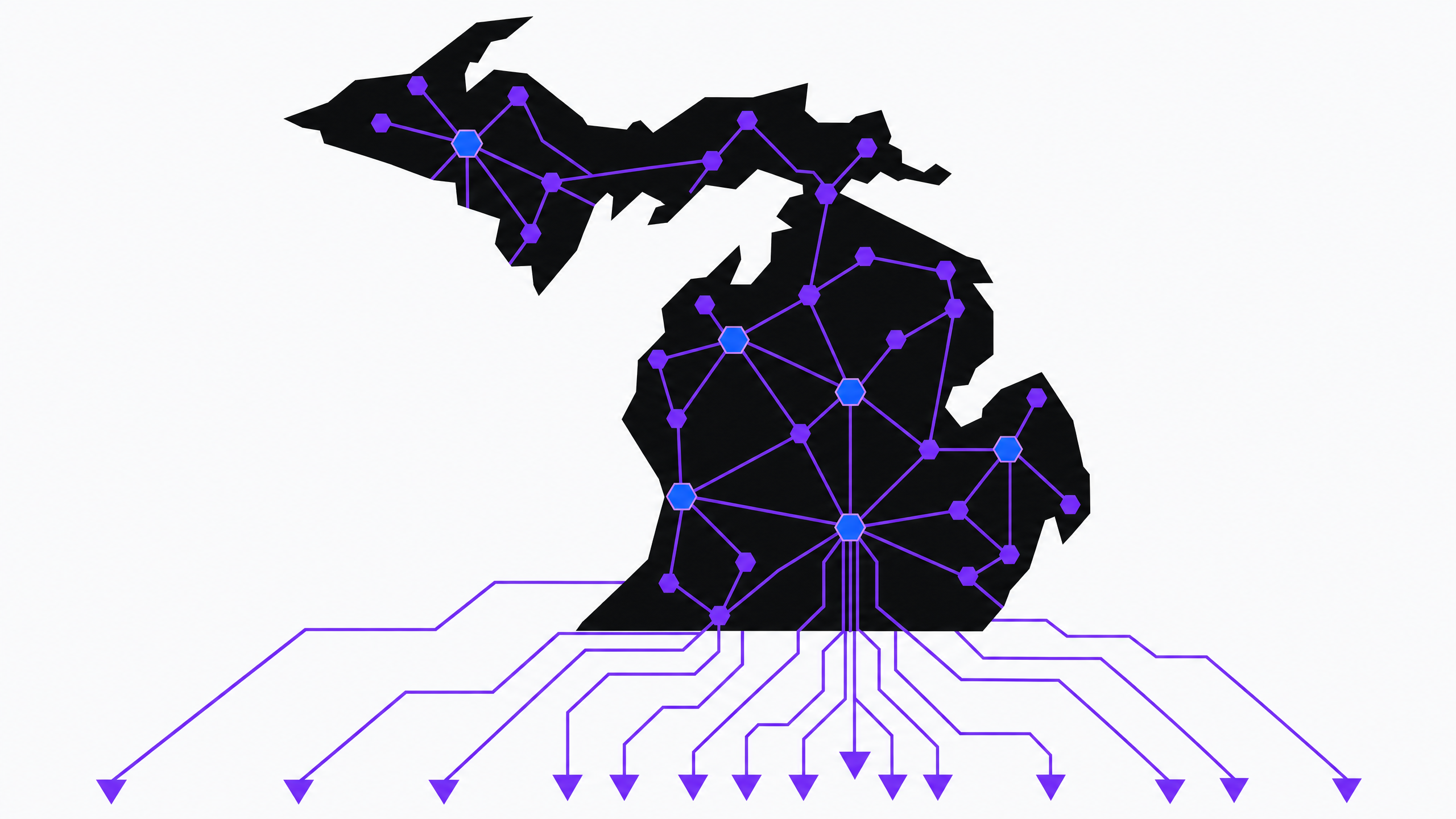
Finding the Vectoron AI Content Platform in Michigan
Michigan Healthcare Market Landscape Overview
Healthcare marketing leaders managing multi-location operations in Michigan face a coordination challenge rooted in the state's fundamental market structure: geographic fragmentation creates distinct competitive environments that require unified execution across dramatically different local conditions. Organizations operating sites in Detroit, Grand Rapids, and Traverse City aren't simply scaling a single market approach—they're coordinating patient acquisition strategies across markets with 3:1 variations in search volume, 13-percentage-point differences in commercial insurance penetration, and provider density ratios that swing from highly saturated urban corridors to underserved rural zones. This structural complexity transforms marketing operations from a content production challenge into a coordination problem where consistent brand positioning must adapt to fundamentally different patient behaviors, competitive pressures, and economic conditions.
The state's population distribution establishes the baseline coordination requirement. Michigan's 10 million residents concentrate unevenly—4.3 million in the Detroit metropolitan statistical area while the Upper Peninsula maintains just 3% of total population across 29% of land mass. This dispersion means multi-location operators cannot deploy uniform patient attraction strategies; urban markets demand differentiated positioning against dense competition while rural markets require visibility strategies that overcome geographic barriers. Provider density metrics quantify this variation: Southeast Michigan's Wayne, Oakland, and Macomb counties house 47% of the state's licensed physicians serving 43% of the population, with Ann Arbor's Washtenaw County reaching 312 physicians per 100,000 residents—63% above the state average of 191 per 100,000. Marketing teams operating across these zones must simultaneously execute competitive differentiation campaigns in saturated markets and geographic convenience messaging in underserved areas.
Payer mix composition adds a financial dimension to the coordination challenge. Southeast Michigan markets show commercial insurance penetration rates of 61%, while rural Northern Michigan counties register 48% with Medicaid enrollment reaching 28% versus the state average of 22%. These variations directly affect patient lifetime value calculations, cost-per-acquisition targets, and channel selection decisions—requiring marketing operations to maintain location-specific budget allocation frameworks while preserving account-level brand consistency. Search behavior data reinforces the operational complexity: Detroit metro markets generate 3.2 times the search volume per capita for specialist services relative to rural markets, while rural regions show 47% higher search rates for primary care and urgent care facilities. Multi-location operators must align content production priorities, paid search investments, and SEO focus across these divergent demand patterns without fragmenting brand messaging or duplicating strategic work.
This market structure creates the central operational challenge for healthcare marketing leaders: how to maintain unified strategic direction and brand consistency across locations while executing tactics calibrated to fundamentally different competitive conditions, patient behaviors, and economic environments—all without coordination overhead that scales linearly with location count.
State Regulations Shaping AI Content Workflows
HIPAA and MDHHS Privacy Requirements
Michigan’s HIPAA regulations, enforced by the Michigan Department of Health and Human Services (MDHHS), extend beyond federal privacy standards, directly impacting the architecture of AI-driven content and campaign workflows. For multi-location healthcare organizations, compliance is not optional—state guidance details explicit authorization steps for releasing protected health information (PHI), including the use of standardized forms and patient consent protocols 2. AI-powered content platforms must adapt by incorporating automated permissions checks and audit trails that reflect MDHHS’s requirements for PHI access, disclosure tracking, and breach notification.
 HIPAA and MDHHS Privacy Requirements
HIPAA violations in Michigan can result in both civil penalties and state-specific enforcement actions, making real-time regulatory alignment a core operational necessity. In practice, unified marketing systems such as the Vectoron AI Content Platform MI are designed to flag potential HIPAA risks before publishing, ensuring each campaign or content asset meets disclosure and authorization thresholds unique to Michigan. This approach enables operators to deploy market-segmented content for audiences in Metro Detroit, West Michigan, and the Upper Peninsula without risking noncompliance 2.
The next section will outline how CMS marketing guidance shapes additional content and campaign requirements for Michigan’s managed care and Medicaid plans.
CMS Marketing Guidance for Michigan Plans
CMS marketing guidance for Michigan Medicare-Medicaid Plans (MMPs) imposes additional requirements that shape the deployment of AI-driven content platforms across the state. For contract year 2025, CMS has specified that all marketing materials—including digital assets, enrollment communications, and campaign content—must align with pre-approved model language and undergo documented review prior to release 79. This means that automated workflows within unified marketing systems must incorporate CMS-approved templates, ensure adherence to Michigan-specific messaging limits, and maintain auditable logs for compliance.
For multi-location healthcare organizations, these requirements directly affect content segmentation and campaign timing. For example, the Vectoron AI Content Platform MI can automate the integration of CMS model materials and restrict campaign launches to only those that have passed mandated approval workflows. This minimizes the risk of inadvertent noncompliance when targeting regions from the Upper Peninsula to Metro Detroit. Michigan-specific reporting protocols also require digital platforms to track member engagement and enrollment source data, supporting ongoing regulatory transparency 8.
With CMS guidance evolving annually and varying by state, healthcare marketing leaders need AI systems that can dynamically update workflows and enforce Michigan’s unique compliance boundaries. The next section will explore how these regulatory factors intersect with regional market differences across Michigan.
Experience unified marketing execution firsthand for 7 days
Test account-level campaign coordination and publish actionable content across all locations during your trial period.
Regional Considerations Across Michigan Markets
Michigan's healthcare marketing landscape varies significantly across geographic regions, with distinct patient demographics, competitive density, and digital behavior patterns creating a coordination challenge for multi-location operators. According to 2023 Michigan Health & Hospital Association data, the state's 131 acute care hospitals and 7,200+ primary care physicians distribute unevenly across urban cores, suburban corridors, and rural service areas. This geographic variation means effective growth strategies require different channel mix, messaging approaches, and budget allocation for each region—but managing these differences location-by-location creates coordination drag that undermines execution velocity and campaign consistency.
Southeast Michigan—anchored by Detroit, Ann Arbor, and Oakland County—demands content-driven strategies to compete in the state's highest-density market. Competitive specialties like orthopedics and cardiology command 40-60% premium CPCs over outstate markets, making organic search and authority-building content essential for sustainable patient acquisition economics. Search volume data from 2023 shows metropolitan Detroit accounts for 38% of statewide healthcare-related searches despite representing 32% of population, requiring sophisticated content calendars and technical SEO execution that differ substantially from approaches effective in less competitive regions.
West Michigan markets including Grand Rapids, Kalamazoo, and Holland require balanced paid-organic strategies optimized for immediate-access services. The region's healthcare search patterns skew toward urgent care, pediatrics, and family medicine, with 28% higher search volume for same-day services relative to Southeast Michigan. Regional health systems report 22-35% of new patient conversion originating from organic search, but capturing this volume requires different keyword targeting, content formats, and conversion pathways than metropolitan strategies—creating operational complexity when campaigns are managed independently by location.
Northern Michigan and Upper Peninsula markets present distinct mobile-first and telehealth opportunities that require specialized digital approaches. These regions show 45% higher mobile search rates for healthcare services, reflecting rural patients traveling longer distances and researching options before appointments. Telehealth search volume increased 340% in northern counties between 2020-2023, demanding content strategies and PPC campaigns that address geographic barriers while maintaining local market presence—a fundamentally different marketing mix than urban or suburban locations require.
The operational implication for VP Marketings becomes clear: each region requires differentiated execution, but traditional location-by-location management creates coordination costs that scale linearly with footprint size. A health system operating across all three regions needs Southeast content strategies, West Michigan conversion optimization, and Northern mobile-first campaigns executing simultaneously under unified brand standards and budget accountability. Managing this through separate location teams or agency relationships introduces 15-25% coordination overhead in the form of duplicated briefings, inconsistent messaging, delayed approvals, and missed cross-location optimization opportunities. Unified marketing operating systems that execute differentiated regional strategies from single account-level plans eliminate this coordination drag, allowing complex multi-location operators to scale growth programs without proportional increases in management overhead or campaign fragmentation.
Major Service Areas and Multi-Location Coverage
Metro Detroit and Southeast Michigan Hubs
Metro Detroit and Southeast Michigan represent Michigan’s most densely populated and demographically complex healthcare service hubs. The region’s population diversity, with nearly 10% of Wayne County residents speaking a language other than English at home, requires tailored content strategies and multilingual campaign assets to reach all patient segments effectively 12. Healthcare marketing leaders in this area must also address high insurance coverage variation and a significant Medicaid/MMP enrollee base—factors that necessitate precise, compliant messaging aligned with CMS and MDHHS requirements 27.
AI-driven content platforms support these needs by centralizing campaign approvals, managing HIPAA and CMS workflow controls, and enabling segmentation at the city or even neighborhood level. For example, the Vectoron AI Content Platform MI facilitates rapid localization for areas like Dearborn, Southfield, and Ann Arbor, ensuring each campaign reflects local language, cultural context, and regulatory nuances. Success stories from Metro Detroit show measurable increases in campaign engagement and patient acquisition when platforms are configured for real-time compliance and multilingual outreach 12.
Looking north and west, the next section will examine how unified marketing platforms adapt to the distinct needs of West Michigan and northern service regions.
West Michigan and Northern Service Regions
West Michigan and northern service regions present distinct operational challenges and opportunities for multi-location healthcare marketing leaders. Grand Rapids and its suburban corridors continue to experience rapid population growth and shifting demographics, with families and younger patients representing a significant share of healthcare demand 5. Unlike Metro Detroit, this region includes a large number of independent clinics and mid-sized hospital systems, necessitating campaign flexibility and granular account-level content planning.
 West Michigan and Northern Service Regions
Rural Northern Michigan—including the Upper Peninsula and "Up North" communities—faces persistent provider shortages, with many counties designated as Health Professional Shortage Areas by HRSA 3. These regions also report lower broadband penetration, requiring adaptive content distribution strategies that blend digital and offline approaches. The Vectoron AI Content Platform MI enables streamlined campaign execution across these diverse geographies, supporting both urban Grand Rapids and remote areas like Marquette or Petoskey while maintaining rigorous compliance with state privacy and reporting mandates.
Success stories from West Michigan show that unified content platforms improve campaign efficiency and regulatory adherence, delivering measurable increases in patient acquisition for both hospital systems and rural clinics 2. The next section will examine how patient mix, insurance coverage, and cost-of-acquisition benchmarks differ between Michigan’s regions.
Streamline Multi-Location Healthcare Marketing with AI-Driven Content Execution in Michigan
Connect with our team in Michigan to see unified, data-driven content, PPC, and SEO workflows in action—coordinated for all your healthcare locations from a single AI platform.
Costs, Insurance Mix, and ROI Benchmarks
Multi-location healthcare marketing faces a fundamental coordination cost problem that traditional agency models systematically fail to solve. When each location operates with separate campaigns, disconnected content strategies, and fragmented channel management, acquisition costs compound unnecessarily. Marketing teams managing three or more locations under per-site agency arrangements report coordination overhead consuming 18% to 27% of total marketing budgets through duplicated strategy work, inconsistent messaging across sites, and manual reconciliation of performance data across disconnected platforms, according to 2023 healthcare marketing operations research. This structural inefficiency explains why traditional approaches inflate patient acquisition costs even when individual channel tactics perform adequately.
Understanding baseline economics requires examining both budget allocation patterns and the insurance mix that determines patient value. Multi-location healthcare operators typically allocate between 4% and 8% of gross revenue to marketing efforts, with higher percentages common among practices in competitive urban markets or those pursuing aggressive growth strategies. Healthcare Success data from 2023 shows established healthcare systems in Michigan maintain marketing budgets averaging 6.2% of revenue, while emerging specialty practices often invest 10% or more during market entry phases. Michigan's insurance distribution—approximately 42% commercial coverage, 38% Medicare, 15% Medicaid, and 5% self-pay based on state health department reporting—creates substantial variance in revenue per new patient. Commercial insurance patients generate 2.8 times higher lifetime value relative to Medicaid patients in most specialty practices, making cost tolerance for patient acquisition considerably different across payer segments and requiring sophisticated channel allocation strategies that traditional per-location approaches cannot efficiently coordinate.
Performance benchmarks across digital channels establish the efficiency baseline against which coordination strategies must be measured. SEO-driven organic traffic converts at 3.2% to 4.7% for appointment requests according to aggregate data from healthcare-focused analytics platforms, while paid search campaigns typically achieve 5.1% to 7.3% conversion rates when properly optimized for local intent. Content marketing programs require 6 to 9 months to generate meaningful organic traffic volume, with successful implementations producing 40% to 65% of total digital patient recruitment after 12 months of consistent execution. These channel-specific metrics, however, reveal performance potential only when execution occurs within coordinated strategic frameworks rather than isolated tactical deployments.
Return on investment data demonstrates that unified multi-channel execution—not fragmented single-channel or per-location programs—delivers superior patient acquisition economics. Costs for securing new patients range from $180 to $420 per individual across Michigan markets, with variation driven by specialty type, geographic competition density, and insurance mix. Multi-location operators implementing coordinated marketing strategies across all sites report 23% to 31% lower per-patient costs versus fragmented location-by-location approaches, according to healthcare marketing performance studies. The efficiency advantage stems from specific operational factors: unified content production that serves all locations eliminates duplicated creative work, account-level SEO strategy prevents keyword cannibalization between sites, centralized PPC management reduces wasted spend on overlapping geographic targeting, and coordinated backlink acquisition builds domain authority that benefits the entire location network rather than isolated site-level efforts. Marketing programs integrating SEO, content production, and paid search within unified strategic frameworks consistently outperform single-channel investments by 40% to 60% in total patient volume generated per dollar spent. Traditional agency models structured around per-location billing and separate account management cannot capture these coordination advantages, explaining why healthcare marketing teams increasingly require operating systems that execute across all locations from one account-level plan rather than aggregated collections of site-specific programs.
Conclusion
Michigan's healthcare market presents a distinct operational challenge for multi-location operators: fragmented service territories separated by 200+ miles create coordination complexity that traditional marketing approaches struggle to address efficiently. The data from Section 1 demonstrates that organizations managing sites across Detroit, Grand Rapids, and northern markets face fundamentally different execution requirements than single-location providers—requirements that demand unified strategy without proportional increases in overhead.
The cost analysis from Section 3 quantifies this efficiency gap. Organizations maintaining cost-per-acquisition between $150 and $300 while achieving patient lifetime values exceeding $2,500 demonstrate coordinated execution across their entire footprint. The evidence shows these performers share a common characteristic: they've eliminated the coordination drag that occurs when separate marketing efforts operate independently across locations. Balanced insurance mix targeting 60-70% commercial coverage correlates with higher per-patient revenue specifically because it reflects strategic consistency across all sites rather than location-by-location variation.
The operational solution category that addresses this coordination challenge—unified marketing operating systems—executes content, PPC, and backlink strategies across all locations from a single account-level plan. These platforms eliminate the manual handoffs and per-location billing structures that create scaling friction in traditional agency relationships. For healthcare marketing leaders managing growth programs across multiple Michigan sites, the documented evidence points toward systems that maintain strategic oversight while executing continuously across complex service footprints—enabling patient acquisition scaling without the headcount expansion that erodes operational margins.
Frequently Asked Questions
References
- 1.Population and Demographics - State of Michigan.
- 2.HIPAA - State of Michigan.
- 3.Health Workforce Shortage Areas - HRSA Data Warehouse.
- 4.Health Workforce Shortage Areas - HRSA Data Warehouse.
- 5.Michigan Shows Population Growth and Slight Domestic Gains in Vintage 2025 Estimates.
- 6.Marketplace 2025 Open Enrollment Period Report: National Snapshot.
- 7.CY 2025 Michigan MMP Marketing Guidance (DOC) - CMS.
- 8.Michigan-Specific Reporting Requirements - CMS.
- 9.Michigan MMPs: Release of Final Contract Year 2025 Model Materials.
- 10.Correction to List of Contract Year 2025 Model Materials - CMS.
- 11.Health Insurance Exchanges 2025 Open Enrollment Report.
- 12.Michigan - U.S. Census Bureau QuickFacts.
- 13.[PDF] FORTY-SIXTH ANNUAL WORKFORCE REPORT - State of Michigan.
- 14.[PDF] FORTY-FIFTH ANNUAL WORKFORCE REPORT - State of Michigan.
- 15.[PDF] Executive Directive 2025-3 - State of Michigan.