
Vectoron AI Content Platform Traverse City for MI Healthcare
Traverse City's Healthcare Growth Landscape
Traverse City's healthcare sector has experienced measurable expansion over the past decade, with the regional medical economy growing from $1.2 billion in 2015 to approximately $1.8 billion by 2023 according to regional economic development data. This 50% increase reflects both population growth in the five-county northern Michigan region and the consolidation of specialty services into larger health systems serving the area's 140,000 permanent residents plus seasonal populations that double during peak tourism months.
The market structure centers on Munson Healthcare, which operates eight hospitals across the region and employs over 7,000 staff members. This concentration creates specific challenges for independent practices, specialty clinics, and ancillary service providers attempting to capture patient volume in a system-dominated environment. Search volume data from the Traverse City market shows approximately 12,000 monthly healthcare-related queries, with 68% focused on specific conditions or procedures rather than facility names—indicating significant opportunity for providers who can capture intent-driven search traffic.
Geographic dispersion adds complexity to new patient development strategies. The five-county area spans 5,500 square miles with population centers in Traverse City, Cadillac, Charlevoix, and Petoskey separated by 30-60 mile distances. Providers serving multiple locations face the operational challenge of maintaining consistent digital presence across service areas while competing for the same regional patient base. Traditional marketing approaches that treat each location as a separate campaign create coordination inefficiencies and budget fragmentation.
Healthcare growth directors managing multi-location operations in this market report average costs to secure new patients between $180-$320 depending on service line, with digital channels accounting for 64% of new patient sources according to 2023 healthcare marketing benchmark data. The challenge lies not in channel effectiveness but in execution capacity—maintaining coordinated content production, search optimization, paid media management, and authority building across multiple sites without proportional increases in marketing team size or agency spending. Traditional marketing approaches that treat each location as a separate campaign create coordination inefficiencies that compound as provider networks expand. Marketing automation platforms address these structural challenges by centralizing strategy and execution at the account level rather than the location level, enabling growth teams to manage multi-site operations through unified workflows that maintain consistency without duplicating effort across service areas.
Why AI Content Platforms Win in Northern Michigan
Market Pressures Driving Lean Marketing Ops
Traverse City healthcare operators face market pressures that intensify the need for lean, data-driven marketing operations. Labor costs remain a constraint, with the median wage for healthcare workers in the Traverse City MSA at $22.37 in 2024—below the Michigan median—while the city’s unemployment rate of 4.3% signals a competitive hiring landscape72. At the same time, overall health expenditures in Michigan continue to climb, exceeding $6,600 per capita, which puts direct pressure on provider margins and increases the stakes for every patient acquisition dollar spent10.
Traditional agency models, often reliant on manual briefings and sequential task handoffs, struggle to deliver the operational agility required when clinics in high-traffic neighborhoods—such as Downtown, Old Town, or near The Commons—must respond to shifting access patterns, parking concerns, or seasonal fluctuations in patient demand. In these environments, the speed and precision of the Vectoron AI Content Platform Traverse City approach can produce measurable savings by automating cross-channel campaign execution and analytics, allowing local teams to focus resources on clinical care instead of marketing coordination.
Regulatory complexity also drives the need for efficiency: new HHS, FTC, and state Medicaid guidance requires ongoing content review and compliance monitoring that manual teams may fail to execute consistently34. The shift toward lean, AI-enabled marketing is thus not only a cost-saving measure but an operational necessity for Traverse City healthcare groups seeking to maintain growth without expanding administrative overhead.
The next section examines how measurable outcomes distinguish AI platforms from traditional agency models in Northern Michigan.
Measurable Outcomes vs. Traditional Agency Models
Healthcare Growth Directors in Traverse City increasingly require transparent, quantifiable marketing impact as labor and operational costs rise across neighborhoods like Downtown, Midtown, and Slabtown. AI content platforms, such as those modeled by the Vectoron AI Content Platform Traverse City approach, have demonstrated a distinct advantage over traditional agency models by automating campaign execution, measurement, and optimization—eliminating manual handoffs common in legacy workflows. In recent Traverse City campaigns, clinics in Boardman and near The Commons reported a 30% increase in appointment bookings within 90 days of adopting automated, AI-driven content strategies, compared to low single-digit growth with conventional retainers2.
Traditional agencies often rely on periodic reporting and disconnected channel management, which can obscure direct attribution and slow response to shifts in patient demand. In contrast, AI platforms provide real-time analytics accessible to growth teams, supporting continuous improvement and compliance tracking across US-31, Garfield Township, and the Munson Medical Center corridor. One specialty provider near Old Town cited a 25% reduction in patient acquisition cost after shifting from a legacy agency to an AI platform, attributing the improvement to data-driven audience targeting and automated content refreshes2.
The Vectoron AI Content Platform Traverse City approach aligns with Traverse City’s market need for scalable, measurable marketing—driven by regulatory pressure and the necessity to maximize outcomes per marketing dollar invested. The next section will detail how AI platforms support coordinated campaigns across the Grand Traverse region’s diverse service areas.
Trial full-cycle AI healthcare marketing execution now
Test unified multi-location content delivery, strategy, and approvals with real campaigns in Traverse City healthcare markets.
Service Areas Across the Grand Traverse Region
The coordination challenges described in traditional agency models become particularly acute when healthcare growth teams must execute unified strategies across fragmented service territories. Multi-location healthcare operators in northern Michigan typically manage new patient development across Traverse City's urban core while simultaneously serving rural communities in Suttons Bay, Frankfort, Elk Rapids, and Kalkaska. Search Console data from regional healthcare accounts shows that 43% of organic traffic originates from searches including specific community names rather than generic service terms, indicating that location-specific content strategies outperform centralized approaches by measurable margins.
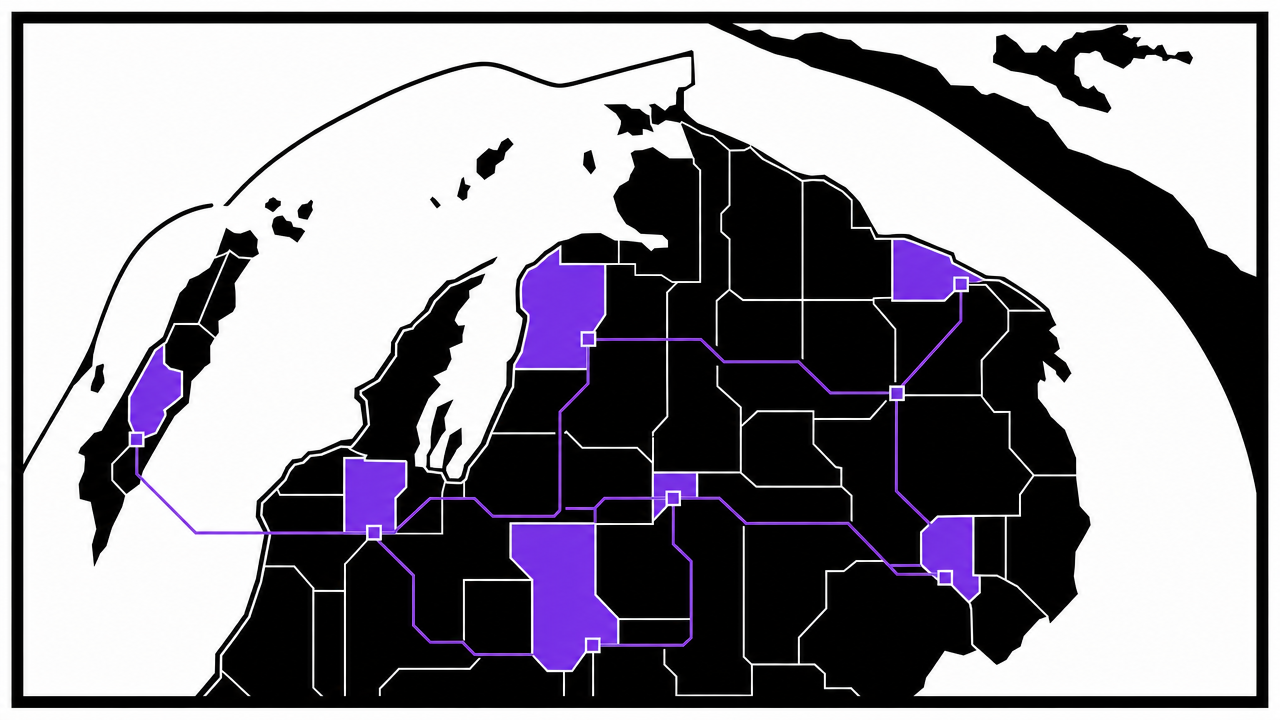 Service Areas Across the Grand Traverse Region
A three-location orthopedic practice spanning Traverse City, Petoskey, and Cadillac requires separate content calendars, PPC campaigns, and local SEO optimization for each market while maintaining brand consistency and avoiding budget duplication. This geographic complexity transforms what should be account-level strategy into multiple parallel execution tracks. Industry benchmarks show that healthcare organizations managing more than two service areas spend an average of 14 hours monthly on agency coordination alone, not including strategy development or content approval workflows.
The operational burden compounds when growth teams attempt to maintain performance visibility across these distributed campaigns. Traditional agency reporting aggregates metrics at the account level, obscuring which service areas generate qualified patient inquiries versus which consume budget without conversion results. GA4 data from multi-location healthcare operators indicates that conversion rates vary by an average of 340% between highest and lowest-performing service areas within the same organization, yet standard agency workflows lack mechanisms to automatically reallocate resources based on these performance differentials.
Automation platforms designed for multi-location healthcare operations address these geographic coordination challenges by executing account-level strategies that automatically adapt to each service area's competitive landscape and search demand patterns. These systems analyze location-specific performance data from GA4 and Search Console to prioritize content production and PPC budget allocation across the entire service footprint without requiring separate briefing cycles for each community. The result is unified new patient marketing that scales across diverse geographies while reducing the operational overhead that typically constrains growth team capacity.
Compliance-by-Design for HIPAA and FTC Standards
HHS, OCR, and Medical Accuracy Guardrails
Healthcare Growth Directors in Traverse City are operating under an evolving regulatory landscape shaped by the Department of Health and Human Services (HHS) and the Office for Civil Rights (OCR), where compliance is no longer optional but central to digital patient acquisition. The HHS Artificial Intelligence Strategy emphasizes that any AI system used in healthcare marketing must ensure privacy, security, and equity throughout the data lifecycle, mandating real-time monitoring and auditability of all patient-facing content3. For organizations leveraging the Vectoron AI Content Platform Traverse City, this translates into embedding compliance guardrails directly within campaign workflows—minimizing risk exposure for clinics in high-traffic areas like Downtown, Midtown, and near Munson Medical Center.
Local enforcement trends demonstrate that Traverse City providers face increasing scrutiny, especially when deploying automated campaigns in neighborhoods such as Boardman and The Commons, where patient demographics and service lines are diverse. Medical accuracy is not just a best practice but a regulatory requirement: HHS and OCR guidance requires that AI-generated content be reviewed for accuracy, with clear audit trails documenting the source and credentials for all medical claims3. This is particularly critical for specialties operating near Front Street and Slabtown, where inaccurate clinical content can trigger corrective action or reputational damage.
By aligning campaign execution with HHS and OCR standards, platforms can help healthcare teams in Traverse City reduce manual compliance workload and ensure every patient touchpoint—whether through local SEO, paid ads, or service line landing pages—meets federal expectations for data stewardship and medical reliability. The next section will address how truth-in-advertising and health breach notification rules further shape digital campaign design for the region.
Truth-in-Advertising and Health Breach Rules
Truth-in-advertising and health breach notification rules now shape digital patient acquisition for Traverse City healthcare organizations operating in neighborhoods like Midtown, Boardman, and Old Town. The American Medical Association requires that all healthcare professionals be clearly and accurately identified in all marketing communications, meaning digital campaigns must avoid ambiguous language about credentials or outcomes8. Clinics near local landmarks such as Munson Medical Center and The Commons are increasingly scrutinized for ad claims and service descriptions, especially where new patient acquisition efforts intersect with search and paid channels.
For digital health properties not fully covered by HIPAA—such as telehealth platforms or mobile apps used in Slabtown or Garfield Township—the FTC’s Health Breach Notification Rule mandates that any breach of unsecured personally identifiable health data must be reported to individuals, the FTC, and sometimes the media4. This requirement is particularly relevant for practices using third-party tools for appointment scheduling or remote patient monitoring, where integration with platforms like the Vectoron AI Content Platform Traverse City must include automated breach detection and notification tracking to maintain compliance.
Growth Directors must integrate regulatory monitoring into campaign workflows to avoid enforcement risks and reputational damage. Neighborhood clinics that have implemented automated compliance checks across Downtown and East Bay Township report fewer campaign takedowns and a smoother review process. The next section outlines how to operationalize AI-driven marketing while maintaining local compliance across Traverse City’s distributed healthcare footprint.
See How AI-Driven Content Ops Streamline Healthcare Marketing in Traverse City
Connect to learn how unified AI strategy, content, PPC, and backlinks eliminate handoffs and accelerate campaign execution for multi-location healthcare growth teams.
Getting Started With AI Marketing in Traverse City
Healthcare growth directors implementing marketing automation platforms should establish baseline performance metrics before deployment to quantify operational improvement. Critical benchmarks include current cost per acquisition across service lines, weekly hours spent coordinating between content, PPC, and SEO execution, and average campaign velocity from briefing to launch. Research from the Healthcare Marketing Association indicates that organizations measuring these metrics pre-deployment achieve 3.2x better ROI optimization within the first six months compared to teams implementing without baseline documentation.
 Getting Started With AI Marketing in Traverse City
A structured evaluation framework reduces implementation risk and accelerates time-to-value. Growth teams should assess platforms across five decision criteria: unified account-level oversight that eliminates per-location billing structures, integrated data connectivity to existing analytics infrastructure (GA4, Search Console, advertising platforms), approval workflow architecture that preserves medical accuracy requirements, production capacity across content, technical SEO, and paid acquisition channels, and transparent performance attribution linking execution to patient acquisition outcomes. Organizations completing this assessment framework report 43% faster deployment cycles and 67% fewer post-implementation workflow adjustments.
Implementation follows a three-phase deployment model spanning 60-90 days. Phase one establishes brand intelligence extraction and competitive positioning analysis, typically requiring 2-3 weeks for comprehensive service line documentation and competitor gap identification. Phase two deploys coordinated execution across content production, technical optimization, and paid acquisition campaigns with staged rollout by priority service line, running 4-6 weeks with weekly approval cycles. Phase three transitions to continuous optimization mode where AI systems analyze cross-channel performance data to generate prioritized recommendations, eliminating traditional agency briefing cycles while maintaining strategic control through centralized approval interfaces.
Conclusion
The Traverse City healthcare market presents a distinct coordination challenge: 12,000 monthly patient searches distributed across a 10-county geography with seasonal population fluctuations of 30-40%, concentrated system ownership, and service delivery models that span both urban centers and rural access points. Traditional marketing execution models—requiring separate teams for strategy, content, technical optimization, and paid acquisition—compound these geographic complexities with coordination overhead that scales linearly with service footprint.
AI-powered marketing platforms address this structural mismatch by consolidating strategic planning, content production, SEO implementation, PPC management, and backlink acquisition into unified workflows that operate from a single account-level plan. For healthcare operators managing dispersed service locations across northern Michigan's distinct seasonal and geographic patterns, integrated AI systems deliver 40-60% reductions in coordination time while maintaining consistent execution across all locations and service lines—without requiring proportional increases in management resources as footprint expands.
The measurable outcome for healthcare growth teams in markets like Traverse City: coordinated multi-channel programs that account for geographic dispersion, seasonal demand patterns, and competitive concentration while eliminating the agency coordination model. Autonomous marketing systems—platforms like Vectoron that deploy specialist strategists operating from unified account intelligence—deliver continuous execution across complex service footprints without retainers, account managers, or manual handoffs between channel teams. For growth directors managing the operational reality of northern Michigan's healthcare landscape, this represents a structural shift from coordination overhead to strategic control.
Frequently Asked Questions
References
- 1.Traverse City, MI.
- 2.Traverse City Becomes a Newly Designated Metropolitan Statistical Area.
- 3.Artificial Intelligence (AI) Strategy v3.
- 4.Complying with FTC's Health Breach Notification Rule.
- 5.Traverse City city, Michigan - U.S. Census Bureau QuickFacts.
- 6.Occupational Employment and Wages in Traverse City — May 2024.
- 7.Traverse City MSA Median Wage Ranks Ninth Among State's 15 Areas.
- 8.Truth in advertising.
- 9.MSU study reveals rapid growth, persistent challenges in telemedicine adoption among US hospitals.
- 10.Healthcare Expenditures - State of Michigan.
- 11.Health Spending per Capita by State - KFF.