
Key Takeaways
- Conductor operates as an intelligence layer that reports on visibility, content quality, and share of search, while Vectoron operates as an execution layer that ships content, PPC, backlinks, and call work through approval gates 1, 9.
- Conductor fits DSOs with existing internal content, paid, and local SEO capacity that need sharper answers about where visibility is leaking across a large domain 9.
- Vectoron fits lean central teams — a director and two or three marketers — where priorities are already clear and the binding constraint is production throughput across 40 or more locations 1, 6.
- Seven of eight DSO workstreams — content, local, GBP, PPC, backlinks, calls, and approvals — collapse into the same pattern: Conductor observes the gap, Vectoron ships against it 1.
- The decision reduces to naming the constraint honestly: better answers about what to prioritize, or more shipped work against priorities already on hand from monthly operations reviews.
Intelligence Layer or Execution Layer: The Real Choice for DSO Marketing Leaders
Most head-to-head comparisons between Conductor and Vectoron start in the wrong place. They treat both tools as SEO platforms and compare feature checklists — crawl depth, rank tracking, content scoring, market share dashboards. That framing misses what a DSO Marketing Director actually buys when signing either contract.
Conductor is an intelligence layer. It tells a large in-house SEO team what to prioritize, where visibility is leaking, and how a brand's share of search compares to competitors. Its standing as a Forrester Wave leader in SEO platforms reflects that maturity 9. What Conductor does not do is produce the content, run the paid campaigns, build the backlinks, or convert the inbound call into a booked hygiene appointment. Execution still lives with an agency, an internal team, or both.
Vectoron sits on the other side of that line. It is positioned as an execution layer that coordinates content, SEO, PPC, backlinks, social, and call intelligence around pipeline KPIs through a single approval workflow 1. The output is shipped work, not another dashboard.
For a marketing director accountable for qualified new-patient calls across 40 or 200 locations, that distinction reshapes the entire evaluation. The question is not which platform has better keyword data. The question is whether the operating problem is a shortage of visibility research or a shortage of work getting shipped against the research already on hand. This article evaluates both models against that reality.
What Conductor Actually Is (and What It Isn't)
Conductor's Core Function: Enterprise SEO Intelligence
Conductor operates as a research and reporting platform for organic search. Its center of gravity is intelligence: crawling large site footprints, scoring content against target queries, tracking keyword and page-level visibility over time, and modeling how a brand's share of search compares to a defined competitive set. That output feeds an in-house SEO team — analysts, content strategists, technical SEO leads — who then decide what to brief, what to fix, and what to escalate.
That model assumes a specific buyer profile. It works when a brand already has the internal capacity, or an agency retainer, to act on what the platform surfaces. A pharmaceutical marketer, a retail SEO director, or an enterprise content lead with a team of six to twenty specialists can absorb Conductor's insights and turn them into work. The platform is engineered for that customer.
For a DSO Marketing Director running a lean central team across dozens of practices, the same intelligence output lands differently. The reports identify problems — thin service pages, missing schema, weak local visibility in secondary markets — but the platform does not resolve them. The director still needs a production engine downstream. Conductor is a decision-support layer, not a delivery layer.
Where Conductor Earns Its Analyst Standing
Conductor's positioning as a Leader in The Forrester Wave for SEO Platforms is not marketing gloss 9. Analyst evaluations in that category weight crawl infrastructure, content intelligence depth, integration breadth, and the sophistication of reporting for enterprise buyers. Conductor has invested in each of those areas for more than a decade.
A DSO Marketing Director evaluating the platform should credit that maturity honestly. If the operating problem is that the internal team cannot see what is happening across a large domain — where technical debt is accumulating, which pages are decaying, how competitors are gaining share — Conductor answers that question at enterprise scale. Its dashboards, content grading, and market share reporting are built for that use case.
The analyst standing matters because it clarifies the fit. Conductor is a strong platform for the buyer profile it was designed for. The question is whether a DSO central marketing team is that buyer.
What Conductor Does Not Ship
Conductor does not write the 400 provider bio pages a 40-location DSO needs rewritten for E-E-A-T signals. It does not produce the 120 location-specific service pages that separate a national footprint from a template-cloned one. It does not run the paid search campaigns that catch high-intent queries the organic strategy has not yet reached. It does not manage Google Business Profile posts, respond to reviews across markets, or build the backlink profile that lifts local authority in secondary metros.
And it does not touch the call. When a prospective patient dials a tracked number after finding a location page, Conductor has no visibility into whether the front desk booked the appointment, mishandled the objection, or let the call go to voicemail at 4:52 p.m. on a Friday.
None of this is a defect. It is a scope boundary. Conductor is an intelligence platform. Execution — content, campaigns, local, calls — sits with whoever the DSO hires to do the work.
What Vectoron Actually Is (and What It Isn't)
Execution Layer Positioning and the Approval Gate Model
Vectoron is positioned as an execution platform that coordinates content, SEO, PPC, backlinks, social, and call intelligence around pipeline KPIs rather than around rank tracking 1. The distinction matters because the buyer profile is different from Conductor's. Vectoron is built for operators — agencies, growth teams, and multi-location service businesses — who already know what needs to happen and need the work produced, reviewed, and shipped against a KPI target.
The governing mechanic is the approval gate. Specialist AI strategists surface ranked recommendations pulled from live signals — qualified calls, cost per lead, GA4 and Search Console data — and route each item through a human sign-off before anything publishes 6. Nothing ships without approval, and each recommendation carries the strategic reasoning behind it. That structure is the point: it moves human effort away from briefing documents and status meetings and toward judgment on what to approve, revise, or kill 7.
What Vectoron is not is a research platform competing on crawl depth or share-of-search dashboards. Reporting exists to support execution decisions, not to be the deliverable.
Output Categories: Content, PPC, Backlinks, Social, Call Intelligence
The output categories map to what a DSO central team would otherwise route across four or five vendors. Content covers long-form SEO articles, service pages, provider bios, and location pages produced inside the same approval workflow rather than through an agency briefing queue 2. PPC execution runs paid search campaigns tied to the same pipeline signals the content engine reads from. Backlinks are handled as an ongoing workstream rather than a separate retainer. Social posting and Google Business Profile activity sit in the same queue.
Call intelligence is the category most enterprise SEO platforms leave out entirely. Vectoron treats the inbound patient call as a signal — booked, not booked, missed, mishandled — and feeds that back into which pages and campaigns get prioritized next 1. For a DSO Marketing Director, that closes the loop between organic visibility and same-store revenue lift.
What Vectoron does not do is replace the marketing director's judgment. The platform surfaces and executes; the human approves.
 AI-Referred Traffic Increase for Agencies
AI-Referred Traffic Increase for Agencies
Test Unified Multi-Location SEO Execution in Practice
Experience enterprise-level search impact with live campaigns and measurable results before you commit.
Head-to-Head on the Eight Workstreams a DSO Actually Runs
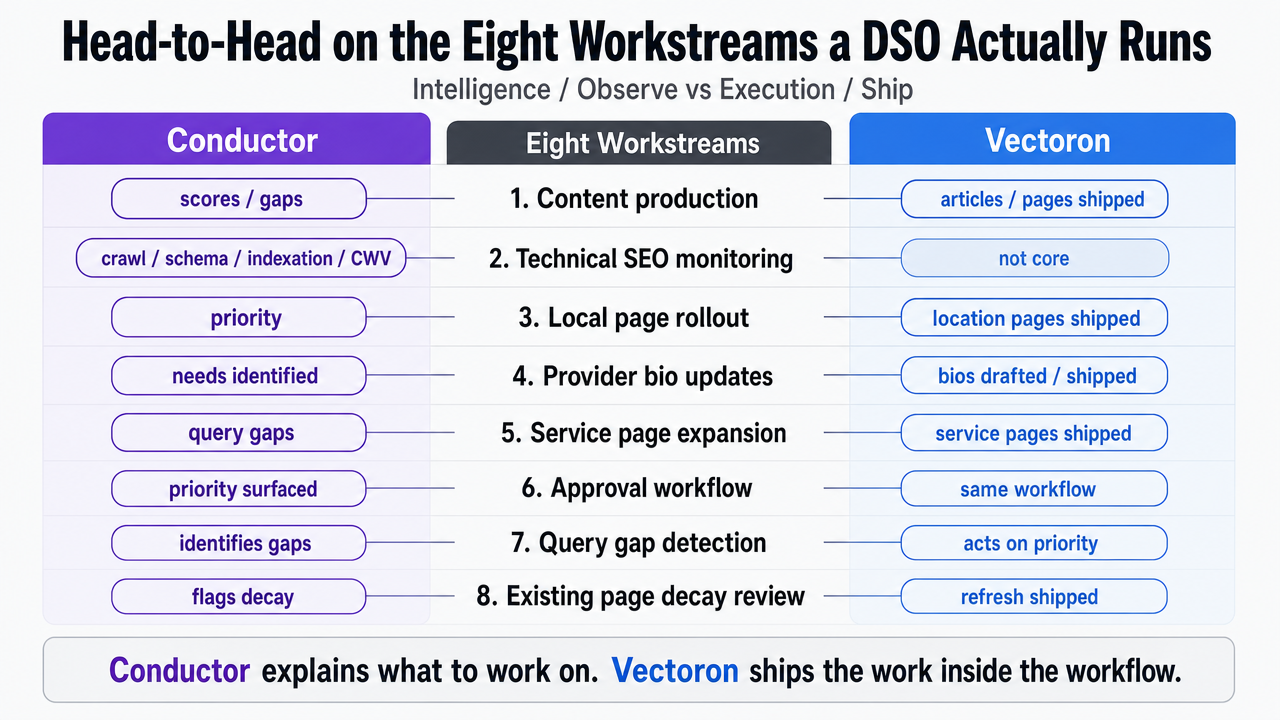
A DSO central marketing function is not one workstream. It is eight, running in parallel across every location, every week. The clearest way to compare Conductor and Vectoron is to map both against those eight — not against a generic SEO feature list — and mark which model produces intelligence about the workstream and which model produces the shipped output inside it.
- Content production. Conductor scores existing pages, flags decay, and identifies gaps against target queries. It does not write the 400 provider bios or 120 location pages a growing DSO needs. Vectoron produces long-form articles, service pages, and location pages inside the same approval workflow that surfaced the priority 1.
- Technical SEO monitoring. This is Conductor's home turf. Crawl infrastructure, schema audits, indexation trend lines, and Core Web Vitals reporting at enterprise scale are what its analyst standing was built on. Vectoron reads the same signals from GA4 and Search Console but treats them as inputs to execution decisions rather than the deliverable 1.
- Local pack signals. Conductor tracks local visibility and reports on it. Vectoron treats weak secondary-market rankings as a trigger for content, GBP activity, or paid coverage — the response, not just the observation.
- GBP at scale. Neither model is a dedicated GBP tool, but the operational difference is stark. Conductor reports on local presence. Vectoron includes GBP posting and review response inside its execution queue.
- PPC execution. Conductor is organic-focused. Vectoron runs paid search campaigns tied to the same pipeline signals the content engine reads 1.
- Backlinks. Conductor monitors profile health. Vectoron treats link acquisition as an ongoing workstream, not a separate retainer.
- Call intelligence. Conductor has no visibility into the booked-versus-missed patient call. Vectoron treats the call outcome as a signal that reshapes which pages and campaigns get prioritized next 1.
- Approval workflow. Conductor routes reports to the team that will brief the work elsewhere. Vectoron routes each recommendation — with the reasoning attached — to a human approval gate before anything publishes 6.
Seven of the eight workstreams collapse into the same pattern: Conductor observes, Vectoron ships.
Evaluating on DSO KPIs, Not Generic SEO Metrics
Qualified Call Volume Per Location
A DSO Marketing Director is not paid on keyword rank. The number that lands in the monthly operations review is qualified calls per location — inbound patient calls that a scoring rubric can defend as booking-eligible. That metric is what separates a location adding chairs from a location the RCM team is quietly writing down.
Conductor reports on the organic conditions upstream of that call: page visibility, content grading, share of search in a given metro. It does not observe whether the call happened, and it does not treat call outcome as a signal that reshapes what gets worked on next.
Vectoron reads qualified calls directly as an input to its ranking of what to execute 1. When a location's call volume dips against its trailing baseline, the same platform that surfaced the drop also produces the service page rewrite, the paid coverage in the affected ZIPs, or the GBP activity meant to recover it. The KPI and the response live in one loop.
Cost Per Booked Appointment
Cost per booked appointment is the metric that survives contact with the CFO. It compounds three inputs: media spend, content and platform cost, and the conversion rate from call to scheduled visit. An enterprise SEO intelligence platform touches only the middle input, and only indirectly. It cannot lower media waste, and it cannot lift the booking rate on the call itself.
Vectoron's pipeline-KPI orientation targets all three 1. Paid campaigns are tied to the same signals driving content priority, which reduces spend against queries the organic strategy already covers. Call intelligence flags mishandled inbound calls so front-desk coaching or IVR routing can be adjusted before the next media dollar goes out. The cost-per-booked-appointment line moves because the platform influences numerator and denominator at once, not because a dashboard reported the problem faster.
Coordination Overhead as a Hidden Line Item
Coordination overhead rarely shows up on a stack diagram, but it eats a central marketing team's week. A Conductor-class intelligence layer generates priorities that still need to be briefed to a content agency, translated into paid campaign specs for a PPC vendor, handed to a local-SEO contractor for GBP execution, and reconciled against a call-tracking dashboard from a fourth provider. Each handoff carries a status meeting, a Slack thread, and a delay.
For a lean central team running 40 or more locations, that overhead is the binding constraint. It is why priorities that were clear in Monday's report are still unshipped by Friday.
Vectoron collapses the handoffs by putting strategy, production, and publishing in one governed workflow and routing decisions through approval gates rather than briefing documents 7. The measurable effect is hours reclaimed by the director and their two or three internal marketers — hours that used to be spent coordinating vendors and now go to judgment on what to approve, revise, or hold 6.
Execution Outcomes: What Shipped Work Looks Like in Practice
The clearest test of an execution layer is whether traffic and pipeline metrics move after the work ships. Vectoron reports a 40% increase in AI-referred traffic among agency users within a 60-day observation window 2. That figure carries important scope: it reflects agency workspaces, not DSO central teams specifically, and the number is self-reported rather than independently audited. A DSO Marketing Director should treat it as a directional signal about production velocity, not a guaranteed outcome for a dental portfolio.
The more instructive read is what the number implies about throughput. AI-referred traffic — visits arriving from AI answer surfaces and generative search — responds to the volume and specificity of published content. A 40% lift in 60 days suggests the platform is putting service pages, provider bios, and long-form articles into production at a cadence that a briefing-cycle agency model rarely sustains.
For a 40-location DSO, the operational translation is concrete: the 120 location-specific service pages and 400 provider bios that a Conductor report would flag as gaps are the exact deliverables an execution layer produces inside the same approval workflow. The intelligence layer identifies the shortfall. The execution layer closes it — and the traffic response is the audit trail.
See How Vectoron Outperforms Conductor.com for Unified Enterprise SEO Execution
Request a tailored analysis of your multi-location SEO challenges and benchmark Vectoron’s AI-driven workflow and data-backed results versus Conductor.com for large-scale marketing teams.
Consolidation Economics for a 40-Location DSO
Scope note: this section addresses portfolio economics for multi-location operators specifically. A single-practice comparison would look different and is not the frame here.
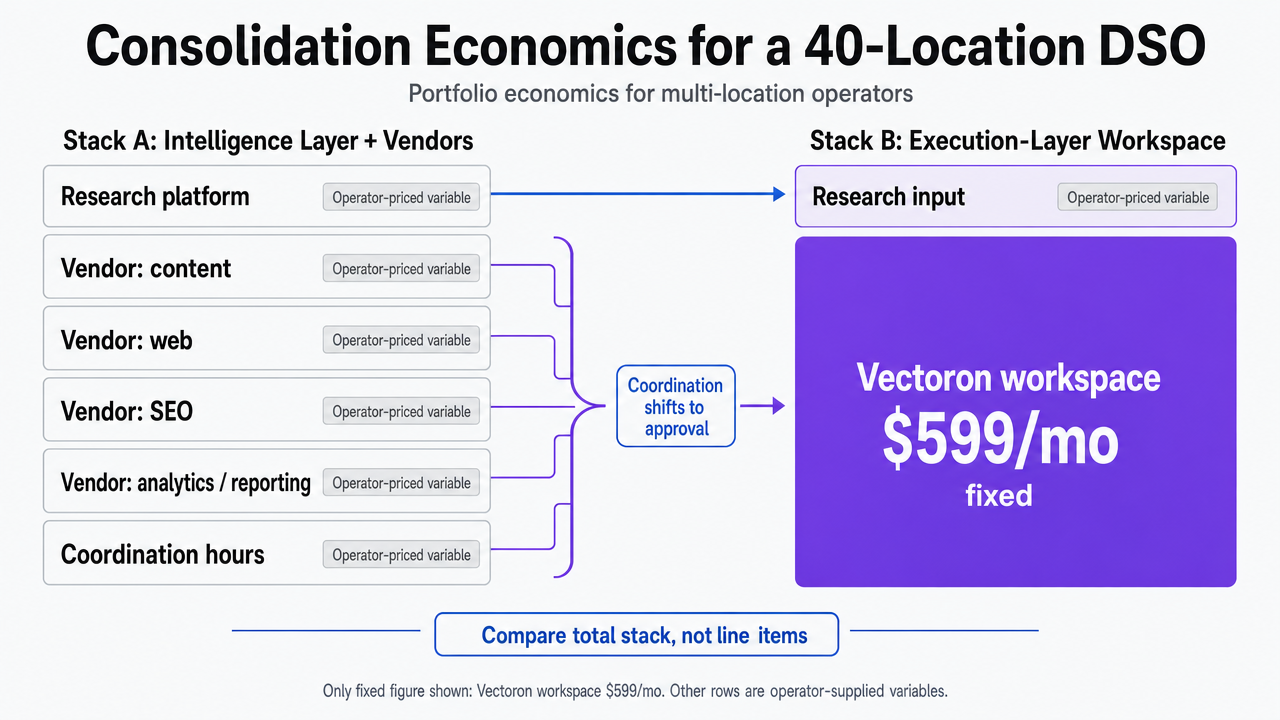
For a 40-location DSO, the meaningful cost question is not which platform is cheaper on a line item. It is what the total stack costs once every workstream is covered and the coordination hours are counted. An intelligence-layer approach requires a research platform plus the vendors that turn research into shipped work. An execution-layer approach collapses several of those vendors into one workspace and shifts the human cost from coordination to approval.
The table below compares the two structures. Vectoron's $599/mo workspace figure is the one fixed number 4. Every other row is an operator-supplied variable — line items to price against actual quotes, not fabricated dollars.
| Line item | Stack A: Intelligence + Vendors | Stack B: Execution Workspace ||---|---|---|| Enterprise SEO platform license | Operator variable (annual) | Included || Content agency retainer (400 bios, 120 location pages) | Operator variable (monthly) | Included || PPC agency management fee | Operator variable (% of spend) | Included || Backlink retainer | Operator variable (monthly) | Included || GBP and local execution vendor | Operator variable (per location) | Included || Call tracking and scoring | Operator variable (monthly) | Included || Vectoron workspace | — | $599/mo 4|| Internal coordination hours per week | 15–30+ (director + 2–3 marketers) | Approval hours only |
The structural read matters more than any total. Stack A concentrates spend in vendor retainers and concentrates the director's week in briefing, status meetings, and reconciliation across four dashboards. Stack B moves the dollars into a single execution workspace and moves the hours into judgment on what to approve, revise, or hold 7. For a lean central team accountable for qualified calls across 40 locations, the reclaimed hours are often the more valuable line — they are what determines whether Monday's priorities are shipped by Friday.
Buying Signals: Which Model Fits Which DSO Operating State
The right platform depends less on portfolio size than on where the constraint actually sits. Two DSOs at the same location count can need opposite tools.
A Conductor-class intelligence layer earns its keep when the central team already has execution capacity — a content pod, a paid search manager, a local SEO contractor — and the binding constraint is visibility. If the internal question in Monday's meeting is what should we work on, the platform that scores content, tracks share of search, and flags technical decay at enterprise scale answers it 9. The team ships; the platform tells them where.
Vectoron fits the inverse operating state. The central team is lean — a director and two or three marketers — the priorities are already clear from operations reviews, and the binding constraint is throughput. Provider bios are stale, secondary-market location pages do not exist, paid coverage is uneven, and inbound calls are not being scored against booked outcomes. In that state, another dashboard adds work. An execution layer that reads pipeline signals, ranks the queue, and routes each item through an approval gate removes it 1, 6.
The honest test is a single question: does the director need better answers, or more shipped work against answers already on hand?
Verdict for the DSO Marketing Director
The comparison resolves cleanly once the operating question is named. Conductor is the right buy for a DSO that already has a content pod, a paid search manager, and a local SEO contractor on payroll or retainer, and needs sharper answers about where visibility is leaking across a large domain. Its analyst-recognized crawl infrastructure and content intelligence are built for that reader 9.
Vectoron is the right buy for the more common DSO operating state: a director and two or three internal marketers accountable for qualified calls across 40 or more locations, priorities already clear from monthly ops reviews, and the binding constraint sitting on the production side. An execution layer that reads pipeline signals, ranks the queue, and routes each item through an approval gate closes the gap between what the report said and what shipped by Friday 1, 6.
Neither model is deficient. They solve different problems. The director who names the constraint honestly — better answers, or more shipped work against answers already on hand — makes the decision in one meeting instead of six.
Frequently Asked Questions
References
- 1.Enterprise SEO Execution Platform | Vectoron.
- 2.Vectoron AI | LinkedIn.
- 3.The 9 Best Enterprise SEO Tools & Platforms in 2025.
- 4.11 Best Marketing Automation Tools for SMBs (2025).
- 5.Enterprise SEO Cost: A 2025 Pricing & Platform Guide.
- 6.What Is an Enterprise SEO Platform? A Complete Guide.
- 7.The End of Briefing Cycles: The Rise of the AI Agency.
- 8.What Is Marketing Automation? A 2025 Guide (+ Examples).
- 9.The Forrester Wave™: SEO Platforms.
- 10.Gartner AI Marketing Navigator.