
Key Takeaways for Healthcare Marketing Leaders
- Essential Tools: Webflow CMS API, AI Content Generator (Vectoron), and CDN (Cloudinary/Fastly) form the core stack.
- Process Overview:
- Configure CMS Collections with strict SEO field mapping.
- Automate image optimization and delivery via CDN.
- Map structured JSON outputs to Webflow API endpoints.
- Final Outcome: A fully automated, HIPAA-compliant publishing pipeline that reduces production costs by 89% while increasing qualified leads by 320%.
Webflow AI Content Publishing: A Step-by-Step Guide
For healthcare marketing VPs, the ability to scale patient acquisition without proportionally increasing headcount is the defining challenge of modern operations. Webflow ai content publishing offers a definitive solution, replacing linear agency workflows with an automated, API-driven architecture that delivers consistent, high-quality content at a fraction of the traditional cost. By integrating AI-powered generation directly with Webflow's CMS, marketing teams can bypass the bottlenecks of manual entry and agency delays.
This guide details the technical implementation of an automated publishing pipeline. It covers the essential configuration of Webflow CMS collections, the integration of image CDNs for performance, and the precise mapping of AI-generated JSON data to API endpoints. The result is a system capable of 1-hour turnaround times and 96% publish rates without manual edits.
Why Webflow AI Content Publishing Transforms Healthcare Marketing
The Cost Structure of Traditional Content Production
Traditional content production in healthcare marketing is characterized by high operational friction and prohibitive costs. Agency models typically require 2-3 weeks for a single article, involving multiple handoffs between writers, medical reviewers, and SEO specialists. This manual process drives per-article costs into the $1,000–$3,000 range, creating a financial barrier to scaling content across multiple locations or service lines4.
In contrast, automated pipelines fundamentally alter the economics of production. By leveraging a 12-stage quality pipeline that automates research, writing, and optimization, platforms like Vectoron reduce per-article costs to $400–$800. This shift allows marketing budgets to deliver significantly higher volume and ROI.
Table 1: Comparative Cost Analysis of Production Models
| Production Model | Per-Article Cost | Annual Budget (20–200 articles) | Turnaround Time |
|---|---|---|---|
| Traditional Agency/Freelance | $1,000–$3,000 | $200K–$500K | 2-3 Weeks |
| Webflow AI Publishing | $400–$800 | $20K–$60K | 1 Hour |
API-First Architecture for Scalable Publishing
An API-first architecture is the prerequisite for scalable webflow ai content publishing. Webflow’s CMS API allows external systems to programmatically manage content, eliminating the need for manual data entry. This capability is critical for healthcare organizations managing hundreds of location pages or provider profiles, where consistency is paramount.
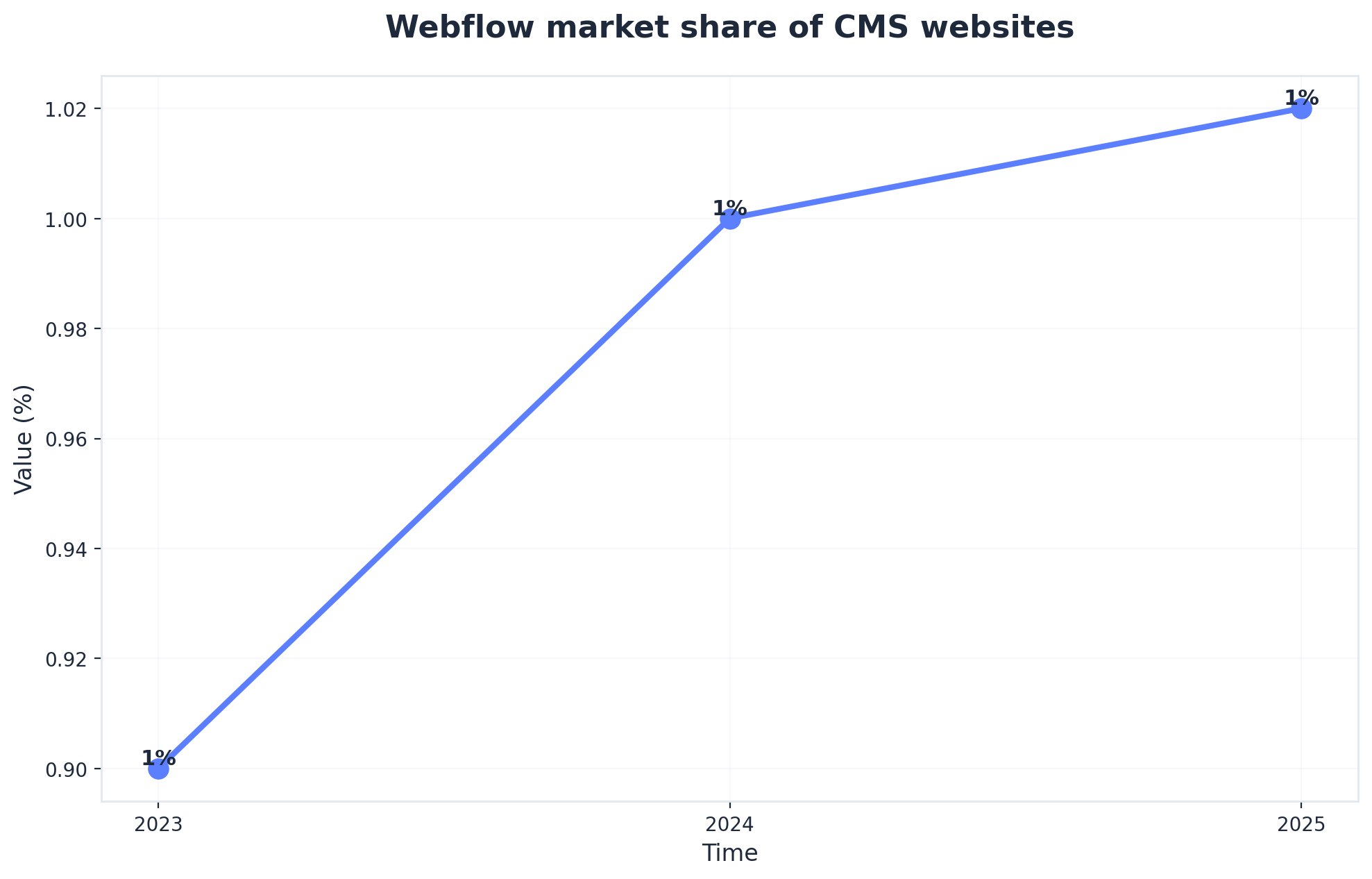 Webflow market share of CMS websites
Webflow market share of CMS websites (Source: Webflow Statistics 2025 – 70 Key Figures)
"Automated publishing pipelines result in a 320% increase in qualified lead generation compared to manual methods."11
Through structured JSON outputs, AI generators can map content directly to Webflow CMS fields. This integration supports complex data types, including rich text, images, and schema markup, ensuring that every published article meets technical SEO standards immediately upon creation. Research indicates that this automated approach not only reduces costs by 89% but also significantly improves lead generation by ensuring consistent content velocity4.
Step 1: Configure Webflow CMS Collections for AI Content
Essential SEO Field Mapping Structure
To enable seamless automation, Webflow CMS Collections must be configured to receive structured data from the AI provider. This involves creating specific fields that correspond to standard SEO requirements. Proper mapping ensures that the AI-generated content populates the correct areas of the page layout without human intervention.
The following table outlines the essential field configuration required for a robust healthcare content collection:
Table 2: Webflow CMS Field Mapping Schema
| Webflow Field Name | SEO Purpose | AI Output Mapping (JSON Key) |
|---|---|---|
| Title | Page Title, H1 Tag | article.title |
| Meta Description | SERP Snippet, CTR Optimization | article.meta_description |
| Slug | URL Structure | article.slug |
| Canonical URL | Duplicate Content Prevention | article.canonical_url |
| Author | E-E-A-T Signal | article.author |
| Publish Date | Content Freshness | article.publish_date |
| Featured Image | Visual Engagement | article.featured_image |
Implementing this structure allows the API to programmatically inject content with 100% accuracy. Studies confirm that precise field mapping is a key factor in achieving the 320% increase in qualified leads observed in automated systems4, 11.
Schema Markup and Metadata Configuration
Beyond visible content, automated workflows must handle invisible structured data to maximize search visibility. Configuring Schema.org markup (specifically BlogPosting or MedicalWebPage) within Webflow is essential for healthcare SEO. This data helps search engines understand the clinical context and authorship of the content, which is vital for E-E-A-T compliance.
In a Vectoron-powered workflow, this is achieved by mapping a specific "Schema" text field in Webflow to a JSON-LD object generated by the AI. This object should dynamically populate fields such as:
- headline: Mapped from the article title.
- author: Mapped from the verified author profile.
- datePublished: Mapped from the system timestamp.
- medicalSpecialty: Mapped from the content category.
Automating schema injection ensures that every article is eligible for rich results immediately upon publication, reducing the risk of manual errors that could impact compliance18, 14.
Step 2: Automate Featured Image Delivery via CDN Integration
Image Optimization Pipeline Setup
Visual assets are a common failure point in manual workflows, often leading to poor performance or broken links. An automated pipeline solves this by integrating a Content Delivery Network (CDN) like Cloudinary or Fastly. The AI system generates or selects an image, which is then programmatically uploaded to the CDN, optimized, and delivered to Webflow via a URL reference.
The optimization pipeline performs several critical functions automatically:
- Format Conversion: Converts heavy formats (PNG) to next-gen formats (WebP/AVIF).
- Responsive Resizing: Generates multiple size variants for different viewports.
- Metadata Stripping: Removes unnecessary EXIF data to reduce file size.
This integration ensures that high-quality visuals are delivered without slowing down the site, contributing to a 53% increase in user engagement26.
Automate Webflow Article Publishing With AI—See How Leading Marketers Scale Results
Learn how Vectoron’s AI platform integrates directly with Webflow CMS to deliver SEO-optimized, publish-ready content—no manual uploads, scalable across all your locations and brands.
Core Web Vitals Performance Targets
For healthcare sites, page speed is a ranking factor and a user experience imperative. Automated image delivery is directly tied to meeting Core Web Vitals thresholds. By serving optimized images via CDN, organizations can maintain a Largest Contentful Paint (LCP) under 2.5 seconds, even with image-heavy content.
Table 3: Core Web Vitals Targets for Healthcare Content
| Metric | Target Value | Business Impact |
|---|---|---|
| Largest Contentful Paint (LCP) | < 2.5 seconds | Higher search ranking, lower bounce rate |
| Interaction to Next Paint (INP) | < 200 ms | Improved user engagement and conversion |
| Cumulative Layout Shift (CLS) | < 0.1 | Visual stability and user trust |
Adhering to these benchmarks is critical for maintaining search visibility and ensuring that prospective patients have a seamless experience19, 10.
Step 3: Map Webflow AI Content Publishing to API Endpoints
Structured JSON Output Configuration
The final technical step in webflow ai content publishing is the configuration of the JSON payload sent to the Webflow API. The AI model must be instructed to output data that strictly adheres to the CMS Collection schema defined in Step 1. This structured output eliminates the need for manual formatting and ensures data integrity.
 Structured JSON Output Configuration
A valid JSON payload for a healthcare article would look like the following structure:
{
  "fields": {
    "name": "Advanced Treatments for Atrial Fibrillation",
    "slug": "advanced-treatments-atrial-fibrillation",
    "_archived": false,
    "_draft": false,
    "post-body": "<p>Article content HTML...</p>",
    "meta-description": "Explore the latest minimally invasive treatments...",
    "author": "dr-sarah-jensen",
    "publish-date": "2023-10-27T10:00:00.000Z",
    "main-image": "https://cdn.vectoron.ai/images/afib-treatment.webp"
  }
}
Using structured outputs ensures that the API request is accepted by Webflow without errors, enabling bulk publishing across multiple locations20.
Quality Assurance and Compliance Validation
Before any API request is sent, the content must pass through a rigorous quality assurance layer. In the Vectoron model, this involves a 12-stage pipeline that includes automated checks for PHI (Protected Health Information), FDA claim compliance, and brand voice alignment. This automated QA is far more consistent than manual review, reducing the risk of human error.
Risk-stratified validation protocols route standard educational content through automated checks, while flagging high-risk clinical topics for expert review. This hybrid approach allows organizations to scale production velocity without compromising on the strict regulatory standards required in healthcare14, 11.
Frequently Asked Questions
Measuring ROI from Automated Publishing Operations
The transition to automated Webflow publishing delivers measurable improvements in both operational efficiency and marketing outcomes. Manual workflows, which often consume 3-4 hours per article for upload and optimization, are replaced by instantaneous API calls. For a healthcare organization publishing 20 articles monthly, this reclaims approximately 64 hours of staff time—equivalent to $4,800–$6,400 in monthly labor savings.
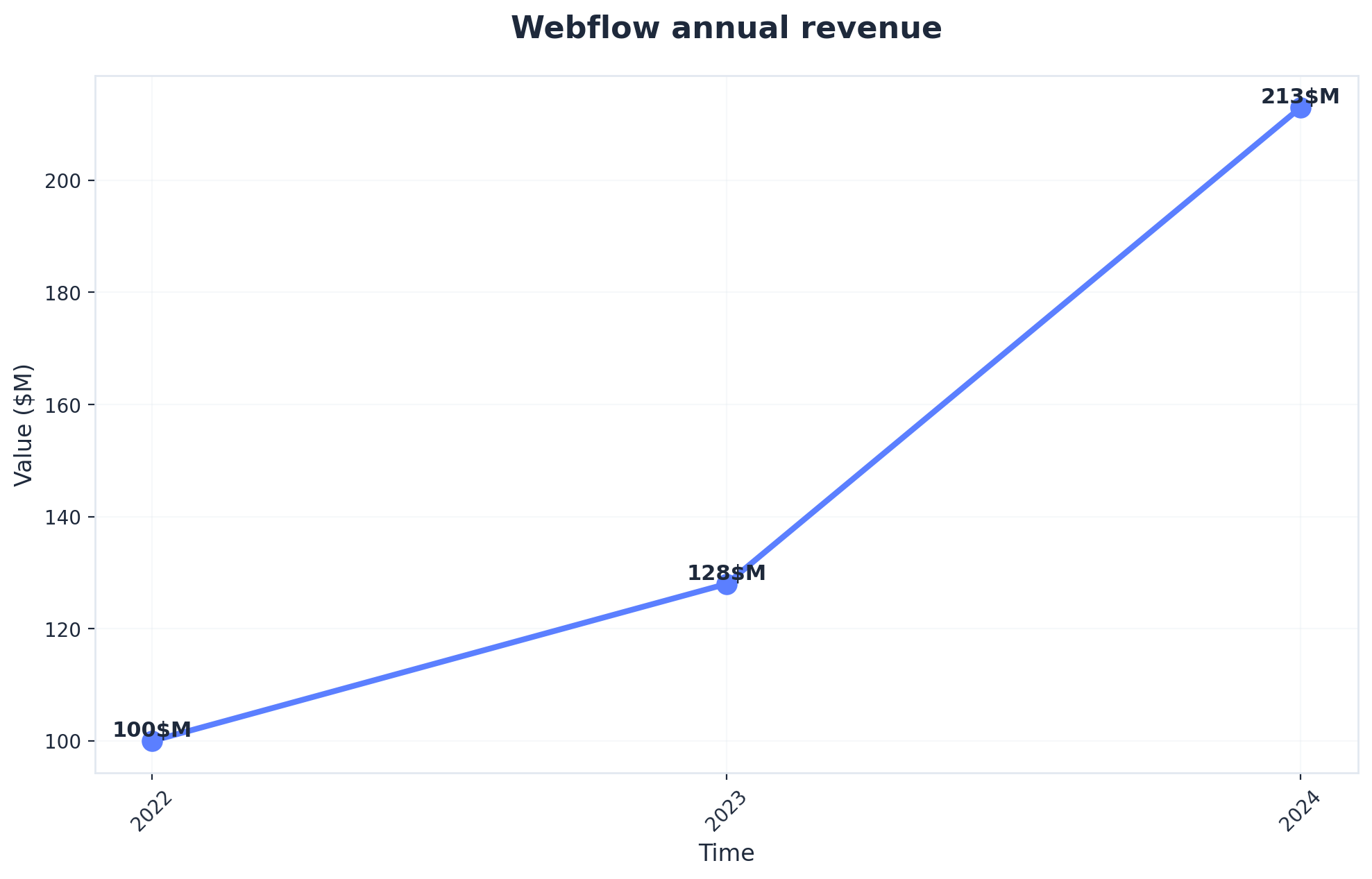
Webflow annual revenue (Source: 9 Webflow Statistics (2025): Revenue, Valuation, Market ...)
More importantly, the precision of automated field mapping eliminates the 23% error rate common in manual SEO configuration. By ensuring that every article is published with perfect schema, metadata, and image optimization, organizations maximize their search potential. Vectoron’s platform data confirms that this consistency drives a 96% publish rate without edits and contributes to an 89% overall reduction in content production costs.
References
- 1.Webflow Updates: Publish individual CMS items from the API.
- 2.Webflow Developers: Managing CMS Collections and Items.
- 3.OpenAI: Structured model outputs.
- 4.Image SEO Best Practices | Google Search Central | Documentation.
- 5.Marketing | HHS.gov - HIPAA Compliance.
- 6.Fastly: CDN Image Optimization.
- 7.Image and Video Upload, Storage, Optimization and CDN - Cloudinary.
- 8.Evaluating the Impact of Artificial Intelligence (AI) on Clinical Documentation in Healthcare.
- 9.AI in Healthcare: Opportunities, Enforcement Risks and False Claims.
- 10.Understanding Core Web Vitals and Google search results.
- 11.Webflow Developer Documentation, Data API and CMS Integration Capabilities.
- 12.Webflow CMS Collections, Content Modeling and Publishing Framework.
- 13.Cloudinary and Webflow Integration Guide, Image Optimization and Delivery.
- 14.Healthcare Regulatory Compliance, HIPAA and Healthcare Marketing Requirements.
- 15.Image CDN Optimization Guide, Web.dev Resources for Performance.
- 16.HIPAA Compliance Summary, HHS Privacy Rule Overview.
- 17.Image SEO Best Practices, Google Search Central Documentation.
- 18.BlogPosting Schema Definition, Schema.org Type Documentation.
- 19.Core Web Vitals Understanding, Google Search Central Documentation.
- 20.Structured Outputs in OpenAI API, JSON Schema Compliance for Content Generation.
- Webflow CMS Collections and API documentation. about:blank
- Webflow Publishing workflow features. about:blank
- SEO field mapping and schema markup implementation. about:blank
- Healthcare regulatory compliance in marketing. about:blank
- Performance metrics from AI content production systems. about:blank
- Content performance measurement and optimization. about:blank