
Key Takeaways
- A go-to-market strategy is a continuously optimized commercial system that binds targeting, positioning, distribution, conversion, and measurement into one operating loop—not a launch document filed away after kickoff.
- Harvard Business School Online defines GTM as reaching customers effectively and efficiently, with customer acquisition cost—sales plus marketing costs divided by customers acquired—as the diagnostic that keeps every stage honest 2.
- GTM sits between the business plan and the marketing plan: the business plan defines what business the company is in, the marketing plan describes tactical actions 1, 4, and GTM connects market thesis to executable channels.
- Most GTM strategies fail on execution capacity rather than logic, with approval-cycle time and fragmented vendor handoffs causing campaigns to ship late and measurement cadence to collapse 3.
GTM as an operating loop, not a launch document
Most go-to-market content treats GTM as a binder: a slide deck written once, presented at a launch meeting, and quietly retired into a shared drive. That framing misses what GTM actually is for an operating company. Harvard Business School Online defines a go-to-market strategy as a plan for reaching customers effectively and efficiently—two words that imply ongoing measurement, not a one-time event 2. McKinsey is more direct about the operating reality: GTM optimization is the work of translating channel strategy into sales-force execution and improving it over time 3.
Read together, those two framings settle a question marketing leaders quietly debate every quarter. A GTM strategy is a continuously optimized commercial system, not an artifact. It binds five decisions into one loop: which customer to target, how to position against alternatives, which channels to distribute through, how to convert qualified demand, and how to measure unit economics tightly enough to course-correct.
That distinction matters because the binding constraint for in-house marketing teams has shifted. Strategic insight is rarely the missing ingredient. Execution capacity is. A correctly chosen ICP, value proposition, and channel mix still fails when the team cannot ship coordinated content, paid, and outbound work at the cadence the strategy assumes. The rest of this article treats GTM as that operating loop—stage by stage, with the measurements that keep each stage honest.
A working definition marketing leaders can actually use
The HBS definition and what 'effectively and efficiently' means in practice
Harvard Business School Online's working definition of go-to-market is short enough to fit on a sticky note: a plan for reaching customers effectively and efficiently 2. The two adverbs do a lot of work. Effectiveness is a hit-rate question—does the strategy actually reach the right buyers and convert them. Efficiency is a unit-economics question—at what cost per acquired customer, and at what payback period.
That dual standard is what separates GTM from a campaign or a quarterly plan. A campaign can be effective and still uneconomic. A budget can be efficient and still miss the customer. GTM forces both to be true at the same time, which is why HBS pairs the definition with the customer acquisition cost formula—sales costs plus marketing costs, divided by customers acquired—as the diagnostic that keeps the strategy honest 2.
For an in-house marketing VP, the practical test is whether every channel investment can answer two questions on demand: who did it reach, and what did it cost to convert them. If a tactic cannot answer both, it is not yet part of a GTM strategy. It is an unmeasured bet.
GTM vs. marketing plan vs. business plan: scope, horizon, and owner
Three artifacts get conflated in most strategy conversations. The clean way to separate them is by scope, time horizon, and primary owner.
Marketing plan : Tactical. The U.S. Small Business Administration describes it as the document that "describes the actions you'll take to persuade potential customers to buy your products or services," and recommends updating it at least annually with ROI tracking attached to each action 1. Its scope is persuasion tactics—campaigns, channels, creative, budget allocation. Its horizon is typically the fiscal year. Its owner is usually a marketing director or campaign lead.
Business plan : The whole-company roadmap. The SBA frames it as a multi-year document that organizes goals, researches the market, defines competition and revenue assumptions, and specifies how the business will operate 4. Its scope spans operations, finance, hiring, and capital structure. Its horizon is three to five years. Its owner is the founder or CEO.
GTM strategy : Sits between the two and connects them. Its scope is the commercial system that converts the business plan's market thesis into the marketing plan's executable tactics. Its horizon is continuous—McKinsey frames GTM optimization as ongoing translation of channel strategy into execution, not an annual reset 3. Its owner is typically the CRO, CMO, or VP of marketing partnering with sales leadership.
The conflation matters because each artifact answers a different question. The business plan answers "what business are we in." The marketing plan answers "what will we ship this year." The GTM strategy answers "how does the commercial engine actually run, and how do we know it is working." Treating GTM as a synonym for either of the other two collapses the operating layer where most growth-stage failures actually happen.
The five stages of the GTM operating loop
Target: customer selection before channel selection
Channel decisions made before customer decisions are how marketing budgets get burned. The Rock Center for Entrepreneurship at Harvard frames the targeting stage as four questions a team must answer before spending a dollar on distribution: who is the customer, what problem are they solving, why should they buy, and are they actually buying—or is the team selling 8. That fourth question is the one most ICP exercises skip. There is a difference between a buyer pulling a product into a budget cycle and a seller pushing a product into a prospect's inbox. Both can produce meetings. Only one produces predictable pipeline.
The four questions function as decision gates. A weak answer at any gate invalidates the channel work downstream. If the customer is loosely defined, paid acquisition will optimize toward whoever clicks. If the problem is fuzzy, sales calls turn into discovery sessions instead of closes. If the reason to buy is generic, the offer competes on price. If the team cannot distinguish buying from selling, the forecast becomes a list of hopes.
Marketing leaders auditing an existing GTM should run the four questions against their last twenty closed-won deals and their last twenty closed-lost. Patterns surface quickly. The customer profile written into the strategy doc rarely matches the one actually paying. That gap—between stated ICP and revealed ICP—is where channel spend leaks.
Position: the two upstream choices GTM operationalizes
Positioning is where strategy hands a baton to GTM. A peer-reviewed strategy paper compresses the entire discipline into two questions: what is the organization trying to do, and for whom—and how will it be different 7. Those two choices sit upstream of every GTM tactic. The customer choice constrains the channel mix. The differentiation choice constrains the message.
When the differentiation choice is weak, GTM defaults to competing on the same axis as everyone else. The strategy paper notes that competing on the same basis pushes firms toward price competition—a position most service businesses cannot survive 7. Positioning has to give the sales team a reason a buyer should choose this provider over the next three on the shortlist, in language a buyer would actually repeat to a colleague.
The operational test for a position is whether it changes a tactical decision. If the position is "we offer premium service," nothing about the channel mix, creative, or sales script changes. If the position is "we are the only provider that publishes outcome data per location," the content calendar, the proof points on the website, and the sales deck all shift. Position is what makes the rest of the loop coherent.
Distribute: channel mix and the sales-execution handoff
Distribution is the stage where GTM most often breaks. The strategy doc names three or four channels—content, paid search, outbound, partnerships—and the team treats each as an independent workstream. McKinsey's framing of GTM optimization is the corrective: the work is translating channel strategy into sales-force execution, which means the channels must hand off cleanly to the same pipeline, with the same qualification criteria and the same follow-up cadence 3.
Channel selection follows two constraints. The first is where the target customer already looks for solutions—buyers in regulated verticals lean on referrals and search; buyers in commodity categories respond to paid acquisition and review aggregators. The second is unit economics. A channel that generates qualified meetings at twice the blended CAC of another channel does not belong in the mix unless it produces deals with materially better retention or contract value.
The handoff to sales is the silent failure point. A content-generated lead and a paid-search lead behave differently in a sales conversation. If both enter the same nurture sequence and get the same opening pitch, the channel work upstream gets diluted. Marketing leaders running a coherent GTM map each channel to a defined intent stage, a defined qualification threshold, and a defined first-touch script. Anything less and the channel mix is a budget allocation, not a distribution strategy.
Convert: pipeline velocity and the messaging-to-offer fit
Conversion is where messaging meets the offer. A qualified lead that stalls in pipeline is rarely a lead-quality problem; it is a messaging-to-offer mismatch. The promise made in the ad, the article, or the outbound email has to match the shape of the offer the sales team presents on the call. When the two drift apart, pipeline velocity drops and sales cycles stretch.
Pipeline velocity—the rate at which opportunities move from stage to stage—is the diagnostic. It surfaces friction faster than win rate. A stage where opportunities consistently age past benchmark is a stage where the messaging upstream is selling something different from what is being offered downstream. The fix is rarely more follow-up. It is usually a rewrite of the offer or a tighter qualifying question earlier in the funnel.
The HBS framing of GTM as a system for reaching customers effectively also applies inside the funnel: every conversion stage has its own effectiveness question (does the message reach the buyer at this stage) and its own efficiency question (at what touch cost) 2. Marketing leaders who treat conversion as a single number miss the stage-level diagnostics that tell them which message to rewrite.
Measure: CAC as the binding constraint
Measurement is what turns the loop from a sequence into a system. The single most-cited unit-economics metric in GTM is customer acquisition cost, which Harvard Business School Online defines as (Sales Costs + Marketing Costs) / Number of Customers Acquired 2. The formula is simple. The discipline of applying it across channels, at the same cadence, with consistent cost attribution, is not.
CAC works as the binding constraint because it forces every other stage of the loop to produce evidence. Targeting that picks the wrong customer shows up as inflated CAC. Positioning that fails to differentiate shows up as longer sales cycles and rising sales costs per deal. A channel mix that misallocates spend shows up as channel-level CAC divergence. Conversion friction shows up as marketing costs piling up against deals that never close. The formula is a single number, but the composition of that number tells the team which stage needs attention.
Visualizing CAC as a stacked composition—sales costs and marketing costs combining per acquired customer, broken out by channel—turns it from a board-deck metric into an operating diagnostic. Channels with disproportionate sales-cost contribution often signal weak messaging that requires heavy human selling. Channels with disproportionate marketing-cost contribution often signal weak targeting that requires heavy spend to find buyers. The SBA's marketing-plan guidance reinforces the principle: every action should carry ROI tracking, updated on a defined cadence 1. Without that cadence, CAC becomes a quarterly autopsy instead of a weekly steering input.
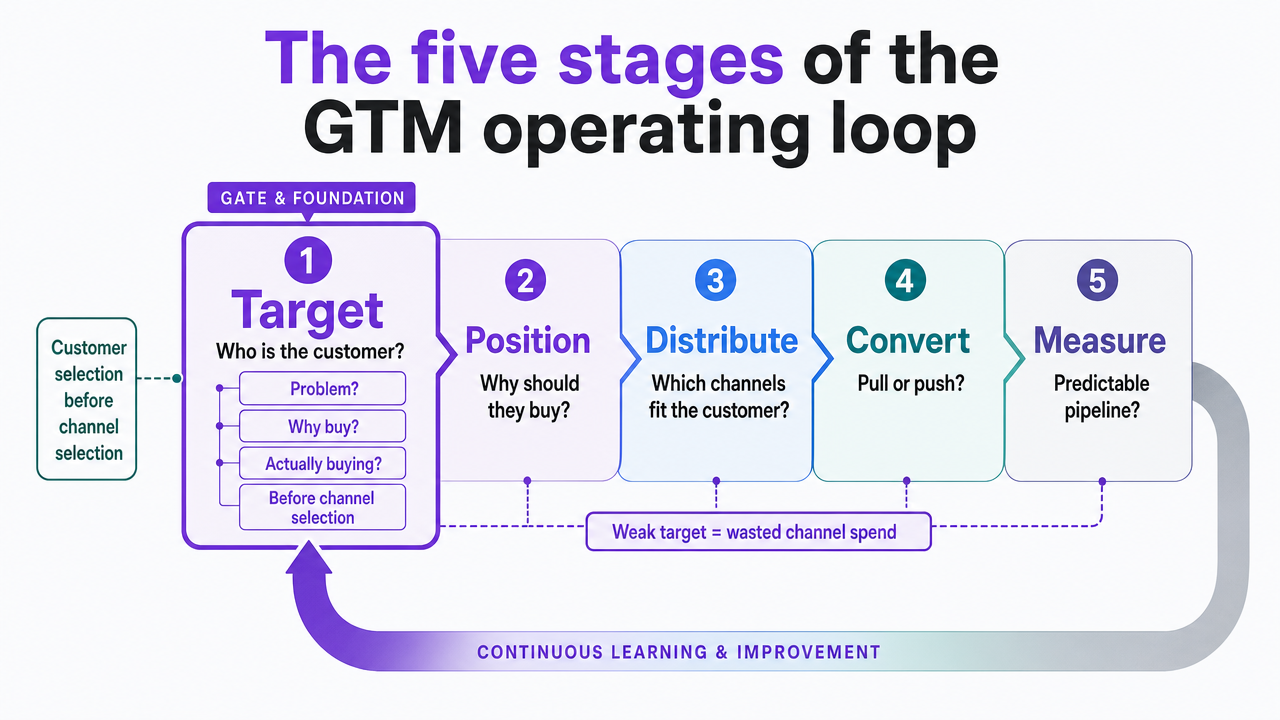 Visualize the five-stage GTM operating loop described in detail across the subsections, giving readers a structural map of Target, Position, Distribute, Convert, and Measure with the diagnostic question for each stage
Test Your Next GTM Strategy With Full Access
Validate GTM execution and publish live campaigns during your risk-free trial—data and outcomes included.
Timing, windows, and when GTM choices expire
A GTM strategy is dated the moment it is written. The market it targets, the channels it relies on, and the competitive position it stakes out all decay at different rates—and the team that treats the strategy as fixed is the team that gets caught optimizing toward a window that has already closed. Research on new product development frames timing as a core variable: anticipating and capitalizing on market opportunities before competitors is decisive, but the same body of work cautions that being first is not always the winning position 5. The operational read is that timing is a choice the GTM has to make explicitly, not a side effect of when the team happened to ship.
Three signals tell a marketing leader the current GTM is expiring. CAC drifts up across channels without a corresponding lift in deal size or retention. Win rates fall against the same competitors the team used to beat. Messaging that pulled qualified meetings six months ago now lands as generic. Any one of those is noise. Two together is a window closing. The McKinsey framing of GTM as ongoing optimization is the discipline that catches this early—channel strategy translated into execution, then re-tested against fresh data, not annual review cycles 3.
GTM beyond SaaS: service businesses and long-cycle sales
Most GTM writing assumes a software product with a free trial and a self-serve funnel. That model collapses when the buyer is a hospital procurement committee, a regional dental group, or a municipal contractor. A report on European deep-tech scaleups defines GTM as the strategy used to bring a product or service to market and reach target customers effectively—language deliberately broader than software, written for companies whose commercialization is constrained by technical complexity, customer education, and long sales cycles 9. The same loop applies; the stage weights shift.
In long-cycle service sales, the targeting stage carries more weight than channel selection. A regulated buyer rarely changes vendors on the strength of an ad. They change vendors on the strength of a referral, a published outcome, or a peer reference. That tilts the channel mix toward content that demonstrates expertise, partnerships that produce warm introductions, and outbound that arrives with a specific, named problem. Paid acquisition still has a role, but as a research-stage touch, not a closing channel.
The measurement stage also looks different. CAC is still the binding constraint, but payback periods stretch across multiple quarters, and the leading indicators—qualified consultations, proposal acceptance rates, reference calls scheduled—matter more than monthly conversion volume. Academic work on commercialization makes the same point from a different angle: end-to-end GTM is broader than launch promotion, especially in service categories where the product is partly delivered through the sales process itself 6.
See How Leading Brands Operationalize GTM Strategy with Unified AI Execution
Request a walkthrough to discover how enterprise teams and agencies use AI-powered workflows to coordinate multi-channel GTM campaigns, reduce manual overhead, and achieve measurable improvements in pipeline velocity.
If you manage multiple locations: consolidating the GTM loop
The audience shifts here. Single-site operators can stop reading; the next few hundred words are written for marketing VPs running portfolios—DSOs, multi-state law firm groups, home services rollups, behavioral health networks, senior living operators. The GTM loop described above still applies, but the failure mode is different. The strategy is rarely wrong at the portfolio level. It fragments at the location level, where each site runs its own version of targeting, channel mix, and measurement.
The economic question is whether a single consolidated GTM operating loop produces a lower blended CAC than the sum of fragmented per-location efforts. The HBS formula—(Sales Costs + Marketing Costs) / Number of Customers Acquired—still defines the unit 2. The SBA's ROI-tracking principle still applies: every action carries measurement, updated on a defined cadence 1. What changes is the denominator. Pooled customer acquisition across locations gives the portfolio leverage that single sites do not have on creative production, channel testing, and vendor consolidation.
The variables operators should plug into their own model:
| Variable | Fragmented model | Consolidated GTM loop |
|---|---|---|
| Locations | N sites, independent budgets | N sites, pooled budget with local overlays |
| Blended CAC | Calculated per location, high variance | Calculated at portfolio, variance becomes a diagnostic |
| Monthly channel spend | Duplicated creative and testing per site | Single creative system, local targeting layer |
| Vendor count | Multiple agencies, per-channel or per-region | Consolidated execution, single approval workflow |
| Approval-cycle time | Briefing rounds per location and per vendor | One approval queue, governed centrally |
The variance row is the one most operators underweight. When CAC is calculated only at the location level, portfolio leaders see averages. When it is calculated at the portfolio with location-level breakouts, variance becomes the signal—which sites are pulling the average up, which channels are misallocated, which messages are not traveling across markets. That diagnostic is what turns a multi-location budget into a steerable system instead of a stack of independent line items.
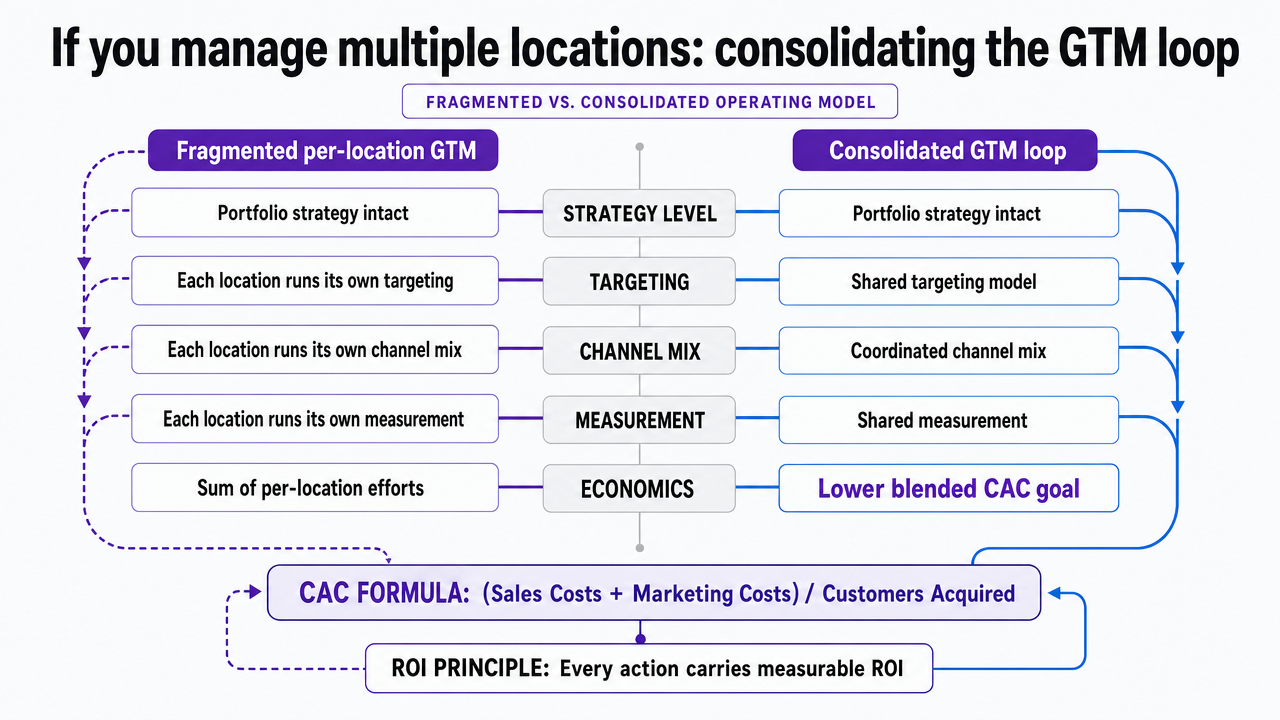 Render the in-article comparison table as a clean side-by-side infographic so multi-location operators can scan the fragmented vs. consolidated GTM model differences at a glance
Where GTM strategies fail: the execution-capacity gap
Strategy documents rarely fail on logic. They fail on ship rate. A correct ICP, a defensible position, and a sound channel mix all assume the team can produce coordinated work across content, paid, outbound, and social at the cadence the loop requires. Most in-house marketing teams cannot, and the gap shows up as drift: campaigns that ship two months late, a website that lags the new positioning by a quarter, paid creative that contradicts the latest sales narrative, and a content calendar that goes quiet whenever a senior hire leaves. McKinsey's framing—that GTM optimization is the work of translating channel strategy into execution—is precise about where the binding constraint actually sits 3.
The symptom marketing VPs feel first is approval-cycle time. Briefing rounds, vendor handoffs, and revision loops compound across channels. A single campaign can sit in queue across three agencies and four internal reviewers before anything ships, and by the time it does, the data that justified it has aged. The SBA's principle that every marketing action should carry ROI tracking on a defined cadence assumes the cadence exists in the first place 1. When execution capacity is the bottleneck, the measurement layer collapses with it—not because the team stopped caring about CAC, but because there is nothing fresh to measure.
Closing the gap is not a headcount problem. Adding a marketer or a third agency adds coordination overhead before it adds output. The structural fix is a single approval workflow that connects strategy, production, and publishing across every channel the GTM loop depends on—governed centrally, executed continuously, and tied back to the CAC and pipeline metrics the strategy already defines. That is the operating layer Vectoron is built to run.
Frequently Asked Questions
References
- 1.Marketing and sales | U.S. Small Business Administration - SBA.
- 2.How to Develop a Go-to-Market Strategy for Your Tech Venture.
- 3.Go To Market Optimization | Growth, Marketing & Sales - McKinsey.
- 4.Write your business plan | U.S. Small Business Administration - SBA.
- 5.Navigating new product development: Uncovering factors and ....
- 6.Reclaiming or rebranding marketing: implications beyond digital.
- 7.DISCOVERING STRATEGY: A KEY CHALLENGE FOR ACADEMIC ....
- 8.Go-to-Market Strategy - Rock Center for Entrepreneurship.
- 9.European Deep-Tech Scaleups: Go-To-Market Strategy.
- 10.Research Your Market and Create a Business Plan.