
Key Takeaways
- Google Analytics and Google-adjacent credentials matter most because agencies run on GA4, Search Console, and Looker Studio, shortening onboarding for juniors expected to produce client reports quickly.
- HubSpot Content Marketing and SEO certifications work as a screening baseline since they are free and recognized, signaling self-directed learning when paired with a Google Analytics badge 13.
- The Moz Professional Certificate via LinkedIn Learning carries more weight than free badges due to broader curriculum depth and tool-integrated practice useful for upskilling junior staff 7.
- Semrush Academy and similar tool-vendor badges only matter when the agency already licenses that platform, and hiring managers should discount any badge older than eighteen months.
- Educator-led programs from Coursera and Salesforce-curated paths help career changers transitioning into SEO but add little value for established practitioners with years of agency experience 8.
The certification signal has weakened — and that changes how agencies should use it
A decade ago, an SEO certificate on a resume signaled baseline competence. In 2025, its meaning has diminished. Career platforms, recruiter guides, and practitioner blogs now agree: certifications are supplemental signals, not hiring determinants. TealHQ emphasizes that employers prioritize demonstrated results and experience, using certifications to strengthen a profile rather than qualify a candidate 2. One practitioner guide bluntly states that certifications
"don't mean that you know what you're doing; they just prove you're not a total idiot"
13.
This shift is crucial for agency leaders. SEO remains a top in-demand marketing skill, according to LinkedIn data summarized by MarketingProfs 3, indicating an active and competitive talent pipeline. However, the credential layer within this pipeline no longer serves as a clear filter. Coursera, a significant certificate provider, acknowledges that no single SEO certification is mandatory for candidates 1.
For heads of SEO staffing across multiple client accounts, this redefines the role of certifications. They should be viewed as evidence of structured exposure and self-direction, useful for sorting a large applicant pool or developing an internal learning and development framework. They are not a substitute for portfolio reviews, technical assessments, or practical sessions using live client data. This article will evaluate which credentials still hold value and which have become less relevant.
How agency leaders should actually read a certification on a resume
Three operator dimensions: screening signal, time-to-productivity, deliverable alignment
Most certification analyses cater to job seekers. Agency leaders require a different perspective. A credential on a resume is a procurement signal that should be assessed against three operational dimensions before influencing hiring or L&D decisions.
The first dimension is screening signal strength, which measures how effectively a certificate helps sort a high volume of applicants. Adaface's recruiter framework for SEO managers suggests that structured interviews and practical assessments are more effective than credential checks, treating certificates as baseline indicators rather than performance predictors 12. For pod leads sifting through dozens of applications, a recognized credential acts as a tie-breaker, not an automatic qualification.
The second dimension is time-to-productivity impact. A valuable certification reduces the ramp-up time for tools and workflows already in use at the agency. For instance, a Google Analytics credential is more relevant to an agency heavily reliant on GA4 dashboards than a general search marketing certificate. This allows a new hire to analyze properties and generate client reports within days, rather than weeks.
The third dimension is client-deliverable alignment. Hiring managers should consider whether the certificate directly relates to services clients pay for, such as technical audits, content briefs, link governance, or monthly reporting. TealHQ positions certifications as supplementary elements that enhance a candidate's profile when combined with demonstrated results 2. This focused evaluation provides a clearer picture than assessing badges in isolation.
The platform certification shift, and what it does not mean
Coursera's data on entry-level hiring indicates a rising employer preference for platform certifications—credentials linked to tools like Google Analytics, Google Ads, and Semrush. This preference increased from 35% in 2019 to 68% in 2024 1. This figure reflects how often employers express a preference for platform-native credentials on entry-level resumes, not how often they are a strict requirement. This distinction is important.
This rise signifies a genuine shift: hiring managers seek evidence that a junior can immediately use agency tools without extensive orientation. A platform credential serves as a proxy for this capability, though it is neither a guarantee nor a substitute for portfolio evidence or practical tests.
However, this statistic does not imply that 68% of agencies will reject uncertified candidates. It also doesn't mean a platform badge outweighs a documented case study where a candidate significantly improved a client's search ranking. Furthermore, educator-led certificates from Coursera, HubSpot, or Moz retain their relevance, particularly for foundational fluency, especially for applicants without prior agency experience.
For heads of SEO, the practical implication is to heavily weigh platform certifications for entry-level screening due to their correlation with shorter onboarding times. For mid-level and senior roles, where the focus shifts to strategic impact and revenue attribution, these certifications should be weighted less.
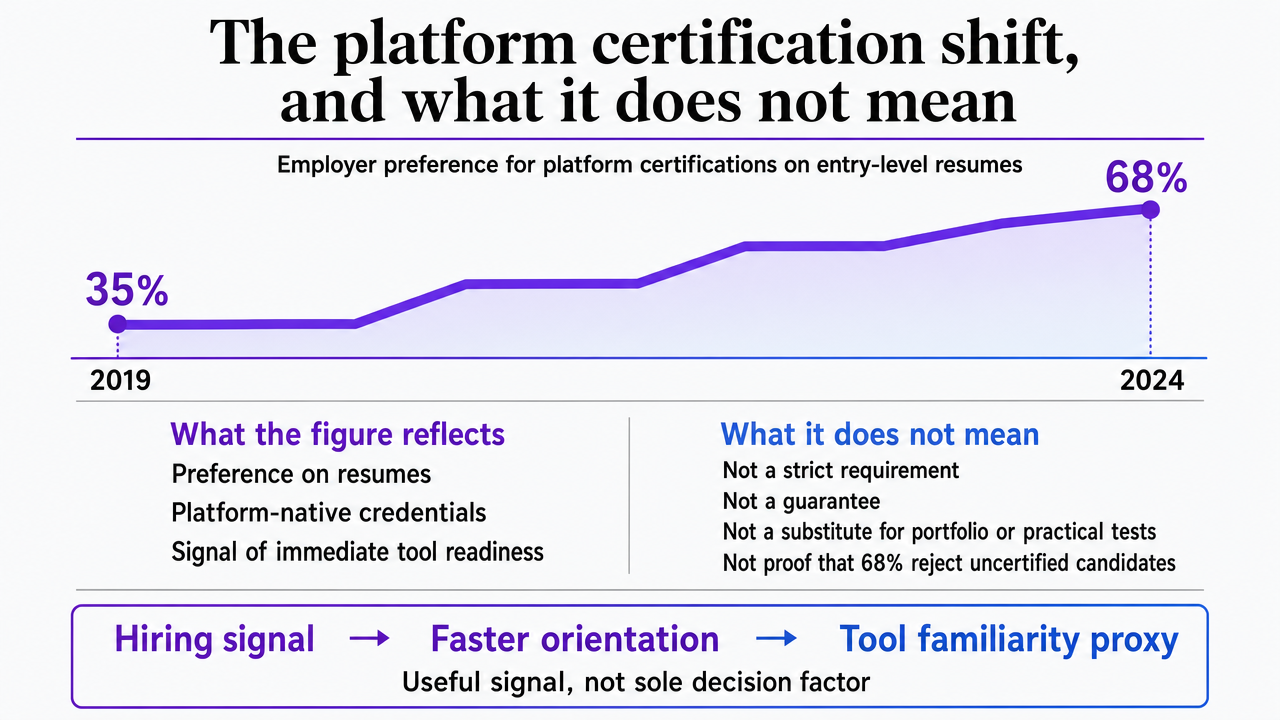 Visualize the documented rise in employer preference for platform certifications in entry-level hiring, which is the central data point discussed in this subsection
The certifications worth weighing in 2025
Google Analytics and Google Search-adjacent credentials
Google's own credentials are paramount for screening because agencies heavily rely on Google's ecosystem. GA4, Search Console, Google Ads, and Looker Studio form the foundation of most client engagements. A candidate proficient in these tools from day one significantly shortens onboarding.
The Google Analytics Certification is particularly valuable. It verifies a candidate's ability to configure properties, build reports, and interpret attribution paths—essential skills for a junior to produce monthly client deliverables independently. A widely recognized practitioner guide for aspiring SEO professionals lists the Google Analytics certification, alongside HubSpot, as a primary credential to pursue 13, aligning with typical agency onboarding practices.
Google does not offer a formal SEO certification. Instead, its SEO Starter Guide acts as the de facto curriculum for credible training programs 4. Search Engine Journal reports that this guide is being updated to remove outdated advice and incorporate current best practices 5. Therefore, any Google-adjacent credential should be checked for its publication date, as a 2021 course predating significant algorithm updates differs greatly from one revised in 2024.
HubSpot Content Marketing and SEO certifications
HubSpot's certifications are free, concise, and widely recognized, making them effective as a screening baseline rather than a pinnacle of achievement. The Content Marketing Certification and the SEO Certification cover content strategy, topic clusters, on-page optimization, and link building at a level that confirms foundational understanding.
For agency leaders, HubSpot credentials are significant in two scenarios. First, for entry-level resumes, a candidate with both HubSpot and Google Analytics certifications demonstrates sufficient self-directed learning to warrant a phone screen. The aforementioned practitioner guide specifically recommends this combination for those seeking their first SEO role 13. Second, if an agency's client work involves inbound marketing or HubSpot-implemented sites, a certified contributor can operate more efficiently within the CMS.
The limitation is clear: free certifications are widely obtained and do not significantly differentiate candidates. TealHQ emphasizes that certifications supplement demonstrated results, rather than replacing them 2. A HubSpot badge confirms participation; a portfolio confirms capability.
Moz Professional Certificate via LinkedIn Learning
The Moz Search Engine Optimization Professional Certificate, offered through LinkedIn Learning, stands apart from free vendor badges. It comprises multiple courses covering SEO fundamentals, keyword research, technical audits, and reporting workflows, all integrated with Moz's toolset 7. This depth alters how hiring managers perceive the credential.
This certificate carries more weight than a HubSpot badge for several reasons:
- Its comprehensive curriculum and broader topic coverage ensure a higher baseline of exposure for candidates.
- Moz is a familiar name to many agency leaders, making the credential more recognizable than a generic Coursera completion.
- The course materials encourage practical application with Moz tools to create content and reports 7, aligning with how agencies evaluate candidates.
The Moz path is particularly effective for upskilling existing junior staff whom the agency intends to transition to independent client work. While it still requires portfolio backup as a standalone resume entry, it can foster measurable competence within eight to twelve weeks of part-time study for an internal hire.
Semrush Academy and other tool-vendor badges
Semrush Academy, Ahrefs Academy, and similar tool-vendor programs serve a specific, valuable purpose: they train candidates on the exact platforms an agency may already license. This means a certified hire can immediately perform tasks like competitive gap analyses or backlink audits without additional training.
Coursera's data on the increasing prominence of platform certifications in entry-level hiring highlights this trend 1. For agencies, the interpretation is straightforward: tool-vendor badges are relevant when the agency uses that specific tool. A Semrush badge on a candidate applying to an Ahrefs-exclusive agency is a weak signal, but the same badge for a Semrush-stack agency indicates a significant onboarding advantage.
These credentials also tend to become outdated faster than educator-led programs, as vendors frequently update interfaces and features. Hiring managers should verify the badge issue date and discount any older than eighteen months, as a 2022 Semrush certification covers a different product version than a 2025 one.
Educator-led programs: Coursera, Salesforce-curated paths, and structured cohorts
Educator-led programs encompass longer, multi-week structured courses that go beyond single-vendor badges. This category includes Coursera's SEO specializations, SEO courses highlighted in Salesforce's 2026 roundup, and cohort-based programs from independent educators 1, 8. These are the closest equivalents to a degree in the SEO industry.
These credentials hold significant weight when an agency leader is evaluating a candidate transitioning from another field—such as a content writer moving into SEO, an analytics specialist shifting to technical SEO, or a generalist marketer applying to a specialist role. The Salesforce list frames its selections as outcome-oriented programs focusing on rankings, traffic, and broader digital skills 8, which is ideal for career changers.
For candidates already established in the industry, an educator-led credential offers less added value. A senior professional with five years of agency experience does not require a Coursera certificate to validate their competence. Submerge's evaluation framework for certifications emphasizes alignment with specific learning needs and provider credibility 9. Such a credential is only worthwhile if it imparts knowledge the individual wouldn't gain through their daily work.
Test AI-powered SEO workflows for real client projects
Evaluate end-to-end SEO delivery efficiency by publishing live content during your trial—no commitment required.
Where certifications fit by role seniority
IC specialists: certifications as screening tie-breakers
For individual contributor roles—such as SEO specialists, analysts, and junior strategists—certifications are most effective at the initial screening stage. They help sort through a large applicant pool. A pod lead reviewing numerous resumes for a single specialist opening uses credentials similarly to how a procurement officer uses ISO badges: as a quick indicator of a candidate's self-directed learning, making them worth a phone screen.
The practitioner guide for entering an SEO role recommends HubSpot and Google Analytics certifications as initial steps 13, a recommendation consistent with what hiring managers look for. A resume featuring both badges, a personal site that ranks well, and a well-crafted cover letter typically passes the first cut. A resume lacking these requires a stronger portfolio to compensate.
During the interview phase, the importance of certifications diminishes. The conversation shifts to practical work: a technical audit of a sample site, a keyword research walkthrough, or a reporting exercise in GA4. Certifications serve to get the candidate to this stage, but the actual evaluation occurs through practical demonstration. For IC hiring, this division of labor is appropriate: credentials triage the applicant stack, while practical work determines the offer.
SEO managers: strategy, analytics, and team leadership trump badges
At the manager level, certifications lose their significance as a hiring signal. TealHQ's guide on SEO manager credentials views them as tools that assume prior experience, useful for recognition rather than qualification 11. Adaface's recruiter guide is more explicit: hiring SEO managers should prioritize strategic thinking, technical depth, and demonstrable results, assessed through structured interviews and case studies, not badge counts 12.
The reason is fundamental. An SEO manager's responsibilities include setting quarterly strategy across client accounts, allocating specialist resources, defending recommendations to clients, and taking ownership of performance metrics. None of these skills are evaluated by a multiple-choice exam. Instead, they are assessed by asking candidates to describe campaigns they led, decisions made during performance dips, and how they mentored junior analysts through complex migrations.
What agency leaders should prioritize instead are:
- case studies detailing specific traffic and revenue improvements
- references from former clients or direct reports
- a working session on a live client scenario
- evidence of cross-channel proficiency in analytics, content, and paid media
While a Moz Professional Certificate on a manager's resume 7 is acceptable, it is not the primary reason for hiring. The decision should be based on their track record of successful campaigns and team leadership.
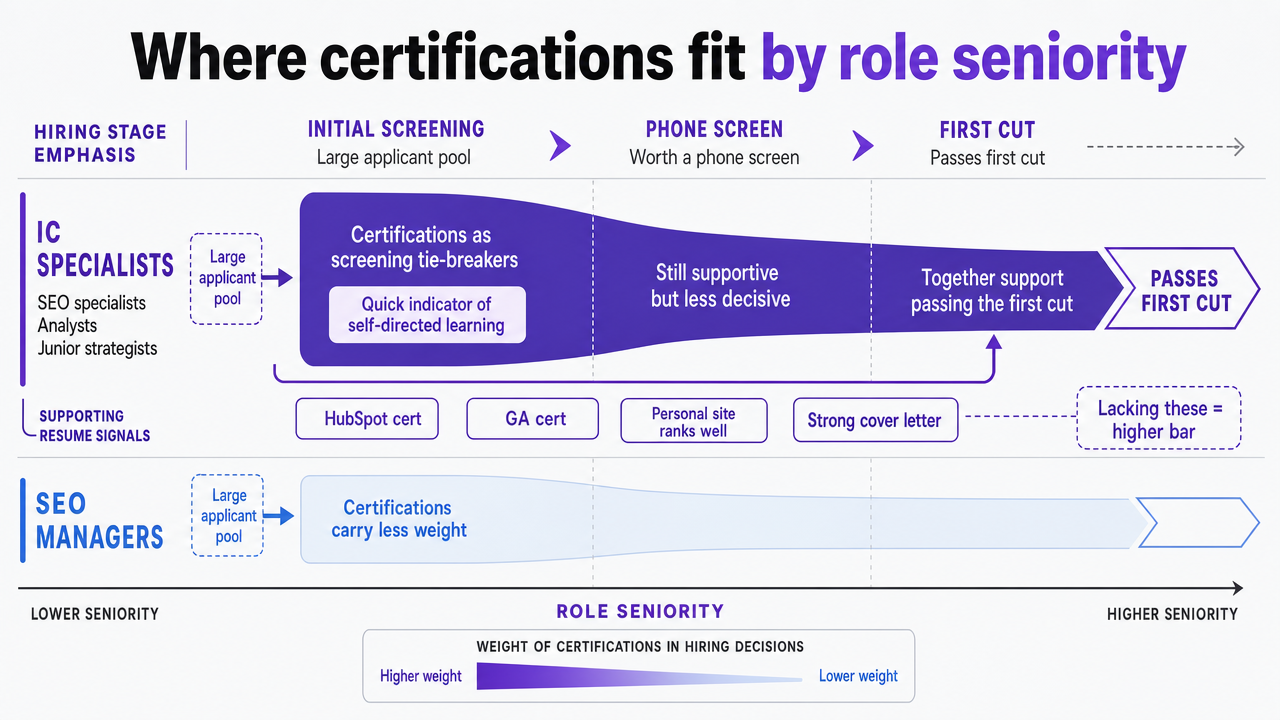 Visualize the comparison framework between IC specialists and SEO managers regarding how certifications should be weighted in hiring, directly supporting the two subsections that follow
Hire, upskill, or expand capacity: a portfolio capacity decision
This section addresses agency leaders managing ten or more client accounts, where adding SEO capacity is a budget consideration rather than a single hiring decision. The calculations differ for in-house teams.
When a pod is operating at full capacity, three options are available.
- Hiring a certified mid-level SEO at market rate. IMG Courses, citing 2023 Semrush data, reported that SEO professional salaries increased by 7.2% over 2022 levels 6, a trend that continues. This means each new mid-level hire comes with a higher base salary than the last, plus fully loaded costs including benefits, software licenses, and ramp-up time before generating billable hours.
- Upskilling an existing junior. A structured credential path—such as HubSpot's free SEO and Content Marketing certifications, the Google Analytics certification, and the Moz Professional Certificate via LinkedIn Learning 7—costs significantly less than an external hire and produces a contributor already familiar with the agency's client base. The main constraint is time; eight to twelve weeks of part-time study means the pod must absorb a temporary delivery gap.
- Expanding capacity without increasing headcount, by using AI-assisted execution platforms for production tasks like briefs, drafts, audit pulls, and reporting. This allows existing strategists to focus on judgment and client ownership. Platforms like Vectoron operate in this space.
No single path is universally superior. The optimal choice depends on the pod's current utilization, client mix, and whether the bottleneck is strategic judgment or production throughput. Agency leaders should evaluate each option based on billable capacity added per dollar, rather than the abstract appeal of a new hire.
See How Top Agencies Are Reassessing SEO Credentials for 2025
Connect with our team to benchmark your talent pipeline against new industry standards for SEO certification and platform-driven execution at scale.
Why static credentials age faster than Google's guidance
Certifications are static artifacts, reflecting the state of search at the time their curriculum was developed. They often remain on resumes for years while the underlying field evolves. Google's own SEO Starter Guide, considered a canonical reference, is currently being revised to remove outdated advice and incorporate current best practices, as reported by Search Engine Journal 5. The guide's existing recommendations already prioritize helpful, reliable, people-first content over the tactical checklists often found in older courses 4.
This presents a challenge for hiring managers. A candidate with a 2021 SEO certification was trained in a pre-helpful-content-update environment, before spam policy changes and the impact of generative search results on click distribution. While the badge appears the same on a resume, the underlying knowledge may be significantly different.
Submerge's framework for evaluating certifications emphasizes checking provider credibility and alignment with current learning needs before considering a credential a valid hiring signal 9. This is a crucial operating principle. Heads of SEO reviewing inbound resumes should treat any certification older than eighteen months as a starting point for discussion, not a definitive claim of competence. A more useful inquiry is what the candidate has learned, implemented, or tested in the past six months, as this truly indicates their ability to keep pace with the evolving search landscape.
What hiring managers should weight more than a certificate
A certificate confirms curriculum completion, but not the ability to improve a client's site or defend recommendations when domain authority fluctuates. Heads of SEO making critical hiring decisions should prioritize four factors above any resume badge.
- A portfolio demonstrating attributable movement: specific URLs, ranking improvements, and traffic deltas, with the candidate's precise role clearly defined. JobPrepped's 2025 hiring guide concurs, stating that practical project work and portfolio evidence are what truly meet current SEO hiring standards 10.
- A live working session: a sixty-minute exercise on a sample client site—covering a technical audit, content gap analysis, or GA4 data pull—reveals more insight than any credential review. Adaface's recruiter framework positions structured assessments and case studies as the primary evaluation mechanism, not a supplementary step 12.
- Evidence of continuous learning: what the candidate has read, tested, or implemented in the last six months, especially given Google's ongoing guidance revisions 5.
- References from former clients or team leads who can attest to their judgment under pressure.
While certificates may open doors, these four elements ultimately determine the hire.
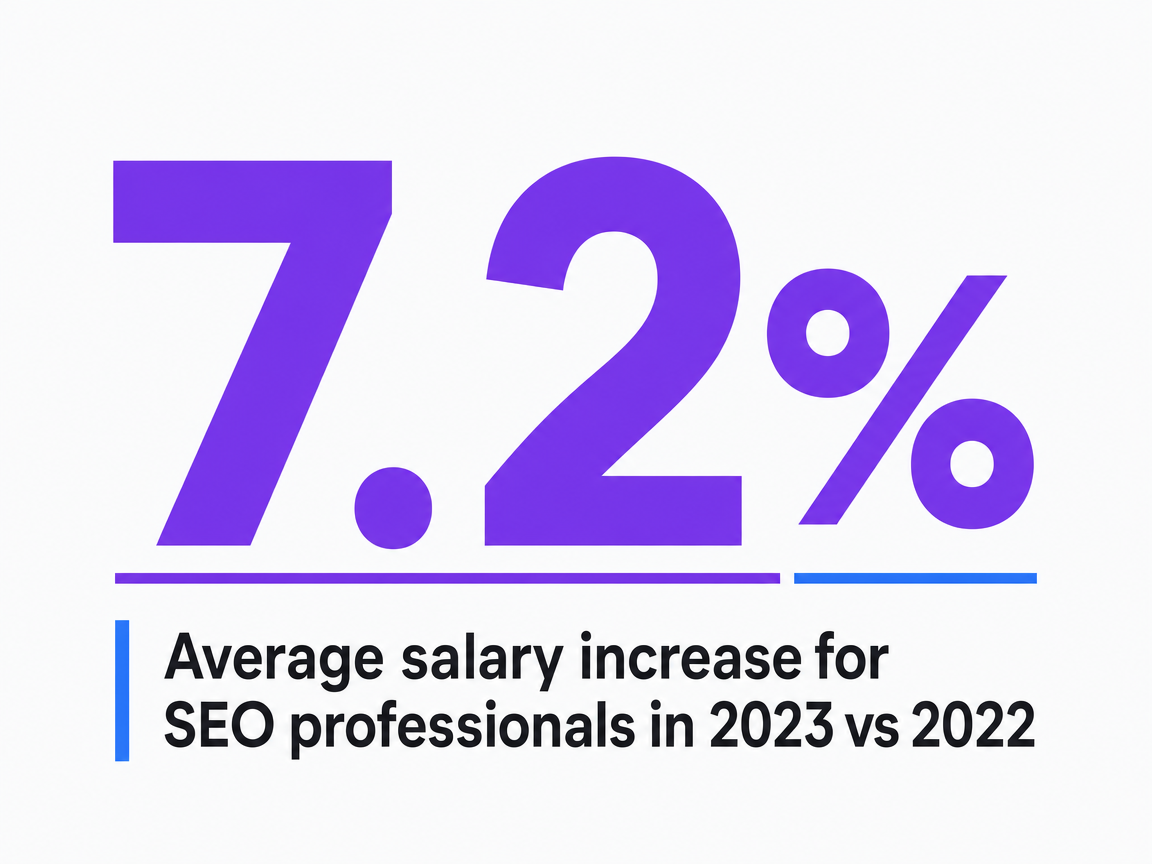 Average salary increase for SEO professionals in 2023 vs 2022
Average salary increase for SEO professionals in 2023 vs 2022
Frequently Asked Questions
References
- 1.SEO Certification: What It Is and How It's Beneficial.
- 2.SEO Specialist Certifications: Best Credentials to Advance Your Career.
- 3.LinkedIn Data: The Most In-Demand Marketing Skills in 2024.
- 4.Search Engine Optimization (SEO) Starter Guide.
- 5.Google's SEO Starter Guide Set For A Major Update.
- 6.Is SEO a Good Career in 2024?.
- 7.Search Engine Optimization Professional Certificate by Moz.
- 8.10 Best SEO Courses in 2026.
- 9.7 SEO certifications worth the investment in 2026.
- 10.Best SEO Course: The Ultimate 2025 Guide to Learning What Actually Gets You Hired.
- 11.SEO Manager Certifications: Best Credentials to Advance Your Career.
- 12.How to Hire an SEO Manager: A Comprehensive Guide for Recruiters.
- 13.How to Get an SEO Specialist Job with Zero Experience.