
Key Takeaways
- A content audit judges existing assets against relevance, freshness, and performance to decide what to keep, update, consolidate, or retire — distinct from an inventory, which only lists what exists 1, 12.
- Audit decisions are budget decisions: consolidating duplicates, refreshing B-grade pages, and retiring failing URLs reclaim writer hours that would otherwise go to net-new production 5, 10.
- A grading rubric from A+ to F turns three evaluation criteria into one defensible score per page, with each grade triggering a specific action and removing debate from planning meetings 2, 8.
- Scope audits to a question — a topic cluster, a performance tier, or a migration path — and convert the decision log into ongoing governance with named owners and review cadences 4, 5, 13.
The Capacity Hidden in Your Existing Library
Most content teams are sitting on more production capacity than they realize. It is locked inside the 400-URL blog archive, the half-finished pillar pages, the 2021 product comparisons still ranking on page two, and the three near-duplicate posts competing for the same query. A content audit is the mechanism that unlocks it.
The working definition is simple. An audit is the process of judging existing content to determine what needs to be created, updated, or removed 12. It pairs a quantitative inventory of every asset with a qualitative evaluation of quality, relevance, and effectiveness against user and business goals 1, 8. That second half is where the leverage lives.
For an in-house content manager working under a flat headcount and a rising production target, every audit decision is a budget decision. A page kept is a brief not written. A page consolidated reclaims two writer assignments. A page retired removes a maintenance liability from the backlog. Digital NSW frames the audit as a tool to evaluate and action improvements based on evidence rather than instinct 10, and that framing matters: the question is not whether the library has problems, but which problems return the most capacity when solved.
This article treats the audit as that capacity instrument, not a cleanup chore.
Inventory vs. Audit: The Distinction That Determines What You Do Monday
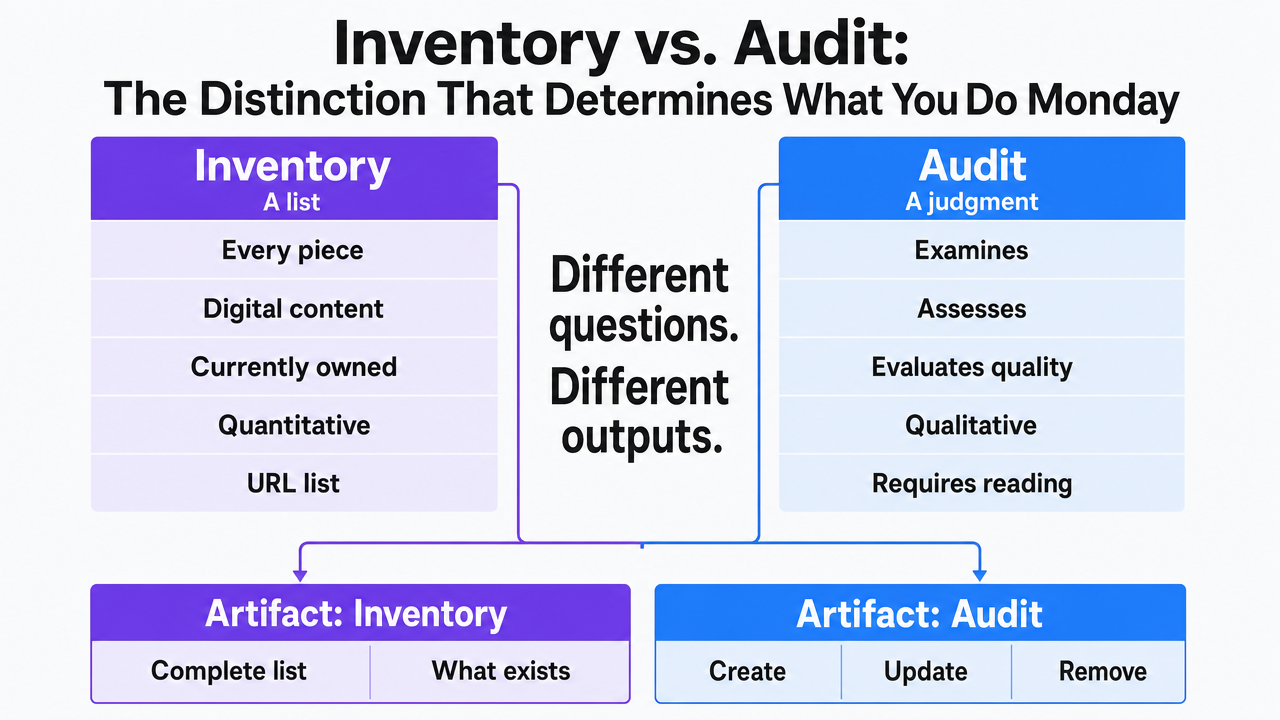
An inventory is a list. An audit is a judgment. The two terms get used interchangeably in vendor decks and team Slack channels, but conflating them is what turns a content audit into a six-month spreadsheet project that nobody acts on.
Nielsen Norman Group draws the line cleanly: a content inventory is a list of every piece of digital content a team currently owns, while a content audit examines, assesses, and evaluates the quality of that content 1. Texas A&M's UX group sharpens the second half — an audit is the process of judging existing content to determine what needs to be created, updated, or removed, and it is explicitly a qualitative exercise that requires reading the content rather than scanning a URL list 12.
That distinction matters because the two activities answer different questions and produce different artifacts.
An inventory answers what exists. It produces a spreadsheet — URLs, titles, owners, publish dates, word counts, traffic, maybe metadata. It is a quantitative artifact, and modern crawlers can populate most of it automatically 1. A 400-URL blog can have a complete inventory by lunchtime.
An audit answers what should exist, and in what condition. It produces a decision log — grade, recommended action, owner, and deadline for each asset evaluated against user need, brand standard, and business goal 3, 8. It cannot be automated end-to-end because someone has to read the page and form a judgment about whether it still serves the audience it was written for 12.
The operational consequence is what determines Monday's calendar. A content manager who scopes "an audit" but actually delivers an inventory hands their director a list, not a plan. The pages still need to be evaluated, the decisions still need to be made, and the production calendar still has no new capacity. Digital NSW puts the point bluntly: an audit exists to evaluate and action improvements based on evidence 10. The inventory is the evidence. The audit is the action.
Both are needed, and they run in sequence. Pull the inventory first to know the universe. Then audit a defensible subset of it to know what to do.
 Visualize the section's core comparison between content inventory (quantitative list) and content audit (qualitative judgment), reinforcing the distinct artifacts each produces
What an Audit Actually Evaluates
Three criteria do the heavy lifting in any serious audit: relevance, freshness, and performance 2. Each one maps to a different signal — audience fit, accuracy decay, and measurable business contribution — and each one triggers a different decision. The subsections below break them apart because conflating them is how audits stall. A page can be accurate but irrelevant, fresh but underperforming, or popular but off-brand. The grade depends on which dimension is failing.
Relevance to Audience Need and Brand Standard
Relevance is the first criterion to fail, and it fails quietly. A 2022 buyer's guide written for a product tier that no longer exists still loads, still ranks, and still gets indexed — but it no longer answers the question the visitor came with. The page is technically live and substantively dead.
Yale's audit framework reduces the relevance check to three questions a reviewer can answer in under a minute per page: does the content meet a current audience need, is it written for the user rather than the internal team, and does it align with brand standards 3. Each question maps to a different failure mode. A page can be on-topic but written in legacy product language. It can be user-friendly but cover a use case the company no longer serves. It can be accurate but tonally off-brand after a rebrand or voice update.
Pages that drift from brand standard create a second cost beyond the relevance gap — they erode the voice consistency that downstream production depends on. Comparing similar pages side by side, as Yale recommends, surfaces both the duplicate-coverage problem and the voice-drift problem in a single pass 3.
Assess and optimize your content library today
Run a complete content audit and publish improvements live during your free trial.
Freshness, Accuracy, and Decay Signals
Freshness is the criterion that fails on a schedule. Product names change, pricing pages move, integration partners get acquired, statutes get amended, and the page that was authoritative in Q2 2023 quietly becomes a liability. The content did not break — the world around it did.
Accuracy decay is rarely flagged by analytics until it has already cost rankings. A page can hold traffic for months after its claims go stale, then drop a position at a time as competing content gets refreshed and search engines re-evaluate. NSW's grading system treats freshness as a first-class audit criterion alongside relevance and performance for exactly this reason — pages get scored A+ through F on whether the information still holds up, not just on whether it ranks today 2.
The practical decay signals are concrete:
- dated statistics older than the source's update cadence,
- screenshots of UI that no longer exists,
- links to acquired or shuttered tools, and
- references to product tiers or pricing the company no longer offers.
Digital.gov's audit method records the last review date and update cadence on every content item precisely so these signals surface during review rather than after a customer complaint 5.
Performance Against User and Business Goals
Performance is the criterion that most teams measure first and interpret last. Pageviews, time on page, and keyword positions are easy to pull and easy to misread — a page can rank well for a query nobody converts on, or carry steady traffic while contributing nothing to pipeline. The audit question is not whether the page performs, but whether it performs against the goal it was written to serve.
Digital.gov's audit method makes this concrete by mapping each content item to user entry points and task flows, not just to traffic numbers 5. A how-to page is measured against task completion. A comparison page is measured against demo requests or qualified clicks downstream. A definition page like this one is measured against organic capture and onward navigation. Pages without a defined goal in the inventory cannot be graded on performance — they can only be flagged for re-scoping or retirement 8.
The audit pairs analytics with the relevance and freshness grades from the prior sections. A high-traffic page that fails relevance is a consolidation candidate. A low-traffic page that passes both relevance and freshness is a distribution problem, not a content problem.
The Grading Rubric: From A+ to F, and What Each Grade Triggers
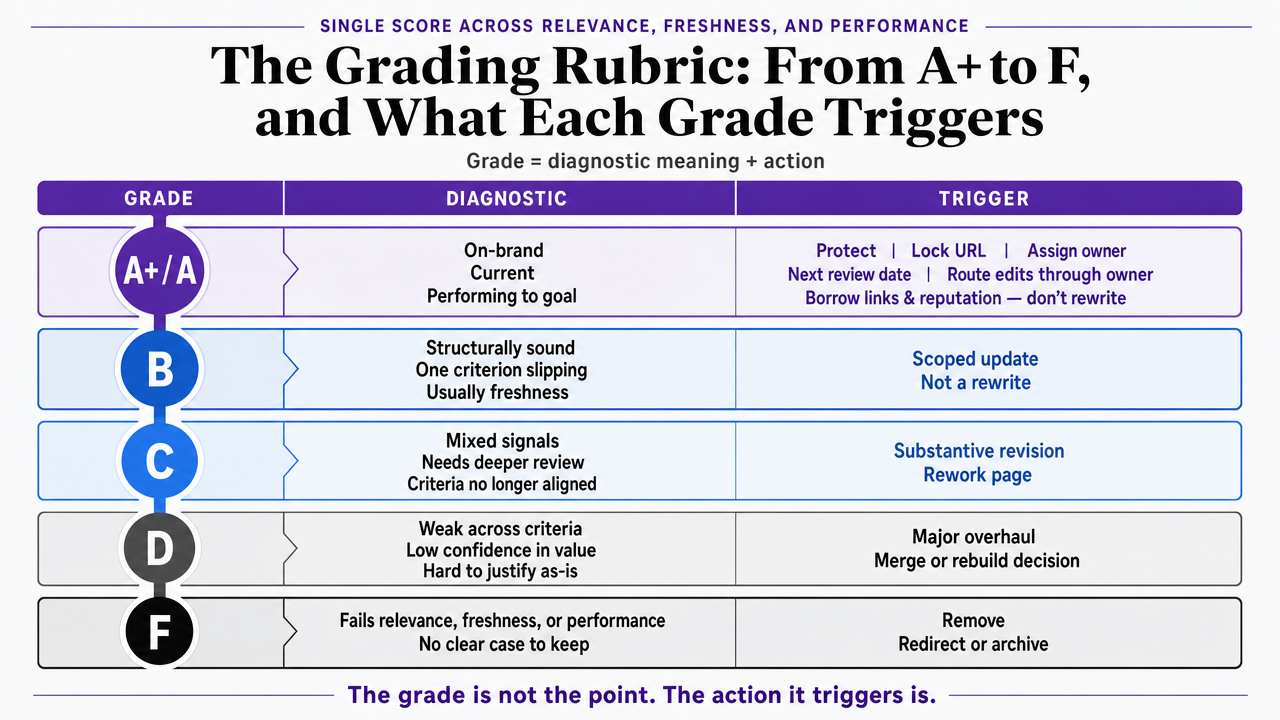
A grading rubric turns the three evaluation criteria into a single defensible score per page. NSW's audit method grades each page A+ through F across relevance, freshness, and performance, which gives a content manager one column on the spreadsheet that everyone — director, SEO lead, subject-matter owner — can read the same way 2. The grade is not the point. The action it triggers is.
A or A+ : An A or A+ page is on-brand, current, and performing against its goal. The trigger is protection: lock the URL, assign an owner, set a next review date, and route any future edits through that owner. These are the pages the production calendar should be borrowing internal links and reputation from, not rewriting.
B : A B page is structurally sound but has one criterion slipping — usually freshness. The trigger is a scoped update, not a rewrite. A 200-word refresh, a statistic swap, a screenshot replacement, and a re-publish date. Writer hours in the single digits.
C : A C page passes relevance but fails on two of three criteria, or is competing with a stronger sibling page. The trigger is a decision: consolidate into the stronger page with a 301, or commit to a full rewrite with a clear performance target. University of Oregon's audit framework names exactly these outcomes — revise, delete, or move — as the artifact the audit produces 8.
D : A D page is off-brand, outdated, or aimed at an audience the company no longer serves, but holds inbound links or residual traffic. The trigger is redirect to the closest relevant URL and remove from the sitemap. The link equity stays; the liability leaves.
F : An F page fails all three criteria and has no meaningful traffic, no links, and no strategic role. The trigger is removal. Digital NSW's framing — evaluate and action improvements based on evidence — is what justifies the delete in a planning meeting 10. Without the grade and the criteria behind it, every retirement turns into a debate about sunk cost.
The rubric's job is to make the debate unnecessary. By the time a page has a C or below next to its URL, the conversation is no longer whether to act, but who owns the action and when it ships.
 Translate the section's five-tier grading rubric into a scannable visual reference showing each grade, its diagnostic meaning, and the action it triggers
Four Outcomes for Every Audited Page
Every audited page resolves into one of four production decisions: keep, update, consolidate, or retire. University of Oregon's audit framework names three of these explicitly — revise, delete, or move — as the artifact a finished audit produces 8. The fourth, keep-as-is, is the one most teams forget to document, even though it carries real consequences for the production calendar.
Keep is a commitment, not a default. A kept page has an owner, a next-review date, and a freeze on edits outside that owner's queue. Without those three attributes, "keep" is just deferral. Digital.gov's audit method records ownership and update cadence on every retained item precisely because unowned pages drift back into the audit backlog within a year 5.
Update covers the B-grade refresh and the C-grade rewrite, and the distinction matters for budgeting. A refresh swaps stats, screenshots, and stale references inside an otherwise sound page — measured in hours. A rewrite rebuilds the page against a current goal and audience definition — measured in the same hours as net-new production. Conflating them is how update queues miss deadlines.
Consolidate is the highest-leverage outcome and the one teams under-use. Three near-duplicate posts competing for the same query become one stronger page with two 301s pointing in. The link equity merges, the cannibalization stops, and two URLs leave the maintenance surface area. NN/g treats this kind of merge as a core audit move because it directly reduces the inventory the team has to govern going forward 1.
Retire is removal with a redirect to the nearest relevant URL, or a clean 410 when nothing relevant remains. The grade and the criteria behind it are what make the retirement defensible in a planning meeting — Digital NSW's evidence-based framing exists for exactly this conversation 10.
Each outcome ships with a writer-hour estimate attached. That number is what the next section runs the math on.
See How Top Brands Accelerate Content Audits With AI-Driven Insights
Request a walkthrough of brand-level content audit automation—learn how leading teams identify gaps, benchmark quality, and ensure consistency across large content libraries without adding headcount.
Capacity Reclaimed: The Production Math Behind Audit Decisions
The audit's business case lives in a four-column spreadsheet: pages reviewed, decision split, hours per decision, and net writer capacity returned to the calendar.
Start with the decision split. On a typical 400-URL blog reviewed against the rubric in section 4, the distribution rarely lands evenly. A common shape is roughly half the archive scoring A or B (keep or refresh), a quarter scoring C (consolidate or rewrite), and the remaining quarter scoring D or F (redirect or retire). The exact ratios vary, but the math holds: only one of those four outcomes — the C-grade rewrite — costs anything close to net-new production hours.
Assign hours to each outcome. A B-grade refresh runs two to four writer hours: swap stats, replace screenshots, update the publish date. A consolidation merges two or three pages into one stronger asset at roughly the cost of a single net-new piece, but it removes the merged URLs from future maintenance. A retirement costs minutes — a redirect rule and a sitemap update. A net-new brief, by contrast, typically consumes the full production cycle: outline, draft, edit, internal review, publish.
The reclaimed capacity is the delta between what the team would have written from scratch and what the audit decisions actually require. A C-grade page consolidated into an A-grade sibling is one fewer brief on next quarter's calendar without sacrificing topical coverage. Three D-grade retirements remove three pages from the quarterly refresh queue permanently.
Digital.gov's audit method makes this math defensible by recording ownership, update cadence, and needed changes for every content item — the fields that let a content manager forecast hours rather than guess at them 5. Without those fields, the audit produces opinions. With them, it produces a production budget.
Scoping the Audit So It Actually Ships
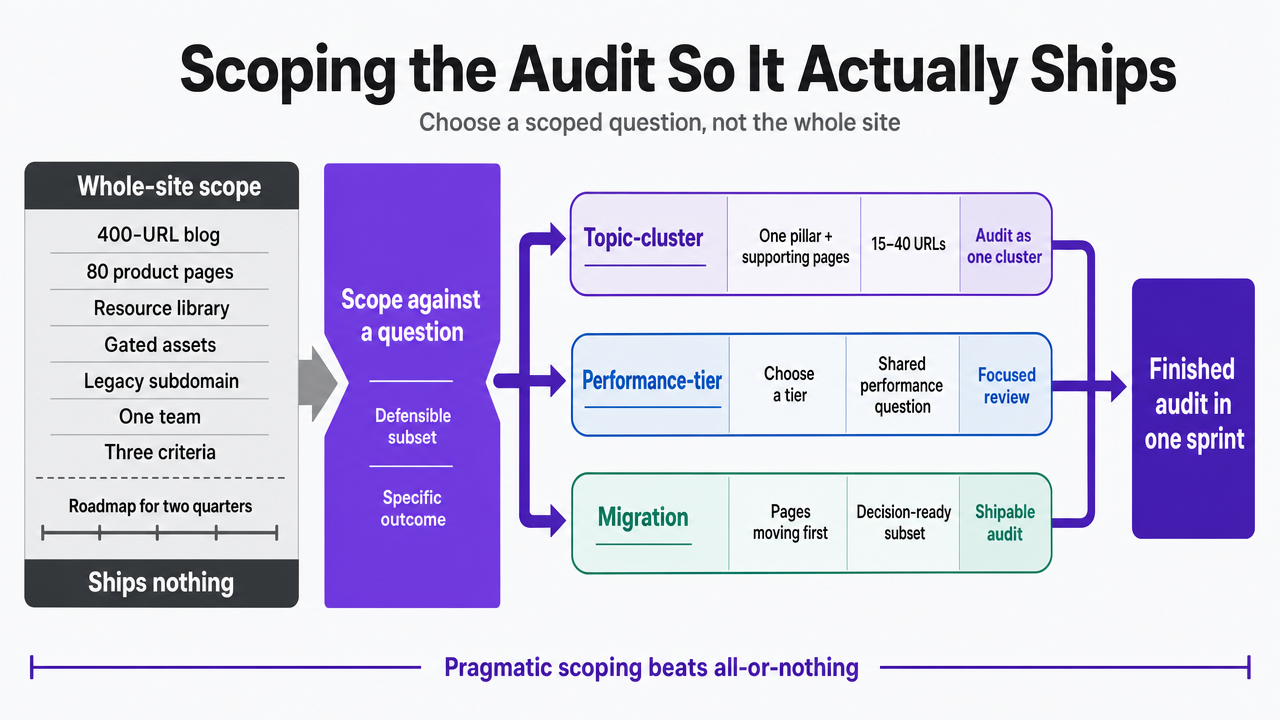
The audits that stall are the ones scoped against the whole site. A 400-URL blog, 80 product pages, a resource library, gated assets, and the legacy subdomain everyone forgot about — reviewed in one pass, by one team, against three criteria — is a project that lives on the roadmap for two quarters and ships nothing.
The audits that ship are scoped against a question. NN/g's guidance treats scoping as the first real audit decision: pick a defensible subset tied to a specific outcome rather than waiting for the perfect full-site review 1. Digital.gov's content designers echo the point — exhaustive audits are the enemy of finished ones, and pragmatic scoping beats all-or-nothing every time 4.
Three scoping patterns work in practice:
- Topic-cluster scope takes one pillar and its supporting pages — typically 15 to 40 URLs — and audits them as a cannibalization and consolidation exercise.
- Performance-tier scope pulls the top 20% of pages by traffic plus the bottom 20% by recency, ignoring the middle, and grades only those.
- Migration scope audits everything in the path of a redesign or replatform because the URLs are moving anyway 6.
Each pattern produces a finished audit inside one sprint rather than an open-ended backlog. The next section covers what happens after the spreadsheet closes.
 Visualize the three scoping patterns described in the section (topic-cluster, performance-tier, migration) as parallel approaches a content manager can choose between to ship a finished audit inside one sprint
The Afterlife: Turning a One-Time Audit Into Governance
The audit closes when the spreadsheet does, but the system it produces is supposed to keep running. The teams that get one cycle of capacity back and then watch their archive decay into the same condition twelve months later are the ones that treated the audit as a project rather than the first turn of a loop.
Governance is the loop. Digital.gov's audit method already records the three fields that make it possible: ownership, update cadence, and needed changes for every retained item 5. Those fields are the seed of a maintenance schedule. An A-grade page with a six-month review cadence and a named owner enters the calendar automatically. A B-grade page tagged for a Q2 refresh shows up on a sprint board, not in a memory. The audit's decision log becomes the input to next quarter's editorial planning rather than a document that gets archived and forgotten.
The Department of Labor's framing is the operational point: building content governance into the workflow promotes consistency, minimizes confusion, and makes content easier to maintain and improve over time 13. The mechanism is unglamorous — a quarterly review cycle, a clear owner per topic cluster, and a small set of triggers that move a page from "kept" back to "audit queue" (a statistic ages past its source, a product changes, traffic drops two quarters running).
Washington State University's web group makes the same point from the practitioner side: inventory and audit work belongs inside ongoing maintenance, not bolted on before a redesign 9. A team that runs a topic-cluster audit every quarter never faces the 400-URL backlog again, because the backlog never accumulates.
The capacity math from the prior section compounds when governance is in place. Each cycle returns writer hours; each cycle also prevents the next year's decay from absorbing them.
When to Audit: Triggers Beyond the Calendar
A quarterly cadence handles the routine work, but the audits that return the most capacity are the ones triggered by an event rather than a date. Four triggers justify pulling an audit forward.
A redesign or replatform is the canonical trigger — URLs are moving anyway, and shipping outdated content onto a new template just preserves the decay 6. A rebrand or voice update exposes every page written under the prior standard as a relevance failure against the new one, and Yale's brand-standard question becomes the dominant grading criterion until the library catches up 3. A traffic drop across a topic cluster for two consecutive quarters signals competing content has been refreshed while the team's hasn't — a pull-forward audit of that cluster ships faster than a rewrite plan built on guesses.
The fourth trigger is a strategic pivot: a new ICP, a product line sunset, or a market the company no longer serves. Pages written for the old direction are not just stale — they're misdirection 8. Audit before the next brief ships, not after.
Frequently Asked Questions
References
- 1.Choosing A Scope And....
- 2.How to run a website content audit - NSW Government.
- 3.How to Conduct a Content Audit | YaleSites.
- 4.A conversation about content audits.
- 5.Content goals.
- 6.Content Strategy 101 - NN/G.
- 7.How To: Content Inventory and Audit (Video) - NN/G.
- 8.Content Audit | UO Digital Strategy.
- 9.Content Inventory, Audit, & Management.
- 10.Content audit | Digital NSW.
- 11.Content audits: How to conduct them effectively.
- 12.Content Inventory and Content Audit.
- 13.Content governance: lightweight practices your team can adopt now.