
Key Takeaways
- A 301 is not an error but a 3xx redirection response signaling a resource has moved permanently to a new URI 2.
- Google treats 301s as a top-tier canonicalization signal, ranking them above rel=canonical, HTTPS preference, and sitemap inclusion when selecting which URL to index 7.
- Use 301 for permanent GET moves, 308 for non-GET endpoints, 302 or 307 for temporary shifts, and 404 or 410 when no equivalent destination exists 12, 19.
- Keep redirects live for at least one year per Google and one to two years per Bing, flatten chains to a single hop, and enforce server-side implementation with named owners 6, 17, 9.
The 'Error' Framing Is the First Red Flag
The phrase "301 error code" is a category mistake. A 301 sits in the 3xx redirection class of HTTP responses, which the current HTTP semantics standard defines as successful signals that a resource has been assigned a new permanent URI, not as failures 2. Errors live in the 4xx and 5xx ranges. When a stakeholder, developer, or junior strategist reports a 301 as something to fix, the underlying issue is almost always a policy gap, not a broken response.
That vocabulary problem tends to travel with operational ones. Teams that call 301s errors usually also treat them as one-off tickets rather than a governed signal that Google explicitly weighs when deciding which URL to keep in the index 1. The redirect gets shipped, logged nowhere, and forgotten until a migration audit surfaces broken chains, missing mappings, or 301s pointed at pages that no longer exist.
For a head of SEO running a portfolio, the reframe is the work. A 301 is a deliberate instruction to browsers, crawlers, and search engines that a URL's canonical address has changed 4. Everything downstream, from equity preservation to migration retention windows, depends on treating it that way.
What a 301 Actually Is, in Protocol Terms
RFC 9110 defines a 301 as a signal that the target resource "has been assigned a new permanent URI" and specifies that the server SHOULD provide a Location header carrying that preferred URI 2. The standard also tells clients with link-editing capability that they can permanently replace references to the old URI with the new one, which is the exact behavior a search engine imitates when it swaps the destination into its index 3.
On the wire, the exchange is small. A client requests the old URL. The server returns a 301 status line and a Location header pointing at the replacement. A browser then automatically issues a fresh request to that Location value 4. Crawlers behave the same way, and MDN notes that search engines attribute links from the original URL to the redirected resource 4. Nothing about that flow is exceptional or broken; it is the mechanism the protocol was written to support 5.
Two protocol details matter for agency work. First, the Location header is the payload — misconfigured Location values, protocol-relative URLs, or trailing-slash mismatches are what actually break redirects, not the 301 itself. Second, a 301 is heuristically cacheable under RFC 9110 unless response headers say otherwise 2, which becomes an operational concern the moment a target URL needs to change again. Both details are covered in later sections; the point here is that 301 is a normative instruction, not a diagnostic.
How Google Treats a 301 as a Canonicalization Signal
Redirects Sit at the Top of the Signal Hierarchy
Google does not weigh every canonicalization input equally. Its own documentation places redirects and rel="canonical" annotations at the top of the stack as strong signals, with HTTPS preference below them, and sitemap inclusion explicitly labeled a weak signal 7. That ranking is the reason a 301 outperforms almost every other tool an SEO team has for telling Google which URL should represent a piece of content.
Canonicalization itself is the selection problem: when Google sees a set of duplicate or near-duplicate URLs, it picks one to represent the group in the index 8. Redirects influence that pick more directly than any annotation because the server is not suggesting a preferred version, it is refusing to serve the old one. The instruction is behavioral, not advisory.
For an agency briefing junior strategists, the practical consequence is a triage order:
- If a URL has genuinely moved, a 301 or 308 is the first tool.
- If two URLs must both remain live but one should represent the pair, rel="canonical" is the next tool.
- Sitemap entries, hreflang groupings, and internal link patterns reinforce those signals but never substitute for them 7, 8.
Teams that skip the top of the stack and try to canonicalize through sitemaps alone routinely watch Google pick a different URL than the one they intended.
What Actually Transfers, and What Doesn't
A 301 tells Google that the destination should become the canonical URL and that links pointing at the old address should be attributed to the new one 1, 4. That is the mechanism behind the industry shorthand of "passing equity." It is accurate as far as it goes, and it is where most explanations stop.
The part worth internalizing is that the destination is still evaluated on its own merits. Google's redirect guidance describes the 301 as a strong signal for canonical selection, not as a guarantee that the destination will inherit the source URL's exact ranking positions 1. If the new page has thinner content, weaker internal linking, or a different topical focus than the original, rankings can shift even when the redirect is implemented perfectly. The 301 moves the address; it does not rewrite the page.
Recrawl timing is the other detail agencies underestimate. Googlebot needs to recrawl the old URL, follow the redirect, and update the index, and that cycle is not instantaneous 21. Migration dashboards that expect same-week canonical swaps almost always misread normal latency as a redirect problem. The correct action is to submit updated sitemaps and wait for the recrawl to finish before diagnosing anything.
301 vs. 308 vs. 302/307 vs. 404/410: The Decision That Governs Everything Else
301 or 308: The Method-Preservation Question
Both 301 and 308 signal a permanent move, and Google treats them as functionally equivalent for canonicalization purposes 1. The wire-level difference is what happens to the request method. A 308 preserves the original method and body, so a POST stays a POST when the client follows the Location header 12. A 301 has historically been handled inconsistently, with some clients silently converting the follow-up request to a GET 12.
For page-level content served over GET, that distinction rarely changes SEO outcomes. Pick 301 and move on. The choice matters when the endpoint accepts form submissions, API calls, or webhook posts. Redirecting a POST endpoint with a 301 risks dropping the body payload against clients that downgrade the method; 308 avoids that class of bug entirely 12.
The operational rule for agency work is narrow: use 301 for content URLs, and require developer sign-off before a 301 is placed in front of any non-GET endpoint. If the endpoint accepts anything other than GET, the default should be 308.
When 404 or 410 Is the Right Answer
A 301 is the wrong tool when nothing on the new site actually replaces the old page. Google's guidance is direct: if content moved to a new URL, use a 301; if no similar content exists, the old URL should return 404 or 410, and both are treated similarly for indexing purposes 19. The instinct to redirect every deprecated URL somewhere, usually the homepage, produces exactly the pattern Google has told webmasters to avoid — bulk redirects to unrelated destinations 20.
Google's site-migration and government-webmaster documentation both recommend page-level mapping to a page with similar content, not a catch-all redirect to the root 20. When there is no equivalent, the honest response is the correct one. A 404 or 410 tells Google the URL is gone and lets the index reflect reality, which is a healthier long-term state than a soft-404 pattern generated by mass redirects to the homepage.
The working rule: 301 requires an equivalent destination. If a strategist cannot name the specific replacement page, the URL returns 410.
Temporary Moves Belong on 302 or 307
Permanence is a claim about the URL, not about the calendar. A 302 or 307 tells crawlers the source URL should stay canonical while the destination serves the content temporarily; a 301 or 308 tells them to replace the source in the index 1, 18. Using a 301 for A/B tests, seasonal landing pages, geographic routing, or maintenance redirects invites Google to swap the temporary destination into search results and leaves the original URL orphaned.
The pattern to watch for on client sites is legacy campaign infrastructure that hard-codes 301 for what are actually rotating destinations. Audit the redirect table, flag any rule tied to a time window or experiment ID, and downgrade those to 302 or 307. The status code should describe the intent, not the current traffic direction.
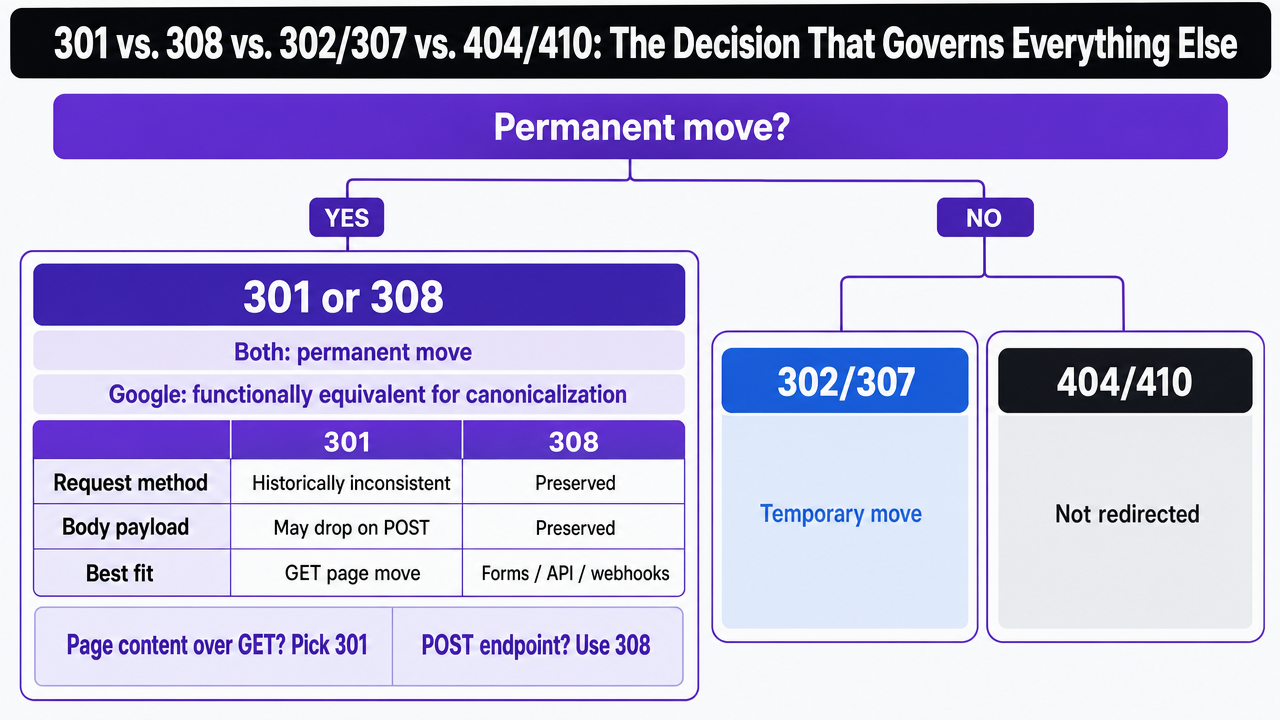 Visualize the decision framework comparing status codes so readers can quickly pick the correct response for each scenario, directly supporting the section's comparison content
Test 301 redirect strategies in live environments
Validate redirect workflows and measure SEO impact with real-time data before committing to new processes.
Retention Windows: How Long a 301 Must Stay Live
The default answer inside most agencies is wrong by a factor of two. Google's site-move documentation sets the minimum retention for redirects at approximately one year after a URL-changing migration 6. Bing's webmaster guidance sets a longer floor, recommending that old-domain redirects stay live for at least one to two years, preferably longer 17. The operational default, then, is Bing's, not Google's. A portfolio that runs to Google's minimum will still be leaking equity in the crawl and click paths that Bing serves.
Those windows are minimums, not targets. They cover the time engines need to recrawl the old URLs, follow the redirects, update canonical selections, and let third-party links, bookmarks, and cached references catch up 21. External signals lag longer than internal ones. Backlinks pointing at legacy URLs get updated on the linking site's own schedule, which for editorial and directory sources is measured in years, not weeks. Retiring a 301 before those references migrate turns preserved equity back into a 404.
The agency rule that survives audit is a two-year minimum on any domain-level migration, extended indefinitely when the redirect fronts high-value inbound links or paid-media destinations. Section-level or single-URL 301s can follow the one-year Google floor when link inventory is thin. Retention decisions belong on the migration ticket at the moment the redirect ships, not in a cleanup sprint eighteen months later when the reasoning has been lost.
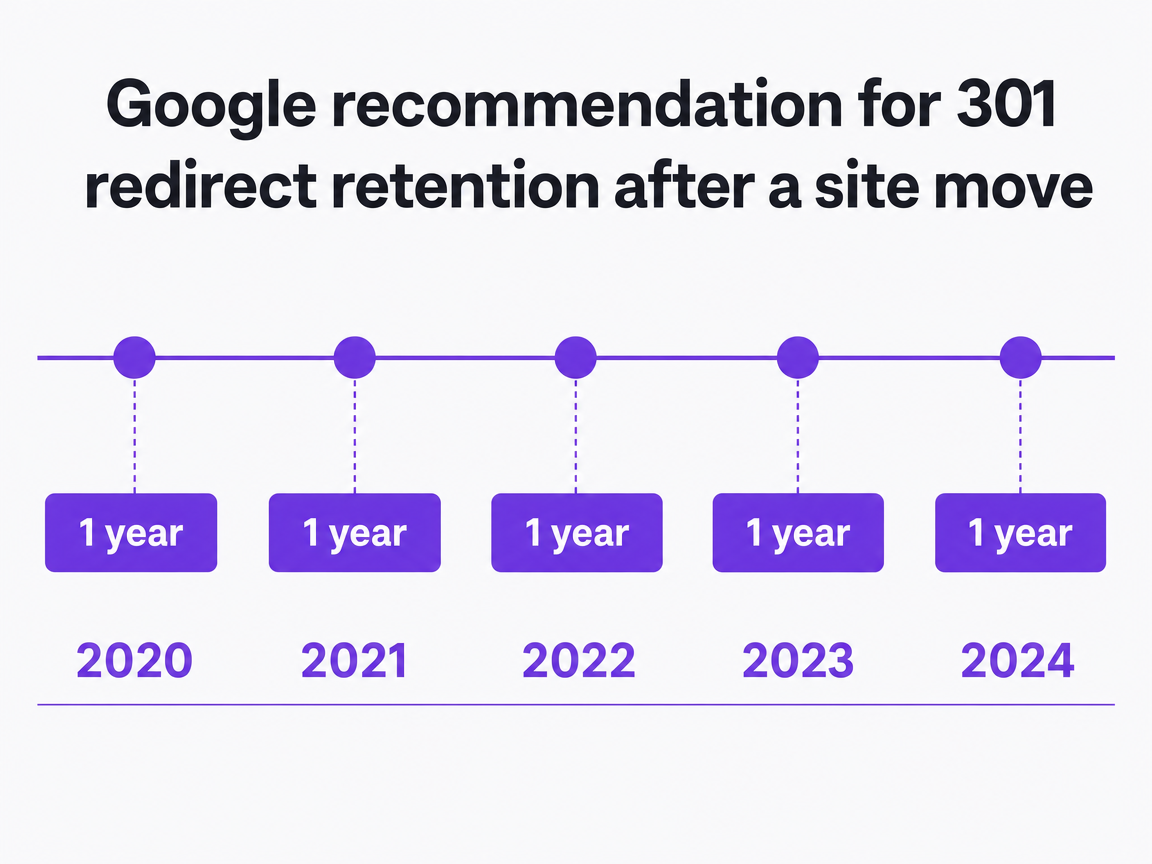 Google recommendation for 301 redirect retention after a site move
Source: Start The Site Move
Chains, Caches, and the Physics of Redirect Debt
Chain Length: The Rule People Misquote
The "five redirects" number circulating in agency Slack channels comes from RFC 9309, and it does not mean what most strategists think it means. The specification says crawlers SHOULD follow at least five consecutive redirects when fetching robots.txt, and MAY treat the file as unavailable after more than five 14. That is a minimum guarantee for a single file type, not a universal ceiling for HTML pages.
For content URLs, the governing guidance is different. Google's crawl-budget documentation tells large-site operators to avoid long redirect chains because they have a negative effect on crawling, without publishing a numeric threshold 9. The two rules point in the same direction but describe different systems: robots.txt has a guaranteed floor, HTML crawling has a soft ceiling that scales with site size and crawl demand.
The practical policy for portfolio work is to flatten chains to a single hop whenever the old and new URLs are both known. When a migration layers a second rename on top of a first, the redirect table should be rewritten so the original URL points directly at the current destination, not at the previous intermediate. Two hops is tolerable; three is a cleanup ticket; anything longer is redirect debt that will surface in Search Console coverage reports before it surfaces in rankings.
Cache Persistence and the Cost of Changing Your Mind
A 301 is heuristically cacheable under RFC 9110 unless response headers say otherwise 2, and RFC 9111 defines the header fields that control how long that cached response persists in browsers, CDNs, and intermediary proxies 10. That default caching behavior is the reason a redirect decision made carelessly on Tuesday can still be routing traffic incorrectly six months later, even after the server-side rule has been changed.
The operational consequence shows up when a destination URL needs to move again. Users whose browsers cached the original 301, and intermediaries that stored the response, will keep following the stale Location value until their cache expires or they clear it manually. The server is answering correctly; the client never asks. Search engines run their own recrawl schedule, but end users and third-party tooling do not 11.
The fix is to set explicit Cache-Control directives on any 301 that fronts a URL likely to change again, such as campaign endpoints, promotional pages, or interim migration hops. A short max-age gives the team room to redirect the destination later without waiting out an indefinite heuristic cache. Long-lived 301s on stable canonical moves can keep default caching; short-lived operational redirects should not.
Implementation: One Rule, Not a Server Tutorial
Server syntax varies across Apache, NGINX, IIS, CDN edge workers, and application frameworks, and none of that variation matters at the policy level. Apache's mod_alias, for example, exposes RedirectPermanent and the permanent status argument, both of which return a 301 13. Every stack has its own equivalent. The rule an agency needs to enforce across a portfolio is not a config snippet; it is a single sentence: redirects run server-side, at the highest layer that owns the URL.
That placement decision is what separates durable redirects from fragile ones. A 301 issued by the origin server, edge CDN, or reverse proxy fires on the first request, before any client-side JavaScript, meta refresh, or framework router gets involved. Google's redirect documentation recommends server-side implementation for permanent moves precisely because it is the only path that guarantees crawlers, browsers, and intermediaries all receive the same status code and Location header 1.
The corollary is a ban list:
- Meta-refresh tags
- JavaScript window.location assignments
- Framework-level route rewrites
These should not carry permanent moves. They fail silently for crawlers that do not execute scripts and they cannot be cached by intermediaries. Push the redirect down to the server layer, document the rule once, and let developers pick the syntax that fits their stack.
Eliminate 301 Redirect Uncertainty with Data-Driven SEO Automation
Connect with a strategist to see how leading agencies are automating 301 redirect management at scale—maintaining SEO equity and reducing manual oversight without adding headcount.
The Security Surface Most SEO Teams Ignore
Redirect infrastructure built for marketing rarely gets audited by security, and that gap is where open redirects live. OWASP defines an open redirect as an application that sends users to an attacker-controlled URL supplied through unvalidated input, and classifies the flaw as a phishing enabler that also bypasses domain-based validation checks 15. The pattern shows up in campaign tracking endpoints, email-click wrappers, and location-selector routes that accept a destination parameter and forward the browser without checking it against an allowlist.
Client-side redirects widen the surface. The OWASP Web Security Testing Guide flags any redirect whose destination is controlled by user input as an input-validation flaw with phishing and malware-delivery risk 16. A marketing platform that reads a query string and writes it into window.location is exactly the shape of endpoint attackers scan for.
The fix is a strict allowlist of permitted destinations, applied server-side, on every redirect that reads any external input. Fixed 301s between owned URLs are not the risk; parameterized forwarders are. Add them to the same audit cadence as the redirect table itself.
Running Redirects Across a Portfolio
If You Manage Multiple Client Sites or Locations
Portfolio work changes the failure mode. A single site can absorb a sloppy redirect table because the strategist who shipped it remembers what happened; thirty client sites cannot, because institutional memory dies at the account-manager handoff. The rule that keeps a multi-client program intact is that every 301 lives in a versioned mapping file owned by the agency, not in the client's .htaccess or CDN console alone.
Multi-location operators face a related but distinct problem. Location URL structures change when a franchise renumbers markets, a DSO acquires a practice, or a home-services brand consolidates city pages into regional hubs. Each of those events produces a wave of 301s that must map to specific replacement pages, not to the corporate homepage 20. When the mapping is missing, the redirect either fails silently or points at a page Google will not accept as canonical 8.
The governing artifact is the mapping file. Everything else is downstream.
Redirect Governance Matrix
The matrix below is the working reference for portfolio decisions. It compresses the choices covered earlier in this article into the five scenarios that account for most agency redirect tickets, and it assigns each scenario a correct status code, a minimum retention window, a monitoring cadence, and an approval owner. Retention floors cite Google's site-move guidance of at least one year 6and Bing's recommendation of one to two years or longer 17; the operational default is the longer of the two.
| Scenario | Status code | Minimum retention | Monitoring cadence | Approval owner ||---|---|---|---|---|| Single-page URL change with equivalent content | 301 | 1 year 6| Quarterly Search Console coverage check | SEO strategist || Section reorganization or taxonomy rename | 301 | 1–2 years 6, 17| Monthly for first quarter, then quarterly | SEO lead || Full domain migration | 301 (or 308 for non-GET endpoints) 12| 2+ years 17| Weekly for first 90 days, monthly through year one | Head of SEO || Deprecated content with no equivalent | 404 or 410 19| N/A | Quarterly crawl audit | SEO strategist || Tracking or campaign redirect with parameterized input | 301 with allowlist 15| Duration of campaign | Per-campaign security review | SEO lead + security |
The matrix is not exhaustive, and edge cases exist. It is meant to end the recurring debate at the ticket level so that a junior strategist can ship a redirect without escalating, and a senior lead can audit the table in a single pass.
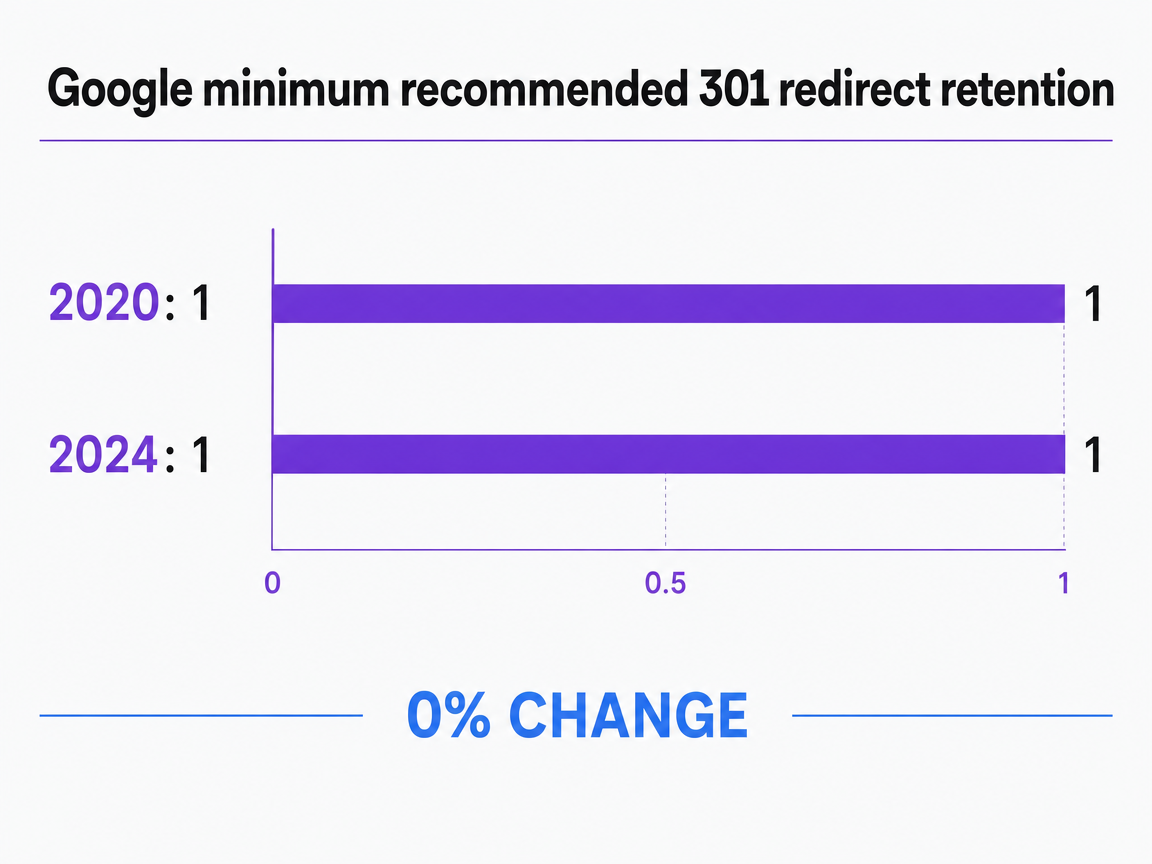 Google minimum recommended 301 redirect retention
0% change. Source: https://developers.google.com/search/docs/crawling-indexing/site-move-with-url-changes
Monitoring, Ownership, and When to Retire a Redirect
A redirect that no one owns is a redirect that will fail quietly. The portfolio-level rule is that every 301 has a named owner on the mapping file and a review date, not a vague team assignment. Ownership sits with the strategist who shipped the redirect until the migration is closed out, then transfers to whoever inherits the account. When the owner leaves the agency, the mapping file gets reassigned in the same handoff document that covers reporting access and client contacts.
Monitoring is a Search Console job first and a log-file job second. Coverage reports surface redirect errors, soft-404 patterns, and canonical mismatches faster than any third-party crawler, and they cost nothing to check on a monthly cadence 6. Server logs answer the harder question of whether the old URLs are still receiving traffic worth preserving. If a redirect fires fewer than a handful of times a quarter and no external links point at the source, retirement becomes defensible.
Retirement is the decision most agencies never actually make. The default should be to keep long-standing 301s live indefinitely on stable canonical moves, and to retire only operational redirects — campaign endpoints, expired promotional URLs, resolved A/B tests — once traffic and inbound links have decayed to zero. Even then, replace the 301 with a 410 rather than silently deleting the rule; the explicit gone response tells Google the URL is intentionally retired 19and closes the loop the mapping file opened.
Frequently Asked Questions
References
- 1.Redirects and Google Search.
- 2.RFC 9110: HTTP Semantics.
- 3.RFC 9110: HTTP Semantics | RFC Editor.
- 4.301 Moved Permanently - HTTP - MDN Web Docs - Mozilla.
- 5.Redirections in HTTP.
- 6.Start the site move.
- 7.How to Specify a Canonical with rel="canonical" and Other Methods.
- 8.What is URL Canonicalization | Google Search Central.
- 9.Manage your crawl budget for large sites.
- 10.RFC 9111: HTTP Caching.
- 11.RFC 9111: HTTP Caching.
- 12.308 Permanent Redirect - HTTP - MDN Web Docs - Mozilla.
- 13.Apache Module mod\_alias.
- 14.RFC 9309: Robots Exclusion Protocol.
- 15.Open Redirect.
- 16.WSTG - Latest | Client-side URL Redirect.
- 17.Website Migration with Bing.
- 18.Site architecture and SEO – file/page issues (SEM 101).
- 19.Do 404s hurt my site?.
- 20.Answering the top questions from government webmasters.
- 21.A few questions from our Google Group.