
Key Takeaways
- A 301 Moved Permanently tells clients the resource has a new permanent URI via the Location header, and signals to Google that the target should become canonical 1, 2.
- Google treats 301 as a strong canonicalization signal rather than a directive, so redirects, internal links, sitemaps, and rel=canonical annotations must all point to the same target 4, 5.
- Choose 301 for GET-dominant HTML pages and 308 when POST, PUT, PATCH, or DELETE endpoints require the original method and body to replay against the new URI 1, 7.
- Keep redirect chains to a single hop, maintain the ruleset indefinitely, and monitor both properties in Search Console through the weeks-long recrawl window 3, 10, 11.
The Canonicalization Signal Hiding Inside a Three-Digit Status Code
A 301 response acts as a server directive but functions as a canonicalization signal. This distinction is crucial for migrations to preserve organic revenue rather than spending months recovering it.
The HTTP specification defines 301 Moved Permanently as a declaration that the target resource has a new permanent URI, delivered via the Location header 1. The IANA registry links this status to RFC 9110, Section 15.4.2 8. While this covers the mechanical aspect, the strategic half involves how Google processes this response: a permanent redirect is a strong signal that the target should become the canonical URL, not a command that forces it 2, 5. Google selects canonicals from various compatible signals—redirects, internal links, sitemaps, rel="canonical" annotations, HTTPS—and may override a site owner's preference if these signals conflict 4.
For SEO leads managing migrations across client portfolios, this reframing changes the approach. The task isn't merely emitting 301s; it's about assembling a coherent set of signals, from a one-to-one URL map to aligned canonicals and a clean redirect chain, ensuring Google's selection algorithm has no reason to choose anything other than the intended target.
What RFC 9110 Actually Says About 301
The Spec Definition and the Location Header Contract
RFC 9110 defines 301 Moved Permanently as a status indicating that the target resource has been assigned a new permanent URI, with future references expected to use that new URI 1. The server is expected to generate a Location header carrying the preferred replacement URI, which clients read to issue the follow-up request 1, 12. The IANA HTTP Status Code Registry assigns this to RFC 9110, Section 15.4.2, classifying 301 and 308 together as permanent redirection 8.
Two specification details are critical for migration planning. First, the Location value is a recommendation to clients, not a guarantee that every client will rewrite stored links or follow the redirect identically 12. Second, 301 permits user agents to decide whether to redirect automatically, and historical client behavior regarding request methods differs from the stricter method-preserving behavior associated with 308 1, 7. A redirect rule that assumes universal, method-identical replay overspecifies what the standard promises.
301 as a Google Canonicalization Signal, Not a Directive
Google treats a permanent redirect as a strong signal for canonicalization, not an absolute instruction 2, 5. Canonical selection is based on multiple signals: redirects, rel="canonical" annotations, internal links, sitemaps, and HTTPS all contribute. Google may select a different canonical than the site owner intends if these signals conflict 4.
This understanding has operational implications. A 301 from /old-category/ to /new-category/ can be undermined by internal links still pointing to the old path, a sitemap listing the old URL, or a canonical tag on the new page pointing elsewhere. Google's guidance recommends combining compatible signals: consistent absolute URLs, direct internal links to the canonical URL, and server-side redirects as the fastest way to communicate URL replacement 5.
For agency SEO leads, a migration audit must go beyond verifying 301 status codes. The entire signal set must agree. When mapping, canonicals, sitemaps, and internal links all point to the same target, Google's selection algorithm has little room to choose otherwise 4, 5.
301 vs 308: A Method-Semantics Decision for Migration Scope
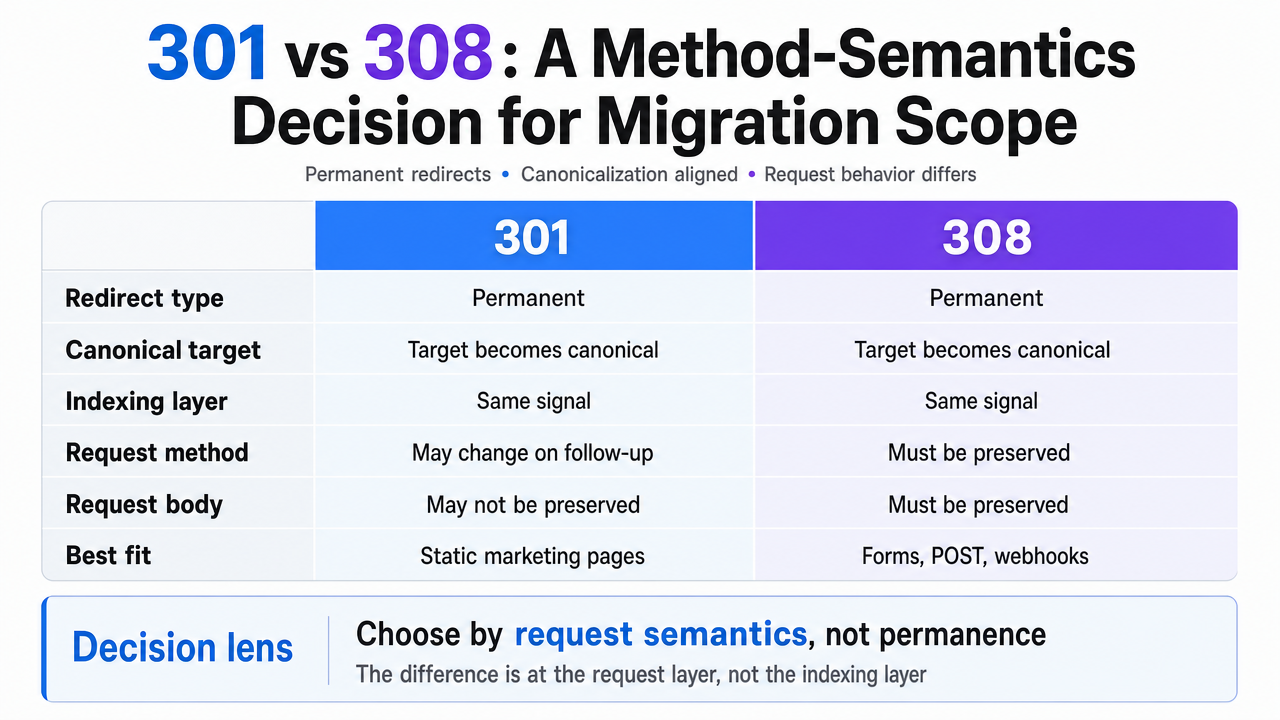
The common practice of treating 301 and 308 as interchangeable permanent redirects is problematic when a migration involves anything beyond idempotent GET traffic. The IANA registry classifies both as permanent redirection statuses 8, and Google treats both as signals that the target should become canonical 2. The key difference lies at the request layer, not the indexing layer.
RFC 9110 allows user agents receiving a 301 to decide whether to redirect automatically, and historically, non-GET methods were often downgraded to GET on the follow-up request 1. MDN highlights this quirk, contrasting it with 308, where the request method and body must be preserved during redirection 6, 7. For a static marketing site, this distinction is academic. However, for migrations involving form endpoints, authenticated POST handlers, webhook receivers, or JSON APIs, it can mean the difference between a transparent cutover and silent data loss.
| Status | Permanence | Method Preservation | Canonicalization Signal |
|---|---|---|---|
| 301 | Permanent 1 | Not guaranteed; clients may rewrite non-GET to GET 1, 6 | Strong 2 |
| 308 | Permanent 8 | Required; method and body preserved 7 | Strong 2 |
| 302 | Temporary 2 | Not guaranteed 9 | Weak 2 |
| 303 | Temporary 2 | Forces GET on follow-up 9 | Weak 2 |
| 307 | Temporary 2 | Required; method and body preserved 9 | Weak 2 |
For migration planning, the practical rule is: 301 is appropriate for GET-dominant HTML surfaces where crawler and browser behavior is the primary concern, and the canonical signal to Google is the main objective 2, 5. Conversely, 308 is the correct choice when the migrated path accepts POST, PUT, PATCH, or DELETE, and the client contract requires the original method and body to replay against the new URI 7. Mixed-scope migrations should segment rule sets by path pattern instead of defaulting to a single status across the entire origin. NGINX explicitly supports both codes, so there's no implementation cost to applying the correct status per route 13.
 Visualize the comparison table of redirect status codes already present in this section, giving readers a scannable reference for permanence, method preservation, and canonicalization strength
Test seamless 301 redirects on real content
Validate redirect strategies with live pages and track SEO impact before committing long term.
The Migration Workflow: Map, Implement, Verify, Monitor, Decommission
Mapping: The Artifact That Determines Whether Traffic Survives
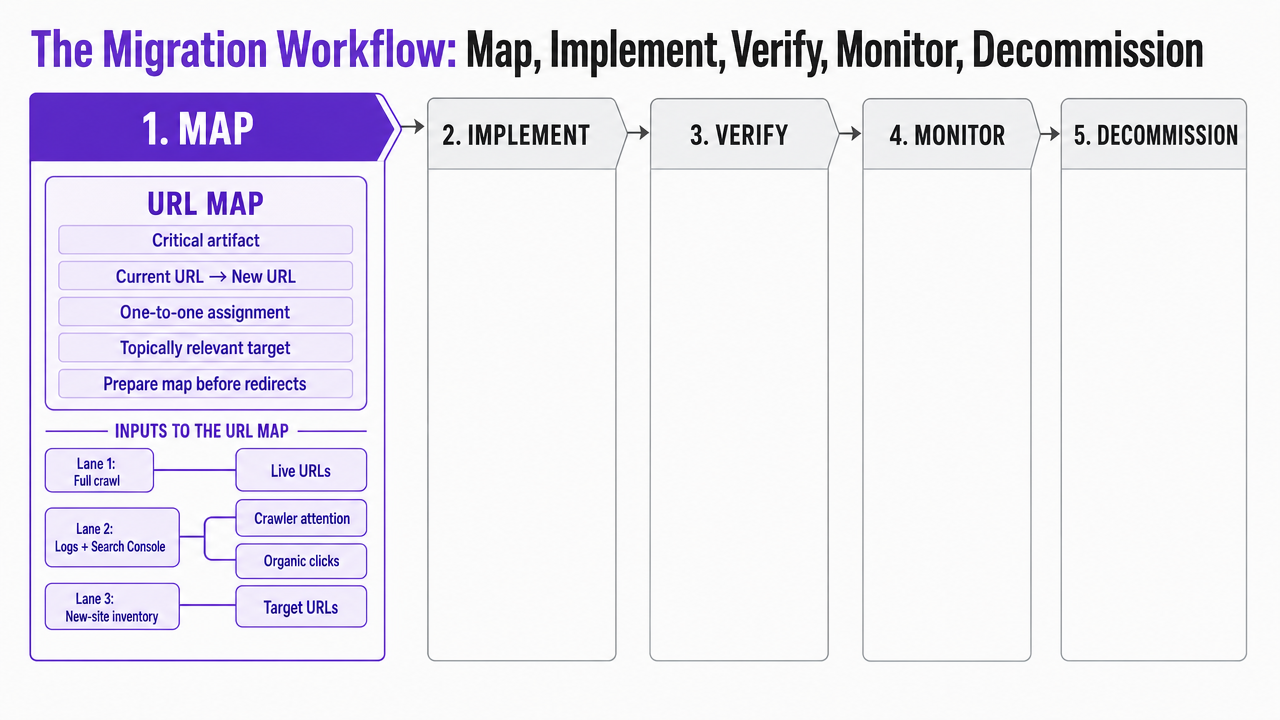
The URL map is the single most critical artifact for preserving organic revenue during a migration. Google's site-move guidance begins with the instruction to prepare a mapping from current URLs to their new counterparts before writing any redirect rules 3. This map is not merely a crawl export; it's a reviewed, one-to-one assignment of every indexed path to the most topically relevant target on the new URL space.
Three inputs contribute to a robust map:
- A full crawl of the current origin identifies all live URLs.
- Server log data and Search Console performance reports pinpoint which URLs receive crawler attention and organic clicks, focusing mapping efforts where traffic is concentrated.
- A content inventory from the new site provides the target URLs, with explicit tagging for pages that lack a direct equivalent and require a judgment call rather than a pattern match.
A common failure is collapsing pages without obvious equivalents into a catch-all redirect to the homepage or a category root. Google treats a redirect as a strong signal that the target should become canonical 5, so redirecting a thousand old URLs to one target tells the selection algorithm that the target represents a thousand different intents. The map should flag unmapped URLs for editorial review, not route them to a generic landing page.
Implementing Server-Side Rules Without Lazy Catch-Alls
Google's redirect guidance identifies server-side redirects as the preferred method for communicating URL replacement, with 301 and 308 classified as permanent 2. NGINX implements this via the rewrite module, where the permanent flag returns a 301, and explicit return statements can emit 301, 302, 303, 307, or 308 as needed 13. The implementation decision centers on the granularity of the rule set.
A disciplined rule set translates the URL map into explicit one-to-one entries for traffic-bearing URLs, followed by narrow pattern rules for structural changes (like category slug renames), and finally, a catch-all rule that returns 410 or 404 for intentionally retired paths instead of redirecting them. In contrast, a single rule that captures every path on the old origin and rewrites it to / on the new one is problematic.
This catch-all pattern can break a migration in three ways 13:
- Per-URL canonical signal is lost: if every historical URL points to the same target, Google has no basis to assign redirected equity to a specific new page 5.
- Loop risk increases if the rule's capture pattern inadvertently matches the destination path, as NGINX will continue processing until internal redirect limits are hit.
- Query strings and fragments are dropped unless explicitly preserved, silently breaking tracked campaign URLs, paginated archives, and faceted navigation.
Rule ordering is as important as rule content. More specific patterns should precede broader ones, and host matching should be explicit if the migration includes a domain change. HTTP-to-HTTPS, apex-to-www, and old-path-to-new-path should resolve in a single hop whenever the rule structure allows 10.
Verifying Before Launch: Status Chains, Headers, Canonical Alignment
Pre-launch verification tests the entire signal set, not just status codes. A rule returning 301 is necessary but insufficient; the response must carry the correct Location header, resolve in a single hop, and land on a page whose canonical tag, internal links, and sitemap entry all point back to that same URL 1, 5.
A thorough QA pass involves running the full mapping file through an automated check in a staging environment with the production rule set loaded. For each old URL, the test asserts four conditions:
- The response status is 301 (or 308 if method preservation is required).
- The
Locationvalue precisely matches the mapped target (including protocol and host). - The final response after following the chain is a 200.
- The destination's
rel="canonical"annotation resolves to the same URL specified in theLocationheader 1, 5.
Edge cases to include in the test matrix are trailing-slash variants, uppercase paths, query-string permutations, and apex-versus-www host variations.
The output is a defect list, not a simple pass/fail. Chains longer than one hop, canonical mismatches, and 404s at the mapped destination each represent distinct remediation tasks that must be addressed before launch.
Monitoring Recrawl and Reindex Through Search Console
Launch marks the beginning of the measurement window, not the end of the project. Google's site-move documentation indicates that medium-sized sites may take weeks or more for recrawl and reindex, with larger sites taking even longer, and ranking fluctuations are possible even with correct implementation 3. Monitoring must align with this timeline, not just a two-week post-launch sweep.
Both the old and new properties should remain instrumented in Search Console throughout this period. The old origin's Coverage and Pages reports should show redirected URLs exiting the index; the new origin's reports should show equivalent URLs entering. Submitting the updated sitemap on the new property and keeping the old sitemap available until crawl volume on the old origin drops to near zero provides Google with explicit URL inventories for both sides of the move 3.
Signals to monitor daily for the first two weeks and weekly thereafter include:
- Crawl volume on the old versus new host
- Indexed URL counts on each property
- Impression and click deltas segmented by landing page
- The ratio of 301 responses to 404s in server logs
A rising 404 count on the old origin indicates mapping gaps missed during QA. A canonical mismatch warning in Search Console's URL inspection tool points to signal conflicts among the redirect, the rel="canonical", and the sitemap 4, 5.
Decommissioning the Old URL Space Without Losing Equity
Permanent redirects are intended to be permanent; they are not meant to be retired quarterly. RFC 9110 frames 301 as a signal for future references to use the new URI 1, and MDN's guidance states that permanent redirects imply the original URL should no longer be used and crawlers should update their references 9. External backlinks, bookmarks, and syndicated citations update on their own timelines, often spanning years.
Decommissioning the old URL space, when it occurs, means retiring the host or infrastructure serving the redirect, not disabling the redirects themselves. The sequence involves: confirming that organic traffic to the old origin has significantly decreased and Search Console shows old URLs removed from the index, then migrating the redirect rules to the lowest-cost infrastructure that can serve them reliably, such as a static edge rule set or CDN-level configuration. The redirect ruleset itself remains an asset. Removing it reintroduces the broken-link decay that the migration was designed to prevent.
 Visualize the five-stage migration workflow explicitly structured in this section's subheadings, giving readers a process map before they drill into each stage
Redirect Chains and the Latency Cost Most Migrations Ignore
Most migration post-mortems focus on mapping gaps and canonical conflicts. The latency cost of the redirect chain itself is often overlooked, despite being a migration defect that degrades Core Web Vitals, crawl efficiency, and user-perceived performance simultaneously.
The mechanism is straightforward: a redirect requires the browser to issue an additional request before retrieving the final document, and multiple redirects compound this delay 10. Chrome's performance documentation identifies redirects as a direct contributor to document request latency and recommends a mitigation often skipped: making links point directly to the current resource location, not to a URL that will redirect 11. Each hop in the chain adds another DNS lookup, TCP handshake, and TLS negotiation that delays the final document.
Chain depth accumulates in predictable scenarios. An HTTP request to the apex host on an old domain can resolve as HTTP → HTTPS → www → new domain → new path, resulting in four hops before the browser sees a 200. Each of these transitions might be defensible in isolation, but when stacked, they explain why a migration can result in measurably slower document latency than the site it replaced 10, 11.
The solution is a rule-set change, not an infrastructure change. Collapse protocol upgrades, host normalization, and path rewrites into a single terminal redirect per request. NGINX supports this directly: a return 301 statement that constructs the final absolute URL in one expression resolves in one hop, whereas a cascade of rewrite rules across separate server blocks might resolve in three or four 13. The audit is equally direct: run the mapping file through a header check that records the number of 3xx responses before the terminal 200, and treat any URL with a chain depth greater than one as a pre-launch defect to fix, not a nuance to document.
The chain's impact also extends to internal references. Internal links, canonical tags, and sitemap entries that still reference pre-migration URLs force every crawler and browser request through the redirect, even when the destination is known. Updating these references to the final URL eliminates the hop at the source, which is the only scalable mitigation 10, 11.
Streamline Complex Site Migrations With Data-Backed 301 Redirect Management
Speak with an expert about scalable, error-free 301 redirect strategies that preserve rankings and user experience during high-volume site moves—built for agencies managing multiple domains or enterprise migrations.
If You Manage Migrations Across a Client Portfolio
Standardizing SOP Inputs: Hours per 1,000 URLs, Chain Tolerance, Monitoring Weeks
The preceding sections focused on a single migration; this section addresses agency leads managing multiple concurrent migrations. The economics change when the same workflow must execute across a portfolio without continuous senior specialist oversight.
Portfolio-level planning benefits from treating the migration SOP as a set of inputs rather than a narrative. Each input is a variable the agency standardizes once and then adjusts per engagement based on site size, traffic concentration, and scope of change. The table below presents these variables in a format suitable for project managers to integrate into staffing models and client timelines.
| SOP Input | Variable | Portfolio Default | Source Basis |
|---|---|---|---|
| URL mapping effort | Hours per 1,000 indexed URLs | Scales with share of URLs lacking a pattern-matched equivalent | Google site-move preparation guidance 3 |
| Redirect chain tolerance | Maximum 3xx hops before terminal 200 | One hop; any URL above one is a pre-launch defect | web.dev and Chrome latency guidance 10, 11 |
| Pre-launch QA coverage | Percentage of mapped URLs run through automated header check | 100% of traffic-bearing URLs; sampled coverage for long-tail | Spec requirements for Location and canonical alignment 1, 5 |
| Monitoring window | Weeks of daily log and Search Console review | Weeks for medium sites; longer for large sites | Google recrawl and reindex timeline 3 |
| Decommission trigger | Old-origin crawl volume and indexed-URL thresholds | Near-zero crawl volume plus removal from index | MDN permanent-redirect semantics 9 |
The purpose of standardization is not to force every migration into a single template, but to make deviations visible. A client with 80,000 indexed URLs, a domain change, a path restructure, and an HTTPS upgrade requires different hours-per-thousand and a different monitoring window than a client with 2,000 URLs undergoing a slug rename. When inputs are explicit, staffing models and client timelines can be adjusted based on evidence rather than instinct.
Governance Artifacts an Agency Reuses Across Clients
Standard inputs are only effective if the artifacts that carry them are reusable. Four key artifacts manage most of the portfolio workload:
- The URL mapping file is the primary deliverable, versioned per client, with columns for old URL, new URL, status code (301 or 308), mapping rationale, and QA result.
- The server rule set is the second, expressed in the client's actual server syntax rather than pseudocode, with explicit one-to-one rules preceding pattern rules and a terminal 410 or 404 for retired paths 13.
- The pre-launch QA report is the third, generated from the mapping file by an automated header check that asserts status,
Locationvalue, chain depth, final 200, and canonical alignment 1, 5. - The post-launch monitoring dashboard is the fourth, pulling Search Console coverage data for both properties alongside server-log 301-to-404 ratios across the recrawl window 3.
Codifying these four artifacts into templates enables a mid-level technical SEO to manage a migration end-to-end with senior review at defined checkpoints, rather than requiring continuous oversight. This provides the operating leverage essential for the portfolio model.
URL Stability as a Long-Term Asset
A URL that consistently resolves to the same resource for a decade holds more value than one that changes every two years, even if both eventually return a 200. Research on persistent HTTP identifiers directly supports this: a stable identifying URI, maintained while the resource's locating URI changes behind a redirect, preserves external references across time horizons that outlast platform migrations, CMS replatforms, and brand refreshes 14.
This separation of identity from location is what a well-maintained 301 ruleset provides to an agency's client. The redirect acts as a contract, ensuring that a 2019 backlink from a trade publication, a 2021 citation in a legal filing, and a 2024 syndication link all resolve to the current canonical page. RFC 9110 frames 301 as a signal for future references to use the new URI 1, but external publishers rarely update on that cue. The redirect is what honors the original reference regardless.
For portfolio-level planning, this reframes the redirect ruleset as a client asset with a maintenance budget, not a project artifact that concludes at launch. Decommissioning the rules to simplify server configuration effectively retires the equity the migration was designed to preserve 9, 14.
Frequently Asked Questions
References
- 1.RFC 9110: HTTP Semantics.
- 2.Redirects.
- 3.Site Moves and Migrations.
- 4.What is URL Canonicalization.
- 5.How to Specify a Canonical with rel="canonical" and Other Methods.
- 6.301 Moved Permanently - HTTP - MDN Web Docs - Mozilla.
- 7.308 Permanent Redirect - HTTP | MDN Web Docs.
- 8.HTTP Status Code Registry.
- 9.Redirections - HTTP - MDN Web Docs.
- 10.General HTML performance considerations.
- 11.Document request latency.
- 12.RFC 9110 - HTTP Semantics.
- 13.Module ngx\_http\_rewrite\_module.
- 14.Persistent URIs Must Be Used To Be Persistent.