
Key Takeaways
- A 302 is a temporary routing instruction that keeps the source URL as the indexed canonical, not a weaker 301 that passes reduced link equity to the destination 1, 2.
- Google treats 302 as a weak canonicalization signal, but conflicting internal links, sitemaps, or self-referential canonical tags on the destination can still cause consolidation on the target URL 4, 5.
- Reserve 302 for three scenarios: A/B tests where Google recommends preserving the original URL, short maintenance windows, and time-boxed campaign routing 6, 14.
- At portfolio scale, 302s create three recurring failures: cached redirects outliving their window, chains draining crawl budget across multi-location sites, and open-redirect exposure in unvalidated campaign URLs 7, 8, 12.
302 Is Not a Weaker 301
The most durable misconception about HTTP 302 in agency SEO work is that it behaves like a 301 with reduced link equity. It does not. The two codes issue different instructions to Google, and the practical consequences show up in which URL stays in the index, not in some folkloric percentage of PageRank passed downstream.
Google Search Central's guidance is explicit on this point. A 301 signals Google to display the target URL in search results, while a 302 keeps the source page as the representative result and treats the redirect as a weak signal that the target should be processed 1, 2. That distinction is the entire game. A 302 is a routing instruction with the source URL as the canonical anchor; a 301 is a canonicalization instruction that transfers that anchor to the destination.
Framing 302 as a diminished 301 leads to the wrong debugging instincts. When a client's traffic drops after a migration executed with 302s, the failure is not lost equity. It is that Google is still trying to keep the old URLs indexed while the site owner assumed the new URLs would take over. When a temporary campaign redirect quietly outlives its intended window, the failure is not signal decay. It is that the source URL is doing exactly what a 302 tells it to do: staying put.
The rest of this article treats 302 on those terms. It is the correct instruction for temporary states, and the wrong instruction for anything an agency wants to become authoritative in Google's index.
What RFC 9110 Actually Says About 302 Found
RFC 9110, the current IETF specification for HTTP semantics, defines the code in one sentence:
"The 302 (Found) status code indicates that the target resource resides temporarily under a different URI"
14. The server should normally identify that temporary URI in a Location header, and the user agent may automatically redirect to it 14. Nothing in that definition references link equity, PageRank, or search-ranking outcomes. The specification defines protocol behavior; the SEO consequences come from how Google's indexing systems then interpret that behavior 14, 2.
The word doing the work in the definition is temporarily. A 302 asserts that the source URI is still the resource's effective address for future requests. The redirect is a routing hop for this transaction, not a rename. That is why Google's documentation treats the source URL as the one that should remain in the index, and treats the redirect itself as only a weak signal that the destination should be processed 1, 2.
The historical baggage that produces most agency confusion comes from RFC 7231, the earlier HTTP/1.1 specification that RFC 9110 consolidated and replaced. RFC 7231 used the same "resides temporarily under a different URI" language and recommended that clients continue using the original effective request URI for future requests 9. In practice, though, many clients responding to a 302 after a POST silently changed the request method to GET on the follow-up request. That deviation from the spec is why 303 See Other and 307 Temporary Redirect were formalized as separate codes: 303 explicitly instructs the client to switch to GET, and 307 explicitly preserves the original method and body 9. RFC 7538 later added 308 as the permanent counterpart to 307, closing the matrix for method-preserving redirects 10.
For an agency SEO lead, the practical takeaway from the spec is narrow but load-bearing. A 302 is a temporary routing instruction that leaves the source URI as the effective address, with historically ambiguous method behavior on non-GET requests. Every SEO argument about 302 downstream of Google's crawler builds on that protocol reality, not on folklore about redirect "strength."
How Google Actually Processes a 302
Google's crawler follows a 302, then makes an indexing decision that is separate from the HTTP round trip. The follow behavior is predictable; the canonicalization behavior is where agencies get surprised. Google Search Central states plainly that Googlebot follows temporary redirects but does not treat them as a strong signal that the destination should replace the source as the canonical URL 1, 2. That is a two-part rule, and both parts have to be understood together to debug what shows up in the SERP after a 302 goes live.
The Weak Canonicalization Signal, In Scope
Google's own status-code documentation describes a 302 as a weak signal that the target should be processed, and notes that 307 is equivalent to 302 for Google Search even though the two codes remain semantically different in HTTP 2. The word to hold onto is weak. It does not mean ignored, and it does not mean discounted equity. It means the redirect enters Google's canonicalization pipeline as one input among several, alongside internal linking, rel="canonical" annotations, HTTPS, sitemap inclusion, and content similarity 4.
The scope of that signal matters for agency standards work. A 302 alone will rarely flip the canonical to the destination, which is exactly the behavior temporary redirects are supposed to produce: the source URL stays in search results while the destination temporarily serves the response 1. When agency teams document redirect standards for junior strategists, the accurate framing is that 302 is a routing instruction Google honors at the crawler layer and largely disregards at the canonicalization layer, not a discounted version of 301.
When Google Overrides the Source URL Anyway
The exception clause is where portfolio-level incidents originate. Google's canonicalization documentation is explicit that canonical selection is an indexing decision drawn from multiple signals, and the declared preference is not always accepted when other signals conflict 4. If a 302 points at a destination that is materially identical to the source, is internally linked as if it were primary, appears in the XML sitemap, or carries a self-referential rel="canonical", Google may consolidate on the destination despite the temporary status code 4, 5.
Google's troubleshooting workflow for unexpected canonicals lists incorrect 3xx redirects and server misconfigurations among the diagnostic paths, and recommends the URL Inspection tool to see which URL Google is treating as canonical in practice 5. For an agency running standards across dozens of properties, the operational rule is simple: a 302 is not a shield against canonical drift when supporting signals contradict it. Redirect status codes and the surrounding signal environment have to be audited together, not in isolation.
Test advanced SEO workflows with real redirects
Trial full-scale SEO management and monitor live 302 redirect performance across actual published pages.
302 vs 301 vs 303 vs 307 vs 308: A Method-Preservation Matrix
Five redirect codes live in the 3xx range that agency SEO leads actually have to make decisions about. They split cleanly on two axes: whether the redirect is permanent or temporary, and whether the client's original request method is preserved or allowed to change. Google's treatment of each code then sits on top of that protocol behavior as a separate layer.
| Status | Permanence | Method preserved | Google canonicalization signal | Appropriate use case |
|---|---|---|---|---|
| 301 Moved Permanently | Permanent | Historically allowed to change (typically to GET) | Strong signal that the target should be canonical 1 | Permanent URL migrations, consolidating deprecated duplicates 3 |
| 302 Found | Temporary 14 | Historically allowed to change (typically to GET) 9 | Weak signal; source URL generally remains indexed 1, 2 | Time-boxed experiments, short maintenance, temporary campaign routing |
| 303 See Other | Temporary | Explicitly switches to GET 9 | Temporary, treated similarly to other temporary redirects 1 | Post-form navigation to a result URL |
| 307 Temporary Redirect | Temporary | Preserved 10 | Equivalent to 302 for Google Search 2 | Temporary redirects where non-GET methods and bodies must survive |
| 308 Permanent Redirect | Permanent 16 | Preserved 16 | Permanent redirect, treated like 301 for canonicalization 1 | Permanent migrations for APIs, form endpoints, or any non-GET traffic |
The permanence axis drives the canonicalization outcome. Google lists 301 and 308 as permanent redirects and 302, 303, and 307 as temporary redirects, and its canonicalization guidance says permanent redirects should be used when the intent is to retire a duplicate URL and consolidate on the destination 1, 3. A 302 in that same slot instructs Google to keep the source URL as the representative result, which is the opposite of a consolidation intent.
The method-preservation axis is where 307 and 308 earn their existence. RFC 7538 formalized 308 specifically because 301 had a long history of clients changing POST requests to GET on the follow-up, and 307 provided the same guarantee on the temporary side that 308 now provides on the permanent side 10. For ordinary HTML pages served over GET, the distinction rarely matters. For API endpoints, form submissions, or any workflow where the request body has to reach the redirect target intact, 307 and 308 are the correct selections.
Google's status-code documentation collapses the SEO layer of this matrix into one useful sentence: 307 is equivalent to 302 for Google Search, even though the two codes remain semantically different at the HTTP layer 2. In practice, an agency's redirect standard can treat 302 and 307 as interchangeable for canonicalization outcomes and select between them based on whether preserving the request method matters. The permanent side works the same way. 301 and 308 both act as strong canonicalization signals, and the choice between them is a protocol decision about method preservation, not an SEO decision about ranking strength 1, 16.
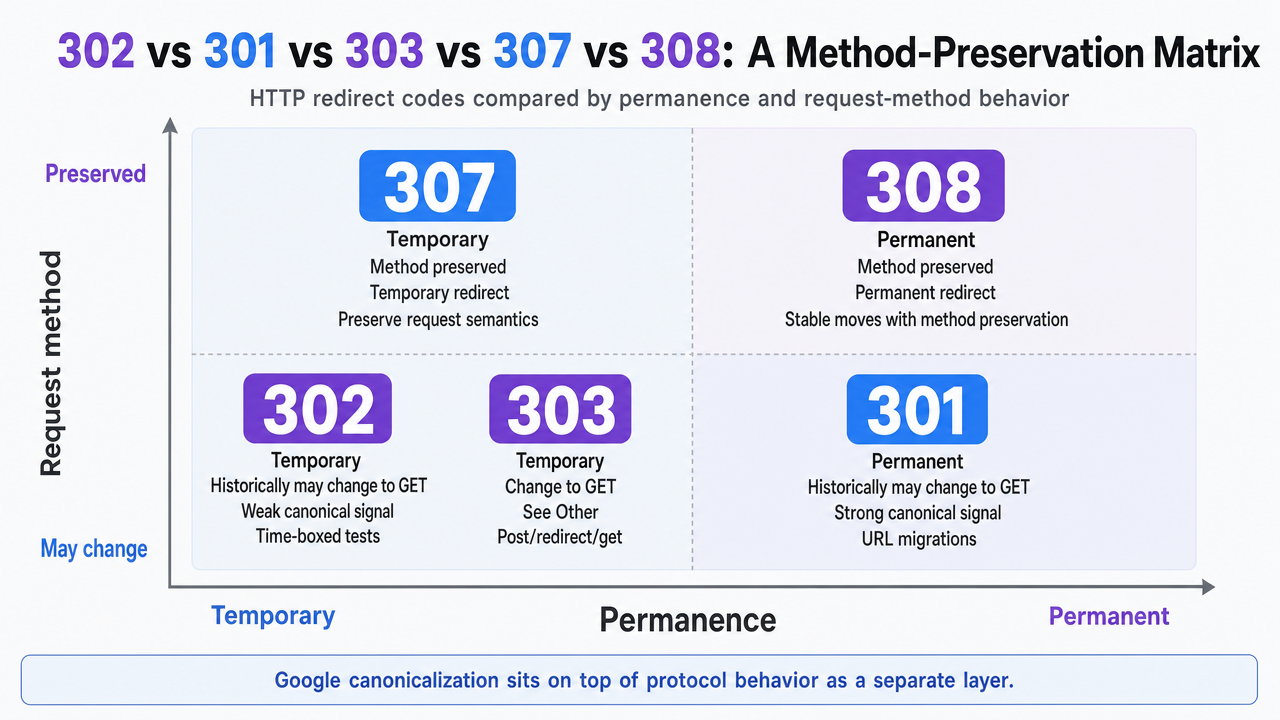 Visualize the two-axis comparison of the five HTTP redirect codes covered in this section, reinforcing the permanence and method-preservation matrix that the prose walks through
The Portfolio Decision Framework: When 302 Is the Right Call
The correct question for an agency SEO lead is not whether 302 is good or bad, but which scenarios genuinely require a temporary redirect and which quietly demand a permanent one. Three scenario clusters justify 302 on their own terms:
- Controlled experiments
- Short maintenance windows
- Time-boxed campaign routing
Everything else that touches consolidation, deprecation, or long-lived redirects belongs on the permanent side of the matrix.
A/B Tests and URL-Variant Experiments
Google's testing guidance is the clearest sanctioned use case for 302. When an experiment routes users from an original URL to an alternate variant, Google specifically recommends a 302 rather than a 301, because the original URL should remain in the index while the temporary test is active 6. A 301 in the same slot would signal Google to consolidate on the variant, which is the opposite of what a bounded experiment needs. The redirect has to end when the experiment ends, and the original URL has to survive the test intact as the indexed asset 6.
Short Maintenance Windows and Time-Boxed Campaigns
Planned maintenance that pulls a page offline for hours or a few days is a legitimate 302 scenario, as is a seasonal campaign URL that borrows an existing route to a landing page for a defined promotional window. Both cases meet the RFC 9110 test: the target resource resides temporarily under a different URI, and the source URL is still the address clients should use once the temporary state ends 14. Because 302 keeps the source page as the representative search result, the indexed URL survives the window without a canonicalization event 1.
Scenario-to-Status-Code Decision Table
| Scenario | Correct status code | Canonical outcome | Crawl-budget impact at portfolio scale |
|---|---|---|---|
| Permanent domain migration | 301 or 308 | Destination becomes canonical 1 | One-hop redirects required; chains drain crawl budget 7 |
| Short maintenance window | 302 | Source URL remains indexed 1 | Low, if the window is measured in hours or days |
| A/B or URL-variant test | 302 | Original URL stays in index during the experiment 6 | Low, provided variant paths are excluded from crawl paths |
| Seasonal campaign URL | 302 | Source URL remains representative 1 | Low, if retired cleanly at campaign end |
| Location page temporarily offline | 302 | Location URL stays indexed 1 | Chain risk grows across multi-location portfolios 7 |
| Tracking or campaign router link | 302 | Not intended for indexing | Chains and open-redirect surface expand with volume 7 |
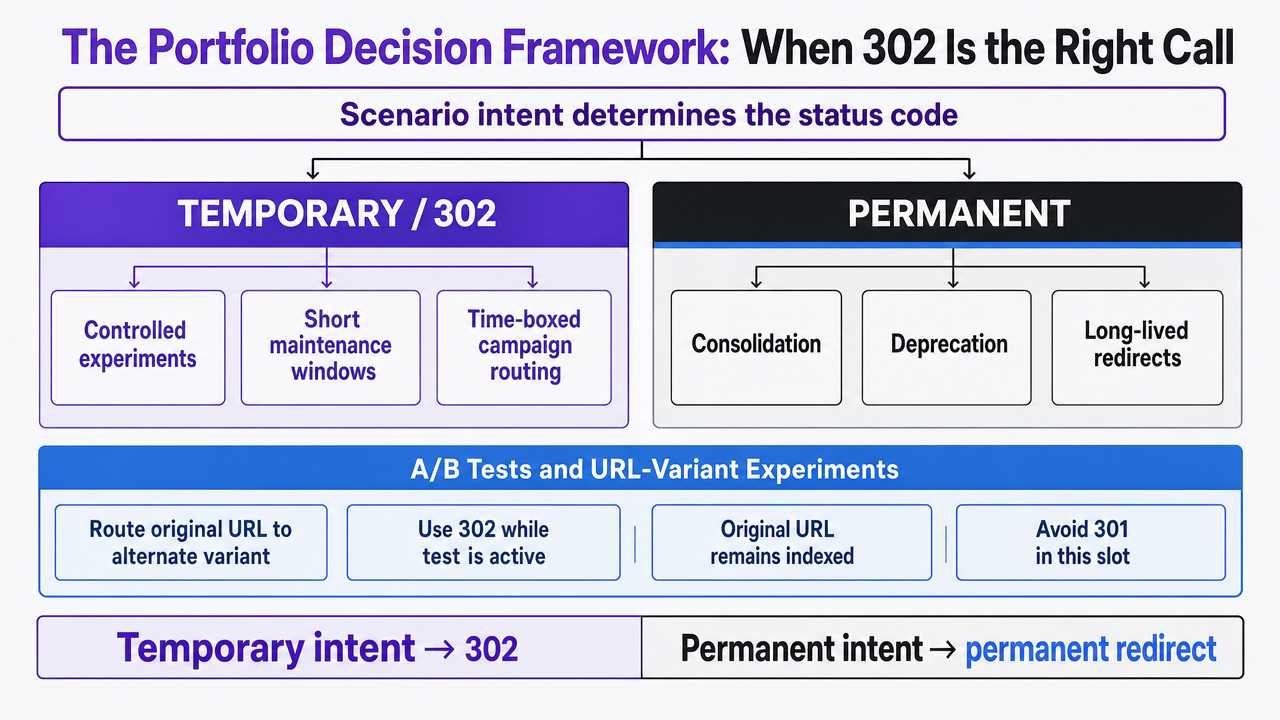 Visualize the decision framework flow from scenario intent to the correct status code selection, mirroring the section's scenario-to-status-code decision table
Three Failure Modes That Show Up at Agency Scale
At one client property, a misapplied 302 is a bug to fix. Across a portfolio of dozens, the same misapplications concentrate into three recurring failure modes:
- Cached temporary redirects that quietly persist
- Redirect chains that erode crawl budget on large multi-location sites
- Open-redirect exposure in the campaign and tracking URLs marketing teams generate at volume
Cached 302s That Outlive the Temporary State
The word temporary in RFC 9110 refers to the resource's location, not to how long the response sits in caches. RFC 9111 defines a cacheable response as one a cache is allowed to store and reuse for subsequent requests, subject to client and origin-server constraints, and it does not exempt 302 responses from that framework 8. When a 302 ships without explicit Cache-Control directives, browsers, CDNs, and reverse proxies decide for themselves how long to hold the redirect, and their defaults are rarely aligned with the marketing team's intended window.
RFC 9205 sharpens the practical implication for teams building redirect-heavy routing: redirects can be cached when appropriate cache directives are present, and a redirect is not automatically sticky for similar URIs with different query parameters 13. That has two consequences at portfolio scale. First, a maintenance-window 302 flipped off at the origin may still route users and crawlers to the temporary destination for hours after the intended cutover, because intermediaries hold the old response. Second, redirect rules that assume query-string variation will produce fresh lookups can be wrong, which distorts campaign attribution and creates ghost destinations that outlive the promotion.
The operational fix belongs in the redirect standard itself: every 302 emitted for a bounded event ships with an explicit, short max-age, and the QA checklist verifies response headers at the CDN edge, not just at the origin.
Redirect Chains That Drain Crawl Budget Across Multi-Location Portfolios
This is the failure mode where the audience shifts from a single-property SEO lead to the agency lead running standards across multi-location brands with hundreds or thousands of URLs per client. At that scale, redirect chains stop being a cosmetic issue and start consuming crawl activity that would otherwise be spent on discovery and refresh of location pages, service pages, and localized inventory.
Google's own crawl-budget documentation for large sites advises against long redirect chains because they can negatively affect crawling 7. The mechanism is simple: each hop is a fetch. A crawler that follows an original URL through two or three redirects to reach a final destination has spent that many requests on a single resource, and the budget for other URLs on the property contracts accordingly. When a multi-location portfolio accumulates chains from stacked historical migrations, seasonal campaigns that were never retired, and CMS-generated 302s layered on top of legacy 301s, the aggregate cost is measurable across the whole property.
RFC 9309 provides a useful outside anchor for how crawlers actually treat redirect depth. The Robots Exclusion Protocol specifies that crawlers should follow at least five consecutive redirects for robots.txt, and if more than five occur, crawlers may treat robots.txt as unavailable 11. That limit governs robots.txt specifically, not indexable HTML, but it establishes the principle: crawler redirect traversal is bounded, and depth carries operational cost. Agency standards that require every redirect to resolve in a single hop and that flag any chain of three or more for cleanup solve this class of failure before it aggregates.
Open-Redirect Exposure in Campaign and Tracking URLs
The third failure mode is a security defect that lives inside the marketing stack. Campaign routers, click trackers, landing-page builders, and email-link wrappers commonly issue 302 responses whose destination is supplied through a URL parameter. When the application does not validate that parameter, an attacker can craft a link on the trusted domain that redirects users to an arbitrary destination. OWASP classifies this as an open redirect and recommends parsing the destination with a standard URL parser, restricting redirects to the application's own domain or a strict allowlist, and avoiding blocklists or string matching as the sole validation method 12.
The surface area matters for agencies because campaign volume compounds the risk. A single tracking template deployed across dozens of clients means one unvalidated redirect parameter reproduces the same defect across every property using it. The trusted domain in the visible URL is the attacker's asset in a phishing lure, and the 302 is the mechanism that delivers the victim to the attacker's page. OWASP notes that open redirects are often treated as low-severity defects but can enable phishing and abuse of a trusted domain 12.
An agency redirect standard that governs SEO decisions has to include the security surface as well: any endpoint that emits a 302 based on user-supplied input requires destination validation against an allowlist before the redirect is issued.
See How Top Agencies Use 302 Redirects for Controlled SEO Impact
Discuss advanced redirect management and automation strategies with a specialist. Learn how leading teams govern 302 usage to maintain rankings, reduce manual oversight, and scale multi-site SEO delivery efficiently.
Diagnosing an Unexpected Canonical When 302 Is in the Path
When Google Search Console reports a canonical the site owner did not declare, the 302 in the redirect chain is rarely the sole cause. Canonicalization is an indexing decision drawn from multiple signals, and Google's own guidance is direct that a declared preference is not always accepted when other signals conflict 4. The diagnostic sequence has to treat the status code as one input among several, not as the smoking gun.
Start with the URL Inspection tool to confirm which URL Google is treating as canonical in practice, then work outward from there. Google's troubleshooting workflow lists incorrect 3xx redirects and server misconfigurations among the standard diagnostic paths, alongside conflicts in internal linking, sitemap inclusion, and rel="canonical" declarations 5. A 302 that points to a destination with a self-referential canonical tag, prominent internal links, and sitemap membership is not being ignored by Google; it is being outvoted by the surrounding signal set 4, 5.
The order of investigation matters at portfolio scale. Confirm the response chain at the edge, not just at the origin, since intermediary caches can serve a stale destination. Check the destination's canonical tag, its inbound internal links, and its sitemap status. Then reconcile the 302's intent with what those signals are telling Google. If the site owner wants the source URL to remain canonical, the fix is usually in the signal environment around the destination, not in the redirect itself 4. If the site owner actually wants consolidation, the redirect should be reissued as a 301 or 308 to match that intent 3.
Standardizing 302 Handling in an Agency Playbook
The point of a standard is that a junior strategist and a dev partner reach the same redirect decision without escalating it. For 302, that standard reduces to a short rule set an agency lead can hand off without commentary.
Default to permanent redirects for anything that outlives its bounded window. If the intent is consolidation, deprecation of a duplicate, or a migration that should transfer the canonical to the destination, the correct instruction is 301 or 308, not 302 3. Reserve 302 for the three scenarios that actually require it: Google-sanctioned A/B tests where the original URL must stay indexed during the experiment 6, short maintenance windows, and time-boxed campaign routing where the source URL is still the address clients should use after the window closes 14.
Attach three non-negotiables to every 302 the standard permits:
- Ship an explicit short max-age so the temporary state does not persist in CDN and browser caches after the origin flips 8, 13.
- Require every redirect to resolve in a single hop, and flag any chain of three or more for cleanup, since chain depth erodes crawl activity on large multi-location portfolios 7.
- Validate the destination against an allowlist on any endpoint that emits a 302 from user-supplied input, closing the open-redirect surface in tracking and campaign routers 12.
Two QA checks close the loop. Inspect response headers at the CDN edge, not just the origin, and reconcile the surrounding signal environment—internal links, sitemap membership, rel="canonical"—against the 302's intent before it ships 5. Governed at portfolio scale, that is where platforms like Vectoron route redirect decisions through approval before they reach production.
Frequently Asked Questions
References
- 1.Redirects and Google Search.
- 2.HTTP Status Codes, Network and DNS Errors, and Google Search.
- 3.How to Specify a Canonical with rel="canonical" and Other Methods.
- 4.What is URL Canonicalization | Google Search Central.
- 5.Fix Canonicalization Issues.
- 6.Don't cloak your real content.
- 7.Manage your crawl budget for large sites.
- 8.RFC 9111: HTTP Caching.
- 9.Hypertext Transfer Protocol -- HTTP/1.1: Semantics and Content.
- 10.RFC 7538: The Hypertext Transfer Protocol Status Code 308 (Permanent Redirect).
- 11.RFC 9309: Robots Exclusion Protocol.
- 12.Open Redirect.
- 13.RFC 9205: Building Protocols with HTTP.
- 14.HTTP Semantics.
- 15.302 Found - HTTP | MDN - MDN Web Docs.
- 16.The Hypertext Transfer Protocol Status Code 308 (Permanent Redirect).