
Key Takeaways
- Treat organic search as a credibility-substantiation channel governed by Rule 206(4)-1, not a traffic channel where session volume and keyword rankings decide success.
- Integrity signals convert cautious prospects better than polished design: named advisors with current credentials, specific fee numbers, and written conflict statements pre-qualify visitors before contact 9.
- Testimonials, endorsements, and third-party ratings on ranked pages carry embedded disclosure obligations, and compensated promoters require diligence against disqualifying events within the prior ten years 1.
- Shift measurement from rankings to qualified consultation requests, per-page conversion, credential-page assist rates, and archived approval records tied to each advertisement 10.
Why search behavior for advisory services rewards credibility over volume
A prospect with $2M in investable assets does not choose an advisor the way a homeowner chooses a plumber. The RAND Corporation's survey work on advice-seeking behavior found that investors cite trust as the most important determinant when selecting a financial professional, and that respondents with lower trust scores are measurably less likely to engage either an investment adviser or a broker at all 4. That study looked at self-reported behavior across a general investor population, not a specific wealth tier, but the direction of the finding is unambiguous: credibility gates the decision to hire.
Search behavior mirrors that gating. A researcher comparing three RIAs after a Google query is not counting backlinks. They are reading the credentials page, checking the fee disclosure, scanning reviews for language that sounds like a real client, and looking for anything that contradicts a fiduciary claim. Volume-first SEO strategies — thin blog posts, keyword-stuffed service pages, aggressive review solicitation — tend to produce more sessions and fewer booked calls because they add noise to the exact signal a cautious prospect is scanning for.
The rest of this article treats organic search as a credibility-substantiation channel governed by Rule 206(4)-1, not a traffic channel governed by volume metrics.
Trust is the conversion variable, not traffic
What RAND and Wharton found about advisor selection
The RAND Corporation's working paper on trust and financial advice reported that investors cite trust as the most important determinant when seeking a financial service professional, and that respondents scoring lower on trust measures were less likely to engage either an investment adviser or a broker 4. The study drew on survey responses from a general investor population and measured self-reported advice-seeking behavior, not booked assets. That scope matters: the finding does not claim to model high-net-worth prospects specifically, but the direction holds across income tiers.
Wharton and State Street Global Advisors, in their joint report on the advisor-client relationship, isolated the drivers that produce or erode that trust. Communication quality, transparency about how the firm gets paid, and demonstrable alignment with client interests emerged as the elements clients actually use to judge whether an advisor is worth a first meeting 5. These are not abstract virtues. Each one maps to a specific on-page element a prospect encounters during a search session: the bio page that explains credentials in plain language, the fee schedule that names dollar figures rather than ranges, the conflict statement that admits where incentives could diverge from client outcomes.
For a firm running SEO, the practical read is that the ranked page is doing the pre-qualification work that used to happen in a discovery call. The visitor is scanning for reasons to disqualify the firm before making contact. Every credential, disclosure, and communication choice on the page is either closing that gap or widening it.
Why integrity signals outperform polished design
A separate line of research on consumer decision-making in financial services found that integrity was the only statistically significant driver of trust in the broker relationship, and that low trust and dissatisfaction pushed consumers toward online channels 9. Two implications follow. First, the visual polish of a landing page is not what earns the click on a consultation form. Second, prospects who arrive from search are often already skeptical of a prior relationship, which raises the bar for how a firm's site reads on first contact.
Sites that over-index on design language — hero videos, aspirational photography, marketing copy about "partnership" — tend to read as promotional rather than substantive. Sites that lead with named advisors, credentials, fee structures, and the specific client situations the firm handles read as disclosure. The second category converts better because it matches the evidence a cautious researcher is trying to collect.
The operational takeaway: before adding another design pass, audit the pages that rank for firm-name and "fiduciary advisor [city]" queries and count how many concrete integrity signals a first-time visitor can identify above the fold. If the answer is fewer than three, the page is competing on visibility rather than credibility.
The SEC Marketing Rule as an SEO design input
What Rule 206(4)-1 permits, prohibits, and conditions
Rule 206(4)-1, the Investment Adviser Marketing Rule, took effect May 4, 2021 and replaced the decades-old prohibition on testimonials with a conditional permission structure 3. For a firm building organic search visibility, the practical read is that the rule is not a peripheral compliance concern. It defines what can appear on a service page, a review widget, a rich snippet, or a landing page tested against a paid campaign.
The SEC's small business compliance guide summarizes the permitted categories directly: testimonials from clients, endorsements from non-clients, third-party ratings, and performance information — including hypothetical performance — are all allowed in adviser advertisements when specific disclosure, oversight, and disqualification conditions are met 2. A ranked page that displays a client quote must disclose that the speaker is a client, whether any compensation was provided, and any material conflicts of interest. A page that surfaces a third-party rating must disclose the date range the rating covers, the identity of the rater, and any compensation paid to obtain or promote it.
Prohibitions are equally specific. Untrue statements of material fact, unsubstantiated material claims, and presentations that omit material facts necessary to prevent statements from being misleading are barred outright 2. Hypothetical performance carries additional conditions, including policies designed to ensure the presentation is relevant to the likely financial situation of the intended audience.
The design consequence for search: every high-intent page — service overviews, advisor bios, review sections, comparison pages targeting "[city] fiduciary advisor" queries — carries embedded disclosure obligations that survive publication, indexing, and syndication.
Promoter compensation, disqualifying events, and paid reviews
The area where SEO strategies most often collide with the rule is compensated promotion. The SEC's Marketing Compliance FAQ addresses this directly: Rule 206(4)-1(b)(3) prohibits an adviser from compensating a person, directly or indirectly, for a testimonial or endorsement if the adviser knows, or reasonably should know, that the person is subject to a disqualifying event within the prior ten years 1. That covers a range of securities-related judgments, injunctions, and administrative orders.
The operational implication is that any paid arrangement — an influencer partnership, a compensated review request program, a co-marketing agreement with a referral partner who posts a written or video endorsement — requires a diligence step on the promoter's background before content ships. "Reasonable care" is the standard, not strict liability, but the FAQ makes clear that a firm cannot rely on the promoter's own attestation without more.
Compensation itself is permitted when disclosed. A page that features a paid endorsement must state that the endorser was compensated and describe the material terms in a way a reasonable reader would understand 1. "Compensation" is defined broadly and includes non-cash consideration such as free access to services or reduced fees.
Firms that treat review generation as a growth tactic without a promoter-diligence checklist and disclosure template are creating enforcement exposure on their highest-traffic pages.
Where RIA rules diverge from CPA advertising standards
A note on scope, because the query behind this article pulls in both accounting firms and advisory firms. CPAs operate under state board rules and AICPA Code of Professional Conduct provisions governing advertising, solicitation, and client confidentiality. Registered investment advisers operate under Rule 206(4)-1 and, for state-registered firms, parallel state adviser rules. The two frameworks are not interchangeable.
For a CPA firm that also holds an RIA registration — a common structure — the advisory side of the practice must meet Marketing Rule conditions on any page that promotes advisory services, regardless of how the accounting side handles its own advertising 2. That includes shared homepages, unified bio pages, and any content that references investment advice, financial planning, or portfolio management alongside tax and audit services. When in doubt, the more restrictive standard applies to the shared page.
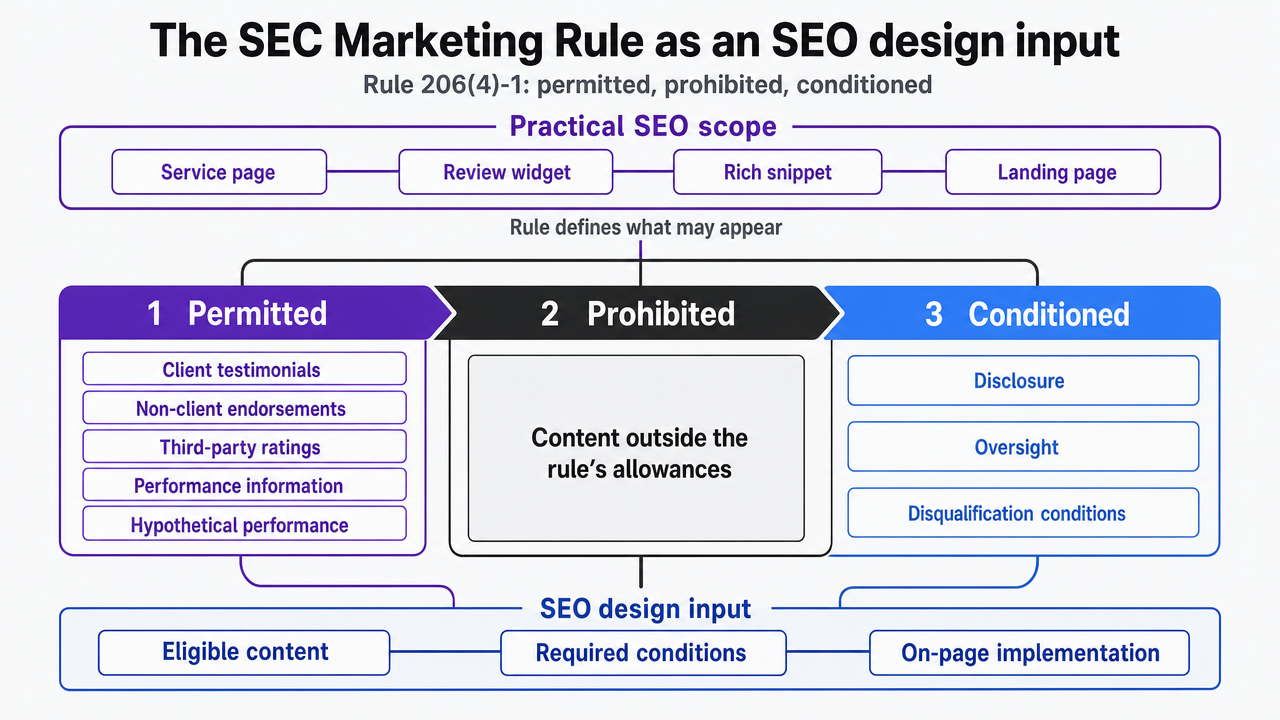 Visualize the Marketing Rule's three-part structure (permitted, prohibited, conditioned) as it applies directly to on-page SEO elements, mirroring the section's cited framework
Test data-driven SEO content for your firm now
See how real-time SEO content impacts search rankings and qualified accounting leads in just seven days.
A trust-substantiation content architecture
Credentials, bios, and Form ADV Part 2B pages
The credentials page is where a search visit either qualifies or disqualifies a firm. The SEC's retail advice study noted that trust is affected by advisors' communication style, credentials, and related factors, and that more financially literate investors are more likely to seek professional advice in the first place 6. Those are the visitors most likely to read a bio in full before scheduling a call.
A useful bio page names the advisor, lists the CFP, CFA, CPA/PFS, or other marks with the granting body, states the years the individual has held each mark, and links to the firm's Form ADV Part 2B brochure supplement for that advisor. Team pages that group photographs without disclosing which advisors hold which credentials read as marketing. Pages that pair each named advisor with a Part 2B link, a plain-language description of their client focus, and their disciplinary history status read as disclosure.
Two operational notes. First, credentials referenced on the page must be current and verifiable through the granting body; a lapsed designation left on a bio is a material misstatement under the general prohibitions of the Marketing Rule 2. Second, the same bio content often gets syndicated to LinkedIn, third-party directories, and podcast show notes. Each syndicated copy should point back to the canonical firm page so that any correction — a new credential, a departure, a disciplinary update — propagates from a single source.
Fee schedules, conflict statements, and fiduciary disclosures
Wharton and State Street's report on the advisor-client relationship identified transparency about compensation and demonstrable alignment with client interests as core drivers of trust 5. On a website, that translates into two page elements most firms underinvest in: a fee schedule that names specific numbers, and a conflict statement that admits where incentives could diverge from client outcomes.
A fee page that says "our fees are competitive and tailored to each client" is a disqualification signal for the researcher who has already compared three firms. A page that publishes the advisory fee tiers — basis points at each AUM band, minimum annual fee, financial planning fees where separate, and any third-party custody or platform costs the client will see — matches what a cautious prospect is trying to verify before a call. Ranges are acceptable when the firm genuinely prices by complexity; the ranges should be narrow enough to be useful.
Conflict statements belong on the same page or adjacent to it. If the firm receives 12b-1 fees, sells insurance products, has referral arrangements with attorneys or CPAs, or custodies at a broker-dealer affiliate, the conflict statement names each one and describes how it is mitigated. Omitting a material conflict on a page that promotes advisory services is the kind of omission the general prohibitions treat as misleading 2.
Educational content for financially literate prospects
The SEC's retail advice study found that more financially literate investors are more likely to seek professional advice, and cautioned that advice is not a substitute for financial literacy 6. The practical read for a content program is that educational articles should be written for a reader who already understands the basics, and should stop short of anything that reads as personalized recommendation.
Topics that perform in that register:
- how Roth conversion windows interact with IRMAA brackets
- what changes in the estate exemption sunset mean for gifting strategy
- how concentrated stock positions are typically unwound around a liquidity event
- how a donor-advised fund compares to a private foundation at different giving levels
Each of these gives a researcher enough substance to judge the firm's depth without crossing into advice tailored to their specific facts.
Two guardrails apply. Educational content still sits inside the Marketing Rule's general prohibitions against untrue statements and material omissions when it appears on a firm's site or promotes advisory services 2. And case studies or example scenarios that describe specific client outcomes fall under testimonial and performance conditions if they identify or imply results a client experienced. Hypothetical examples work when the page states they are hypothetical and the presentation is relevant to the intended audience.
Handling reviews, ratings, and social proof under the rule
Google Business Profile, third-party ratings, and website testimonials
Three surfaces carry most of a firm's search-visible social proof:
- the Google Business Profile
- third-party rating widgets embedded on the site or displayed as badges
- the testimonial block on the homepage or service pages
Under Rule 206(4)-1, all three are advertisements when they appear in a context that offers or promotes advisory services, and each carries its own disclosure math 2.
A client review on a Google Business Profile is a testimonial. If the firm solicited it, responded to it, or displayed it in a way that adopts it, the disclosure conditions attach: the review must be presented in a manner that makes clear the speaker is a client, whether cash or non-cash compensation was provided, and any material conflicts of interest 2. Practical execution: the GBP response acknowledges the reviewer as a client where accurate, avoids editing or curating negative reviews out of view, and does not repost individual reviews to the firm's website without adding the required disclosures alongside them.
Third-party ratings — "Top 100 Advisor" badges, best-of lists, ranking widgets — are permitted when the page discloses the identity of the rater, the date range of the rating, and any compensation the firm paid to obtain or promote the badge 2. A footer that displays five ranking logos without those disclosures is the pattern the general prohibitions treat as misleading by omission 2.
Social media exposure, recordkeeping, and antifraud risk
The SEC's risk alert on adviser use of social media stated the standard plainly: firms' social media activity is subject to the antifraud, compliance, and recordkeeping provisions of the federal securities laws 10. That covers LinkedIn posts, YouTube videos indexed by search, X threads, and any third-party content the firm interacts with in a way a regulator would read as adoption.
Earlier SEC guidance on the testimonial rule and social media noted that third-party posts on an adviser's page may themselves be testimonials depending on how the firm curates, likes, or responds to them 8. A comment thanking an advisor for a specific outcome, left visible and unaddressed, can carry the same disclosure weight as a quote on the homepage.
Recordkeeping is the operational tail. Every piece of content that meets the advertisement definition — including social posts and comment interactions — must be retained in a form that supports later review 10. Firms that publish through search-optimized workflows without an archive step create gaps that surface during examinations.
An approval-first workflow that keeps content shipping
The bottleneck in most advisory content programs is not writing. It is the review step that sits between a finished draft and a published page. Firms that batch compliance reviews into weekly or monthly cycles push publication dates by weeks, and drafts age out of relevance before they ship. Firms that skip review shift the exposure to the general prohibitions of the Marketing Rule and to the recordkeeping obligations the SEC's risk alert on social media applies to any adviser advertisement, including search-optimized content repurposed across channels 10.
A workable pattern runs five stages in sequence. Each stage has a named owner and a defined artifact:
- Research produces a topic brief with the citations the draft will rely on. Research produces a topic brief.
- Draft produces the page copy, including disclosure language for any testimonial, endorsement, third-party rating, or hypothetical example on the page 2.
- Compliance review produces a redlined version with the CCO's sign-off recorded against the specific file.
- Publish loads the approved version to the CMS.
- Archive retains the approved copy, the review record, and any subsequent edits in a form that supports later examination 10.
The gain from formalizing this loop is throughput. When each stage has an owner and an artifact, the CCO reviews queued drafts against a checklist rather than reconstructing context from scratch, and marketing stops guessing which changes will survive review.
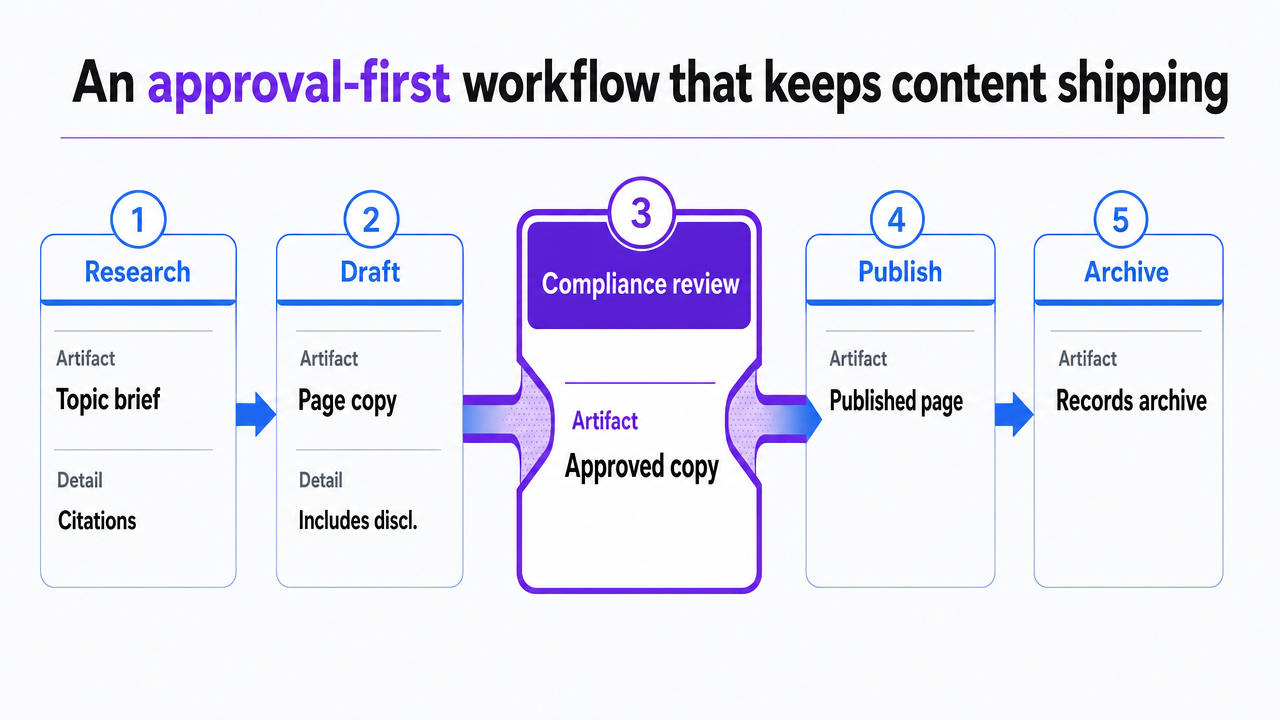 Visualize the five-stage sequential workflow explicitly described in the section: research, draft, compliance review, publish, archive, with the named artifact for each stage
See How High-Impact SEO Drives Qualified Accounting Leads
Request a strategy session to review benchmark data on accounting SEO performance and discover scalable methods for attracting high-intent clients in compliance-sensitive industries.
If you manage multiple advisors or offices: execution model tradeoffs
This section shifts scope. The earlier guidance applies to any RIA or CPA firm with advisory services; the tradeoff below is written for principals running a multi-advisor practice or a multi-office footprint, where per-location content velocity and centralized compliance review become the constraints that determine which execution model actually works.
Three structures dominate:
- A traditional agency retainer buys account managers, writers, and an SEO lead at a monthly fee, with compliance review sitting outside the agency and adding calendar time before anything ships.
- An in-house marketing hire compresses that loop by putting a marketer next to the CCO, but the loaded cost of a full-time employee — salary, benefits, tools, management overhead — becomes fixed regardless of output volume.
- An AI-assisted approval-workflow model routes drafts through the same five-stage sequence described earlier, with the CCO's sign-off recorded against each file before publication, and scales content velocity per office without adding headcount.
The variables that separate the three, not benchmarks:
- Retainer or loaded cost: agency monthly fee vs. FTE fully loaded cost vs. platform subscription.
- Per-office content velocity: pages, bios, and review responses produced per location per month.
- Compliance review integration: whether the CCO reviews inside or outside the production loop, and whether the approved version and its review record are archived in a form that supports later examination 2.
- Oversight artifact: whether each shipped page carries a named reviewer, a timestamped approval, and the disclosure language required for testimonials, endorsements, and third-party ratings 2.
The model a firm picks is less about cost and more about which structure produces the archived approval record the Marketing Rule expects for every advertisement across every office.
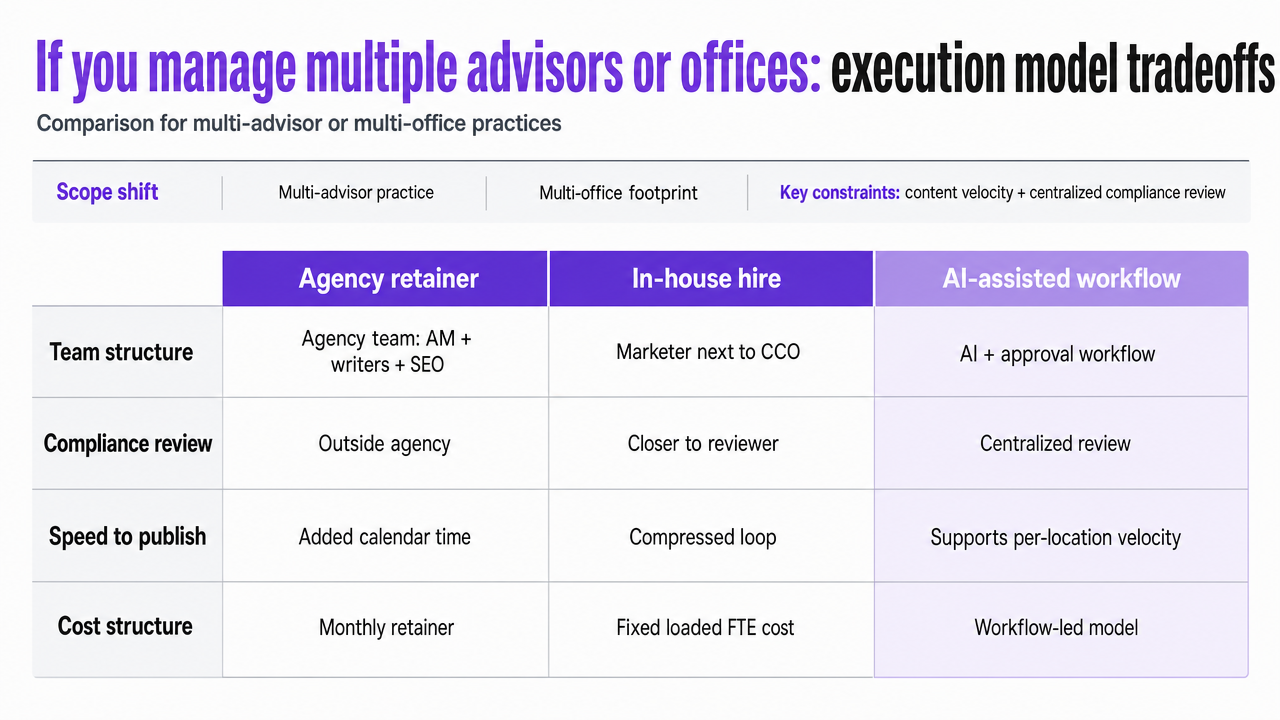 Present the three execution models as a side-by-side comparison table, matching the section's explicit comparison of agency retainer, in-house hire, and AI-assisted workflow across the four named variables
How to measure qualified pipeline, not just rankings
Rank tracking and session counts describe visibility. They do not describe whether the firm is booking calls with prospects who match its client profile. A search program built around trust substantiation needs a measurement layer that starts where the ranked page ends: at the consultation request.
Four metrics carry more decision weight than keyword position:
- Qualified consultation requests per month, defined by an intake threshold the firm sets in advance — investable asset range, planning complexity, or geography.
- Conversion rate from ranked page to that qualified request, tracked per page rather than sitewide, so a bio page and a fee page can be judged on different jobs.
- Assist rate of credentials, fee, and disclosure pages in multi-page sessions that end in a booking, since those pages rarely convert on first visit but often close the loop.
- Archived approval record for each ranked page and any testimonial or third-party rating it displays, which the recordkeeping provisions treat as part of the advertisement itself 10.
Rankings remain useful as a leading indicator. They stop being the scorecard the moment the firm's growth question becomes how many qualified consultations shipped this quarter.
Frequently Asked Questions
References
- 1.Marketing Compliance - Frequently Asked Questions.
- 2.Investment Adviser Marketing.
- 3.Final Rule: Investment Adviser Marketing.
- 4.Trust and Financial Advice (RAND Working Paper WR-1075).
- 5.Bridging the Trust Divide: The Financial Advisor-Client Relationship.
- 6.The Retail Market for Investment Advice.
- 7.SEC Adopts Modernized Marketing Rule for Investment Advisers.
- 8.Division of Investment Management Guidance: Guidance on the Testimonial Rule and Social Media.
- 9.Role of trust and satisfaction in consumer decision making in the industry of financial services.
- 10.Risk Alert: Investment Adviser Use of Social Media.