
Key Takeaways
- A working SEO program runs seven coordinated clusters: search behavior research, keyword and intent mapping, content production, technical SEO, on-page optimization, off-page authority, and measurement.
- Most failures happen at the seams between clusters, not inside them — content and paid bidding on the same query, or links pointed at pages with weak on-page structure.
- Persistent execution outperforms headcount: weekly intent mapping, continuous content updates, and bi-weekly measurement reconciliation create the feedback loops that convert strategy into performance 7.
- For YMYL and healthcare operators, named authors, dated expert review, cited sources, and accessibility for lower digital literacy segments become ranking prerequisites rather than editorial polish 2, 3.
Why most SEO programs execute four clusters well and leave three on the floor
Walk into almost any SaaS marketing review and the SEO update sounds competent. Keyword research is happening. Content is shipping. Technical audits get run. Someone reports on rankings. The numbers move sideways.
The reason is rarely effort. It is asymmetry. An SEO program is not one job, it is seven coordinated activity clusters, and most teams run four of them on a real cadence while the other three drift into quarterly projects or get assumed away. Search behavior research becomes a one-time persona deck. Off-page authority becomes a once-a-year link campaign. Measurement collapses into a rankings dashboard that no one reconciles against pipeline. Each of these gaps is invisible from inside the function, because the four clusters that do run produce enough output to look like a working program.
The academic record is clear that structured SEO covers technical, content, and link-based work as interdependent strategies rather than separable tactics 10. Public-sector guidance frames the same scope as ongoing service to users, not a launch checklist 8. What this article maps is the full seven-cluster system, where each cluster sits, how the handoffs between them fail, and how a VP of Marketing can tell whether SEO, content, paid, and link work are actually pointed at one acquisition number or running in parallel as separate cost centers.
The seven-cluster operating system behind a working SEO program
Search behavior research: mapping how target buyers actually start their queries
Search behavior research is the cluster most teams confuse with keyword research. They are not the same activity. Keyword research produces a list. Behavior research produces a model of how a specific buyer segment phrases a problem before they know the solution category exists.
For high-consideration decisions, the search engine is still the front door. Systematic reviews of online health information seeking find that search engines are the primary starting point for users investigating conditions, treatments, and providers 11. Pew's earlier work on U.S. adults reached the same directional conclusion: a large majority of online health seekers begin a health investigation at a search engine rather than a portal, social channel, or branded site 12. The SaaS analogue is the same pattern with different language — buyers do not start at a vendor homepage, they start with a problem phrased in their own words.
What this cluster actually produces is a segmented query model: which queries belong to which buyer stage, which queries are dominated by competitors, and which queries are misread by the content team as transactional when they are still informational. A dermatology group's keyword map and a payroll SaaS keyword map share the same failure mode — both tend to over-index on bottom-funnel branded terms because those are the ones that close in the same quarter the report is written.
The deliverable to demand from this cluster is a behavior model, not a spreadsheet. Without it, every downstream cluster optimizes against the wrong target.
Keyword and intent mapping: assigning each query to a single owning page
Keyword and intent mapping is where most coordination failures get baked in. The cluster has one job: assign every priority query to exactly one owning page, with a documented intent, a target SERP feature, and a funnel stage. When that discipline breaks, three pages start competing for the same query, internal links split equity across them, and the team interprets the resulting plateau as a content quality problem.
The structural taxonomy holds up under academic review — SEO work splits cleanly into technical, content, and link-based activities, but only when each query has a clear owner inside the content layer 10. Healthcare patterns reinforce why this matters at the query level: people searching health information are looking for a specific answer to a specific question, and reviews of search behavior consistently show that disparities in digital literacy and trust make ambiguous results worse for some segments than others 1.
For a SaaS VP coordinating SEO with paid, this cluster is also where the most expensive overlap hides. The content team writes a long guide for a keyword the PPC team is already bidding on at the top of the funnel, and neither side realizes they are buying the same click twice. A keyword map with a paid-versus-organic column closes that gap on its own.
The output is one document — query, owning URL, intent, funnel stage, paid status, target SERP feature — kept current, not refreshed annually.
Content production: writing for E-E-A-T, AI summaries, and scannable answers at once
Content production has quietly become the hardest cluster to run well, because a single asset now has to serve three readers at once: the human scanner, the SERP snippet engine, and the AI conversational summary. Research on evolving search interfaces finds that new affordances — voice prompts, bite-sized summaries, conversational answers — expand the range of entry points and formats users rely on when seeking information 6. A page written only for the scrolling reader gets parsed into something it was never designed to be.
The structural answer is to write one asset with a layered architecture. The opening 60 to 90 words must stand alone as a complete, citable answer that an AI summarizer can extract without distortion. Subheadings must be queries phrased as a user would phrase them, so a featured-snippet engine can lift them intact. The body must remain depth-first for the reader who actually clicks through. Public-sector guidance reaches the same conclusion from a different angle: content needs to be clear, concise, unique, and authoritative to be useful at all 14.
For YMYL pages — anything affecting health, money, or safety — E-E-A-T is the quality filter that gates this cluster. The misinformation pressure on health content is well-documented, with systematic reviews describing an information environment in which false and accurate content are mixed in ways that make trustworthy guidance hard to find 3. Public health authorities have urged content creators to align reach-oriented work with public health responsibility 4. The operational consequence is that author credentials, citation discipline, and dated medical review are not decoration — they are the difference between a page that ranks and a page that gets demoted.
The deliverable cadence matters as much as the format. A content cluster that ships ten unreviewed posts a month loses to one that ships four medically reviewed, structurally layered, AI-summary-ready assets and updates eight existing pages.
Technical SEO: crawlability, accessibility, and the lifecycle of stale content
Technical SEO is the cluster where most teams have a vendor, a checklist, and no lifecycle. Crawlability audits get run. Core Web Vitals get reported. Then a thousand legacy pages sit untouched, and the site gets slower at ranking new content because the crawl budget is being spent on URLs no one would defend if asked.
Federal SEO guidance is explicit on this point: organizations should conduct regular web content maintenance, eliminating redundant, outdated, and trivial content, and treat alt text, internal linking, and structure as ongoing practices rather than a launch event 14. Public-sector framing reinforces it — strong SEO fosters transparency and user experience, which means stale or contradictory pages are a service failure, not just a ranking drag 8.
Accessibility belongs in this cluster, not as a compliance footnote. Scoping reviews of older adults' online health information behavior find that lower digital literacy, font size, navigation complexity, and trust heuristics meaningfully shape whether the audience can use a page at all 2. For a dermatology group serving a patient base skewed older, an inaccessible page is functionally invisible regardless of where it ranks.
The operational output of this cluster should be a content register with three states: keep, update, retire. Anything that cannot be assigned a state in 30 seconds is a candidate for retirement. Crawl health, schema coverage, page speed, and accessibility scores get attached to the register so the technical and content teams are reading from the same map, not two different ones.
On-page optimization: findability mechanics the content team actually controls
On-page optimization is the cluster the content team owns whether they call it that or not. Title tags, H1s, heading hierarchy, internal links, image alt text, descriptive URLs — every one of these decisions is made by the person writing the page, and every one of them gets undone the first time a CMS template overrides it.
USAGov's practical guidance for content writers captures the actual stakes: it does not matter how strong the content is if the reader cannot find it quickly, and findability is a function of structure as much as substance 9. Scannable formatting, clear headings that match user phrasing, and language that mirrors how the audience actually asks the question are the on-page mechanics that determine whether a well-researched page ever gets read.
Inside an SEO operating system, this cluster is where the keyword map gets enforced. Each priority query has an owning URL; the on-page work makes sure the title, H1, and primary heading reflect that ownership without cannibalizing a neighboring page. When this discipline holds, internal linking compounds. When it breaks, the same anchor text points to four different pages and search engines pick the wrong one.
The deliverable is a per-URL on-page brief that ships with every new piece of content, not a quarterly audit that finds the same issues twice a year.
Off-page authority: link acquisition pointed at pages that can hold rank
Off-page authority is the cluster that fails most often by aiming at the wrong target. Links get acquired for the homepage or for a thin landing page that cannot hold the rank a strong link would buy. Six months later, the equity dissipates because the page itself did not earn the position it was lifted into.
The academic taxonomy is consistent: SEO is built from technical, content, and link-based strategies operating together, with links functioning as a quality signal rather than a standalone lever 10. Medical publishing research reaches a parallel conclusion — descriptive titles, careful keyword choice, and link strategies together increase the visibility and citation of articles, but no single one of those activities does it alone 13.
The operational discipline this cluster needs is target selection, not link volume. A backlink team should be working from a short list of pages that already have strong on-page structure, defensible content, and a query owner — pages that can absorb authority and convert it into durable rank. The output is not a monthly link count. It is a per-page authority plan tied to the keyword map.
Where this cluster coordinates poorly with content and on-page, every link earned is a partial waste.
Measurement: closing the loop between rankings, sessions, and pipeline
Measurement is the cluster that, when missing, lets the other six drift undetected. Most teams report rankings and organic sessions. Fewer connect those to assisted conversions. Almost none reconcile organic performance against the same acquisition number used for paid and pipeline reporting.
The empirical case for treating measurement as continuous, not periodic, is direct: SEO strategy persistency has a significant positive effect on website performance and plays a mediating role between e-business strategy and performance outcomes 7. Persistence requires a feedback loop, and the loop requires shared definitions across SEO, paid, and revenue teams.
The minimum useful measurement stack for this cluster covers four layers:
- ranking and SERP-feature coverage by priority query,
- organic session quality by funnel stage,
- assisted and last-click conversion contribution mapped to the keyword map,
- and pipeline or revenue attribution against the single acquisition target the marketing function is held to.
When any one layer is missing, the cluster reports activity rather than outcome.
The deliverable is a single dashboard that paid, SEO, and content all read from. Not three.
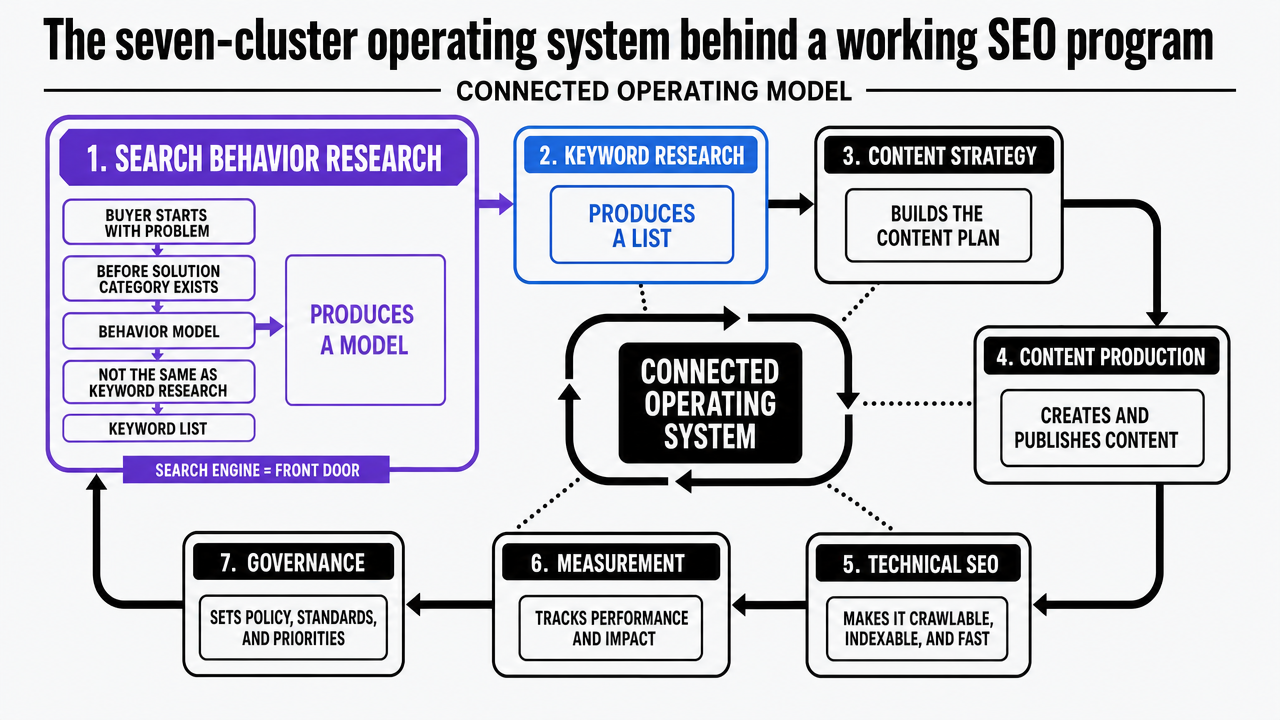 Visualize the seven coordinated SEO activity clusters as a connected operating system, reinforcing the article's central framework before readers dive into each subsection
Test data-driven SEO workflows with real publishing
Evaluate coordinated SEO activities and see measurable results from live content in your own environment.
Coordination failures: where the seven clusters quietly stop talking to each other
The seven clusters do not fail in isolation. They fail at the seams between them, and those seams are invisible on any single team's dashboard.
A common pattern: the content team ships a 2,400-word guide on a high-volume informational query. Three months later, the paid team is bidding $14 a click on the same query because the organic page never broke into the top three. Neither team is wrong on its own metric. They are wrong together, because no shared keyword map flagged the query as one organic was already chasing. The fix is not more meetings — it is a single artifact, owned by intent mapping, that both teams read before they spend.
A second pattern shows up between off-page and content. The backlink team books placements pointed at a category page that has weak on-page structure, no schema, and a thin body. The links land. The page does not move. Six months in, the report shows links acquired and ranking unchanged, and the conclusion drawn is that the niche is too competitive. The actual diagnosis is that authority was poured into a container that could not hold it — a coordination failure between target selection and on-page readiness, not a competitive one.
A third pattern lives between technical and measurement. The technical team retires 200 stale URLs to clean crawl budget, which is the right move under federal content-maintenance guidance 14. The measurement team flags an organic session drop the next month and treats it as a ranking incident, triggering a content sprint that solves nothing. The two clusters were reading from different definitions of healthy traffic.
Each of these failures looks like a different problem from inside the function — a content problem, a link problem, a tracking problem. They are the same problem in three disguises: seven clusters running on seven calendars, against seven scorecards, with no shared artifact tying them to one acquisition number.
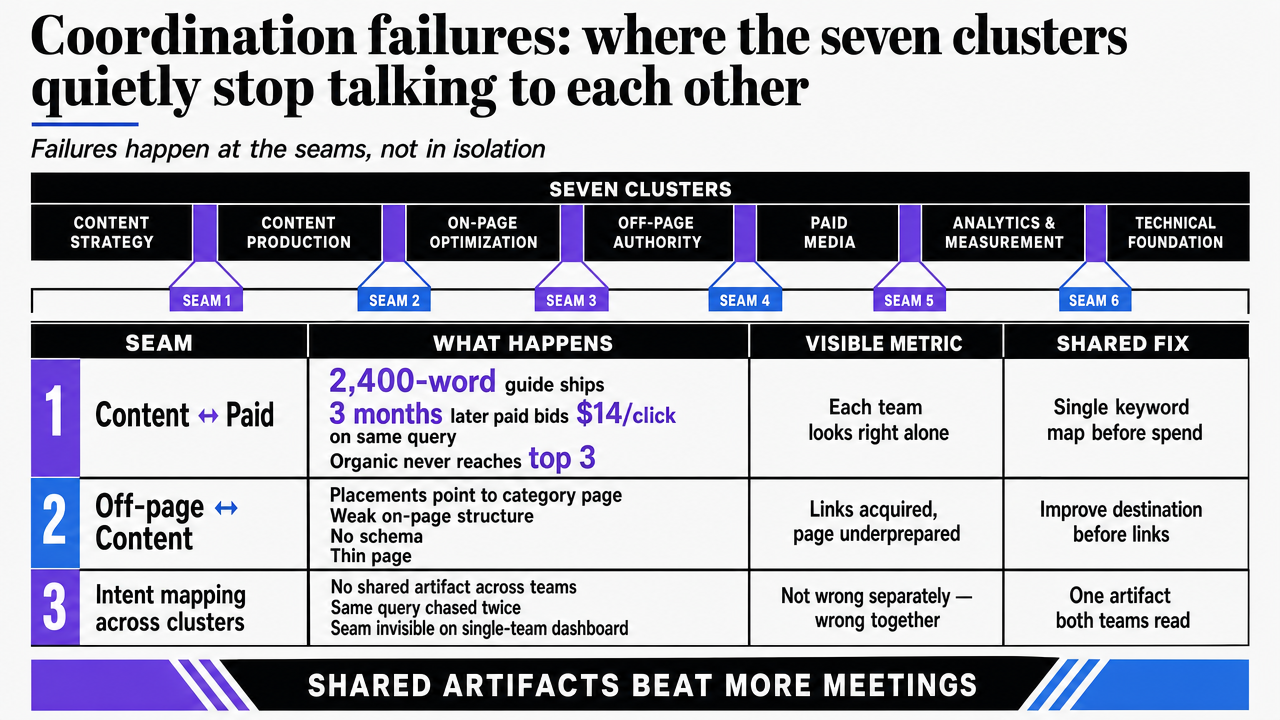 Show the three named coordination failure patterns described in the section as a comparison table, making the abstract 'seams between clusters' concrete and scannable
Cadence over headcount: why persistent execution outperforms quarterly sprints
The most common request a VP of Marketing fields after a flat SEO quarter is a headcount one: another writer, another technical specialist, another link vendor. The data points the other way.
An empirical study of SEO strategy as a determinant of e-business performance found that SEO strategy persistency has a significant positive effect on website performance, and that persistent strategy plays a mediating role between broader e-business strategy and the outcomes leadership actually cares about 7. The mediating-role finding is the part that matters. Persistence is not just an input that helps SEO work better — it is the mechanism through which strategy converts into performance at all. Sporadic execution does not produce a slower version of the same result. It produces a different, weaker result, because the feedback loops never run long enough to compound.
What this looks like in operating terms is unglamorous. A team running keyword and intent mapping weekly will catch a competitor's new cluster eight weeks before a team that runs it quarterly. A content cluster updating eight existing pages every month will hold rank that a quarterly-refresh team will lose. A measurement loop reconciling organic to pipeline every two weeks will spot a tracking break before the next planning cycle bakes the wrong number into the forecast.
The headcount question gets the diagnosis backwards. Three contractors running in quarterly sprints produce less durable rank than two practitioners running weekly against a shared plan. The constraint is not how many hands are on the work — it is how often the seven clusters touch each other. Cadence is the multiplier; headcount without cadence is just more parallel cost.
See How Integrated SEO Activities Accelerate Enterprise Acquisition Goals
Request a walkthrough of coordinated SEO, PPC, and backlink workflows designed to drive measurable pipeline impact for multi-location and enterprise teams—beyond what siloed execution delivers.
If you manage multi-location healthcare or YMYL practices: the activity quality bar shifts
For operators running multi-location healthcare programs, dental groups, behavioral health networks, or any portfolio where the content sits inside Google's Your Money or Your Life category, the seven clusters do not change. The quality bar inside each one does.
Content production is the cluster where the shift bites hardest. Systematic review evidence describes an online health information environment in which accurate and false content are mixed densely enough to make trustworthy guidance hard to surface 3. Public health authorities have framed this as a content-creator responsibility, not just a platform problem 4. Translated to operating terms: medical review by a credentialed clinician, dated last-reviewed timestamps, cited primary sources, and named authors with verifiable credentials stop being editorial preferences and start being ranking prerequisites. Pages without them get demoted regardless of how well the on-page and technical clusters are run.
Accessibility hardens too. Scoping review evidence on older adults finds that lower digital literacy, navigation complexity, and trust heuristics shape whether an audience can use a page at all 2. A cardiology group serving a patient base skewed 60-plus carries a different on-page bar than a SaaS analytics product serving practitioners. Font sizing, contrast, plain-language summaries above clinical detail, and obvious next-step CTAs move from accessibility checklist into ranking-relevant UX.
Off-page and local sit on the same shifted bar. Medical publishing research confirms that descriptive titles and disciplined link strategies materially affect visibility for clinical content 13, but the link targets have to be pages that already clear the E-E-A-T threshold. Authority pointed at a thin service-line page in a YMYL niche does not lift the page — it exposes it.
Auditing your own setup: a short diagnostic before adding more activities
Before approving another headcount request or another agency line item, a VP of Marketing can run a 30-minute audit that surfaces which of the seven clusters is actually running and which is being performed at a quarterly cadence dressed up as a program.
Five questions do most of the work.
- Can someone produce, in under five minutes, a single keyword map that shows owning URL, intent, funnel stage, and current paid status for every priority query? If not, intent mapping is a project, not a cluster, and content and PPC are almost certainly buying overlapping clicks.
- Does every YMYL or high-stakes page carry a named author, dated medical or expert review, and cited primary sources? If the answer is uneven across the site, content production is operating below the quality bar the search environment now enforces 3.
- Is there a content register that assigns every URL a keep, update, or retire state, and was it touched this quarter? A missing register means technical work is reactive and crawl budget is being spent on pages no one would defend 14.
- Do SEO, paid, and revenue teams read from a single dashboard reconciled to one acquisition number, or do three reports circulate?
- When was the last competitor cluster shift detected — and how long did it take to detect?
Sustained advantage comes from running these clusters against each other on a tight loop, not from adding another specialist 7. The audit usually reveals that the missing activity is coordination, not capacity.
Frequently Asked Questions
References
- 1.Online Health Information Seeking Behavior: A Systematic Review.
- 2.Online Health Information Seeking Behaviors Among Older Adults: Systematic Scoping Review.
- 3.Infodemics and health misinformation: a systematic review of reviews.
- 4.Health Misinformation (U.S. Surgeon General Advisory).
- 5.WE CAN TAKE ACTION - Confronting Health Misinformation.
- 6.Evolving Health Information–Seeking Behavior in the Context of New Search Interfaces.
- 7.Search engine optimisation (SEO) strategy as determinants to firm performance in e-business.
- 8.Search engine optimization.
- 9.SEO Tips for Content Writing - USAGov.
- 10.Search Engine Optimization and Its Importance in Digital Marketing.
- 11.Online information seeking for health: a systematic review.
- 12.Health Online 2013.
- 13.Search engine optimization in medical publishing.
- 14.Search Engine Optimization Best Practices.