
Key Takeaways
- Keyword placement at agency scale is a governance problem: codify a per-URL contract enforced through CMS templates rather than leaving decisions to individual writer discretion.
- Assign one primary keyword per URL across six on-page surfaces—title, meta description, URL, H1, body, alt text—unique from every other page on the site 8.
- Choose the primary keyword from observed audience search language, not client brand glossaries, verifying terms against Search Console and Google Trends 11, 15.
- Front-load the primary keyword in the title tag and include it in the URL slug, with template rules that reject duplicates and enforce character limits 10, 14.
- Place the primary keyword in a single H1 and the first paragraph so it functions as a scan signal for readers and crawlers alike 3, 6.
- Use alt text, internal link anchors, and meta descriptions to reinforce the primary term naturally, prioritizing accessibility and click-through over exact-match repetition 8, 2.
- Eight independent institutional sources converge on the same six-surface placement map, giving the framework defensible authority when justifying rubrics to clients.
- Retire the meta keywords tag, 1–2% density targets, exact-match repetition, and stuffed alt text—tactics that consume QA time without providing ranking value 16, 1.
Why keyword placement is now a governance problem, not a checklist
Adding keywords to a website used to be a simple task. Now, at an agency scale, it's a governance challenge. A Head of SEO overseeing 20 to 200 client sites isn't just deciding keyword placement for one page; they're establishing rules for every writer, editor, and CMS template across thousands of URLs for the foreseeable future. The risk isn't a missed meta tag but widespread inconsistency.
The Department of Energy's guidance highlights this shift: keyword density and exact matches are less important than comprehensive, credible content that satisfies user intent. This type of content also qualifies pages for citation in AI Overviews and answer engines 1. Placement still matters, but the signal has moved from repetition to structure. Semantic HTML, a single H1 per page, and meaningful headings enable search systems to reliably parse a page 3, 6.
This redefines the agency's task. It's not about "where do keywords go"—most guides already cover that. Instead, it's about codifying a per-URL contract that maps one primary keyword to a fixed set of on-page surfaces, enforced through templates and QA, rather than relying on writer discretion. This playbook outlines how to build that contract.
The per-URL keyword contract: one primary term, six on-page surfaces
The per-URL keyword contract is straightforward in concept but challenging to enforce: one primary keyword per URL, deployed across six on-page surfaces, and unique from every other page on the site. Ohio State's content optimization guidance identifies these placements: meta title, meta description, header tags, page copy, image alt tags, and natural link anchors, also noting that primary keywords should appear in the URL and H1 8. The State of Georgia's digital standards list similar elements: title tag, URL, heading tags, alt tags, body text near the beginning, and meta tags 12. The University of Alaska Fairbanks recommends these six placements for every page 9. Penn Law emphasizes three core placements: the title tag, URL slug, and H1 15.
Despite slight variations, these institutional guides converge on a consistent map, making the framework defensible to clients and enforceable within a CMS template.
This contract has three enforceable clauses:
- Each URL targets one primary keyword, ensuring no page targets multiple head terms and no two pages on the same site target the same one. Ohio State explicitly states that unique keywords per page signal distinct topics 8.
- The keyword must appear on all six surfaces naturally, not as a forced repetition.
- These six surfaces are treated as required fields in the CMS, removing them from optional writer decisions.
Everything that follows—the QA rubric, writer training, and template scaffolding—stems from these three clauses. The subsequent sections detail each surface.
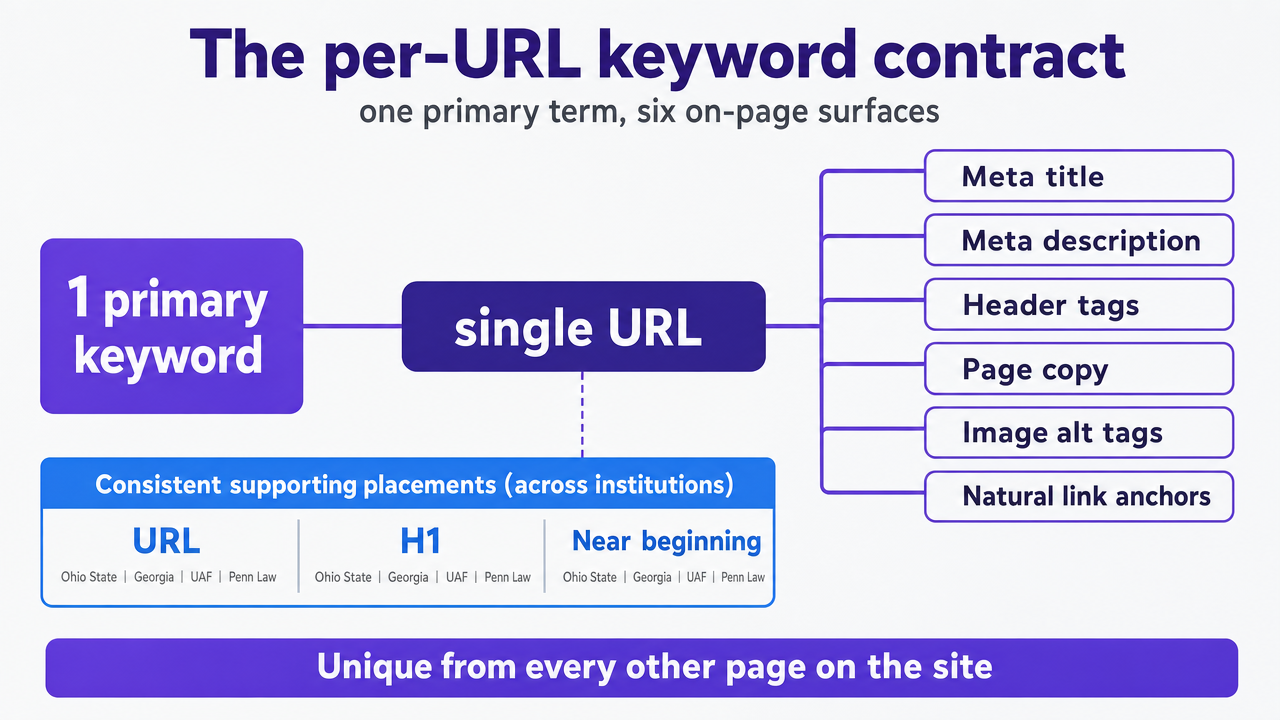 Visualize the core framework of the article: one primary keyword deployed across six on-page surfaces, which is the organizing model referenced throughout every subsequent section
Selecting the primary keyword: audience language over internal jargon
The keyword contract fails if the chosen term reflects the client's internal structure rather than the searcher's query. Penn Law advises walking in the user's shoes when selecting keywords 15. This is often difficult to enforce when clients insist on branded service names, internal product codes, or industry shorthand that prospects don't use in search engines.
The Bureau of Indian Affairs similarly recommends using language people actually use, starting with the page title, summary, and first paragraph 4. The University of Illinois suggests using data from Search Console and Google Trends for keyword discovery, rather than relying on stakeholder interviews 11. These two approaches—audience-centric selection and data-verified term choice—replace the guesswork common among junior writers.
Two rules follow: each URL receives exactly one primary keyword, chosen based on observed search demand, not from the client's brand glossary. If a client's preferred phrase differs from the audience's, the audience's phrase takes the primary slot, with the brand phrase becoming a secondary term in the body copy.
Title tag and URL slug: front-loading and uniqueness rules
The title tag and URL slug are critical surfaces where disciplined placement yields immediate benefits, and template rules can enforce quality without writer intervention. The IRS guidance is clear: place the main keyword at the front of the page title, and ensure every title is distinct from other pages on the site 10. Front-loading isn't just stylistic; it helps the primary term survive SERP truncation and signals the topic to crawlers.
The uniqueness rule is a common failure point for large client sites. Ohio State views it as a topic-signaling issue: unique keywords per page help search engines understand which URL addresses which query 8. When a multi-location client publishes multiple service pages with the same generic head term, these pages compete with each other. The solution is to audit title tag inventory, group by leading phrase, and rewrite duplicates so the primary keyword is paired with a modifier specific to that URL's intent.
The URL slug operates under stricter constraints. Grand Valley State's CMS guide advises including the primary keyword in the URL, keeping it short, descriptive, and human-readable 14. Penn Law considers the URL slug, title tag, and H1 as the three non-negotiable surfaces for the primary term 15. The State of Georgia's standards echo the URL requirement but caution against diluting it with secondary terms 12.
Two template rules can address these issues:
- The CMS title field should auto-populate with the primary keyword in the first position and reject saving if the exact string already exists on another published URL.
- The URL slug field should strip stop words, enforce a character limit, and block publication if the primary keyword is absent.
These rules eliminate common on-page failures without requiring writer judgment.
Test keyword optimization workflows on live content
See measurable SEO impact from real-time keyword implementation across your actual pages during your trial.
H1, subheads, and intro paragraph: keywords as scan signals
The H1, subheads, and opening paragraph transform the primary keyword from a metadata entry into a scan signal for both readers and crawlers. HHS plain-language guidance emphasizes that headings should be specific, and including keywords makes it easier for users to find information and for search engines to surface content 6. Stanford Medicine views this practice as descriptive communication, where keywords in headings clarify section meaning rather than solely serving ranking intent 7.
Three placement rules apply here:
- The primary keyword belongs in exactly one H1 per URL, structured as semantic HTML to help crawlers distinguish the page's main topic from its subsections 3.
- The opening paragraph should contain the primary keyword within the first sentence or two; the Bureau of Indian Affairs guidance identifies the page title, summary, and first paragraph as key areas for audience language 4.
- Subheads should feature secondary or related terms that correspond to genuine sub-topics, not just variations of the main term.
A common agency QA finding is a page with a keyword-rich title but no keyword presence in the visible content. The template rule is straightforward: the H1 field is required, singular, and must contain the primary keyword string. The intro paragraph field should flag for review if the term is absent from the first 100 words 10.
Alt text, internal links, and meta description: the supporting surfaces
The last three surfaces—alt text, internal link anchors, and meta descriptions—often receive less writer attention but frequently generate QA findings. Each should carry the primary keyword when contextually appropriate, and each has specific failure modes when treated as a mere checkbox.
Alt text prioritizes accessibility first and indexing second. The University of Illinois stresses that alt text should be meaningful and not stuffed, accurately describing the image 11. Ohio State includes image alt attributes in the primary placement map alongside the title and H1, advocating for natural link relationships over exact-match anchors 8. Operationally, if an image depicts the primary keyword's subject, the term belongs in the alt attribute within a descriptive sentence. Otherwise, the alt text should simply describe the image.
Internal link anchors follow a similar principle. Ohio State's guidance to "provide for natural link relationships" 8 discourages forcing exact-match anchors on every internal link. Instead, vary anchors with modifiers that describe the destination in context.
The meta description doesn't directly influence ranking but is crucial for click-through rates. Digital.gov requires a meta description on every page for discoverability and accessibility 2. Include the primary keyword once, in a natural voice, within the first 120 characters—long enough to appear in SERP results but short enough to allow for a benefit statement.
Where institutional SEO guides actually agree
A framework gains credibility when independently verified. Eight non-commercial sources, none selling SEO services, offer concrete guidance on primary keyword placement. Their consensus underpins the defensibility of the six-surface contract.
Mapping these eight sources against the six surfaces reveals striking convergence:
- The title tag is universally cited by Ohio State 8, UAF 9, IRS 10, State of Georgia 12, Emory 13, GVSU 14, Penn Law 15, and DOE 1.
- The URL slug is nearly as consistent, specified by Ohio State 8, UAF 9, State of Georgia 12, GVSU 14, and Penn Law 15.
- The H1 is mentioned by Ohio State 8, State of Georgia 12, Emory 13, GVSU 14, and Penn Law 15.
- Body copy and the intro paragraph are named by every source.
- Subheads appear in Ohio State 8, UAF 9, IRS 10, State of Georgia 12, GVSU 14, and DOE 1.
- Alt text and internal link anchors are highlighted by Ohio State 8, UAF 9, State of Georgia 12, and GVSU 14.
No source contradicts another on where placement belongs. While they differ in emphasis—Penn Law focuses on three non-negotiable surfaces 15, the State of Georgia provides a full checklist 12, and DOE redefines intent 1—the fundamental placement geometry remains consistent across federal agencies, tax authorities, state governments, and universities.
This consensus is significant. When clients question an on-page framework, referencing eight independent institutional sources that agree on the six surfaces resolves the discussion. For a Head of SEO rolling out a QA rubric, this framework is seen as a documented standard, not just an agency's house style.
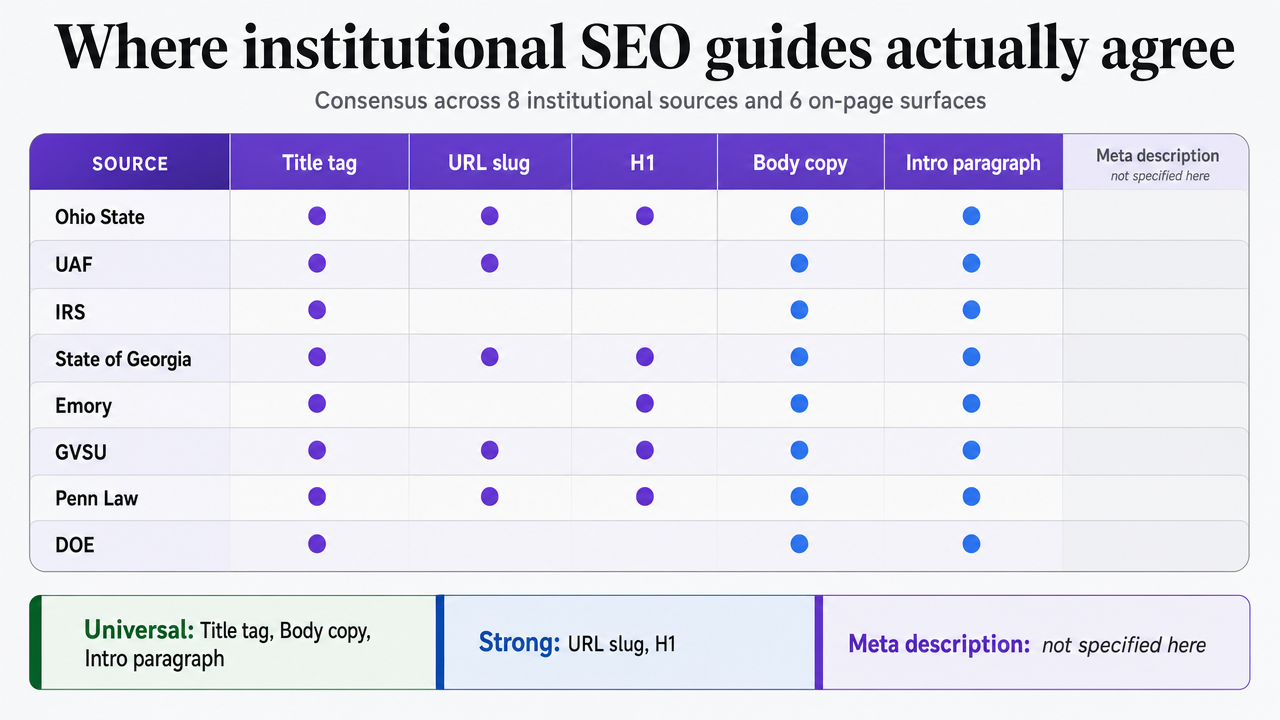 Visualize the cited consensus matrix showing which of the eight institutional sources mention each of the six on-page surfaces, directly supporting the section's comparison claim
Obsolete tactics to remove from your on-page playbook
Several tactics persist in inherited style guides, junior training, and legacy CMS templates. While once relevant, they now consume quality control time without providing ranking value. Removing them is more efficient than retraining writers to work around them.
The meta keywords tag is the clearest to eliminate. Michigan Tech explicitly states it does not affect SEO 16. Emory still lists it as an optional field 13, which perpetuates its use. The best action is to remove this field from CMS scaffolding entirely, preventing writers from wasting time on it.
The 1–2% keyword density target is a more nuanced issue. UAF's guidance still includes this older estimate 9, while the Department of Energy's updated guidance emphasizes comprehensive, credible, and relevant content over keyword density and exact matches 1. A QA rubric should verify keyword presence on the six required surfaces, not enforce a repetition quota. Writers chasing a density target often pad sentences with awkward exact-match phrases, failing the intent test now prioritized by DOE.
Exact-match repetition follows similar logic. DOE's guidance implicitly discourages this tactic by prioritizing intent over exact matches 1. Related terms, synonyms, and natural language now achieve what repetition once did. Keyword-stuffed alt text is another outdated practice. The University of Illinois is clear: alt text should be meaningful, not stuffed 11. Accurately describing an image benefits both accessibility and indexing; keyword-stuffed alt attributes serve neither.
The consolidated rule for QA teams is simple: if a placement decision optimizes for a search engine at the expense of the reader, it is obsolete. The four tactics above are the most common examples found in inherited style guides.
See How Enterprise Teams Automate Keyword Placement—Without Losing Strategic Oversight
Connect with our specialists to review real-world workflows for integrating keywords at scale, ensuring measurable SEO impact across high-volume client portfolios while maintaining full editorial control.
Turning placement into QA: enforcing the contract across writers and templates
The six-surface contract is ineffective if enforcement relies on a Head of SEO reviewing every URL. Scale requires two enforcement layers: template constraints that prevent incorrect placement, and a QA rubric that catches failures templates cannot prevent.
The template layer handles mechanical checks. Required fields, character limits, and uniqueness validation should be built into the CMS. GVSU's CMS guidance is a key reference: primary keyword in the URL, short and human-readable slug, and natural keyword placement in paragraphs, headings, alt text, and links 14. This translates into template rules:
- The title field requires an entry and rejects duplicates.
- The URL slug field enforces a character limit and blocks stop words.
- The H1 field is singular and required.
- The meta description field caps at a character count suitable for SERP truncation 2.
- Image uploads require an alt attribute before saving.
These rules eliminate common failure modes without relying on writer memory.
The QA rubric addresses what templates cannot: whether the primary keyword appears naturally on each surface, if the term aligns with audience language rather than client jargon, and if subheads cover genuine sub-topics. The State of Georgia's standards identify two common failure modes for the rubric: keyword stuffing and keyword dilution across too many terms 12. A four-line rubric per URL is sufficient:
- Primary keyword present on all six surfaces (yes/no).
- Unique across the site (yes/no).
- No exact-match repetition beyond natural voice (yes/no).
- Audience-language match verified against Search Console (yes/no) 11.
Governance completes the loop. The rubric runs on every URL before publication, with a 10% sample post-publication to check for drift. A Head of SEO reviews only rubric exceptions, not every page.
If you manage keyword deployment across a client portfolio
Managing the same contract across 40 client sites changes the dynamics. A Head of SEO managing a portfolio budgets pod capacity against URL volume, not minutes per URL. The six-surface contract is only sustainable if the per-URL time cost is predictable.
Key variables include:
U : URLs per client per month
C : Clients per pod
H : Hours per URL for keyword research, placement, and QA
A pod managing 12 clients with 8 new URLs each handles 96 URLs monthly; 25 clients at the same rate mean 200 URLs. Template enforcement significantly reduces H. Mechanical checks built into the CMS—duplicate title rejection, URL slug validation, singular H1 requirement, alt attribute prompts 14, 2—save minutes per URL without impacting writer output. Judgment calls in the rubric—audience-language match, subhead relevance, natural voice 11, 12—remain in H because they require human assessment.
Two portfolio patterns emerge:
- Standardize and version the six-surface contract once, so all clients use the same rubric.
- Prioritize template development over writer hours; a single CMS constraint eliminates a QA check for every subsequent URL.
A Head of SEO's leverage is per rule, not per page.
Feeding AI Overviews with the same on-page structure
The six-surface contract serves a dual purpose. The Department of Energy's updated guidance explicitly links comprehensive, credible, intent-satisfying content to eligibility for citation in AI Overviews and answer engines—the same factors that drive traditional SERP rankings 1. Agencies don't need a separate workflow for generative surfaces; they need their existing workflow to withstand stricter parsing.
Three structural signals are most important for answer-engine eligibility, each aligning with a surface governed by the contract:
- Semantic HTML with one H1 per URL helps systems differentiate the page's main claim from its subclaims 3.
- Meaningful, specific headings—containing the primary keyword where relevant—identify passages suitable for citation 6.
- A first paragraph that answers the query in audience language, not jargon, is most likely to be extracted 4.
The rule holds: build the page for both the reader and the crawler simultaneously, and AI Overview eligibility will follow. No separate playbook is required.
Frequently Asked Questions
References
- 1.Search Engine Optimization Best Practices.
- 2.Optimize your content | Digital.gov.
- 3.An introduction to search - Digital.gov.
- 4.Headings and titles.
- 5.Headings and Titles.
- 6.Section 5.2 Use meaningful headings.
- 7.SEO & Accessibility Quick Guide - Stanford Medicine.
- 8.Content Optimization - Office of Marketing - The Ohio State University.
- 9.Search engine optimization | University Relations.
- 10.2.25.101 IRS.gov Web Content Management Procedures.
- 11.Part 2: Deep Dive: SEO Elements and Best Practices.
- 12.3.3 Search Engine Optimization (SEO) - Digital Services.
- 13.Search Engine Optimization.
- 14.Search Engine Optimization (SEO) - CMS 5 Resource Guide.
- 15.Seo Keyword Guidelines.
- 16.Best Practices: Search Engine Optimization and Usability.