
Key Takeaways
- Semrush anchors layer-one SERP-feature intelligence, logging daily snippet, AI Overview, and PAA turnover across large keyword sets so strategists catch ownership flips before they cost client traffic.
- Ahrefs supports upstream vulnerability research, quantifying snippet owner strength, format, and content gaps so strategists can size a capture attempt before assigning production hours.
- Similarweb SEO Intelligence handles zero-click and AI Overview citation monitoring with vertical segmentation, exposing which client URLs get quoted, ignored, or replaced against industry benchmarks rather than portfolio averages.
- Schema App keeps answer-feature eligibility intact by deploying and validating JSON-LD across large client sites, catching schema regressions from migrations or CMS changes before snippet losses appear.
- AlsoAsked maps People Also Ask trees at depth, letting strategists identify the sub-questions an AI Overview will likely synthesize and structure pages into extractable answer blocks during a single brief cycle.
- Vectoron closes layer three by converting alerts from the other tools into ranked, approved work orders that ship on the same cycle, protecting the accounts-per-FTE ceiling the tracking layers set.
Answer-feature risk is now a portfolio problem
The math on organic visibility has changed for anyone running a client book. Authoritas tested a sample of commercial keywords during Google's SGE rollout and found AI-generated content appeared on 86.8% of them, with projected click-through rates falling by as much as 8x for some top-position organic results once SGE panels expanded fully 1. The sample was commercial queries, and the CTR figure is a projection tied to a specific expansion scenario, not an observed universal decline. That scope matters. It also does not blunt the operational point: the surface a Head of SEO is contracted to defend now sits below an answer feature on most of the queries that drive client revenue.
This reframes the job. A single-domain audit workflow, tuned around static keyword rankings and monthly snippet checks, cannot cover a book of 40 or 120 clients moving through this shift at the same time. The signal set expanded. AI Overview presence, citation status inside those overviews, snippet volatility, pixel displacement of the first organic result, and People Also Ask position have all become tracked features that determine whether a client keeps or loses acquisition traffic 8.
Portfolio-level tooling has to answer three questions per client, per week: which queries have gained an answer feature, which client pages are being cited or displaced, and where the strategist should send production capacity next. The six tools ranked below are evaluated against that operational load, not against feature-list parity.
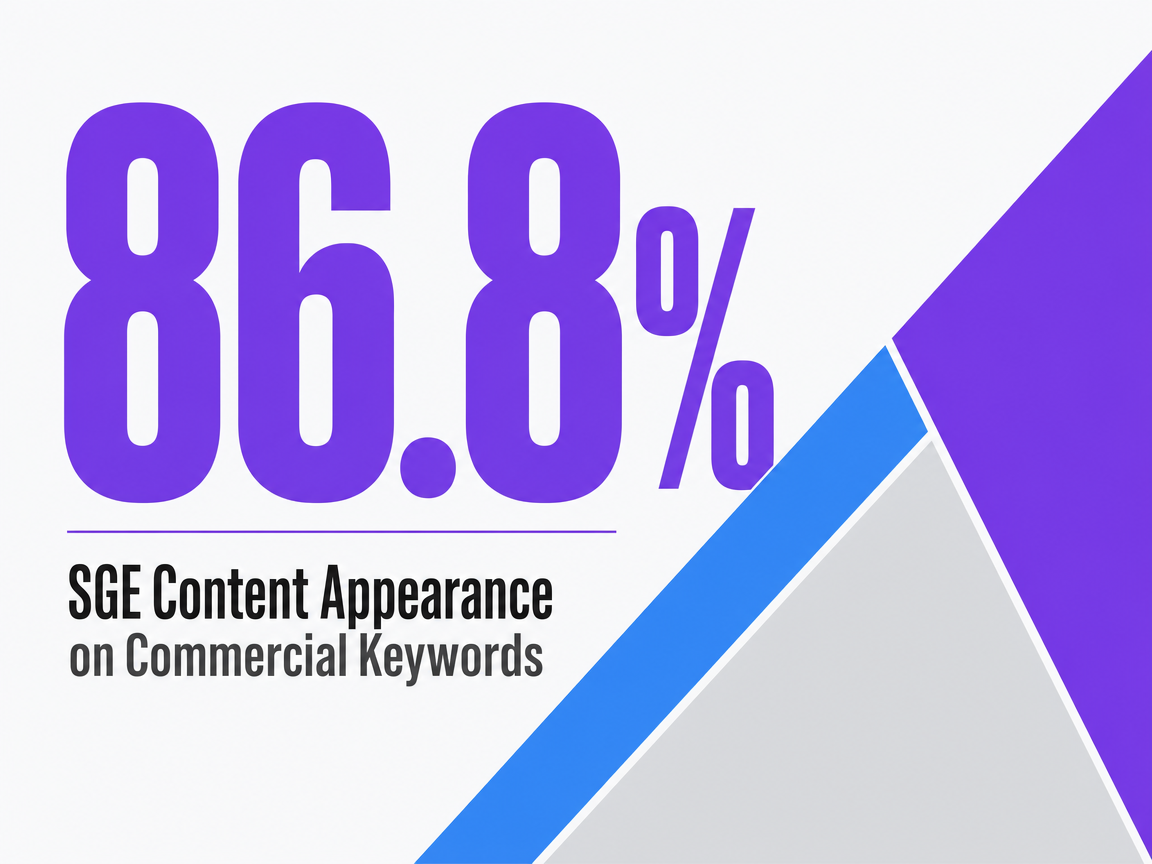 SGE Content Appearance on Commercial Keywords
SGE Content Appearance on Commercial Keywords
The three-layer AEO stack an agency actually needs
Industry taxonomies now split AEO tooling into three functional classes: broad SEO suites with SERP-feature awareness, dedicated SERP-feature and rank trackers, and AI citation monitors that watch how answers get assembled across Google AI Overviews, ChatGPT, Perplexity, and Gemini 8. That split is not academic. Each class produces a different signal, and none of them alone tells a strategist where to send production capacity next.
Layer one handles SERP-feature intelligence. It answers which client queries now carry an AI Overview, a featured snippet, a People Also Ask cluster, or a knowledge panel, and how those features move week over week. Modern answer engines pull from multiple sources at once rather than a single snippet owner 8, so the tracking has to log presence, ownership, and displacement as separate fields.
Layer two handles citation and zero-click monitoring. This is where an agency learns whether a client page is being quoted inside an AI Overview, ignored, or replaced by a competitor's URL. It is also where zero-click behavior gets measured against actual traffic outcomes rather than assumed CTR curves.
Layer three is the execution and approval layer. Signals from layers one and two are worthless if the strategist cannot get a schema fix, a rewritten answer paragraph, or a new FAQ block through review and into production the same week the risk was flagged. Most agencies underinvest here, and it shows in the gap between audit output and shipped work.
Selection criteria: accounts per FTE, not feature checklists
Tool selection at the portfolio level answers one question: how many client accounts can a single strategist defend without missing an answer-feature event that costs the client traffic. Feature checklists do not answer that question. Volatility coverage, alerting granularity, and citation visibility do.
Three criteria carry the most weight. First, does the platform monitor SERP-feature turnover across the full client keyword set on a cadence tight enough to catch snippet flips and AI Overview appearances within days, not weeks. One study of generative search impact projected an 18% to 64% decrease in organic clicks depending on query type and rollout scope 7, a spread wide enough that monthly rank pulls will miss the events that matter most. Second, does the platform surface citation status inside AI Overviews, not just presence. Sites cited as sources inside AI Overviews saw an average traffic lift of 18% 3, which reframes AEO tooling as an offense signal, not only a loss report. Third, does the platform output work orders that a strategist can approve and route to production, or does it stop at a dashboard.
Applied against a 40-client book, the first two criteria set the ceiling on accounts per FTE. The third determines whether that ceiling gets reached.
Test AEO analysis workflows with live content
Evaluate AEO tool impact on real client results before committing to a full rollout.
The six tools, ranked by job in the stack
Semrush: SERP-feature intelligence at portfolio scale
Semrush earns the layer-one slot because its Position Tracking and Sensor products log SERP-feature presence and turnover across large keyword sets on a daily cadence. For a Head of SEO defending a mixed book, that granularity matters more than keyword database depth. The feature-tracking module flags when a query gains or loses a featured snippet, an AI Overview panel, a People Also Ask cluster, or a knowledge panel, and attributes ownership when the client's URL is the source.
The operational value shows up in how the alerts stack. Featured snippets are volatile enough that a 12-month study documented material CTR shifts each time ownership flipped for the queries they replaced 11. A strategist managing 40 accounts cannot manually catch those flips. Semrush's alert layer collapses that surveillance work into a dashboard filter, which is where the accounts-per-FTE ceiling actually gets raised.
Two gaps limit its role. Semrush's AI Overview coverage lags dedicated citation monitors, and its treatment of AI Overviews still reports presence more reliably than it reports which sources the overview cited. Modern answer engines assemble responses from multiple sources at once rather than a single snippet owner 8, so a presence-only signal understates the competitive picture. The second gap is that Semrush stops at insight. It flags a snippet loss; it does not open a work order.
Best use in an agency stack: the default layer-one platform for SERP-feature turnover monitoring across the full client keyword set, paired with a citation monitor for AI Overview attribution.
Ahrefs: keyword and snippet vulnerability research
Ahrefs sits alongside Semrush in layer one, but its strongest AEO application is upstream of tracking. The Keywords Explorer and Content Explorer modules quantify snippet ownership, format (paragraph, list, table), and the strength of the current owner's backing content. That combination supports the vulnerability assessment a strategist runs before greenlighting a snippet-capture brief.
Featured snippet research quantifies traffic changes when snippet ownership shifts, and format identification directs whether a client page should be restructured as a paragraph, list, or table 9. Ahrefs surfaces those signals cleanly. Its SERP overview for a target query shows the current snippet owner, the snippet format, and the referring-domain depth of that URL, which lets a strategist estimate how expensive a capture attempt will be before assigning production hours.
The AI Overview treatment inside Ahrefs has improved, but the platform still reports snippet and PAA data more reliably than it reports AI Overview citation attribution. For agencies that treat Ahrefs as their primary keyword research tool, that split is workable: the research work happens in Ahrefs, and the ongoing AI Overview citation surveillance runs in a dedicated monitor.
The other operational advantage is content gap analysis at the domain level. When a client vertical shifts and previously stable queries start losing organic clicks, Content Explorer's historical view lets a strategist identify which questions the client has never answered on the site, which is the shortest path from AEO diagnosis to a production brief. Best use: keyword and snippet vulnerability research at the brief-planning stage.
Similarweb SEO Intelligence: zero-click and AI Overview citation monitoring
Similarweb SEO Intelligence anchors layer two. Its zero-click reporting and AI Overview citation tracking answer questions that pure rank trackers cannot: whether a client's URL is being quoted inside an AI Overview, whether the query is returning any clicks at all, and how those patterns move by vertical.
Vertical segmentation is where the platform earns its slot on an agency stack. AI Overview and SGE impact is not uniform. The Raptive network's estimates show roughly 25% traffic reduction overall, with food properties around 20% and travel and family verticals near 29% 6. A citation and zero-click monitor that rolls those signals up to a portfolio average will hide the accounts most at risk. Similarweb's vertical filters let a strategist segment client-level zero-click behavior by industry benchmark rather than portfolio mean, which is the difference between catching a food client's 20% erosion and missing it inside a 25% network average.
The platform's citation monitoring also reframes the reporting narrative. Sites cited as sources inside AI Overviews saw an average traffic lift of 18% 3. That single data point moves AEO analysis from defense-only to offense: a strategist can identify which client pages are already being cited, which are cited by competitors, and where to build the answer content that earns a citation slot on high-intent queries.
Two constraints apply. Similarweb's citation data is inferred from panel and clickstream signals, not from a direct feed of Google's AI Overview sources, so attribution should be validated against the client's own analytics before reporting a win. And the platform is priced for enterprise use, which raises the cost-per-monitored-domain calculation for smaller books. Best use: portfolio-level zero-click and AI Overview citation monitoring, segmented by client vertical, feeding weekly review of accounts trending outside their vertical benchmark.
Schema App: structured data validation for answer-feature eligibility
Answer features do not select content at random. Google's own documentation states that structured data helps Google understand the content on a page and can enable special search result features 12. Schema App operationalizes that at agency scale, generating, deploying, and validating JSON-LD across large client sites without pushing schema work back into developer queues.
The platform's job on an AEO stack is narrow and important: keep every client page that is eligible for a rich result, an FAQ answer, or an AI Overview citation actually eligible. Schema drifts. Site migrations strip markup. New CMS templates ship without FAQ or HowTo schema attached. Schema App's monitoring layer catches those regressions before a strategist finds out from a Semrush alert that a snippet was lost.
For agencies running clients in verticals where answer-feature eligibility drives acquisition (legal, healthcare, home services, dental, senior living), the platform's aggregate deployment matters more than any single schema template. A strategist can push an updated FAQ schema across 400 location pages in a session rather than filing 400 developer tickets. That is the accounts-per-FTE lever.
The limit is scope. Schema App validates and deploys structured data; it does not track SERP features, monitor citations, or write the answer copy that fills the schema. It slots in behind layer-one and layer-two tools, executing the technical fix a snippet or citation alert points to. Best use: structured data deployment and validation across large client sites, treated as the technical execution partner to SERP-feature and citation alerts.
AlsoAsked: question-graph mapping for AI sub-queries
AlsoAsked maps People Also Ask trees at depth, showing how Google's related-question layer branches out from a seed query. That output has become more valuable as answer engines assemble responses from multiple sub-queries at once rather than resolving a single question 8.
For an agency, the tool solves a specific research problem: which sub-questions does the client's target answer need to cover to be usable as source material inside an AI Overview. Mapping AI sub-queries to keyword clusters is now a standard capability for AEO keyword research 9, and AlsoAsked's visual question graphs make that mapping fast enough for a strategist to complete during a single brief cycle rather than across a multi-day audit.
The operational payoff is at the content-brief stage. A strategist working on a client's pillar page can pull the full PAA tree for the head term, identify the four or five sub-questions the AI Overview is most likely to synthesize, and structure the page to answer each one with a discrete, extractable block. That structure raises the probability of citation without adding word count for its own sake.
The tool is narrow. It does not track rank, monitor citations, or validate schema. Its value is upstream, informing the shape of the content that layer-one and layer-two tools will later measure. Best use: pre-brief question-graph research on pillar and cluster content, used to structure pages for AI sub-query extraction.
Vectoron: execution and approval workflow layer
The first five tools produce signals. Vectoron closes the loop between signal and shipped work, which is why it belongs in layer three of the stack rather than in layer one or two. Its specialist strategists ingest the outputs an agency's existing SERP-feature, citation, and schema tools generate, then rank the resulting production work by projected impact on client acquisition metrics.
The operational premise is the gap layer three usually fails to close. A strategist can identify, on a Tuesday, that a client's top commercial query lost its featured snippet and that a competitor is now being cited inside the AI Overview. If the fix, a restructured answer block, a schema update, and an internal link revision, does not ship until the following month's content cycle, the alert did not defend the account. Vectoron routes that fix through a Command Center where a human strategist approves each recommendation before execution, then the platform handles production and publishing on approved work.
For a Head of SEO measuring accounts per FTE, the workflow layer determines whether the ceiling set by layer-one and layer-two tools is actually reached. Approval-first automation preserves the strategic oversight the role is contracted to provide, while removing the briefing, handoff, and status-meeting cycles that consume analyst hours without producing shipped work.
Vectoron does not replace Semrush's tracking or Similarweb's citation monitoring. It sits behind them, converting their alerts into approved work orders and executed changes. Best use: the execution and approval layer that turns AEO findings into shipped content and technical updates on the same cycle as the alert.
AEO stack economics per monitored client
Tool budgets get approved on cost per monitored domain per month and analyst hours saved per client per month. The table below is a planning template a Head of SEO can populate against actual contract rates. It uses variables rather than invented prices for third-party platforms, because AEO tool pricing shifts with contract volume and vertical mix, and the sourced deltas that matter for ROI are on the traffic side, not the license side.
| Layer | Representative tool | Primary AEO output | Analyst hours saved per client per month |
|---|---|---|---|
| SERP-feature intelligence | Semrush | Daily snippet, AI Overview, and PAA turnover alerts across the client keyword set | H_serp |
| Keyword and snippet vulnerability research | Ahrefs | Snippet owner strength, format, and content-gap identification at the brief stage | H_research |
| Zero-click and AI Overview citation monitoring | Similarweb SEO Intelligence | Vertical-segmented citation status and zero-click behavior by client | H_citation |
| Structured data validation and deployment | Schema App | Answer-feature eligibility across large multi-page sites | H_schema |
| Question-graph research | AlsoAsked | PAA trees mapped to extractable content blocks for AI sub-queries | H_graph |
| Execution and approval workflow | Vectoron | Ranked, approved work orders shipped on the same cycle as the alert | H_exec |
Two variables anchor the ROI math on the traffic side. Sites cited inside AI Overviews saw an average 18% traffic lift 3, and observed CTR on informational queries with AI Overviews present fell 61% 4. A Head of SEO can model expected client outcomes as a function of citation-capture rate against the retained-traffic base, then compare that expected value to the sum of license cost and analyst hours across the six layers. The stack pays for itself when the sum of H_serp through H_exec, priced at the agency's fully loaded strategist rate, exceeds the license total plus the traffic-value uplift from citation capture.
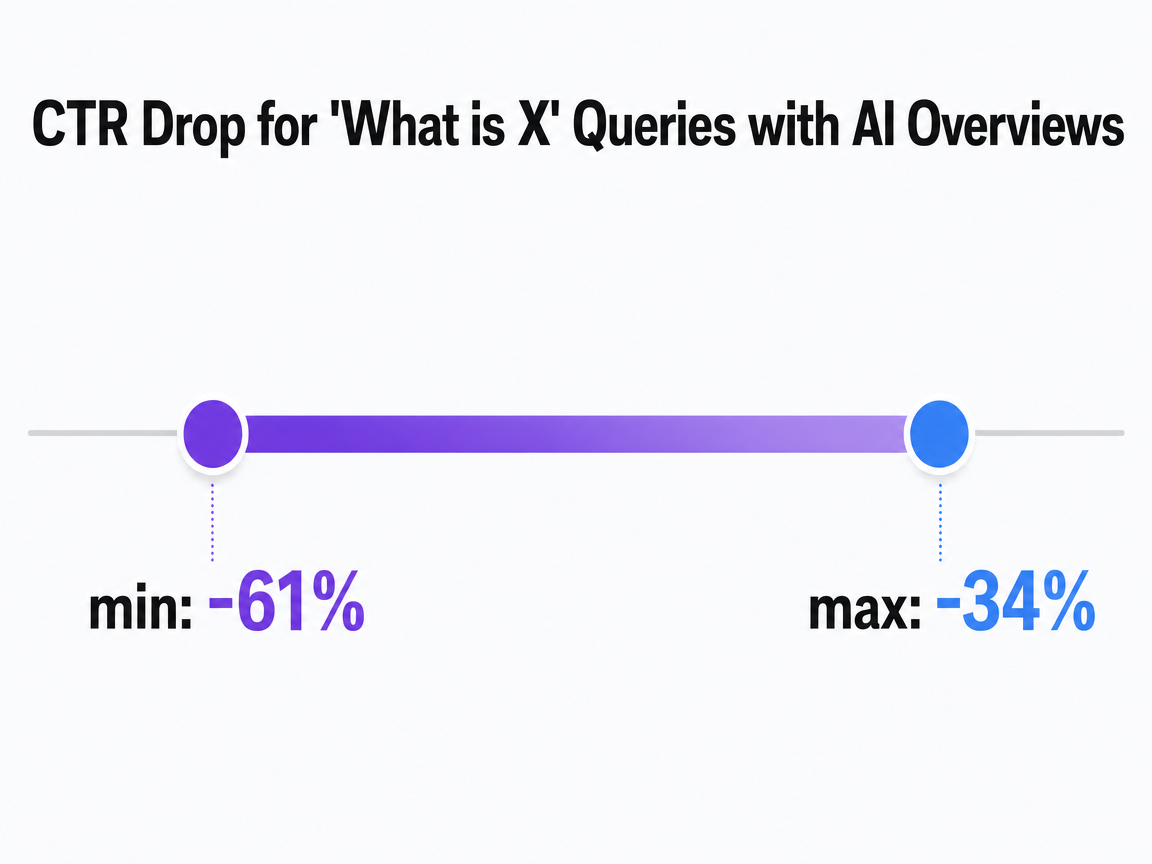 CTR Drop for 'What is X' Queries with AI Overviews
Range of click-through rate decline observed for sites relying on informational 'what is X' style content when Google AI Overviews are present.
See How Leading Agencies Operationalize AEO Analysis at Scale
Connect with our team to benchmark your current AEO analysis workflow, explore automation opportunities, and review performance data from top agency implementations.
What AEO analysis software cannot do alone
No tool in this category ships content. That gap is where agency margin quietly disappears. A citation monitor can prove that a competitor now sits inside an AI Overview for a client's highest-intent query, and a schema validator can confirm the client's FAQ markup went missing after the last CMS release. Neither of them writes the corrected answer block, updates the JSON-LD, or gets the change reviewed and pushed to production.
The delay between diagnosis and shipped work is the real cost. Featured snippets are volatile enough that ownership can flip inside a single tracking window 11, and generative search studies project organic click declines wide enough to matter at the client-revenue line 7. An alert that sits in a queue for three weeks while briefs, drafts, and dev tickets move through separate handoffs has already lost the account traffic it was meant to defend.
Structured content design also has limits. Backbone's guidance to structure pages for AI extraction assumes the pages get restructured 10. That is a production question, not a tooling question. The stack works when the layer-three workflow ships approved changes on the same cycle the layer-one and layer-two alerts fire.
Segmenting the stack across a mixed client book
A single stack configuration does not defend a mixed book equally. SGE and AI Overview coverage vary enough by vertical that a portfolio-average dashboard hides the accounts most at risk 5. A publisher-heavy content client and a local services client cannot share the same alert thresholds or the same tool weighting.
Three segmentation cuts do most of the work.
- Informational-heavy clients (publishers, education, health content) need Similarweb citation monitoring weighted higher than SERP-feature tracking, because their traffic base sits in the exact query class where AI Overview CTR falls hardest.
- Transactional clients (legal, dental, home services) need Semrush snippet volatility and Schema App validation weighted higher, because their acquisition depends on holding local-pack and FAQ features.
- Content-cluster clients running pillar-and-spoke structures need AlsoAsked at the brief stage more than the others.
The workflow layer stays constant across all three segments. What changes is which alerts route to production first, and that ranking should be set per client, not per agency.
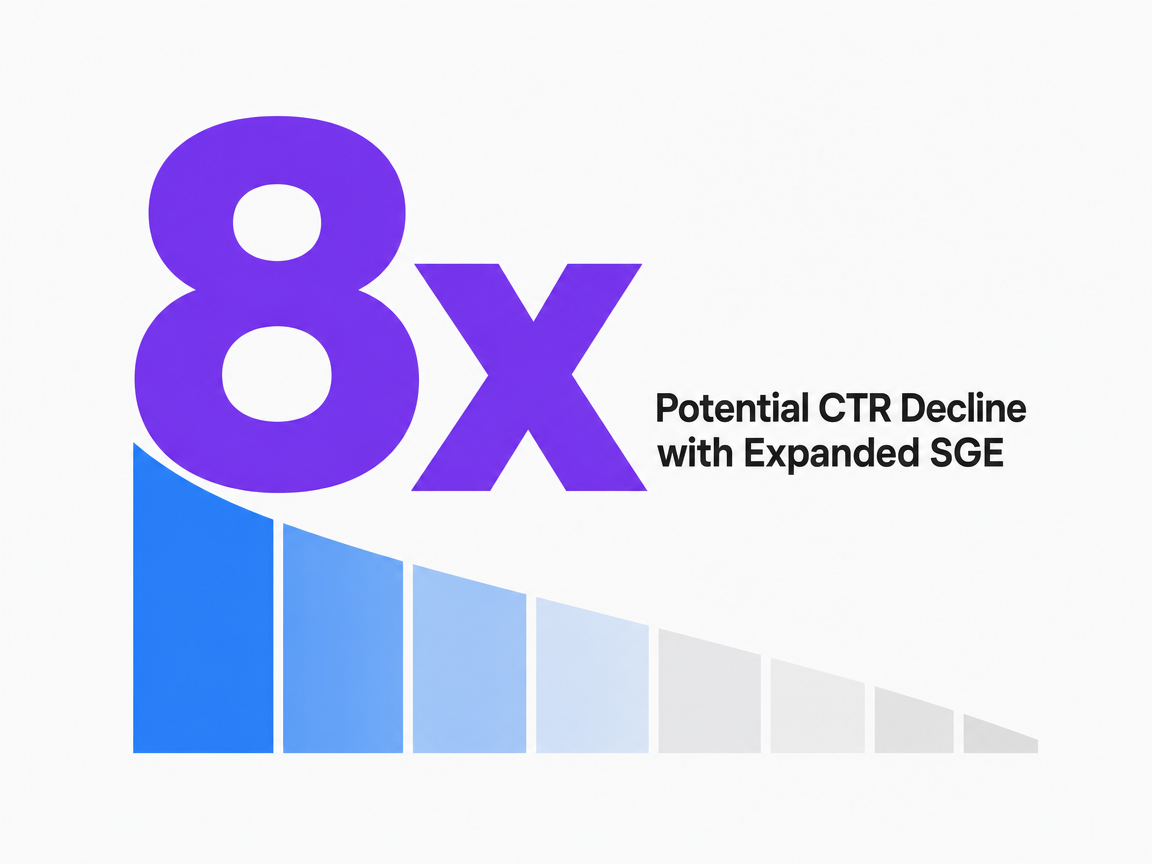 Potential CTR Decline with Expanded SGE
Potential CTR Decline with Expanded SGE
Frequently Asked Questions
References
- 1.Authoritas Analysis Warns of Organic Traffic Decline Amid Google's AI-Based Search Replies.
- 2.The Impact of Google’s Generative Experience (SGE) on Organic Traffic.
- 3.Google AI Overviews: What the Real Traffic Data Shows.
- 4.Google AI Overviews: Key CTR and Traffic Insights - Psyke.
- 5.Google SGE Organic Traffic Impact Divided By Verticals.
- 6.Google's AI-driven Search Generative Experience could slash publishers' organic search traffic by 20% to 60%.
- 7.Google Generative Search (SGE) and Its Effect on Organic Traffic.
- 8.Best AEO Tools in 2026: 11 Answer Engine Optimization Tools.
- 9.Best AEO Keyword Research Tools 2026 | CheckThat.ai.
- 10.Google's Search Generative Experience (SGE) Rollout and Backbone's Strategic Recommendations.
- 11.Google Featured Snippets: A 12-Month Study.
- 12.Overview of Google Search Appearance and Structured Data.