
Key Takeaways
- Answer engines retrieve and score passage-level evidence rather than ranking pages, so competing for citations requires claim-first answer units that surface for decomposed sub-queries 4.
- Measure AEO across four distinct layers: retrieval eligibility, nugget coverage, sentence-support rate, and downstream qualified action tied to CRM events, mirroring TREC RAG scoring dimensions 1.
- Every factual claim needs pre-publication substantiation and a provenance ledger; the FTC's Workado order requires competent, reliable evidence retained on file before publishing accuracy or efficacy claims 3.
- Agency delivery teams should sequence the next 90 days by building the evaluation loop first, then answer-unit production against a substantiation gate, then closing the loop to qualified conversions.
Why Answer Engines Reward Retrieval, Not Rankings
Answer engines do not rank pages; they retrieve evidence fragments, score them for relevance and support, and generate a synthesized response with citations. The NIST TREC 2025 RAG track formalizes this with a multi-layered evaluation covering retrieval relevance, response completeness, attribution verification, and agreement analysis 4. This is the underlying mechanism for AI Overviews, ChatGPT search, Perplexity, and Gemini. Agencies still optimizing for traditional SERP rankings are measuring the wrong surface.
The practical consequence for SEO agencies is a shift in the unit of competition. A page ranking third on a traditional query might be entirely absent from a generated answer if its passages do not surface as retrievable evidence for the model's decomposed sub-questions. The TREC 2025 track uses Union Nuggets Coverage and Sentence-Support Rate to score how well generated answers cover factual elements and whether each sentence is supported by the cited source 1. These metrics define what answer engines reward.
Retrieval eligibility is distinct from ranking. A passage enters the candidate set based on semantic match to a decomposed sub-query, is then re-ranked against other passages, and finally evaluated for its ability to supply a discrete answer element. Traditional SEO signals are relevant for the initial retrieval stage but less so thereafter.
Stanford HAI's 2025 AI Index highlights the rapid adoption of generative AI and the scarcity of standardized responsible-AI evaluation among major model developers 9. Agencies that establish internal evaluation loops now, based on public RAG benchmarks, will better maintain client visibility as these surfaces evolve. Those that wait for a stable API for citation counts will face uncertainty.
The Four-Layer AEO Measurement Stack
Retrieval Eligibility: Being in the Candidate Set
Retrieval eligibility is the initial gate. If a passage isn't included in the candidate set for a decomposed sub-query, subsequent stages like coverage, attribution, or citation become irrelevant. The NIST TREC 2025 RAG track scores retrieval as a distinct dimension, separate from response quality, with numerous retrieval runs evaluated independently of the generation process 4.
For agencies, this means classical technical SEO remains crucial for the first stage. Factors like crawlability, indexability, semantic proximity between passage text and likely sub-queries, and passage-level clarity determine if a content chunk is retrieved. A page that ranks for broad terms but buries its answer within a lengthy paragraph will be outperformed by a concise passage that states the answer upfront.
The key metric is not "did we rank" but "did our passage appear in the retrieved candidate set for relevant queries." Agencies should regularly sample target queries across major answer surfaces, log cited URLs, and track eligibility as a distinct KPI, upstream of coverage and attribution.
Nugget Coverage: Answering the Actual Question
Being retrieved does not equate to answering the question comprehensively. The TREC 2024 RAG Search Track distinguishes three scoring axes often conflated by agencies:
- document relevance,
- nugget coverage (whether the answer contains specific factual elements required by the question), and
- citation/support assessment (whether each sentence is supported by its cited source) 6.
High performance on one does not guarantee it on the others.
Nugget coverage is frequently overlooked in agency measurement. A model breaks down a query into discrete facts—"nuggets"—required for a complete answer, then scores how well the generated response covers them. A highly relevant and retrieved page might still miss half the nuggets if its passages discuss the topic generally without providing specific numbers, definitions, exclusions, or steps implied by the question.
This implies that answer units should be structured around question decomposition, not just broad topic coverage. For each priority query, delivery teams should identify the essential nuggets for a complete answer and verify their presence in retrievable passages on the client's site. Coverage must be scored independently, as it cannot be inferred from ranking or the mere presence of a citation.
Sentence-Support Rate: Attribution That Survives Audit
Attribution often fails under scrutiny in AEO reporting. A citation link next to a sentence does not automatically mean the source supports that sentence. The TREC 2025 RAG track uses Sentence-Support Rate alongside Union Nuggets Coverage because attribution requires verification at the sentence level, not just the presence of a URL 1.
The four layers of the measurement stack—Retrieval Eligibility, Nugget Coverage, Sentence-Support Rate, and Downstream Qualified Action—directly align with the TREC evaluation framework. Union Nuggets Coverage assesses if the response contains the necessary facts, while Sentence-Support Rate verifies if each generated sentence is backed by its cited source 1. These two metrics define how answer engines evaluate content for citation.
For agencies, this means QA for published answer units must include a citation-check pass. For every claim in an answer unit, the linked source must actually contain the specific asserted fact, in language a model can match. Attribution integrity ensures a passage is consistently cited rather than being used once and then discarded for a more reliable source.
Downstream Qualified Action: Citation Without Revenue Is Vanity
The fourth layer is what clients ultimately value. A citation in an AI Overview or Perplexity answer is a top-of-funnel event, not a business outcome. Agencies that stop measurement at "we got cited" produce reports that lack substance when clients inquire about pipeline impact.
Downstream Qualified Action completes the loop by connecting answer-surface visibility to revenue-generating actions: qualified form fills, booked consultations, tracked calls, or product trial starts, based on the client's conversion definition. Measurement involves attributing sessions from answer surfaces, segmenting by queries and answer units that led to citations, and tracking through to qualified events—a process familiar to teams managing paid and organic campaigns.
The Stanford HAI 2025 AI Index notes the rarity of standardized responsible-AI evaluations among major model developers 9. Agencies should not expect a ready-made citation-to-revenue API. The effort lies in integrating citation logs with CRM events, transforming AEO from a visibility metric into a P&L story.
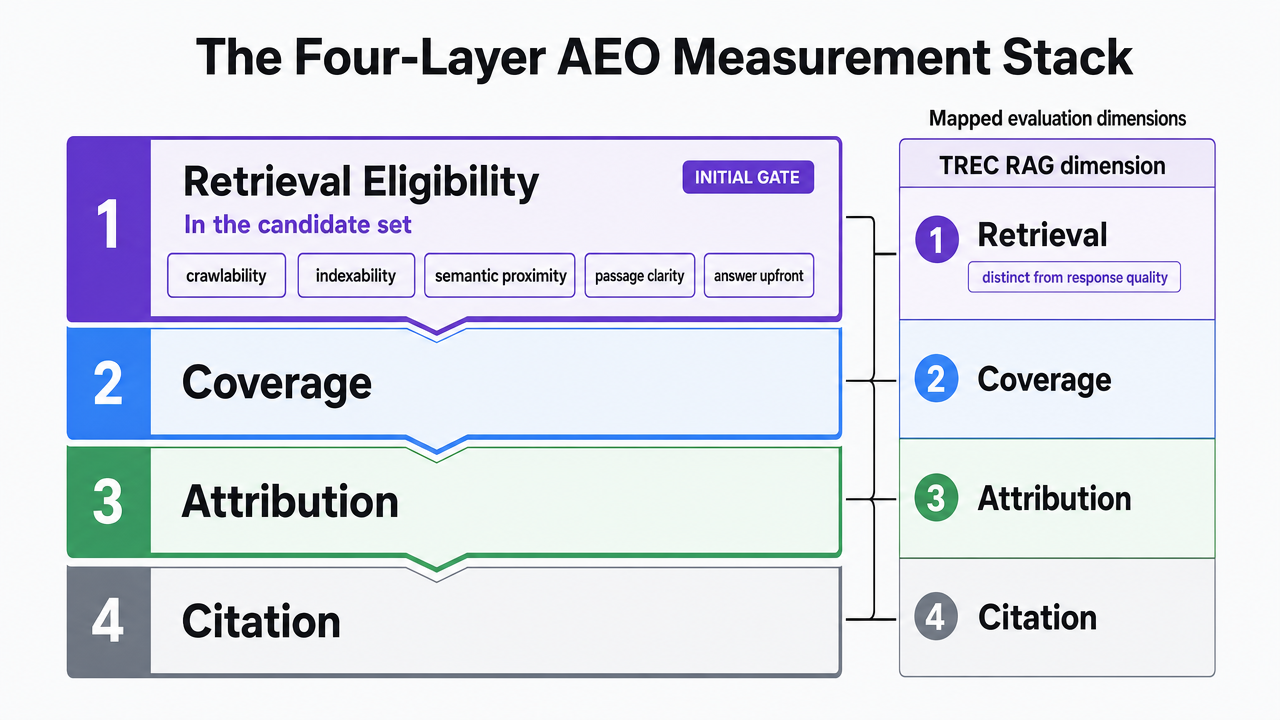 Visualize the four-layer measurement stack introduced in this section, mapping each layer to its corresponding TREC RAG evaluation dimension referenced in nearby prose
Building Answer Units That Get Retrieved
The Answer Unit as the Production Primitive
The traditional article, page, or blog post is no longer the primary unit of production; the answer unit is. An answer unit is a self-contained passage that directly resolves a decomposed sub-query, starting with a direct claim, followed by supporting evidence, and sentence-level citations.
The TREC 2024 RAG Search Track scores nugget coverage at the level of discrete factual elements and citation support sentence by sentence 6. This granularity is what answer engines evaluate, and production workflows must align with it.
An answer unit has four key properties:
- a leading claim,
- supporting facts stated in model-liftable language,
- consistently named entities for semantic retrieval, and
- each factual sentence linked to a source that verifies the assertion.
For agency delivery teams, this means a measurable shift. Instead of assigning a writer a 1,500-word article, the task becomes covering a target query's decomposed nuggets with specific answer units. A single landing page might contain multiple independently retrievable answer units. Editors QA at the unit level, and schema wraps individual units, not the entire page. The goal is to make passages retrievable, not just to rank a page.
Evidence Substantiation Before Publication
The substantiation standard for answer unit claims is equivalent to the FTC's requirements for Workado: claims about accuracy, performance, or efficacy must be backed by competent and reliable evidence, retained on file, prior to publication 3. Agencies publishing answer units with statistics, benchmarks, or outcome numbers without underlying evidence risk exposure for themselves and their clients.
A pre-publication substantiation pass involves a checklist mirroring the Workado order. For each factual claim, the editor confirms:
- the source exists at the cited URL,
- the source contains the specific fact matching the claim,
- the source is authoritative, and
- a dated snapshot of the source is retained.
The January 2025 accessibility AI marketer order reinforces this principle for automation and compliance claims 2.
This process offers dual benefits. Substantiated units pass editorial QA efficiently, shortening production cycles. They also survive sentence-level attribution scoring by answer engines, as a passage whose claims are verifiable against its sources is precisely what a RAG system seeks 1. Unsubstantiated units fail both compliance and retrieval scoring, merging these two workflows into a single gate.
Agencies in regulated verticals should treat the substantiation folder as a client-deliverable artifact, not just an internal file, as it serves as a record to defend both the answer unit and the agency if claims are challenged.
Test AI-driven AEO content workflows risk-free
Experience live AEO-optimized content production and deploy real outputs within your existing SEO process.
Answer Standards for High-Stakes Verticals
Answer engines in high-stakes sectors like healthcare, behavioral health, senior living, legal, and financial services are held to a higher standard than those for consumer topics. The Surgeon General's advisory on health misinformation provides a baseline for answer-unit production in these verticals: verify information against trustworthy sources, include strong caveats, seek expert opinions, provide context, and use a broad range of credible sources, including local ones 12. This is a mandatory editorial specification.
In answer-unit construction, this means the passage's claim leads with the fact, followed by sentences naming the authoritative source and relevant caveats. Cited entities should include clinical or professional bodies where applicable. For example, a behavioral health answer stating a treatment duration without a range, contraindication, or caveat about individual clinical judgment is a liability, not a defensible answer unit.
Expert input is also non-negotiable. For clients with licensed professionals, the answer-unit workflow should include a named reviewer, their credential, and a review date as visible metadata. This serves as both an editorial control and a retrieval signal, as named authorship and clinical review are entity signals answer engines can resolve.
Provenance completes the loop for AI-assisted production. NIST defines provenance data tracking as recording a digital asset's origins and history to determine authenticity, integrity, and credibility 5. For regulated verticals, this record—detailing who drafted, what evidence was consulted, who reviewed, when published, and when updated—must be maintained in an internal ledger. This ledger distinguishes defensible AI-assisted production from output that cannot withstand legal review.
The operational rule is strict: no unit in a high-stakes vertical ships without a named reviewer, appropriate caveats, citations to authoritative bodies, and a provenance record in the CMS. Establishing this gate once and applying it across all regulated clients eliminates recurring debates about content quality.
Reputation Signals Feeding AI Answers
Reviews, testimonials, and third-party mentions contribute to the same retrieval systems that pull passages from client sites. When an answer engine recommends a local attorney, dental practice, or home services provider, it draws from review corpora, business listings, and citation sources alongside the client's own pages. The reputation surface is an integral part of the retrieval corpus.
The FTC's Consumer Reviews and Testimonials Rule, effective October 21, 2024, prohibits fake or false reviews, sentiment-conditioned reviews, undisclosed insider testimonials, review suppression, and misrepresenting company-controlled review sites as independent 10. It authorizes civil penalties for violations and explicitly covers AI-generated fake reviews 11. Agencies managing reputation workflows are now under a substantiation regime that treats manipulated reputation content similarly to unsupported accuracy claims under the Workado order.
Operationally, this means review acquisition programs must solicit feedback without conditioning on sentiment, insider reviewers must disclose their relationship, and negative reviews cannot be suppressed. Agencies inheriting legacy review-gating workflows should audit and dismantle them before the next reporting cycle, as these reviews are potential passages an answer engine might quote when a prospect seeks a trusted provider.
If You Manage a Client Portfolio: Answer-Unit Production at Scale
Three Production Models Compared
For agency operators managing answer-unit production across 10 to 150 client accounts, single-site economics are insufficient. The focus shifts from the cost of a single answer unit to the marginal cost of an answer unit for client 47.
Three dominant production models exist, each with a different labor mix and varying unit economics at portfolio scale. The table below uses hour variables to illustrate cost curve shapes, rather than specific dollar figures which vary by market.
| Model | Writer hrs / unit | SEO editor hrs / unit | Schema & dev hrs / unit | Substantiation QA hrs / unit | Marginal cost behavior |
|---|---|---|---|---|---|
| A. In-house writer + SEO editor + schema dev | 2.0–3.0 | 0.75–1.0 | 0.25–0.5 | 0.5–0.75 | Roughly linear; each new client adds proportional hours |
| B. Freelance pool + agency PM overhead | 1.5–2.5 | 0.75–1.0 | 0.25–0.5 | 0.5–0.75 | Linear plus PM tax (0.5–1.0 hr/unit) that grows with vendor count |
| C. AI-assisted production with human approval workflow | 0.25–0.5 | 0.5–0.75 | 0.1–0.25 (templated) | 0.5–0.75 | Sub-linear; drafting and schema hours compress, substantiation QA stays flat |
Two observations are critical for delivery organizations. Substantiation QA hours remain constant across all models; the FTC's Workado order mandates evidence retention and reporting per claim, which cannot be automated 3. Additionally, the PM tax in Model B scales with vendor headcount, not client count, which limits freelance-heavy shops at certain portfolio sizes. Vectoron's platform is designed for Model C economics, offering a $599/month trial for teams evaluating the workflow before a full portfolio rollout.
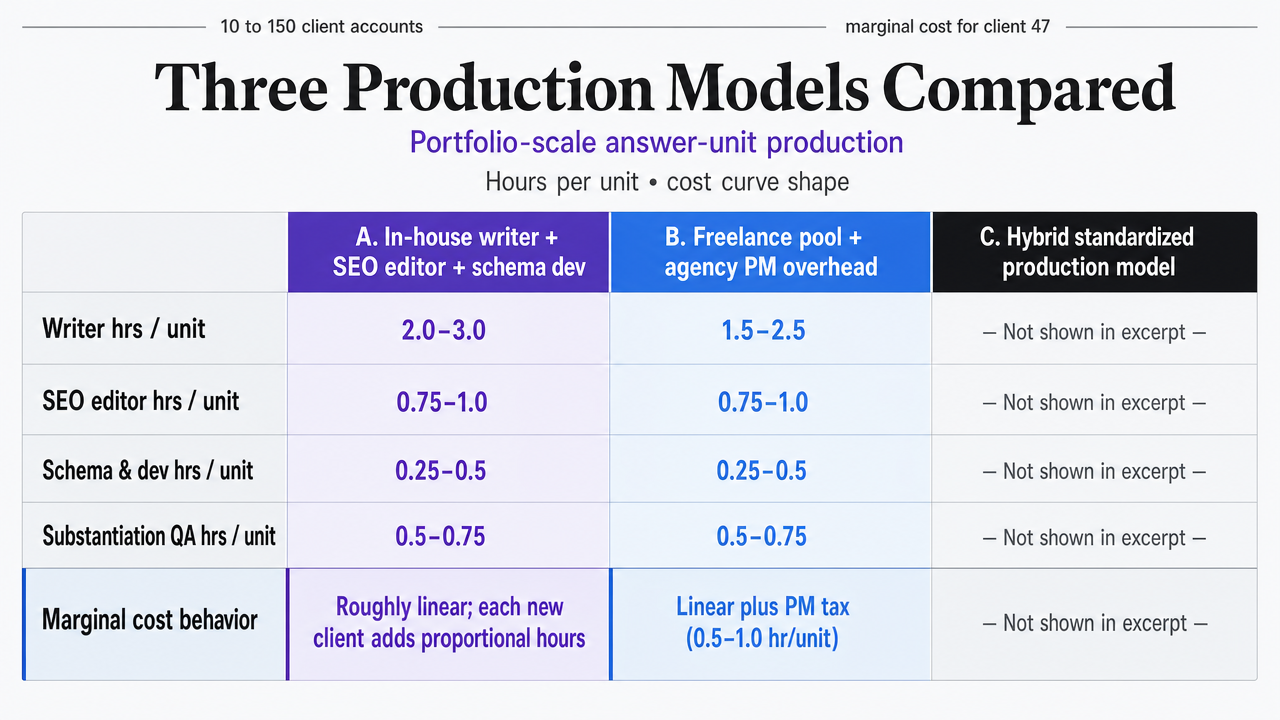 Render the three production models comparison table as a scannable side-by-side infographic, directly supporting the labor mix comparison discussed in this section
Provenance and Editorial Accountability in AI-Assisted Production
Model C's viability depends on a robust provenance record. NIST's synthetic content report defines provenance data tracking as recording a digital asset's origins and history to support authenticity, integrity, and credibility 5. For an agency using AI-assisted answer-unit production across a portfolio, this record is essential for defensible delivery.
Minimum ledger fields include:
- draft author (human or model, with version),
- evidence sources consulted,
- substantiation snapshots,
- named human reviewer with credential and review date,
- publish timestamp, and
- revision history.
NIST identifies provenance, labeling, detection, testing, and auditing as distinct approaches to digital-content transparency, noting that no single method provides complete transparency 7. Provenance is the aspect an agency directly controls.
Two operational rules follow. AI-detector scores are not a substitute for editorial review; NIST's GenAI pilot study explicitly states that detection performance does not equate to factual accuracy or usefulness 8. Furthermore, the ledger should reside within the CMS record for each unit, not in a separate spreadsheet, allowing client audits to be resolved with a single query.
See How Leading Agencies Operationalize AEO-Ready Content Across Brands
Connect with our team to benchmark your current AEO optimization workflows and discover approval-first automation that accelerates answer-first content production at scale.
What Not to Measure
Three commonly reported AEO metrics do not withstand scrutiny. First, raw citation count without query context is misleading. A client cited 400 times a month for irrelevant queries is not a meaningful result. Citations are only valuable when linked to the query taxonomy that drives Downstream Qualified Action, a connection enforced by the four-layer measurement stack.
Second, AI-detector scores are not a proxy for quality. NIST's GenAI pilot study clarifies that detection performance indicates whether text appears machine-generated, not its accuracy or usefulness 8. An answer unit scoring "100% human" but containing a factual error about drug interactions is inferior to a flagged draft that is factually correct and properly attributed. Detector scores have no place in an AEO scorecard.
Third, any performance claim an agency cannot substantiate on demand is problematic. The FTC's Workado order sets the standard: accuracy and efficacy claims about AI outputs require competent and reliable evidence retained prior to publication 3. A claim like "Our AEO program lifted citations 340%" must be able to withstand a client's legal review, not just appear on a slide.
A 90-Day Operating Plan for Agency Delivery Teams
This plan assumes an agency delivery organization establishing AEO as a portfolio capability, not a single-account pilot. Ninety days is sufficient to prove the end-to-end loop if the work is sequenced effectively.
- Days 1–30: Build the evaluation loop before the production loop. Select five priority queries per client across three anchor accounts. Decompose each query into its factual nuggets. Log which URLs appear as cited sources on AI Overviews, Perplexity, ChatGPT search, and Gemini. This baseline provides the Retrieval Eligibility and Nugget Coverage data against which the rest of the quarter's performance will be measured. NIST's TREC 2025 RAG track treats retrieval, coverage, and attribution as separate scored dimensions 4; internal evaluation should mirror this separation from day one.
- Days 31–60: Stand up answer-unit production against the substantiation gate. Rework one content workflow to focus on answer units: claim-first passages, sentence-level citations, and an evidence folder attached to each unit before publication. Enforce the substantiation checklist derived from the Workado order for every claim 3. Add provenance ledger fields to the CMS record so the review trail is integrated with the unit, not in a separate spreadsheet.
- Days 61–90: Close the loop to Downstream Qualified Action. Integrate citation logs with CRM events for the anchor accounts. Report Sentence-Support Rate and Nugget Coverage alongside qualified conversions 1. Present the four-layer stack to clients as the ongoing scorecard. By month four, the goal is a repeatable delivery model, not just a case study.
Frequently Asked Questions
References
- 1.Proceedings - Retrieval Augmented Generation (RAG) 2025.
- 2.FTC Order Requires Online Marketer to Pay $1 Million for Deceptive Claims Its AI Product Could Make Websites Compliant with Accessibility Standards.
- 3.FTC Approves Final Order against Workado, LLC, Which Misrepresented Accuracy of Its Artificial Intelligence Content Detection Products.
- 4.Overview of the TREC 2025 Retrieval Augmented Generation (RAG) Track.
- 5.Reducing Risks Posed by Synthetic Content.
- 6.Text REtrieval Conference (TREC) 2024 RAG Search Track.
- 7.Reducing Risks Posed by Synthetic Content: An Overview of Technical Approaches to Digital Content Transparency.
- 8.2024 NIST GenAI (Pilot Study): Text-to-Text Evaluation Overview and Results.
- 9.The 2025 AI Index Report.
- 10.Federal Trade Commission Announces Final Rule Banning Fake Reviews and Testimonials.
- 11.The Consumer Reviews and Testimonials Rule: Questions and Answers.
- 12.Confronting Health Misinformation: The U.S. Surgeon General’s Advisory on Building a Healthy Information Environment.