
Key Takeaways
- An agency-grade AEO tool must handle four jobs: monitoring share-of-answer, attributing AI visibility to pipeline, structuring content for citation, and governing production through approval workflows.
- Monitoring should track share-of-answer within defined competitive sets across engines, with polling frequencies matched to retrieval behavior since Perplexity re-indexes per query while ChatGPT often relies on training data 15.
- Attribution needs to bridge zero-click AI answers to pipeline through branded search, UTM-segmented direct traffic, and CRM integration, since referral logs underreport influence 7.
- Structural automation of FAQ quality, answer clarity, statistical density, and heading structure drives 71% of citation likelihood, and rewriting the first 30% of pages is where specialist hours compound 13.
- Governance through per-client approval queues, diff views, and evidence libraries prevents unreviewed automation from damaging client retention or creating liability in regulated verticals 6.
- With 2000% growth in the AEO category, filter vendors by their original function, insist demos cover all four jobs, and reject blended cross-engine visibility scores 2.
- Retainers anchored on link packages and rank reports should shift toward share-of-answer, structural remediation, evidence-library upkeep, and prompt-cluster testing tied to pipeline stages.
- A 30-day pilot on a controlled page set should demonstrate citation lift consistent with the 17.3% structural optimization benchmark before signing an annual contract 13.
Why AEO tool selection is now a portfolio infrastructure decision
Agency heads of SEO recognize the growing importance of answer engines. A March 2026 analysis by Averi found that 73% of B2B buyers use AI tools like ChatGPT and Perplexity during purchase research9. This trend directly impacts agencies, as clients increasingly question their brand's visibility in AI-generated answers.
The choice of an AEO tool for an agency is not merely about features; it's a strategic infrastructure decision. It dictates the cost per client, the efficiency of specialists, and the capacity of a delivery team to manage multiple accounts without compromising quality. A tool that only tracks mentions or generates content in isolation fails to address the comprehensive needs of agencies, particularly the measurement layer clients will demand.
McKinsey's perspective on AI-powered interfaces as the new gateway to the internet8 highlights the strategic significance. Operationally, the key question for agencies is which capabilities must be integrated into a single system to effectively manage answer-engine optimization across 30, 60, or 120 client sites without increasing headcount. This article explores this question through a decision framework, outlining the essential functions a tool must perform, key metrics to track, outdated services to discontinue, and how delivery economics shift with automated structural optimization.
The four jobs an agency-grade AEO tool has to do
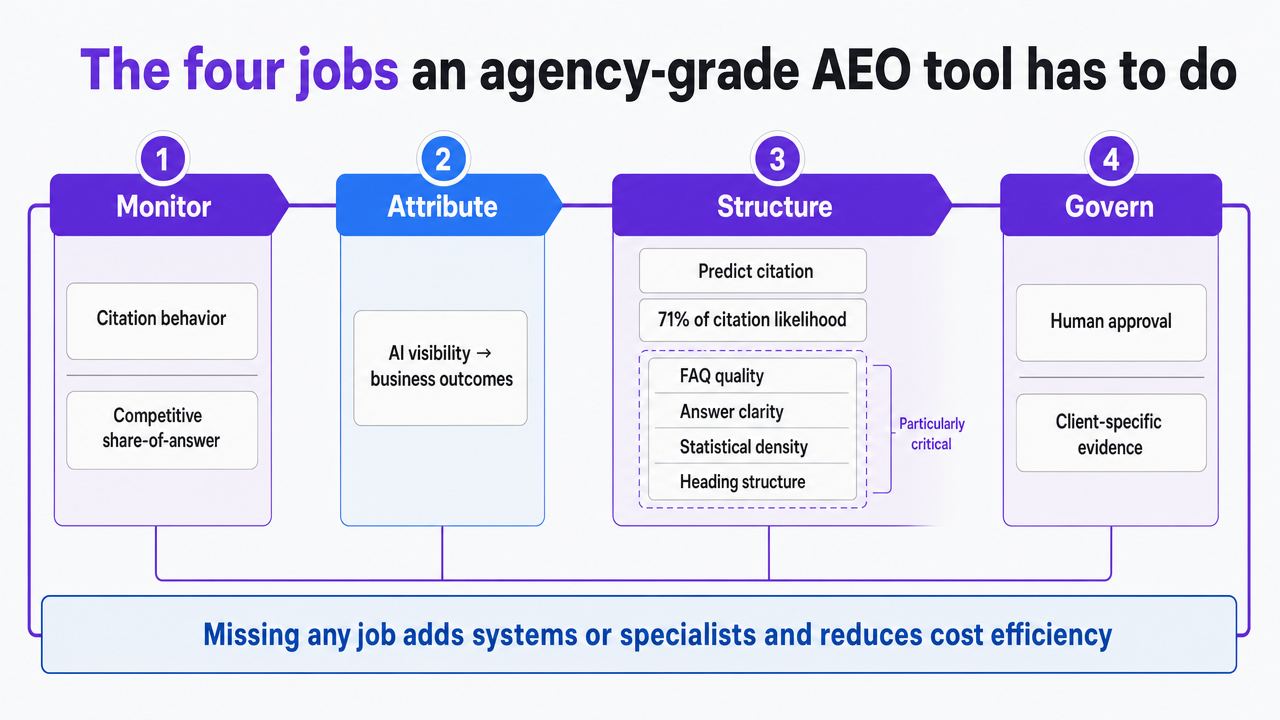
While vendors often highlight numerous features, an effective AEO tool for agencies must perform four core functions:
- Monitor citation behavior and competitive share-of-answer
- Attribute AI visibility to business outcomes
- Structure content to predict citation
- Govern production through human approval and client-specific evidence
A tool lacking any of these capabilities necessitates additional systems or specialists, negating the cost efficiencies AEO tooling aims to provide.
The "Structure" job is particularly critical, with a strong evidence base. Research from the AEO Checklist indicates that FAQ quality, answer clarity, statistical density, and heading structure collectively account for 71% of citation likelihood across eight studied signals13. This significant correlation means that evaluating a tool without considering its ability to automate these four signals overlooks a major driver of outcomes. The following framework assesses each job as a distinct scoring axis, evaluating it against research on citation rates and the practicalities of agency delivery across varying client loads.
Job 1 — Monitor: citation and share-of-answer across engines
Monitoring is an area where many AEO vendors emphasize superficial features, potentially misleading agencies. Simple citation counts can be deceptive. The Query Fan Out experiment, which ran 270 queries across ChatGPT, Gemini, and Perplexity, revealed that alternative recommendations consistently originate from a limited pool of brands. The same names reappear across different phrasings, with their ranking shifting but the overall roster remaining stable15. This "share-of-answer" within a defined competitive set is the crucial metric, rather than a single, isolated brand appearance.
The experiment also highlighted significant retrieval differences between engines. Perplexity performed web searches for 100% of captured queries (90 out of 90), whereas ChatGPT did so for only 44%15. Perplexity re-indexes information with each prompt, while ChatGPT often relies on prior training data. A monitoring tool that polls both engines at the same frequency might overspend on ChatGPT and fail to capture Perplexity's rapid content volatility.
Essential tool requirements include:
- client-specific prompt-cluster libraries (covering category questions, alternatives, and buyer-stage variations)
- competitive-set definitions for accurate share-of-answer calculation
- engine-specific polling frequencies
- the ability to capture sentiment or recommendation context, not just brand mentions
A tool must differentiate between a brand being recommended and being cited as a fallback option. Without these capabilities, dashboards may appear active but provide little actionable insight into client performance within the answer layer.
Job 2 — Attribute: tying AI visibility to pipeline
Attribution is frequently overlooked by AEO tools. They typically report citations and prompt coverage, leaving the crucial link to pipeline outcomes for the agency's analyst. This gap often leads to retainer non-renewals, as clients need to see a clear connection between AI visibility and bookings.
A key challenge is that AI answers often don't generate clicks. Nielsen Norman Group's research found that AI-generated overviews at the top of search results pages capture significant attention, often eliminating the need to visit the underlying page7. Referral traffic from LLM interfaces therefore underreports the actual impact on buyer behavior. A robust pipeline-attribution layer must account for this zero-click influence, rather than solely relying on GA4 referral logs.
Concrete capabilities to evaluate include:
- tracking branded search volume as a proxy for AI exposure
- segmenting direct traffic with UTM parameters
- integrating with CRM for form-fill and call tracking to attribute AI-driven leads
- mapping prompt-to-outcome to identify which category questions correlate with pipeline growth over time
Tools that only offer citation counts and referral traffic will not withstand a client's CFO review.
For agencies, two additional requirements are vital. First, cross-client benchmarking, allowing comparison of a client's citation-to-booking conversion against portfolio norms, transforming AEO into a strategic account planning input. Second, an alerting system that signals drops in share-of-answer before they impact pipeline, enabling proactive intervention. Attribution should function as an early-warning system directly linked to retainer health.
Job 3 — Structure: automating the signals that predict citation
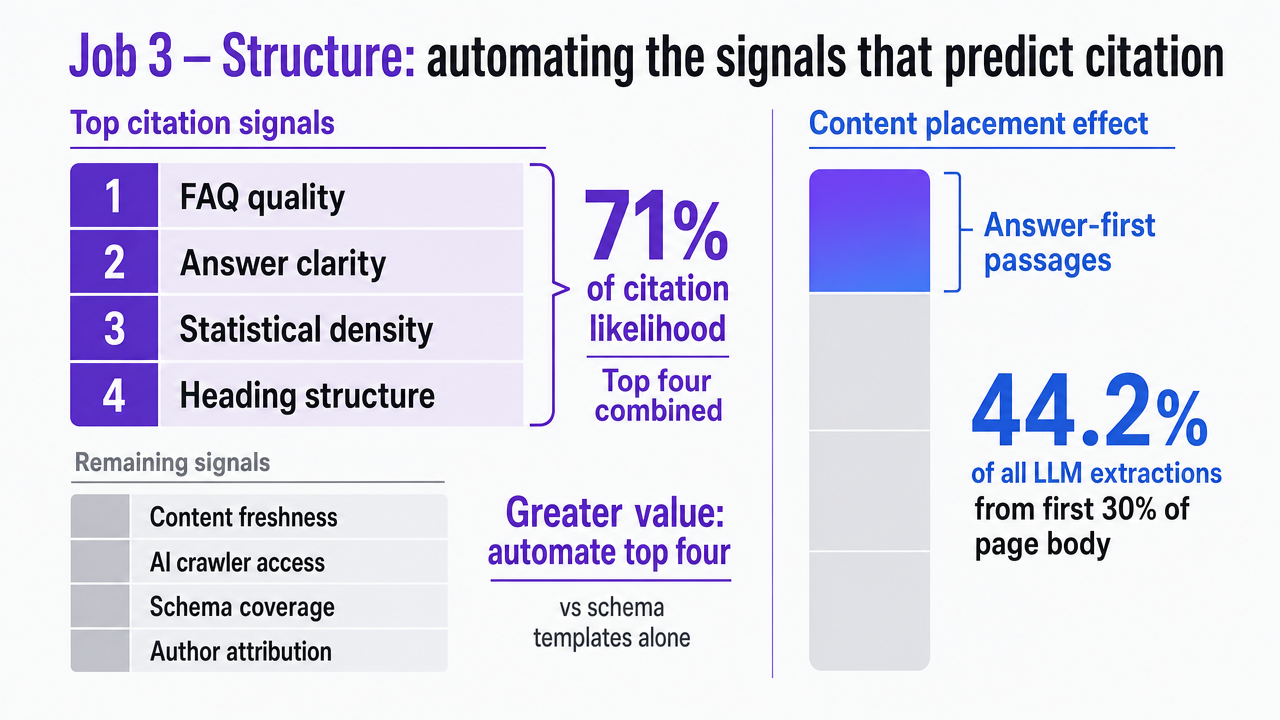
The "Structure" job offers the clearest outcome benchmark and is where tool selection significantly impacts specialist efficiency. The AEO Checklist identifies FAQ quality, answer clarity, statistical density, and heading structure as the top four citation signals, collectively accounting for 71% of citation likelihood13. The remaining signals include content freshness, AI crawler access, schema coverage, and author attribution. A tool that automates the optimization of these top four signals across a client portfolio provides greater value than one focused solely on schema templates.
Content placement further amplifies this effect. The same research found that 44.2% of all LLM extractions come from the first 30% of a page's body content13. The tool must be able to produce and maintain "answer-first" passages at the top of pages, self-contained enough for direct quotation, at scale. If specialists must manually restructure numerous pages per client to achieve this, the tool has not effectively automated the task.
Agencies should evaluate if the tool can:
- audit and rewrite the first 30% of content with answer-first passages
- generate and maintain FAQ blocks with schema
- identify pages lacking statistical density and suggest source-backed inserts
- enforce heading structures that align with common category questions
While bulk auditing is a baseline, the ability to perform bulk remediation with human approval is the true measure of capability.
The outcome benchmark for vendors is specific: structural optimization alone led to a 17.3% citation lift and an 18.5% quality-rating lift across six generative engines, as summarized in the AEO Checklist13. This metric should be central to vendor pilot discussions. If a tool cannot commit to a citation-lift target over a defined test period on a specific page set, it is likely selling monitoring under the guise of optimization. The "Structure" job directly translates into reclaimed specialist hours per client, which is a key driver of delivery economics.
 Show the ranked citation signals and the 71% concentration in the top four, plus the 44.2% first-30%-of-page extraction stat, both cited in nearby prose
Job 4 — Govern: approval workflows and per-client evidence libraries
The "Govern" function distinguishes tools designed for individual users from those built for agencies managing retention risk across multiple clients. At portfolio scale, quality degradation often stems from content being published without human review due to overloaded queues. An AEO tool that automates structural rewrites without a mandatory approval step risks publishing content that misrepresents a client's services, credentials, or claims, leading to retention issues and potential legal liabilities in regulated industries.
Practitioner guidance on LLM SEO explicitly advises against fully AI-generated content and recommends human review for any material intended to earn AI citations6. The tool must embed this review process as a default. Agencies should score vendors on:
- per-client approval queues with role-based routing
- diff views showing exact changes before publication
- batch approval for low-risk edits (like schema or headings) versus single-item review for high-risk edits (claims, statistics, service descriptions)
- auditable logs for client inspection
The second aspect of governance is the evidence library. Answer engines reward specific, quotable facts—statistics with sources, named methodologies, and credentialed authors4. At agency scale, these facts must be centrally stored per client and kept current. A tool without a per-client evidence library forces specialists to repeatedly source the same statistics across various pages and quarters, creating the manual overhead that AEO tooling should eliminate.
Approval-first governance enables agencies to increase their client-to-specialist ratio without compromising quality. It is the operational counterpart to the outcome benchmarks achieved in Job 3.
 Visualize the four-job evaluation framework (Monitor, Attribute, Structure, Govern) that the section defines as core AEO tool selection criteria
Filtering vendor noise in a category that grew 2000%
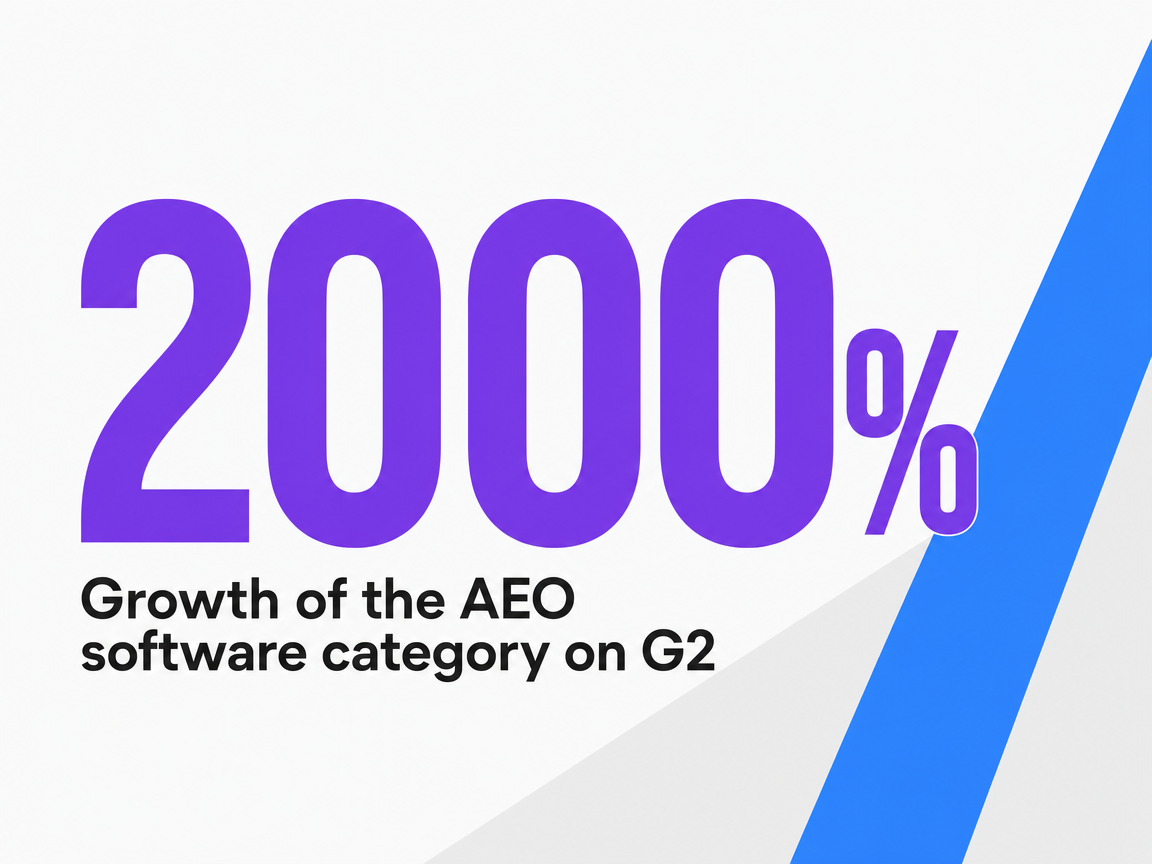
The AEO software category on G2 experienced a 2000% increase in listings, indicating rapid vendor expansion that outpaced agencies' ability to evaluate options2. This growth doesn't necessarily signify quality; rather, it suggests that many offerings are repurposed SEO software, content generators with citation-tracking add-ons, or brand-monitoring tools that recently incorporated prompt logging.
Three filters can quickly narrow down the shortlist.
- Inquire about the tool's original function six months prior. If it was primarily a rank tracker or content ideation platform, its AEO capabilities are likely superficial, offering only basic citation counts or lacking share-of-answer analysis and structural remediation. The G2 category description itself notes confusion between AEO tools and SEO platforms2, a confusion vendors often exploit.
- Insist that demos focus on the four core jobs. Ask vendors to demonstrate, using a live client account or sandbox, how their tool monitors share-of-answer within a defined competitive roster, attributes AI visibility to a client's existing CRM pipeline metrics, rewrites the first 30% of a page with answer-first passages, and routes these rewrites through a per-client approval queue. Vendors that can only demonstrate two of these four functions are likely single-purpose tools priced as comprehensive platforms.
- Disregard marketing claims that ignore engine-specific differences. A tool that provides a single, blended "AI visibility score" across ChatGPT, Perplexity, Gemini, and Claude averages behaviors that differ significantly at the retrieval layer15. Agencies require per-engine breakdowns to determine where a client's structural optimization efforts will yield the most impact, rather than a consolidated number that obscures critical details.
The most effective filter is to ask for a specific outcome benchmark the vendor will commit to during a defined pilot period on a specific page set. Vendors selling monitoring disguised as optimization will typically decline this. Those offering genuine optimization will provide a citation-lift target and a clear measurement methodology.
Test AEO automation workflows on live projects now
Validate AEO process efficiency and quality control using your actual client campaigns—no sandbox restrictions during trial.
What to stop selling and what to start selling clients
The decision to adopt an AEO tool necessitates a re-evaluation of retainer structures. Practitioner analysis of LLM SEO suggests that traditional ranking metrics like domain rating and backlinks are less influential for AI chatbot citations compared to content depth, answer clarity, and readability5. While this claim is debated within traditional SEO circles—as links still impact Google's classical index, which feeds AI Overviews—the operational implication for agencies is clear: retainers focused on link volume and DR movement are selling an input that is becoming less relevant for a growing segment of client discovery.
Agencies should move away from selling:
- monthly link packages as primary deliverables
- generic content calendars based solely on publish cadence
- rank-tracking reports that ignore client visibility in AI platforms like ChatGPT, Perplexity, Gemini, or Google AI Overviews
While these elements still have a place, they cannot be the sole anchors of a 2026 retainer without clients eventually questioning the agency's approach to the answer layer.
Instead, agencies should focus on selling share-of-answer within defined competitive sets, structural remediation of the first 30% of priority pages, evidence-library maintenance, and prompt-cluster testing linked to client pipeline stages. Frame these outputs in terms of client revenue: which buyer questions the client wins, which competitors appear when the client should, and the specific actions the delivery team is taking to improve these metrics. The right AEO tool makes these deliverables achievable without increasing headcount.
The math on scaling AEO across a client book
The economic case for an AEO tool becomes clear when breaking down the work into hours. For a mature retainer, monthly AEO scope typically involves five recurring tasks:
- prompt-set testing across engines
- citation and share-of-answer monitoring
- structural remediation of priority pages
- evidence-library maintenance
- client reporting
H : the total specialist hours per client per month for manual execution
R : the fully-loaded hourly cost of that specialist
N : the number of clients
Manual delivery costs scale as N × H × R. Specialist capacity limits this: a senior operator with approximately 120 productive hours per month, and H between 8 and 14 hours per client for comprehensive AEO, can manage 9 to 15 accounts before quality declines. Exceeding this requires a new hire or reduced scope.
An AEO tool that automates monitoring and structural remediation significantly reduces H. This reduction isn't uniform across all tasks; reporting and prompt-set testing shrink most, structural remediation shrinks considerably (with human approval), and evidence-library curation shrinks least due to the need for specialist judgment. Let the automated hours be H'. Agencies should model the delta as N × (H − H') × R, minus the tooling cost. This figure represents the headcount-avoidance value, which increases linearly with the client book.
On the value side, structural research shows a 17.3% citation lift and an 18.5% quality-rating lift across six generative engines when structural optimization is properly implemented13. Agencies holding vendors to this benchmark on a defined page set can price retainers based on measurable output, not just hours. When the tool delivers this lift and reduces H, margins expand on existing accounts, and the number of clients a specialist can manage increases. This is how AEO tooling improves agency P&L without requiring organizational changes.
See How Leading Agencies Select and Operationalize AEO Tools at Scale
Connect with our team to review your agency’s current AEO workflow and receive a custom, data-driven assessment for scalable, approval-driven implementation across all client verticals.
If you manage multi-location client accounts: added tool requirements
For agencies managing multi-location accounts—such as DSOs, home service franchises, senior living groups, regional law firms, or behavioral health networks—the AEO tool requirements differ significantly from those for single-entity brands. Most AEO vendors have not developed solutions for these specific needs.
The core challenge is that answer engines resolve queries geographically. Prompts like "Best orthodontist near me" or "orthodontist in Grand Rapids" yield different citation pools than brand-level category questions. Perplexity's per-query web search behavior15 means location-modified prompts refresh independently of the corporate site's ranking. A monitoring system that reports a single national share-of-answer for a 60-location client obscures 60 distinct competitive landscapes.
Four additional requirements for multi-location work should be added to the vendor scorecard:
- Per-location prompt libraries with city and service-line modifiers, tracked against location-specific competitive sets rather than the parent brand's national roster.
- Bulk structural remediation for location pages, including FAQ blocks, answer-first passages in the first 30% zone, and consistent heading structures across hundreds of pages without manual editing13.
- Per-location evidence libraries to ensure accurate credentials, service scopes, and licensure claims on each site's pages.
- Roll-up reporting that aggregates share-of-answer to the parent brand while retaining location-level drill-downs for operational leads.
Agencies that overlook these requirements risk having delivery costs scale linearly with the number of locations rather than the number of clients, a failure mode that AEO tools are designed to prevent.
A 30-day evaluation playbook before you sign
While vendor presentations can secure initial interest, pilots are essential for validating outcome claims. A 30-day evaluation should compel the tool to demonstrate all four core jobs on a live account before committing to an annual contract.
- Days 1–5: Select two clients—one single-entity and one multi-location. Provide the vendor with a defined competitive roster, a prompt-cluster library covering category and alternatives-to questions, and a page set of 15–25 priority URLs. Demand per-engine baselining across ChatGPT, Perplexity, Gemini, and Google AI Overviews, rejecting any blended visibility scores.
- Days 6–20: The vendor performs structural remediation on the designated page set, with human approval routed through the agency's queue. The objectives include: answer-first passages in the first 30% zone, FAQ schema, statistical density with sourced inserts, and heading structures that align with the prompt clusters13.
- Days 21–30: Re-poll the prompt library and measure the citation delta, share-of-answer movement within the roster, and any branded-search or direct-traffic lift as a zero-click proxy7. Hold the vendor to a citation-lift range consistent with the 17.3% benchmark from structural optimization research13. If the tool cannot demonstrate measurable improvement on a controlled page set within 30 days, it will not scale effectively across 60 accounts.
 Growth of the AEO software category on G2
Growth of the AEO software category on G2
Frequently Asked Questions
References
- 1.The Influence of Generative AI on Information Search and Retrieval in Consumer Decision Making.
- 2.Inside the 2000% Growth of the AEO Software Category on G2.
- 3.B2B Marketers Need to Know AEO – Answer Engine Optimization.
- 4.Answer Engine Optimization for B2B.
- 5.Transform Your SEO Strategy for the AI Era: Complete LLM Optimization Guide.
- 6.LLM SEO: The Ultimate Guide to Ranking in AI Search.
- 7.How AI Is Changing Search Behaviors.
- 8.New front door to the internet: Winning in the age of AI search.
- 9.73% of B2B Buyers Use AI Tools in Purchase Research, Analysis ....
- 10.AI Answer Engines Are Shaping Shopping Behavior, Especially Among Younger Adults.
- 11.How Consumer Search Behavior Has Changed With AI Search: Full Market Study.
- 12.The Year in Data: 2024 Review and Predictions for 2025.
- 13.AEO Checklist: Get Cited by ChatGPT, Perplexity, and Claude.
- 14.LLM SEO: How to Rank in ChatGPT, Perplexity & Gemini.
- 15.Query Fan Out Experiment: How ChatGPT, Gemini, and Perplexity Recommend Alternatives.