
Key Takeaways
- BrightEdge suits enterprise QBRs because its Hyper Cube module tracks brand presence across ChatGPT, Gemini, Perplexity, and AI Overviews with impression-weight evidence built for boardroom narratives 13.
- Conductor anchors the competitive gap slide by tracking brand mentions and citations against named competitors over time, exposing where rivals are recommended in answers the client is absent from 13.
- Surfer AI Tracker delivers prompt-level diagnostics, showing which sources LLMs cite when the client is missing, feeding content briefs that target citation weight rather than keyword volume 13.
- Scrunch represents specialized trackers running daily probe queries across LLMs, converting raw citation counts into qualified presence through sentiment layers that distinguish neutral mentions from recommended provider status 14.
- Semrush and Ahrefs AI modules preserve reporting continuity for mid-market retainers that cannot absorb another SaaS line, though they lag specialized tools on prompt-level and sentiment depth 13.
- GSC and GA4 form the non-negotiable foundational layer, surfacing AI-segmented impressions and referral traffic from AI-adjacent domains before any specialized purchase is justified 12.
- Execution platforms close the loop from visibility signal to published page, compressing the brief-to-approval workflow where analyst hours accumulate faster than any dashboard reflects.
Why Rank Tracking Stopped Correlating With Retention
The math that carried agency retainers for a decade has broken. When a top-ranking page earned an average 39.8% click-through rate at position one 5, a Head of SEO could walk into a QBR with a rank movement chart and a traffic curve and let the correlation do the talking. That correlation no longer holds. Ahrefs' 2026 dataset, compiled into a widely-cited benchmark, found that when an AI Overview appears on the results page, the top-ranking organic result loses roughly 58% of its clicks against historical norms — Google now keeps 58 of every 100 clicks that page would have earned 4. The scope matters: this measures top-position pages on queries where AI Overviews are present, not every query in a client's keyword universe. But those are precisely the informational and commercial-investigation queries most agency content targets.
The retention consequence is direct. A page can hold position one, gain impressions, and still deliver a traffic chart trending down. Clients read that chart before they read the strategy memo attached to it. Rank tracking, in isolation, now underreports the work an agency did to earn the ranking in the first place — and overreports the traffic that ranking should have produced. AEO tracking software exists to close that gap by measuring visibility inside the answer layer, not just the blue-link layer beneath it.
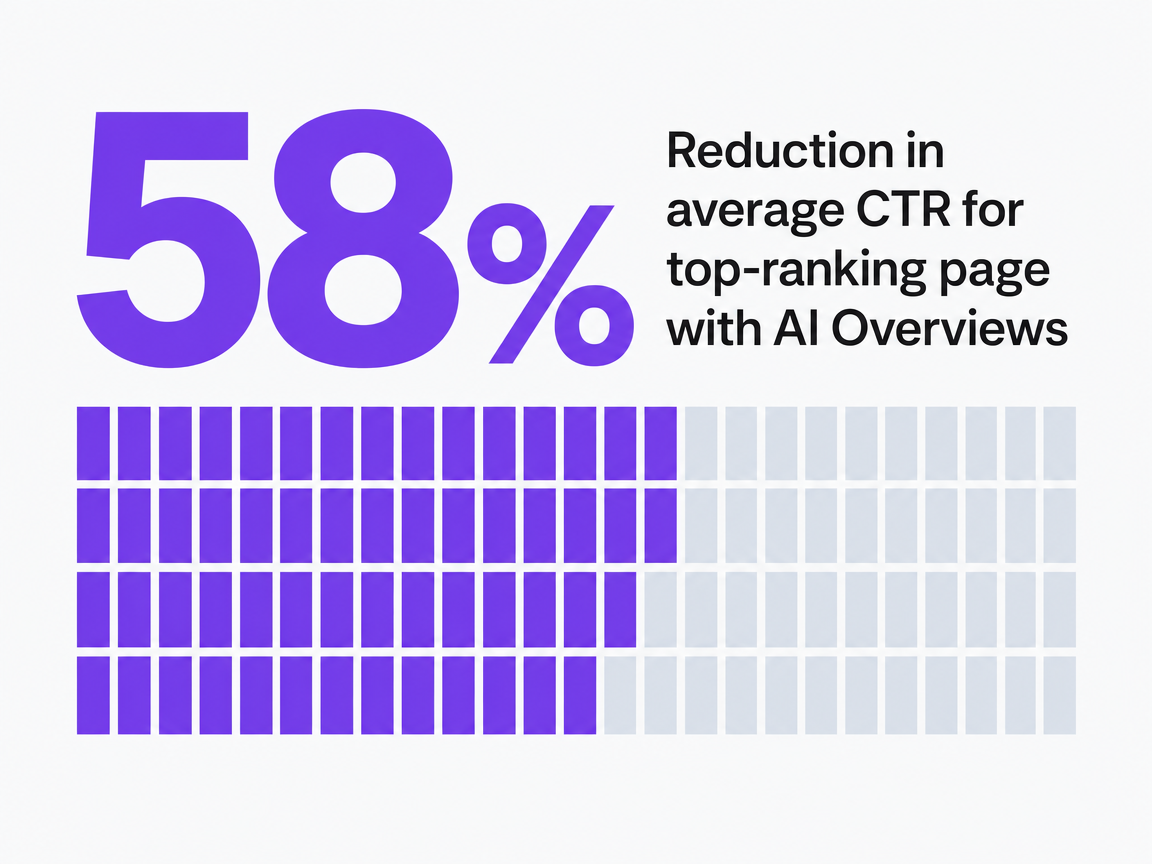 Reduction in average CTR for top-ranking page with AI Overviews
Reduction in average CTR for top-ranking page with AI Overviews
The 4-Axis Rubric Behind This Shortlist
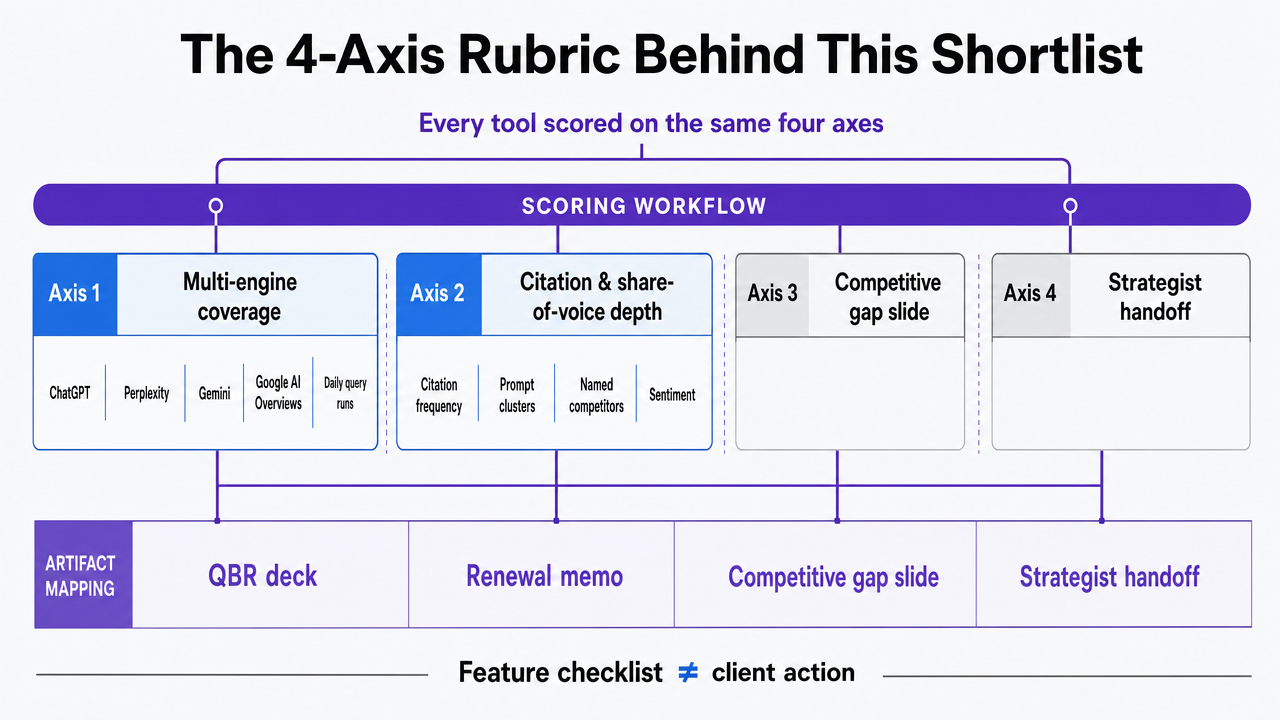
Every tool below is scored against the same four axes, chosen because they map to the specific artifacts a Head of SEO has to produce: the QBR deck, the renewal memo, the competitive gap slide, and the strategist handoff. Feature-checklist reviews miss this. A platform can list forty capabilities and still fail to generate a chart a client will act on.
Axis 1 — Multi-engine coverage : The tool must probe ChatGPT, Perplexity, Gemini, and Google AI Overviews at minimum, ideally with daily query runs across each. Specialized AEO trackers now standardize on daily probe queries across major LLMs 14; anything less produces a snapshot that ages out inside a reporting cycle.
Axis 2 — Citation and share-of-voice depth : Presence is the low bar. What matters is citation frequency by prompt cluster, share of voice against named competitors, and sentiment on the mention itself 14. A brand cited neutrally in a comparison answer is not the same asset as a brand cited as the recommended provider.
Axis 3 — Attribution integration : The tool has to reconcile AI visibility signals with GSC impressions and GA4 behavior in one view. Otherwise the strategist rebuilds the story in a spreadsheet every month.
Axis 4 — Client-reporting output : Can an analyst export a slide, not a screenshot? That single question separates tools that scale across a book from tools that consume analyst hours instead of saving them.
Redefining Performance When 60% of Searches End Without a Click
Two independent datasets now define the reporting problem. Sparktoro/Datos analysis synthesized across multiple studies found that more than 60% of U.S. Google searches end without a click on any result 6. Pew Research, tracking 68,879 real Google searches from 900 U.S. adults, quantified how AI summaries compound that pattern: users clicked a traditional search result in 8% of visits when an AI summary appeared, versus 15% when one did not 15. Only 1% of visits produced a click on a source link inside the summary itself 15.
Read together, these numbers force a reporting shift. Clicks are no longer the primary output of a well-optimized page — they are the residual after answer engines have already served the user. A Head of SEO who continues to sell retainers on organic sessions alone is defending a metric the platform is actively suppressing. The remaining evidence of work performed sits in what tracking software can still see: which prompts trigger a client mention, how often the client is cited relative to competitors, and whether that citation is neutral, favorable, or recommended.
This is why specialized AEO trackers now treat citation frequency, share of voice, and sentiment as primary KPIs rather than supporting metrics 14. The reporting artifact a client renews against has to lead with presence data and treat sessions as a downstream consequence, not the headline. Anything less asks the client to grade the agency on a scoreboard the search engine has quietly turned off.
Test AEO tracking on live client projects risk-free
Validate reporting accuracy and workflow impact before making a commitment.
The Seven Tools
BrightEdge — For the Enterprise QBR That Needs Impression-Weight Evidence
BrightEdge earns its place on this list because its own operational data crystallizes the reporting problem every enterprise agency now faces. The platform reported that search impressions jumped 49% year-over-year while click-through rates dropped 30% across its dataset 9. That single comparison — visibility expanding, engagement contracting — is the QBR argument in one chart. When an analyst walks a Fortune 1000 marketing lead through a retention conversation, this is the shape of the story they have to tell.
The Hyper Cube module tracks brand presence across ChatGPT, Gemini, Perplexity, and Google AI Overviews, giving enterprise teams a structured view of AI citation gaps rather than a screenshot audit 13. BrightEdge is positioned specifically for organizations that require AI visibility to inform broader SEO reporting and decision-making 13, which is another way of saying its output is built for a boardroom, not a strategist's desktop.
The honest limitation: BrightEdge is priced and configured for enterprise books. A five-client boutique agency will find the annual license absorbs margin faster than the reporting artifact returns it. The tool also assumes analysts have the bandwidth to interpret its outputs into a client narrative — the software surfaces the data, but the QBR story still gets written by a human. For agencies with two or three enterprise accounts anchoring the book, the impression-weight evidence justifies the line item. For mixed rosters, the ROI math tightens quickly.
Conductor — For the Competitive Gap Slide
Conductor's AI Search Performance report is built around the one slide every renewal conversation eventually reaches: how does the client stack against the two or three competitors the CMO watches. The module tracks brand mentions, website citations, and cited pages across AI search engines, then lets analysts compare those signals against named competitors over time 13. That structure matches how a Head of SEO actually assembles the competitive gap slide — not by prompt count, but by which competitor is being recommended in the answer where the client is absent.
The platform's strength is the temporal view. Citation share against a competitor set on day one, day thirty, and day ninety tells a story that a static snapshot cannot. When the client asks why the retainer should renew at the current rate, a widening citation gap against a specific competitor is the answer that lands.
Where Conductor struggles is at the prompt diagnostic level. It will show that a competitor is winning citation share on a topic cluster, but the workflow to translate that finding into a specific content brief still runs through the strategist's judgment. Analysts should expect to pair Conductor's competitive data with a prompt-level tool when the client asks the follow-up question: which specific answers do we need to earn our way into.
Surfer AI Tracker — For Prompt-Level Content Diagnostics
Surfer's AI Tracker captures prompt-level insights and the sources LLMs pull from, exposing content gaps at a granularity most enterprise suites blur over 13. For a Head of SEO who owns the content brief pipeline, that specificity matters. The tool answers a question a competitive dashboard cannot: when the client is absent from a Perplexity answer, which sources did the engine cite instead, and what do those sources contain that the client's page does not.
That output feeds directly into the strategist handoff. A content brief anchored in the specific citations an LLM prefers on a target prompt is materially different from a brief built on keyword volume. It shifts the writing target from ranking against ten organic competitors to earning citation weight against three or four sources the engine already trusts.
The tradeoff is scope. Surfer's tracker sits closer to the content team than the client-reporting layer. Its outputs feed the production pipeline, not the QBR deck directly. Agencies pairing it with a broader visibility platform get the full picture; agencies expecting it to replace enterprise citation reporting will find gaps at the executive summary level.
Scrunch — For Daily Multi-LLM Citation Monitoring
Scrunch is representative of the newer category of specialized AEO trackers built around daily probe queries. Comparative reviews describe this class of tool as running daily probe queries across major LLMs and reporting on citation frequency, share of voice versus competitors, and sentiment 14. For a Head of SEO managing a book where any given client can request an ad-hoc visibility check, that daily cadence is the difference between a fresh answer and a stale one.
Sentiment tracking is where Scrunch and its peers earn their place against generalist platforms. A brand cited neutrally in a comparison answer is not the same asset as a brand cited as the recommended provider — and clients who see the distinction stop treating citation count as a vanity metric. The sentiment layer converts raw presence into qualified presence.
The limitation to name: probe queries are a sample, not a census. Two vendors probing the same LLM on the same day can report different citation frequencies depending on prompt phrasing and seed variation. Analysts should treat the trend line as the signal and any single-day figure as directional. Clients who understand the sampling caveat trust the report more, not less.
Semrush + Ahrefs AI Modules — For the Retainer That Can't Afford Another SaaS Line
Not every account carries the margin to justify a dedicated AEO tracker on top of the existing SEO stack. Semrush and Ahrefs have both extended into AI visibility, and industry overviews now group them with Scrunch, Goodie, Surfer AI Tracker, and BrightEdge as contributors to modern AEO monitoring 13. For mid-market retainers already paying for one of these platforms, the AI module is the pragmatic starting point rather than the ceiling.
The reporting job these modules do well is continuity. An analyst who has spent two years training a client to read Semrush-shaped charts does not need to introduce a new visual grammar in the QBR — the AI visibility data slots into the existing deck. That reduces the strategist's explanation overhead and preserves the client's mental model of the reporting cadence.
The honest limitation is depth. The generalist platforms do not yet match specialized trackers on prompt-level diagnostics, daily multi-LLM probe cadence, or sentiment granularity. Agencies with a client actively demanding competitive citation share by prompt cluster will outgrow the module inside a quarter. For accounts where the client asks quarterly whether the brand shows up in AI results at all, the module answers the question at the price already committed.
GSC + GA4 as the Foundational Layer — Before You Buy Anything Specialized
Search Engine Land's practitioner toolkit for AEO leads with Google Search Console and GA4 before any specialized tracker, positioning both as foundational measurement infrastructure 12. Search Console provides direct data on how a site performs in Google Search, and GA4 tracks on-site behavior and referral traffic sources — including visits from AI-adjacent platforms 12. Any agency evaluating a specialized purchase should first confirm the foundational layer is actually being read, not just accessed.
The value here is diagnostic honesty. GSC's AI report surfaces impression and click data segmented by AI surface, which lets an analyst distinguish visibility gains from click declines within the same property. GA4 referral data, filtered for domains associated with AI engines, provides the closest thing to a downstream signal that AI presence is producing behavior — imperfect, but concrete.
The limit is coverage. GSC and GA4 report on what Google shares and what the user's browser sends. They do not see ChatGPT citations, Perplexity source lists, or Gemini answer composition. A Head of SEO who leans exclusively on the foundational layer will report accurately on one engine and blindly on the others. The correct sequence is to master GSC and GA4 first, then layer a specialized tracker where the client's visibility question extends beyond Google.
Execution Platforms That Close the Loop From Visibility to Content
Every tool discussed above ends its work at the report. The strategist still has to translate visibility gaps into briefs, briefs into drafts, drafts into approvals, and approvals into published pages that earn future citations. That handoff is where analyst hours accumulate faster than any single dashboard reflects, and it is the category most AEO listicles ignore.
Execution platforms compress that loop by connecting the visibility signal to the content production step inside one governed workflow. When a citation gap surfaces on a target prompt cluster, the platform routes it into a brief, a draft, and a human approval queue rather than a Slack thread and three status meetings. For an agency scaling delivery across a mixed client book, that consolidation is where margin per account actually moves.
Vectoron sits in this category as one option among several. The reporting artifact matters, but the artifact only earns renewal when the visibility gap it exposes gets closed before the next QBR. Any tool selection that stops at measurement leaves the highest-cost step — production and approval — unchanged. The Head of SEO evaluating an AEO stack should ask which platform in the shortlist ends where the client renewal actually gets decided: on the next citation earned, not the last one reported.
Reporting Stack Economics for a 20-Client Book
The cost that matters to a Head of SEO is not the SaaS line item — it is the analyst hours consumed producing a client narrative each month. A tool that saves three hours per account across a 20-client book returns 60 hours monthly, which compounds faster than any license fee on the market. The economic question is where each layer of the reporting stack sits on that hours-per-account curve, and whether its output survives a QBR without a strategist rebuilding it in slides.
The table below frames the tradeoff. Variables are left open because they are the only numbers a Head of SEO can populate accurately from their own book: blended analyst hourly rate, number of clients, and the tool's actual license cost at the tier the agency needs.
| Stack Layer | Engine Coverage | Reporting Output | Analyst Hours / Client / Month |
|---|---|---|---|
| Rank tracker only | Google organic positions | Rank movement chart; no AI visibility | Baseline (declining relevance) |
| GSC + GA4 foundational layer 12 | Google surfaces including AI report segments | Impression/click deltas, referral traffic from AI-adjacent domains | Baseline − modest savings; manual segmentation still required |
| Dedicated AEO tracker 14 | Daily probes across ChatGPT, Perplexity, Gemini, AI Overviews | Citation frequency, share of voice, sentiment by prompt cluster | Baseline − 1 to 2 hours; slide-ready exports vary by vendor |
| Enterprise AEO suite 13 | Multi-engine plus SEO reporting integration | Executive dashboards, competitive benchmarks, board-ready views | Baseline − 2 to 3 hours; interpretation overhead remains |
| Integrated execution platform | Visibility signals piped into content production and approval | Brief-to-publish workflow tied to citation gaps | Baseline − 3 to 5 hours; closes the loop, not just the report |
Two patterns emerge when a Head of SEO populates the table with real book numbers. First, the foundational layer is non-negotiable and nearly free — any agency skipping GSC and GA4 rigor before buying specialized software is paying twice for the same insight. Second, the largest hour savings sit at the execution layer, because the QBR narrative is only half the cost of retention; the other half is closing the citation gap before the next review cycle.
Demonstrate AEO Impact with Transparent, Real-Time Tracking
See how advanced AEO tracking software can quantify authoritative search visibility and automate client reporting—enabling your team to validate performance across all accounts without additional manual effort.
Defending Impression-Heavy Reporting to a Skeptical Client
The pushback lands in the same shape every time. A CFO or brand director sees a report leading with citation share and prompt coverage, then asks the question that stalls the renewal: where are the clicks. A Head of SEO needs a defensible answer that neither dismisses the concern nor retreats to a metric the platform has already suppressed.
The strongest response is a sequenced argument. First, name the behavior change on the record: bruceclay.com's practitioner guidance is explicit that visibility without clicks can still be a brand awareness win, and it advises SEOs to track visibility in AI Overviews as a first-class metric rather than a supporting one 10. Second, calibrate expectations against independent user research. Pew's follow-up work found that about half of Americans who have encountered AI summaries say they have at least some trust in the information presented 17. That trust is what converts impression exposure into a downstream branded search, direct visit, or sales conversation the client's own CRM can eventually confirm.
Give the client the caveat before they raise it. Impression-heavy reporting is not a substitute for pipeline; it is the leading indicator that precedes it. The QBR narrative that survives scrutiny pairs citation share and sentiment trends with whatever branded-search lift, direct traffic, or self-reported attribution the client can supply from their side of the funnel 11. Clients renew against evidence they can defend to their own executives, not against a metric an agency invented alone.
Building a Blended Attribution Model Clients Will Renew Against
The attribution model that survives the next renewal cycle is not last-click, and it is not any single vendor's share-of-voice dashboard. It is a blended panel that reads four signals in parallel and refuses to let one of them dominate the client conversation. Generative engines have broken the referral chain that traditional analytics assumed, and analysts covering the space now argue that AI share of voice should be treated as a measurable output alongside legacy metrics rather than a soft supplement to them 11.
The panel a Head of SEO should assemble has four inputs.
- AI share of voice supplies the presence layer — citation frequency and sentiment across the engines a specialized tracker probes daily 14.
- GSC impressions and AI-segment data supply the Google-side visibility signal, sourced directly from the platform rather than a vendor's estimate 12.
- GA4 behavior supplies the on-site consequence — sessions, referral domains associated with AI engines, and downstream events.
- Self-reported attribution, collected in sales conversations or intake forms, supplies the human confirmation that presence produced pipeline 11.
Read together, these four inputs answer the question a client actually asks at renewal: is the agency's work showing up where buyers now look, and is it moving anything the client can feel. No single tool in the shortlist above produces that panel on its own. The reporting artifact that earns renewal is assembled by the strategist, from signals the stack was chosen to surface.
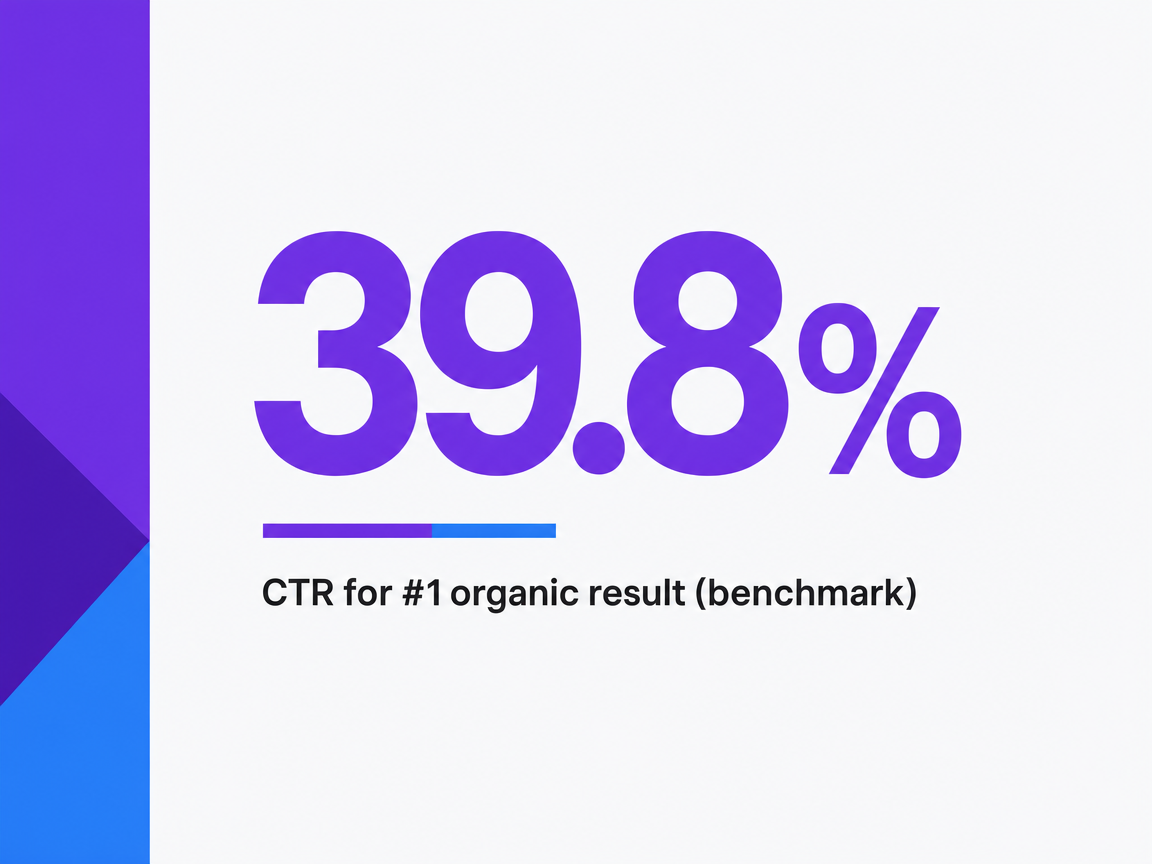 CTR for #1 organic result (benchmark)
CTR for #1 organic result (benchmark)
Frequently Asked Questions
References
- 1.SERP features' impact on CTR quantified - Grips Intelligence.
- 2.Exploring the Impact of SERP Features on Organic Click-Through Rates.
- 3.Beyond Rankings: Exploring the Impact of SERP Features on Organic CTR (thesis).
- 4.SERP CTR by Position & Feature: Click-Through-Rate Benchmarks.
- 5.Google Click-Through Rates (CTRs) by Ranking Position.
- 6.Google AI Overview & SGE: How AI Search Is Changing Organic Traffic.
- 7.AI Overviews in Google Search: Impact on website traffic, customer behaviour and content marketing.
- 8.How SERP features impact your organic click-through rate.
- 9.What the New Search Console AI Reports Reveal.
- 10.How Google's AI Overviews Are Changing Click Behavior & SEO Metrics.
- 11.Generative Engines Are Breaking Attribution Models.
- 12.7 tools for doing AEO right now.
- 13.AEO Tracking Tools Overview.
- 14.11 Best AEO Tracking Tools Tested in 2026 | Ranked.
- 15.Do people click on links in Google AI summaries?.
- 16.BY Athena Chapekis, Anna Lieb, Sono Shah and Aaron ....
- 17.How Americans feel about AI summaries in search results.