
Key Takeaways
- Otterly.AI delivers uniform brand-monitoring coverage across ChatGPT, Perplexity, Google AI Overviews, and Copilot, giving agencies a single prompt-set view that matches how buyers now ask questions 5.
- Profound centers on competitor omission and share-of-voice reporting, turning abstract AI visibility gaps into a concrete target list clients recognize from traditional competitive analysis 3.
- Peec AI structures output around citation change over time, which is the shape monthly reports need to attribute visibility gains to specific content sprints 1.
- Gracker.AI exposes AI Overview trigger and citation movements at the keyword level, matching how SEO strategists work when the client narrative still leads with a keyword table 5.
- LLMRefs provides the portable three-metric vocabulary — mentions, citations, and recommendation density — that keeps disparate tools reporting consistently across client accounts 10.
- SE Ranking bundles rank tracking, on-page SEO, backlinks, and AI Overview citation detection in one workspace, though its AIO data is Google-native and misses ChatGPT, Perplexity, and Gemini 4.
- Ahrefs layers AI Overview signals onto its existing backlink and SERP stack, creating a coherent narrative from its own 58% first-position CTR benchmark down to account-level exposure 6.
- AccuRanker's on-demand refresh keeps AIO citation data current the moment a client opens the deck, useful when new content ships or source sets shift mid-cycle 4.
- Nightwatch tracks AI Overview citations at the location level, exposing city-by-city variance that domain-aggregated tools hide for multi-location clients 4.
- seoClarity and BrightEdge integrate AIO metrics into enterprise SEO workflows, fitting engagements where governance and unified dashboards matter more than adding another vendor 4.
Why AI Citation Tracking Became a Retention Line Item
Every agency SEO lead has now had the meeting where a client asks why organic sessions are down even though rankings are steady. The answer sits inside the AI Overview panel above the blue links. An Ahrefs analysis of 300,000 keywords in Google Search Console data from December 2025 found that the presence of Google AI Overviews correlates with 58% fewer clicks for the first organic result 6. That single figure has reshaped what the quarterly business review needs to contain.
The scope matters. The study measured click-through rate on position-one URLs when an AI Overview appeared alongside the standard results, not average traffic across all queries or verticals. Even with that caveat, the direction of travel is clear enough that agencies can no longer treat AI citation data as a curiosity. It is the variable that explains the gap between a green ranking dashboard and a flat conversion report.
This reframes the tooling question. AEO tracking platforms are not a rank-tracker upgrade. They are the measurement layer that lets an agency show, month over month, which client queries now trigger AI answers, whether the client is cited inside those answers, and which competitor domains are being pulled in instead 5. Without that layer, the retention conversation runs on assertion. With it, the conversation runs on evidence — and evidence is what justifies the AEO service line sitting on top of the existing retainer.
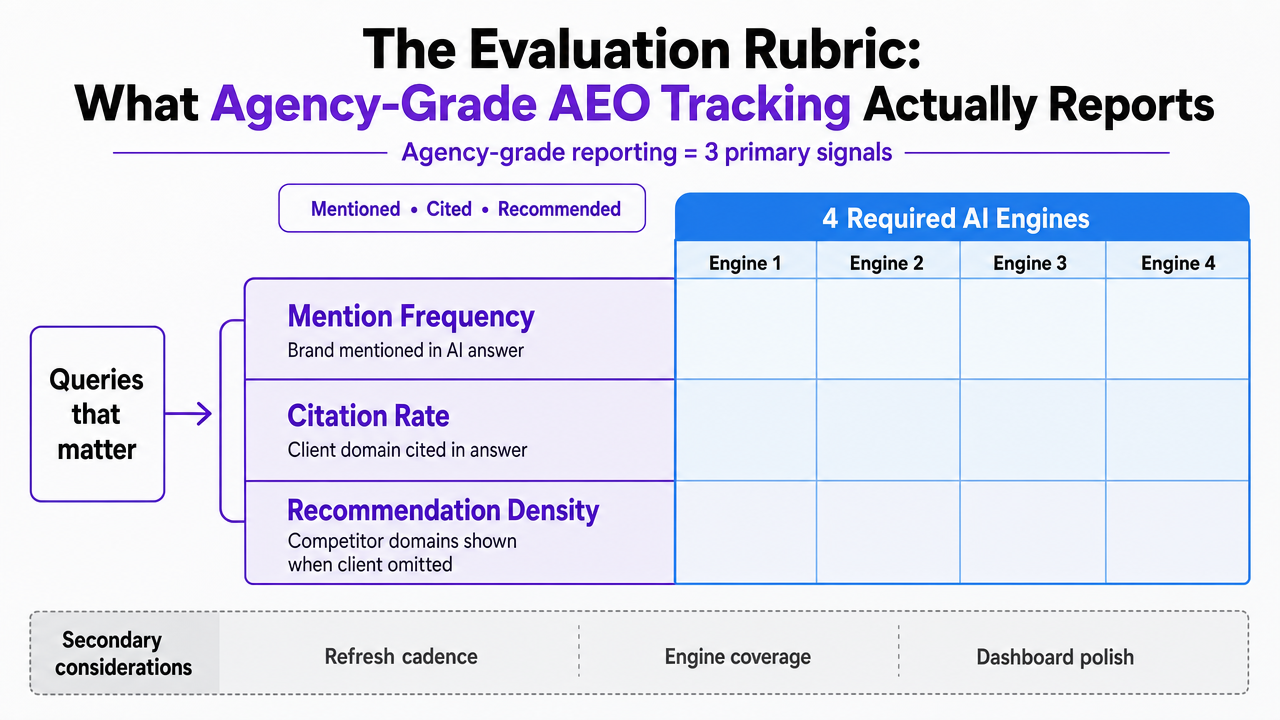
The Evaluation Rubric: What Agency-Grade AEO Tracking Actually Reports
Before ranking tools, agencies need a shared definition of what counts as reportable data. The market has settled on three primary outputs: which queries trigger an AI answer, whether the client domain is cited inside that answer, and which competitor domains are pulled in when the client is omitted 5. Everything else — refresh cadence, engine coverage, dashboard polish — is secondary to those three signals.
A useful frame comes from the LLMRefs definition of AI search visibility as
"how often your brand is mentioned, cited, or recommended across AI search engines for the queries that matter to your business"
10. That splits neatly into three client-facing KPIs: mention frequency, citation rate, and recommendation density. Mentions confirm the brand exists in the generative context. Citations confirm the AI is sending users to the client's URL. Recommendation density measures how often the brand is named as a preferred option, not just a source.
Agency-grade tooling has to report those three metrics across at least four surfaces — Google AI Overviews, ChatGPT, Perplexity, and Gemini — because single-engine tracking no longer covers where buyers ask questions 3. Anything narrower produces a partial picture, and a partial picture is what clients push back on when the invoice arrives.
Pure AEO Trackers Built for Multi-Engine Citation Data
Otterly.AI — Cross-Engine Brand Monitoring for ChatGPT, Perplexity, AIO, Copilot
Otterly.AI sits in the category that agencies reach for when Google-only tracking stops answering the client's questions. It monitors brand presence across ChatGPT, Perplexity, Google AI Overviews, and Copilot in a single prompt-set view, which is the coverage pattern practitioner reviews now treat as table stakes 5.
For an agency lead running 20 or more accounts, the operational value is the prompt library structure. Each client gets a defined set of buyer questions, and Otterly reports which engines return an answer, whether the client domain is cited, and which competitors surface instead. That is the exact triangulation the reader already sells to clients in a rank-tracking context, ported to the four surfaces where buyers now ask 2.
The trade-off is depth versus breadth. Otterly's strength is uniform reporting across engines, not deep SERP feature analysis on any single one. Agencies pairing it with a traditional rank tracker get the cleanest client narrative — one platform for AI answers, one for blue-link performance — without asking an analyst to reconcile two Google-specific tools.
Profound — Competitor Omission and Share-of-Voice Reporting
Profound is built around the report slide most agency leads have to produce every month: who is being cited when the client is not. The platform tracks brand presence inside generative answers and quantifies competitive framing, which comparative scorecards flag as a distinct category from rank trackers and content suites 3.
The share-of-voice output is what makes Profound useful for retention conversations. When a legal or dental client sees that three specific competitor domains appear in 60% of AI answers to their core buyer queries while their own domain appears in 15%, the gap is no longer abstract. It is a target list.
For agencies already selling competitive gap analysis in traditional SEO, Profound extends the same argument into AI answers without requiring a new client-facing framework. The reporting reads the way the client already thinks.
Peec AI — Citation Deltas Over Time for Client Deliverables
Peec AI's differentiator for agencies is temporal. Where several tools report a snapshot of citations, Peec structures its output around change over time — which queries added the client's domain to the AI answer this month, which dropped it, and which competitor domains moved in the opposite direction 1.
That is the shape of a monthly report. Agency leads do not need to know that a client is cited in 43% of tracked answers; they need to know that citation rate moved from 31% to 43% after the last content sprint. The delta is what justifies the retainer.
Peec fits agencies that have already committed to a GEO content workflow and need to attribute output to visibility gains. Without a production cadence feeding it, the delta view has less to measure. With one, it becomes the proof layer for every deliverable that shipped.
Gracker.AI — SEO-Team Workflow for AIO Query Triggers
Gracker.AI is oriented to the SEO team's daily workflow rather than the executive dashboard. The platform's core output is trigger data: which of a client's tracked keywords now surface an AI Overview, whether the client domain is cited inside it, and which competitor domains Google pulls from instead 5.
That framing matters because AI Overview presence is not stable. A query that triggered an AIO last week may not trigger one this week, and the citation set inside a stable AIO shifts as Google refreshes its sources. Gracker exposes those movements at the keyword level, which is where an SEO strategist actually works.
The tool suits agencies whose client-facing narrative is built around keyword portfolios rather than share-of-voice percentages. If the reader's quarterly review still leads with a keyword table, Gracker layers the AIO dimension onto the format the client already reads.
LLMRefs — Mentions, Citations, and Recommendation Density as KPIs
LLMRefs is less useful as a dashboard and more useful as a definition. Its framing of AI search visibility —
"how often your brand is mentioned, cited, or recommended across AI search engines for the queries that matter to your business"
— gives agencies a portable three-metric structure that maps cleanly onto client reports across ChatGPT, Google AI Mode, AI Overviews, and Perplexity 10.
Mentions : Establish that the brand exists in the generative context at all.
Citations : Confirm the AI is passing users to the client's URL.
Recommendation density : Measures how often the brand is named as a preferred option, not just a source among many.
Those three lines are what a client can absorb in a 30-second scan of a slide.
Agencies using LLMRefs typically pair it with an execution-oriented tracker. The value here is the KPI vocabulary — a shared language that keeps different tools reporting the same things to different clients without the analyst rebuilding the framework each time.
Test Real-World AEO Tracking on Live Projects
Validate AI-driven answer visibility metrics using your clients’ actual search data before you commit.
Rank Trackers with AI Overview Detection Bolted On
SE Ranking — Traditional Ranking Plus AIO Citation Detection
SE Ranking is the tool most agencies already have a seat for, which is what makes its AI Overview module worth reading closely. The platform combines traditional rank tracking, on-page SEO, and backlink monitoring with AI Overview citation detection in a single interface 4. For a Head of SEO staring down 40 client accounts, that consolidation is the argument.
The AI Overviews Tracker inside SE Ranking reports which of a client's keywords trigger Google AI Overviews, whether the site is linked or the brand is mentioned, and how visibility shifts over time 1. That is the same triangulation agencies get from pure AEO trackers, delivered inside the workspace analysts already open every morning.
The limitation is engine scope. SE Ranking's AI Overview data is Google-native, which means it does not answer the ChatGPT, Perplexity, and Gemini side of the client's exposure. For agencies whose clients still get most of their AI risk from Google surfaces, that trade is acceptable. For accounts where buyers openly use multiple engines, SE Ranking has to be paired with a cross-engine tool to close the reporting gap.
Ahrefs — AI Overview Signals Inside an Existing Backlink Stack
Ahrefs earned its position in most agency stacks on backlink data, and its AI Overview signals inherit that context. The platform now surfaces AI Overview presence and citation data alongside the existing SERP, keyword, and referring-domain views agencies already use 4. The advantage is analytical, not just operational: the same tool that shows a client's link profile also shows which of their pages Google is pulling into generative answers.
That pairing matters because Ahrefs is the source of the benchmark most agencies now quote in client meetings — the 58% first-position click decline from its 300,000-keyword Google Search Console analysis 6. Using the same platform that produced the market's reference stat to measure a specific client's exposure creates a coherent narrative from industry data to account-level evidence.
Where Ahrefs falls short for AEO reporting is multi-engine coverage. It reports Google AI Overview signals, not ChatGPT, Perplexity, or Gemini citation data. For agencies whose client-facing story leads with backlinks and Google visibility, Ahrefs handles the AIO layer without adding a new vendor. For pure share-of-voice work across four engines, it is one input, not the whole system.
AccuRanker — On-Demand Refresh for AIO Citation Data
AccuRanker's differentiator has always been refresh speed, and that same characteristic now applies to its AI Overview module. The platform includes AI Overview citation detection in its SERP data with on-demand refresh capability 4. For agencies running weekly or event-driven reports, that means citation data is current at the moment the client opens the deck, not stale from a scheduled crawl three days earlier.
The operational value shows up in two situations. First, when a client ships new content and wants to know whether Google has picked it up in the AI Overview for the target query — AccuRanker can answer that same day. Second, when an AI Overview shifts its source set and the client's domain drops out, on-demand refresh surfaces the omission before the monthly report cycle turns it into a surprise.
The trade-off is that AccuRanker sits firmly in the rank-tracker category. It reports AIO citations as an extension of SERP data, not as a share-of-voice framework across ChatGPT, Perplexity, and Gemini 3. Agencies that already treat AccuRanker as the source of record for rankings get an AIO layer for free. Those without it should not adopt AccuRanker solely for AEO tracking.
Nightwatch — Location-Level Rank Data with AIO Overlays
Nightwatch fills a narrower slot but a common one for agencies working with multi-location clients. The platform tracks rankings at the location level and has added AI Overview citation detection to its SERP data 4, which means a dental group, home-services franchise, or senior-living operator can see AIO exposure city by city rather than aggregated to a domain.
The reporting utility here is specific. When a client operates in 30 metros, the AI Overview that appears for a Denver query is not necessarily the one that appears for the same query in Tampa. Domain-level AEO tracking hides that variance. Location-level tracking exposes it, which lets an agency identify which markets are losing citation share and target content or GBP work accordingly.
Nightwatch is not a cross-engine platform. It is a location-aware rank tracker with AIO overlays, and agencies should pair it with a ChatGPT and Perplexity monitor when clients ask about non-Google surfaces.
seoClarity / BrightEdge — Enterprise Stacks Adding AIO Metrics
seoClarity and BrightEdge occupy the enterprise end of the AI Overview tracking market. Both platforms have integrated AI Overview citation metrics into their existing SERP data 4, layering AEO reporting onto the content, technical, and workflow tooling large agencies and in-house teams already run.
For agencies serving enterprise clients, the value is governance rather than feature novelty. AI Overview data lives alongside the same content inventories, site audits, and workflow queues the client's SEO program already reports against. That reduces the analyst overhead of stitching AIO citation data into an executive dashboard that a Fortune 500 marketing lead will actually approve.
The cost profile matches the audience. Enterprise stacks are not the tool an agency reaches for when adding an AEO service line to a mid-market client at a $4,000 monthly retainer. They are the tool that already sits inside a $15,000-plus engagement where AI Overview reporting has to arrive as part of the existing workflow, not as a separate deck from a separate vendor 3. For agencies without that client profile, seoClarity and BrightEdge are context, not a purchase decision.
The Citation Upside Most Client Reports Miss
Most AEO decks lead with loss. The story is easier to tell that way — clicks are down, AI Overviews are the reason, here is the exposure. What that framing misses is the other half of the same data set. Seer Interactive's September 2025 CTR analysis found that when a brand is cited inside a Google AI Overview, it receives 35% more organic clicks and 91% more paid clicks compared with cases where the brand is not cited at all 7. The AI panel that suppresses traffic for omitted domains amplifies it for included ones.
That uplift changes what an AEO tracker is measuring. Citation rate stops being a defensive metric and becomes a leading indicator of organic and paid performance. For agency leads, the reporting shift is straightforward: pair citation deltas with the client's paid search dashboard and the argument writes itself. Every query where the client moved from omitted to cited is a query where both channels should show measurable lift.
The practical read for tool selection is that pure citation counts are not enough. Agencies need trackers that expose which cited queries also drive paid volume, because that intersection is where the 91% figure translates into a revenue conversation rather than a visibility slide.
Which Query Types Deserve Tracker Budget First
Not every client keyword deserves a spot in the AEO tracker. Informational queries are where the citation math bends hardest against the client. Ahrefs' analysis of 300,000 informational keywords found top-ranking pages losing 34.5% of their click-through rate when an AI Overview appeared alongside them 9. That is the query bucket where omission from the AI panel costs the most measurable traffic, and it is where tracker seats produce the clearest before-and-after evidence.
A meta-review of 12 separate studies puts the range of CTR declines at 15% to 89% depending on query type and methodology 8. The spread argues against tracking everything equally. Agencies get more reporting leverage by concentrating tracker budget on three groups:
- High-volume informational queries that already lose CTR to AIO
- Commercial-comparison queries where competitor citation shifts the buyer's shortlist
- Branded queries where the client's own name in an AI answer should be non-negotiable
Navigational and pure transactional queries can sit outside the tracked set for most accounts. They trigger AI answers less often, and when they do, the citation dynamics matter less to the client's revenue conversation. Prioritizing tracker capacity along that axis is what keeps per-client cost defensible when the portfolio grows.
See Exactly Where Your Clients Win in AI-Powered Search and AEO
Request a tailored walkthrough of advanced AEO and AI visibility tracking tools built for agencies managing multi-client portfolios. Understand how to validate, benchmark, and report measurable AI-driven SERP gains at enterprise scale.
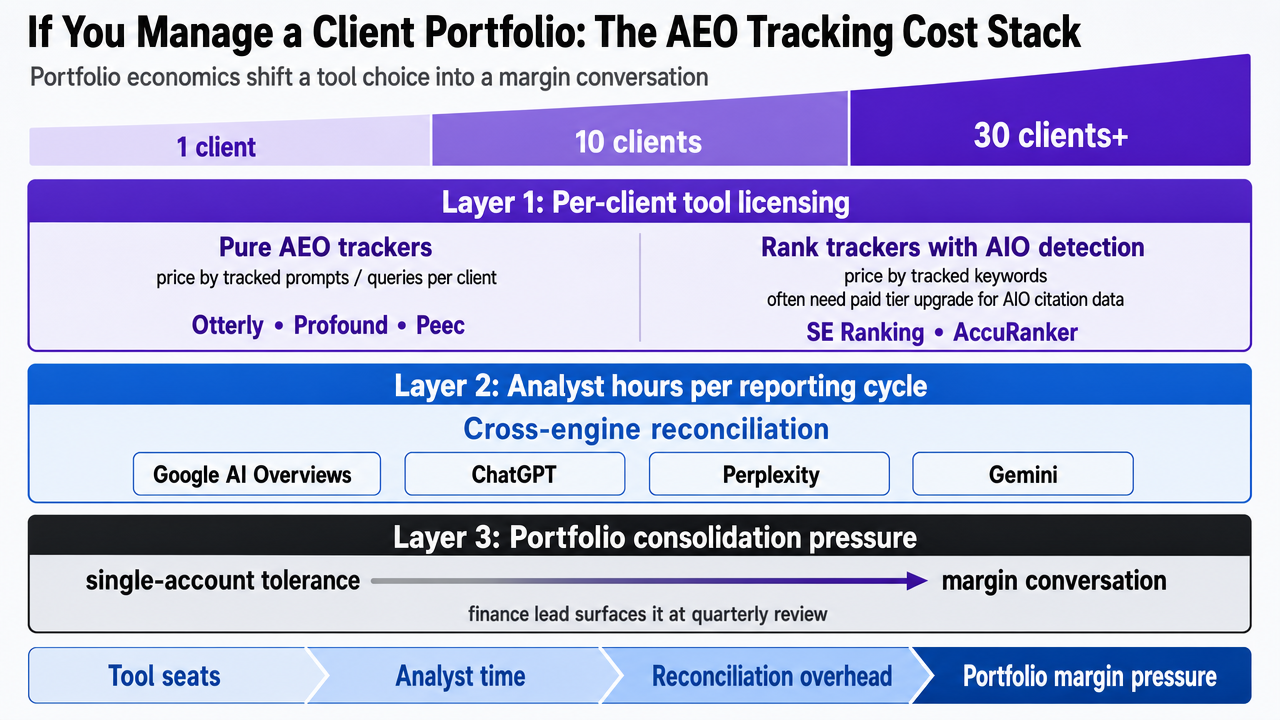
If You Manage a Client Portfolio: The AEO Tracking Cost Stack
This section shifts scope from single-account tooling to portfolio economics. The reader running one client can absorb a $99 seat and an hour of analyst time without noticing. The reader running 30 clients cannot — the same math turns into a margin conversation the finance lead will surface at the next quarterly review.
The cost stack has three layers:
- Per-client tool licensing. Pure AEO trackers like Otterly, Profound, and Peec typically price by tracked prompts or queries per client, while rank trackers with AIO detection bolted on — SE Ranking, AccuRanker — price by tracked keywords and often need a paid tier upgrade to expose AIO citation data 4.
- Analyst hours per reporting cycle. Cross-engine coverage across Google AI Overviews, ChatGPT, Perplexity, and Gemini requires reconciling four data sources unless the agency has standardized on a single multi-engine platform 3.
- The report-build itself — the slide or dashboard that translates citation deltas into a client-facing narrative.
| Portfolio size | Tool cost driver | Analyst hours per cycle | Consolidation pressure |
|---|---|---|---|
| 10 clients | Point-tool seats scale linearly | Low — one analyst absorbs the load | Optional |
| 30 clients | Multi-tool stacking begins to compound | Moderate — reconciliation across engines | Material |
| 60 clients | Per-client licensing dominates margin | High — dedicated AEO analyst emerges | Non-negotiable |
The pattern most agencies discover at 30-plus accounts is that stacking three or four point tools per client kills the margin the AEO service line was supposed to add. Consolidation onto a smaller number of platforms — or onto a unified measurement layer that reports citation, mention, and recommendation density across engines from one workspace 10 — is what keeps the retainer defensible.
Consolidating the Stack Without Killing Signal Depth
The instinct after auditing ten tools is to buy three of them. That instinct is what erodes AEO margin at scale. The harder discipline is deciding which signals the agency will actually report on and consolidating around the smallest stack that produces them across every client.
Three signals do most of the work: citation rate inside AI answers, competitor domains cited when the client is not, and change in both over time. Any platform that reports mentions, citations, and recommendation density across ChatGPT, Google AI Mode, AI Overviews, and Perplexity from a single workspace covers the reportable ground 10. The stack only needs to grow when a client's business model — multi-location footprint, paid search dependency, enterprise governance — demands a signal the consolidated tool cannot produce.
The consolidation test agencies apply well: for each tool in the stack, name the client question it answers that no other tool in the stack answers. Anything that fails that test comes out. What remains is a measurement layer that scales with the portfolio rather than against it — the same premise Vectoron applies to specialist marketing execution when agencies stop stitching point tools and start reporting from one governed workflow.
Frequently Asked Questions
References
- 1.Best Google AI Overviews Trackers: 10 Tools To Choose.
- 2.I tested the top 5 AI Overviews SEO rank tracking tools for 2026.
- 3.25 AI Search Visibility Tools Compared (2026 Scorecard).
- 4.18 Best Google AI Overviews Tracking Tools in 2026.
- 5.10 Best Google AI Overview Tracking Tools for SEO Teams (2026).
- 6.Ranking #1 on Google Now Delivers 58% Fewer Clicks Than It Used To, Gravitate Analysis Finds.
- 7.AIO Impact on Google CTR: September 2025 Update.
- 8.Google AI Overviews Are Crushing CTRs: What 12 Studies Show.
- 9.Impact of Google AI Overviews on Click-Through Rates.
- 10.AI Search Visibility (AI SEO / AEO / GEO Tracker).