
Key Takeaways
- Semrush is the closest single-tool Ahrefs swap, covering keyword, backlink, and competitor jobs in one seat, though breadth trades depth and enterprise pricing climbs quickly 3, 5.
- SE Ranking wins on cost-per-client-report, bundling white-label dashboards, an Agency Pack, and AI Search Visibility tracking into a single anchor seat for mid-market rosters 6, 10, 12.
- Majestic justifies its line item when link prospecting, disavows, and backlink audits are billable work, giving agencies depth on link intelligence that mid-market suites do not match 7, 12.
- Screaming Frog stays across every stack redesign because no all-in-one suite matches its depth on redirect forensics, JavaScript rendering, hreflang, and log file work 4, 5.
- Surfer SEO belongs as an editorial layer above the keyword and link seats, giving content pods a scoring surface that suite-bundled writing assistants do not replicate 1, 5, 7.
- Moz Pro earns its slot as a second-opinion metric layer, keeping Domain Authority and Page Authority in pitch decks and matching client-side reports without funding a second full suite 2, 4.
The agency question isn't which tool replaces Ahrefs
Most "Ahrefs alternatives" roundups answer a question Heads of SEO stopped asking around client number twenty. The real decision isn't which single suite performs a like-for-like swap. It's which combination of two or three data tools, plus whatever execution layer sits on top, delivers the same intelligence at a lower blended cost per client without slowing delivery.
Recent 2026 reviews implicitly concede the point. Zapier's roundup slots eight tools into distinct jobs rather than crowning a winner, aligning Semrush with competitor analysis, Clearscope and Surfer with content optimization, and seoClarity with enterprise workflows 1. SEO Testing's agency-focused comparison goes further and labels Semrush the "most like-for-like Ahrefs competitor," Screaming Frog the "best-in-class technical SEO crawler," and Surfer SEO the on-page optimization pick — three separate line items, not one 5. A practitioner review from Alex Birkett reaches the same conclusion by listing thirteen tools organized by workflow priority rather than overall rank 7.
The piece that follows treats Ahrefs as a benchmark, not a target. It maps six substitutes — Semrush, SE Ranking, Majestic, Screaming Frog, Surfer SEO, and Moz Pro — against the four jobs agency delivery actually depends on, then addresses the throughput problem no data tool solves: getting approved work out the door across a portfolio of clients.
Four agency jobs the substitute has to cover
Before comparing tools, it helps to name what agency delivery actually buys from Ahrefs. Strip the marketing gloss and four jobs remain:
- competitive and keyword intelligence
- backlink intelligence
- technical crawling at scale
- content optimization tied to on-page briefs
Every substitute worth evaluating either covers one of these deeply or spans several at shallower depth. Confusing the two shapes is where stack decisions go sideways.
The 2026 SEO Testing comparison sorts its picks along exactly these lines, tagging Semrush the "most like-for-like Ahrefs competitor," Screaming Frog the "best-in-class technical SEO crawler," and Surfer SEO the on-page optimization pick — three separate jobs, three separate line items 5. Zapier's roundup matches the pattern from a different angle, routing Semrush to competitor analysis, Clearscope and Surfer to content optimization, and seoClarity to enterprise workflows 1. Neither review pretends one product owns all four jobs.
Two of the six picks that follow are span tools rather than specialists. SE Ranking covers keyword intelligence, rank tracking, and client-facing reporting in one seat, which is why practitioner reviews keep placing it in agency shortlists alongside Semrush 9, 12. Moz Pro spans keyword, link, and site audit data at a lighter depth, which makes it useful as a second-opinion layer rather than a primary source 4. Majestic and Screaming Frog do the opposite — one job each, done deeper than any suite matches 7.
The mapping matters because it dictates what a Head of SEO is actually buying back. A suite swap trades depth for consolidation. A best-of-breed stack trades consolidation for depth. Neither trade addresses throughput, which is the fifth job hiding behind the other four.
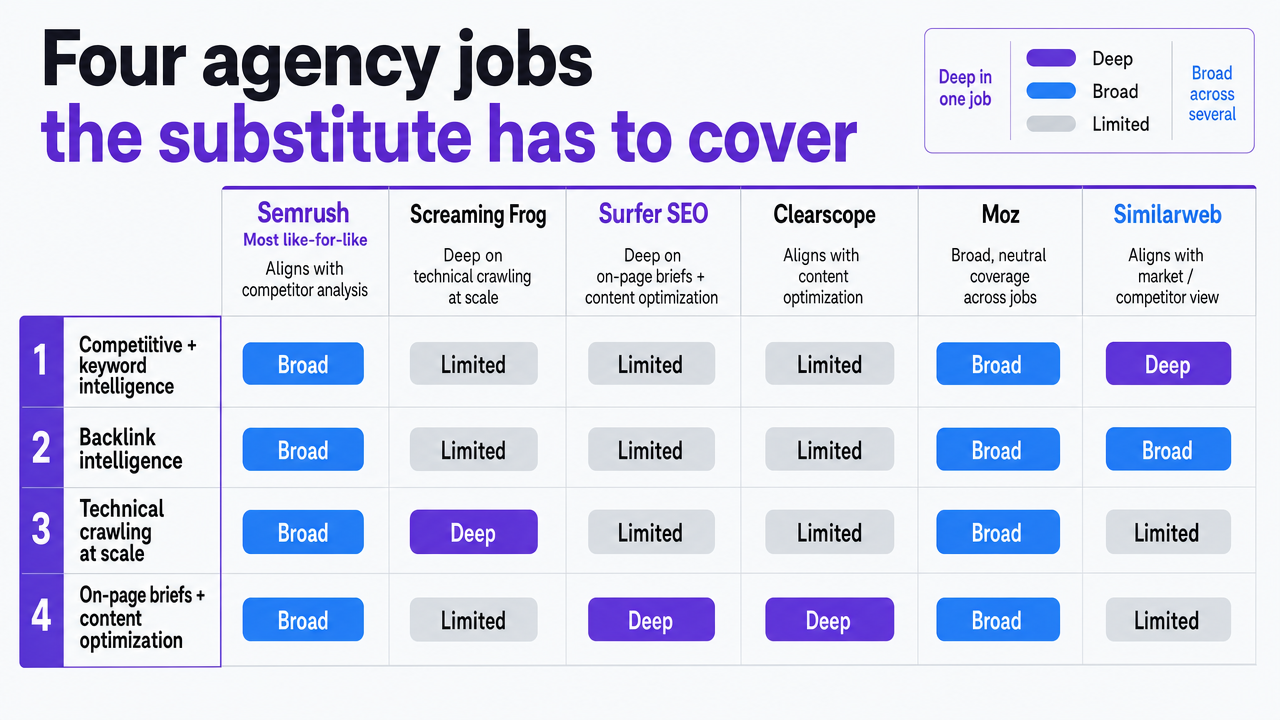 Visualize the four agency jobs and map which of the six substitute tools cover each job at what depth, directly reinforcing the section's framework
Semrush: the closest single-tool swap
Of the six picks, Semrush is the only one multiple 2026 reviews will commit to calling a like-for-like Ahrefs competitor. SEO Testing's agency comparison uses that exact phrase 5. Gizmodo's 2024 roundup ranks it "the best overall alternative to Ahrefs" 2. Zapier files it under all-in-one SEO and competitor analysis, citing the Keyword Gap, Backlink Gap, and Market Explorer tools as the reason it survives a suite-to-suite swap without leaving obvious holes in day-to-day delivery 1.
The agency-relevant part is what sits beyond the SEO core. Experte's 2026 review frames Semrush as a "complete marketing system" rather than a narrow SEO tool, which matters for shops running paid, social, and content out of the same delivery pod 8. Marketing91's comparison notes recent additions like AI PR, social media, and local toolkits, reinforcing the same trajectory — Semrush is drifting toward marketing suite, not SEO suite 12. For a Head of SEO consolidating vendor sprawl across a portfolio, that scope is either the reason to swap or the reason to hesitate, depending on whether adjacent teams already have their own stacks.
There are two caveats worth naming before the swap gets signed. First, breadth costs depth. A practitioner review notes Semrush's full digital marketing suite "may be excessive for teams needing only core SEO," which is the polite way of saying agencies pay for surface area they may not staff against 9. Second, at the top of the market the calculus shifts again. Semrush Enterprise sits in the same conversation as BrightEdge, Conductor, and Ahrefs Enterprise, with pricing that comparisons peg in the tens of thousands of dollars per year once SSO, SCIM, API export, and 100,000+ URL crawl scale enter the requirements list 3.
The practical read: Semrush is the defensible answer for agencies where "replace Ahrefs" means one contract line, one seat topology, and one reporting surface across ten to fifty clients. It stops being the defensible answer at the point where a best-of-breed stack — the next four picks — starts covering the same jobs at more depth per dollar.
SE Ranking: the white-label workhorse for client reporting
SE Ranking earns its place in this list on a different axis than Semrush. Where Semrush wins the like-for-like argument, SE Ranking wins the cost-per-client-report argument — which is often the one that actually decides the contract inside an agency finance review.
The 2026 ClickRank guide puts the case plainly: "SE Ranking has quietly become one of the highest-ROI Ahrefs alternatives for agencies and mid-market teams" 10. FeedTheBot's 2026 review reaches the same conclusion from a features angle, recommending SE Ranking for "agencies and SEOs looking for the best value all-in-one tool with solid accuracy and AI features" 9. Marketing91's comparison files it under "SEO pros, agencies, growing teams," citing its AI Search Visibility Tools and a dedicated Agency Pack for multi-client workflows 12. OneLittleWeb's practitioner review specifically calls out its white-label reporting as the reason it lands in agency shortlists 6.
The operational fit sits in three places:
- Client seats scale without the per-seat surcharges that make larger suites painful past twenty accounts 9.
- The reporting layer produces white-label PDFs and dashboards that account managers can send under the agency's own brand — a line item that would otherwise sit in a separate reporting tool 6.
- The AI Search Visibility feature tracks rankings inside AI overviews, which closes a gap that legacy suites are still patching in 9.
For a Head of SEO whose delivery pod spends more hours packaging results than gathering them, that combination compresses two seats into one.
The caveat is depth. SE Ranking's backlink index and keyword database are competitive at the mid-market tier but do not match Semrush at the top of the range or Majestic on link intelligence specifically 10. Agencies pitching enterprise accounts on the strength of their competitive research will feel the ceiling. Agencies running fifty small-to-mid clients on standardized reporting cycles will not. The rough decision rule from the reviews: SE Ranking is the primary seat where reporting throughput matters more than analyst-grade data depth, and a supporting seat where the reverse is true 10, 12.
Test AI-driven SEO execution on live projects
Publish real SEO content and measure performance impact before making a commitment.
Majestic: link intelligence when Ahrefs is the line item to cut
Majestic occupies a narrower slot than Semrush or SE Ranking, and that is precisely its argument. When a Head of SEO is looking at the renewal invoice and asking which Ahrefs job justifies the seat cost on its own, backlink intelligence is usually the answer that survives scrutiny. Majestic exists to do that one job at depth.
Practitioner reviews consistently isolate it in the link category rather than the suite category. Alex Birkett's 2026 ranking places Majestic among the core backlink intelligence picks alongside Screaming Frog for crawling, treating the two as specialists that fill gaps a broader suite leaves open 7. Sitepoint's 2025 comparison lists Majestic among the top ten alternatives specifically for backlink analysis workflows rather than end-to-end SEO 4. SEO Testing's agency-focused 2026 comparison keeps it in the shortlist for the same reason — historical link data and index depth that mid-market suites do not match at the same tier 5.
The honest tradeoff is scope. Marketing91's comparison notes that while Majestic excels at historical backlink intelligence, it lacks broader marketing functionality, which forces agencies to pair it with another tool for keyword and content work 12. That is the point of picking it. Agencies dropping Ahrefs for cost reasons rarely lose sleep over losing a second keyword database — they already have one in Semrush or SE Ranking. What they lose is the link index. Majestic is the seat that gets that job back without paying for a second suite around it. It belongs on the invoice when link prospecting, disavow work, and competitive backlink audits are billable line items across the client roster, and it comes off the invoice the moment they are not.
Screaming Frog: the crawl seat you keep no matter what
Screaming Frog is the one line item in this comparison that survives almost every stack redesign. When agencies drop Ahrefs, swap Semrush for SE Ranking, or trade Majestic in and out based on the client mix, the crawler seat rarely moves. Two 2026 agency-focused reviews land on the same label — SEO Testing calls it the "best-in-class technical SEO crawler," and Alex Birkett's practitioner ranking keeps it in the core technical slot alongside Majestic for links 5, 7.
The reason it holds is that no all-in-one suite delivers the same depth on the technical job. Semrush and SE Ranking both ship site audit modules, but agency-side technical work — redirect chain forensics, JavaScript rendering audits, hreflang validation across international rollouts, log file cross-referencing, custom extraction against staging environments — sits outside what a suite audit is built to do. Sitepoint's 2025 comparison implicitly concedes the point by noting that agencies replacing Ahrefs typically pair a broader suite with a dedicated crawler rather than assume the suite covers both 4.
The operational read is simpler than the other picks. Screaming Frog is a fixed-cost analyst seat, not a per-client scaling cost. One license runs across the portfolio, the outputs feed migration plans, technical audits, and pre-launch QA, and the seat pays for itself the first time a redirect map catches a mistake before it ships. Keep it. The stack decisions worth arguing over sit elsewhere.
Surfer SEO: on-page optimization outside the suite
Content optimization is the job where suite-inclusive modules most reliably fall short of what an agency editor actually needs on the page. Semrush and SE Ranking both ship writing assistants, but the 2026 reviews keep routing the deep on-page work elsewhere. Zapier's roundup files Surfer alongside Clearscope specifically under content optimization rather than general SEO, treating it as a separate seat from the suite 1. SEO Testing's agency comparison labels Surfer the on-page content optimization pick and does not fold it into the Semrush recommendation 5. Alex Birkett's practitioner ranking places Surfer among the AI content tools that agencies increasingly bolt onto a broader stack rather than replace with a suite module 7.
The agency case for a dedicated on-page seat comes down to editor throughput. Content teams working across ten to fifty client sites need a scoring surface that briefs writers, catches gaps before review, and standardizes the output enough that a strategist is editing rather than rewriting. That is a workflow tool, not a research tool. Suite-bundled content modules tend to optimize for the analyst opening a keyword report, not the editor closing a brief.
The caveat: Surfer sits on top of the data other tools produce. It does not replace keyword or link seats. Agencies adding it should treat it as an editorial layer above Semrush or SE Ranking, not a substitute for either 7.
Moz Pro: the second-opinion metric layer
Moz Pro earns its slot in this list not as a primary Ahrefs replacement but as the metric layer that keeps the other picks honest. Domain Authority and Page Authority remain the shorthand scores that pitch decks, outreach targeting spreadsheets, and client-side stakeholders still reference by name, which is a workflow reality no other tool on this list solves. Gizmodo's 2024 roundup lists Moz Pro among the six recognized Ahrefs competitors on that basis, positioning it as a lower-cost option that covers keyword, link, and site audit data at a lighter depth than Semrush 2. Sitepoint's 2025 comparison keeps it in the top-ten shortlist for the same reason — recognized brand metrics and broad workflow coverage rather than category-leading depth in any single job 4.
The honest read from practitioner reviews is that Moz Pro's link index and keyword database do not match Semrush at the top of the range or Majestic on link intelligence specifically 7. That is not the argument for keeping it on the invoice. The argument is triangulation: when a competitive audit needs a second data source to confirm a link profile, or when a client's internal team runs Moz-based reports and expects matching scores in the deliverable, a Moz seat closes that gap for less than the cost of a second full suite. Agencies dropping Ahrefs almost never adopt Moz Pro as the anchor tool. They adopt it as the check against the anchor tool.
See How Leading Agencies Replace Ahrefs Without Sacrificing Scale or Data Quality
Request a workflow analysis to benchmark your SEO toolchain against AI-powered alternatives proven to streamline delivery, increase oversight, and reduce costs across multi-client portfolios.
Agency stack economics: three ways to cover the Ahrefs job
The stack decision reduces to three configurations, each with a defensible reader profile. The chart below scores the four agency jobs — competitive/keyword intelligence, backlink intelligence, technical crawling, and content optimization — against a single-suite swap, a best-of-breed stack, and an AI-augmented hybrid. Pricing signals are drawn only from what the supplied reviews state directly.
| Configuration | Tools included | Primary jobs covered | Notable gaps | Cost signal from research |
|---|---|---|---|---|
| Single-suite swap | Semrush | Keyword, backlink, content, light technical audit in one seat 5, 8 | Editor-grade on-page depth; enterprise crawl scale past 100,000 URLs 9 | Semrush Enterprise sits with BrightEdge, Conductor, and Ahrefs Enterprise at tens of thousands of dollars per year once SSO, SCIM, API export, and 100,000+ URL crawl enter scope 3 |
| Best-of-breed stack | SE Ranking + Majestic + Screaming Frog + Surfer | Keyword and reporting (SE Ranking), link intelligence (Majestic), technical crawl (Screaming Frog), on-page optimization (Surfer) 5, 7 | Four contracts, four dashboards, no shared workflow surface 7 | SE Ranking positioned as one of the highest-ROI mid-market anchors 10; the other three are specialist seats, not per-client scaling costs |
| AI-augmented hybrid | SE Ranking or Semrush + AI execution layer + Google Search Console | Suite-level SEO data, first-party performance data, and workflow throughput on top 9, 11 | Requires disciplined approval workflow; still pairs with a crawler for deep technical work 4 | Practitioner reviews describe the LLM-plus-GSC pattern as a way to reduce dependence on a monolithic suite 11 |
The single-suite swap is the defensible pick when consolidation matters more than depth and the client roster fits inside standard mid-market plans. The best-of-breed stack wins on capability per dollar when the delivery pod has the analyst hours to run four surfaces. The hybrid is where most agencies actually land once the throughput problem — covered in the next section — starts eating margin faster than the data problem does.
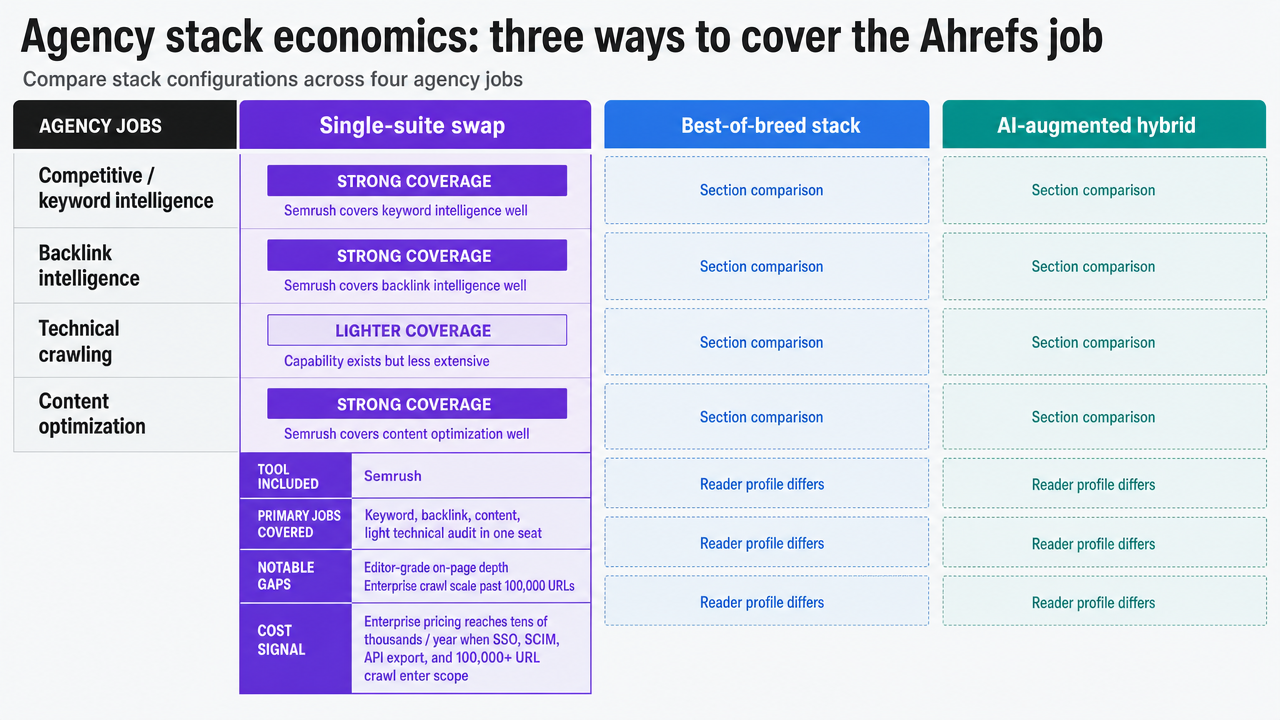 Turn the section's comparison table into a clearer visual comparison of the three stack configurations
Where the throughput problem actually sits
Swapping Ahrefs for any combination of the six picks solves a data question. It does not solve the delivery question. A best-of-breed stack of SE Ranking, Majestic, Screaming Frog, and Surfer produces four separate outputs — keyword gaps, link prospects, crawl exceptions, on-page briefs — that still need a human to read, rank, package into approved work, and route to whoever ships it. Multiply that loop across thirty clients and the analyst hour, not the seat cost, becomes the constraint.
The 2026 reviews acknowledge the gap indirectly. The narrative review from Behind Rankings describes a hybrid pattern in which agencies pair a suite like SE Ranking or Semrush One with LLMs connected to Google Search Console, using AI models against first-party performance data rather than expecting a single monolithic SEO tool to run the workflow 11. Zapier's roundup flags the same direction from the tool side, noting seoClarity's Sia AI assistant for bulk SEO tasks as an example of automation moving into the workflow layer rather than the reporting layer 1. Marketing91's comparison singles out WebCEO for task managers and collaboration features aimed at multi-client agencies, which is the workflow problem showing up as a product category 12.
The pattern in each case is the same. Data tools sit upstream. An approval and routing layer sits between the data and the delivered work. Publishing sits downstream. The seat that most agencies are actually missing is the middle one — and no keyword database, link index, or crawler ships with it.
How Heads of SEO should sequence the swap
The sequence that keeps delivery intact starts with the crawler seat and ends with the suite decision, not the other way around. Screaming Frog stays regardless of what happens above it, so it is the wrong place to argue. The first live decision is whether the anchor seat is Semrush or SE Ranking, and the deciding variable is client mix. Portfolios weighted toward enterprise pitches and competitive research keep Semrush as the anchor 5, 8. Portfolios weighted toward standardized reporting cycles across twenty to fifty mid-market accounts default to SE Ranking, where the white-label layer and Agency Pack absorb a reporting seat that would otherwise sit separately 10, 12.
Second, decide the link seat on billable work, not habit. Majestic earns the invoice line when link prospecting, disavows, and competitive backlink audits appear in scoped deliverables across the roster 7. When they do not, the anchor suite's link module is enough and the seat comes off. Third, add Surfer only after the editorial pod confirms the on-page brief is the bottleneck, not the keyword research feeding it 1. Moz Pro comes last, as the triangulation seat for pitches and client-side reports that reference Domain Authority by name 2.
The swap fails when the sequence runs in reverse — suite first, workflow last. The next section covers the seat the data tools do not ship.
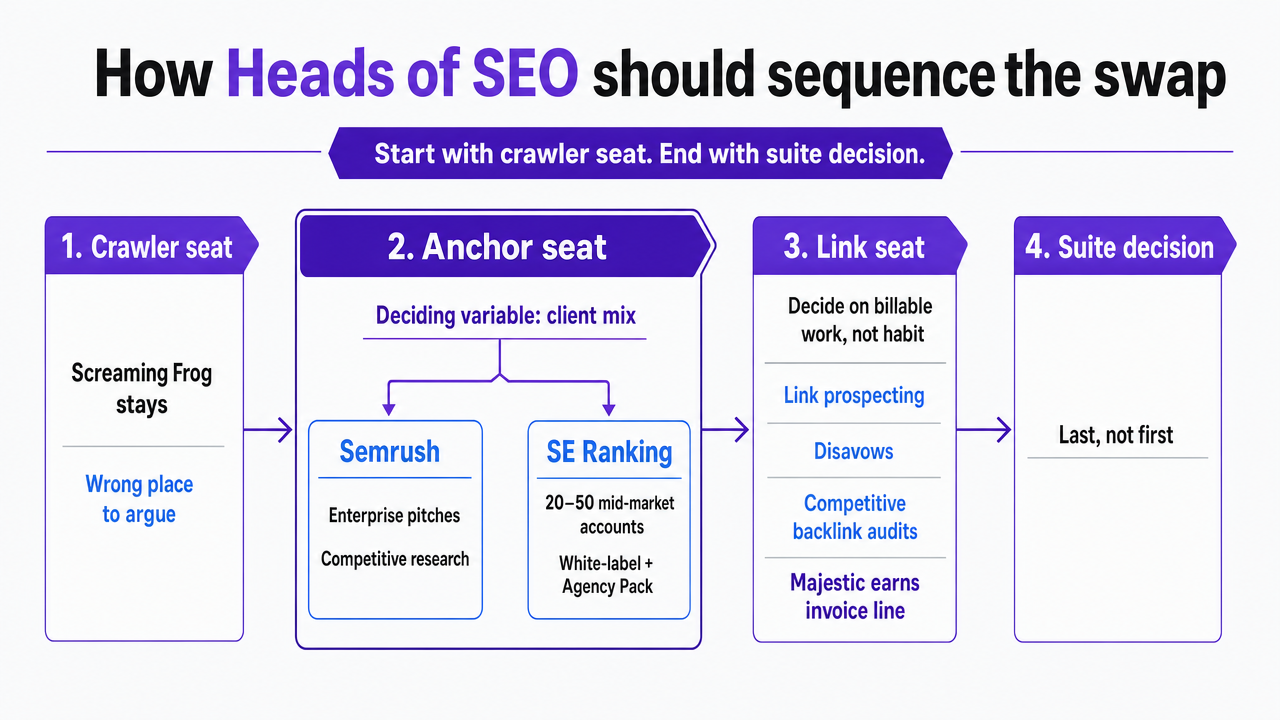 Visualize the four-step sequencing framework the section prescribes for stack migration
Frequently Asked Questions
References
- 1.The 8 best Ahrefs alternatives in 2026.
- 2.Best Ahrefs Alternatives: 6 Competitors to Consider [Free + Paid].
- 3.Best Enterprise SEO Tools in 2026 Compared.
- 4.Ahrefs Alternatives: Top 10 Tools For SEO Needs In 2025.
- 5.10 Best Ahrefs Competitors for Agencies & In-House Teams.
- 6.7 Best Ahrefs Alternatives I've Tested for 2026.
- 7.The 13 Best Ahrefs Alternatives in 2026 - Alex Birkett.
- 8.Best Ahrefs Alternatives 2026: 9 SEO Tools Reviewed.
- 9.4 Ahrefs Alternatives For SEO and Content Marketing Teams.
- 10.Unlock the 11 Shocking Best Ahrefs Alternatives in 2026 ....
- 11.Why I Ditched Ahrefs (+ 10 Free & Paid Alternatives).
- 12.7 Best Ahrefs Alternatives for 2026: Which Fits Your Needs?.