
Key Takeaways
- Profound delivers enterprise-grade AI-surface tracking across ChatGPT, Perplexity, Gemini, Copilot, and AI Overviews, but offers no execution layer to close identified citation gaps.
- Athena (formerly Otterly.AI) monitors prompt-level visibility and competitor citations, making it useful for query-focused teams that already have strong in-house writers.
- Peec AI quantifies citation share and benchmarks it by prompt category, buyer stage, and geography, giving diagnosis without production support to fix gaps.
- Writesonic GEO accelerates content by drafting AI Overview-ready intros, FAQs, and schema, but stops at the draft and leaves publishing and measurement to external workflows.
- Scrunch AI prioritizes citation gaps by volume, competitive density, and buyer intent, clarifying the backlog for teams that still need writers and developers to execute.
- HubSpot's AI Search Grader plus Content Hub bundles visibility and content production inside a CRM, though AI-surface coverage is narrower and live business signals aren't factored in.
- Conductor extends enterprise SEO reporting into AI surfaces, unifying executive reporting while leaving actual writing and publishing to in-house content teams.
- Vectoron operates as a closed-loop execution platform that ranks recommendations against live business signals, drafts assets, routes approvals, and tracks KPI impact at $599/month post-trial.
Why monitoring-only tools stopped being enough
The initial wave of AI brand visibility software addressed a specific need: informing marketing leaders about their brand's presence in ChatGPT answers, Perplexity citations, and Google's AI Overviews. While valuable in 2024, this functionality has become a basic expectation by 2026.
This shift is driven by workflow saturation. Forrester's State of Customer Engagement Survey reveals that over 90% of customer marketing and experience professionals now use generative AI daily, with 95% anticipating significant changes to their work due to AI 10. In an environment where buyers, competitors, and answer engines are all AI-native, a dashboard that merely reports absence is insufficient; it simply highlights a missed opportunity.
McKinsey emphasizes that generative AI is transforming marketing from episodic campaigns to continuous, "always-on" production, where content, personalization, and measurement are ongoing processes rather than quarterly events 4. A monitoring-only tool cannot keep pace with this rapid cadence. It might identify a citation gap on Monday, but then relies on a human agency to draft a response by Friday.
By 2026, the most valuable platforms for marketing VPs will be those that seamlessly integrate measurement with content execution.
The strategist's rubric: five criteria that separate the eight platforms
A robust shortlist for AI brand visibility software should be built on a scoring framework, not just a feature comparison. The following five criteria are designed to help marketing VPs justify their choices to the CFO.
AI-surface coverage. : This refers to the range of generative interfaces the platform monitors. Google's AI Overviews, ChatGPT, Perplexity, Gemini, and Copilot each have distinct indexing and citation methods. A tool that covers only a few leaves significant blind spots.
Execution depth. : Once a citation gap is identified, what does the platform produce? Capabilities range from mere dashboards to draft briefs, or even fully published assets with structured data. McKinsey estimates that generative AI can boost marketing productivity by 5–15% of total marketing spend, equating to roughly $463 billion annually across the function 3. The higher end of this potential is only realized when execution is integrated with the system that identifies the gap.
Governance model. : How are human approvals incorporated into the workflow? Approval-first platforms require a named reviewer for every recommendation before publication. Auto-publish platforms prioritize speed over human oversight.
Data integration. : Does the platform incorporate live business signals such as calls, bookings, pipeline, and cost per lead, or does it rely solely on public web data?
Unit economics. : Evaluate the price against the outcome, not just the number of features. The comparison later in this article models this against a typical agency retainer.
Three tiers of AI brand visibility software
Visibility Trackers: measurement without execution
Visibility Trackers primarily report on brand presence. They scan generative interfaces, identify which prompts surface the brand, and quantify citation share against competitors. The output is typically a dashboard.
This output is valuable for marketing VPs needing a baseline for budget requests, providing data-driven answers to questions like "Does our brand appear in ChatGPT?"
However, their limitation lies in the subsequent steps. When a Tracker identifies a citation gap for a high-intent prompt, the resolution still requires a human writer, an external agency, or a separate content system. The tool itself does not generate the necessary article, schema, or citation.
Content Accelerators: measure plus produce
Content Accelerators represent an advancement, monitoring AI-surface presence and generating draft assets such as briefs, article outlines, FAQ blocks, and structured data. These drafts are tailored to address specific prompts and queries where the brand is underrepresented.
These tools align with McKinsey's finding that generative AI can boost marketing productivity by 5 to 15 percent of total marketing spend, particularly in content, personalization, and campaign work 3. Accelerators contribute to the lower end of this range by streamlining research and drafting.
However, they do not handle publishing, distribution, or reconciliation against downstream KPIs. A human editor is still responsible for approval, CMS integration, and incorporating feedback into strategy. The tool's function concludes at the draft stage.
Execution Platforms: measure, rank, and ship across channels
Execution Platforms offer a complete solution. They monitor AI surfaces, prioritize recommendations based on live business signals (e.g., calls, bookings, cost per lead), produce the necessary assets, manage approval workflows, publish to the CMS, and track KPI responses. This integrates measurement and execution within a single system.
This tier is essential because the surrounding workflow is already AI-native. Forrester's State of Customer Engagement Survey indicates that over 90% of customer marketing and experience professionals use generative AI daily, with 95% expecting it to significantly alter their work 10. At this production pace, a measurement-only tool creates a backlog that teams cannot manage.
Most of the eight platforms reviewed fall into the first two tiers; only a select few operate at this comprehensive third level.
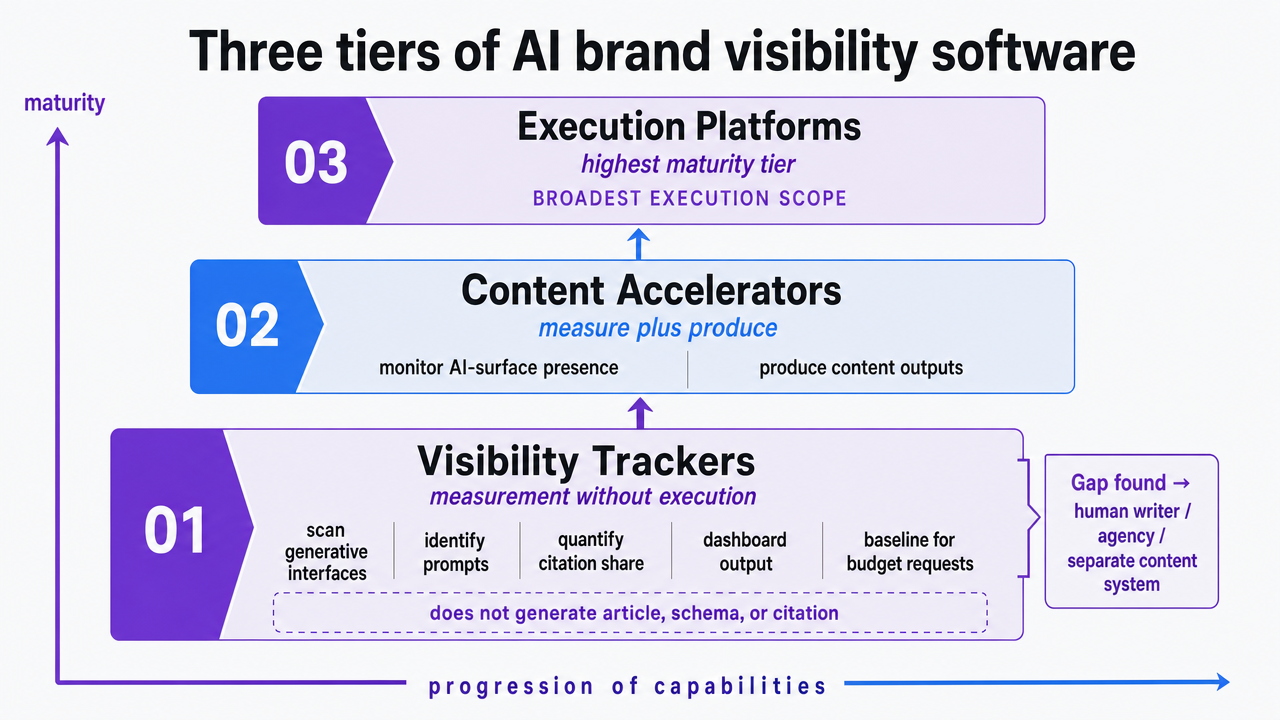 Visualize the three-tier maturity model described in the section (Visibility Trackers, Content Accelerators, Execution Platforms), showing progression of capabilities
Test AI-Driven Brand Visibility Workflows Now
Evaluate real outcomes by publishing live brand content through a unified AI workflow during your 7-day trial.
The eight platforms, evaluated
Platform 1 — Profound: enterprise AI-surface tracking
Profound caters to the enterprise segment of the tracker market. It monitors brand presence across ChatGPT, Perplexity, Gemini, Copilot, and Google's AI Overviews, providing detailed analysis of prompt-level presence, sentiment, and competitive share of voice against defined peers.
Its strength lies in broad coverage and deep prompt analysis. A marketing VP can present a CEO with a dashboard showing the brand's citation share across hundreds of relevant prompts, updated regularly.
The limitation is its lack of execution capabilities. Profound does not generate articles, schema blocks, or FAQs to close citation gaps. Execution is outsourced to in-house teams or external agencies. For VPs with lean teams, this tool highlights problems without providing solutions.
Platform 2 — Athena (formerly Otterly.AI): prompt-level visibility monitoring
Athena, previously Otterly.AI, is a Visibility Tracker. It monitors a specified set of prompts across ChatGPT, Perplexity, and Google's generative surfaces, indicating when the brand appears, when a competitor is cited, and the ranking of linked sources in the answer.
Its prompt-first reporting is ideal for marketers focused on query intent. Alerts are triggered when citation share declines or a competitor gains ground on a monitored prompt.
Athena does not offer production features like brief generation, schema output, or CMS handoff. VPs using Athena still require a separate content workflow to act on dashboard insights. This setup works for teams with strong in-house writers but can create bottlenecks for others.
Platform 3 — Peec AI: citation share and competitive benchmarking
Peec AI focuses on quantifying citation share, measuring how often a brand is mentioned in generative answers relative to competitors. It tracks this share over time and across various surfaces. This is particularly useful for VPs addressing questions about competitive visibility.
Its key differentiator is the depth of benchmarking, segmenting data by prompt category, buyer stage, and geography, which is crucial for service businesses with varying market visibility.
Execution remains outside the tool. Peec identifies gaps, but the solution depends on the brand's content creators and publishers. While actionable with a strong content team, it provides diagnosis without treatment if no production resources are available.
Platform 4 — Writesonic GEO: AI Overviews optimization with content assist
Writesonic's GEO module functions as a Content Accelerator. It scans AI Overviews and generative answer sources for a brand's prompts, then generates draft optimizations such as rewritten introductions, FAQ blocks, and structured data suggestions tailored to these formats.
This draft output significantly reduces the research-to-first-draft cycle, aligning with McKinsey's lower estimate of 5–15% marketing productivity gains from generative AI in content work 3. Tasks that once took days can now be completed in hours.
However, the tool's function ends at the draft. Approval, brand voice editing, CMS publishing, and impact measurement are external processes. For marketing VPs, this means the platform reduces production time but still necessitates an editor and a publishing workflow.
Platform 5 — Scrunch AI: brand mention analysis with recommendation engine
Scrunch AI combines mention tracking with a recommendation layer. Beyond logging brand appearances in generative answers, it prioritizes gaps based on prompt volume, competitive density, and inferred buyer intent, then suggests specific content strategies to address each gap.
The prioritization feature is highly valuable. Instead of an overwhelming list of missed prompts, Scrunch provides a manageable, prioritized list of 20, ordered by potential revenue impact, which an in-house team can act upon.
Scrunch's capabilities stop at recommendations; it does not draft articles or push structured data to a site. The work still requires writers, editors, and developers. For VPs struggling with prioritization, Scrunch streamlines decision-making. For those facing production capacity issues, it clarifies the backlog without shortening it.
Platform 6 — HubSpot AI Search Grader plus Content Hub: bundled visibility inside a CRM
HubSpot integrates its AI Search Grader (a free visibility diagnostic) with Content Hub, its generative content module. For teams already using HubSpot as their marketing system of record, this integration is a key advantage, placing prompt-level visibility data alongside campaign, contact, and pipeline data.
Content Hub generates blog drafts, landing page copy, and email sequences based on brand voice inputs. AI Search Grader reports on brand presence in ChatGPT and similar surfaces. This pairing covers both measurement and production.
Two limitations exist: AI-surface coverage is narrower than specialized trackers like Profound or Peec. Additionally, execution is content-only; HubSpot generates copy but does not prioritize recommendations based on live call volume, booked appointments, or cost-per-lead signals from paid channels. While convenient for HubSpot-native stacks, it leaves gaps for multi-channel operations.
Platform 7 — Conductor with AI Search module: enterprise SEO extended into generative surfaces
Conductor, known for enterprise organic search reporting, extends its capabilities with an AI Search module. This module tracks brand presence and content performance across AI Overviews and answer engines, integrating this data with traditional SERP data already used by enterprise teams.
The primary benefit is continuity. Teams already using Conductor for keyword rankings, content audits, and technical SEO gain AI-surface visibility within their existing reporting framework, streamlining executive reporting.
Conductor's content workflow is brief- and recommendation-focused rather than fully generative. It guides teams on what to write and where technical gaps exist, but the actual writing and publishing occur externally. This suits enterprise organizations with in-house content teams and established editorial governance. For mid-market VPs without such resources, Conductor accelerates decisions but leaves production as an unresolved task, often filled by agency retainers.
Platform 8 — Vectoron: closed-loop measurement, ranking, and publication
Vectoron stands as an Execution Platform. It integrates six specialist strategists—content, SEO, PPC, backlinks, social, and call intelligence—through a single Command Center. This system reads live business signals, prioritizes recommendations accordingly, and executes approved work across channels.
Its closed-loop model is a key differentiator. When a citation gap emerges for a high-intent prompt, the platform drafts the asset, routes it for review, publishes upon approval, and tracks its impact on calls, bookings, and cost per lead. Measurement and execution are unified within one system.
Governance is approval-first, ensuring nothing publishes without human sign-off. Each recommendation includes strategic reasoning, addressing concerns about scale without oversight eroding brand authenticity and ethical standards, as highlighted in academic research on generative AI in marketing 2. Post-trial pricing is $599/month, providing a clear benchmark for comparing against agency costs.
Agency retainer versus platform stack: what the math actually looks like
Budget discussions rarely prioritize feature comparisons; they demand a defensible cost model. The following framework withstands CFO scrutiny.
McKinsey estimates that generative AI can increase marketing productivity by 5 to 15 percent of total marketing spend, amounting to approximately $463 billion annually across the function 3. For a mid-market service business spending $600,000 annually on marketing, this translates to $30,000 to $90,000 in recoverable productivity. For a $2 million spend, the recoverable range expands to $100,000–$300,000. These figures represent the maximum justification for any AI tooling against current costs.
Three stack configurations compete for this recovered budget:
| Stack | Typical monthly cost | What ships | Approval control |
|---|---|---|---|
| Traditional agency retainer | $X/mo (variable) | Content, ads, reporting via briefing cycles | Client-side review, agency executes |
| Point AI tools (tracker + writer + scheduler) | $X/mo (variable, 3–5 vendors) | Draft assets, dashboards, handoffs to internal team | Fragmented across tools |
| Unified execution platform (Vectoron) | $599/mo post-trial | Ranked recommendations, drafted assets, published on approval, KPI-tracked | Single approval workflow |
The variable "$X" columns are intentional, as retainer costs vary significantly by market and scope. This brief does not provide a definitive number. Readers should compare their current line item against the sourced productivity band and the single named platform price. This is the financial argument a VP presents to the CFO.
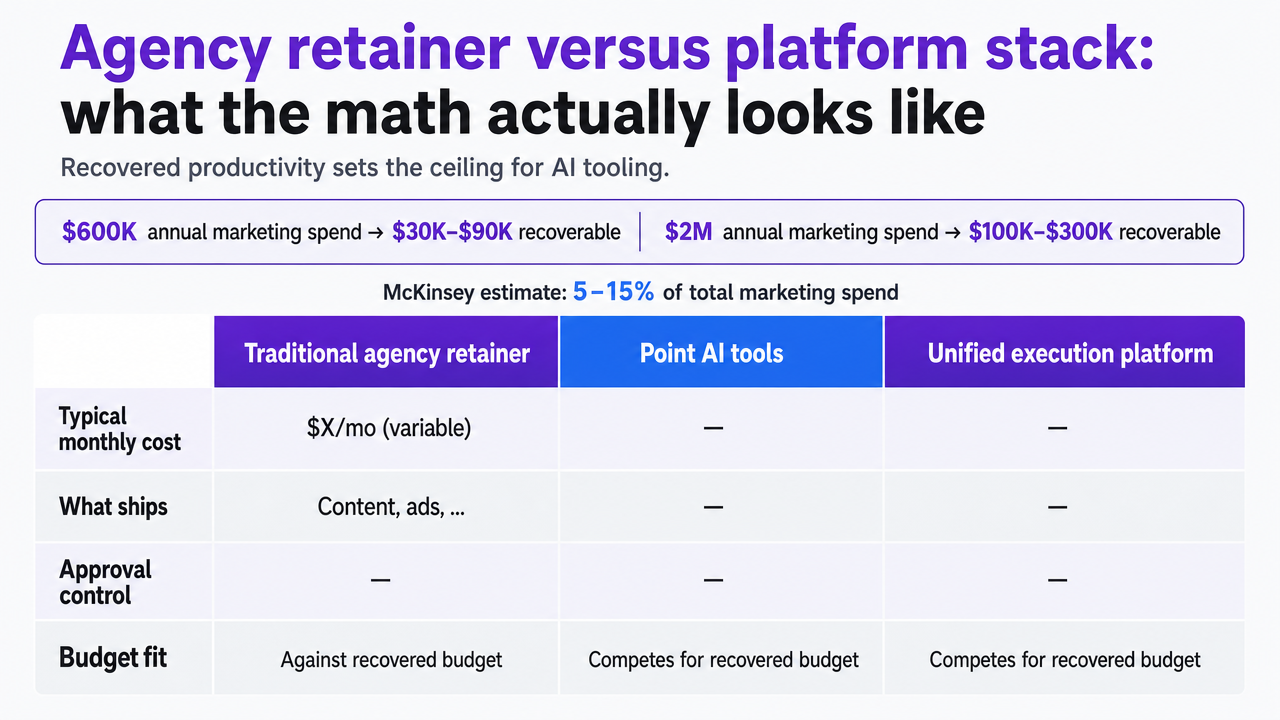 Visualize the three-column comparison table from the section (Traditional agency retainer, Point AI tools, Unified execution platform) so readers can scan stack differences at a glance
If the buyer runs multiple locations, the math changes
For multi-location businesses—such as a DSO with 40 practices, a home services franchise with 60 territories, or a senior living group with 25 communities—single-site economics no longer apply. Visibility gaps multiply by location, as does the cost of addressing them through traditional agency models, which typically price per market or cluster.
As the number of locations increases, two variables diverge. Agency retainer spend scales almost linearly with market count, as each market requires unique content, local citations, and reporting. Platform spend, however, does not, because the same measurement, ranking, and execution layer operates across all locations from a single account.
| Operator profile | Agency retainer approach | Unified platform approach |
|---|---|---|
| Single location | $X/mo per market | $599/mo post-trial |
| 10–25 locations | $X/mo × market count | $599/mo, shared execution layer |
| 25+ locations | $X/mo × market count, plus coordination overhead | $599/mo, with per-location approval routing |
The break-even point is often reached sooner than anticipated. A VP managing 20 markets should compare the platform's cost against the total retainer spend, not just the per-market cost.
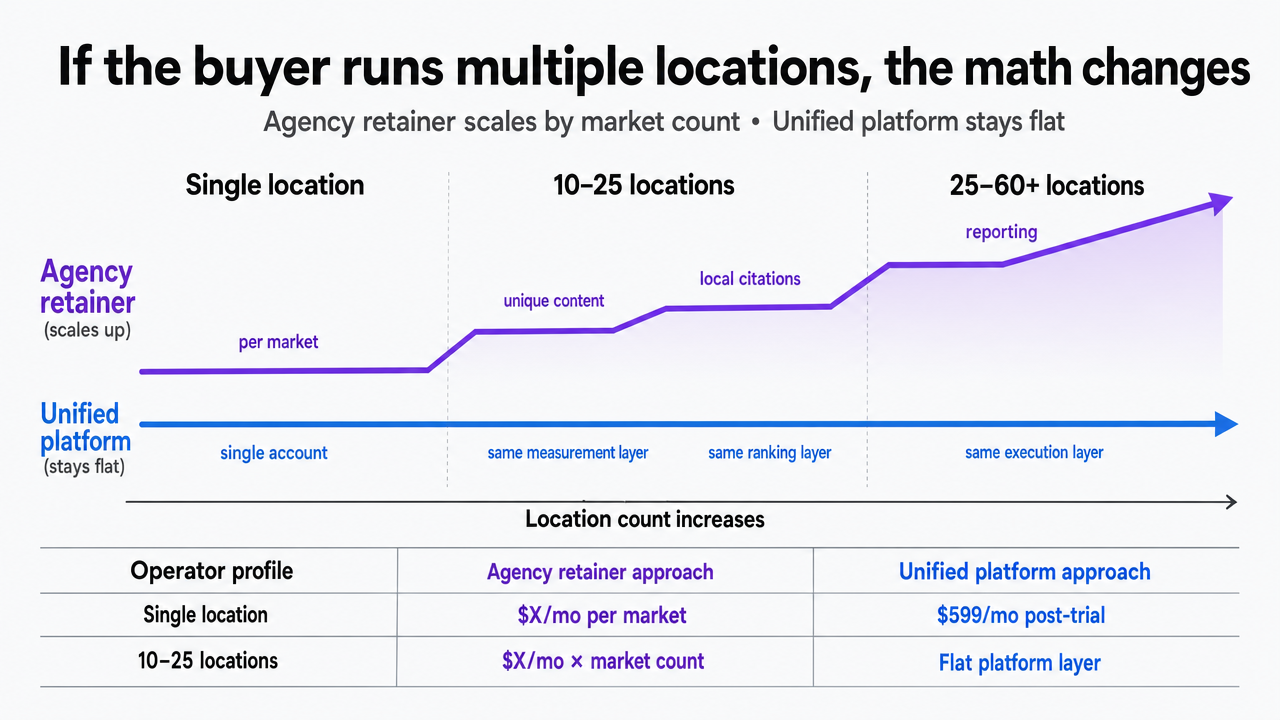 Visualize how agency retainer cost scales linearly with location count while a unified platform stays flat — a key argument in the section supported by the article's own table
See How Leading Brands Automate Multi-Channel Visibility with AI
Request a tailored walkthrough of AI-driven brand visibility platforms proven to streamline execution, eliminate manual workflows, and scale results—without expanding your team or adding vendor complexity.
Governance, approval, and the human-in-the-loop question
The governance model determines whether a platform is acceptable for legal, compliance, or brand reviews in regulated industries. Auto-publish workflows typically fail these reviews, while approval-first workflows succeed.
Academic research on generative AI in marketing warns that scaling without oversight can compromise brand authenticity and ethical standards, especially when the same system drafts and distributes content 2. The practical solution is a named reviewer for every asset—an actual sign-off by a person before anything goes live, not just a policy document.
Three governance questions are critical for every vendor discussion:
- Who approves before publication?
- What reasoning does the platform provide with each recommendation?
- Can approval routing be segmented by asset type, location, or risk tier?
A platform that concretely answers all three merits consideration; one that treats approval as a simple toggle does not.
Why the 2026 buying window is closing
Delaying this decision incurs a measurable cost. Deloitte's Q4 2024 survey of 2,773 director-to-C-suite leaders across 14 countries found that 78% expect to increase overall AI spending in the next fiscal year, and 74% report their most advanced generative AI initiatives are meeting or exceeding ROI expectations 6. Marketing is among the four functions Deloitte identifies as most advanced in GenAI adoption, alongside IT, customer service, and cybersecurity 6.
The compounding effect is more significant than the headline numbers. Competitors already outranking a brand in ChatGPT and AI Overviews accumulate authority signals—inbound links, prompt-level share, structured data footprint—which widen the gap monthly. A brand that first measures in Q3 2026 is not starting on equal footing; it is already behind peers who measured in Q1.
Deloitte also notes a governance lag, with leaders expecting data and compliance challenges to take one to two years to resolve 6. VPs who select a platform with approval-first controls now can avoid rebuilding governance later.
How a VP should sequence the decision
The order of operations is more critical than the specific tool. A VP who invests in execution without first establishing a baseline cannot demonstrate impact. Conversely, a VP who invests in measurement without a production plan will only create a backlog.
The decision should follow three sequential steps:
- Implement a Visibility Tracker or run a free diagnostic for at least 90 days to establish a baseline of prompt-level presence against competitors. This baseline will be the benchmark for future spending justification.
- Audit the current production line: quantify published assets per month, approval steps, and the percentage tied to ranked recommendations. This audit reveals whether the bottleneck is diagnosis or execution.
- Select the tier that addresses the identified bottleneck, rather than simply choosing the platform with the most features.
Vectoron's $599/month post-trial price and two-week trial fit into this sequence as an execution tier test, once the baseline and audit are complete.
Frequently Asked Questions
References
- 1.Marketing and sales soar with generative AI.
- 2.How Generative AI Is Shaping the Future of Marketing.
- 3.How Generative AI Can Boost Consumer Marketing.
- 4.The Future of Marketing in the Age of AI.
- 5.The Economic Potential of Generative AI: The Next Productivity Frontier.
- 6.Deloitte’s State of Generative AI in the Enterprise – Quarter Four 2024.
- 7.Forrester's 2024 DCIS Wave Is Live.
- 8.AI Will Transform Customer Service Interactions As A Collaborative Partner.
- 9.Inside Club Med's Conversational AI Strategy.
- 10.Is Customer Success Paying Enough Attention To GenAI Today?.