
Key Takeaways
- Google Search Console's GenAI performance reports anchor any free stack because they deliver first-party AI-surface impressions across hourly, daily, weekly, and monthly views 1.
- SEO Gets layers AI-generated commentary onto Search Console data, compressing junior analyst report assembly time and freeing hours back to strategy work on smaller books.
- Serpstat's free plan captures AI Overview presence and competitor citations, filling the competitive visibility gap Search Console leaves open, though its 30-query daily cap limits scope.
- SEranking's 14-day trial absorbs onboarding load with full AI Overview tracking and white-label PDF exports, functioning as a temporary seat rather than permanent infrastructure.
- Mangools SERPWatcher earns its slot on interface speed and client-friendly indices for one or two anchor accounts, not as portfolio-wide tracking capacity.
- Ubersuggest's three-searches-per-day limit rules it out of client delivery but makes it a defensible pitch-support utility that protects paid seats from pre-sales churn.
- Specialist-agent approval platforms bundle rank tracking with content, backlinks, and PPC signals under human sign-off, collapsing several tool line items into one consolidated seat 8, 14.
Why free rank tracking became a P&L decision
Rank tracking used to be a line item nobody argued about. In 2026, it sits inside a margin equation that agency directors can no longer ignore. SEO-focused agencies operate in an 11–20% net margin band, well below the 25–40% ranges specialist shops reach in other disciplines and behind the 15–20% generalist agency norm 9, 10. Every recurring tool seat, every hour a junior analyst spends assembling a client report, compounds against that thin spread.
Two forces made the tracker line item newly consequential. The first is scope. Google's June 2026 rollout of Search Generative AI performance reports in Search Console treats AI-surface impressions as a first-class reporting category, which means agencies that only monitor blue-link positions are now reporting on a shrinking slice of client visibility 1. The second is delivery cost. White-label SEO packages typically clear 40–60% gross margins, and that band assumes tracking, reporting, and monitoring overhead stays contained 11. A $600 enterprise seat spread across ten clients quietly consumes six points of gross margin before any strategic work ships.
Free and AI-augmented trackers change the math because they shift monitoring from a fixed cost per seat to a near-zero variable cost per client. That reframes the tool selection question from feature checklist to P&L exposure per account.
The scoring frame: cost per client report and AI-surface coverage
Most rank tracker roundups score on keyword volume, UI polish, and SERP feature depth. That frame no longer fits agency P&L. A tracker that costs $600 per month and lands eight hours of analyst time in a Looker Studio export is a different economic asset than a free-tier tool that emits an AI-ready CSV on a schedule, even when the paid tool has richer historical charts.
Four scoring dimensions matter for a Head of SEO evaluating a stack in 2026.
- Cost per client report per month, calculated as (tool subscription ÷ clients tracked) + (analyst hours × loaded hourly rate). The Wix pricing framework treats reporting time as a first-class project cost, and agency directors who track it usually find reporting eats more delivery hours than analysis 12.
- AI-surface coverage: whether the tool captures impressions and citations in AI Overviews and generative results, or leaves that visibility unreported. Google's Search Console GenAI reports made that a measurable category rather than a guess 1.
- Reporting automation depth: scheduled exports, API access, and integration with client dashboards without manual assembly.
- Scale ceiling: how many client properties and keywords the free tier absorbs before an upgrade is forced.
Each entry in the shortlist below is scored against those four axes, not against feature parity with an enterprise seat.
The shortlist: seven AI-enabled free and freemium rank trackers
Google Search Console with the new GenAI performance reports
Search Console moved from adjacent data source to primary tracker the moment Google shipped its Search Generative AI performance reports in June 2026. The new reports provide dedicated views of impressions within generative AI features on Search, with hourly, daily, weekly, and monthly granularity 1. That granularity is what makes it useful as a rank tracker rather than a diagnostic tool.
Hourly and daily views support incident response when an AI Overview citation disappears mid-campaign. Weekly views feed the standard client cadence most agencies already run. Monthly views roll up cleanly into quarterly business reviews without extra assembly work. For a Head of SEO running a 30-client book, the practical effect is that AI-surface visibility becomes a native column in the reporting stack rather than a separate research project.
Cost per client per month is effectively zero once properties are verified. The scale ceiling is generous, though the 1,000-row export limit still forces API access for anything past mid-size portfolios. AI-surface coverage is the strongest of any free option because the data is first-party from the platform that owns the surface. Reporting automation depth is moderate: the API and Looker Studio connector handle scheduled pulls, but historical retention past 16 months still requires an external warehouse. Directors evaluating the stack should treat Search Console GenAI reports as the anchor everything else attaches to, not as a supplement.
SEO Gets (formerly Rank Math Analytics) free tier
SEO Gets packages Search Console data into a client-friendly layer, then layers AI-generated commentary on the trend lines. The free tier tracks unlimited keywords and unlimited pages across up to three properties, which covers the analyst side of a small book without a paid seat.
Where the tool earns its slot is reporting time compression. The auto-generated weekly summaries replace a step that most agencies still pay a junior analyst to perform by hand. On a 20-client book with two hours of report assembly per client per month, cutting that in half is roughly 240 hours a year returned to strategy work or billable overflow.
The scale ceiling is the obvious constraint. Three properties per free account forces multi-account juggling past that limit, and there is no consolidated agency dashboard across accounts on the free tier. AI-surface coverage is inherited from Search Console, so it is only as complete as the underlying GenAI reports. Directors should treat SEO Gets as a reporting accelerator sitting on top of Search Console, not as an independent tracker.
Serpstat free plan with AI SERP features
Serpstat's free plan pushes further into the SERP feature layer than most freemium trackers. It captures AI Overview presence, People Also Ask expansions, and featured snippet ownership on the queries it does track, which matters when client conversations move from "where do we rank" to "who is being cited."
The free tier caps at 30 queries per day and limits historical depth, so it is not a monitoring solution for a full client book. It is a competitive research tool that happens to include AI-surface signals. Used that way, it fills a gap that Search Console cannot: visibility into competitor citations inside generative results, not just client-owned impressions.
Cost per client per month is zero, but analyst hours creep back in because the daily cap forces manual query rotation across accounts. Directors running the numbers should score Serpstat's free tier as a research supplement worth roughly one analyst hour of value per client per month, not as a replacement for continuous monitoring. Pair it with Search Console for coverage that actually spans owned and competitive AI-surface visibility.
SEranking free trial and lite tracking
SEranking's free tier is time-limited rather than feature-limited, which changes how it fits an agency stack. The 14-day trial covers the full rank tracker, including AI Overview tracking, local pack monitoring, and scheduled white-label PDF exports. After that, monitoring reverts to paid.
The practical use is onboarding acceleration. A new client account can move from contract to first full report inside the trial window without pulling a paid seat off another account. For agencies that cycle 40 to 60 new clients a year, that timing flexibility lowers the number of paid seats required to cover the roster.
AI-surface coverage during the trial is strong, particularly the AI Overview citation tracking, which most free tools omit. Reporting automation depth is the highest in the shortlist because white-label PDF scheduling is included. The scale ceiling collapses at day 15, so directors should not model SEranking as a permanent free tracker. It functions as a temporary seat that absorbs onboarding load, then hands off to Search Console plus SEO Gets for steady-state monitoring.
Mangools SERPWatcher free tier for small books
Mangools SERPWatcher runs a limited free tier through the KWFinder trial, tracking 25 keywords per day for 10 days. That footprint sounds too small to matter, and for an established book it is. For a specialist practice or a single flagship client, it functions as a lightweight second opinion against Search Console position data.
Where SERPWatcher earns a mention is interface speed. The Performance Index and Dominance Index metrics condense position changes into a single number that a client on a call can absorb without a chart tour. Junior analysts consistently report the fastest turnaround on Mangools-based summaries in agency time studies, though those studies are internal rather than published.
AI-surface coverage is minimal on the free tier. Reporting automation is basic. Cost per client per month is zero during the trial and rises steeply after. Directors should slot Mangools as a client-facing communication tool for one or two anchor accounts, not as portfolio infrastructure. The interface value is real; the tracking capacity is not.
Ubersuggest free daily quota for spot checks
Ubersuggest's free tier allows three searches per day, which rules it out as a monitoring tool and rules it in as a spot-check utility. The rank tracking feature on the free plan covers up to 25 keywords for one project, refreshed weekly.
The useful role is pitch support. When a business development lead needs a quick visibility snapshot for a prospect, Ubersuggest delivers a defensible one-page view without pulling a paid seat into pre-sales work. That protects the paid tool budget from prospect churn, where 60 to 70 percent of pitches do not convert.
AI-surface coverage is limited to whether an AI Overview appears for a query, not who is cited within it. Reporting automation is thin. The scale ceiling is a hard blocker for client delivery. Directors should assign Ubersuggest to the sales and marketing side of the agency, not to the delivery team, and remove it from any conversation about client-facing rank tracking infrastructure.
The specialist-agent approval platform tier
The seventh entry is a different category. Specialist-agent approval platforms bundle rank tracking with content production, backlink monitoring, PPC signals, and call intelligence under a single approval workflow, then route recommendations through a human sign-off gate before execution. Rank tracking is a feature, not the product.
The economic argument for this tier rests on the compensation shift BCG describes, where AI reshapes end-to-end marketing workflows rather than substituting for a single tool 8. Independent analysis of agency business model evolution reaches the same conclusion: automated monitoring and reporting move to AI while humans focus on strategy and creative decisions 14. A platform that ranks priorities across channels and executes only after approval collapses several line items on the tool budget at once.
Free-tier availability on this category is typically a trial rather than a permanent free plan, which places it outside the strict definition of free rank tracking. It belongs on the shortlist because directors evaluating consolidation math should compare the true fully-loaded cost of six free tools plus analyst assembly time against one platform seat. Vectoron is the reference implementation of this category, built around the approval-first model that keeps AI-driven monitoring defensible to clients and internal QA reviewers.
Test AI-driven rank tracking workflows risk-free
Experience live rank data and content publishing without commitment for seven days.
Consolidation economics: replacing an enterprise seat on a 20-client book
Consider a typical mid-market SEO practice: 20 retained clients at a $1,500 monthly retainer, one $600 enterprise rank tracker seat, and roughly 1.5 hours of report assembly per client per month. The paid seat alone costs $30 per client per month. The analyst time, at a $65 loaded hourly rate, adds another $97.50 per client. Reporting delivery cost lands near $127.50 per client, or 8.5% of the retainer, before any strategic work is counted.
Replacing that seat with Search Console GenAI reports, a free reporting layer, and a shared research supplement drops the tool cost to zero and compresses assembly time to roughly 45 minutes per client. New reporting cost per client falls to about $49, freeing 6 points of retainer margin per account. Across 20 clients, that is roughly $1,570 per month returned to the P&L, or nearly $19,000 annually. The CMO Survey of senior marketers found that AI adoption drove an average 7.0% reduction in marketing overhead and a 5.1% lift in sales productivity, which aligns with the direction of the consolidation math even though the survey measured in-house teams rather than agency delivery 4.
The table below models the shift using reader-supplied variables rather than invented tool prices.
| Variable | Paid seat baseline | Consolidated free stack ||---|---|---|| Tool cost per month | $600 | $0 || Clients tracked | 20 | 20 || Tool cost per client | $30 | $0 || Reporting hours per client | 1.5 | 0.75 || Reporting cost per client (at loaded rate R) | $30 + 1.5R | 0.75R || Retainer margin recovered | baseline | (30 + 0.75R) per client |
Against the 40–60% white-label SEO gross margin band 11and the 11–20% SEO net margin band 9, recovering 6 points on a 20-client book moves a practice from the middle of the net margin range toward its upper edge without adding a single billable hour. The consolidation is not a discount play. It is a margin lever that redirects delivery cost from monitoring into strategy.
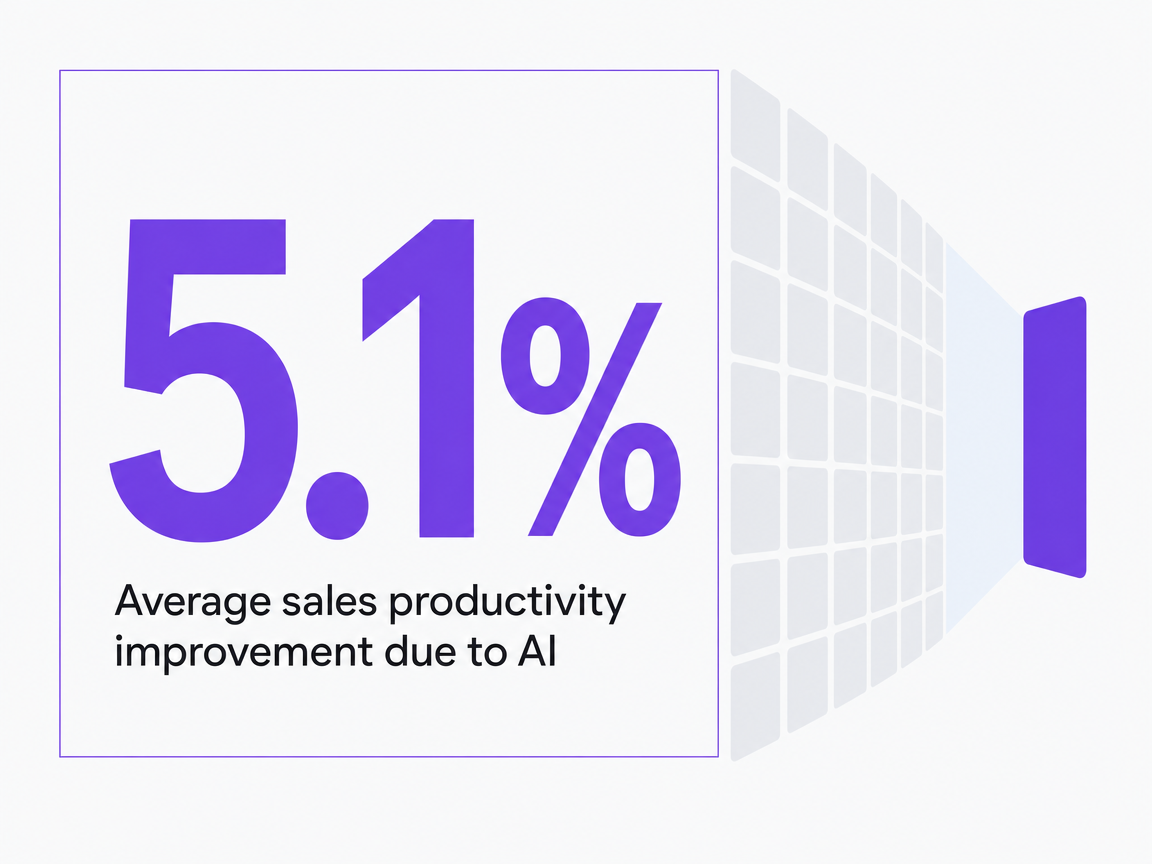 Average sales productivity improvement due to AI
Average sales productivity improvement due to AI
Where free tools break: the honest limits agency directors should price in
Free-tier stacks look clean on a spreadsheet and get messier at scale. The first break point is portfolio math. Three properties per free account, 25 keywords per project, 30 queries per day, 1,000-row exports: each cap becomes an operational tax the moment a book crosses 15 to 20 clients. Analysts start juggling multi-account logins, exporting in slices, and stitching CSVs by hand. The reporting hours the tools were supposed to save reappear as coordination hours.
The second break point is adoption cost. Independent analysis of AI's real financial impact on agencies warns that technology, integration, and training investments can range from hundreds of thousands to several million dollars per firm, which means the sticker-free tool is rarely free once integration labor is counted 13. A director who moves from one paid seat to six free tools without a warehouse, an API budget, or a data engineer is trading a known cost for a diffuse one.
The third break point is data completeness. Search Console GenAI reports cover owned properties, not competitors 1. Serpstat's free tier caps daily queries. Ubersuggest limits searches to three per day. No single free source produces a defensible competitive picture, and the gaps show up in QBRs when a client asks why a competitor is being cited in AI Overviews.
The fourth break point is client optics. White-label PDFs, custom domains, and consolidated dashboards sit behind paywalls on nearly every free tier. Agencies that ship raw exports risk positioning themselves below the retainer price point they charge. Directors should price these limits in before consolidating, then decide which caps to absorb and which to solve with a modest paid layer.
See How AI-Driven Rank Tracking Cuts Agency Overhead at Scale
Request a walkthrough of automated rank tracking workflows that eliminate manual reporting and reduce delivery costs—purpose-built for agencies managing multiple client portfolios.
The approval loop that keeps automated reporting defensible
Automated tracking gets cheaper the moment a human stops sanity-checking every export. It also gets riskier. Harvard Business School's marketing AI guidelines set a workable floor: AI can draft, but a person has to proofread for accuracy and quality before anything reaches an audience 6. Applied to rank reporting, that means AI-generated commentary, anomaly flags, and priority rankings should pass through a named reviewer before a client sees them.
The defensible loop has four steps.
- Signal capture pulls position data, AI Overview citations, and query-level impressions from Search Console and any supplemental trackers.
- Ranked recommendation lets AI surface what changed and what to do about it.
- Human approval routes each recommendation to the account lead, who accepts, edits, or rejects it.
- Execution and attribution then push the approved action into the workflow and tie the result back to the KPI it was meant to move.
This structure protects two things at once. Client trust survives because no unreviewed AI output ships under the agency's name. Delivery cost stays low because reviewers spend minutes on ranked recommendations rather than hours assembling reports from scratch.
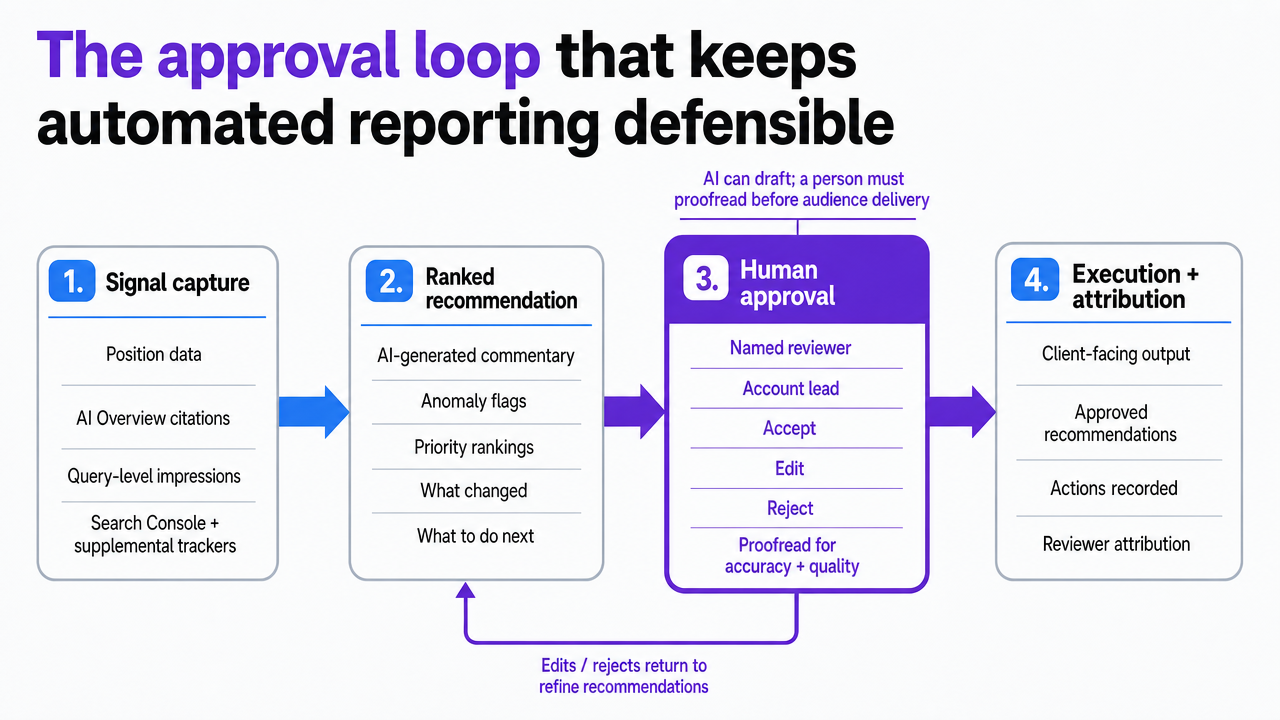 Diagram the four-step human-in-the-loop workflow described in the section, showing how AI-generated rank tracking outputs pass through named human review before reaching clients
A 30-day migration path from paid seat to consolidated stack
Migration fails when it happens all at once. A staged 30-day cutover keeps client reporting intact while the new stack proves itself in parallel.
- Week one is inventory and baseline. The delivery lead exports the last three months of reports from the incumbent paid seat, records the loaded hourly rate, and logs actual reporting hours per client for two full cycles. This is the counterfactual the new stack will be measured against. Search Console GenAI reports get verified on every client property in the same week, since the AI-surface data is first-party and takes days to accumulate meaningful history 1.
- Week two runs both stacks in parallel on five representative accounts, chosen to span retainer size and vertical. The free reporting layer generates the client deliverable. The paid seat generates the internal QA copy. Discrepancies get logged, not ignored. Most gaps trace to competitor visibility and historical retention rather than owned-property positions.
- Week three moves the remaining accounts onto the consolidated stack in batches of five, with the account lead approving each first client-facing report before it ships. This is where the human-approval gate does its real work.
- Week four cancels the paid seat, reallocates the recovered hours to strategy work, and locks the new reporting cadence. BCG's operating model analysis frames this as reshaping end-to-end workflows rather than swapping tools, which is the right lens for a director signing off on the change 8.
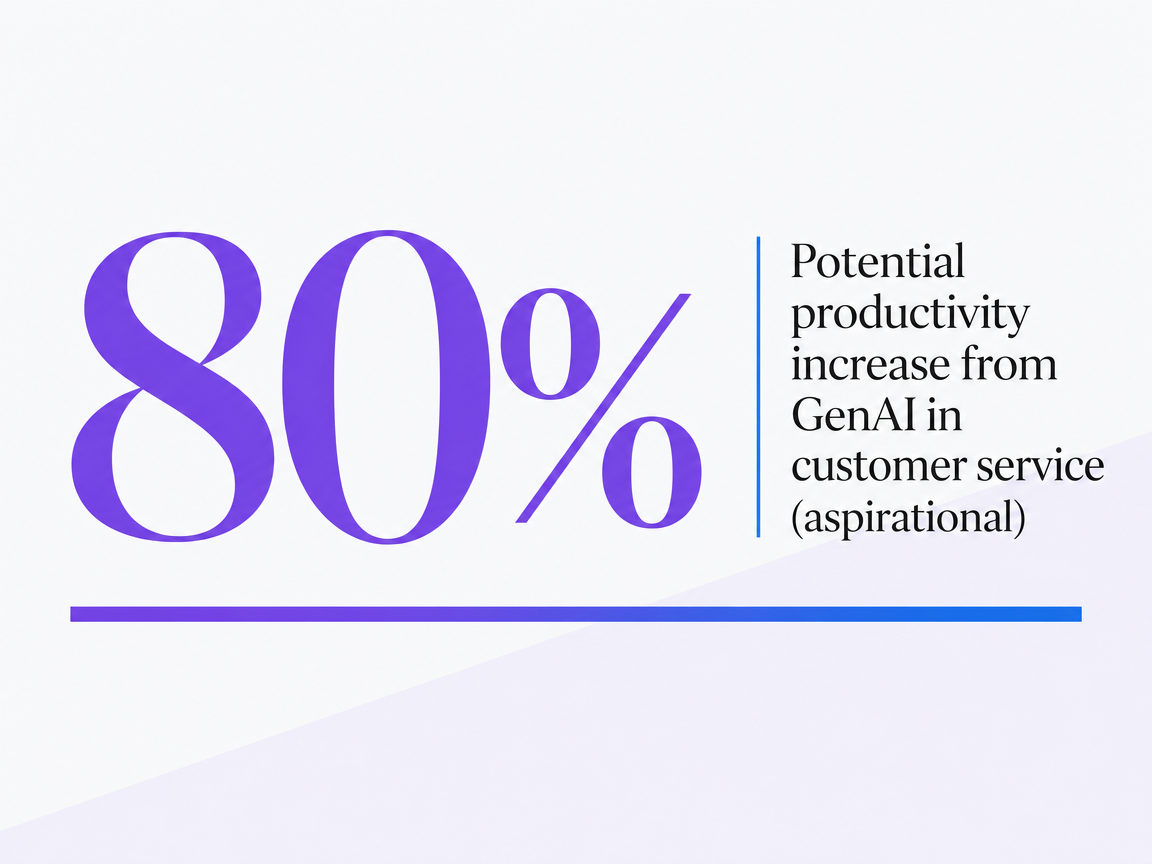 Potential productivity increase from GenAI in customer service (aspirational)
Potential productivity increase from GenAI in customer service (aspirational)
Frequently Asked Questions
References
- 1.Introducing Search Generative AI performance reports in Search Console.
- 2.Tracking Firm Use of AI in Real Time.
- 3.The Fed - Measuring AI Uptake in the Workplace.
- 4.Marketers Spend on New Technologies While Battling Usage and Impact Challenges.
- 5.AI Agents Open the Golden Era of Customer Experience.
- 6.Marketing AI Guidelines.
- 7.AI Will Shape the Future of Marketing.
- 8.From Campaigns to Business Value: How AI Will Transform Marketing.
- 9.Agency Profitability Guide — Benchmarks, Metrics, and Margins.
- 10.Ad Agency Profit Margin: Benchmarks, Breakdown, And What Drives It.
- 11.How Much to Mark Up White Label SEO Services for Profit.
- 12.SEO agency pricing: Define pricing & protect margins.
- 13.What are the real impacts of AI on agency fees?.
- 14.How will AI impact agency business models and compensation?.