
Key Takeaways
- Scalable keyword research runs as a four-stage retrieval pipeline: sparse signal collection, constrained semantic expansion, intent clustering with SERP overlap evidence, and a senior-strategist approval gate.
- Constrain semantic expansion with client-specific allow lists and block lists, because unconstrained global expansion drifts toward model priors and shifts commercial meaning away from the client's actual demand surface 12.
- Score outputs with precision, recall, and nDCG against a labeled monthly sample of 50 to 100 clusters per account, then pair with downstream ranking and revenue outcomes 13.
- For YMYL accounts, layer the approval gate so strategists review intent while subject-matter reviewers approve claims and definitions, with authoritative sources carried into each brief 2.
Why keyword research became a retrieval problem
The question agency SEO leads face is no longer whether to use generative AI in keyword discovery. Stanford HAI's 2025 AI Index reports that 71% of surveyed organizations used generative AI regularly in at least one business function in 2024, with marketing and sales among the most common functions and marketing strategy and content support identified as a leading application at 27% 11. McKinsey's 2025 global survey reports the same 71% figure, up from 65% in early 2024, and names marketing and sales among the top deployment areas 8. Adoption is settled. Design is not.
What has shifted underneath the category is the nature of the problem. Classical keyword research treated the task as list-building: pull volume, filter by difficulty, assign to a calendar. Modern search behavior, modern SERPs, and modern generation systems have turned the same work into an information-retrieval problem. The MIT 2024 thesis on dense and sparse representations describes retrieval as a pipeline that combines lexical matching, semantic expansion with language models, and reranking, rather than as a single lookup step 7. That is the vocabulary the discipline now runs on.
For an agency head managing delivery across many accounts, the practical consequence is that scalable keyword research cannot be solved by buying a larger seat count on a volume tool. It has to be designed as a staged pipeline with retrieval logic, evaluation metrics, and an approval gate. The rest of this article lays out that architecture.
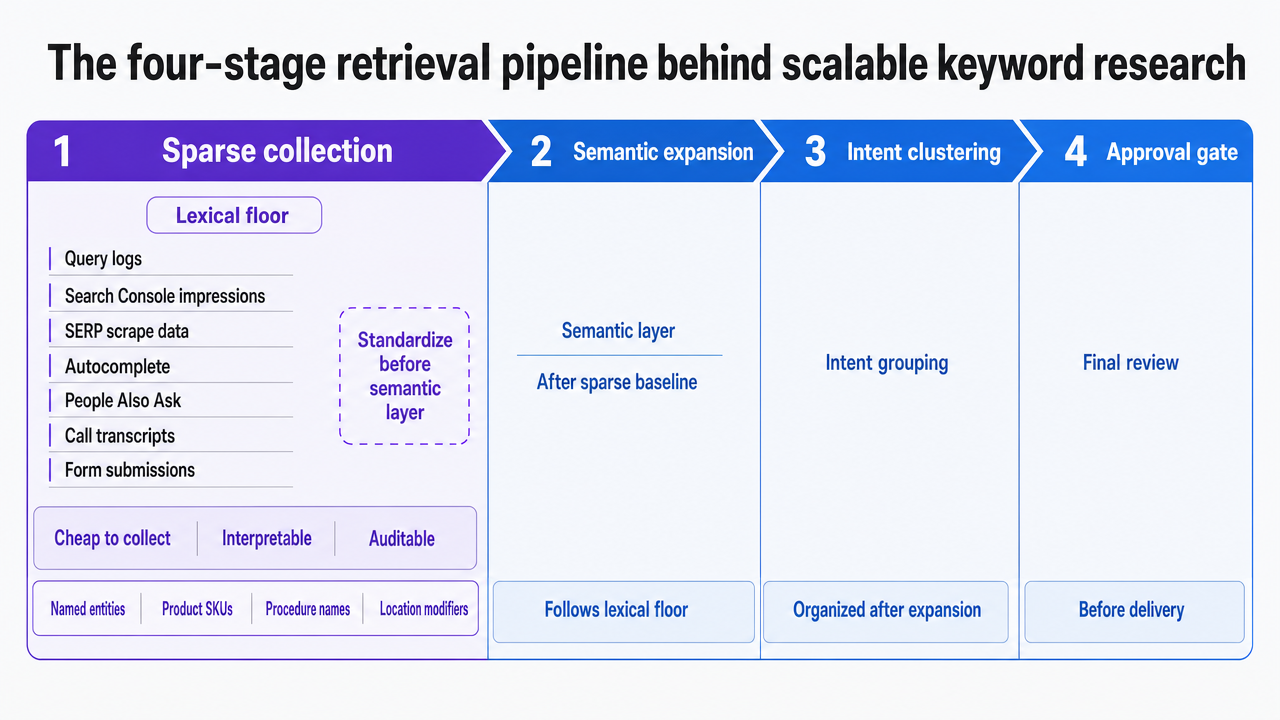
The four-stage retrieval pipeline behind scalable keyword research
Sparse signal collection: the lexical floor
Sparse retrieval is the lexical floor every agency pipeline needs before any model gets involved. These are the exact-term signals: query logs, Search Console impressions, SERP scrape data, autocomplete, People Also Ask, and the client's own call transcripts and form submissions. They are cheap to collect, interpretable, and auditable. The MIT 2024 thesis on dense and sparse representations treats sparse methods as the computational baseline for retrieval precisely because they preserve exact matches on named entities, product SKUs, procedure names, and location modifiers that embeddings often blur 7.
For a head of SEO running delivery across many accounts, the operational point is that sparse collection should be standardized before any semantic layer touches a client's data. Every client gets the same intake: 90 days of Search Console query data, top 100 ranking URLs with on-page terms extracted, SERP features for the top 50 commercial queries, and a transcript sample from sales or intake calls. The output is a lexical seed set that is defensible on its own, independent of any model.
Skipping this step is the most common failure in AI keyword workflows. Teams that start with LLM brainstorming inherit the model's priors instead of the client's actual demand surface, and the error compounds through every later stage.
Semantic expansion without bias drift
Once the lexical seed is fixed, the semantic layer broadens coverage. This is where most agencies either underuse the model or let it run unsupervised. The Stanford information-retrieval chapter on relevance feedback and query expansion draws a distinction that should govern how expansion is configured: global methods expand or reformulate queries independently of returned results, typically using thesauri or related-term resources, while local methods adjust the query relative to documents that initially match it 12. The two produce different outputs and carry different failure modes.
Global expansion, in an AI context, uses an LLM or embedding model to generate related terms from the seed without looking at live SERPs. It is fast and cheap, and it is where bias drift originates: the model generalizes toward popular interpretations of a term and away from a client's specific commercial meaning. Local expansion, modeled on pseudo-relevance feedback, pulls the top ranking pages for each seed query and expands against the vocabulary actually present in those documents. It is slower and more faithful to the live SERP.
The EPA's Query Expansion Toolbox is a useful precedent here. It was built to expand expert-derived search strings in a comprehensive and non-biased manner, specifically because unconstrained semantic expansion will pull in loosely related terms that look relevant but shift the search's meaning 5. The equivalent discipline for an agency is to constrain expansion with a client-specific allow list of entities, services, and geographies, and a block list of adjacent categories the client does not serve. Expansion that cannot explain which seed term produced each candidate should not reach clustering.
Intent clustering as the production unit
Expanded term lists are not briefs. The unit of production in a scalable workflow is the intent cluster: a group of queries that resolve to the same user goal and therefore map to a single page. Clustering is where sparse signals and semantic candidates get reconciled. Embeddings group queries by meaning; SERP overlap confirms that search engines treat them as the same intent; sparse term analysis preserves the specific phrasing that must appear on the page.
VA.gov's SEO guidance is useful as the editorial constraint on clustering output. It recommends writing relevant, unique content based on real searches, using clear heading hierarchy, avoiding thin pages, and answering conversational questions 4. Translated to a clustering rule: a cluster is valid only if it supports one primary intent, enough sub-questions to justify a complete page, and no meaningful overlap with an existing cluster already assigned to another URL. Clusters that fail those tests either merge upward or get rejected, not pushed into the calendar.
For portfolio delivery, this is the stage that benefits most from automation. A trained strategist can review 40 candidate clusters per hour when the pipeline presents each one with its member queries, SERP overlap evidence, representative top-ranking URLs, and the specific lexical terms that must be preserved. Without that packaging, the same review takes four to five times longer and judgment quality drops with fatigue.
The approval gate: where specialist judgment lives
The last stage is the one that distinguishes a pipeline from a generator. Every cluster, before it becomes a brief, passes through an approval gate where a senior strategist accepts, rejects, or revises. This is not a formality. It is the control point for intent accuracy, commercial fit, cannibalization risk, and regulated-content exposure.
NIST's Generative AI Profile identifies confabulation, confidently stated but false or inaccurate output, as a core risk category for generative systems and recommends risk-management actions across the AI lifecycle rather than at a single checkpoint 10. In a keyword workflow, confabulation shows up as plausible-looking clusters that misread intent, invent subtopics the SERP does not support, or recommend pages that duplicate existing coverage. The approval gate catches these because a human with account context evaluates each decision against evidence the pipeline is required to present alongside the recommendation.
The practical design choice is what the gate shows the reviewer. A defensible gate presents the cluster, its evidence trail (seed terms, expansion source, SERP overlap, lexical anchors), the recommended page type, the proposed title and H1, and any flags the pipeline raised, such as YMYL category, brand-term proximity, or overlap with an existing URL. The strategist's decision is logged against the cluster, which becomes the audit record for the client. Scale comes from the pipeline doing the assembly; quality comes from the gate being real.
 Visualize the four-stage pipeline described in the section (sparse collection, semantic expansion, intent clustering, approval gate) as a horizontal process flow with the key constraints at each stage
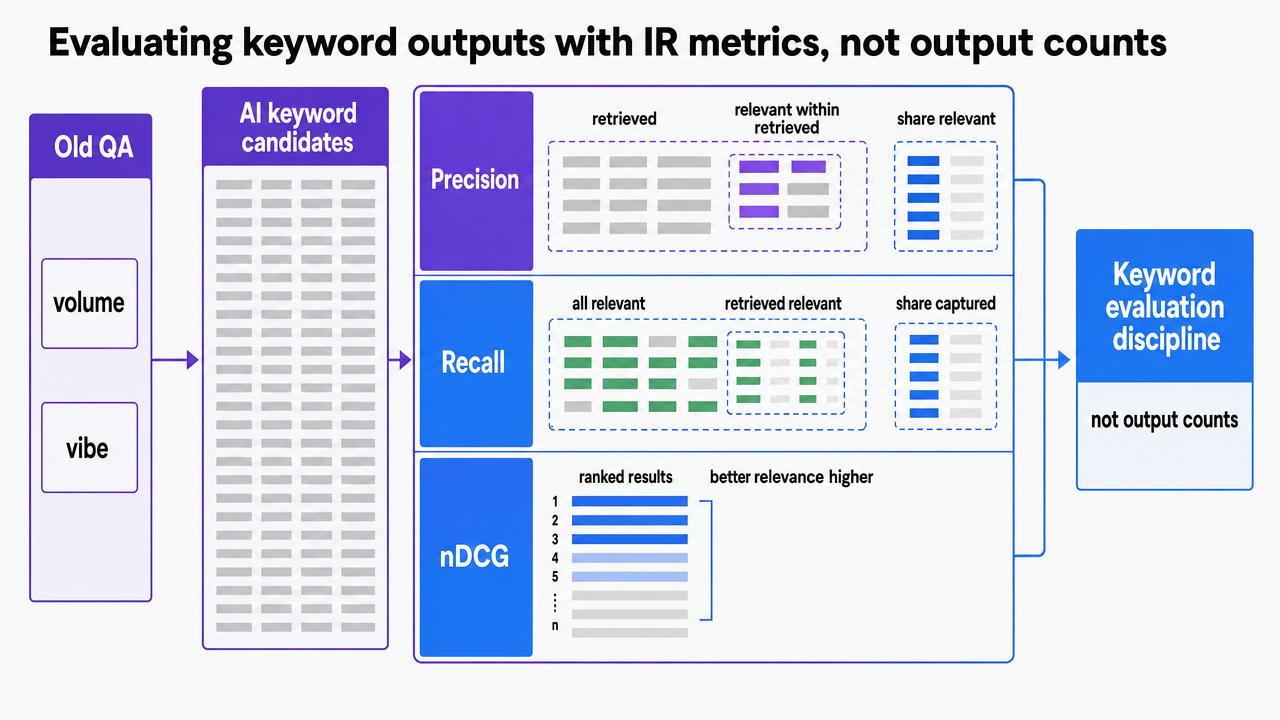
Evaluating keyword outputs with IR metrics, not output counts
Most agency QA for AI keyword outputs still runs on volume and vibe. A strategist opens the cluster file, scans the first ten entries, judges whether they look reasonable, and signs off. That worked when the input was a hundred rows pulled from a tool. It does not work when the input is a few thousand model-generated candidates per account per month, and it is why so many AI keyword programs produce calendars that feel comprehensive and perform like filler.
The missing layer is evaluation discipline borrowed from information retrieval. NIST's TREC overview defines precision as the proportion of retrieved documents that are relevant and recall as the proportion of relevant documents actually retrieved, with normalized discounted cumulative gain (nDCG) and average precision listed among the standard measures for ranked results 13. The same vocabulary applies cleanly to keyword outputs. Precision asks how many of the clusters the pipeline produced are genuinely addressable intents the client should rank for. Recall asks what share of the client's real demand surface the pipeline actually captured. nDCG asks whether the pipeline ranked the highest-value clusters at the top of the queue instead of burying them under volume.
Operationalizing these metrics does not require a research team. It requires a labeled sample. Each month, a senior strategist marks a random sample of 50 to 100 candidate clusters per account against a short rubric: relevant to the client's commercial scope, supported by SERP evidence, non-duplicative of existing coverage. Precision is the share marked relevant. Recall is estimated by seeding the sample with known-good clusters from manual research or Search Console winners and checking how many the pipeline surfaced independently. nDCG is calculated against the pipeline's own priority ranking.
TREC's own caveat applies. Benchmark relevance judgments do not capture business value, lead quality, or the needs of local service clients on their own 13. The metrics are necessary, not sufficient. Pair them with downstream outcomes, ranking movement, qualified sessions, and booked revenue per published cluster, and the pipeline becomes defensible to clients who ask why they are paying for AI-assisted work. Agencies that skip this layer end up arguing about taste. Agencies that adopt it argue about scores.
 Translate the three IR metrics (precision, recall, nDCG) into a comparison framework showing what each measures in the keyword workflow context, as described in the section
Test AI-driven keyword research at scale now
Validate and publish data-backed content using live keyword intelligence in your workflow, risk-free for seven days.
Governance: approval gates against confabulation and YMYL risk
Mapping the NIST AI RMF to a keyword workflow
Agency governance stories tend to collapse into a single sentence about human review. That is not enough for enterprise clients, and it is not enough for the pipeline itself. NIST's AI Risk Management Framework organizes AI risk management around four functions, Govern, Map, Measure, and Manage, and emphasizes that trustworthy AI should be valid and reliable, accountable and transparent, and have harmful bias managed 9. Those functions map cleanly onto an AI keyword workflow when treated as separate decision points rather than a vague wrapper.
Govern : Sets the policies the pipeline runs under: which clients are tagged YMYL, which expansion sources are approved, which models can touch client data, who owns final sign-off.
Map : Is the intake stage, where the pipeline documents the client's commercial scope, excluded categories, brand terms, and regulated-content flags before any seed collection runs.
Measure : Is the evaluation layer covered in the previous section, precision, recall, and nDCG against a labeled sample, logged per account per cycle.
Manage : Is the approval gate itself, plus the escalation path when a reviewer rejects clusters at above a defined threshold, which signals the expansion rules need retuning rather than more human effort.
The NIST Generative AI Profile narrows this further for generative systems, naming confabulation, data privacy, harmful bias, information integrity, and human overreliance among the risk categories to manage across the AI lifecycle 10. For a keyword pipeline, overreliance is the quiet one. If strategists stop reading evidence trails and start rubber-stamping clusters because the pipeline has been reliable for three months, the gate has already failed. Govern-level controls, random audit samples, rejection-rate monitoring, periodic rotation of reviewers across accounts, exist to catch that drift before a client does.
Regulated verticals: legal, behavioral health, dental, senior living
YMYL accounts raise the cost of a bad cluster. A misread intent on a legal practice area page, a behavioral health service page, a dental procedure page, or a senior living care-level page can produce content that misstates eligibility, scope of service, or clinical claims. The approval gate has to carry more weight on these accounts, and the pipeline has to feed it more evidence.
TREC's 2024 Biomedical Generative Retrieval track is instructive here. The overview reports that most submitted systems used a two-stage retrieval-augmented generation approach to produce answers with references, treating citation grounding as part of the evaluation rather than a presentation layer 2. The equivalent discipline for YMYL keyword briefs is that each cluster assigned to a regulated page type must carry its source evidence into the brief itself: the authoritative references the page will cite, the regulatory or clinical definitions the page will use, and the specific claims that require legal or clinical sign-off before publication.
NIST's synthetic-content guidance reinforces the point. Risk reduction is treated as a multi-approach problem involving provenance, watermarking, detection, and authentication rather than a single universal control 6. For an agency, that translates into a layered gate on regulated accounts: the strategist reviews intent and scope, a subject-matter reviewer from the client's side reviews claims and definitions, and the publication record logs who approved what. The pipeline makes that layering cheap by assembling evidence; the gate makes it defensible by requiring named approvals before a cluster becomes a brief.
From approved cluster to publishable brief
An approved cluster is a decision, not a document. The brief is where the decision becomes something a writer, a subject-matter reviewer, and a publishing system can all act on. The handoff is also where most pipelines leak quality, because strategists approve clusters in one tool and briefs get assembled later in another, with the evidence trail stripped out along the way.
The brief should carry the cluster's evidence forward intact. Digital.gov's content guidance recommends structured content optimized for findability, with regular review for accuracy, currency, and usefulness 3. VA.gov's SEO guidance adds the one-intent-per-page constraint and the requirement to answer conversational questions drawn from real searches 4. Translated into brief fields:
- A primary query and intent statement
- The member queries the page must answer
- The lexical anchors that have to appear verbatim
- The heading hierarchy derived from SERP overlap
- The page type and word-count range
- Internal link targets already in the client's architecture
- The schema the page will emit
For regulated accounts, the brief carries the extra layer established at the gate: the authoritative sources the page will cite, the regulatory or clinical definitions it will use, and the specific claims flagged for client sign-off before publication, consistent with the citation-grounded approach used in biomedical generative retrieval evaluations 2. Writers are not asked to invent evidence; they assemble against it.
The operational test is simple. If a brief can be handed to a competent writer who has never worked the account and produce a page that passes the gate's own standards, the pipeline is working. If each brief needs a strategist's verbal context to be usable, the handoff is still manual and the pipeline has not scaled.
See How Leading Agencies Use AI for High-Impact Keyword Research at Scale
Connect with our team to explore AI-driven workflows that automate keyword analysis, streamline approvals, and deliver measurable content performance—without increasing headcount or sacrificing strategic oversight.
If you manage multiple accounts: portfolio economics of the pipeline
The scope shifts here. Everything above describes the pipeline working on a single account. The reason agency heads care about any of it is what happens when the same architecture runs across 15 to 80 clients with a specialist team that is not growing linearly with the book of business.
The economics come down to three variables:
- Hours per client per month on keyword research and brief production
- Loaded cost per strategist hour
- Clients per strategist
The pipeline moves all three. Specialist hours shift from collection and assembly, which the pipeline handles, to review, which the gate requires. Loaded cost per hour stays roughly constant unless the agency rebalances toward more senior reviewers, which is usually the right move. Clients per strategist rises because assembly scales with compute rather than with headcount.
The table below holds dollar figures as variables because supplied research does not include agency hourly benchmarks. Fill in H (hours), R (rate), and C (clients) from internal records to get a defensible comparison.
| Model | Hours per client per month (H) | Reviewer seniority mix | Clients per strategist (C) | Monthly cost per client |
|---|---|---|---|---|
| Manual research | H₁ (highest) | Mid-level dominant | C₁ (lowest) | H₁ × R_mid |
| Tool-assisted (volume tool + spreadsheets) | H₂ (≈ 0.6–0.8 × H₁) | Mid-level dominant | C₂ (≈ 1.3–1.6 × C₁) | H₂ × R_mid |
| AI pipeline with approval gates | H₃ (≈ 0.3–0.4 × H₁, review-weighted) | Senior dominant | C₃ (≈ 2–3 × C₁) | H₃ × R_senior |
Two numbers are worth watching more than cost per client. The first is reviewer rejection rate at the approval gate. A rate climbing above a defined threshold means the expansion rules need retuning, not that the team needs more hours. The second is throughput variance across strategists. In the manual and tool-assisted models, variance comes from individual research habits. In the pipeline model, variance comes from how reviewers interpret evidence, which is a training problem with a defined fix. McKinsey's 2025 survey on organizations rewiring to capture value emphasizes workflow redesign and senior oversight as the mechanism by which generative AI adoption produces returns, rather than tool deployment on its own 8. The portfolio case for the pipeline rests on the same claim: the lever is where senior hours get spent, not how many of them exist.
What this changes for the agency operating model
The pipeline rearranges the org chart more than it rearranges the tech stack. Collection, expansion, and clustering move to compute. Review, judgment, and client-facing scope decisions move to senior strategists whose hours are now the scarce resource. The mid-level research role, as traditionally defined, thins out; the senior reviewer role expands and becomes the throughput ceiling for the entire book.
Three operational commitments hold the model together:
- Standardize intake so every account enters the pipeline the same way.
- Keep the approval gate real by requiring evidence trails on every cluster and auditing rejection rates monthly.
- Score outputs with precision, recall, and nDCG against labeled samples 13 instead of defending the work on volume.
Agencies that make those commitments stop selling research hours and start selling governed throughput, which is the only version of this that holds up when a client asks what changed.
Vectoron was built around that same approval-first architecture for teams running this play across many accounts.
Frequently Asked Questions
References
- 1.Overview of TREC 2024 - Text REtrieval Conference.
- 2.Overview of TREC 2024 Biomedical Generative Retrieval (BioGen) Track.
- 3.An introduction to content.
- 4.Writing for SEO - VA.gov Design System.
- 5.The Query Expansion Toolbox: Leveraging Semantic AI to Develop Comprehensive and Non-Biased Search Queries.
- 6.Reducing Risks Posed by Synthetic Content: An Overview of Technical Approaches to Digital Content.
- 7.Information Retrieval with Dense and Sparse Representations.
- 8.The state of AI: How organizations are rewiring to capture value.
- 9.Artificial Intelligence Risk Management Framework (AI RMF 1.0).
- 10.Artificial Intelligence Risk Management Framework: Generative Artificial Intelligence Profile.
- 11.CHAPTER 4: Economy.
- 12.Relevance feedback and query expansion.
- 13.Overview of TREC 2021.
- 14.Economy | The 2025 AI Index Report | Stanford HAI.