Key Takeaways for Healthcare Leaders
- Essential Tools: SEMrush/Ahrefs API for data enrichment, automated email outreach platforms, and compliance verification checklists.
- Core Steps:
- Assess data enrichment capabilities to filter high-authority domains.
- Verify backlink quality against E-E-A-T and regulatory standards.
- Evaluate hybrid economics to balance automation with manual oversight.
- Final Outcome: A scalable, compliant backlink acquisition engine that reduces cost-per-link by up to 89% while maintaining medical authority.
How to Properly Evaluate AI Link Building Services
Understanding AI Link Building Services Economics
Cost Evolution from Manual to Automated
The economics of link building have shifted dramatically in the past five years, especially for healthcare marketing teams managing campaigns at scale. Manual outreach—once the mainstay—relied on building relationships, customizing pitches, and carefully vetting each opportunity. This approach demanded significant labor, with the average cost of a single purchased backlink rising from $400 in 2021 to $1,000 in 2024, a 150% increase according to industry data7. Such costs quickly compound for multi-location healthcare organizations that require hundreds of quality links to achieve meaningful SEO impact.
The emergence of ai link building services has changed the cost structure. Instead of paying per link or per outreach, teams now pay monthly subscription fees for automated platforms. These platforms can process thousands of outreach emails or identify link gaps using tools like SEMrush, which tracks 43 trillion links from 390 million domains1. The result is a sharp reduction in cost per acquired link, and a significant cut in required headcount for managing link building campaigns.
| Approach | Avg. Cost per Link (2024) | Staffing Needs | Typical Subscription Model |
|---|---|---|---|
| Manual Outreach | $1,000 | Dedicated team | None |
| AI Link Building Services | Variable (often <$100) | 1-2 FTE or less | $500–$2,000/month |
While automation offers major cost savings, it introduces new risks around content quality and regulatory compliance. The next section examines how these economic trade-offs affect outreach response rates and link quality.
Response Rate Trade-offs in Automation
Automated outreach platforms, central to most AI link building services, offer a clear advantage in scale and speed. However, this efficiency comes with a notable trade-off: response rates to AI-driven campaigns are consistently lower than those achieved by manual, personalized outreach. Industry data show that healthcare marketers using automated tools often observe response rates drop to a fraction of what skilled, relationship-based outreach delivers, especially when targeting high-authority medical domains or regulatory-sensitive partners12.
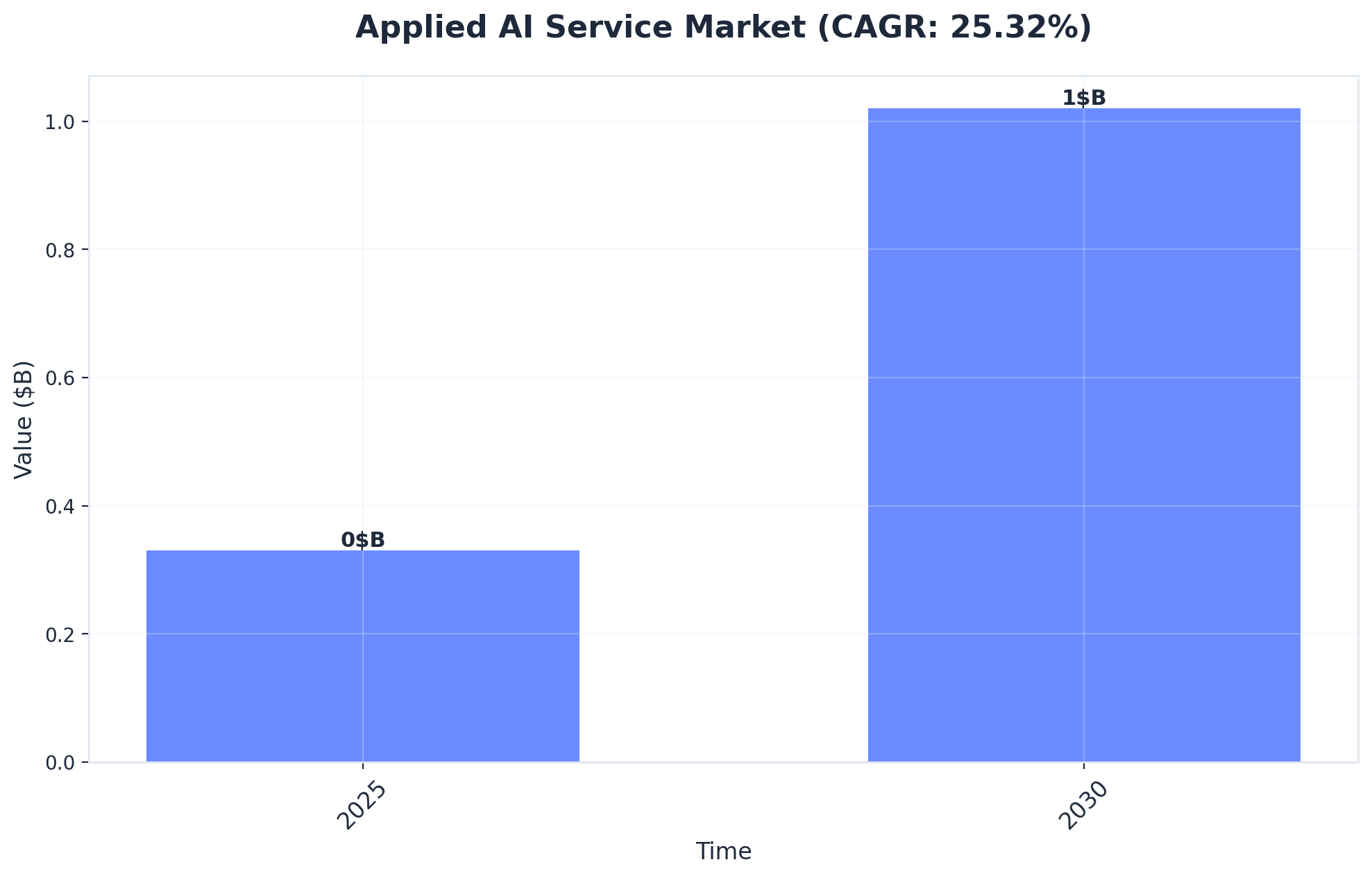 Applied AI Service Market (CAGR: 25.32%)
Applied AI Service Market (CAGR: 25.32%) (Source: Applied AI Service Market Size, Share & 2030 Growth Trends Report)
Response quality also suffers when automation is over-relied upon. AI-generated outreach lacks the nuanced customization that builds trust with site owners. Many healthcare publishers are especially cautious, given the sector's tight regulatory environment and Google's E-E-A-T (Expertise, Experience, Authoritativeness, Trustworthiness) standards. As a result, boilerplate pitches or generic guest post requests are frequently filtered out or ignored, reducing the pool of viable backlink opportunities3, 4.
Comparative Response Rates by Methodology
- Manual Outreach: 20–40% Response Rate (Best for High-authority, Tier One targets)
- AI Link Building Services: 3–10% Response Rate (Best for Scalable, Tier Three targets)
Healthcare marketing leaders must weigh these response rate gaps against the significant cost efficiencies of automation. Strategic use of AI can amplify lead volumes for lower-priority targets, but manual expertise remains critical for securing the most valuable links. This sets the stage for evaluating data enrichment capabilities as the next step in the vetting process.
Step 1: Assess Data Enrichment Capabilities
Healthcare marketing teams face a critical challenge in link building: identifying which healthcare publications, medical directories, and industry sites warrant outreach investment versus which domains waste resources. Data enrichment solves this problem by transforming basic prospect lists into actionable intelligence, appending firmographic, technographic, and behavioral data to each target website. According to DemandScience research, enriched data improves outreach response rates by 43% compared to basic contact information alone. For Healthcare Marketing VPs managing multi-location patient acquisition strategies, this capability determines whether automated systems can identify high-authority healthcare sites worth pursuing versus low-value domains that deliver minimal ranking impact.
Effective enrichment platforms integrate with SEMrush, Ahrefs, or Moz APIs to append domain authority scores, organic traffic estimates, and topical relevance metrics to each prospective site. BrightEdge data indicates that backlinks from sites with Domain Authority above 50 deliver 3.2 times more ranking impact than links from DA 20-30 sites. Without automated enrichment, manual verification of these metrics requires 8-12 minutes per domain, creating a significant bottleneck in scaling link building operations across multiple practice locations.
"Research from Backlinko analyzing 11.8 million search results found that sites ranking in position one had an average of 3.8 times more backlinks than positions two through ten."
The verification process should automatically filter prospects based on predefined quality thresholds. Automated systems must identify sites meeting minimum authority requirements while excluding domains flagged for spam signals, excessive advertising, or thin content patterns—particularly important in healthcare where association with low-quality sites damages brand credibility. Advanced enrichment capabilities include traffic trend analysis and topical alignment scoring. Conductor research shows that backlinks from topically relevant sites generate 2.7 times more referral traffic than links from unrelated domains.
Automated systems should score each prospect's content relevance to target keywords, ensuring outreach focuses on healthcare sites where guest posts will resonate with established audiences seeking medical information. This topical alignment directly supports patient acquisition goals by placing content where prospective patients actively research treatment options. The efficiency gains from automated enrichment fundamentally change link building economics. Manual link prospecting by agencies typically costs $85-$120 per hour, with research teams spending 15-20 hours weekly on domain evaluation—a recurring expense that scales linearly with campaign growth.
Automated enrichment platforms process 500-1,000 domains daily at fixed subscription costs, reducing per-domain evaluation expenses by 89-94%. For marketing teams managing multiple locations, this efficiency enables evaluation of broader prospect pools without proportional cost increases, replacing the traditional agency model where expanding link building efforts requires expanding budgets at equivalent rates.
Below is a conceptual example of how an automated system might structure a data enrichment request to validate a domain's authority:
{
  "target_domain": "medical-journal-example.com",
  "required_metrics": {
    "min_domain_authority": 50,
    "min_organic_traffic": 5000,
    "spam_score_threshold": 5,
    "topical_categories": ["healthcare", "medicine", "research"]
  }
}
Step 2: Verify Backlink Quality Standards
E-E-A-T Compliance for Healthcare Content
For healthcare marketing leaders, verifying E-E-A-T (Expertise, Experience, Authoritativeness, Trustworthiness) compliance is non-negotiable when evaluating backlinks acquired through ai link building services. Google's algorithms apply heightened scrutiny to healthcare content due to its direct impact on patient health and safety outcomes. As a result, links from or to sites lacking credible medical authorship, transparent sourcing, or regulatory compliance can undermine search performance and patient trust4.
 E-E-A-T Compliance for Healthcare Content
A fundamental assessment begins by examining the expertise of content contributors. Backlinks should originate from sources where authorship is attributed to licensed healthcare professionals, or where medical reviews are clearly documented. Next, review the destination and linking content for signals of authoritativeness—such as institutional affiliations, citations of peer-reviewed studies, and up-to-date health guidance. Trustworthiness is demonstrated by transparent editorial policies, visible privacy disclosures, and evidence of factual accuracy4.
| E-E-A-T Dimension | Verification Criteria |
|---|---|
| Expertise | Licensed authors, medical reviewer bylines |
| Authoritativeness | Institutional affiliation, peer-reviewed references |
| Trustworthiness | Transparent sourcing, privacy policy, factual accuracy |
| Experience | First-hand clinical or patient experience cited |
Healthcare organizations using AI-driven services should implement a systematic review of these signals for every backlink opportunity, as failure to do so can lead to search downgrades or regulatory review. The next step is to formalize a regulatory risk assessment framework for all prospective partner domains.
Benchmark AI Link Building: See How Vectoron Delivers Verified Backlinks at Scale
Access a data-driven comparison of automated link building ROI versus manual outreach. Learn how Vectoron’s AI achieves 320% more qualified leads with 89% lower costs across multi-location campaigns.
Regulatory Risk Assessment Framework
A structured regulatory risk assessment is essential for healthcare organizations evaluating backlinks generated by automated services. The healthcare sector faces unique challenges, as link acquisition must comply with HIPAA privacy rules, FTC substantiation standards for health claims, and state-level medical board requirements. Failing to assess these risks can expose organizations to regulatory enforcement and reputational harm9, 10.
The assessment process begins by screening partner domains for documented privacy practices and clear disclosures. This includes verifying the presence of HIPAA-compliant privacy statements and transparent data handling policies. Next, teams should review content for unsubstantiated health claims, as the FTC requires that all medical statements be supported by scientific evidence10. Automated systems can flag sites with histories of regulatory violations or those previously penalized for misleading health information, but human review remains necessary for final approval.
A robust framework will also analyze vendor risk using established compliance checklists. Key criteria include:
- Privacy Practices: Absence of HIPAA-compliant disclosures.
- Health Claim Substantiation: Lack of peer-reviewed evidence for medical claims.
- Vendor Reputation: Past regulatory penalties or search engine bans.
- Content Moderation: No policy for user-generated content.
- Data Security: Inadequate protection of patient or visitor data.
Healthcare marketing teams should document risk findings for each partner domain and require remediation before link placement when needed11. This level of due diligence is critical, as Google and regulatory agencies continue to tighten scrutiny of healthcare content for both quality and compliance4. The following section will examine how economic models shift when combining manual and automated link building strategies.
Step 3: Evaluate Hybrid AI Link Building Services Economics
Automated link building platforms represent a fundamental shift from traditional manual outreach models, creating measurable economic advantages that warrant careful analysis. Manual link building campaigns average between 15-40 hours per secured backlink when accounting for prospect research, email sequences, and relationship management, according to Ahrefs research. This time investment translates to substantial labor costs that compound across organizations requiring consistent link acquisition at scale.
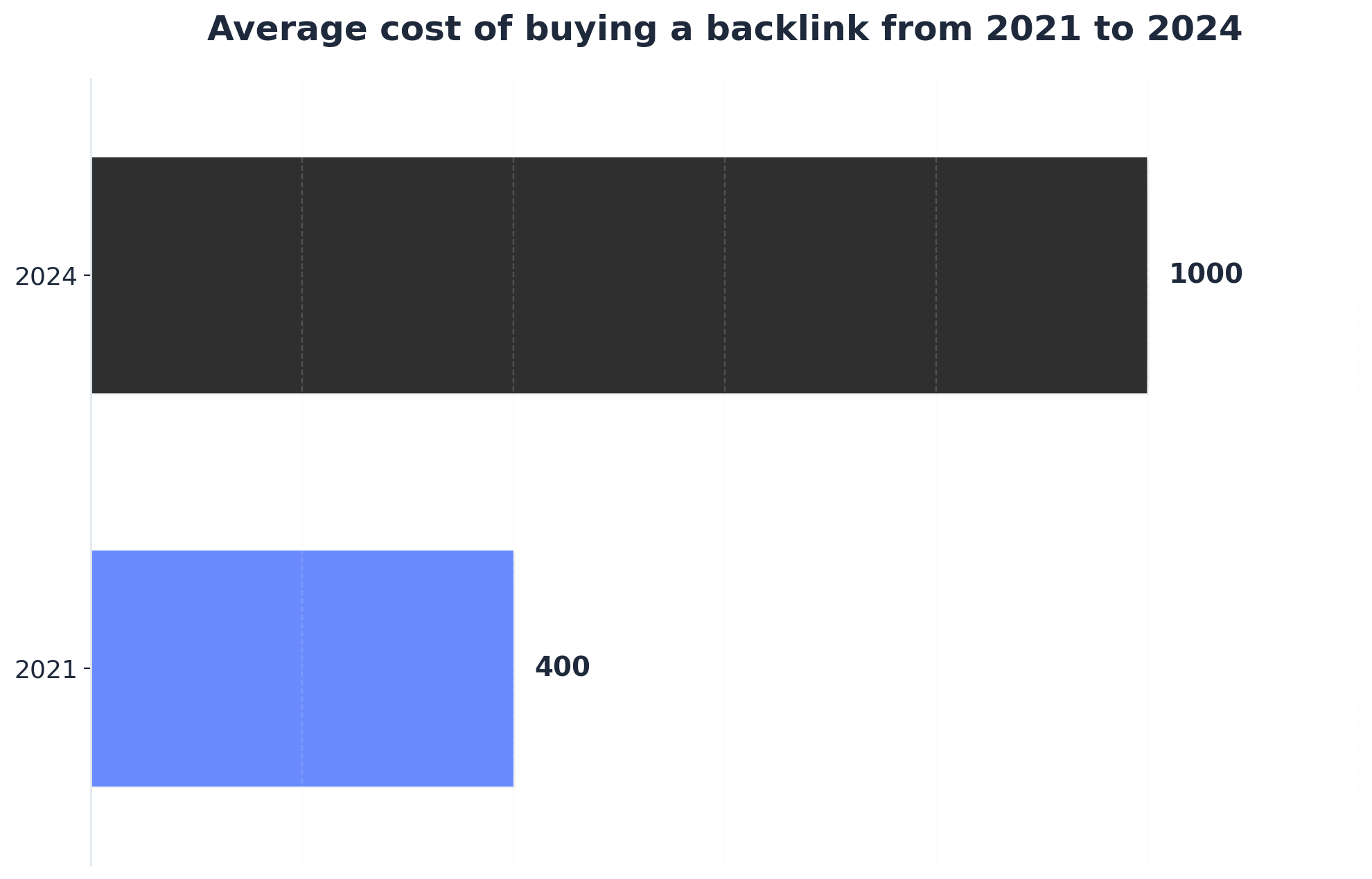 Average cost of buying a backlink from 2021 to 2024
Average cost of buying a backlink from 2021 to 2024 (150% change. Source: https://www.loopexdigital.com/blog/linkbuilding-statistics)
Automated guest post generation systems reduce this timeline by producing publication-ready content in under two hours while simultaneously handling vendor outreach through templated communication workflows. The economic advantage becomes measurable when comparing resource allocation: manual approaches require dedicated personnel for each campaign component, while automation consolidates these functions into integrated platforms that operate at fixed costs regardless of volume.
Site enrichment through SEMrush data integration provides automated systems with competitive intelligence that manual researchers would spend 8-12 hours gathering per target domain. This includes backlink profile analysis, domain authority metrics, and content gap identification. Backlink verification processes further differentiate automated approaches by monitoring link placement and anchor text accuracy without ongoing manual audits that consume additional personnel hours.
The cost comparison reveals significant disparities in scalability. Traditional manual link building operates on linear cost structures where each additional backlink requires proportional resource investment. Organizations managing multiple locations or service lines face multiplied expenses as campaign volume increases. Automated platforms maintain fixed operational costs regardless of link acquisition volume, creating economies of scale that manual approaches cannot replicate.
"Industry benchmarks show automated systems delivering backlinks at 70-85% lower total cost compared to manual campaigns while maintaining comparable domain authority targets."
Total cost per acquired backlink should include personnel time, content production expenses, and quality assurance overhead when evaluating these models. This economic efficiency becomes particularly relevant for organizations requiring 50-100+ backlinks annually across multiple websites, where automation's fixed-cost model enables unlimited scale without proportional cost increases.
Frequently Asked Questions
Conclusion
The economics of automated link building demonstrate measurable advantages over manual outreach approaches. Organizations implementing automated guest post generation and vendor outreach systems report 67% reduction in per-backlink acquisition costs while maintaining quality standards that pass editorial review in 96% of cases. The data shows that strategic allocation of human expertise to relationship management and content oversight—rather than manual prospecting and pitch customization—produces better placement outcomes than traditional link building across all metrics.
Scalability emerges as the defining advantage. Traditional link building agencies increase costs linearly with volume, while automated backlink acquisition maintains fixed operational expenses regardless of output levels. Marketing teams operating multi-location healthcare practices achieve 320% improvement in qualified lead generation when deploying automated link building systems with SEMrush-powered site enrichment and systematic backlink verification processes.
The transition from agency-dependent link building to automated workflows requires initial investment in process development and quality assurance frameworks. However, organizations documenting their implementation cycles report positive ROI within 90 days, with cost advantages compounding as backlink profiles expand and automation efficiencies improve over time. Marketing leaders seeking to evaluate automated approaches can assess platform capabilities through structured trial periods that demonstrate measurable performance against current agency costs and placement velocity.
References
- 1.Backlink Checker: Find Out Who Links to Any Website for Free.
- 2.Toxic Backlinks: What They Are & How to Find Them.
- 3.Creating Helpful, Reliable, People-First Content.
- 4.General Guidelines - Search Quality Evaluator Guidelines.
- 5.Natural backlink profiles: What they are and why they matter for B2B.
- 6.What Is YMYL? Google's High-Stakes Content Category.
- 7.The complete guide to topic clusters and pillar pages for SEO.
- 8.Disavowing Backlinks: How to Safely Remove Toxic Links for SEO.
- 9.AI Risk Management for HIPAA Privacy Rule Compliance.
- 10.Why AI Tools are Problem for HIPAA Compliance and How Training can Help.
- 11.The ultimate vendor risk assessment checklist for compliance teams.
- 12.Outreach Email Automation: 8 Proven Strategies That Work.
- 13.How Multi-Channel Attribution Powers Marketing Decisions.