
Key Takeaways
- Incumbent SEO platforms like Ahrefs, Semrush, and STAT offer the fastest AIO adoption because existing query lists, competitor sets, and white-label templates carry over without retraining analyst pods.
- Specialist AIO and LLM visibility trackers such as Profound, Peec AI, and Otterly.AI justify their cost through citation depth, logging full citation sets, positions, and passage text incumbents rarely capture.
- Enterprise SERP platforms like seoClarity, Conductor, and BrightEdge fit agencies with a few very large accounts because they store full historical SERP snapshots queryable per query per day.
- AI-orchestrated workflows like Vectoron connect citation signals directly to briefs, refresh queues, and approval steps, compressing the loop between AIO detection and published pages.
Why Classic Rank Tracking Now Undersells Client Visibility
For most agency SEO leads, the weekly rank report has been the load-bearing artifact of client reporting for a decade. Position 3 moves to position 2, the client sees green arrows, and the retainer holds. That artifact is now measuring a shrinking slice of the actual search surface.
The clearest signal comes from updated Ahrefs data on which pages Google's AI Overviews actually cite. In the earlier version of the study, 76% of AI Overview–cited pages also appeared in the top 10 organic results for the same query. In the updated pass, that figure fell to 38% 14. Roughly two-thirds of AIO citations now come from pages that a top-10 rank tracker would not flag as visible for the query in question.
That gap is the whole argument for a second measurement layer. If an agency reports on a client's position 4 ranking for a commercial query, and Google's AI Overview for that same query cites three pages from outside the top 10, the client is being under-credited or over-credited in ways the classic report cannot see. Neither the win nor the loss shows up in the tool of record.
Forrester has framed this directly for the vendor side, arguing that SEO platforms must extend rank tracking to capture generative answer presence and brand citation, or risk underreporting clients' true exposure 8. The analyst position matters less than what it implies for agency operations: the KPI set clients will ask about in the next renewal cycle already includes AIO presence, whether the tooling supports it or not.
The rest of this piece looks at what that second layer needs to do, and which four tool archetypes agencies are combining to build it.
The Measurement Gap Agencies Are Actually Paying For
What AI Overviews Broke About the CTR-to-Traffic Model
Rank tracking earns its keep because rank correlates with clicks, and clicks correlate with sessions the client can see in analytics. AI Overviews weaken the first link in that chain before agencies can adjust the second.
Pew Research Center analyzed browsing behavior from more than 900 U.S. adults across roughly 68,000 Google queries in 2025. On result pages that included an AI summary, users clicked a traditional search result on 8% of visits. On pages without a summary, they clicked on 15% 1. Almost none of that lost click volume was recaptured by the source links Google surfaces inside the summary itself: about 1% of users clicked a link within the AI summary 1.
The important scope note is that this is field data from consumer browsing, not agency B2B queries or transactional local searches. The 8-versus-15 gap is a behavioral benchmark for how a general population interacts with informational SERPs, not a universal CTR discount to apply to every client vertical. It tells agencies the direction and rough magnitude of the click compression, not the per-query loss for a personal injury firm in Denver.
What it does confirm is the shape of the problem. When a client's page still ranks in position 3 but the query now triggers an AI Overview, the classic rank report can look identical week over week while the traffic line drops. Rank held; visibility did not. Any AIO rank tracking tool being evaluated has to answer that discrepancy, which means recording, at minimum, whether an AIO appeared for the query and whether the client was among the cited domains.
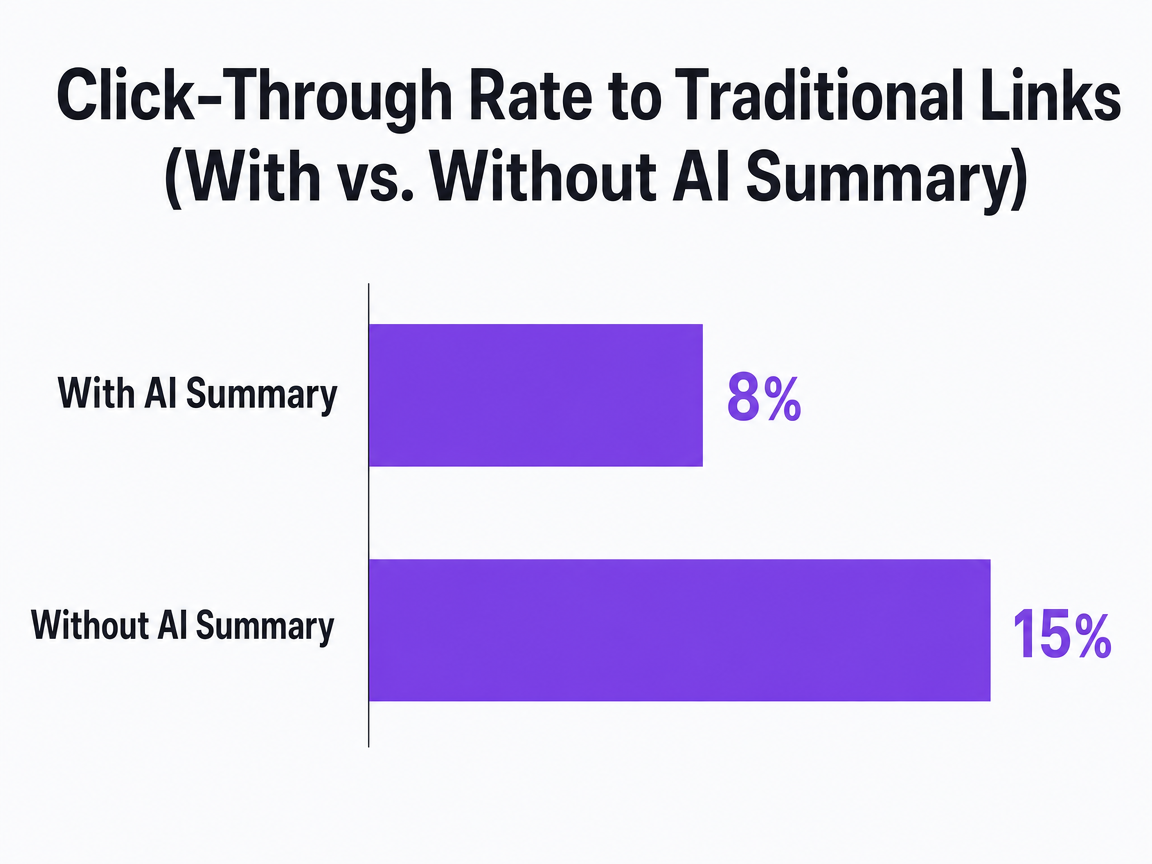 Click-Through Rate to Traditional Links (With vs. Without AI Summary)
Pew Research found that users click traditional search links on 8% of visits when an AI summary is present, compared to 15% of visits when it is not.
Why Presence Without a Click Still Belongs in the Report
The click deficit is the easy story to tell a client. The harder story, and the one that changes what an AIO tracker needs to capture, is that AI Overview presence has value even when no click follows.
YouGov's March 2025 survey of U.S. adults found 67% notice AI-generated summaries in their searches sometimes or often, 38% read them in half or more of their searches, and 52% call them at least somewhat helpful 7. A citation inside that summary is a branded impression seen by a user who is actively evaluating an answer, sometimes on a query the client would never rank for organically. The impression does not show up in GA4 as a session. It shows up, if the agency has instrumented for it, as a citation event.
Google's own documentation reinforces the presence-versus-click distinction. AI Overviews and AI Mode are reported inside Search Console under the Web search type, meaning impressions from AIO surfaces are already mixed into the same performance data agencies pull for organic reporting 9. What Search Console does not natively separate is which of those impressions came from an AIO citation versus a blue-link listing. That parsing is where a dedicated tracker earns its line item on the tool budget: attributing the impression, naming the query, and flagging which client domain appeared in the citation set.
The Counter-Evidence Worth Naming
Not every study points the same direction, and any agency defending a new tool line item to a CFO should know where the evidence is contested.
An AIS SIGHCI experimental paper compared AI-assisted and non-AI search interfaces under controlled conditions, measuring clicks, visual attention, cognitive load, and perceived satisfaction. It found no significant differences in user engagement or website traffic between the two conditions, though visual attention did increase for AI-generated summaries 5. The methodological gap between that finding and Pew's is real: lab tasks with prescribed queries behave differently than millions of self-directed searches in the wild.
The practical read for agency leads is not that the click-loss story is wrong. It is that the effect size varies by query type, user intent, and study design, which is exactly why an AIO tracker needs to report at the query level rather than a single portfolio-wide CTR discount. Client reporting built on a blanket assumption will get argued with; reporting built on per-query citation and impression data will not.
Test AI rank tracking workflows in real time
Track live AI Overview positions and validate reporting accuracy before scaling across client accounts.
Operational Criteria for Evaluating an AIO Tracker
Feature lists on vendor sites tend to blur together. What separates a tracker that survives a 40-client portfolio from one that stalls at 5 is a short set of operational variables that agency leads already use for classic rank tracking, adapted to the citation layer.
Query volume per account is the first constraint. AIO citations are query-level events, not page-level, and the same client will trigger AIOs on some queries and not others. A tracker that caps at a few hundred queries per domain forces triage decisions before the tool has produced any data. Refresh cadence is the second. Google's cited page sets shift over rolling windows, and updated Ahrefs data showed the top-10 overlap with AIO citations falling from 76% to 38% between study passes 14. Weekly refreshes catch drift that monthly refreshes miss, but daily refreshes multiply cost fast across large portfolios.
Citation attribution is where trackers diverge most visibly. Recording that an AIO appeared for a query is table stakes. Recording which domains were cited, at which position inside the summary, and whether the client's domain was one of them is the data agency reports actually need. Some tools log only presence; others log the full citation set.
Three more variables round out the checklist. White-label reporting matters for any agency that sends dashboards under a client-branded domain. API access matters for teams piping citation data into a data warehouse or a production workflow. Seat structure matters for pods where three or four analysts share account access. Forrester's read on the vendor landscape is that these capabilities are still uneven, and agencies should expect to combine two tools before one covers the full set 8.
With those criteria fixed, the four archetypes below map to different combinations of them rather than to a single feature-parity race.
Four Tool Archetypes for Agency Portfolios
Incumbent SEO Platform With an AIO Add-On
The lowest-friction path for most agency SEO leads is the tool already in the stack. Ahrefs, Semrush, and STAT have layered AI Overview signals onto their existing rank trackers over the past year, and for portfolios that already run keyword lists inside those platforms, the incremental cost of turning on AIO detection is often smaller than provisioning a new vendor across 40 client accounts.
The strength of the incumbent archetype is inheritance. The query lists, competitor sets, tag structures, and white-label reporting templates that already exist for classic rank tracking carry over. When an analyst opens the same dashboard they opened last quarter and sees an AIO column next to the position column, adoption inside the pod is measured in hours, not weeks. That matters when the alternative is training six analysts on a second interface.
The weakness is depth. Incumbent platforms tend to report AIO presence as a binary flag on the query, sometimes with the citing domains listed, but rarely with the granularity a specialist tracker provides on citation position inside the summary, snippet source attribution, or how the cited passage was worded. For agencies whose reporting stops at "did the AIO appear and was the client cited," that ceiling is high enough. For agencies whose clients ask which competitors are getting cited and why, it is not.
The other consideration is drift. The updated Ahrefs data showing top-10 overlap with AIO citations falling from 76% to 38% came from the same vendor whose product many agencies already use for rank tracking 14. Incumbents have the panel data to catch these shifts early, which makes them useful as a first line of detection even when they are not the last word on citation analysis.
Specialist AIO and LLM Visibility Tracker
A second wave of tools built specifically for generative search visibility now sits alongside the incumbents. Products in this category, including Profound, Peec AI, Otterly.AI, and similar entrants, treat AIO citation tracking as the primary job rather than an add-on module. Some extend the same instrumentation to ChatGPT, Perplexity, and Gemini answers, giving agencies a single view of client presence across generative surfaces.
The design tradeoff is visible immediately. Specialist trackers tend to log the full citation set for each AIO, the position of the client inside that set, the surrounding passage text, and, in some cases, the sentiment or framing of the mention. That level of detail supports the kind of citation analysis Forrester's report described as the direction SEO vendors need to head 8. It also supports briefing content teams on which pages are being cited for which subtopics, which is where the tracker output starts to feed back into production.
Cost structures in this archetype run heavier per query than incumbent add-ons because the crawling and parsing infrastructure is dedicated. Query volume caps matter more here, and refresh cadence is often the primary lever agencies negotiate with vendors. Weekly refreshes across a 40-client portfolio with 200 tracked queries per client is a different price point than daily refreshes across the same set.
The operational risk is duplication. Running a specialist tracker alongside an incumbent means two panels of query data, two sets of reporting templates, and two vendor relationships to manage. Agencies that go this route typically restrict the specialist to a subset of high-priority queries per client, then use the incumbent for portfolio-wide coverage. The specialist earns its budget line on depth, not breadth.
Enterprise SERP-Monitoring Platform
The third archetype is the enterprise SERP crawler, a category populated by tools like seoClarity, Conductor, BrightEdge, and similar platforms that serve in-house SEO teams at large brands and have extended their SERP monitoring to capture AIO features as part of a broader SERP feature coverage set.
What distinguishes this archetype from the incumbent add-on is the underlying data model. Enterprise platforms tend to store the full SERP snapshot per query per day, which means AIO presence, citing domains, and position within the SERP layout are all queryable historically rather than only prospectively. For agencies that inherit clients mid-contract and want to reconstruct what AIO coverage looked like three months ago, that historical panel is difficult to replicate elsewhere.
The scale profile also fits agencies with a small number of very large client accounts, where a single client might have 10,000 tracked queries and warrant its own project workspace. Seat-based pricing and enterprise contracting norms make these platforms less obvious for the 40-client mid-market agency and more obvious for firms serving healthcare systems, national law firms, or multi-location DSOs with hundreds of locations under one brand.
The tradeoff is speed of deployment and rigidity. Enterprise platforms typically require implementation work, taxonomy mapping, and integration with the client's analytics stack before the AIO signals become useful for reporting. An agency running weekly citation refreshes across a small portfolio does not need that overhead. An agency defending a seven-figure retainer against a client procurement team probably does, because the enterprise archetype is what the client's internal team is used to seeing.
AI-Orchestrated Content and Measurement Workflow: Vectoron
The fourth archetype is different in kind from the first three. Rather than a standalone tracker that reports citation data into a separate dashboard, an AI-orchestrated workflow connects the measurement layer to the production layer, so citation signals from AIO surfaces route directly into content briefs, refresh queues, and approval workflows. Vectoron is the reference example of this category.
The premise is that citation tracking is only half of what an agency does with the data. Once an analyst knows a client is missing from AIO citations for 30 commercial queries where the client ranks in positions 4 through 8, the next step is prioritizing which pages get rewritten, which subtopics need new coverage, and which passages need to be structured for extraction. In a traditional stack, that handoff is a Slack message, a brief, a writer assignment, and a two-week production cycle. In an orchestrated workflow, the specialist strategist ranks the opportunity, drafts the recommendation, and routes it for human approval before execution.
The operational advantage for agency leads is the compression of the loop between signal and action. Forrester's argument that vendors must extend rank tracking to capture generative answer presence assumes agencies will then act on that data 8. The bottleneck is rarely detection; it is turning detection into published pages fast enough to matter before the citation set shifts again.
The tradeoff is category fit. Agencies looking for a pure measurement tool to bolt onto an existing production process will find this archetype heavier than they need. Agencies rebuilding how content gets produced across client portfolios, without adding analyst or writer headcount, will find the approval-first automation model closer to how they already want to work. Query coverage, refresh cadence, and white-label reporting sit inside the same workflow rather than across three separate vendors.
See How Leading Agencies Track AI Overview Ranks at Scale
Get a custom walkthrough of advanced AI rank tracking workflows designed for agencies managing multi-client portfolios—no additional headcount required.
Comparing the Four Archetypes on Agency Variables
Placing the four archetypes side by side is more useful than ranking them, because a 40-client mid-market agency and a firm running two national accounts are solving different problems with the same category of tool. The variables that matter are query volume per client, refresh cadence, citation depth, white-label reporting, API access, and how the tracker connects to production.
| Variable | Incumbent SEO Add-On | Specialist AIO Tracker | Enterprise SERP Platform | Orchestrated Workflow |
|---|---|---|---|---|
| Query volume per client | Inherits existing keyword lists | Metered per query, tighter caps | High ceilings per project | Prioritized by opportunity ranking |
| Refresh cadence | Weekly typical | Weekly to daily, cost-sensitive | Daily SERP snapshots standard | Tied to production cycle |
| Citation depth | Presence flag, citing domains | Full citation set, passage text | Full SERP snapshot, historical | Citation gap to brief handoff |
| White-label reporting | Mature, template-driven | Varies by vendor | Enterprise dashboards | Client-facing approval view |
| Pricing structure | Tiered by domain count | Per-query metered | Seat-based, contracted | Platform subscription |
Exact dollar figures are not published consistently across these vendors, so ranges vary and should be confirmed by quote rather than estimated from category norms. The more important read is how each column maps to what the agency is actually reporting to clients each month.
That reporting frame is where the tool selection tightens. Pew's browsing data found users ended their session entirely on 26% of result pages that contained an AI summary, compared with 16% of pages without one 2. Roughly one in four AIO-triggered searches now ends inside Google. Any tool whose reporting stops at clicks and sessions understates a client's exposure to that pattern, because the client's brand may have been cited in the summary the user read before closing the tab. The archetype that fits an agency's clients is the one whose reporting layer can show that citation event alongside the missing click, in language the client's marketing lead will recognize on a Tuesday call.
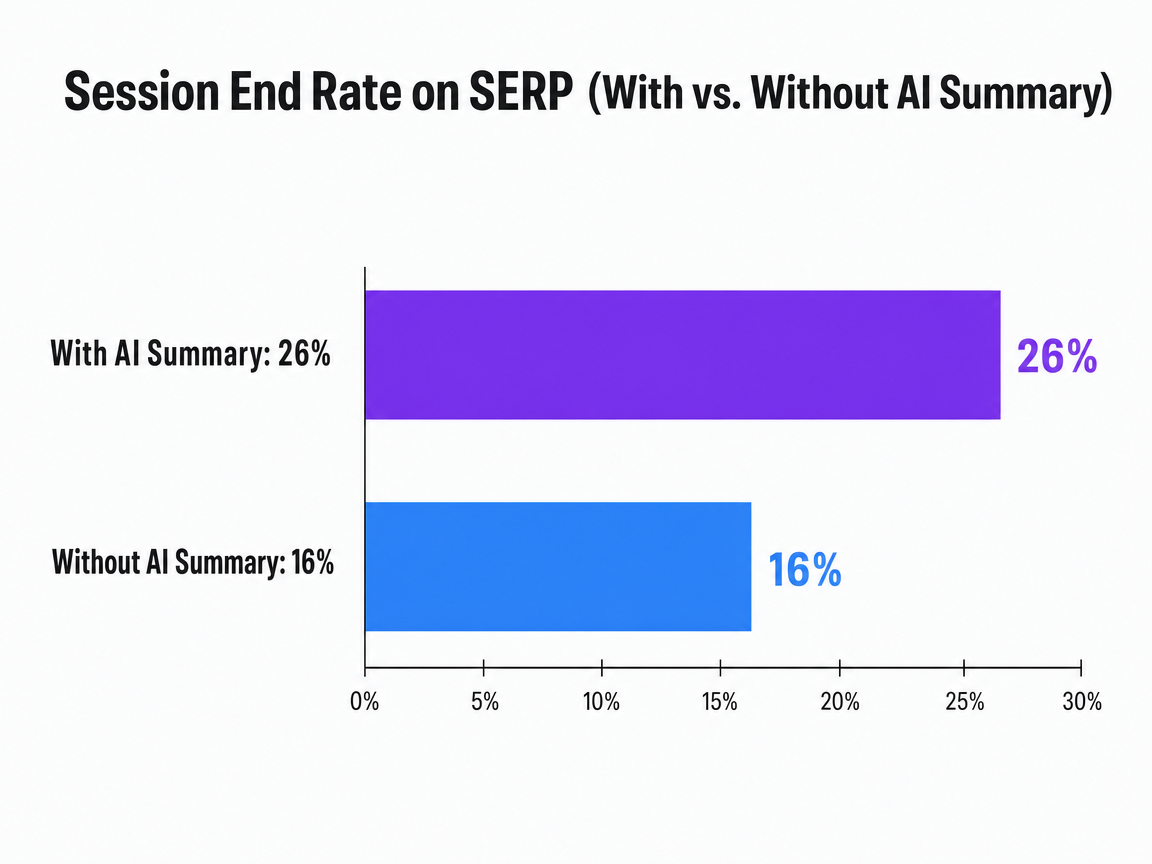 Session End Rate on SERP (With vs. Without AI Summary)
Pew Research data shows users are more likely to end their browsing session on the search results page when an AI overview is present (26% of pages) versus when it is not (16% of pages).
A Decision Frame by Agency Size and Vertical Mix
The right archetype rarely comes down to features. It comes down to portfolio shape.
Agencies running 30 to 60 mid-market clients across mixed verticals usually get the most immediate return from turning on AIO detection inside the incumbent platform they already pay for. The query lists exist, the white-label templates exist, and the analyst pod does not need to learn a second interface. Citation depth is shallow, but breadth is the constraint that actually binds at that portfolio size.
Firms with a smaller book of larger accounts, particularly in verticals where a single client generates thousands of tracked queries, tend to skew toward the enterprise SERP platform. National law firms, healthcare systems, and multi-location DSOs with hundreds of locations under one brand justify the implementation overhead because the historical SERP panel and per-project workspace map cleanly to how the client's own team thinks about reporting.
Boutique agencies competing on strategic depth in one or two verticals often add a specialist AIO tracker on top of an incumbent, restricting it to the 50 to 150 queries per client where citation composition genuinely changes editorial priorities. The specialist earns its line item on the questions it can answer that the incumbent cannot: which competitor pages are being cited, what passage got extracted, and how the citation set shifted between refreshes.
Agencies rebuilding production capacity without adding headcount, or those defending retainers against clients demanding faster turnaround from signal to published page, tend toward the orchestrated workflow model. Platforms in that category, including Vectoron, treat AIO citation gaps as inputs to a ranked recommendation queue rather than as a separate report the analyst then interprets and briefs. Whichever archetype fits, the operational rule holds: the tracker that changes how content gets prioritized next week is worth more than the tracker with the deepest dashboard nobody opens.
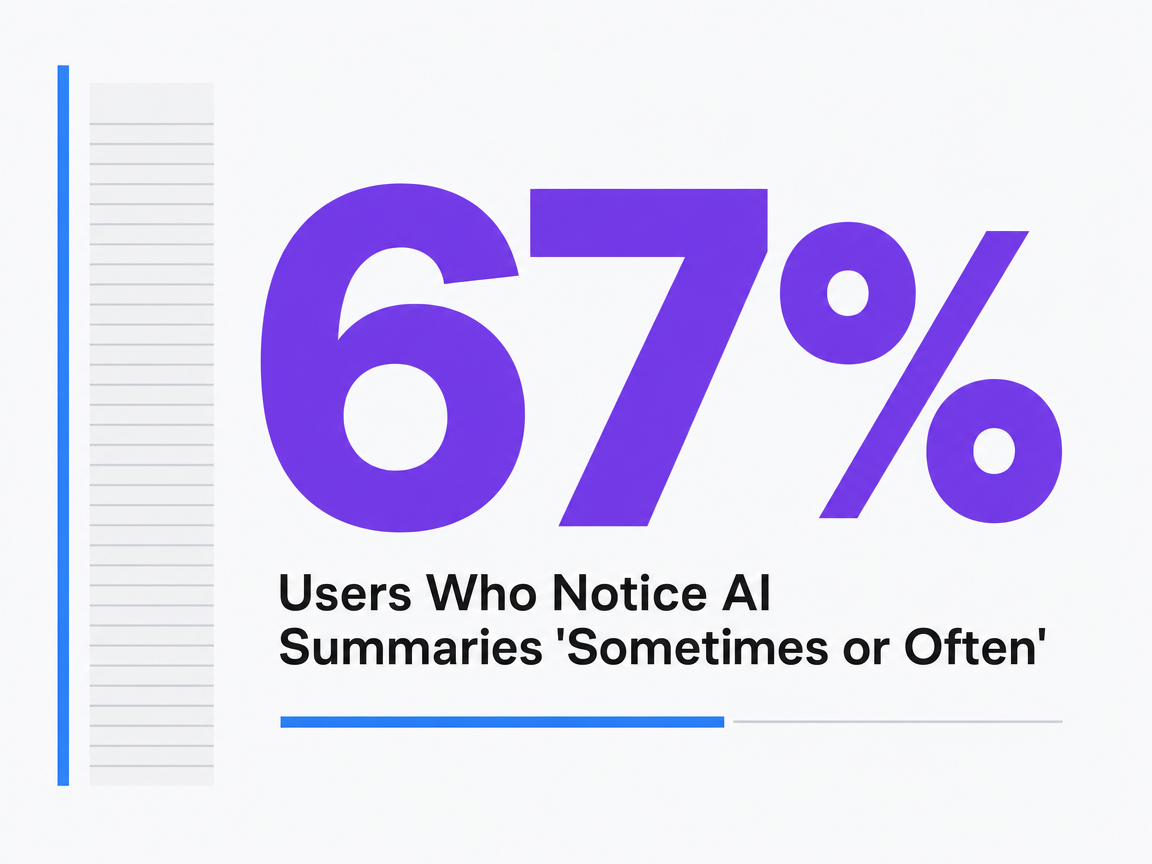 Users Who Notice AI Summaries 'Sometimes or Often'
Users Who Notice AI Summaries 'Sometimes or Often'
Frequently Asked Questions
References
- 1.Do people click on links in Google AI summaries?.
- 2.Pew Research Confirms Google AI Overviews Is Eroding Web Ecosystem.
- 3.Google's AI Summaries Really Do Cut Website Traffic, Study Finds.
- 4.AI overviews alter online behavior but brands should exercise caution.
- 5.Generative AI Summaries Do Not Increase User Engagement: A Study of Google AI Overviews.
- 6.AI summaries in online search influence users' attitudes.
- 7.Should AI-generated search summaries replace traditional search?.
- 8.Generative Search Will Disrupt SEO Measurement.
- 9.AI Features and Your Website | Google Search Central | Documentation | Google for Developers.
- 10.AI Overviews and AI Mode in Search - Google Search.
- 11.Google AI Overviews Impact On Publishers & How To Adapt Into 2026.
- 12.Google AI Overviews decrease CTRs by 34.5%, per new study.
- 13.Google CTR Study: AI Overviews Rise As Click Rates Decline.
- 14.Google AI Overview Citations From Top-Ranking Pages Drop Sharply.