
Key Takeaways
- AccuRanker pairs classic position, local pack, and AI Overview presence with pixel share data, showing analysts how far the blue links sit below Gemini answers.
- SE Ranking builds AI Overview snippet tracking directly into white-label client dashboards, compressing the analyst hours spent stitching data for monthly review decks.
- Semrush's crawl footprint reconstructs prevalence curves across 2025's surge-and-pullback pattern 5, separating coverage shifts from ranking movement in quarterly reviews.
- Ahrefs ties AI Overview citation parsing to backlink and content signals, giving analysts a causal read on why a page earned or lost a citation.
- SeoClarity handles enterprise query-set scale, backed by its 120-million-query prevalence study 2, with citation status logged as a pivotable first-class field.
- Profound tracks LLM brand mentions across ChatGPT, Perplexity, and Gemini as distinct objects 7, 8, catching disappearances that Google-only crawlers cannot see.
- AlsoAsked maps the question graph AI Overviews draw from 10, feeding upstream query intelligence into the keyword lists that other trackers monitor.
- Nightwatch solves the multi-client rollup problem at 50-plus accounts 9, exposing citation deltas and new AI Overview coverage in a native portfolio view.
- Vectoron consumes rank-tracking signals rather than replacing them, converting citation losses into ranked content briefs routed through a Command Center for human approval.
Why Position Tracking Alone Now Misleads Client Reporting
Two clients can hold the #1 organic position for their target keyword and see wildly different traffic. The variable is whether an AI Overview sits above them, and whether their URL appears inside it. That is the reporting problem agencies now hand to their analysts every Monday morning.
The scope of the damage depends on query type. Studies aggregated through 2025 across Ahrefs and Seer Interactive data put the CTR decline for the top-ranking page on informational queries at 58% to 61% when an AI Overview is present, while local and navigational queries remain largely unchanged 4. A position-only dashboard shows the client holding their rank. The revenue report shows organic sessions falling. Both are correct, and neither explains what happened.
What happened is that ranking now has two jobs. On queries where AI Overviews are absent or rare, classical position still predicts clicks. On queries where they dominate, the metric that predicts traffic is whether the client URL is cited inside the overview, not where it sits in the ten blue links beneath it. Google's own product framing acknowledges this asymmetry, claiming cited links inside AI Overviews receive more clicks than the same page would as a traditional listing 1.
Any rank-tracking stack that reports only position, without flagging AI Overview presence and citation status on the same keyword row, is measuring the wrong half of the SERP for a growing slice of the query set.
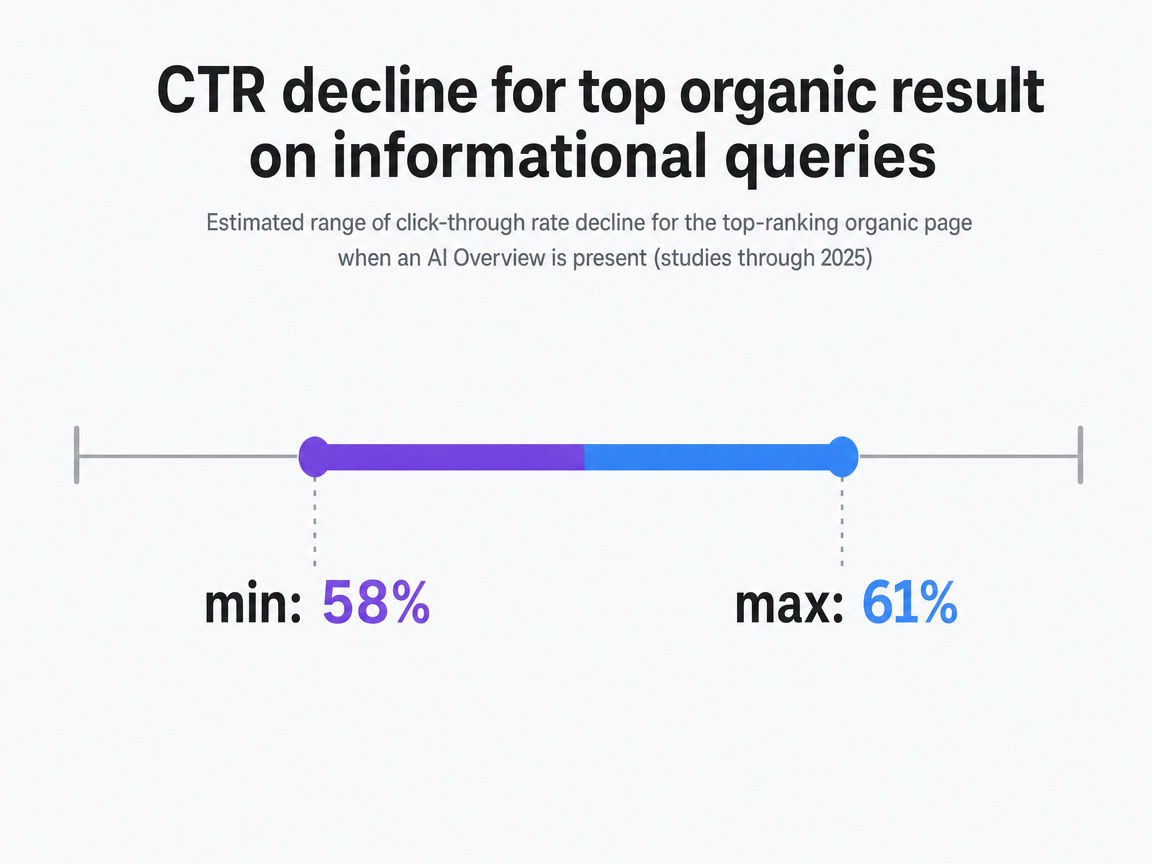 CTR decline for top organic result on informational queries
The range of click-through rate decline (58% to 61%) for the top-ranking organic page on informational queries when an AI Overview is present, based on studies published through 2025.
The Four Capabilities That Define an Agency-Grade Shortlist
AI Overview Presence Detection Across Query Sets
Presence detection is the floor, not the ceiling. A tool that cannot flag whether an AI Overview rendered for a given keyword on a given day cannot answer the first question a client asks: why did sessions move when position did not. Modern trackers now log AI Overview appearance alongside classic positions, local packs, and other SERP features on the same keyword row 7. What separates agency-grade tooling from consumer plugins is coverage density: presence has to be checked frequently enough to catch intra-week flips, and across enough of the client's tracked query set to distinguish a keyword-level change from a portfolio-wide prevalence shift. Sampled once a week on a 200-keyword sliver, presence data is decorative.
Cited-URL Parsing as the Metric That Predicts Traffic
Presence tells the analyst an AI Overview exists. Citation parsing tells them whether the client's URL is inside it, which is the metric that now predicts clicks. Evergreen Media's synthesis of SeoClarity and SE Ranking data found that a website cited as a source within an AI Overview sees CTR rise by as much as 80% versus non-cited results 2. Set that against the 2026 study of 40,000 BFSI keywords, where the #1 organic position lost 34% of its clicks under AI Overview conditions 3. The BFSI scope matters and should not be generalized, but the direction is clear: the same query can reward a cited page and punish an uncited market leader in the same SERP. A tracker that logs only position on that row misreports both outcomes. Parsing means extracting the citation chip URLs from the rendered overview, matching them to tracked domains, and writing citation status as a first-class field next to position.
Cross-LLM Visibility: Gemini, ChatGPT, Perplexity
Google AI Overviews run on Gemini 10, but the answer surface a client competes on is no longer confined to google.com. Tools built for the 2026 landscape now monitor visibility across ChatGPT, Perplexity, and Gemini alongside Google AI Overviews, treating LLM brand mentions as a distinct tracked object rather than a subset of position data 7, 8. For an agency, this changes intake: onboarding a new client means capturing brand strings, product names, and competitor terms that need to be queried against each LLM on a schedule. Trackers that only crawl Google SERPs cannot see when a brand disappears from ChatGPT's cited sources after a model refresh, which is a report the client will eventually ask for.
Multi-Client Rollup Reporting at 50+ Accounts
The fourth capability is where consumer-grade tools break. At 50 clients and up, presence detection, citation parsing, and cross-LLM visibility have to roll into a portfolio view an account director can scan in under a minute per client. Agency-focused platforms have added AI Overview snippet tracking specifically to support this multi-client workflow, exposing whether an AI answer appears for tracked keywords across all managed accounts in a single reporting layer 9. What the analyst actually needs is a delta table: which clients gained citations this week, which lost position on high-prevalence query sets, and which have new AI Overview coverage on keywords that had none seven days ago. Rollup that requires manual export and stitching across tabs does not scale past 20 accounts.
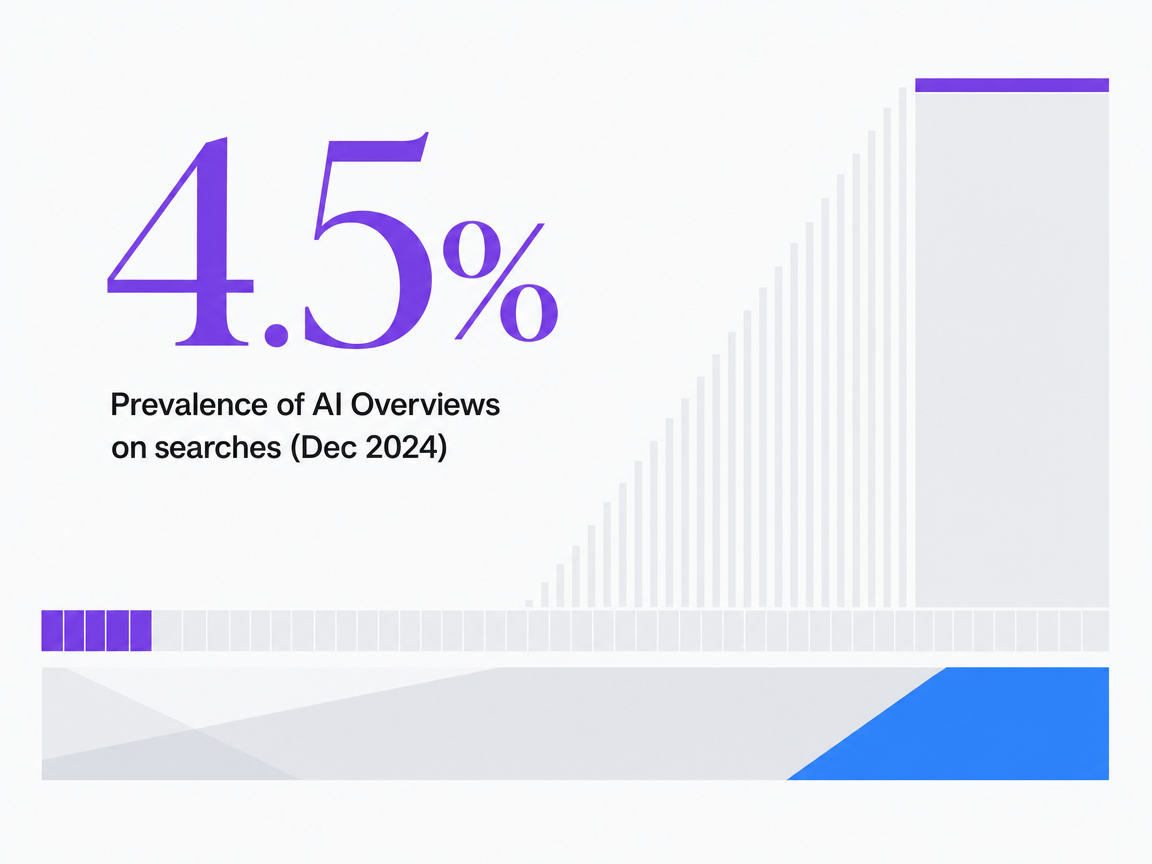 Prevalence of AI Overviews on searches (Dec 2024)
Prevalence of AI Overviews on searches (Dec 2024)
Volatility Is an Operational Cost, Not a Footnote
AI Overview coverage did not settle into a stable baseline in 2025. Google rapidly expanded the feature across the SERP through the first half of the year, then pulled back as coverage receded from commercial and navigational queries and concentrated on informational sets 5. For an agency, that is not a headline; it is a cost line. A tracked query set that had 30% AI Overview coverage in March and 12% in September will produce two different traffic models against the same rankings, and any client review deck built off a point-in-time snapshot will misdate the cause of the delta.
The operational response is prevalence tracking on a rolling basis. Tools that log AI Overview presence at the keyword-day level let an analyst reconstruct which sessions were lost to coverage expansion versus which were lost to ranking movement. Without that time series, every quarterly business review turns into speculation about what Google did.
Agencies that treat volatility as background noise absorb it as unbilled analyst hours. Agencies that treat it as a monitored feature charge for the interpretation.
Test AI-driven rank tracking on live campaigns
Track SEO performance and publish real content using AI for seven days on your actual client sites.
The Nine Tools Worth an Agency's Stack Budget
AccuRanker: Depth on AI Overview Presence and SERP Feature Pixels
AccuRanker's strength is granularity on the SERP itself. The platform logs classic position, local pack, and SERP feature ownership on the same keyword row that carries AI Overview presence, and reports pixel share so an analyst can see how far the ten blue links have been pushed below the fold 7. For agencies running high-frequency crawls on informational query sets, that pixel data is the missing piece in most client decks: a #3 position that used to sit above the fold is now a #3 position sitting under a Gemini-generated answer plus a related questions block. The tool logs both facts on the same row, which is what an account director needs when a client asks why traffic dropped without a ranking change. Where AccuRanker still lags is deep citation parsing across LLM surfaces beyond Google. Agencies pair it with a cross-LLM monitor rather than treat it as the full stack.
SE Ranking: AI Overview Snippet Tracking Built for Client Reporting
SE Ranking added AI Overview snippet tracking specifically to answer the question a client will ask in every review: does the AI answer appear for our keywords, and are we in it 9. The reporting layer is where this matters. AI Overview presence, snippet content, and cited sources feed into white-label client dashboards without the analyst having to stitch data across tools. That is a compression of hours, not features. Data from SeoClarity and SE Ranking's own crawls also informs the broader industry benchmarks agencies now use to contextualize client movement 2. The platform is not the deepest on cross-LLM visibility, but for agencies whose primary reporting cadence is monthly client decks on Google-surface performance, the snippet tracking is close to purpose-built. Multi-project structure supports portfolio views without the export-and-stitch tax that breaks smaller tools past 20 accounts.
Semrush: Prevalence Data at the Scale of the 2025 Volatility Curve
Semrush's crawl footprint is what makes it useful for volatility tracking rather than pure keyword monitoring. The surge-and-pullback pattern that Search Engine Land documented across 2025 was reconstructed from Semrush data showing AI Overview coverage expanding rapidly through the first half of the year, then receding on commercial and navigational queries 5. Agencies using Semrush get the same view at a smaller scale: prevalence curves on their tracked query sets, not just point-in-time flags. That matters when a quarterly business review lands on a client whose informational traffic softened. The prevalence chart separates "Google expanded AI Overview coverage on your query set by 14 points" from "your rankings slipped," which are two different conversations with two different fixes. The platform's citation parsing is workable rather than best-in-class, and its cross-LLM tracking is a newer addition that agencies typically supplement with a dedicated brand mention monitor.
Ahrefs: Citation Parsing Tied to Backlink and Content Signals
Ahrefs pairs AI Overview citation parsing with the backlink and content graph the platform is already built around, which is the closest thing on the market to a causal read on why a client URL earned a citation. When a page enters an AI Overview, the analyst can pull the referring domain profile, topical authority signals, and content structure on the same screen. That is the workflow that turns citation tracking from a status report into a playbook: what does the cited page have that the uncited pages on the same query set do not. Ahrefs data also underpins several of the 2025 studies quantifying CTR impact by query type on informational sets 4. For agencies whose content and link-building teams sit inside the same operation, this tool reduces the tab-switching cost on citation optimization more than any other option on the shortlist.
SeoClarity: Enterprise Query-Set Coverage and AI Overview Attribution
SeoClarity's 120-million-query study of AI Overview prevalence in December 2024 put the figure at 4.5% of examined searches, and that scale is the reason the platform sits on this list 2. Enterprise agencies with clients running six- or seven-figure keyword sets need a tracker that can crawl deep enough to distinguish a real prevalence shift from sampling noise. SeoClarity provides AI Overview attribution at that scale, with citation status logged as a first-class field the analyst can pivot on across the full query set. The trade-off is complexity: setup, taxonomy configuration, and reporting customization require dedicated analyst time, and the platform is priced for agencies that will use the depth. For a 30-client mid-market book, SeoClarity is overkill. For an enterprise agency running SEO on Fortune 500 accounts, the depth is what the client is paying for.
Profound: LLM Brand Mention Tracking Across ChatGPT, Perplexity, Gemini
Profound and platforms in its category treat LLM brand mentions as a tracked object separate from Google position data, monitoring how a client's brand, product names, and competitor terms surface across ChatGPT, Perplexity, and Gemini on a recurring schedule 7, 8. That is a different job from AI Overview citation parsing. When a client's brand disappears from ChatGPT's cited sources after a model refresh, no Google-first tracker will see it. Agencies onboarding clients in categories where LLM referral traffic is measurable, particularly B2B software and considered-purchase consumer verticals, need this layer explicitly. The intake cost is real: brand strings, product terms, and competitor sets have to be curated per client, and the query universe is not the client's Google keyword list.
AlsoAsked and Related AI Query Intelligence Layers
AlsoAsked and similar query intelligence tools do not track rank in the classical sense. They map the question graph that AI Overviews draw from, which is upstream data agencies use to decide which queries are worth tracking in the first place. Gemini pulls from qualifying question sets when generating AI Overviews 10, and the tools that surface those question clusters give content teams the raw material for optimization briefs. For an agency, this is a keyword research replacement, not a rank tracker replacement. It belongs on the stack because the query lists feeding AccuRanker or SE Ranking need to reflect the questions AI Overviews actually answer, not the head terms a legacy keyword tool surfaces.
Nightwatch: Multi-Client Rollup Reporting for Portfolio Operations
Nightwatch is where the multi-client rollup problem gets solved for agencies that outgrew consumer-grade dashboards. Agency-focused platforms in this tier expose whether an AI answer appears for tracked keywords across all managed accounts in a single reporting layer, without the manual export-and-stitch workflow that kills productivity at 50-plus clients 9. The delta table an analyst needs on Monday morning, which clients gained citations, which lost position on high-prevalence query sets, which have new AI Overview coverage on previously clean keywords, is native rather than assembled. White-label reporting, tag-based client segmentation, and API access to feed downstream BI tools make Nightwatch a workflow tool as much as a data tool. The platform is not the deepest on cross-LLM visibility, but it is the shortest path from portfolio data to client-facing report at scale.
Vectoron: Executing on Rank-Tracking Signals, Not Replacing Them
Vectoron is the ninth item on this list, and it is not a rank tracker. It consumes rank-tracking signals. The distinction matters because agencies that have already invested in AccuRanker or SE Ranking for detection and Profound for cross-LLM visibility still spend most of their analyst hours on what comes next: turning AI Overview citation losses into content briefs, ranking priorities across a client book, and shipping the actual updates. Vectoron's specialist strategists ingest live rank and citation data alongside call, booking, and pipeline signals, then surface ranked recommendations, which pages to update to earn a citation, which query clusters to expand, which links to pursue, through a Command Center that routes every decision for human approval before execution. For an agency head running 50 or more accounts, the compression is on the interpretation and execution layer, not the detection layer. The rank trackers stay in the stack. The manual work between the dashboard and the deliverable is what changes.
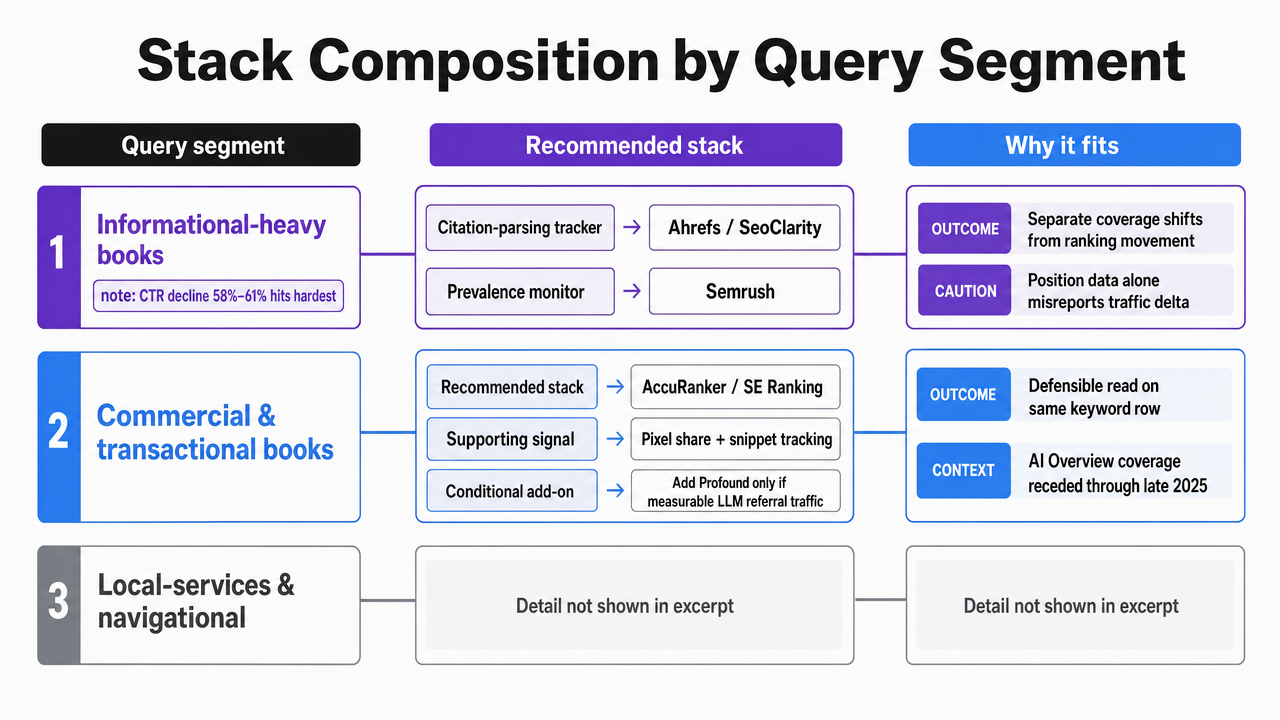
Stack Composition by Query Segment
No single tool on the shortlist solves both jobs. Stack composition depends on where the client's query set actually lives.
- For informational-heavy books, where the 58% to 61% top-result CTR decline hits hardest 4, the pairing that earns its keep is a citation-parsing tracker (Ahrefs or SeoClarity at enterprise scale) plus a prevalence monitor (Semrush) to separate coverage shifts from ranking movement. Position data alone will misreport every traffic delta on this segment.
- For commercial and transactional books, AccuRanker or SE Ranking carry the load. Pixel share and snippet tracking on the same keyword row give the analyst a defensible read even as AI Overview coverage on these query types receded through late 2025 5. Add Profound only if the client's category shows measurable LLM referral traffic.
- For local-services and navigational books, AI Overview impact is minimal 4. A classical rank tracker plus local pack monitoring is sufficient; spending on cross-LLM visibility here is stack bloat.
AlsoAsked sits underneath all three as query intelligence, not as a tracker. Whichever composition an agency picks, the keyword list feeding it is only as useful as the question graph it reflects.
If You Manage a 100-Client Portfolio: The Consolidation Math
A scope note before the numbers: this section is for agency operators running portfolio economics across 50 to 200 accounts, not for in-house teams optimizing a single site. The variables move differently when the same analyst hour is spread across a book.
The honest formula for current stack cost, given that public pricing on the tools above is not consistently disclosed in the research supporting this piece, is: (per-keyword tracking cost × keywords per account × number of accounts) + (analyst hours per account × loaded hourly rate × number of accounts) + (bolt-on AI visibility fee × applicable accounts). Plug in a 100-client book at 500 tracked keywords per account, and the keyword-count line alone runs to 50,000 tracked terms before AI Overview presence detection, citation parsing 2, or cross-LLM monitoring 8is layered in.
The compression opportunity is not on the tracker line. It is on the analyst-hours line. Agency-focused platforms that expose AI Overview presence across all managed accounts in one reporting layer 9remove the manual export-and-stitch work that scales linearly with account count. Cut two analyst hours per client per week at a 100-account book, and the freed capacity funds either the cross-LLM layer or the execution layer that turns citation losses into shipped updates.
See How Top Agencies Monitor AI Overviews and Rankings at Scale
Request a walkthrough of unified rank tracking solutions designed for agencies managing multi-client SEO, including AI Overviews monitoring, cross-domain reporting, and workflow automation for high-volume environments.
The Steelman: Is Rank Tracking Actually Dead?
The strongest version of the argument goes like this: AI Overviews push the ten blue links so far down the page that position becomes a vanity metric, and any dashboard built on it is measuring a SERP that no longer exists 6. It is a serious claim, and dismissing it without engagement is lazy.
The claim fails on two counts. First, AI Overview prevalence is not universal. The SeoClarity crawl of 120 million queries in December 2024 logged AI Overview appearance on 4.5% of them 2, and 2025 saw coverage recede on commercial and navigational sets 5. Position still predicts clicks on the majority of tracked queries. Second, citation status inside an AI Overview is itself a ranking. It is measured on the same keyword row, by the same crawls, in the same tools. Rank tracking did not die. It grew a second column.
Operator Checklist Before You Sign a Contract
Before the procurement conversation starts, an agency head should be able to answer six questions in one sitting.
- Does the tool log AI Overview presence on the same keyword row as classical position, refreshed at a cadence tight enough to catch intra-week flips 7?
- Does it parse citation chip URLs and write citation status as a first-class field, not a screenshot 2?
- Does it monitor brand mentions across ChatGPT, Perplexity, and Gemini as tracked objects 8?
- Does the reporting layer expose AI Overview coverage across all managed accounts in one delta view 9?
- Does it retain prevalence history so the surge-and-pullback pattern of 2025 is reconstructable, not just observable today 5?
- Does it feed downstream execution, or does citation loss land in a spreadsheet an analyst still has to work?
If the answer to any of the first five is no, the stack is incomplete. If the answer to the sixth is no, the interpretation cost stays on payroll.
Frequently Asked Questions
References
- 1.Generative AI in Search: Let Google do the searching for you.
- 2.Google AI Overviews: What's Changing for SEO & SEA in 2025.
- 3.Google AI Overviews Are Eating Your Clicks.
- 4.The Strategic Shift.
- 5.Google AI Overviews surged in 2025, then pulled back: Data.
- 6.Rank Tracking is Dead: How Google's SERP Changes Have Made Traditional Rankings Meaningless.
- 7.Best Rank Tracking Software 2026: 12 SEO + AI Tools.
- 8.7 Best AI SEO Rank Tracking Software Options for 2026 - Arvow.
- 9.Top 6 Agency Rank Tracking Software for 2026 - DesignRush.
- 10.Google AI Overviews: Complete SEO Guide 2026 - RANSEN.