
Key Takeaways
- Traditional position numbers no longer reflect true visibility because AI Overviews now synthesize passages from multiple sources, meaning a page can rank third yet lose sessions or be cited without a click.
- A three-layer measurement stack—trigger detection, citation and passage inclusion, and Search Console outcome data—replaces single-number rank tracking and fills the gaps GSC leaves around citation frequency and passage sourcing9.
- Reports should add citation impressions and share of cited voice, weight citations by observed stability, and match sampling cadence to query volatility so regeneration artifacts are not misread as losses7.
- Manual measurement breaks down past roughly ten clients, with break-even for instrumentation typically falling between ten and fifteen accounts at two to four analyst hours per client per week.
Why Position 3 Stopped Meaning What It Used To
A client recently observed a 40% drop in sessions for their flagship how-to guide, despite rank trackers showing a consistent position 3 for the head term. This discrepancy highlights a critical shift: the SERP itself has changed. An AI Overview now frequently appears above the traditional organic results, synthesizing answers from multiple sources. In such cases, a client's URL might be cited within this summary, rather than being clicked as a third organic result. The traditional position number no longer accurately reflects user visibility.
This divergence between reported rank and actual visibility presents a significant measurement challenge for agency SEO leads. Google's documentation indicates that there isn't a standalone AI Overview rank metric, though clicks from AI features are considered higher quality8. While Search Console's new generative AI performance reports offer data on impressions, pages, countries, devices, and dates for AI surfaces, they do not provide citation frequency or passage-level inclusion9. Referral traffic patterns are evolving, and publishers and analysts are actively working to quantify these changes10.
The key insight is that rank tracking isn't broken; it has simply become one component within a broader measurement framework. Position still indicates whether a page is eligible for inclusion in an AI Overview. However, it no longer reveals if the page was actually pulled, which specific passage was cited, or whether the user engaged beyond the summary. Addressing this tracking challenge requires a three-layer measurement stack, which account teams must learn to interpret holistically. The remainder of this article details this stack and its economic implications for managing a client portfolio.
The Three-Layer Measurement Stack
Trigger Layer: Identifying Queries That Invoke an AI Overview
The trigger layer addresses a fundamental question often overlooked in reports: does a given query even generate an AI Overview? Without this initial filter, subsequent metrics can be skewed by keywords where the traditional ten blue links still dominate the SERP.
User intent is the strongest predictor of AI Overview presence. A study by Northwestern Spiegel Research Center found that 43% of 160 tested queries triggered an AI Overview, with this figure rising to 98% for informational queries13. While this sample is specific to information-seeking prompts, it clearly demonstrates the necessity of intent-based segmentation. A client's how-to guides and comparison content will likely encounter different SERP structures than their transactional or branded terms.
Operationally, this means the trigger layer requires a query classifier before a scraper. Keywords should be grouped into categories such as informational, commercial investigation, transactional, navigational, and local. AI Overview detection should then be focused on segments where triggers are most probable. While log analyzers can identify URLs crawled by Google-Extended and other AI user agents, detecting AI Overviews directly on the SERP necessitates a scraper capable of parsing these features, sampled at a frequency appropriate for the account.
Two design considerations are crucial here. First, cadence: informational query sets, due to shifting trigger patterns as Google refines the feature, warrant daily or every-other-day sampling. Branded terms, conversely, can be sampled weekly. Second, geographic and device splits: AI Overviews can render inconsistently across different locations and devices. Therefore, the sampling frame must accurately reflect the client's actual traffic footprint, rather than relying on a default desktop-US pull.
Once the trigger layer is implemented, an agency can accurately answer the initial client question: how many tracked terms are now appearing under an AI Overview? This data provides essential context for the rest of the report.
Citation Layer: Focusing on Passage Inclusion Over URL Position
Once a query triggers an AI Overview, the next crucial question is whether the client's content was included in the summary, and if so, which specific part. Traditional URL-level rank tracking cannot provide this information. AI search operates at the passage level, using retrieval-augmented generation to select and combine material from various sources to compose an answer6. A page might rank fourth organically but contribute the opening sentence of an AI summary without appearing as a clickable citation card. Conversely, pages ranking well beyond the first page can be cited if a specific passage cleanly matches the retrieval query.
The shift in measurement is conceptually straightforward but more complex to implement. Instead of tracking URL position, the citation layer monitors three aspects for each triggered query:
- whether the client's domain appears in the visible citation set,
- which specific URL was cited, and,
- if the summary text is captured, which passage on that URL was the likely source.
The first two can be obtained using a SERP scraper with AI Overview parsing. The third requires text similarity scoring between the summary sentences and the client's on-page content.
This instrumentation yields two key reporting metrics. Citation share represents the percentage of triggered queries in a tracked set where the client is cited. Passage inclusion rate is the percentage of citations where a specific passage on the client's page can be matched to summary text above a defined similarity threshold. Both metrics offer a more accurate indication of AI Overview visibility than any position number.
This layer also influences content optimization strategies. If the most frequently pulled paragraphs are those containing clear definitions, numerical answers, or concise lists, content teams will adapt their on-page editorial patterns to include more of these elements. While ranking the URL remains a prerequisite, the ultimate goal becomes securing passage inclusion.
Outcome Layer: Understanding Search Console's AI Reports
The outcome layer addresses client concerns directly and is an area where Google has made rapid advancements. Search Console's new generative AI performance reports provide data on impressions, pages, countries, devices, and dates specifically for AI surfaces within Search and Discover9. Google's AI features documentation confirms the absence of a standalone AI Overview rank metric and describes clicks from AI features as higher quality, though without specific quantification8. This combination clarifies what data is first-party and what gaps still exist.
Search Console effectively reports whether pages appear in AI surfaces, how impressions on these surfaces trend over time, and where clicks from AI features land. When combined with BigQuery exports, this data can be segmented by page cluster, country, and device using Google's own metrics, which can enhance credibility for clients who primarily trust Search Console data.
However, Search Console does not provide citation frequency by query, passage-level inclusion, competitor citation share, or the specific summary text from which a click originated9. Crucially, it also doesn't indicate which of a client's queries are sufficiently answered by AI Overviews that users don't need to click through. These are the gaps that the trigger and citation layers are designed to fill.
Attribution, therefore, becomes a process of joining multiple data points rather than relying on a single query. This involves combining GSC's AI-surface impressions and clicks with query-level trigger and citation data from the preceding layers, and then integrating downstream conversion data from analytics or CRM. The result is a per-query view that includes whether a query triggered an AI Overview, whether the client was cited, impressions, clicks, and the eventual outcome. As referral traffic patterns continue to shift across the industry10, owning this internal data join becomes a crucial reporting advantage, offering more confidence than relying on external benchmarks.
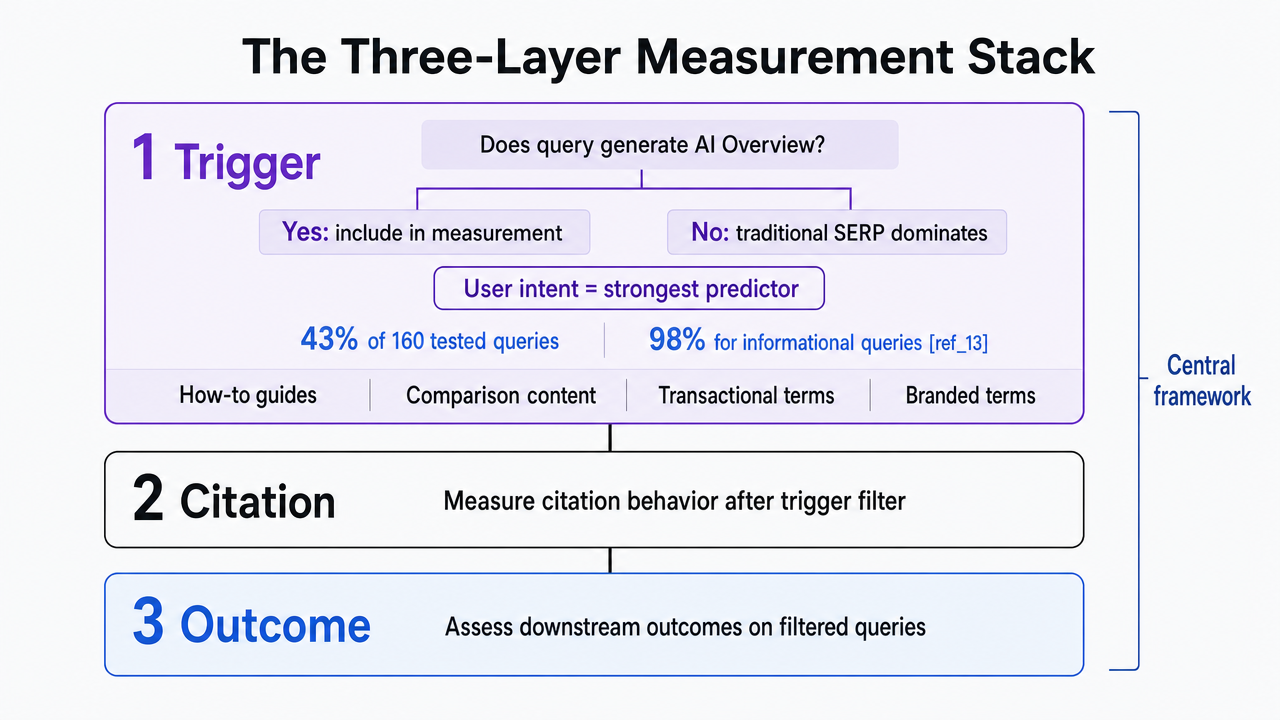 Visualize the three-layer measurement stack (Trigger, Citation, Outcome) that structures the entire article's central framework
Why Impressions Without Clicks Still Belong on the Report
A common challenge in AI-era QBRs is explaining why impressions might increase while clicks remain flat. The honest answer is that a click is no longer the sole measure of value on the SERP. Reports that focus exclusively on clicks risk misrepresenting the true impact of AI Overviews.
Consider the user. A YouGov survey revealed that 67% of respondents notice AI-generated search summaries sometimes or often, and 38% read them in half or more of their searches4. While this is self-reported data and not a click-stream measurement, it indicates that a significant portion of users consume answer text before deciding whether to click. A meaningful minority engage with these summaries for most of their queries. A brand mention within this summary text represents valuable exposure, regardless of whether a session is recorded in GA4.
Academic research suggests that visually prominent AI summaries can influence user perceptions of a topic, its sources, and the search engine itself5. For clients in regulated sectors like legal, healthcare, or senior living, being cited as one of the primary sources in a summary acts as a powerful trust signal that compounds throughout the funnel, not a wasted impression. It also serves as a competitive advantage, as the summary explicitly names one brand over others.
The reporting adjustment is subtle yet impactful. Agencies should add two columns to their standard visibility tables: citation impressions (AI-surface impressions on triggered queries where the client was cited) and share of cited voice (client citations divided by total citations within the tracked set). Both metrics are derived from the existing citation-layer instrumentation. These should be presented with a clear disclosure that they measure exposure within summaries rather than direct sessions, preventing clients from inferring non-existent click volumes. Given the ongoing shifts in referral traffic patterns across the industry10, reports that only count clicks will consistently underestimate the actual value an account is generating on the page.
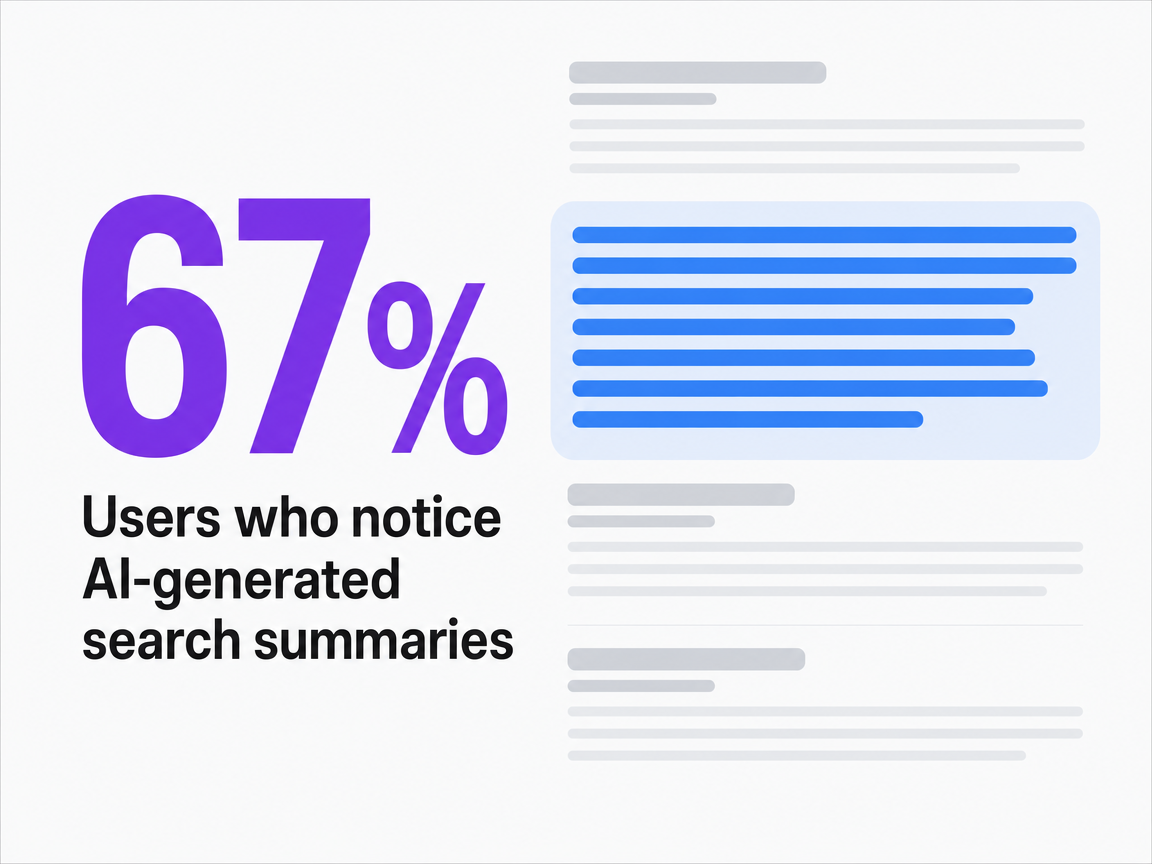 Users who notice AI-generated search summaries
Users who notice AI-generated search summaries
Test AI Overview Rank Tracking in Real Scenarios
Validate AI Overview visibility and reporting accuracy using your own live client projects during the trial.
Citation Quality: Tracking Which Sources Google Actually Trusts
Being cited in an AI Overview is not a guaranteed win. The same summary that cites a client one week might rely on a less authoritative forum thread the next. Researchers have noted both the inconsistency of AI summaries and their tendency to draw from less credible sources for certain queries12. For agencies reporting to clients in regulated verticals such as legal, behavioral health, and senior living, this variability is a governance concern as much as a visibility issue.
The practical solution is to score citations, not just count them. Three attributes are particularly valuable to capture within the citation layer:
- Source authority: is the client cited alongside recognized institutional sources, or alongside low-quality affiliate pages and unmoderated user-generated content?
- Citation stability: across repeated samples of the same query, does the client's URL consistently appear in the citation set, or does it fluctuate as the summary regenerates?
- Competitive composition: which specific competitors are cited alongside the client, and how does this mix change over time?
Stability is often underestimated in reports. A citation that appears once and then vanishes is not equivalent to one that persists across a week of sampling. The same retrieval-augmented pipeline that can pull a passage from page four can also drop it without warning6. Weighting citations by their observed persistence provides account teams with a more accurate measure of durable visibility and highlights queries where the client's position within the summary is tenuous and requires active defense.
Query Volatility as a Measurement Design Constraint
The presence of AI Overviews is not static, and any measurement approach that assumes stability will lead to noisy reports and challenging client discussions. Google itself reduced the frequency of generated answers following early accuracy criticisms, and the feature has continued to expand and contract based on query type7. Independent testing confirms this behavior: summaries can appear and disappear on repeated queries, and the citation set within them can shift between samples12. Treating a single scrape as absolute truth misinterprets this inherent volatility as a definitive signal.
The appropriate design response is to match sampling frequency to observed variance, rather than adhering strictly to reporting cadences. High-variance query classes, typically informational and definitional terms where triggers are common13, require multiple samples within the same day to differentiate a genuine loss of citation from a regeneration artifact. Lower-variance classes, such as branded and navigational queries, can be sampled less frequently without obscuring meaningful changes. Persistence, rather than a single observation, becomes the reported unit: how often a query triggered within a rolling sample window, and how often the client was cited when it did.
Two safeguards ensure report defensibility. First, establish a minimum sample count before categorizing any query as a win or loss at the citation layer. Second, timestamp every observation to ensure that week-over-week comparisons are made against comparable sampling windows, not against a fortunate single pull. By managing volatility in this manner, it transforms from a data-quality problem into a valuable metric in itself.
See How Agencies Are Quantifying AI Overviews Impact—With Audit-Ready Data
Request a walkthrough of advanced AI Overviews rank tracking and reporting frameworks tailored for multi-location SEO at scale—complete with change logs, SERP volatility insights, and actionable data for client reporting.
If You Manage More Than Ten Clients: The Portfolio Economics of AIO Measurement
Where Manual Measurement Breaks Down
This section shifts focus from single-client instrumentation to the operational challenge of applying the three-layer measurement stack across a client portfolio of 25, 50, or 80 accounts without needing to hire an analyst for every ten clients.
Manual measurement scales linearly, and the workload quickly becomes unmanageable. For each client, an analyst must:
- classify keywords by intent,
- sample the SERP for AI Overview triggers at a cadence aligned with query volatility7,
- parse visible citation sets for triggered queries,
- perform text-similarity checks between summary sentences and on-page passages6,
- reconcile this data with GSC's new AI-surface impressions and clicks9, and
- finally integrate all of this with conversion data before each QBR.
A single analyst can realistically manage three or four accounts at this level of depth. Beyond ten clients, compromises become inevitable: sampling frequency for volatile query classes decreases, passage matching is often skipped, citation stability tracking ceases, and reports revert to a position-only view of a SERP where position is no longer the primary indicator of visibility8. Profit margins silently erode because the hours are still being spent, but they are producing a less comprehensive artifact.
A Break-Even Worksheet for Instrumentation
The question is not whether to instrument, but at what client count the automated, instrumented approach becomes more cost-effective than the manual one. The following worksheet uses four variables that agencies typically already know, without introducing arbitrary financial figures.
H : analyst hours per client per week dedicated to AIO measurement (including trigger sampling, citation parsing, passage matching, GSC data integration, and report assembly)
R : blended analyst cost per hour, which the agency fills in from its own P&L
C : number of active clients in the portfolio
W : reporting cycles per month (typically 4 for weekly, 1 for monthly QBR cadence)
| Line Item | Manual Path | Instrumented Path |
|---|---|---|
| Weekly analyst hours per client | H | H × 0.2 to 0.3 (review and narrative only) |
| Monthly analyst cost per client | H × R × 4 | (H × 0.25) × R × 4 |
| Total monthly analyst cost | H × R × 4 × C | (H × 0.25) × R × 4 × C + fixed instrumentation cost |
| Reporting artifact | Regresses past ~10 clients | Consistent across C |
The break-even client count is reached when the fixed cost of instrumentation (which includes SERP scraping with AI Overview parsing, BigQuery GSC exports, similarity scoring, and dashboarding) equals the analyst hours it eliminates. Agencies that have performed this calculation with realistic 'H' values (typically 2 to 4 hours per client per week for genuine three-layer measurement) often find the break-even point between ten and fifteen clients. Below this threshold, manual processes may suffice. Above it, the instrumented path not only costs less but also produces a more defensible artifact, as sampling cadence and passage matching are no longer compromised by workload spikes. As referral traffic patterns continue to evolve10, agencies that internally manage the integration of trigger, citation, and outcome data will be able to report on these shifts with greater confidence than those relying on partial, external views.
Rebuilding the Client QBR Narrative Around Three Layers
The measurement stack is only valuable if it transforms the content of the QBR deck. The traditional narrative progressed from position movement to organic sessions, then to conversions, assuming position was the primary indicator. This is no longer the case. The revised narrative begins with the trigger layer, moves through citation performance, and concludes with outcomes, reflecting the new sequence in which value accrues on an AI-era SERP.
Start by establishing scope. Clearly state how many tracked queries in the client's set now generate an AI Overview, and how this share has changed since the previous reporting cycle. This recontextualizes the report before any position numbers are presented. Follow with citation performance: citation share across triggered queries, share of cited voice against identified competitors, and passage inclusion rate where similarity scoring is implemented6. These figures should be weighted by observed stability to ensure that fleeting citations are not presented as durable wins.
Next, transition to outcomes. Combine Search Console's AI-surface impressions, pages, and clicks9 with the account's conversion data, presenting this as a per-query view rather than a channel-wide rollup. If clicks are down but citation impressions are up, explicitly state this and highlight the exposure the client gained within the summary. Google's documentation suggests clicks from AI features are higher quality without quantifying it8, so treat the click column as representing a narrower but more engaged audience, not the entire story.
Conclude the deck with position, rather than leading with it. Position still confirms eligibility for inclusion in a summary and responds to on-page optimizations, but it is no longer the headline metric. Agencies that restructure their QBRs in this manner will spend less time defending flat click charts and more time engaging in strategic discussions about future optimizations, which is crucial for client retention.
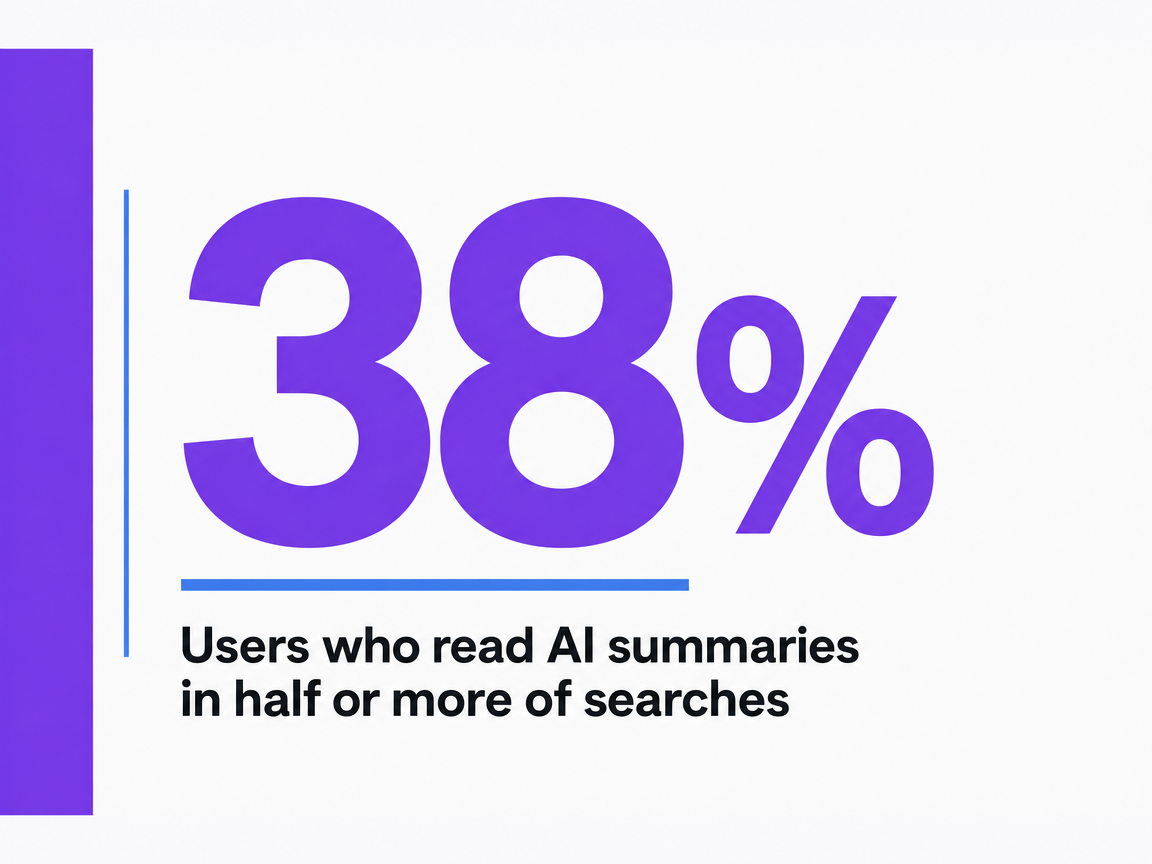 Users who read AI summaries in half or more of searches
Users who read AI summaries in half or more of searches
Frequently Asked Questions
References
- 1.Google AI Overviews: What Do They Mean for Search?.
- 2.How Generative AI Is Changing SEO.
- 3.How AI Is Changing Search Behaviors.
- 4.Should AI-generated search summaries replace traditional search results?.
- 5.AI summaries in online search influence users' attitudes.
- 6.AI Search: How Generative Engine Optimization Reshapes SEO.
- 7.8 SGE SEO Tips for Google's Search Generative Experience.
- 8.AI Features and Your Website | Google Search Central | Documentation | Google for Developers.
- 9.Introducing Search Generative AI performance reports in Search Console.
- 10.Overview and key findings of the 2026 Digital News Report.
- 11.[PDF] Opt-out remedies will not fix AI overviews.
- 12.Data Scientists Say It's Not You, It's Google, In Flap Over AI-Summarized Search Results.
- 13.Google AI Overviews Decoded.