
Key Takeaways
- Semrush Position Tracking adds an AI Overview filter to existing keyword projects, giving agencies the shortest path to layering AI Overview presence onto weekly position reports 4.
- SE Ranking pairs multi-engine coverage across Google, Bing, Yahoo, and YouTube with AI pattern detection, shifting rank reporting from what changed to what caused the movement 10.
- Nightwatch straddles both stack floors, combining Google and Bing position tracking with ChatGPT, Claude, Gemini, and Perplexity visibility in one dashboard for smaller accounts 9.
- Peec AI specializes in prompt-level brand tracking across ChatGPT, Perplexity, and Google AI Overviews, answering whether a client shows up when prospects query models directly 6.
- Ahrefs Brand Radar leads on scale with five AI indexes and over 100 million prompts, making share-of-voice claims defensible in high-volume competitive verticals 6.
- Rankscale AI trades index scale for drill-down depth across ChatGPT, Perplexity, Claude, Grok, and AI Overviews, fitting clients whose audiences skew toward Claude or Grok 9.
- Rankability AI Analyzer, LLMrefs, and Otterly AI serve as focused alternatives for citation tracking, mention monitoring, or lighter-weight AI visibility coverage without a flagship commitment 6.
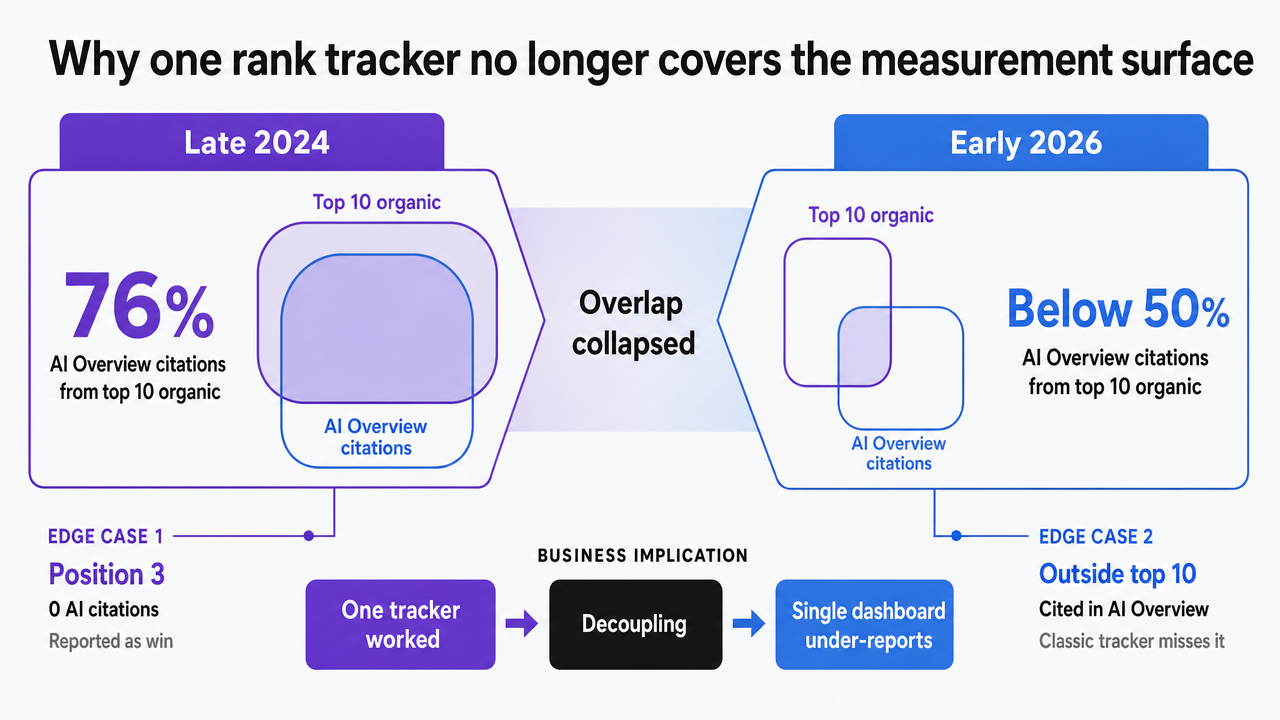
Why one rank tracker no longer covers the measurement surface
The clean overlap between organic rankings and AI Overview citations has collapsed in about fifteen months. In late 2024, roughly 76% of AI Overview citations came from pages already ranking in the top 10 organic results, meaning a single position tracker did double duty as an AI visibility monitor. By early 2026 that overlap had dropped below 50%, a structural decoupling of blue-link rankings from AI Overview inclusion 7.
That gap is the reason a single dashboard now under-reports client performance. A page can hold position three for a commercial term, get cited zero times in the AI Overview covering the same query, and still be reported as a win to the client. The inverse also holds: pages outside the top 10 are increasingly pulled as citation sources for AI-generated answers, which classic rank trackers register as flat or declining even as the brand gains surface area inside the zero-click panel 7.
The category has responded by splitting. Established suites bolted AI Overview flags and filters onto existing position tracking modules, keeping keyword-first workflows intact. A separate class of platforms indexes prompts across ChatGPT, Perplexity, Gemini, Claude, and AI Overviews, then reports citation frequency, sentiment, and share of voice at the prompt level rather than the keyword level 6, 9.
Both layers measure something real. Neither replaces the other. Agency SEO leads managing 20 to 200-plus accounts now face a stack decision, not a tool decision: which platform covers position and SERP features across Google, Bing, and local packs, and which platform covers prompt-level citation across the answer engines clients are actually appearing in. The eight tools that follow are organized by that stack role, so each one slots into position, hybrid, or AI visibility rather than competing head-to-head.
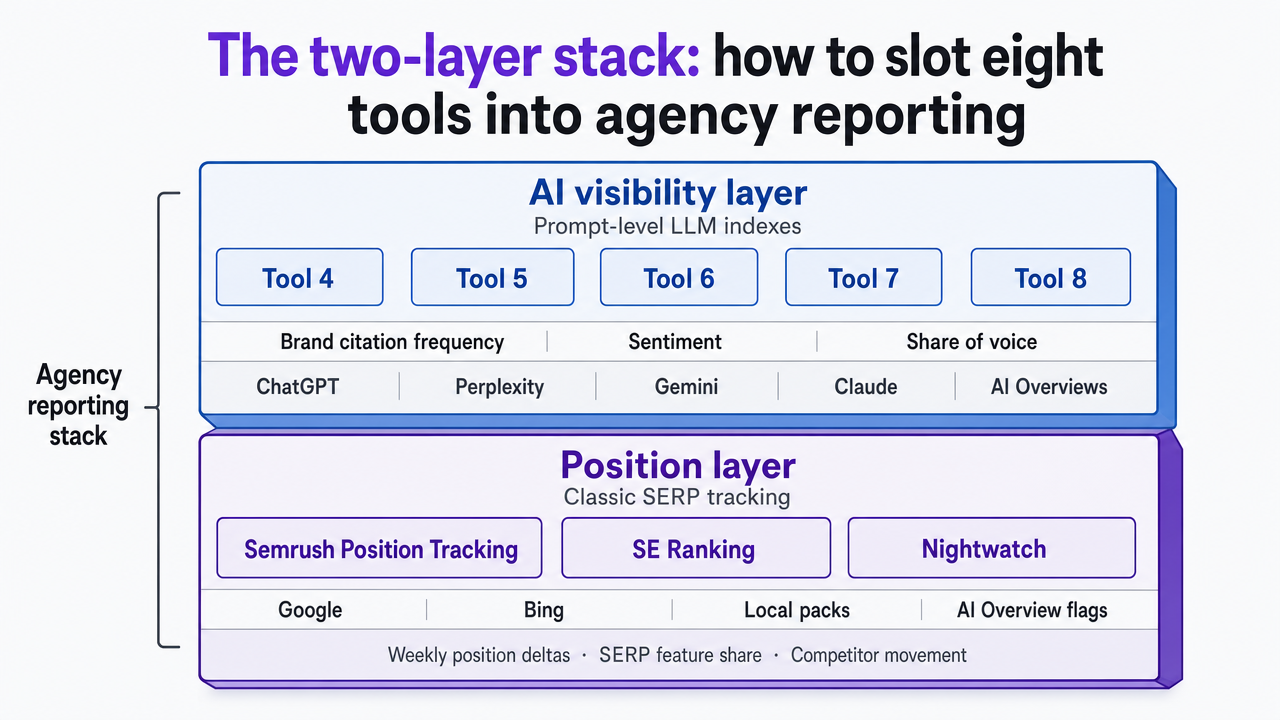
The two-layer stack: how to slot eight tools into agency reporting
Agency reporting now has two floors. The bottom floor is the position layer: classic SERP tracking across Google, Bing, and local packs, with AI Overview flags attached where the suite has shipped them. The top floor is the AI visibility layer: prompt-level indexes that query LLMs directly and report brand citation frequency, sentiment, and share of voice inside ChatGPT, Perplexity, Gemini, Claude, and AI Overviews 6, 9.
Three of the eight tools slot into the position layer. Semrush Position Tracking, SE Ranking, and Nightwatch keep keyword-first workflows intact while adding AI Overview filters or hybrid AI-engine coverage on top of traditional SERP data 9, 10. These are the platforms client-services teams already use for weekly position deltas, SERP feature share, and competitor movement.
Four tools sit in the AI visibility layer. Peec AI, Ahrefs Brand Radar, Rankscale AI, and a focused trio of Rankability AI Analyzer, LLMrefs, and Otterly AI query LLMs directly and report at the prompt level rather than the keyword level 6. Ahrefs Brand Radar leads on prompt-index scale; Rankscale AI leads on drill-down depth across Claude, Grok, and Gemini 6, 9.
Nightwatch straddles both floors, which is why it appears in the position layer with a hybrid designation rather than as its own category 9. The eighth slot in the stack is the execution layer that closes the loop from measurement to shipped content, addressed later in this piece. Read each entry that follows as a stack position, not a standalone recommendation.
Position layer: classic SERP trackers with AI Overview flags
Semrush Position Tracking with AI Overview filter
Semrush shipped an AI Overview filter inside Position Tracking that flags which tracked keywords trigger an AI Overview and, of those, which surface the tracked domain as a cited source 4. For agency teams already running weekly Position Tracking reports across a client roster, this is the shortest path to layering AI Overview presence onto existing keyword projects without spinning up a second dashboard 4.
The tool sits inside a broader suite that includes Local Toolkit for local pack monitoring and Map Rank Tracker for geo-grid coverage, which matters when the same client account needs both national keyword tracking and local SERP feature analysis in one export 2, 4. Semrush is positioned by comparison guides as a next-generation platform that monitors brand visibility inside AI chats alongside traditional rankings, though the AI-engine coverage is narrower than pure prompt-index platforms 9.
What it does not do: Semrush Position Tracking does not query ChatGPT, Perplexity, Claude, or Gemini directly at the prompt level to measure citation frequency inside those interfaces. Practitioner reviews of the 22-tool landscape describe AI Overview filtering in classic suites as a starting layer rather than a substitute for dedicated LLM visibility platforms 6. Agency leads standardizing on Semrush for the position layer should plan on pairing it with an AI visibility tool from the second layer to close the citation-tracking gap.
SE Ranking with AI pattern detection
SE Ranking approaches the position layer with a pattern-detection angle rather than a straight positional readout. Its AI-enhanced rank tracker identifies patterns and ranking factors that influence visibility across Google SERPs and Maps, Bing, Yahoo, and YouTube, which gives agency analysts a why-did-this-move layer on top of the raw position deltas 10. For a Head of SEO defending a client QBR, that shift from what changed to what caused it reduces the interpretation load on senior staff.
Multi-engine coverage is the practical differentiator here. Weekly reports for clients whose audiences split between Google and YouTube search, or between Google and Bing, land in one export instead of two 10. Diagnostic AI capabilities in this class of tool also flag at-risk pages before they drop and surface content gaps competitors are filling, which pushes rank tracking closer to a forecasting workflow 8.
What it does not do: SE Ranking's public positioning centers on classic search engine coverage plus AI-assisted pattern analysis, not prompt-level citation tracking inside ChatGPT, Perplexity, Claude, or Gemini. Agency teams choosing SE Ranking for the position layer will still need a dedicated AI visibility platform to report citation frequency and share of voice inside LLM interfaces. The pattern-detection strength lives in explaining SERP movement, not in measuring brand presence inside AI-generated answers.
Nightwatch as a hybrid position and AI visibility tracker
Nightwatch is the position-layer entry that straddles both floors of the stack. Comparison guides position it as a next-generation rank tracker that monitors brand visibility inside AI chats and answer engines alongside traditional Google and Bing rankings in a single dashboard 9. For agencies resisting a two-tool subscription for smaller accounts, that hybrid coverage collapses the reporting surface into one platform.
The tool's engine list extends across Google, Bing, and AI models including ChatGPT, Claude, Gemini, and Perplexity, which puts it closer to the AI visibility layer than Semrush or SE Ranking without abandoning the keyword-first workflows agency ops teams already run 9. That combination is why the outline places Nightwatch in the position layer with a hybrid designation rather than in either camp exclusively.
What it does not do: hybrid coverage in a single dashboard trades depth for breadth. Practitioner reviews of dedicated AI visibility platforms describe drill-down prompt analysis, sentiment scoring, and prompt-index scale that hybrid trackers typically match at a shallower level 6. Agency leads with a heavy AI-Overview-cited client base, or clients competing hard inside ChatGPT and Perplexity answers, will still find pure AI visibility tools cover the top floor of the stack with more granularity than a hybrid can deliver at the same price point.
Test AI-powered rank tracking with real data
Evaluate ranking changes and SERP impact using your actual client domains before making a commitment.
AI visibility layer: prompt-level citation trackers across LLMs
Peec AI for ChatGPT, Perplexity, and AI Overview brand tracking
Peec AI is a specialized analytics platform focused on tracking brand visibility across ChatGPT, Perplexity, and Google AI Overviews, with prompt-level reporting rather than keyword-level position reads 6. That distinction matters for agency reporting because a client whose brand shows up inside a Perplexity answer for a high-intent commercial query has gained surface area a classic tracker will never capture.
The tool indexes prompts across the major LLMs and reports which brands are mentioned, how often, and in what sentiment, which gives client-services teams a defensible answer to the question every account is now asking: does our brand appear when a prospect asks the model directly? Practitioner reviews position Peec AI in the specialist camp of the 22-tool landscape, alongside Rankability AI Analyzer and Otterly AI, rather than as a hybrid platform trying to cover both floors of the stack 6.
What it does not do: Peec AI is not a substitute for a position-layer tracker. It does not report Google or Bing SERP positions, local pack rankings, or SERP feature share in the traditional sense, and comparison guides treat it as a next-generation brand visibility platform rather than a replacement for keyword-based rank tracking 9. Agencies picking Peec AI for the AI visibility layer will still run Semrush, SE Ranking, or Nightwatch underneath it for weekly position deltas.
Ahrefs Brand Radar and the 100M+ prompt index
Ahrefs Brand Radar leads the AI visibility layer on raw prompt-index scale. In the 22-tool practitioner review, Brand Radar is described as the largest AI visibility database in the category, tracking mentions across five AI indexes and over 100 million prompts 6. For agencies with clients competing in high-volume verticals, that index depth is the difference between sampling brand presence and measuring it.
The scale advantage translates into two practical reporting wins. First, long-tail commercial prompts that a smaller index would miss get captured, so a legal client's presence inside niche practice-area questions inside ChatGPT or Perplexity shows up in the dashboard rather than falling below the sampling floor. Second, competitor benchmarking becomes defensible: share-of-voice claims in a client QBR carry more weight when the underlying prompt set runs into nine figures rather than a few thousand 6.
What it does not do: Brand Radar sits inside the broader Ahrefs suite, and its remit is AI visibility measurement rather than remediation. It does not ship on-page recommendations or the full-loop content workflow that some 2026 guides argue is now the direction of travel for AI SEO platforms 5. Agency teams standardizing on Brand Radar for the top floor of the stack will still hand the measurement output off to an editorial or execution workflow to close the loop.
Rankscale AI for drill-down coverage across Claude, Grok, and Gemini
Rankscale AI takes the opposite bet from Brand Radar. Instead of maximizing prompt-index scale, it goes deep on drill-down analysis across a wider LLM roster, covering ChatGPT, Perplexity, Claude, Grok, and Google AI Overviews in a unified dashboard 9. For agency analysts producing client QBRs where the question is not just does our brand appear but why and in what context, that depth changes the reporting output.
The engine list is the practical differentiator. Claude and Grok coverage is thinner across the AI visibility layer than ChatGPT and Perplexity coverage, so clients in verticals where audiences skew toward those models, such as B2B research workflows or developer-adjacent categories, benefit from a tracker that treats them as first-class engines rather than afterthoughts 9. Comparison guides describe Rankscale as a drill-down platform explicitly, positioning it against wider but shallower hybrid trackers 9.
What it does not do: Rankscale AI's depth-over-breadth positioning means it is not the tool of choice when raw prompt-index scale is the reporting priority. Brand Radar's 100-million-plus prompt index still outranks it on that axis 6. Agency teams choosing Rankscale for the AI visibility layer are trading index scale for engine depth and prompt-level granularity, which is the right trade for consultative reporting but the wrong one for market-scale share-of-voice claims.
Rankability AI Analyzer, LLMrefs, and Otterly AI as focused alternatives
Three focused platforms round out the AI visibility layer without asking agencies to commit to a flagship suite. Rankability AI Analyzer, LLMrefs, and Otterly AI all appear in the 22-tool practitioner review as AI-search-specific analytics platforms that emerged around 2025, each with a narrower remit than Brand Radar or Rankscale AI 6.
- Rankability AI Analyzer sits in the monitoring camp, tracking whether AI systems mention, recommend, or cite client brands in their answers, which is the core reporting question for accounts where the client's leadership has started asking about ChatGPT presence directly.
- LLMrefs focuses on citation tracking inside LLM responses, useful for agencies whose clients care specifically about being pulled as a source rather than just being named.
- Otterly AI covers brand visibility across major LLMs and AI Overviews with a lighter-weight dashboard footprint than the flagship platforms 6.
What these tools do not do: none of the three matches Brand Radar's prompt-index scale or Rankscale AI's drill-down depth across five engines. They are focused alternatives, not category leaders, which is why they slot into the AI visibility layer as options for smaller agency rosters or as complements to a flagship tool rather than replacements. Agency leads evaluating this tier should weight the choice on which specific reporting question the client roster keeps asking. If it is citation frequency, LLMrefs earns the slot. If it is broad brand mention monitoring, Rankability AI Analyzer or Otterly AI covers the surface at a lower operational overhead than a full Brand Radar deployment 6.
The KPI standardization gap agency leads have to defend
The metrics agency SEO leads use to report AI visibility are analyst-defined, not standardized. Search Engine Land's twelve proposed KPIs for the generative AI search era include attribution rate in AI outputs, AI citation count, and zero-click surface presence, each framed as a candidate metric rather than a governed benchmark 1. No industry body has ratified them, and no cross-tool definition guarantees that Peec AI's citation count and Ahrefs Brand Radar's citation count measure the same event.
That gap changes what a Head of SEO has to defend in a partner meeting. Legacy KPIs like average position and SERP feature share carry twenty years of shared methodology behind them. The new vocabulary does not. When a client CFO asks why AI citation count moved from 47 to 62 quarter over quarter, the honest answer is that the number reflects one platform's prompt index and sampling method, not an industry-standard measurement 1, 6.
The practical response is to lock KPI definitions into the client contract at onboarding. Name the platform, name the metric, name the engines covered, and name the sampling window. Agency leads reporting attribution rate in AI outputs from Brand Radar's 100-million-plus prompt index are making a different claim than teams reporting the same label from a hybrid tracker sampling a few thousand prompts 6. Defending the KPI means defending the source, not the number.
See How Leading Agencies Track AI Overview Rankings at Scale in 2026
Connect with our team for a walkthrough of advanced AI-powered rank tracking workflows purpose-built for multi-client SEO operations. Learn how top agencies benchmark and report on AI Overviews with real-time accuracy and strategic oversight.
If you manage multi-location clients: adding a local pack layer
Agency leads whose client roster skews toward multi-location operators — dental groups, home services franchises, senior living portfolios, regional legal networks — need a third layer under the position and AI visibility floors. The two-layer stack described above measures national keyword visibility and prompt-level citation, but neither reports how a specific location ranks inside the local pack for a query issued from a specific ZIP code.
The scale gap is the reason a dedicated local pack tracker earns a slot. Semrush's Map Rank Tracker shows local pack position across 25,000 US locations, giving agency analysts a geo-grid view that a national position tracker cannot produce from keyword-level data alone 3. For a 60-location dental group or a home services brand with franchisees in 40 metros, that grid density is the difference between reporting a single average position and reporting per-location performance the franchisee can act on.
Local pack tracking now counts as a standard component of modern rank tracking stacks for local and multi-location businesses, not an optional add-on 2. Semrush's Local Toolkit pairs local pack ranking with SERP feature analysis specific to geographic searches, so the same platform handling national Position Tracking also covers the local layer without a separate vendor contract 2, 4.
The stack math for a multi-location agency roster is straightforward: position layer plus AI visibility layer plus local pack layer, with the local layer sized to the client's location count rather than the client's keyword count. Agencies serving high-stakes verticals where discovery happens in Google's Map Pack — legal, healthcare, dental, home services — should treat the local layer as non-negotiable rather than a nice-to-have for the largest accounts.
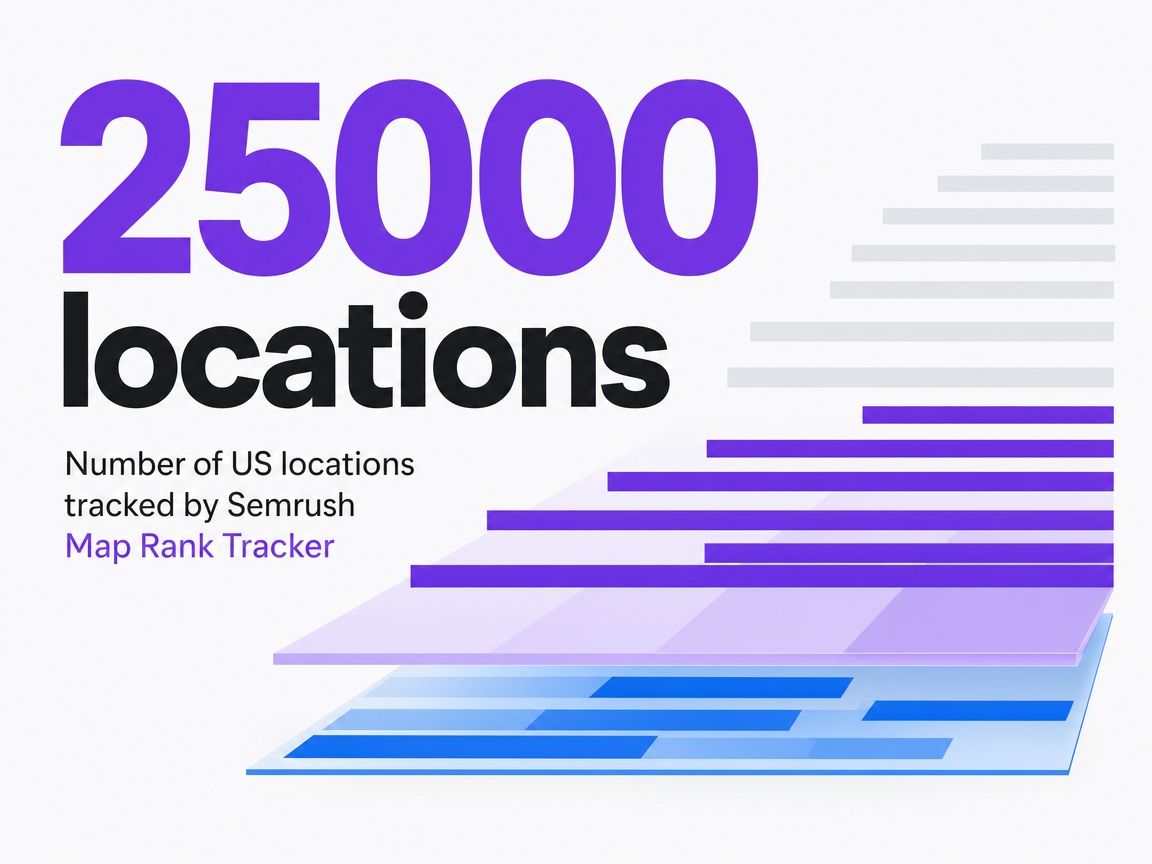 Number of US locations tracked by Semrush Map Rank Tracker
Number of US locations tracked by Semrush Map Rank Tracker
Closing the loop from measurement to shipped content
Measurement tells an agency where the gaps are. It does not close them. The direction of travel in 2026 guides is toward full-loop platforms that combine monitoring with on-page auditing and fix recommendations, rather than tracking tools that hand off a CSV and wish the content team luck 5. That framing matters for agency SEO leads because the bottleneck has shifted. Diagnostic AI capabilities already flag at-risk pages before they drop and surface content gaps competitors are filling 8. The question is what happens next.
Two operational realities decide whether measurement translates into visibility gains. First, prompt-level citation data from Brand Radar, Peec AI, or Rankscale AI arrives faster than editorial teams can brief, draft, review, and publish against it. Second, the KPI ambiguity flagged earlier means every remediation cycle also carries a definition debate about what counts as a win 1. Both compress the window between spotting a citation gap and shipping the content that fills it.
The eighth slot in the stack is the execution layer that connects the position and AI visibility outputs to an approval-governed content workflow. Vectoron sits in that slot, not as a rank tracker but as the layer where measurement signals become approved, shipped content.
Frequently Asked Questions
References
- 1.12 new KPIs for the generative AI search era.
- 2.6 Best Local Pack Tracking Tools in 2026.
- 3.5 Best Local Rank Tracking Tools for Marketers in 2026.
- 4.Best Local AI SEO Tools in 2026.
- 5.Best AI SEO Tools in 2026: the complete guide.
- 6.We Tested 22 Best AI Search Rank Tracking Tools for 2025.
- 7.AI SEO Statistics (2026): 57+ Data Points on Zero-Click ....
- 8.Best AI-Powered SEO Tracking Tools for Small Businesses (2025).
- 9.AI SEO Rank Tracking Tools (comparison table excerpt with Semrush).
- 10.Top 5 AI Tools Shaping SEO with Success in 2025.