
Key Takeaways
- Stop chasing a nonexistent AIO rank position and instead measure three signals: SERP presence, URL citation in AI features, and downstream click quality.
- Build a three-layer stack combining third-party rank trackers for presence, Search Console's generative AI report for citation, and GA4 plus call data for outcome attribution.
- Run weekly SERP scans at a fixed time with device and location splits, producing a standardized AIO-flagged keyword export that feeds the Search Console pull.
- Treat the generative AI performance report as an overlay rather than subtracting its impressions from totals, since Google blends AI feature data into overall Performance metrics.
- Segment GA4 by tagging AIO-exposed landing pages and compare a rolling 28-day pre-exposure baseline against the current window to isolate session quality changes.
- Prioritize informational queries for full weekly instrumentation, since AI Overviews appeared in 42.51% of Q4 search results and suppress clicks most on that intent 7.
- Consolidate workflows through templated joins, standardized GA4 dimensions, and pooled tracker seats to keep 50-client portfolios near 21 analyst hours weekly instead of 83.
- Frame reporting around coverage, editorial share, and visibility trends, and include a limitations paragraph acknowledging blended totals, no inclusion schema, and narrow causal evidence.
Why the "AIO Rank Position" Question Is the Wrong One
Clients frequently ask about their "rank in the AI Overview," but this question is based on a misconception. Google's documentation clarifies that there is no specific schema or markup to guarantee inclusion in AI Overviews. Eligibility is determined by whether a page is already indexed and eligible for snippets in core Search. AI features synthesize answers using supporting links from the same ranking systems that power traditional search results.
Therefore, the relevant measurement isn't a "position," but rather whether a client's content is present, cited, and how it impacts clicks. Agencies that focus on a non-existent AIO rank risk losing credibility.
Three measurable signals are crucial:
- Presence (whether an AI Overview appears for a query)
- Citation and impression (whether a client URL is a supporting link, visible via Search Console's generative AI performance reports since June 2026)
- Downstream click quality (as Google blends AI feature traffic into standard Performance report totals)
This guide details how to measure these three signals across a client portfolio efficiently.
The Three-Layer Measurement Stack
Layer One: SERP Presence Detection
Presence detection determines if an AI Overview renders for a specific query, device, and location. Third-party rank trackers like Ahrefs, Semrush, and Advanced Web Ranking already provide this by scraping live SERPs and flagging AI Overview features at the keyword level. This allows portfolio managers to filter client keyword sets for AIO-triggering queries.
However, presence detection alone doesn't indicate if the client's URL is cited within the overview or how click volume has changed. A keyword's AIO presence can fluctuate intraday, which daily sampling by third-party crawlers might miss.
Presence should be viewed as a coverage signal, not an outcome. Weekly, segment tracked keywords into:
- AIO-present
- AIO-absent
- AIO-volatile (flipped state within 14 days)
Volatility is important because Google is still refining which queries trigger overviews, with informational queries driving most appearances. This layer also provides the necessary AIO-flagged query list for the subsequent GSC pull.
Layer Two: GSC Generative AI Performance Reports
Google's June 2026 launch of generative AI performance reports in Search Console is pivotal. Previously, agencies relied on third-party scrapers and manual checks for AI Overview citation status. Now, Search Console directly exposes impressions for AI features and the specific URLs that appeared within them, transforming citation tracking into a logged, per-property metric.
These reports have limitations. Google confirms that clicks and impressions from AI features are included in the overall Performance report totals, not separated. This means agencies cannot subtract AIO impressions to establish a "non-AIO" baseline. The generative AI report shows which URLs surfaced in AI features but doesn't isolate what would have happened without them.
Third-party rank trackers provide query-level SERP state, which Search Console lacks. Search Console offers URL-level citation and impression data, which scrapers cannot see. GA4 tracks post-click visitor behavior, which neither of the first two measures. These three data sources are complementary, each filling blind spots of the others.
The practical workflow involves weekly pulling of the generative AI report per client property, joining it with the AIO-flagged keyword list from Layer One, and calculating a citation rate (the share of AIO-present queries where the client URL was a linked source). Citation rate becomes the reportable metric, and impression share within AI features becomes the trend line. Both metrics are robust as they originate directly from Google's logs.
Layer Three: Downstream Click Quality and Attribution
Presence and citation are inputs; clicks and conversions are outcomes. Research from the Toulouse School of Economics, based on a randomized field experiment, found that outbound organic clicks per search increased from 0.37 with AI Overviews to 0.62 when they were removed, indicating a 39.8% reduction in outbound clicks attributable to the AI Overview itself on informational queries.
This study focused on outbound organic clicks for queries where an AIO was intended to render. It did not cover branded queries, transactional intent, or long-tail commercial queries in isolation. Agencies should present this finding accurately: it provides causal evidence that AI Overviews suppress click-through on informational-intent queries significantly, but it's not a universal CTR multiplier.
Reporting implications are direct. Presence tracking without click attribution can overstate the problem for clients with transactional or navigational keyword mixes and understate it for those with heavily informational traffic. Layer Three requires GA4 segmentation by landing page and query intent, along with call tracking or form-submission data for service-vertical clients where pipeline outcomes are key.
The mechanical steps include:
- Tagging AIO-flagged landing pages in GA4
- Monitoring session quality metrics (engagement rate, conversion rate, assisted conversions) against a 28-day pre-period baseline
- Integrating call-tracking data for verticals with dominant offline conversions
Google's guidance suggests complementing Search Console with analytics for engagement and conversion analysis, precisely because AI feature traffic is blended into overall search totals. Addressing click quality is a primary concern for clients.
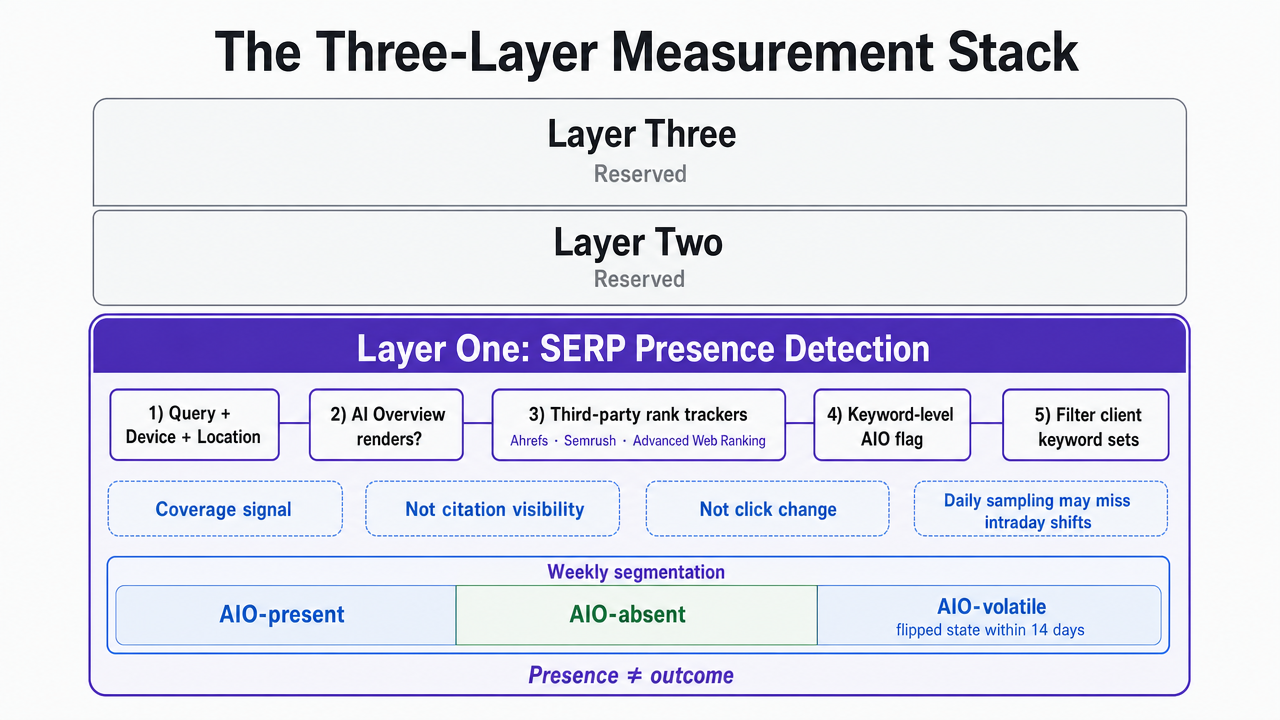 Visualize the three complementary measurement layers described in the section as a stacked framework diagram
Building the Weekly Instrumentation Workflow
Wiring SERP Scans to Client Keyword Sets
The scan cadence is fundamental. Portfolio managers should schedule third-party rank tracker crawls weekly, at a consistent time, for a fixed keyword set per client property. Consistency is more important than frequency, as AI Overview presence can fluctuate intraday. Comparing Tuesday-morning scans across weeks provides a clearer volatility signal than mixed-time samples.
Before scanning, every client keyword list needs device and location splits. Ahrefs, Semrush, and Advanced Web Ranking support this, but default settings often track only desktop or a single geographic centroid. For a legal client with offices in three metros, this means three separate keyword sets, each independently flagged for AI Overview presence. Merging them would obscure geographic variations in AIO impact.
The output of Layer One should be a standardized weekly export per property: keyword, device, location, AIO-present flag, AIO-volatility flag (state change within 14 days), and the top three cited domains within the overview (if exposed by the tracker). This export serves as the join key for the Search Console pull in the next step. Without a clean AIO-flagged keyword list, the generative AI performance report lacks query context.
Pulling and Reconciling GSC Generative AI Data
The Search Console pull for the generative AI performance report should occur on the same weekday as the SERP scan, for each verified property. This report provides impressions attributed to AI features and the specific URLs that appeared as supporting links, making citation tracking a logged metric rather than an estimate.
Reconciliation is critical for accuracy. Google confirms that AI feature clicks and impressions are included in overall Performance report totals. Therefore, subtracting AI-feature impressions from total impressions to create a "clean non-AIO baseline" results in double-counting. The generative AI report should be treated as an overlay, indicating which URLs surfaced in AI features and their impression volume, not what would have happened without the feature.
Two derived metrics are essential for weekly exports:
- Citation rate (AIO-present queries from Layer One where a client URL appears in the generative AI report, divided by total AIO-present queries)
- Impression share within AI features (client AI-feature impressions divided by total client impressions, tracked as a rolling four-week line)
Both metrics are auditable as they originate from Google's logs.
Segmenting GA4 and Call Data for Blended AIO Traffic
Layer Three utilizes GA4 and, for service-vertical clients, call tracking platforms. Segmentation begins with the AIO-flagged landing page list, created by joining Layer One queries to their ranking URLs. These landing pages are assigned a custom dimension in GA4, marking them as AIO-exposed. This allows analysts to filter engagement rate, conversion rate, and assisted conversions for this segment.
The most meaningful comparison is a rolling 28-day pre-period baseline per landing page (before it became AIO-exposed) against the current 28-day window, rather than comparing AIO-exposed versus non-exposed pages in the same week, which can be skewed by traffic mix. Changes in session quality attributable to AI Overview exposure are revealed in this delta.
Call and form data complete the loop for businesses like law firms, dental groups, and home services, where offline conversions drive retainer value. Google explicitly recommends complementing Search Console with analytics for engagement and conversion analysis because AI feature traffic is blended into overall search totals. The tagged landing page dimension can flow through to the call tracking layer, enabling attribution of qualified calls and booked appointments to AIO-exposed sessions without manual reconciliation.
Benchmark AI Overviews Ranking In Real Time
Track and publish live ranking data for AI Overviews to validate performance across actual client sites.
Prioritizing Which Keywords to Instrument First
Agencies must prioritize which keywords receive weekly SERP scans, GSC pulls, and GA4 tagging, and which can be monitored monthly or quarterly. This prevents overspending analyst hours.
Prevalence data guides the initial prioritization. Advanced Web Ranking's Q4 data, reported by Search Engine Journal, showed AI Overviews in 42.51% of search results, often linked to lower CTR for informational queries. Since informational intent queries frequently trigger AIOs and experience significant click suppression, this tier should be prioritized for full instrumentation across all client portfolios.
42.51% of Q4 search results contained an AI Overview (Advanced Web Ranking, via Search Engine Journal) 7.
The remaining portfolio can be organized into three tiers:
- Tier one includes informational and comparative queries in content-heavy verticals (e.g., legal explainers, dental procedure pages). These receive full three-layer weekly instrumentation.
- Tier two comprises commercial-investigation queries where AIOs may appear intermittently and citation shifts significantly impact lead flow. These get weekly Layer One presence scans and monthly Layer Two and Three reconciliation.
- Tier three covers transactional and branded queries, which trigger AIOs less often and already have high click intent. These maintain standard rank-tracking cadence with quarterly AIO audits.
This tiering is dynamic. Any keyword flagged as "AIO-volatile" from Layer One should be promoted to tier one for 28 days, regardless of its initial intent classification, until its presence stabilizes.
Portfolio Economics: Scaling Instrumentation Across 25+ Clients
For agencies managing 25 or more client accounts, the economics of AI Overview measurement shift at the portfolio level. A workflow requiring 90 minutes per client per week is feasible for ten accounts but unsustainable for fifty. The three-layer stack's cost must be weighed against analyst hours, not just tool licenses.
Agencies can input their own variables: blended analyst hourly rate, existing Ahrefs/Semrush/Advanced Web Ranking licenses, hours per client per week for the SERP-to-GSC-to-GA4 join, and hours per client per month for reporting. The multiplier, rather than a fixed dollar amount, reveals the breaking point.
| Cost Driver | Manual Per-Client Workflow (Weekly) | Consolidated Portfolio Workflow (Weekly) |
|---|---|---|
| SERP scan review and AIO flagging | ~45 min/client | ~10 min/client (batched) |
| GSC generative AI report pull and join 6 | ~30 min/client | ~8 min/client (templated) |
| GA4 segmentation and call-data reconciliation | ~25 min/client | ~7 min/client (standardized dimension) |
| Monthly client reporting narrative | ~60 min/client/month | ~20 min/client/month |
| Rank tracker seat allocation | Per-client keyword cap | Pooled across portfolio |
For a 50-client portfolio, the manual workflow implies approximately 83 analyst hours per week before reporting. The consolidated approach reduces this to about 21 hours by templating the join between Layer One exports and Layer Two pulls, standardizing the AIO landing-page dimension in GA4, and pooling rank tracker keyword allowances across properties instead of licensing per client.
Two operational changes drive this efficiency. First, the AIO-flagged keyword export uses a single schema for all client properties, making the GSC join a simple query. Second, the reporting narrative is generated from consistent metrics—citation rate, impression share within AI features, AIO-exposed session quality delta—across all clients, with vertical-specific commentary added rather than rebuilt. Consolidated execution platforms, such as those in the Vectoron category, unify SEO, content, and call intelligence to bridge this gap without increasing headcount.
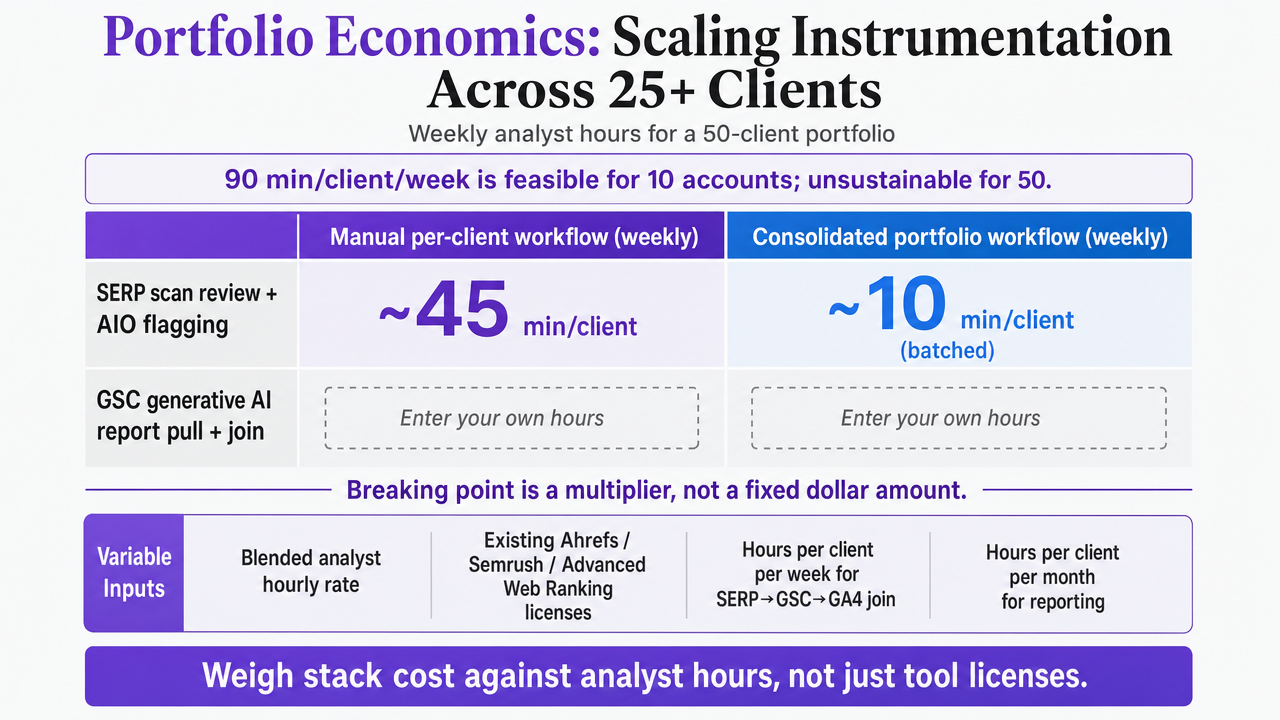 Compare weekly analyst hours between manual and consolidated workflows for a 50-client portfolio, reinforcing the section's operating-model claim
See How AI Overviews Impact Your Clients' Rankings—With Real-Time Tracking Data
Get a walkthrough of AI-powered rank tracking workflows designed for agency-scale SERP monitoring, including automated reporting on AI Overview placements and actionable performance benchmarks for complex client portfolios.
Reporting AIO Impact to Client Stakeholders
Translating Presence, Citation, and Impression Share
Client stakeholders, such as marketing directors or general counsels, typically want to know: are we visible, are we cited, and is the traffic valuable? The three-layer stack directly addresses these questions, provided the reporting analyst translates metrics into familiar business language.
Presence should be framed as coverage. Instead of "38% of tracked keywords now trigger AI Overviews," communicate "38% of the queries in the tracked set are now answered by an AI Overview before the traditional search results load." This positions presence as a market condition.
Citation rate becomes editorial share. When Google's generative AI performance report shows a client URL as a supporting link within AI features, the reporting frame is "the client's content was selected as source material for X% of AI-answered queries in the tracked set." Impression share within AI features becomes a visibility trend, presented as a rolling four-week line. Both metrics are directly traceable to Google's logs, satisfying technically literate stakeholders.
The Honest Limitations Paragraph Every Report Needs
Every monthly client report should include a clear, concise limitations paragraph. Consolidating caveats enhances credibility and protects the agency if a client's in-house analyst scrutinizes the methodology.
Three key limitations belong in this paragraph:
- Google confirms that AI feature clicks and impressions are included in overall Performance report totals, not separately broken out. Therefore, any "AIO-only CTR" is a modeled estimate, not a direct Google metric.
- There is no dedicated schema or markup that forces inclusion in AI Overviews; citation gains correlate with content quality signals, not technical switches.
- Causal evidence on click suppression comes from a randomized field experiment on informational queries, and its magnitude should not be extrapolated to branded or transactional keyword mixes without specific segmentation.
Governance Decisions: Opt-Out, Content Signals, and Escalation Paths
Measurement is one aspect of managing AI Overviews; governance is another. Agency leads must explicitly define three standing decisions for each client property before quarterly reviews.
The first decision is opt-out. Google's June 2026 controls allow sites to remove themselves from generative AI features, but Google states that opted-out sites will not receive traffic or impressions from these features. For a law firm relying on informational content for a long consideration funnel, opting out is usually indefensible. For a publisher whose revenue depends on session-based ad revenue from top-of-funnel articles, the calculus might differ. This decision should be made per-property, documented against the client's revenue model, not applied as a portfolio-wide default.
The second decision concerns content signals. Since no dedicated schema or markup forces inclusion in AI Overviews, citation gains stem from the same eligibility conditions as core Search: indexed, snippet-eligible, and grounded in unique, non-commodity content. If citation rate drops, the escalation path is editorial (refreshing the page) rather than technical.
The third decision is identifying who is responsible when Layer One flags a volatility spike or Layer Two shows a significant citation-rate drop. Designating this owner in advance transforms the measurement stack into a governed workflow rather than just a monthly report.
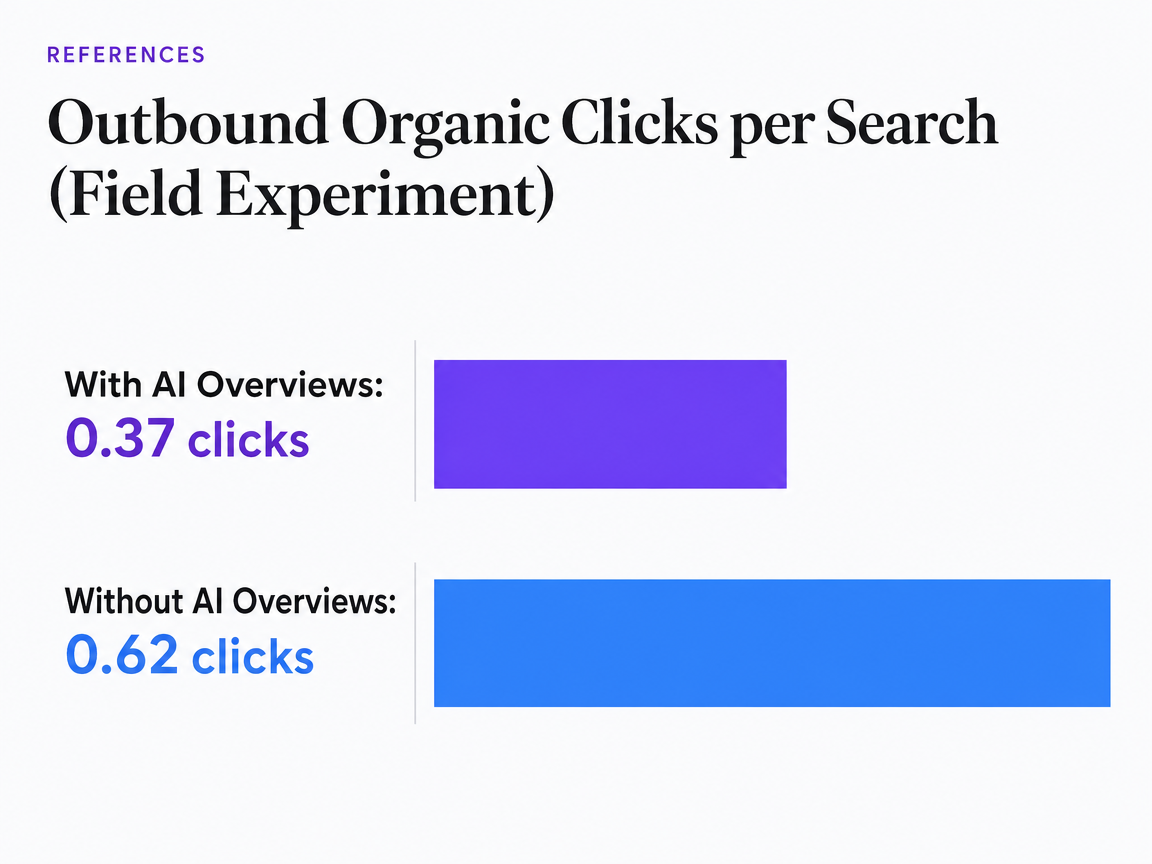 Outbound Organic Clicks per Search (Field Experiment)
Shows the average number of outbound organic clicks per search for queries where AI Overviews were intended to be shown, comparing when they were shown versus when they were experimentally removed.
Frequently Asked Questions
References
- 1.Optimizing your website for generative AI features on Google Search.
- 2.A new resource for optimizing for generative AI in Search.
- 3.AI Features and Your Website | Google Search Central.
- 4.AI Overviews and AI Mode in Search.
- 5.New opportunities, control and insights for website owners.
- 6.Introducing Search Generative AI performance reports in Search Console.
- 7.Google CTR Study: AI Overviews Rise As Click Rates Decline.
- 8.Top tips for generative AI features on Google Search.
- 9.The Impact of Google AI Overviews on Publisher Traffic and User Experience: Evidence from a Field Experiment.
- 10.AI Overviews Impact on SEO: 2026 Data, Stats & Optimization Guide.
- 11.Google AI Overview SEO Impact: Traffic Data & Case Studies (2026).
- 12.Google AI Overviews Surge 58%: SEO Impact Analysis.
- 13.Google AI Overviews Impact on SEO: What Changed and How to ....
- 14.AI Overviews and Your Website | Google Search Central Documentation.
- 15.Google AI Overviews – Search anything, effortlessly.
- 16.Google AI Overviews: A Complete Guide for SEO.