
Key Takeaways
- Classic Search Console metrics still matter, but a second reporting column tracking citation presence, cited URLs, and retrieval phrases is needed to capture visibility inside AI-generated answers.
- Google folds AI Overviews traffic into standard Web performance and adds dedicated generative AI reports 1, 2, while Microsoft's AI Performance view exposes citation counts and retrieval phrases separately 7.
- Citation counts measure exposure, not quality; a sentence-level audit scoring coverage, support, and contradiction turns cited URLs into something a client can actually act on 4, 12.
- Portfolio agencies should tier clients by risk, standardize the two-engine template with role-based ownership, and codify audit trails once so answer-engine reporting scales without linear headcount growth 6.
The Reporting Gap Between Rankings and Answers
Agency SEO dashboards were built for a world where a ranked blue link produced a measurable click. That world still exists, but it now runs alongside a second one. Google's AI Overviews and AI Mode summarize topics directly on the results page while linking to supporting sources 15, and Microsoft's Copilot Search cites sources prominently inside generated answers 8. A brand can be read, quoted, and remembered without ever appearing in a traditional click report.
That gap is becoming operational, not theoretical. Google states that AI-feature traffic currently rolls into the standard Search Console Web performance report, with no separate AI markup required to qualify 1. Microsoft went the other direction and shipped a dedicated AI Performance view in Bing Webmaster Tools that counts citations, cited URLs, unique cited pages per day, and the retrieval phrases AI systems use to pull content 7. Two engines, two reporting philosophies, one client QBR to defend.
For agency heads of SEO, the practical problem is scope. The classic dashboard answers whether a page ranks and whether users click. The new dashboard has to answer a second question: when a generative surface summarizes a topic the client sells into, is the client's content inside that answer, how often, under what phrasing, and against which competitors? The sections that follow treat AI search analytics as an extension of the existing performance stack, not a replacement, and lay out the metrics, sources, and ownership model that make it reportable.
What AI Search Analytics Actually Measures
Classic Signals That Still Belong on the Dashboard
Rankings, impressions, clicks, and conversions have not stopped describing demand. They have stopped describing all of it. Google's own guidance confirms that AI-feature traffic is folded into the standard Search Console Web performance report and that no special markup is required for a page to qualify as a supporting source in AI Overviews or AI Mode 1. The classic funnel still runs underneath every generative surface.
That means the base layer of the dashboard is unchanged in structure, even if the interpretation has shifted. Query-level impressions still indicate topical reach. Position data still exposes which pages compete for which intents. Conversion tracking still ties a visit to a booked consult, qualified call, or filled form. For an agency head of SEO defending a retainer in a QBR, these are still the metrics clients recognize and finance teams accept.
What the base layer no longer does on its own is explain the gap between stable impressions and softer click volume on informational queries. The second layer, built around answer-engine signals, exists to account for that gap rather than to replace the numbers above it.
Answer-Engine Signals: Citation Presence, Cited URLs, Retrieval Phrases
Answer-engine analytics introduces a different unit of measurement: the citation. Instead of a ranked position followed by a click, the measurable event is a page being pulled into a generated answer and shown as a supporting source. Microsoft's AI Performance preview in Bing Webmaster Tools exposes this directly, reporting total citation count, the specific cited URLs, average unique cited pages per day, and the retrieval phrases AI systems used to pull referenced content 7. Google is moving toward similar granularity. Its Search Generative AI performance reports are designed to show how often URLs from a site appeared in generative AI features, broken down by cited pages, country, device, and date 2.
Three signals form the core of this layer.
- Citation presence counts whether a page appears inside an answer at all.
- Cited URL inventory tracks which specific pages carry the citation load, which usually concentrates on a smaller subset than ranking distribution would suggest.
- Retrieval phrases expose the queries AI systems actually used to surface the page, which almost never match the keyword list a strategist started with.
Microsoft is explicit that citation counts do not indicate ranking, authority, or placement within a given answer 7. The signal is visibility, not endorsement. Treated that way, it maps cleanly onto the dashboard as a parallel column to impressions rather than a competitor to them.
Why Click Deltas Understate Brand Impact
A click report built on the pre-AI assumption that visibility equals a visit will read as a decline the moment summaries appear above the result list. The behavioral evidence suggests the decline is real at the click level and incomplete as a measure of exposure.
In a peer-reviewed ACM CHI study of 1,526 U.S. participants running practical search tasks, Google users clicked a traditional result in 8% of visits when an AI summary was present, compared with 15% without one, and clicked a cited AI-summary source in only 1% of visits 3. The scope of that finding matters: the study compared ChatGPT and Google task experiments with a representative U.S. sample, and the authors noted that ChatGPT users were faster and more likely to find a correct solution while relying significantly less on primary web sources. It is not a universal commercial-query finding and it is not a direct measurement of Google AI Overviews behavior.
What it does establish is that the gap between impression and click widens when a summary is in the path, and that cited sources inside summaries capture only a sliver of the referral they would have earned as a top-ranked blue link. For an agency reporting layer, the implication is specific: a client whose cited URL inventory and retrieval phrase coverage are growing while clicks compress is not losing visibility. The dashboard has to be able to show both numbers in the same frame or the trend reads as failure.
A Two-Engine Dashboard: Google and Microsoft Surfaces
Google Side: Search Console Web Performance and the Generative AI Reports
The Google side of the dashboard currently sits in two places at once. Standard Search Console Web performance already includes AI-feature traffic, meaning impressions and clicks from AI Overviews and AI Mode are blended into the familiar query, page, country, and device views that strategists already pull every week 1. No separate filter, no special markup, no additional eligibility step is required for a page to show up as a supporting source 1.
The second place is new. In June 2026, Google announced dedicated Search Generative AI performance reports in Search Console, designed to show how often URLs from a site appeared in generative AI features, with breakdowns by cited pages, country, device, and date trends 2. That reporting split matters operationally. The blended Web view will keep answering the question of total search demand, while the generative reports will isolate the subset of visibility that happens inside AI surfaces specifically.
For a strategist building the Google column of the dashboard, three dimensions carry most of the analytical weight:
- Impressions inside generative features
- The specific pages Google selected as supporting sources
- The time-based trend of both numbers against the classic Web performance line 2
The gap between those two trend lines is the agency's new story. When Web impressions hold and generative impressions grow on the same cluster, the content is doing the job the client is paying for, even if the click column tells a flatter story.
Microsoft Side: AI Performance in Bing Webmaster Tools and Copilot Search
Microsoft shipped a different reporting philosophy. The AI Performance preview inside Bing Webmaster Tools, released in February 2026, surfaces citation count, the list of cited URLs, the average number of unique cited pages per day, and the retrieval phrases AI systems used to pull referenced content 7. Each dimension answers a question the Google blended view does not yet answer on its own: how often, which pages, how concentrated, and under what phrasing.
Copilot Search sits upstream of those metrics. Microsoft describes its design as citing sources prominently and attaching links to the relevant sentences or passages used to generate the curated answer 8. Two reporting consequences follow. Citation presence is observable because Copilot exposes the sources. Citation placement is observable because the links are anchored at the sentence or passage level, not dropped into a generic footer.
The caveat Microsoft states explicitly belongs in the dashboard legend. Citation counts in AI Performance do not indicate ranking, authority, or the role a page played inside a given answer 7. That means retrieval phrase data is more useful as a content-planning input than as a ranking proxy. When a cluster of retrieval phrases concentrates on three pages while twenty rank for the same intents, the strategist has a direct signal about which pages the AI system is treating as the reference set, and which pages are earning traditional visibility without earning citation share.
Consolidation Table: Metric, Source, Cadence, Owner, Deliverable
The point of running two engines on one dashboard is to hand a junior strategist a repeatable weekly process, not a quarterly research project. The table below consolidates the reporting layer into a single operating view. Each metric is tied to the platform that reports it, the cadence the data supports, the strategist role that owns it, and the artifact the client sees.
| Metric | Source system | Cadence | Owner | Client deliverable |
|---|---|---|---|---|
| Impressions, clicks, position | Google Search Console Web performance 1 | Weekly | SEO analyst | Query and page trend lines in QBR deck |
| Generative AI impressions and cited pages | Google Search Console generative AI reports 2 | Weekly | SEO analyst | AI visibility trend overlaid on Web performance |
| Citation count, cited URLs, unique cited pages per day | Bing Webmaster Tools AI Performance 7 | Bi-weekly | SEO strategist | Citation inventory and concentration view |
| Retrieval phrases | Bing Webmaster Tools AI Performance 7 | Monthly | Content lead | Content planning brief for the next sprint |
| Conversions and qualified leads | Analytics and CRM | Weekly | Account lead | Pipeline attribution against the two visibility columns |
The table is deliberately short. Expanding it is where agency reporting operations tend to fail, because each added row demands a weekly pull from someone who has fourteen other accounts to manage. The two-engine split works when the owner column is unambiguous and the cadence is defensible to the strategist carrying the load.
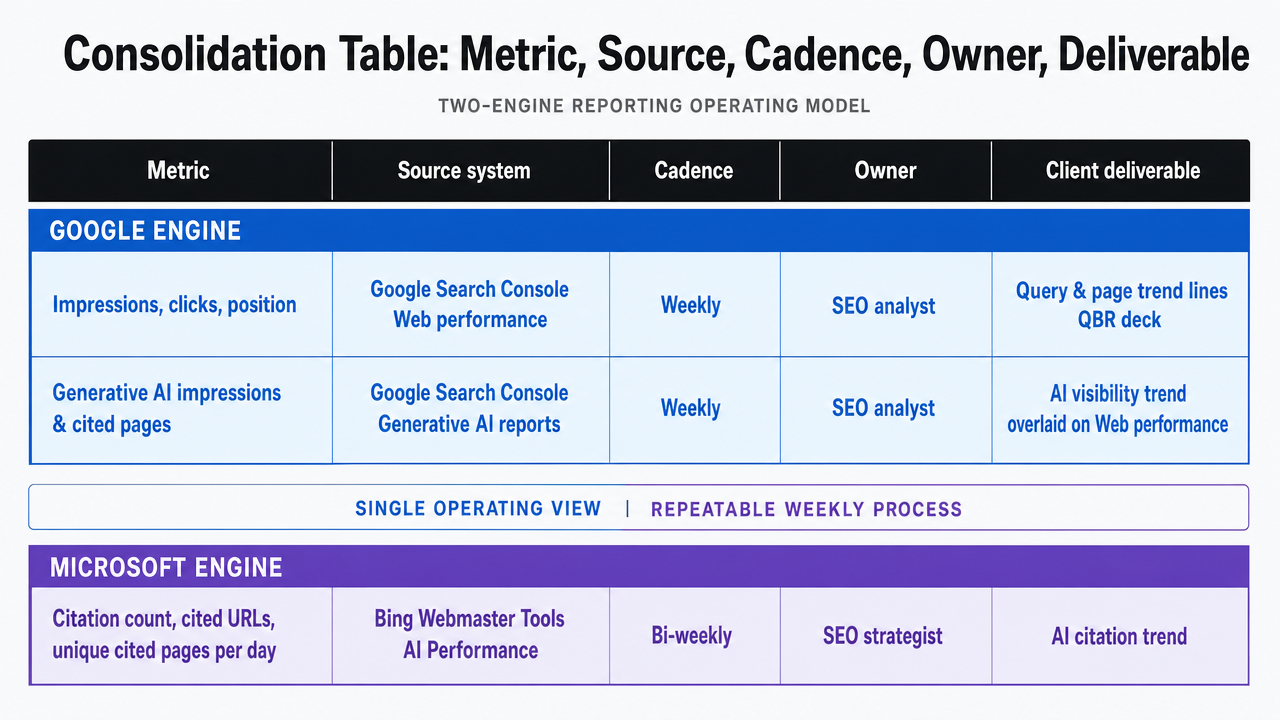 Visualize the two-engine reporting operating model side by side, showing Google and Microsoft sources mapped to metrics, cadence, and owners as described in the section's table
Test AI search analytics on live client data
See real-time performance insights and publish data-backed content before making a commitment.
Citation Presence vs Citation Correctness
Why Counting Citations Misses the Harder Question
A citation count treats every appearance as equivalent. The AI Performance view tells a strategist that a page was pulled into an answer; it does not tell the strategist whether the sentence the page was attached to actually said what the source said. Microsoft is direct about the limit: citation counts in the preview do not indicate ranking, authority, or the role a page played inside a given answer 7.
That matters because a cited URL can be structurally present without being evidentially useful. A page about pricing might be attached to a sentence summarizing eligibility. A clinical overview might be pulled under a sentence that overstates an outcome. AttributionBench defines a claim as attributable only when each component of the claim is directly and explicitly supported by the reference, and the authors show that automatic evaluation of that condition is still difficult, especially for compound claims and multi-source synthesis 12.
For an agency, the practical takeaway is that citation count belongs on the dashboard as a visibility metric, not as a quality metric. The second column has to measure whether the citation is doing the work the client would want it to do.
Claim-Level Auditing Borrowed From Retrieval Research
Retrieval research has already built the measurement vocabulary agencies need. A peer-reviewed NAACL 2025 paper on interleaved reference-claim generation proposed grounding each generated sentence to its supporting reference and reported a 90% citation accuracy rate for its sentence-level attribution method in extensive experiments 11. The caveat sits in the same breath: that figure describes a specific research system on a defined benchmark, not what any commercial engine achieves on live queries. AttributionBench reinforces the gap, documenting that automatic attribution evaluation struggles with compound claims, implied support, and references that are topically related but not evidentially sufficient 12.
Translated into agency practice, this becomes a claim-level audit on the client's own cited pages. The strategist opens a cited URL from AI Performance, isolates the sentence most relevant to the retrieval phrase, and asks a narrower question than SEO QA usually asks: does the on-page sentence directly and explicitly support the kind of claim the AI system is likely to attach to it? Research on multi-source attribution for long-form generation makes the same point from the generator side, noting that accurate evidence citation improves explainability and user trust 13.
The audit is not about rewriting pages to chase a citation. It is about making sure the sentences a page would be cited for say what they appear to say.
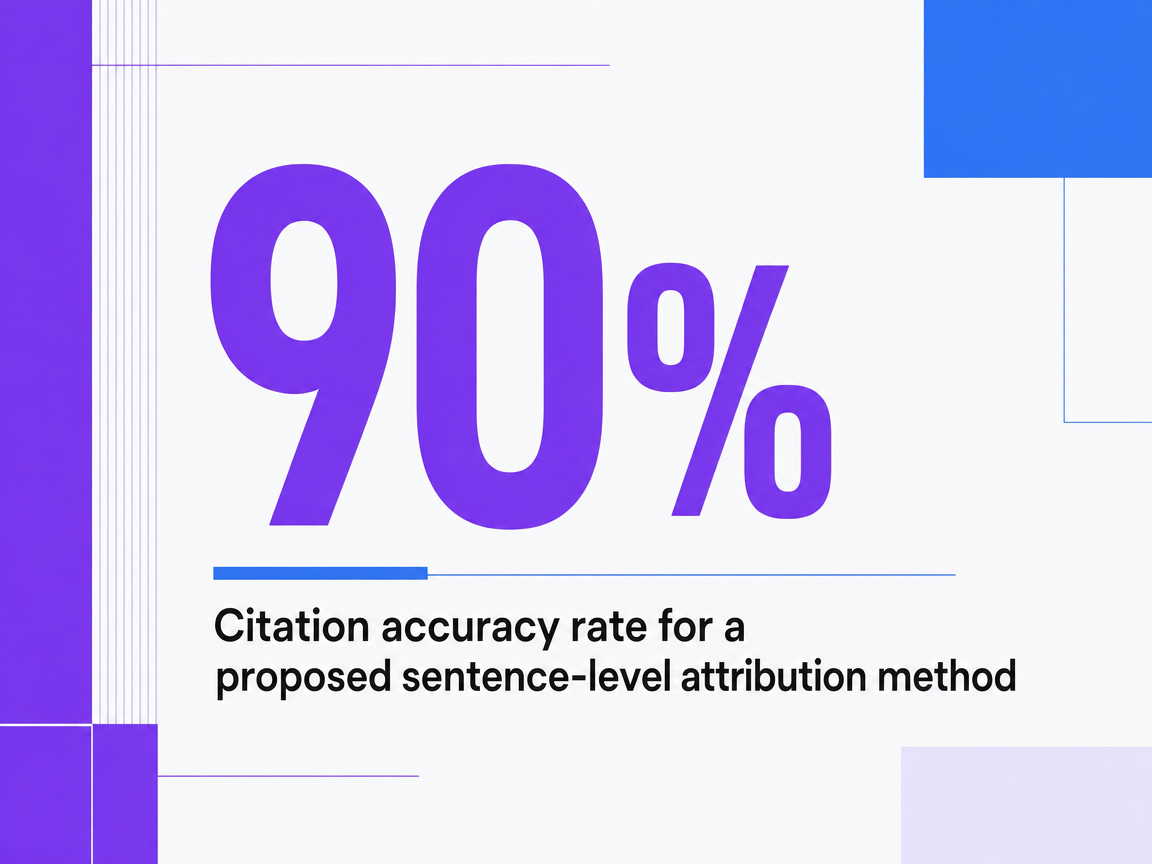 Citation accuracy rate for a proposed sentence-level attribution method
Citation accuracy rate for a proposed sentence-level attribution method
Coverage, Support, and Contradiction as QA Dimensions
The TREC 2025 Biomedical Generative Retrieval overview supplies three QA dimensions that port cleanly into an agency content review.
Citation coverage : Measures the share of generated answer sentences carrying at least one supportive citation.
Citation support : Measures whether the cited reference actually backs the sentence.
Citation contradiction : Measures whether a reference contradicts the claim it is attached to 4.
NIST's evaluation work on machine-generated reports reaches the same conclusion from a different angle: outputs should be complete, accurate, and verifiable, with citations that map claims to source documents 5.
Applied to a client's cited URL inventory, the three dimensions produce a short review per page. Coverage asks whether the page's key assertions are each tied to a visible, specific source on the page itself. Support asks whether those sources, when opened, back the assertion they sit next to. Contradiction asks whether any cited reference points the other direction.
Three columns, one review pass, scored on the pages the AI Performance report says are already being pulled. That is the layer that turns citation presence into something a client can act on.
Technical Readiness Without the Schema Myth
A persistent myth in the GEO conversation is that a special AI-ready schema will unlock citation share. Google's own guidance says the opposite. There are no additional requirements to appear in AI Overviews or AI Mode, and no AI-specific markup qualifies a page for inclusion 1. Structured data remains a standardized format that helps Google classify page content and qualify it for supported rich results, but it is not a generative-search ranking lever 9.
That reframes the technical readiness checklist for an agency rolling the same audit across dozens of client sites. Crawlability, canonicalization, and clean rendering still gate whether a page can be used as a supporting source at all. Article structured data still helps Google understand titles, authors, images, and dates, and Google notes it can improve how those elements appear in results 10. On a template rollout, the audit question is whether authorship, publish date, and page type are exposed consistently, not whether a new AI-specific type has been bolted on.
The practical rule for a strategist: fix the fundamentals that AI systems need to read the page, then stop. Schema deployment is not a substitute for the content a cited sentence has to actually say.
Governance and Audit Trails That Survive a QBR
A dashboard that reports citation counts without explaining how the underlying content was produced will not hold up the first time a client asks who approved a page that got pulled into an AI answer. NIST's Generative AI Profile frames the governance requirement in plain terms: trustworthy AI systems need validity, reliability, transparency, and accountability built into the design, development, and evaluation workflow 6. For an agency reporting into client stakeholders, that translates into a documentation layer sitting underneath every cited URL.
Three artifacts carry most of the weight.
- A change log tying each cited page to its author, reviewer, publish date, and last substantive edit.
- An evidence trail capturing which sources the strategist used to write the sentences the AI system is now attaching to retrieval phrases.
- A review record showing that a human signed off before publication.
NIST's work on agentic AI evaluation probes describes the same pattern as faithfulness, completeness, and sufficiency checks backed by audit trails that show where evidence came from and how it supports the conclusion 14.
When a client asks why a specific page is being cited, the strategist should be able to answer in one pass: here is the page, here is the retrieval phrase pulling it, here is the sentence being attached, here is the source behind that sentence, and here is the reviewer who approved it. That is the artifact that survives the QBR.
See How AI Search Analytics Delivers Real-Time SEO Insights—at Scale
Request a walkthrough of AI-powered dashboards that aggregate live search, ranking, and competitive data—enabling agency teams to streamline reporting, surface new opportunities, and maintain oversight across all client accounts.
If You Manage a Portfolio of Client Properties
The dashboard logic changes when the strategist running it is responsible for 40 client properties instead of one. A single in-house SEO lead can afford to review every cited URL by hand. An agency head of SEO cannot, and the two-engine reporting model has to be engineered for that constraint before it ships to the account team.
Three decisions carry the portfolio.
- Tiering. Not every client property earns the same reporting cadence. Clients in regulated verticals where a mis-cited sentence creates a disclosure risk get the full claim-level audit 12, while lower-stakes accounts get citation inventory and retrieval phrase monitoring on a monthly pass.
- Template reuse. The consolidation table from the Google and Microsoft sources 2, 7 becomes a single reporting template that every account inherits, with the owner column mapped to roles rather than named strategists so turnover does not break the cadence.
- The audit trail layer. NIST's governance framing on validity, accountability, and documented review 6 has to be codified once, as a shared workflow, not reinvented per client.
Portfolio economics are where the model either compounds or collapses. If each new client adds a weekly manual pull from Search Console and Bing Webmaster Tools, headcount rises linearly with the book. If the pulls, the citation inventory diff, and the retrieval phrase review are standardized and routed through one approval queue, a strategist can carry more accounts without the quality of the second reporting column degrading. The agencies that survive the compression in classic click volume will be the ones that treat answer-engine analytics as a production system, not a bespoke deliverable.
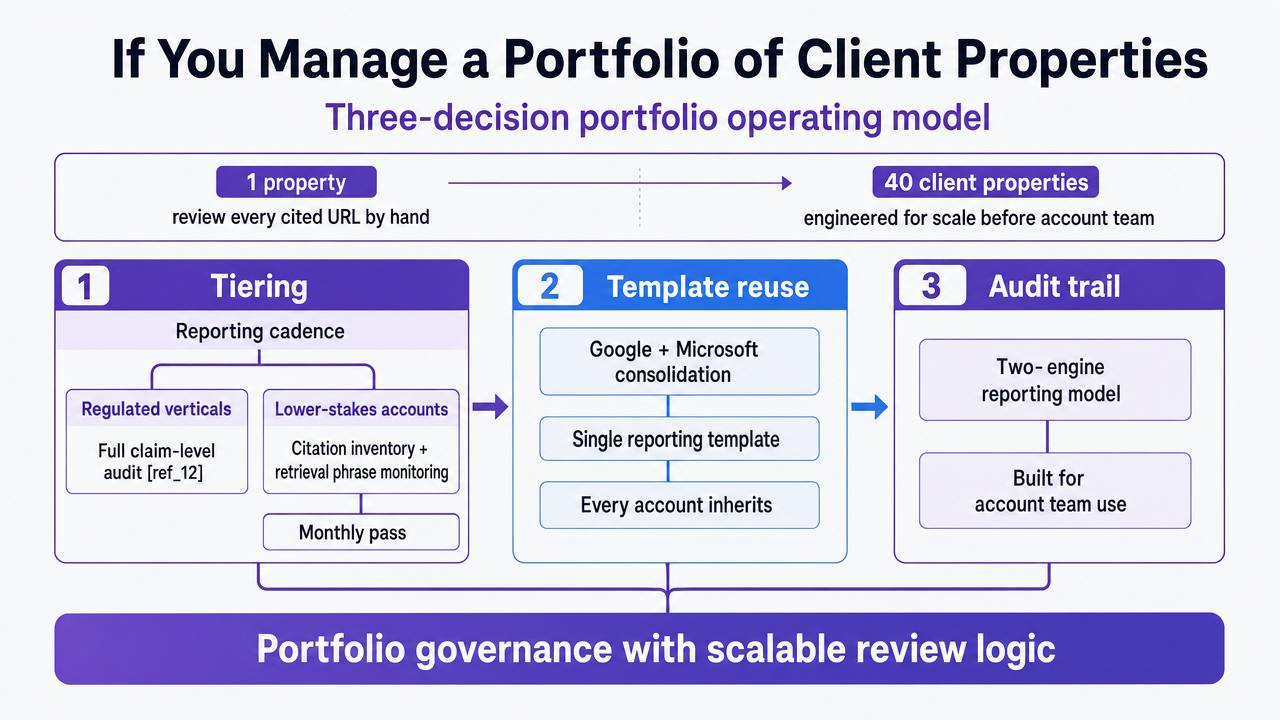 Visualize the three-decision portfolio operating model (tiering, template reuse, audit trail) as a process infographic supporting the section's framework
What the Dashboard Cannot Tell You
Even a well-built two-engine dashboard leaves blind spots the strategist has to name out loud before a client fills them in with the wrong assumption. Citation counts, cited URLs, and retrieval phrases describe exposure. They do not describe whether a reader finished a task, trusted the answer, or formed a brand impression that surfaces weeks later in a direct visit or branded query.
The ACM CHI study referenced earlier found that participants using generative tools were faster and more likely to reach a correct answer, yet still expressed a subjective preference for Google and relied significantly less on primary web sources 3. Preference and task completion are not visible in any Search Console or Bing Webmaster Tools view. Neither is the role a cited page played inside a given answer, which Microsoft states explicitly is not what citation counts measure 7.
The honest line for the QBR is that the dashboard reports visibility across two engines and leaves brand recall, trust, and offline conversion to the research layer underneath it.
Frequently Asked Questions
References
- 1.AI Features and Your Website | Google Search Central.
- 2.Introducing Search Generative AI performance reports in Search Console.
- 3.A New Era of Online Search? A Large-Scale Study of User Behavior and Personal Preferences during Practical Search Tasks with Generative AI versus Traditional Search Engines.
- 4.Overview of TREC 2025 Biomedical Generative Retrieval (BioGen 2025).
- 5.On the Evaluation of Machine-Generated Reports.
- 6.Artificial Intelligence Risk Management Framework: Generative Artificial Intelligence Profile.
- 7.Introducing AI Performance in Bing Webmaster Tools Public Preview.
- 8.Introducing Copilot Search in Bing.
- 9.Structured Data Markup that Google Search Supports.
- 10.Learn About Article Schema Markup | Google Search Central.
- 11.Ground Every Sentence: Improving Retrieval-Augmented LLMs with Interleaved Reference-Claim Generation.
- 12.AttributionBench: How Hard is Automatic Attribution Evaluation?.
- 13.Towards Improved Multi-Source Attribution for Long-Form Generation.
- 14.Building Evaluation Probes into Agentic AI.
- 15.AI Overviews and AI Mode in Search.