
Key Takeaways
- Replace single-score inclusion tracking with a four-layer rubric adapted from TREC evaluation: presence, inclusion, citation support, and nugget coverage, scored separately per engine 1.
- Weight the rubric differently across ChatGPT, Perplexity, Google AI Overviews, Bing Copilot, and Claude, because each engine fails on a different layer and cross-engine averages hide the real behavior.
- Defensible client reporting requires structured evidence artifacts per query, sampled human calibration against automated judges, and lift claims scoped to sample, engines, and method, not headline multipliers 5.
- Scale across 15 to 150 accounts by adopting a Govern-Map-Measure-Manage operating model where human hours move from running queries to calibrating scoring and approving remediation 7.
When a Client Asks 'Why Aren't We Showing Up in ChatGPT?'
The question arrives on a Thursday call, usually from a client who just typed their own brand name into ChatGPT and watched a competitor's blog post get cited back in the answer. Sometimes it's Perplexity. Sometimes it's a Google AI Overview that paraphrases a Reddit thread instead of the client's own service page. The ask that follows is simple and unforgiving: fix it, and prove you fixed it.
Most agencies answer with a screenshot and a theory. That worked for a quarter. It will not survive the next one. Clients who have started asking about ChatGPT visibility also read about FTC enforcement against unsupported AI performance claims, and they are quietly deciding whether the agency's reporting would hold up if anyone looked closely.
The problem is not that generative engines are unmeasurable. It is that the measurement discipline the industry inherited, rank tracking, was never designed for answers that are synthesized, cited, paraphrased, and regenerated per session. Evaluation science already exists for exactly this problem. NIST's TREC 2024 RAG track treats document relevance, answer coverage, fluency, and citation support as separate judgments 1. Agencies that borrow that structure get a defensible scorecard. Agencies that keep bolting ChatGPT columns onto a rank-tracking spreadsheet get a brittle one.
The Four-Layer Measurement Rubric
Why a Single 'Visibility Score' Fails
The industry has defaulted to inclusion rate: the percentage of monitored queries where the brand name appears in the generated answer. It is a comfortable number because it reduces to a single column. It is also unfalsifiable. An inclusion rate of 42% tells a client nothing about whether the engine named them in a service answer or a competitor comparison, whether the cited source actually substantiated what was said, or whether the answer carried the specific facts the brand needs carried, such as licensure, service area, or treatment modality.
The TREC 2025 RAG work from NC State's Laboratory for Analytic Sciences makes the methodological point directly: nugget coverage, citation support, fluency, and retrieval are distinct components of RAG assessment, and collapsing them obscures the behavior that matters 2. The same logic applies to monitoring. A single visibility score hides four different failure modes, and clients eventually ask which one is moving.
Presence, Inclusion, Citation Support, Nugget Coverage
The four-layer rubric adapted here mirrors the structure NIST uses in the TREC 2024 RAG track, which separates document relevance, answer coverage, fluency, and citation/support judgments as independent dimensions of evaluation 1. Agencies can rename these for client reporting without losing the underlying discipline.
Presence : asks whether the engine produced a substantive answer at all for the monitored query. ChatGPT may refuse, Perplexity may return a list of sources without synthesis, and Google AI Overviews may decline to generate for a given query class on a given day. Presence is binary per query per engine per run, and the baseline rate matters because downstream metrics are conditional on it. If an AI Overview fires on 31% of a client's priority queries this month and 47% next month, every other number shifts underneath.
Inclusion : asks whether the client brand, URL, or named entity appears anywhere in the answer or its cited sources. This is the metric most tools surface by default. It is useful but shallow. Inclusion does not distinguish between being named as the recommended provider and being named as the cautionary example.
Citation support : asks whether the sources the engine cited actually substantiate the sentences they are attached to. This is the judgment TREC evaluators perform at the statement level, and it is the layer where generative systems most often fail quietly 1. An answer can cite the client's page and still make a claim that page does not support, which creates both a reporting problem and, in regulated verticals, a liability problem.
Nugget coverage : asks whether the answer carries the specific facts the brand needs carried. For a personal injury firm, those nuggets might be the practice areas, jurisdictions, no-fee-unless-you-win structure, and consultation availability. For a behavioral health group, they might be levels of care, insurance accepted, and age ranges served. Nugget coverage is a brand-authored list, scored per answer, and it is where AI search monitoring stops looking like rank tracking and starts looking like editorial QA.
Separating these four layers produces a scorecard a client can argue with, which is the point. Falsifiability is the feature.
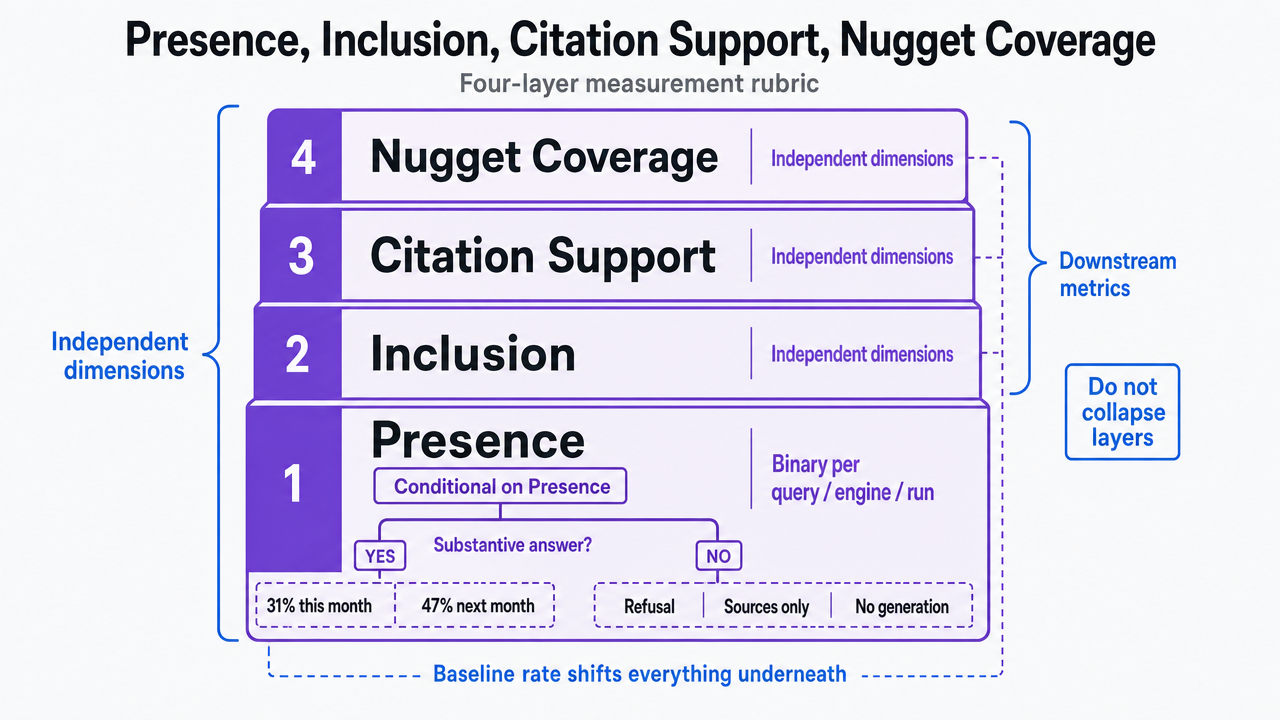 Make the four-layer measurement rubric concrete so readers can see how the layers stack and why collapsing them hides failure modes, directly supporting the section that defines each layer
Applying the Rubric Across ChatGPT, Perplexity, Google AI Overviews, Bing Copilot, and Claude
The four layers apply to every engine, but they do not weight the same across them. ChatGPT with browsing and ChatGPT without browsing behave as effectively different engines and should be sampled separately. Presence rates vary wildly by model version, and the version is rarely stable across a reporting month.
Perplexity is citation-dense by design, so citation support is the layer that moves most. A Perplexity answer that cites eight sources, three of which do not substantiate the sentences they anchor, scores well on inclusion and poorly on support. That gap is the reportable finding.
Google AI Overviews are presence-volatile. Overviews fire inconsistently by query, geography, and user signal, so presence rate per query class becomes the primary stability metric before any inclusion analysis is meaningful.
Bing Copilot behaves closer to Perplexity in citation density but closer to ChatGPT in synthesis style, which means nugget coverage judgments often reveal paraphrase drift the inclusion column misses.
Claude, when accessed through its consumer surface, cites less aggressively than Perplexity but synthesizes more conservatively than ChatGPT, which tends to produce high fluency scores and lower inclusion rates for mid-authority brands.
The operational consequence: the rubric is constant, but the per-engine weighting in the client scorecard is not. An agency that reports a single cross-engine inclusion number is averaging over behaviors that have little to do with each other.
Query Design and Evidence Capture
Sampling: Which Queries, How Many, How Often
Query selection is where most AI search monitoring programs quietly fail. Agencies either sample too narrowly, tracking twenty brand variants per client, or too broadly, pulling thousands of head terms that produce noise no one reviews.
A defensible sample for a mid-market client has three tiers.
- The first is brand and brand-adjacent queries, roughly 15 to 30 per account, covering the client name, named practitioners or locations, and comparison phrases such as 'client vs. competitor.'
- The second is service-intent queries, typically 40 to 80, drawn from the client's revenue-weighted service pages rather than from a keyword tool's volume ranking.
- The third is category and problem-framed queries, 20 to 40, where the user has not yet named a provider. The last tier is where competitors get cited and clients do not, which is usually the finding worth reporting.
Sampling cadence should separate stability from change. Brand queries run weekly because presence volatility on Google AI Overviews moves week to week. Service queries run biweekly. Category queries run monthly, with a second mid-month pull after any confirmed model version change on ChatGPT or Claude. Each query runs at least twice per cadence with fresh sessions to catch session-level variance, a design principle NIST applied in its own text-to-text generative evaluation 8.
The Evidence Artifact: What to Capture Per Query
A screenshot is not an evidence artifact. It is a thumbnail of one. Agencies that intend to defend before-and-after claims to clients, and increasingly to clients' legal counsel, need a structured record per query per engine per run.
The minimum record has seven fields:
- the exact query string,
- the engine and surface (ChatGPT with browsing, ChatGPT without, Perplexity default, Perplexity Pro, Google AI Overview, Bing Copilot, Claude),
- the model version where exposed,
- the timestamp with timezone,
- the full raw text of the generated answer,
- the ordered list of cited URLs with the sentences they anchor,
- and a full-page screenshot.
A short structured JSON payload sits alongside the screenshot so the record is machine-readable for later re-scoring.
Two supplementary fields separate competent monitoring from reportable monitoring: the geographic signal used for the pull and the account state, meaning whether the session was logged out, logged in, or carrying prior conversation context. Both change answers materially and both are easy to forget until a client asks why last month's number moved.
Store artifacts for the full client retention period, not the current reporting quarter.
Human Calibration Against Automated Judges
Scoring citation support and nugget coverage across hundreds of queries per client per month is not feasible manually, and automated LLM-based judges drift. The working compromise is calibration sampling.
A reviewer scores 10 to 15 percent of each client's monthly queries by hand using the four-layer rubric, then compares those human scores to the automated judge's scores on the same queries. Agreement rates are logged per rubric layer. Citation support, where automated judges most often overstate agreement, is the layer that typically requires the lowest divergence threshold before the judge gets re-prompted or the sample re-reviewed.
The TREC 2024 RAG track structures its evaluation around exactly this pairing of human assessment with scalable scoring 1, and the NC State LAS team reinforces that citation support and nugget coverage behave as independent dimensions that need separate calibration 2. Agencies that skip calibration end up reporting judge artifacts, not engine behavior, and the gap surfaces the first time a client re-runs a query themselves.
Test Real-Time AI Search Monitoring at Scale
Experience live AI-powered monitoring and publish search-driven content workflows before making a commitment.
Visibility Is Not Revenue: Language for the Client Call
The scorecard will eventually show movement. Inclusion ticks up on Perplexity, citation support improves across service queries, nugget coverage lands the licensure line in Google AI Overviews. The client sees the chart and asks the next question: how many leads did that produce. The honest answer, in most reporting periods, is that no one knows yet.
The Princeton KDD 2024 research that introduced Generative Engine Optimization reported that tested GEO methods could increase visibility by up to 40% in generative-engine responses, measured against GEO-bench, a 10,000-query academic benchmark across domains 6. That is the number clients encounter in trade press, and it is the number agencies get asked to replicate. It is also an experimental visibility result on a research benchmark. It does not demonstrate equivalent traffic, qualified leads, booked consultations, or revenue in any commercial vertical, and the paper does not claim it does.
The language that holds up on a client call separates three things explicitly.
- Visibility is what the engine does: whether it names the brand, cites the brand's sources, and carries the brand's facts.
- Referral traffic is what the user does next, which generative engines suppress by design because the answer often resolves the query in-surface.
- Qualified pipeline is what the business does with whatever traffic arrives.
Agencies that report all three as a single arrow mislead the client and themselves.
The operational discipline is to show visibility deltas with their scope attached, to show referral traffic from engine-identified sources as a separate panel, and to leave the pipeline column honest when the attribution is not there yet.
Governance: Substantiation, Privacy, and Provenance
Substantiating Lift Claims to Clients
Every number in a client-facing AI-search report is a performance claim. That framing is not rhetorical. The FTC has treated unsupported AI performance statistics as actionable, and the enforcement pattern now includes specific dollar consequences. In one 2025 action, the agency required a $1 million payment and prohibited unsupported claims that an AI product could make websites compliant with accessibility guidelines 4. A separate 2025 proposed order against an AI-detection vendor turned on a stark gap between a marketed accuracy figure of 98% and independent testing that measured 53% accuracy on general-purpose content 5.
The operational lesson for agencies is not that AI-search monitoring reports are illegal. It is that the evidentiary standard behind a lift claim should match the standard the agency would want if the claim were ever questioned. That means a defined sample (which queries, which engines, which cadence), a reproducible method (how presence, inclusion, citation support, and nugget coverage were scored), the raw artifacts that produced the scores, and explicit scope on what the number does and does not cover.
A 'citation support improved 22% quarter over quarter on Perplexity across 68 service queries, scored against the TREC-adapted rubric with 12% human calibration sample' is a defensible claim 1. A '3x AI visibility' headline on a monthly report is the kind of claim that reads cleanly in a slide deck and poorly in a deposition.
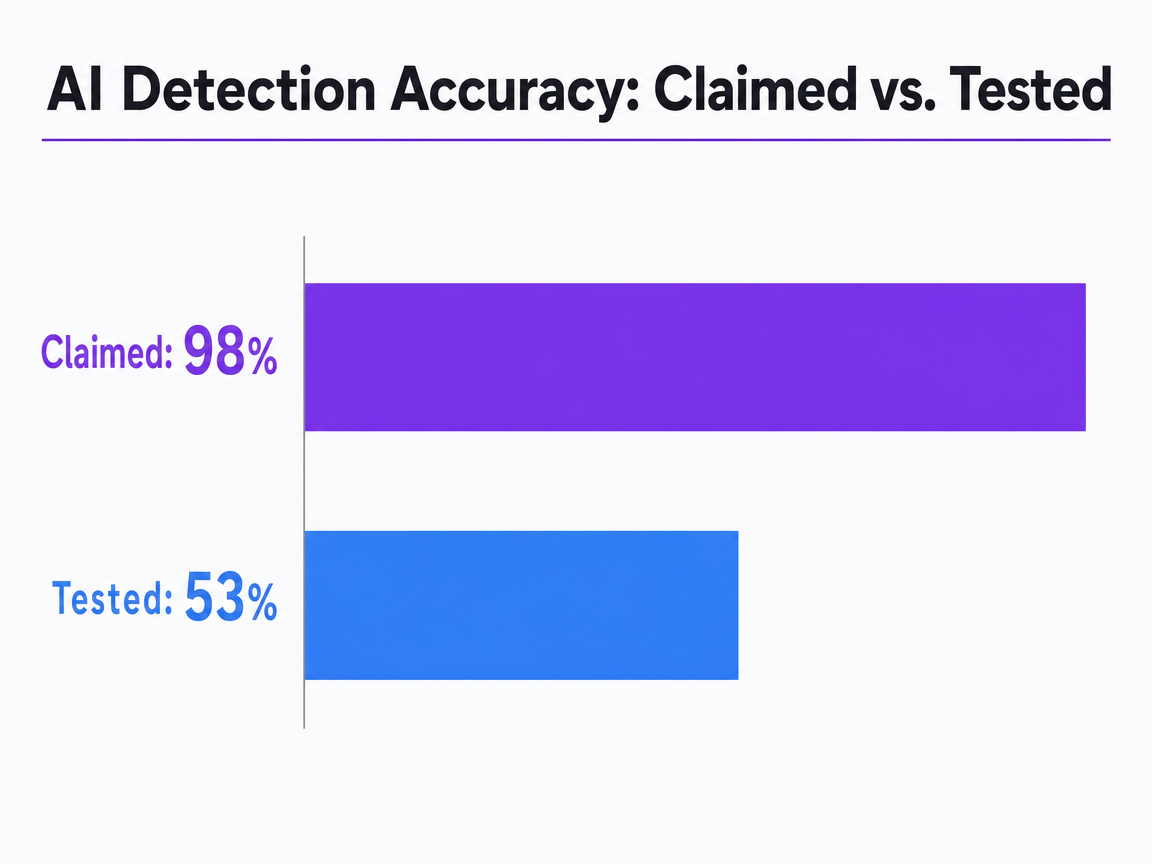 AI Detection Accuracy: Claimed vs. Tested
An FTC action highlighted a case where a company claimed 98% AI-detection accuracy, but independent testing showed only 53% accuracy, demonstrating regulatory scrutiny of performance claims.
Client Data Fed Into Third-Party Monitoring Tools
Monitoring workflows pull in more client data than most agencies realize. Prompt libraries encode service lines, pricing structures, and jurisdictional detail. Call-intelligence transcripts carry patient and client identifiers. CRM exports feed query generation. When those inputs route through third-party AI tools, the vendor's data-use terms become the agency's data-use posture by extension.
The FTC has stated that companies may be liable when they fail to honor commitments about how customer data is collected, used, or shared, including data used to train or update models 11. Agencies should read every monitoring vendor's training-data and retention terms before onboarding regulated accounts, document which data classes are permitted per client, and strip personally identifiable and protected health information from any payload that leaves the agency's controlled environment.
Provenance Logs When AI Output Is Remediated
Remediating a page to improve how generative engines cite it almost always involves AI-assisted drafting. The U.S. Copyright Office concluded that AI outputs may be copyrightable when a human author determines sufficient expressive elements, while prompts alone generally do not establish authorship 3. For agency workflows, that makes the editorial record itself an asset.
A working provenance log records the source material consulted, the AI-assisted draft, the human editor, the specific modifications made, and the approval timestamp. The same log that satisfies a copyright question also answers a client's question about what changed between the April and June versions of a service page, which is the version the AI Overview is now citing.
Escalation Rules for Legal, Health, and Behavioral Health Accounts
Regulated verticals change the stakes of a bad answer. An AI Overview that misstates a law firm's practice areas, a treatment facility's levels of care, or a dental group's accepted insurance is not a visibility problem. It is a disclosure problem the client's compliance team will treat as urgent.
NIST's Generative AI Profile frames this directly, describing the resource as voluntary guidance to help organizations incorporate trustworthiness considerations into the design, development, use, and evaluation of generative AI systems 9. Agencies serving legal, healthcare, behavioral health, dental, and senior living accounts should operationalize that into tiered escalation: any citation-support failure or nugget-coverage error touching licensure, scope of practice, pricing, insurance, or clinical claims routes to named client-side reviewers within a defined SLA. Operation AI Comply reinforces the exposure, with the FTC flagging fake reviews, an alleged AI lawyer service, and deceptive AI-powered income claims as the kinds of client-facing content agencies should actively monitor for in these verticals 10.
See Real-Time AI Search Impact Across All Client Accounts
Request a walkthrough of unified AI search monitoring, benchmarked reporting, and client-ready insights—purpose-built for agencies managing multiple brands and locations at scale.
If You Manage 15 to 150 Accounts: A Portfolio Operating Model
Mapping Govern, Map, Measure, Manage to Agency Workflow
The audience shifts here. The preceding sections described how to measure a single client well. This one describes how a Head of SEO runs the same discipline across a book of 15 to 150 accounts without staffing an analyst per logo.
The GAO's 2025 review of AI oversight describes NIST's AI Risk Management Framework as organized around four functions: Govern, Map, Measure, and Manage 7. The structure translates cleanly into agency operations.
Govern : assigns ownership. One named lead per pod carries the monitoring program, approves the rubric weights per vertical, and signs off on any client-facing lift claim. The role is not optional; without it, calibration drift goes undetected until a client surfaces it.
Map : is the query inventory. Each account gets a tiered query set, revenue-weighted, with escalation flags marking which queries touch licensure, pricing, insurance, or clinical scope. Mapping is where legal and behavioral health accounts diverge from home services accounts, and the map should show that explicitly rather than hide it in a shared spreadsheet.
Measure : is the sampling and scoring cadence described earlier, run on a fixed schedule with artifact capture and calibration sampling built in.
Manage : is the remediation loop: tickets opened against pages, schema, or citation targets, routed through client approval, and re-tested on the next cadence to confirm the delta.
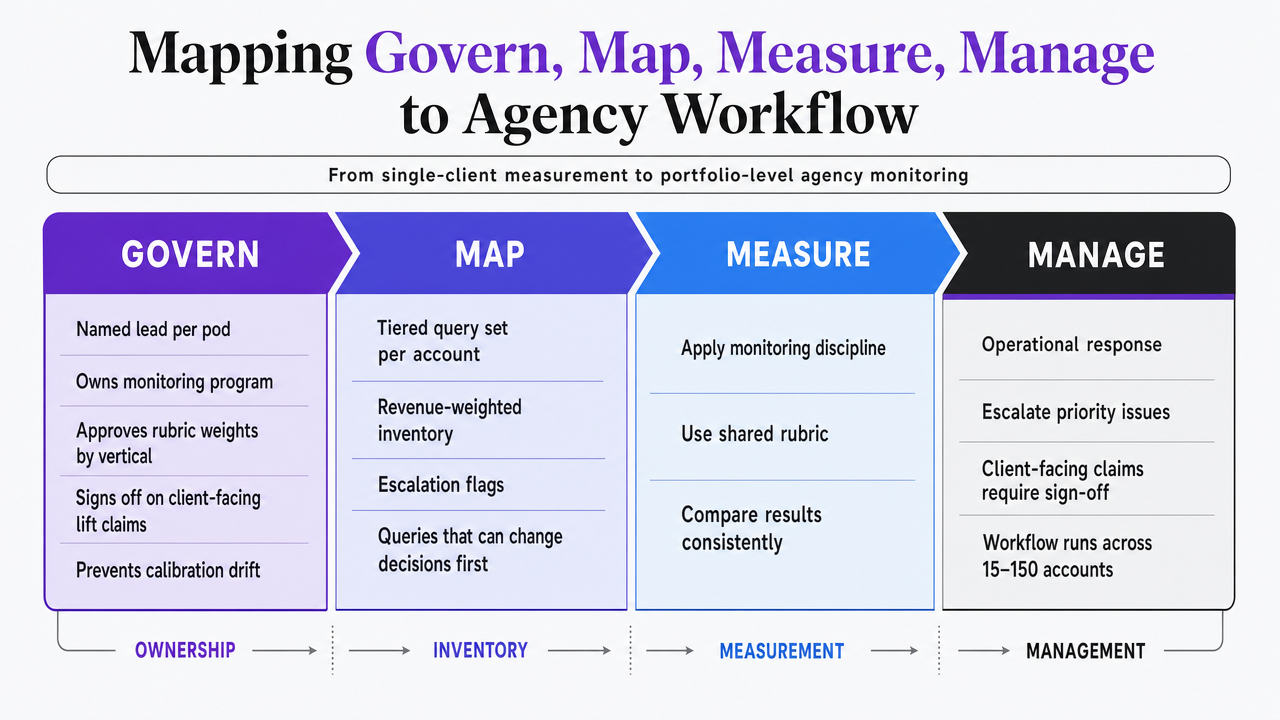 Visualize the four-function NIST AI RMF structure as adapted to agency monitoring workflow, directly supporting the section that walks through each function
Three Operating Models Compared
Agencies tend to arrive at one of three operating models, usually by accident. Naming them makes the staffing math visible.
The first is manual spot-checking: an account manager runs a handful of queries before each client call, screenshots what looks relevant, and writes a narrative. It scales to roughly 15 accounts per lead before quality collapses, and it produces reports that do not survive the substantiation standard the FTC has applied to AI performance claims 5.
The second is tool-only inclusion dashboards: a third-party platform runs queries on a schedule and reports an inclusion rate per engine. Workload drops, but the output is a single number that collapses the four rubric layers and offers no citation-support or nugget-coverage judgment 2.
The third is rubric-based monitoring with sampled human calibration: automated runs produce the artifacts, an automated judge scores the four layers, and a reviewer calibrates 10 to 15 percent of queries per account per month.
| Operating Model | Queries Sampled per Client/Month | Engines Covered | Evidence Artifacts per Query | Human Review Hours per Client/Month | Defensibility for Client Reporting |
|---|---|---|---|---|---|
| Manual spot-checking | 20–40 | 1–2 | Screenshot only | 4–6 | Low |
| Tool-only inclusion dashboard | 200–500 | 3–5 | Inclusion flag + source list | 0.5–1 | Low to moderate |
| Rubric-based with calibration | 150–300 | 4–5 | Query, timestamp, model version, raw answer, cited URLs, screenshot, JSON | 2–4 | High |
The third model is the one that scales past 50 accounts without per-client headcount, because the human hours shift from running the queries to calibrating the scoring. That is the workflow redesign the hiring question is actually asking about.
Where the Discipline Goes Next
Google and Bing are both building first-party reporting for AI-search appearances, and those feeds will eventually land in the same consoles agencies already check on Monday mornings. That does not retire the independent monitoring workflow. First-party data describes what the platform owner is willing to disclose about its own surface. It does not score citation support, it does not judge nugget coverage, and it does not cross-check Perplexity or Claude against Google's view of the same query.
The discipline that holds up over the next 24 months is the one already described: a four-layer rubric adapted from TREC evaluation science 1, a Govern-Map-Measure-Manage operating structure 7, and an evidentiary standard behind every lift number that would survive a client's legal review. Agencies building that spine now stop staffing analysts per account and start running approval-first workflows where specialist strategists handle sampling, scoring, and remediation while human reviewers calibrate and approve. Platforms like Vectoron are built around that approval loop; the discipline exists with or without the tooling.
Frequently Asked Questions
References
- 1.Text REtrieval Conference (TREC) 2024 RAG Search Track.
- 2.Laboratory for Analytic Sciences in TREC 2025 RAG and ....
- 3.Copyright and Artificial Intelligence, Part 2: Copyrightability.
- 4.FTC Order Requires Online Marketer to Pay $1 Million for Deceptive Claims Its AI Product Could Make Websites Compliant with Accessibility Guidelines.
- 5.FTC Order Requires Workado to Back Up Artificial Intelligence Detection Claims.
- 6.GEO: Generative Engine Optimization.
- 7.GAO-25-107197, ARTIFICIAL INTELLIGENCE.
- 8.2024 NIST GenAI (Pilot Study): Text-to-Text Evaluation Overview and Results.
- 9.Artificial Intelligence Risk Management Framework: Generative Artificial Intelligence Profile.
- 10.FTC Announces Crackdown on Deceptive AI Claims and Schemes.
- 11.AI Companies: Uphold Your Privacy and Confidentiality Commitments.