
Key Takeaways
- Treat an AI search tracker as a measurement instrument bound by FTC substantiation rules, not a dashboard, since client-facing ROI statements carry the same evidentiary burden as any advertising claim 1.
- Build a three-layer evidence stack that separates visibility signals, qualified downstream behavior, and CRM outcomes, labeling every revenue figure with the method that produced it to avoid conflating correlation with cause 4.
- Lock a fixed scenario-based prompt matrix per client covering services, geography, competitors, quality dimensions, and target pages, then score answer quality on discrete rubric dimensions rather than counting raw brand mentions 6.
- Attach a six-field evidence file to every claim and maintain a per-cycle measurement log so numbers stay reproducible when prompt sets, rubrics, or AI platforms shift 8.
Why AI Visibility Reporting Is a Substantiation Problem, Not a Dashboard Problem
Most AI search tracker pitches sell a dashboard: a count of brand mentions across ChatGPT, Perplexity, Gemini, and Google's AI Overviews, plotted over time. Agency leaders who paste those counts into a QBR deck under a header labeled "ROI" are quietly making an advertising claim, and that claim carries the same evidentiary burden as any performance statement about revenue, leads, or outcomes. The Federal Trade Commission has held for decades that advertisers and their agencies must have a reasonable basis for objective claims before those claims are disseminated, whether the audience is the public or a paying client 1. A screenshot of a brand appearing in an AI answer is not, on its own, a reasonable basis for a revenue attribution.
The risk stopped being theoretical in January 2025. The FTC required an online marketer to pay $1 million and barred it from making claims that its AI product could deliver a specific compliance outcome without supporting evidence 2. The order concerned accessibility software, not search visibility, but the underlying principle transfers directly: an unsupported claim about what an AI system produces for a client is actionable. Agencies serving law firms, healthcare groups, dental service organizations, and other regulated verticals inherit that exposure the moment they translate visibility data into a dollar figure or a performance guarantee 9.
The reframing that follows in this piece treats an AI search tracker as a measurement instrument, not a reporting surface. That means the tracker's output must be defined, sampled, documented, and connected to downstream behavior with the same rigor a CFO would expect from any other line item in a client's marketing budget.
The Three-Layer Evidence Stack for Defensible AI Search ROI
Layer One: AI Visibility Signals Worth Tracking
The first layer captures where and how a client's brand, pages, and content surface inside AI-generated answers. This is the raw territory most AI search trackers already cover: brand mentions in ChatGPT responses to a defined query set, citation appearances in Perplexity, pages selected as sources inside Google's AI Overviews and AI Mode, and inclusion patterns in Gemini answers. Google Search Console now exposes impressions and click data for AI-driven surfaces, which gives agencies a first-party record they can reconcile against third-party tracker sampling.
Signals worth logging at this layer are narrower than most vendor pitches suggest. The agency's tracking record should distinguish between:
- a citation with a linked source,
- an unlinked brand mention,
- a competitor citation on the same prompt, and
- an answer that references the category but names no brand at all.
Each carries a different downstream implication. A cited link on a personal-injury client's Phoenix service page can plausibly drive a session; an unlinked mention of the firm's name in a Perplexity summary usually cannot.
The operational discipline is to define these signal types once, apply them across every client, and store the raw answer text and timestamp with each observation. Without that, a Layer One dataset is a screenshot library, not a measurement input. What it establishes on its own is presence and share of voice against competitors on a fixed prompt set, nothing more.
Layer Two: Qualified Downstream Behavior
Layer Two connects visibility signals to what a real user did after the AI answer appeared. This is where GA4 path reports, referrer data, engaged sessions, form submissions, booked appointments, and qualified inbound calls enter the record. The tracker's job at this layer is not to claim credit but to establish whether the sessions arriving from AI referrers, or the direct and branded sessions correlated with visibility gains, behaved like qualified prospects once on site.
Qualified behavior means specific things: a session that reached a service-detail page, spent time consistent with real reading, submitted a scoped inquiry, or triggered a call the intake team scored as qualified. A dental service organization tracking implant consultations, a home services client tracking service-area bookings, and a law firm tracking case-type intakes each need Layer Two definitions that map to their pipeline stages, not to generic conversion goals.
Agencies serving regulated verticals should also record what did not happen: the fraction of AI-referred sessions that bounced from a location page, the ratio of unqualified to qualified calls, and any drift in intake quality when AI visibility spiked. Layer Two, done honestly, is where inflated attribution stories fall apart before they reach a client deck.
Layer Three: Business Outcomes and the Causal Gap
Layer Three is revenue, retained clients, closed cases, signed contracts, or booked procedures inside the client's CRM. It is also the layer where most agency reporting quietly overreaches. Tying an AI visibility gain to a booked case in the same month is a correlation, not a cause. The distinction matters because observational attribution and randomized measurement routinely produce different answers. A comparison of 15 Facebook advertising experiments, drawing on roughly 500 million user-experiment observations and 1.6 billion impressions, found that observational methods often failed to reproduce the effects measured by randomized experiments even after controlling for extensive demographic and behavioral variables 4. The lesson is not that attribution is useless. The lesson is that a number derived from last-touch or path modeling is a hypothesis about incrementality, not a measurement of it.
Closing the causal gap at scale is a separate problem. Running a geo holdout or a matched-market test on every client campaign is impractical for an agency managing dozens of accounts. A 2026 study introduced Predicted Incrementality by Experimentation, which uses prior randomized trials to predict incremental effects for untested campaigns. Across 2,226 Meta ad experiments, PIE achieved an out-of-sample R² of 0.88 versus 0.19 for seven-day last-click attribution, and it disagreed with RCT-based decisions in 8 to 12 percent of campaigns compared with 12 to 20 percent for last-click 3. The scope is paid social on Meta, not organic AI visibility, and the method depends on the quality and representativeness of the underlying experiments.
The operational takeaway for Layer Three is to label every revenue figure with the method that produced it: direct CRM close, modeled attribution, matched-market lift test, or holdout. Anything reported to a client without that label is a claim in search of substantiation.
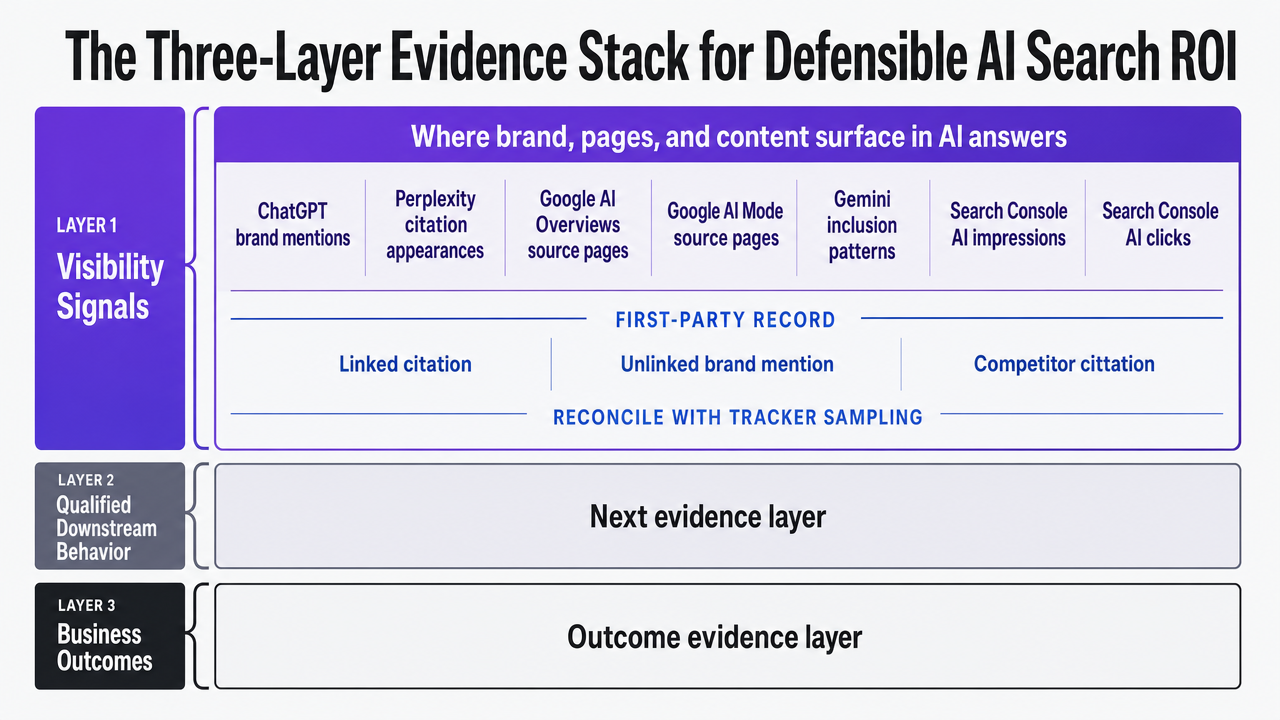 Visualize the three labeled evidence layers described in this section (visibility signals, qualified downstream behavior, business outcomes) as a stacked framework so the reader can hold the model in mind for the rest of the article
Designing a Scenario-Based Prompt Protocol per Client
A tracker that runs different prompts each month cannot produce a defensible trend line. The fix is to borrow the evaluation discipline already used in AI research. NIST's scenario-library approach argues that generative systems should be evaluated against repeatable use scenarios and metrics rather than a single generalized score, because context determines what "good" output looks like 6. The same logic applies when an agency measures how ChatGPT, Perplexity, Gemini, and Google's AI surfaces treat a specific client in a specific market.
A client-level protocol has five inputs, and each one has to be locked before the first measurement window closes.
- The client's services, phrased the way a prospect would ask: "best DUI attorney in Phoenix," not "criminal defense legal services."
- The geographic footprint, expressed as the exact cities, neighborhoods, or service areas the client actually monetizes.
- The named competitor set the client would recognize in a boardroom, not a scraped list of every domain that ranks.
- The answer-quality dimensions the agency will score: citation presence, source accuracy, factual correctness about the client, and tone appropriate to the vertical.
- The conversion links or landing pages the agency wants AI answers to surface, so downstream behavior can be reconciled against Layer Two.
Those five inputs produce a fixed prompt matrix per client. A mid-market home services client with four metro areas and three service lines generates a stable test set of roughly sixty to ninety prompts, run on the same cadence, against the same platforms, with the same scoring rubric. Sampling variance still exists because model outputs shift between runs, so each prompt should be tested more than once per window and the raw responses stored with timestamps.
The protocol is not a menu. It is a fixed instrument that the client's QBR narrative refers back to every quarter. When a competitor's citation share moves or an AI answer starts recommending a different service page, the change is legible because everything else was held constant. That is what makes month-over-month movement interpretable rather than anecdotal, and it is the only foundation on which the higher evidence layers can rest.
Track Real Client Search Gains Instantly
Measure live SERP movement and client ROI with real-time reporting during your free trial period.
Scoring Answer Quality Instead of Counting Brand Mentions
A tally of brand appearances treats every citation as equal. It is not. An AI answer that names the client, links the correct service page, describes the practice areas accurately, and uses tone appropriate to a regulated vertical is a different asset than an answer that mentions the brand in passing while recommending a competitor's booking flow. Counting both as "one mention" flattens the signal and produces trend lines that do not reflect what a prospect actually saw.
NIST's generative-AI evaluation work offers a more useful frame. The 2024 GenAI pilot scores text-to-text systems with statistical measures including AUC and Brier scores, and pairs quantitative scoring with explicit assessment of model capabilities and limitations 5. Follow-on results reinforce that automated metrics for generated text and source attribution work best when applied consistently across a defined task rather than in one-off checks 7. Translated to an agency context, the tracker's scoring rubric should evaluate each AI response on discrete dimensions:
- citation presence and link accuracy,
- factual correctness about the client,
- competitive positioning within the answer, and
- tone fit for the vertical.
Each dimension gets a bounded score per response, averaged across repeated runs of the same prompt to account for output variance. A personal-injury client's Phoenix service page cited with correct attorney names and accurate case-type language scores higher than the same page cited alongside a factual error about fee structure. The composite feeds a client-visible quality index that moves independently of raw mention volume.
Automated scoring has a ceiling. NIST's own guidance notes that benchmark performance does not necessarily transfer to a specific market or regulated context 5. Agencies serving law firms, behavioral health providers, and healthcare groups should route a sampled fraction of scored responses through human review each cycle, flagging factual drift the rubric missed. That hybrid is what makes the quality index defensible when a client's general counsel asks how the number was produced.
The Evidence File: A Per-Claim Artifact That Survives Legal Review
Every client-facing ROI statement should have a matching evidence file before it appears in a deck. The file is not a compliance formality. It is the artifact a general counsel, a CFO, or an FTC investigator would ask for if the claim were challenged, and its structure follows directly from the substantiation standard the FTC has applied to advertising for decades: advertisers and their agencies must possess a reasonable basis for objective claims before those claims are made 1. The 2024 update to the FTC's online-advertising guidance reiterates that the evidence required scales with the nature of the claim, with performance and outcome assertions carrying a higher bar than directional statements 9.
A workable schema has six fields, and each one exists to answer a question a reviewer will ask.
claim : The exact sentence that will reach the client, written out verbatim. "AI Overviews visibility for the client's implant-consultation queries increased 42 percent quarter-over-quarter" is a claim. "AI is driving revenue growth" is not; it is too vague to substantiate and too vague to defend.
definition : Specifies what each term in the claim means operationally. "Visibility" is the count of prompts in the fixed test matrix on which the client appeared as a cited source. "Revenue" is closed-won CRM value attributed by a named method. Ambiguity here is where most agency claims fail on review.
data source : Names the system of record: Search Console's AI Overviews reporting, the tracker's stored raw responses, GA4 path data, the client's CRM export, or the intake team's call-scoring log. Screenshots are not sources. Exportable records with timestamps are.
methodology : Describes how the number was produced, including the prompt set, sampling frequency, scoring rubric, attribution model, and any modeled or predicted components. If a figure came from last-click attribution rather than a holdout test, the file says so.
time window : Fixes the measurement period and the comparison period, with explicit start and end dates. Rolling windows and shifting baselines are how directional wins turn into indefensible ones.
limitations : States what the number does not prove. Correlation is not causation; sampled outputs vary between runs; observational attribution can diverge from randomized measurement 4; AI platforms change ranking behavior without notice. Writing the limits down before the client asks is how an agency keeps the trust it built.
One file per claim, stored alongside the QBR deck, dated and signed by whoever produced the number. When a claim gets challenged, the response is the file, not an email chain.
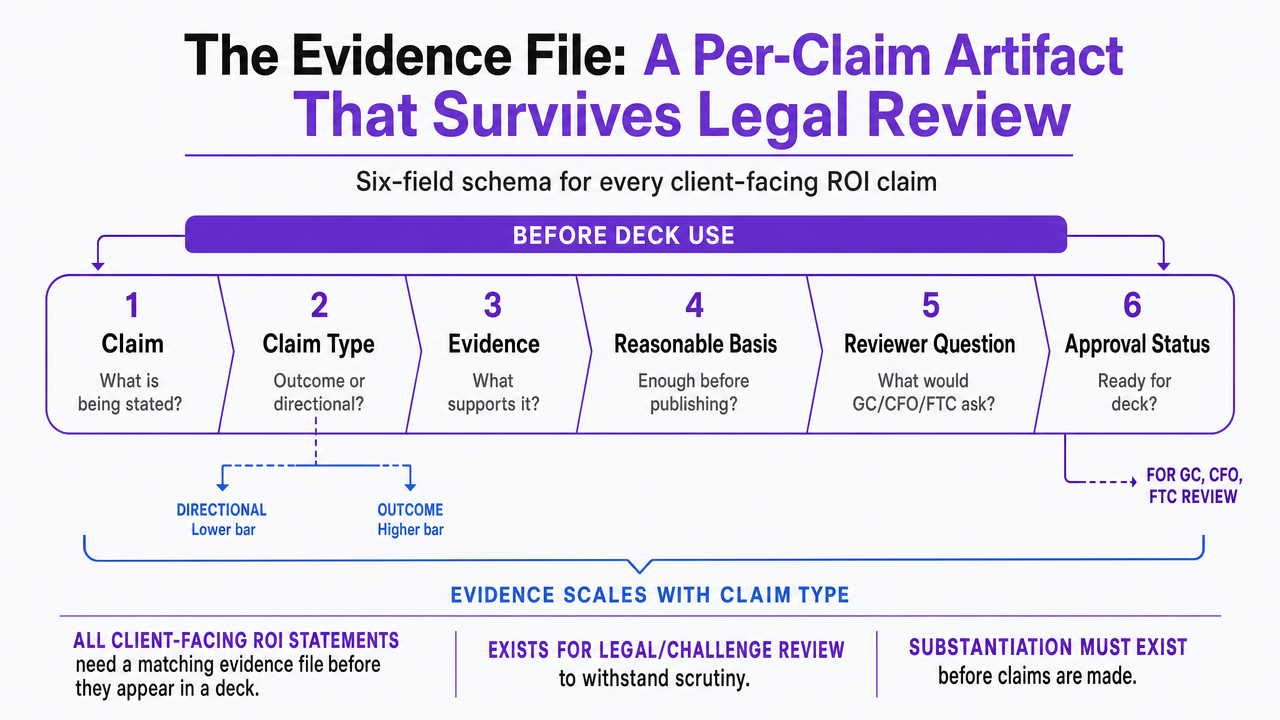 Diagram the six-field evidence file schema explicitly enumerated in this section so agency readers can reuse it as a template
Scaling the Protocol Across a Portfolio of Clients
If the Agency Manages Multiple Client Accounts: A Book-of-Business View
The protocol described so far scales linearly on paper and non-linearly in practice. An agency running the same scenario matrix for one client generates a defensible trend line. An agency running it across forty clients generates a governance problem: prompt sets drift, competitor lists go stale, scoring rubrics get interpreted differently by whichever account manager exports the deck that week, and the raw response archive becomes unusable within two quarters.
A book-of-business view treats the tracker's output as a portfolio dataset, not a stack of client-specific reports. The prompt-set template, scoring rubric, and evidence file schema are versioned centrally. Individual clients inherit the current version and layer their services, locations, and competitor set on top. When the rubric changes, every client's historical scores are re-tagged with the version that produced them, so a quality-index shift attributable to a methodology update is not misread as a performance move.
Causal measurement scales differently than descriptive measurement. Running a matched-market holdout on each of a hundred clients is not viable, and last-touch attribution across that book is a hypothesis about incrementality rather than proof of it 4. Portfolio-level inference borrowed from prior tests, applied cautiously and labeled as modeled, is the realistic middle path for agencies that cannot afford one experiment per account 3. What the agency owes each client is transparency about which layer produced which number, not a uniform ROI figure applied across the book.
Operator Economics: Analyst Hours vs Automated Tracker Workflow
The economics of the protocol determine whether it survives contact with an agency P&L. A single client's monthly cycle involves running the scenario matrix across four AI surfaces, storing raw responses, scoring each response on the rubric, reconciling visibility movement against Search Console and GA4, updating the evidence file for any client-facing claim, and producing a QBR-ready narrative. Done manually by a senior analyst, that cycle absorbs measurable hours per client per month. Multiplied across a book of forty or a hundred clients, the analyst-hour line becomes the constraint on how many accounts an SEO director can retain without hiring.
The operator math is easier to reason about with variables than with invented figures. Let C represent the number of active clients, P the number of prompts per client per month after the fixed matrix is set, H the analyst hours per client per cycle under a manual workflow, and R the agency's blended internal rate per analyst hour. Monthly cost of the manual workflow is C × H × R. An automated tracker workflow reduces H toward the hours required for human review of flagged responses, evidence-file updates, and QBR narrative writing, rather than the hours required for prompt execution and raw scoring.
| Variable | Manual workflow | Automated tracker workflow ||---|---|---|| Prompt execution across platforms | Analyst-run, per client | Scheduled, per client || Response scoring | Manual, rubric-applied | Automated with sampled human review || Evidence file updates | Manual, per claim | Templated, per claim || Analyst hours per client per cycle (H) | Higher | Lower, concentrated on review and narrative || Monthly cost | C × H_manual × R | C × H_auto × R |
Margin implications follow directly. When H drops and R holds, the same SEO director carries a larger book at the same quality bar, or the same book at a higher review-hour density per client. Neither outcome depends on a vendor claim about revenue lift; both depend on where analyst attention gets spent.
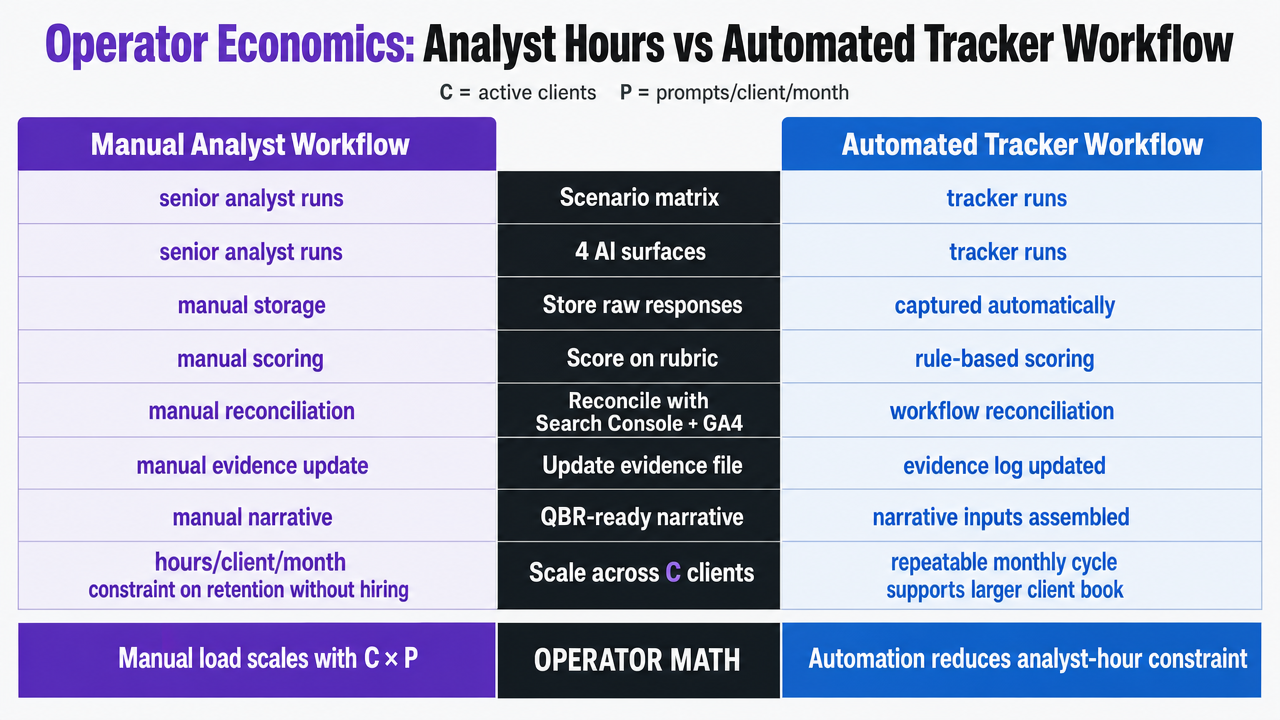 Render the comparison table already present in this section as a legible side-by-side operational comparison so readers can absorb the workflow shift at a glance
See How AI Search Tracking Quantifies Client ROI—With Live, Auditable Data
Request a walkthrough of automated search tracking that links position changes to client ROI, supports multi-site reporting, and delivers executive-ready documentation for agency performance reviews.
Governance: A Measurement Log That Makes the Numbers Reproducible
A tracker's output is only as trustworthy as the record that explains how it was produced. The NIST AI Risk Management Framework treats measurement as an ongoing function, using quantitative, qualitative, or mixed methods to analyze, benchmark, and monitor AI-system behavior and its related impacts over time 8. That discipline maps cleanly onto AI search reporting, where model updates, platform ranking changes, and prompt-set revisions all move the numbers without anyone touching the client's site.
A workable measurement log records seven things per client per cycle:
- the prompt-set version in use,
- the sampling frequency and number of runs per prompt,
- the AI platforms queried and any observed model or interface changes,
- the scoring rubric version,
- the analyst or system that produced the scores,
- the sampled subset routed through human review, and
- the uncertainty range around each headline figure.
When a quality index moves, the log answers whether the movement came from the client's content, a competitor's push, a platform change, or a rubric revision. Without that separation, every trend line is ambiguous.
The log also carries the reproducibility burden. A senior analyst who leaves the account should be able to hand the file to a replacement and have the next cycle's numbers land inside the prior uncertainty band. That is the operational meaning of reproducible measurement, and it is what turns an AI search tracker from a reporting tool into a defensible instrument.
Positioning AI Search Tracking Inside the Wider Marketing Workflow
An AI search tracker earns its keep when its output feeds decisions made elsewhere in the marketing stack, not when it sits in a standalone dashboard reviewed once a quarter. McKinsey's 2025 research on enterprise AI adoption finds that marketing and sales are among the functions most commonly associated with reported revenue gains, with AI most often applied to information capture, content support, and strategy work rather than isolated reporting tasks 10. The pattern that shows up in agency operations mirrors that finding: visibility data that routes into content briefs, PPC negative-keyword lists, backlink targeting, and call-intake scoring produces compounding effects, while data that stops at a screenshot does not.
The workflow implication is governance, not tooling. Every visibility signal, quality score, and evidence file needs an owner, a review cadence, and a routing rule that connects it to the next action across content, SEO, PPC, backlinks, social, and call intelligence. Platforms such as Vectoron's Command Center exist to sit at that junction, holding the approval step where a human decides which tracker-surfaced insight becomes a shipped change. That is the operational form the three-layer stack takes once it clears the reporting deck and enters production.
Frequently Asked Questions
References
- 1.Procedures For Obtaining Commission Guidance on the Substantiation of Advertising Claims.
- 2.FTC Order Requires Online Marketer to Pay $1 Million for Deceptive Claims Its AI Product Could Make Websites Compliant with WCAG.
- 3.Predicted Incrementality by Experimentation (PIE) for Ad Measurement.
- 4.A Comparison of Approaches to Advertising Measurement: Evidence from Big Field Experiments at Facebook.
- 5.2024 NIST GenAI (Pilot Study): Text-to-Text Evaluation Overview and Results.
- 6.NIST AI Use Scenarios Library: Developing Repeatable AI Evaluations and Metrics.
- 7.NIST GenAI (Pilot): an Overview of Text-to-Text Evaluation Results.
- 8.Artificial Intelligence Risk Management Framework (AI RMF 1.0).
- 9.Advertising and Marketing on the Internet: Rules of the Road.
- 10.The state of AI in 2025: Agents, innovation, and transformation.