
Key Takeaways
- AI Answer and Citation Monitors close the measurement gap rank tools can't, since about 5 of 6 AI Overview citations come from content outside the top 10 organic results 11.
- LLM Brand Mention Trackers capture unlinked references inside AI answers, giving agencies a share-of-mention view that connects AI exposure to downstream branded search shifts 2.
- Engagement Analytics Layered on GA4 surface engaged session duration by AI referral source, separating high-intent AI-primed visitors from bounce traffic when raw session counts fall 4.
- Branded Search and Query-Segmented Rank Tools remain relevant by isolating branded queries, which convert at CTRs above 21% versus a 5.9% aggregate that flattens meaningful signal 9.
- Multi-Touch Attribution and CRM-Connected Platforms tie AI referrals to pipeline, which matters because generative AI traffic converts at roughly 1.2x organic with 54.15% session conversion 14.
- Execution and Approval Layers like Vectoron act on tracking insights by turning citation gaps and engagement mismatches into prioritized, human-approved production across a client portfolio.
Why Rank Trackers Stopped Predicting Revenue
The clearest evidence that keyword position no longer maps to business outcomes comes from a peer-reviewed 2022–2024 analysis covering seven industry verticals: overall organic click-through rate fell from 3.17% to 1.94% after AI Overviews rolled out, a relative decline of 38.8% 1. Rank stability, in other words, has decoupled from click delivery. A page holding position three today does not earn the traffic it earned in that same slot two years ago, and no rank tracker in an agency stack surfaces that gap.
The blind spots go deeper than CTR compression. Search Console's Performance report exposes four metrics—clicks, impressions, CTR, and position 7—all of which describe the traditional blue-link SERP. None of them describe what happens inside an AI Overview, a ChatGPT answer, a Perplexity citation panel, or a Gemini response. When an AI system paraphrases a brand's content without sending a click, the impression may not register at all, and the influence on the buyer never touches a session-based report 6.
Agency Heads of SEO managing client portfolios feel this friction in quarterly reviews. Rankings hold, traffic slides, and the standard dashboard cannot explain why. The measurement problem is not that rank tracking became wrong. It became incomplete. A modern AI search tracking tool has to see the answer layer, the engagement layer, and the revenue layer at once—three dimensions that a position-only view was never built to capture 6.
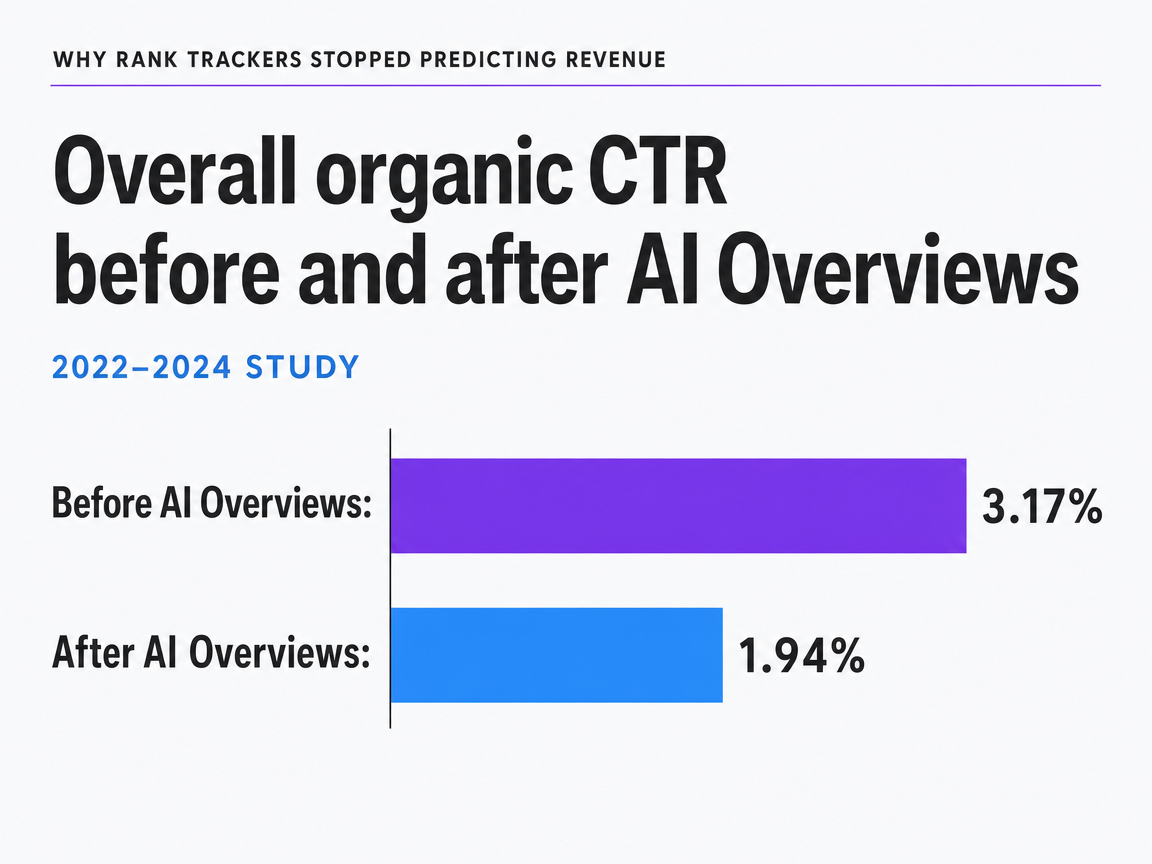 Overall organic CTR before and after AI Overviews
Shows the change in overall organic click-through rate (CTR) following the implementation of AI Overviews, based on a 2022-2024 study.
The Three Measurement Layers an AI Search Tracking Tool Must Cover
Answer Intelligence: What AI Systems Say About a Brand
Answer intelligence is the layer where an AI system decides whether to name a brand, cite its content, or paraphrase it into a response with no attribution at all. This is the layer that traditional analytics stacks cannot see. Server logs capture the moment a crawler fetches a page, but they miss everything the model already knows and everything it says without touching the site again 6.
The measurement gap widens because AI citation patterns do not track rank. In BrightEdge's dataset, roughly 5 out of 6 AI Overview citations pull from content that does not appear in the top 10 organic results 11. A position tracker showing steady rankings tells an agency nothing about whether Perplexity, ChatGPT, or Gemini surface the client's content when a prospect asks a category question. Answer intelligence tools close that gap by logging prompt-level responses across LLMs and recording which sources each platform cites, how often, and against which competitors 3.
Engagement Quality: What Visitors Do When They Arrive
When AI systems do send a click, the visitor arriving from a Perplexity citation or an AI Overview link is a different animal than a top-of-funnel organic searcher. They have already read a synthesized answer. They arrive to verify, compare, or convert. Session counts alone flatten that distinction.
The engagement layer measures what happens after the click: engaged session duration, pages per session, scroll depth, and conversion events. GA4 exposes engaged session duration as the primary indicator of visit quality, defined as how long users interact with content before leaving or becoming inactive 4. Agencies treating engagement as a leading indicator of AI-referral quality can separate high-intent arrivals from bounce traffic even when total session volume declines. This layer also catches the second-order effect of AI exposure — visitors who saw a brand cited in an answer, searched for it later, and arrived with commercial intent already formed 2.
Business Impact: Pipeline, Assisted Conversions, and Revenue
The final layer connects AI visibility to money. Pipeline, assisted conversions, and revenue attribution close the loop that impressions and clicks leave open. Without this layer, an agency can show a client that citations rose 40% quarter over quarter and still lose the account when organic sessions decline.
Multi-touch attribution is the discipline that quantifies the incremental contribution of each channel and touchpoint to a conversion, forming the basis for ROI calculations and budget decisions 10. Applied to AI search, MTA lets an agency isolate the assisted conversions that begin with an AI answer, continue through branded search, and close through a direct visit or CRM-tracked call. A rigorous business-impact layer stitches GA4 events, Search Console query data, and CRM outcomes into one path view 13. That integrated view is what turns AI search tracking from a curiosity dashboard into a defensible line item in a client's quarterly review — the point where visibility becomes revenue.
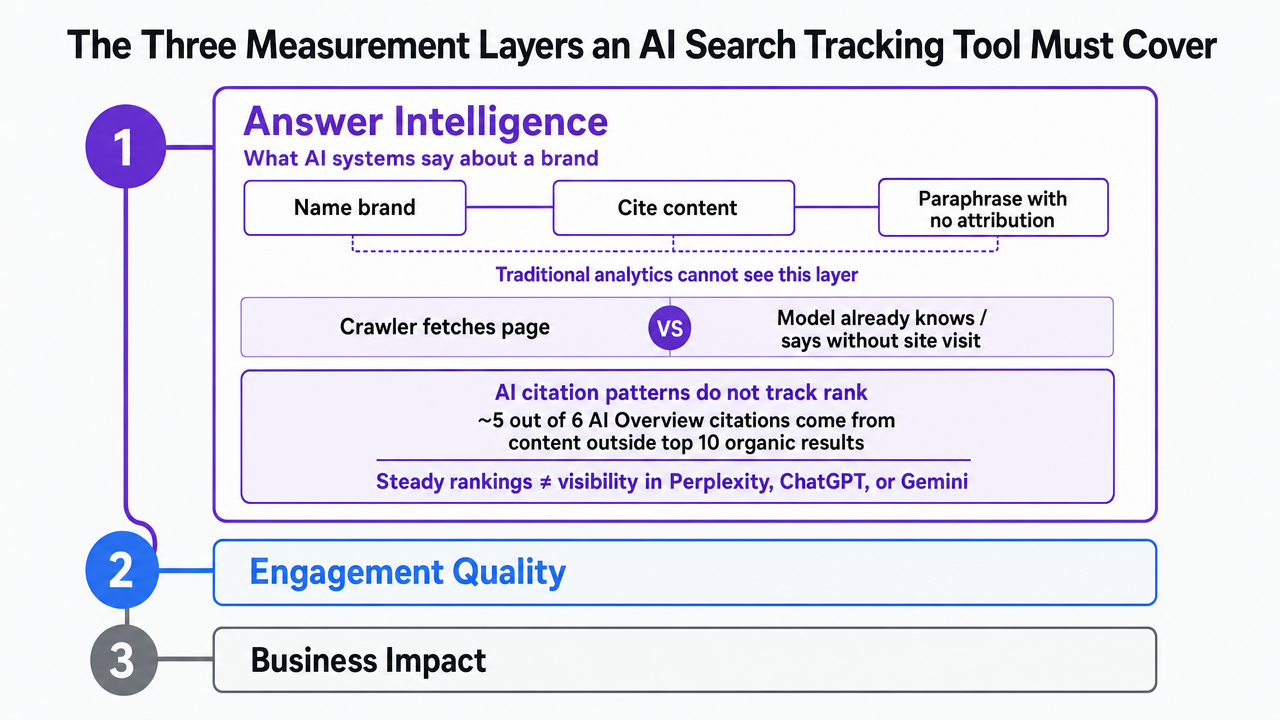 Visualize the three-layer measurement framework (Answer Intelligence, Engagement Quality, Business Impact) that structures this section's three subsections
Test AI-driven search tracking in real time
Monitor live keyword shifts and publish content during your trial to measure actual impact on search performance.
Tool Categories That Map to the Three Layers
AI Answer and Citation Monitors
Citation monitors are the tools built specifically to watch what AI systems do with a brand's content. They send prompts on a recurring schedule to ChatGPT, Perplexity, Gemini, Claude, and Google's AI Overviews, log the responses, and record which sources each platform cited. The output is a citation share-of-voice report: how often a client shows up in category answers, which competitors appear alongside, and which URLs the models are pulling from.
The category exists because rank tracking cannot answer the question that matters most in AI search. On queries where AI Overviews appear, organic CTR drops by 61% and paid CTR by 68%, while only 8% of users click any external link at all 5. That analysis, drawn from SparkToro/Datos data and comparison of pre- and post-rollout CTR curves, means that even a page holding position one can lose the majority of its traffic to an answer box it was never measured against. Citation monitors close that measurement gap by making the answer itself the unit of tracking.
The practical utility for agency Heads of SEO is competitive: a citation monitor shows whether a client is being named in the answers their prospects actually see, and which sources the model prefers when the client is absent. That intelligence directs content investment toward the pages and formats AI systems draw from, rather than the pages that used to rank.
LLM Brand Mention Trackers
Mention trackers overlap with citation monitors but measure a different signal. Where citation monitors record cited URLs, mention trackers record every reference to a brand name inside an AI response, whether or not a link is attached. A model can describe a client's product, quote its positioning language, or recommend it to a prompt about vendor selection without ever citing the source page. That unlinked mention still shapes buyer perception.
Kantar's work on brand measurement in AI search environments frames the problem directly: brand impact increasingly occurs in environments where no click is recorded, requiring new measurement of AI-mediated exposure 2. A traditional brand tracking survey run quarterly cannot keep pace with how quickly LLM answers reshape category perception. Mention trackers sample the same prompts weekly or daily, capture the shifts, and connect them to downstream branded search volume.
The reporting value for agencies is a share-of-mention chart across LLM platforms — how often a client is named against direct competitors when a prospect asks the category question. That is a metric an agency can put in front of a CMO who is skeptical about AI investment. It replaces the anecdotal debate over whether AI matters with a repeatable measurement of how often the brand shows up in the answers buyers now consume 3.
Engagement Analytics Layered on GA4
Engagement analytics tools sit on top of GA4 and expose visit quality in ways the default reports do not. GA4 already surfaces engaged session duration as the key indicator of visit quality — the time a user spends actively interacting with content before leaving or becoming inactive 4. The problem for agencies is not that the metric is missing; it is that pulling it into a client-ready report across dozens of properties, segmented by landing page and traffic source, requires configuration work that eats analyst hours.
Tools in this category do three things default GA4 does not:
- They pre-build engagement dashboards segmented by AI referral sources (chat.openai.com, perplexity.ai, gemini.google.com) so agencies can compare AI-driven visits against organic and direct baselines.
- They surface scroll depth and content interaction events without custom tagging.
- They flag pages where AI-referral engagement diverges from organic engagement, which is the leading indicator of an answer-layer mismatch — content ranking well but failing the visitor who arrives already primed by an AI summary.
The category also catches the second-order effect that pure session tracking misses: visitors who saw a brand cited in an AI answer, searched for it later, and arrived through branded search with commercial intent already formed 2. Engagement quality is where that shift becomes visible.
Branded Search and Query-Segmented Rank Tools
Rank tracking is not obsolete. It is insufficient on its own. The tools that still earn a place in an AI-era stack are the ones that segment branded from non-branded queries and treat each as a separate performance layer. That segmentation matters because branded and generic searches behave nothing alike. Peer-reviewed analysis of large query sets across multiple industries reports branded queries producing CTRs over 21% versus a total CTR around 5.9% — a gap that any aggregate ranking report flattens into noise 9.
The signal Heads of SEO now watch is branded search lift as a proxy for AI answer exposure. When a brand shows up more often in LLM citations and AI Overviews, category searchers convert some of that exposure into direct queries for the brand name. Rank tools that expose branded query volume trends, non-branded impression share, and SERP feature ownership give agencies a way to detect that lift before it converts into pipeline.
Search Console is the free anchor of this layer, offering clicks, impressions, CTR, and position across queries 7, and a 2024 update improved access to recent performance data so agencies can react faster to shifts in AI-driven surfaces 8. Layered rank tools extend that foundation with automated branded-versus-generic segmentation and SERP feature share-of-voice across a client portfolio 13.
Multi-Touch Attribution and CRM-Connected Platforms
Attribution platforms are where AI visibility becomes revenue. Multi-touch attribution focuses on the contribution of each online touchpoint to conversion outcomes, forming the basis of ROI calculations and budget allocation decisions 10. Applied to AI search, MTA isolates the assisted conversions that begin with an AI answer, continue through branded search, and close through a form fill, booked call, or CRM-tracked opportunity.
Sizing the channel that has to be isolated matters here. A large-scale analysis of 2.3 billion sessions found that generative AI traffic grew 796% over two years and converted at roughly 1.2x the rate of organic search, with a session conversion rate of 54.15% 14. AI referrals are still a small share of total traffic, but they arrive further down the funnel than an average organic visit. Attribution platforms that cannot separate AI referral sources from generic organic will systematically undercount their contribution and misdirect budget away from the channel producing the highest per-session return.
The tools in this category ingest GA4 events, Search Console query data, ad platform conversions, and CRM outcomes into a single path view. The right output for an agency is a report that shows, per client, how many pipeline dollars touched an AI referral at any point in the journey — the number that anchors quarterly reviews when raw session counts decline 13.
Execution and Approval Layers: Where Vectoron Sits
Tracking tools reveal problems. Execution layers act on them. The gap between a citation monitor showing a client absent from category answers and a published set of content, backlinks, and technical fixes that changes that outcome is where most agency portfolios lose weeks per client to briefing cycles, vendor coordination, and status meetings.
Vectoron is the execution-layer entry in this list. It is not a citation monitor and not an attribution platform. It is an AI marketing execution platform with specialist strategists across content, SEO, PPC, backlinks, social, and call intelligence, coordinated through a Command Center that routes every recommendation for human approval before anything ships. The strategists read live business signals — qualified calls, bookings, cost per lead, pipeline — and rank the work that will move those numbers, so the output of tracking tools becomes prioritized, approved production rather than a backlog of insights.
The role in an AI-era stack is specific. Answer intelligence, engagement analytics, and attribution tell an agency what to change. An execution layer built on approval-first automation converts that intelligence into shipped work at portfolio scale, without the headcount growth that used to be the only path to serving more clients.
What These Tools Still Cannot Do
The gaps in the current AI search tracking category are worth naming before an agency stakes a client relationship on the outputs. Citation measurement is still fragmented across platforms, and the data reliability question has not been settled. Adobe's analysis of AI search behavior flags this directly: measurement of AI citations is nascent and inconsistent across LLMs, with no shared standard for what counts as a mention, a citation, or a paraphrased reference 3. Two tools can prompt the same model with the same question on the same day and return different citation counts for the same brand.
Cross-LLM parity is another open problem. ChatGPT, Perplexity, Gemini, and Claude expose different amounts of source metadata, and each platform's API access, rate limits, and response formats change without notice. A share-of-voice chart that looks stable across a quarter can shift because a vendor changed its sampling method, not because the brand's actual visibility moved.
Server-side gaps also persist. Server logs capture the moments an AI system actively reaches out to a site, but miss everything the model already knows from training data or cached context 6. Agencies should treat current AI tracking outputs as directional indicators paired with branded search lift and pipeline data, not as audited metrics of record.
See How AI-Driven Search Tracking Delivers Actionable Insights—Not Just Rankings
Request a walkthrough of advanced AI search tracking workflows designed for agencies managing multiple client portfolios. Learn how to connect ranking, intent, traffic, and conversion signals inside a single approval-first system.
A Reporting Cadence for the AI Search Era
Measurement rigor collapses without a cadence, and the cadence that works for AI search is not the monthly rank-and-traffic report agencies inherited from a decade of Universal Analytics. The interval that holds up in practice is 60 to 90 days per test window, long enough for citation patterns to stabilize across LLM sampling cycles and short enough for a client to see cause-and-effect between content shipped and metrics moved 13.
A defensible cadence runs on three overlapping clocks:
- Weekly, the answer-intelligence layer captures citation share and brand mentions across ChatGPT, Perplexity, Gemini, and Google's AI Overviews.
- Monthly, the engagement layer reports engaged session duration and AI-referral quality segmented against organic and direct baselines 4.
- Quarterly, the business-impact layer reconciles assisted conversions, branded search lift, and CRM outcomes into one revenue view 10.
Search Console anchors the query data underneath all three, and its 2024 update to recent performance data lets analysts react to shifts in AI-driven surfaces without waiting on stale reports 8.
The QBR itself gets restructured around this cadence. Rank movement becomes a supporting slide, not the headline. The lead metric is citation share on the client's top 20 category prompts, followed by branded search lift as the downstream proof, followed by assisted pipeline as the outcome. Bing's own framing of modern search as intent-driven — success measured by fulfillment of user intent rather than position alone — supports the reordering when clients push back on losing the familiar ranking chart 12.
If You Manage a Client Portfolio: Consolidating the Stack Across Accounts
The economics shift when the reader is running measurement across 20 to 200 client accounts rather than one. Bespoke reporting per client — a different rank tracker here, a different attribution model there, a citation monitor for the two accounts that pushed hardest for it — turns into an analyst-hour drain that no portfolio can absorb as AI-era metrics multiply. The consolidation move is to standardize one measurement framework across the book and apply it to every account, with client-specific inputs but a shared output structure.
The framework that scales is the same three-layer stack applied uniformly: one citation monitor sampling category prompts across LLMs for every account, one engagement layer built on GA4 with AI-referral segmentation preconfigured, and one attribution model connecting GA4, Search Console, and each client's CRM into a single path view 13. Search Console's 2024 recent-data improvements let a portfolio analyst react to answer-surface shifts within days across every property rather than waiting on delayed reports 8. The QBR deck template stays constant. Only the numbers inside change.
What consolidates further is execution. When tracking tools surface the same three metrics for every client — citation share, engaged AI-referral sessions, assisted pipeline — the work that moves those numbers can be prioritized against a shared playbook rather than reinvented per account.
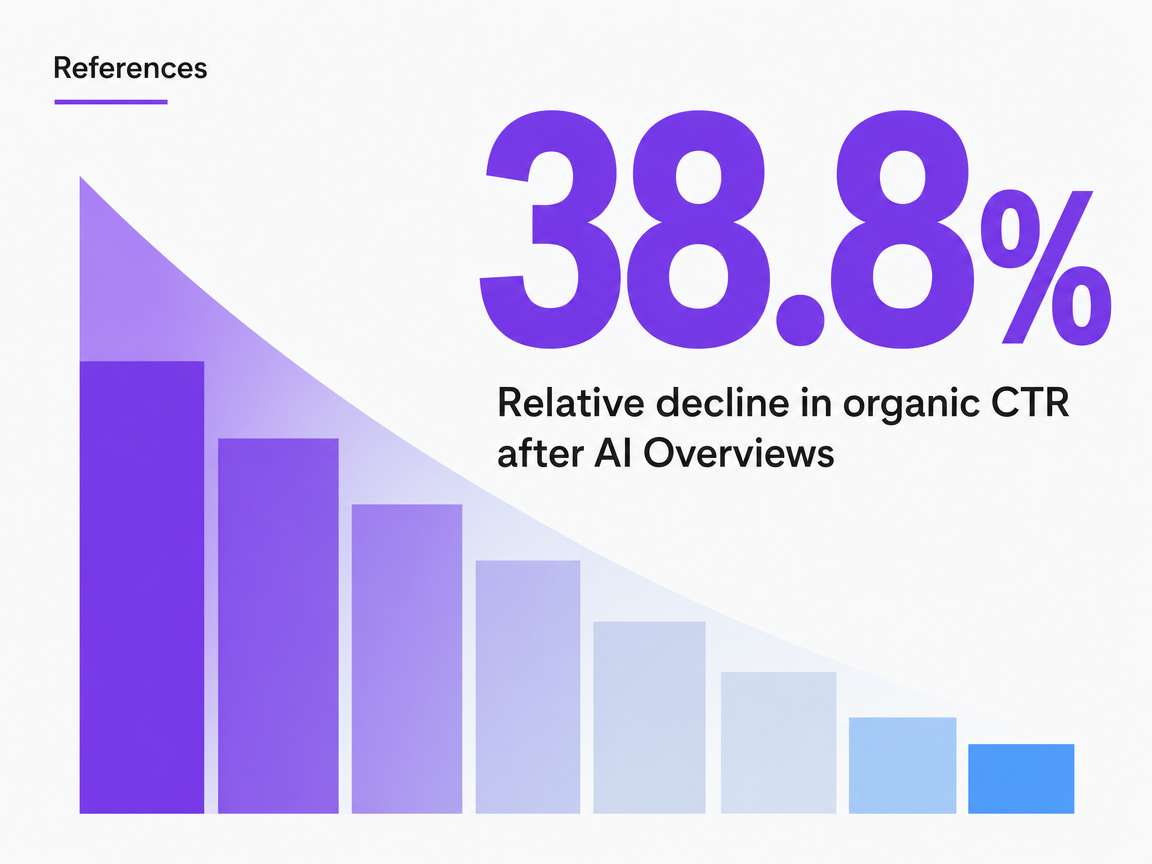 Relative decline in organic CTR after AI Overviews
Relative decline in organic CTR after AI Overviews
Frequently Asked Questions
References
- 1.The Impact of "Zero-Click" AI Overviews on Brand Trust and Traffic.
- 2.Measuring Brand Impact in AI Search Environments.
- 3.AI Search Behavior and Brand Visibility in Customer Journey.
- 4.Beyond Rankings: Important Metrics To Measure For SEO Effectiveness.
- 5.Click Behavior in Zero-Click Search: Why Rankings No Longer Tell the Story.
- 6.AI Search Analytics: The 3 Measurement Layers.
- 7.A deep dive into Search Console performance data filtering and limits.
- 8.An improved way to view your recent performance data in Search Console.
- 9.The User-journey in Online Search.
- 10.Frontiers of Marketing Data Science Journal - Issue 04-2023.
- 11.AI SEO Statistics (2026): 57+ Data Points on Zero-Click ....
- 12.The Value of Intent-Driven SEO in AI-Powered Search ....
- 13.AI-Driven Search: Strategies for Sustained Organic Growth.
- 14.Study: AI Traffic Grew 796% & Out-Converts Organic Search.