
Key Takeaways
- Funnel-stage revenue attribution credits awareness and research queries that last-click models dismiss, keeping content that assists bookings rather than cutting it based on direct conversions alone.
- Call-outcome tagging joins call tracking, intake dispositions, and CRM records so organic pages are ranked by qualified-call and booked-revenue rates instead of raw call volume.
- Local action-to-booking linkage connects location-tagged GBP calls, direction requests, and form fills to each site's booking system, producing a per-location revenue map for multi-location portfolios.
- Content-decay scoring prioritizes refreshes by dollars at risk, protecting quiet conversion-adjacent pages while deprioritizing high-traffic informational URLs that contribute little to pipeline.
- Compliance-risk scoring flags substantiation, endorsement, and accessibility exposures with revenue estimates attached, aligning with FTC guidance 3, 8, 11and DOJ accessibility expectations 4.
- Portfolio-level sanity checks standardize KPI definitions, compare organic against the channel mix, and log every AI recommendation so measurement stays consistent across 25 to 100 accounts.
The QBR Problem: When a CFO Asks What SEO Produced
Picture the quarterly business review for a seven-location dental group. The agency's SEO lead opens with a 42-slide deck: non-brand clicks up 23%, average position improved from 8.1 to 5.4, 14 featured snippets captured. The client's CFO interrupts on slide 11. The question is not hostile, just plain: of the 1,862 new patient appointments booked last quarter, how many came from this work, and what were they worth?
Most agency reporting stacks cannot answer that in the room. Rank trackers show positions. Search Console shows impressions and clicks. GA4 shows last-click organic conversions, which systematically undercount earlier search touches that assisted the booking. The U.S. Government Accountability Office examined this exact gap in a November 2024 review of federal digital marketing, finding that engagement measures such as return on investment, eligible leads, and recorded engagements may fail to reflect overall strategic goals when systems are not connected to downstream outcomes 1.
That is the QBR problem in one sentence. Agency SEO leads are being asked to defend retainers using metrics the client's finance team does not accept as revenue. An AI SEO analyzer earns its place in the stack only if it closes that distance, binding organic activity to the booked appointments, qualified calls, signed matters, and CRM-stage movement a controller already trusts. The six workflows that follow are the ones that hold up when the CFO leans forward.
Funnel-Stage Revenue Attribution for Organic Queries
The first workflow an AI SEO analyzer owes a client is a credit model that stops punishing the top of the funnel. Most agency reports still rank organic keywords by last-click conversions, which means an informational query that pulled a prospect into the brand six weeks before booking shows up as a zero-revenue term. The keyword gets cut. The content gets deprioritized. The pipeline shrinks a quarter later, and no one in the room connects the two events.
The sharpest available data on how funnel stage distributes revenue comes from Jim Jansen's analysis of a 33-month, $56 million sponsored search campaign covering roughly seven million records. Awareness-stage queries produced 67% of sales revenue, research queries produced 18%, and purchase queries produced 9%, with purchase-stage ads costing more per sale than awareness-stage ads 2. The study is paid search, not organic, so it travels by analogy, not proof. What transfers is the shape of the curve: the majority of booked revenue was initiated by queries a last-click model would have dismissed as weak intent.
An analyzer worth deploying classifies every ranking organic query into awareness, research, or purchase intent, then joins that classification to GA4 session paths and CRM revenue records. The output is not another keyword list. It is a revenue-weighted inventory of organic entry points, with each query carrying both its last-click value and its assisted contribution to closed revenue. Agency SEO leads can then show a CFO that the clinic's "what causes jaw pain at night" article did not convert on its own session, but appeared in 31% of the touch sequences that ended in a booked implant consult at an average case value the client's practice management system already reports.
Sales revenue by search funnel stage. Paid search data from Jansen's 33-month, $56M sponsored search study of approximately 7M records, applied by analogy to organic measurement 2.
Three mechanics make the attribution hold up under finance review.
- The funnel-stage classifier runs on query text and SERP features, not on agency intuition, so it can be re-run and audited.
- Assisted-conversion credit uses position-based or data-driven models native to the client's analytics stack, not a proprietary black box the controller cannot inspect.
- The analyzer flags queries where organic contribution is statistically thin, so awareness content is not credited for every booking that happened to share a URL.
The practical consequence shows up in the editorial calendar. Topics that score high on assisted revenue but low on last-click conversions get kept and expanded. Topics that score low on both get cut regardless of ranking. The retainer stops funding keyword real estate that does not move money, and starts funding the awareness surface that the Jansen data suggests is doing the heavier commercial work.
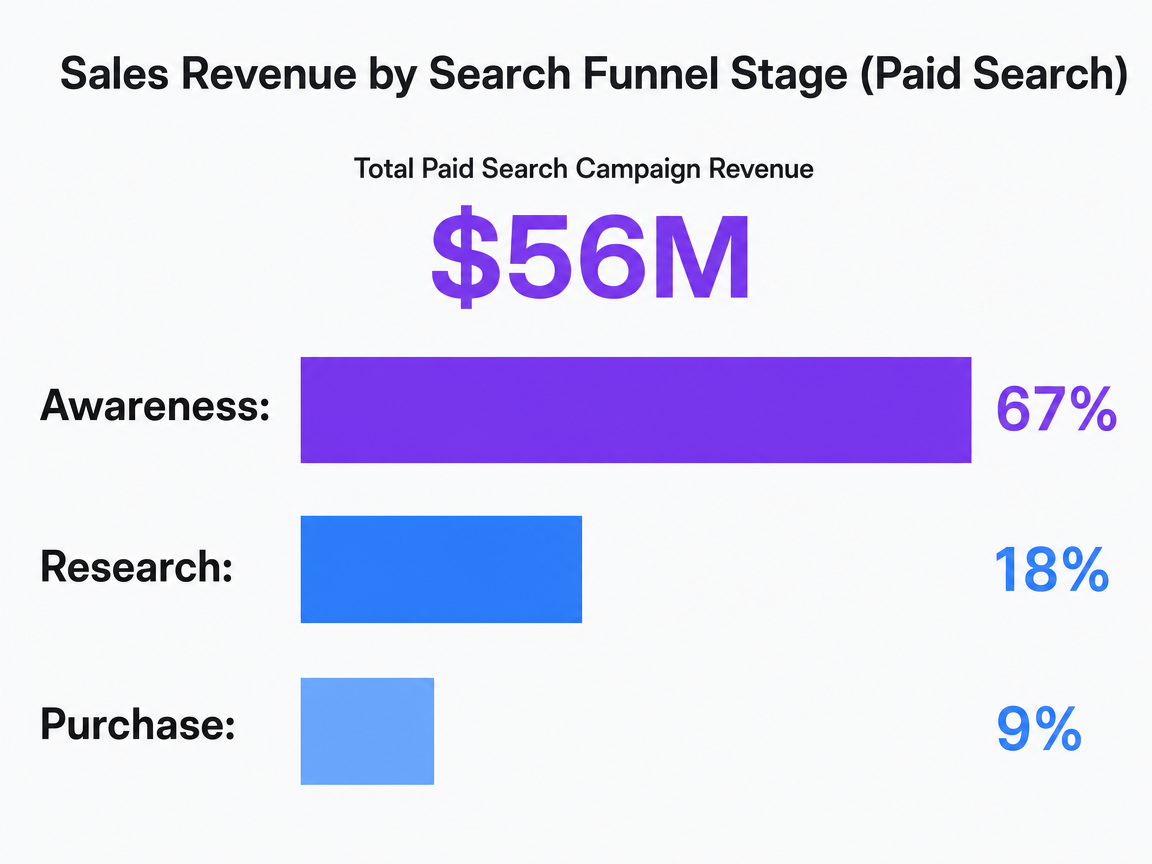 Sales Revenue by Search Funnel Stage (Paid Search)
Breakdown of sales revenue from a $56M paid search campaign, categorized by the user's stage in the buying funnel.
Call-Outcome Tagging: Turning Phone Rings Into Qualified Revenue
For law firms, dental groups, home services, and senior living, the booking still happens on the phone. GA4 records a tel: click or a call-tracking webhook, counts it as a conversion, and stops there. The agency reports 847 organic calls last quarter. The intake manager knows most of those calls were spam, wrong numbers, existing patients asking about billing, or job seekers. The gap between "organic call" and "qualified new revenue" is where the retainer gets lost.
Call-outcome tagging closes that gap by joining three streams the agency usually treats as separate:
- the call-tracking record that identifies the organic session and landing page,
- the intake system's disposition code that marks whether the caller was a qualified prospect, and
- the practice management or CRM entry that logs whether the prospect booked, showed, and generated revenue.
An AI SEO analyzer sits across those streams and attributes outcomes back to the originating query, URL, and funnel stage, not just to the channel label.
Three categories of signal matter.
- Call duration and transcript-derived intent separate consult inquiries from solicitors.
- Disposition tagging by trained intake staff marks each call as qualified, unqualified, existing client, or spam.
- CRM-stage movement confirms whether the qualified caller advanced to a booked consultation, a signed engagement letter, or a completed procedure.
The analyzer scores organic pages by qualified-call rate and booked-revenue rate, not by raw call volume.
The reclassification often reverses the editorial priority list. A personal injury firm's "what to do after a car accident" guide may generate 40% of organic calls but only 12% of qualified matters, because many callers are shopping or seeking general advice. A narrower "commercial truck accident attorney [city]" page may generate a fraction of the call volume with a qualified-call rate above 60%. Reporting that distinction to the client's managing partner changes what the agency builds next quarter.
Two governance notes keep the workflow defensible. Call transcripts and intake dispositions involve protected information in healthcare and behavioral health contexts, so the analyzer should operate on structured outcome codes rather than raw transcript content when regulations require it. And the attribution window should be set with the client's finance team, not chosen by the agency, so the revenue figures in the quarterly report match the ones in the client's own books.
Test AI SEO strategies on live client sites
Experience measurable SEO improvements using live data and real-time publishing during your risk-free trial period.
Local Action-to-Booking Linkage for Multi-Location Clients
This workflow is where the audience shifts. Agency SEO leads running single-site clients can often tie a GA4 conversion to a CRM record directly. The leads running multi-location portfolios — a 23-office dental group, a 60-branch home services franchisor, an eight-state senior living operator — face a different problem. Every location has its own Google Business Profile, its own call-tracking number, its own practice management or booking system, and its own definition of what counts as a booking. The ranking report shows map-pack visibility by location. The revenue report lives in 23 different databases the agency does not control.
Local actions are the connective tissue. Direction requests, GBP calls, website calls routed through DNI tracking, appointment-widget starts, and form fills all fire from a specific location listing or local landing page. Each action carries a location identifier. The AI SEO analyzer's job is to join those location-tagged actions to the booking records that the client's operations team already uses to pay rent and compensate location managers, so the quarterly report reads in the same units the client's regional VP reads every Monday.
The measurement gap is wide enough that the U.S. Government Accountability Office flagged it in its November 2024 review of federal digital marketing, noting that engagement measures such as return on investment, eligible leads, and recorded engagements may fail to reflect overall strategic goals when the systems that record completed actions are not connected to the systems that generate the engagement 1. The same disconnect shows up on every multi-location SEO report that stops at "GBP calls per location."
What last-click attribution surfaces versus what a connected AI analyzer should surface across local actions. Framing grounded in GAO's finding that engagement metrics may fail to reflect strategic outcomes when systems are not connected 1.
| Signal | Last-click report shows | Connected analyzer should surface |
|---|---|---|
| Awareness content (neighborhood guides, condition pages) | Sessions, zero direct conversions | Assisted role in paths that ended in a booked appointment at a named location |
| GBP calls and direction requests | Action counts per location | Qualified-call rate and show rate joined to the location's booking system |
| Local landing page form fills | Form submissions, channel = organic | Lead-to-consultation and consultation-to-revenue rates by page and location |
| Offline bookings (walk-ins, phone-only closes) | Not represented | Modeled contribution via intake source codes and matched visit timestamps |
Three joins make the linkage work across a portfolio.
- Every local URL and GBP listing carries a stable location identifier the analyzer can hand to the client's booking system.
- Call-tracking dispositions are standardized across locations so a "qualified new patient" in Phoenix means the same thing as in Tampa; variation here destroys cross-location comparison.
- The analyzer reports per-location revenue contribution with the attribution window the client's finance team uses, not the default 30-day window the ad platform ships with.
The portfolio-level output is a ranked map, not a ranked keyword list. Locations where organic actions convert to bookings at above-portfolio-median rates earn more content and listing investment. Locations where actions are high but bookings lag get an intake audit before more SEO budget, because the problem is downstream of search. Agency SEO leads walk into the regional VP's review with a map that matches the one on the operations wall.
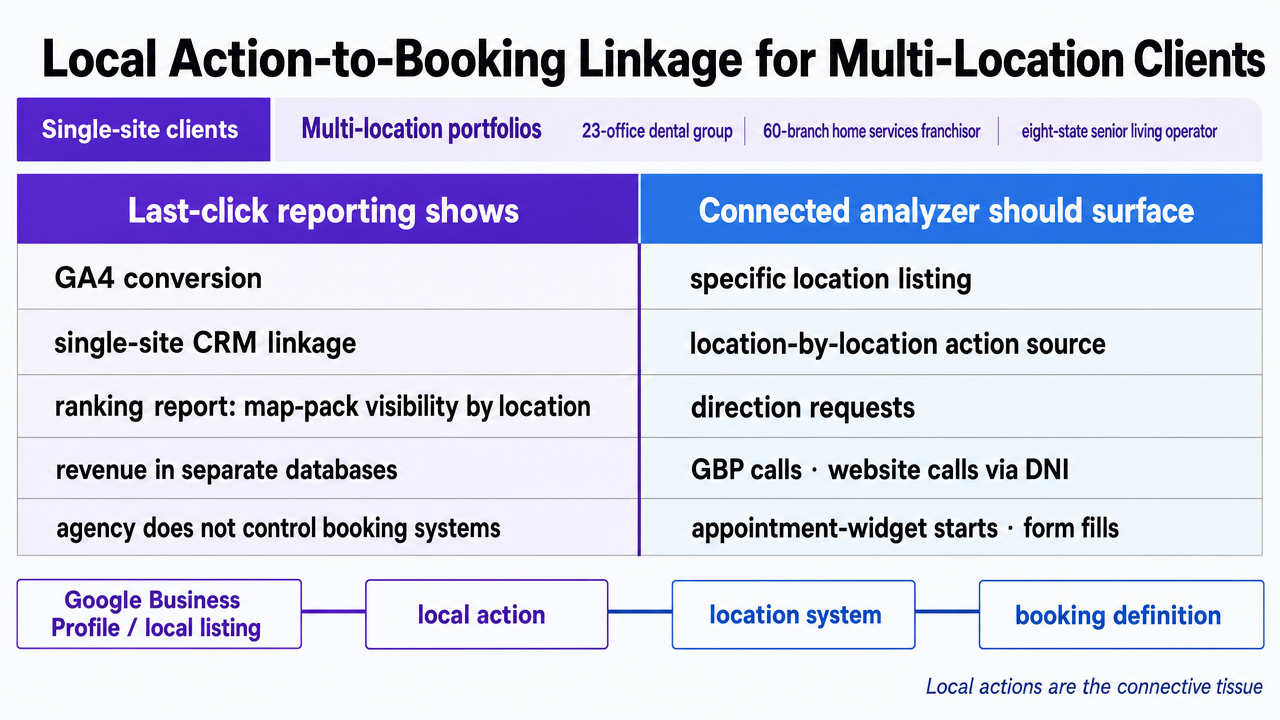 Visualize the comparison table already in the section contrasting what last-click reporting shows versus what a connected analyzer should surface across local actions
Content-Decay Revenue Impact, Not Just Traffic Loss
Content decay reports in most agency tools stop at a traffic chart: a URL ranked for 180 queries in Q1, now ranks for 112, sessions dropped 38%. The remediation ticket gets filed. The client sees a red number in the next deck. What the report does not say is whether that URL was carrying revenue or just impressions, which means the refresh queue often gets sorted by traffic loss rather than by dollars at risk.
An AI SEO analyzer earns the decay workflow by scoring every declining URL on three joined variables:
- the direction of ranking loss by query cluster,
- the assisted-conversion role the URL played in paths that produced qualified leads or booked revenue, and
- the client-reported value of the outcomes that used to come through it.
A page losing 12,000 monthly sessions on top-of-funnel informational queries may contribute less to the pipeline than a page losing 400 sessions on a mid-funnel comparison query that appeared in 22% of booked-matter paths last year. The refresh queue should rank by the second case first.
The GAO review of federal digital marketing makes the same point in a different setting, noting that engagement measures can fail to reflect strategic outcomes when platform metrics are not connected to the systems that record completed actions 1. Applied to decay, that means session loss alone is a lagging engagement signal; the leading revenue signal is the change in assisted-conversion contribution and qualified-lead rate per URL.
Three operational outputs follow.
- Decay tickets carry a dollar range sourced from the client's own booking or CRM records, not an invented traffic-value estimate.
- Refresh work is prioritized against the editorial calendar by revenue-at-risk, so a thin informational page losing rankings may be left alone while a quieter conversion-adjacent page gets rewritten first.
- URLs with declining rankings but stable or growing qualified-lead contribution are flagged as false positives and removed from the queue, which protects the retainer from busywork the client is paying for.
Compliance-Risk Scoring That Protects Lead Value
A booked lead can be clawed back faster than it was earned. A dental client's new-patient landing page that promises a specific whitening outcome without substantiation, a behavioral health page that implies clinical results from a testimonial, a review-generation workflow that filters out negative sentiment, or an inaccessible appointment form that locks out keyboard users — each of these can turn an SEO win into a refund, a regulatory letter, or a lawsuit that costs more than the retainer. Compliance-risk scoring is the workflow that treats these exposures as revenue variables, not a legal footnote.
Three regulatory surfaces govern most of the risk an AI SEO analyzer should score.
- FTC Health Products Compliance Guidance requires adequate substantiation for objective health claims before dissemination, with health-related claims generally requiring competent and reliable scientific evidence 3.
- The FTC's Endorsement Guides require that reviews and testimonials reflect honest opinions and that material connections consumers would not reasonably expect be clearly disclosed 8.
- The Consumer Reviews and Testimonials Rule, effective October 21, 2024, authorizes civil penalties for knowing violations involving fake, false, or suppressed reviews 11.
Separately, the Department of Justice's web accessibility guidance explains that ADA effective-communication obligations extend to online goods and services for businesses open to the public, with WCAG and Section 508 identified as useful technical references 4.
The scoring workflow runs across the content inventory and surfaces three categories of flag.
- Substantiation flags mark pages where objective efficacy, outcome, or safety claims lack cited evidence in the client's own records.
- Endorsement flags mark testimonial and review content where material connections are undisclosed or where review-generation processes filter by sentiment.
- Accessibility flags mark high-converting pages where keyboard access, form labels, heading structure, or text alternatives create friction documented to depress completion rates for assistive-technology users.
Each flag carries an estimated revenue exposure drawn from the same CRM and booking records used in the other workflows, so the client's finance team sees risk in the units it already reports.
Two guardrails keep the scoring honest. The analyzer surfaces flags for human review rather than auto-remediating copy, which matches the measurable performance criteria and human-review posture NIST recommends for generative-AI systems operating in high-stakes settings 6. And the analyzer never represents its output as a guarantee of compliance. The FTC's January 2025 order against an accessibility vendor, which required a $1 million payment over allegations that AI-powered claims of WCAG compliance for any website were false or misleading, is the cautionary line 5. An agency reporting "risk-scored" pages to a client is giving a prioritized remediation queue, not a legal opinion, and the quarterly report should say so in those words.
See How AI-Driven SEO Analysis Connects Every Tactic to Real Revenue Impact
Request a walkthrough of unified reporting that ties organic performance to client pipeline, with traceable, approval-based workflows built for agencies managing multi-channel campaigns at scale.
Portfolio-Level Marketing-Mix Sanity Checks
The audience changes here. The five workflows above describe what an AI SEO analyzer should do inside a single client account. This one is written for the agency SEO lead who runs 25, 50, or 100 of those accounts at once and has to produce revenue-grade reporting without hiring three more analysts to do it. At portfolio scale, the question is not whether any one client's attribution model is defensible. It is whether the same measurement spine runs through every account, so a managing director can compare contribution across the book, flag the clients where organic is underperforming the mix, and route analyst time to the accounts where the math is drifting.
The GAO's November 2024 review of federal digital marketing is useful here because it treats measurement as a portfolio problem, not a campaign problem. It describes KPIs, lead-generation measures, statistical modeling, campaign tags, and integrated marketing systems used to trace prospects toward completed contracts across a large program, and it flags continued reliance on last-click attribution as a source of undervaluation for assisting channels 9. Agencies running multi-client portfolios face the same shape of problem: inconsistent KPI definitions across clients make cross-account comparison noise, and last-click defaults bury the organic contribution the retainer is supposed to be producing.
Three sanity checks belong in the portfolio-level view.
- KPI standardization: every client's revenue report uses the same definitions for qualified lead, booked appointment, and attributed revenue, with client-specific overrides documented rather than improvised.
- Mix check: for each client, the analyzer compares organic's modeled contribution against paid search, paid social, direct, and referral over a rolling window, so a sudden drop in organic share surfaces before the quarterly deck is built.
- Governance log: each AI-generated recommendation that reaches the client carries a record of what data it used, which analyst approved it, and what the measured outcome was, so performance of the analyzer itself is auditable across the book.
Portfolio reporting labor and governance checkpoints by client-count tier. Variables only; actual hours depend on vertical, data integration maturity, and reporting cadence. Methodology framing follows GAO's KPI standardization, lead-generation measurement, and integrated-systems guidance for digital marketing programs 9.
| Client tier | Analyst hours per client per month (traditional) | Analyst hours per client per month (AI-assisted) | Reporting cycle time | Governance checkpoints required |
|---|---|---|---|---|
| 10 clients | Variable, higher per account | Reduced, concentrated on review | Monthly, manual assembly | Per-client KPI definition, per-report approval |
| 25 clients | Variable, strained at month-end | Reduced, standardized templates | Monthly, partial automation | Portfolio KPI dictionary, exception review |
| 50 clients | Variable, requires added headcount | Reduced, analyst time shifts to interpretation | Rolling, dashboard-driven | KPI dictionary, drift alerts, quarterly audit of analyzer outputs |
| 100 clients | Variable, impractical without specialization | Reduced, analyst role is governance and strategy | Continuous, with QBR assembly on demand | KPI dictionary, drift alerts, recommendation log, human sign-off on client-facing outputs |
Two patterns show up once the sanity checks are running. Clients whose organic contribution falls outside the portfolio's expected range get an investigation before the next review, which is usually a tracking gap, a seasonality effect, or a competitor move rather than an SEO failure. And analyst hours migrate up the value chain. The time once spent assembling reports moves into interpreting them, defending them in client rooms, and deciding which of the analyzer's recommendations ship. That is the economics an agency head of SEO is actually trying to produce: more clients served per analyst, with the strategic judgment left in human hands.
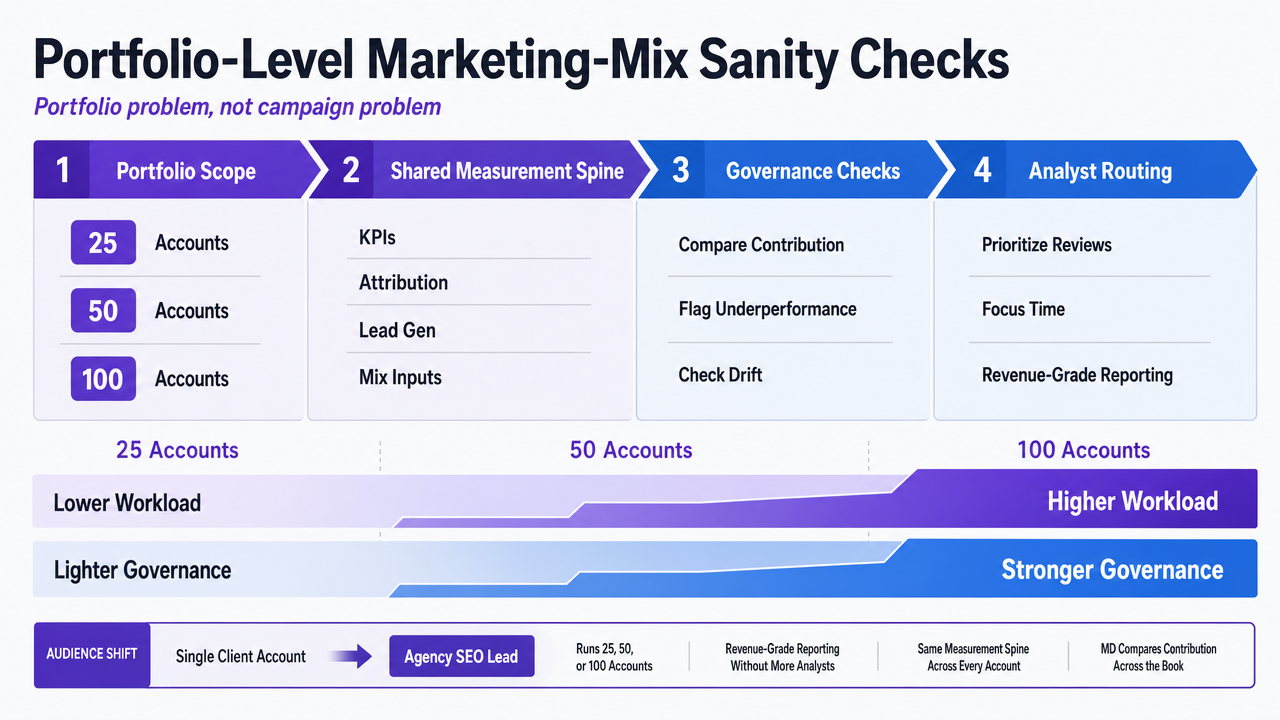 Visualize the client-tier operating model table already in the section, showing how analyst workload and governance checkpoints scale across portfolio sizes
Choosing an AI SEO Analyzer Without the Last-Click Trap
Most tools marketed as AI SEO analyzers fall into one of four categories, and the category matters more than the feature list.
- Crawler-based analyzers (Screaming Frog with AI layers, Sitebulb variants) excel at technical audits but stop at the server log; they do not reach the CRM where revenue lives.
- Rank-tracker suites with AI add-ons (Semrush, Ahrefs, Similarweb) extend keyword and competitive intelligence but default to session-level reporting that reproduces the last-click trap at a prettier resolution.
- GA4-native attribution layers (Google's data-driven model, GA4 custom explorations) handle assisted conversions well but require the agency to build the join between organic sessions, call outcomes, and booked revenue in a separate warehouse.
- Platforms built around approval-first execution across content, SEO, calls, and reporting — Vectoron is one — attempt to run the measurement spine and the production workflow in the same governed loop.
Three questions separate serviceable tools from the ones that survive a CFO review.
- Does the analyzer join organic activity to the client's own booking and CRM records, or does it report channel-level sessions and stop?
- Does it carry an auditable record of what data each recommendation used, in line with the measurable performance criteria NIST recommends for generative-AI systems in deployment 6?
- Does the vendor qualify its performance claims precisely, or does it promise guaranteed rankings, compliance, or revenue — a pattern the FTC has already penalized in the AI capability-claims context 5?
Agency SEO leads evaluating options should run a 90-day pilot on two or three accounts where booking data is clean, score the analyzer on qualified-lead attribution accuracy against the client's own books, and only then expand across the portfolio.
Frequently Asked Questions
References
- 1.GAO-25-106719, MILITARY RECRUITING: Actions Needed to Address Digital Marketing Challenges.
- 2.BIDDING ON THE BUYING FUNNEL FOR SPONSORED SEARCH AND KEYWORD ADVERTISING.
- 3.Health Products Compliance Guidance.
- 4.Guidance on Web Accessibility and the ADA.
- 5.FTC Order Requires Online Marketer to Pay $1 Million for Deceptive Claims Its AI Product Could Make Websites Compliant with WCAG.
- 6.Artificial Intelligence Risk Management Framework: Generative Artificial Intelligence Profile.
- 7.2024 NIST GenAI (Pilot Study): Text-to-Text Evaluation Overview and Results.
- 8.FTC's Endorsement Guides: What People Are Asking.
- 9.MILITARY RECRUITING: Actions Needed to Address Digital Marketing Challenges.
- 10.Online Health Information Seeking Behavior.
- 11.The Consumer Reviews and Testimonials Rule: Questions and Answers.
- 12.Artificial Intelligence Risk Management Framework: Generative Artificial Intelligence.