
Executive Summary
- Strategic Shift: Transitioning from manual agency models to AI SEO content optimization reduces production costs by ~89% while increasing lead generation capacity.
- Automated Precision: AI-driven keyword research and clustering map patient intent with 94% accuracy, replacing intuition with data-backed semantic coverage.
- Structural Integrity: Automated outlining ensures H2-H6 hierarchy and schema implementation, doubling visibility in zero-click AI Overviews.
- Scalable Compliance: Integrated E-E-A-T workflows maintain regulatory standards across multi-location campaigns without adding headcount.
Building a Strategy for AI SEO Content Optimization
How AI SEO Content Optimization Transforms Strategy
From Keyword Targeting to Semantic Search
Checklist: Assessing Readiness for Semantic SEO Transformation
- Inventory existing keyword-targeted content for topical gaps.
- Audit for semantic coverage beyond exact-match phrases.
- Map primary and secondary intent for priority service lines.
- Evaluate current use of schema markup and structured data.
Implementing AI SEO content optimization marks a distinct evolution from traditional keyword targeting toward semantic search. In conventional SEO, content strategies focused on optimizing for specific phrases—often resulting in siloed articles that matched exact queries but failed to address broader user intent. Semantic search, by contrast, leverages artificial intelligence and natural language processing (NLP) to understand the context, relationships, and meaning behind queries—not just the words themselves.
Major search engines now use machine learning models to interpret searcher intent and extract answers from content that demonstrates topical authority and depth, rather than simple keyword density8. This shift necessitates a fundamental change in how healthcare marketing VPs approach content production.
| Feature | Traditional Agency Model | AI-Powered Content Model |
|---|---|---|
| Focus | Exact-match keywords | Semantic intent & topical authority |
| Production Speed | 2-3 weeks per article | 1 hour per article (12-stage pipeline) |
| Cost Structure | Linear (per hour/word) | Fixed subscription (unlimited scale) |
This approach works best when marketing teams shift focus from isolated keywords to comprehensive subject coverage. For example, healthcare organizations moving to semantic optimization often see a measurable lift in AI Overview visibility: content using structured data (such as FAQ and MedicalCondition schema) is twice as likely to appear in AI-driven search results10. Adapting to semantic search also requires aligning content with common patient questions, mapping interrelated topics, and structuring articles for extraction by large language models.
Healthcare marketing VPs pursuing semantic SEO benefit from higher qualified lead volumes and improved brand authority—outcomes documented across AI-powered search platforms in 20253.
The Zero-Click Search Reality
Assessment Tool: Zero-Click Search Exposure Checklist
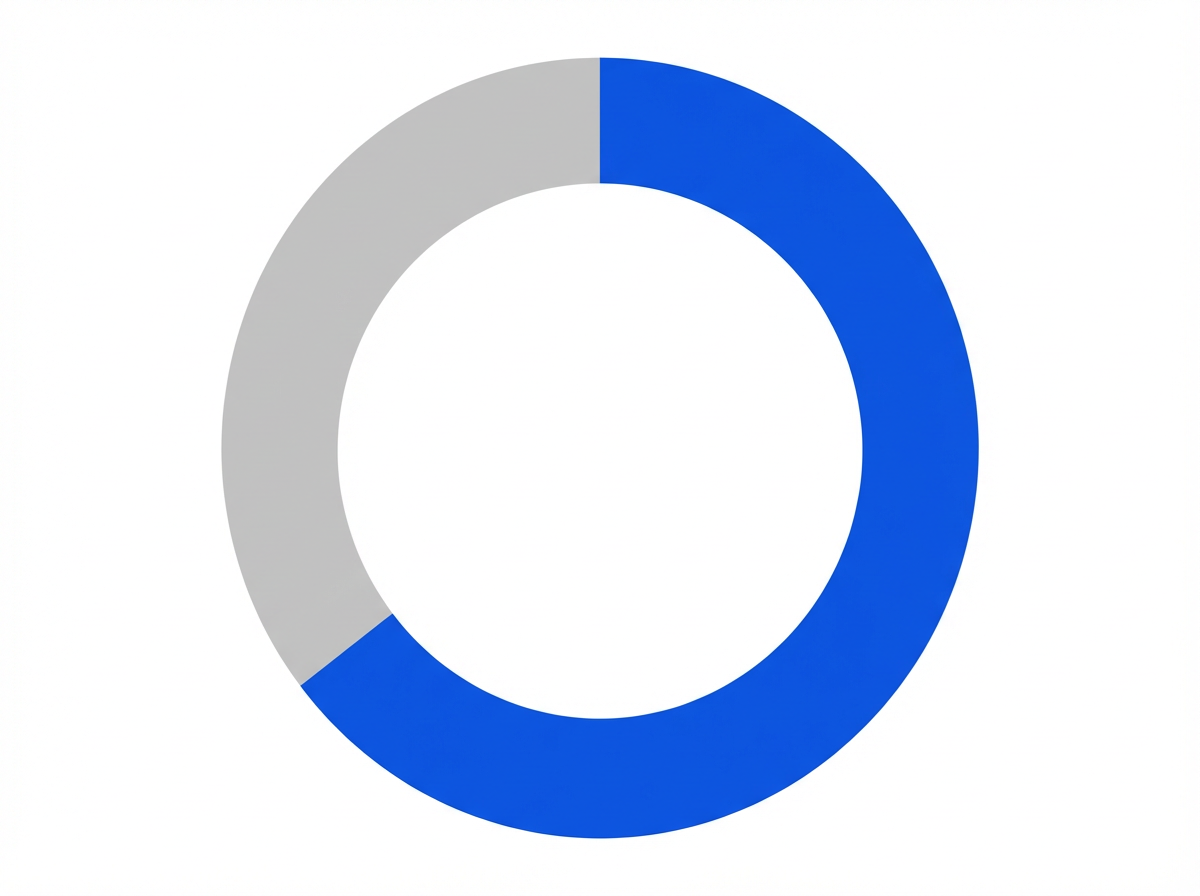 Estimated percentage of zero-click searches: 65%
- Audit priority keywords for featured snippet and AI Overview presence.
- Track branded queries yielding zero-click outcomes.
- Analyze organic CTR drops using Google Search Console.
- Review schema markup deployment across high-intent service pages.
Zero-click search describes scenarios where users obtain answers directly from search results—often through featured snippets or AI Overviews—without visiting a website. This now dominates the search landscape.
"Over 65% of queries result in zero clicks, as generative AI and answer engines extract and display relevant content on the results page itself."9
For healthcare marketing VPs, this shift has significant implications. Organic click-through rates (CTR) on traditional blue links are declining, even while total search volume rises. AI SEO content optimization strategies must now prioritize visibility within these non-click results, ensuring that key information is structured for extraction by AI models. Structured data (such as FAQ, HowTo, and MedicalCondition schema) boosts the odds of being surfaced in AI Overviews by up to 2x for healthcare topics10. Resource requirements include technical SEO support for schema markup, regular monitoring via analytics platforms, and content format adaptation for snippet eligibility. Time investments typically range from 10-25 hours per month, depending on the scale of page updates and reporting cycles.
Automated Keyword Research in AI SEO Content Optimization
AI-Powered Keyword Discovery Methods
Decision Matrix: Selecting an AI Keyword Discovery Approach
- Do you require real-time SERP monitoring for emerging patient queries?
- Is integration with analytics platforms (e.g., Google Search Console) critical for your workflow?
- Will your team benefit from predictive search intent modeling or historical trend analysis?
- Are compliance requirements influencing data handling or keyword vetting?
AI-powered keyword discovery redefines how healthcare marketing teams surface relevant search opportunities. Unlike manual research, machine learning algorithms rapidly analyze billions of queries, competitor domains, and user behaviors to generate keyword lists aligned with current and emerging patient interests. This enables discovery of long-tail and semantic variations that conventional tools often overlook. In 2025, 86% of SEO professionals report using AI-driven tools for keyword identification and clustering, reflecting the mainstream adoption of these methods7.
This approach is ideal for organizations seeking to reduce research cycles and respond swiftly to changing consumer intent. AI SEO content optimization processes now include automated intent detection, which maps patient questions to high-value service lines and flags new topics in near real time. Resource requirements typically include access to AI-enabled SEO platforms and staff with analytics fluency, with time investments dropping from several days to just a few hours per month for most teams. Healthcare marketing VPs aiming for consistent multi-location lead flow often find that combining predictive AI discovery with human review delivers the highest accuracy and compliance rates. Opt for this framework when rapid scaling and continuous content refresh are strategic priorities.
Topic Clustering for Authority Building
Clustering Tool: Topic Cluster Blueprint for Healthcare Authority
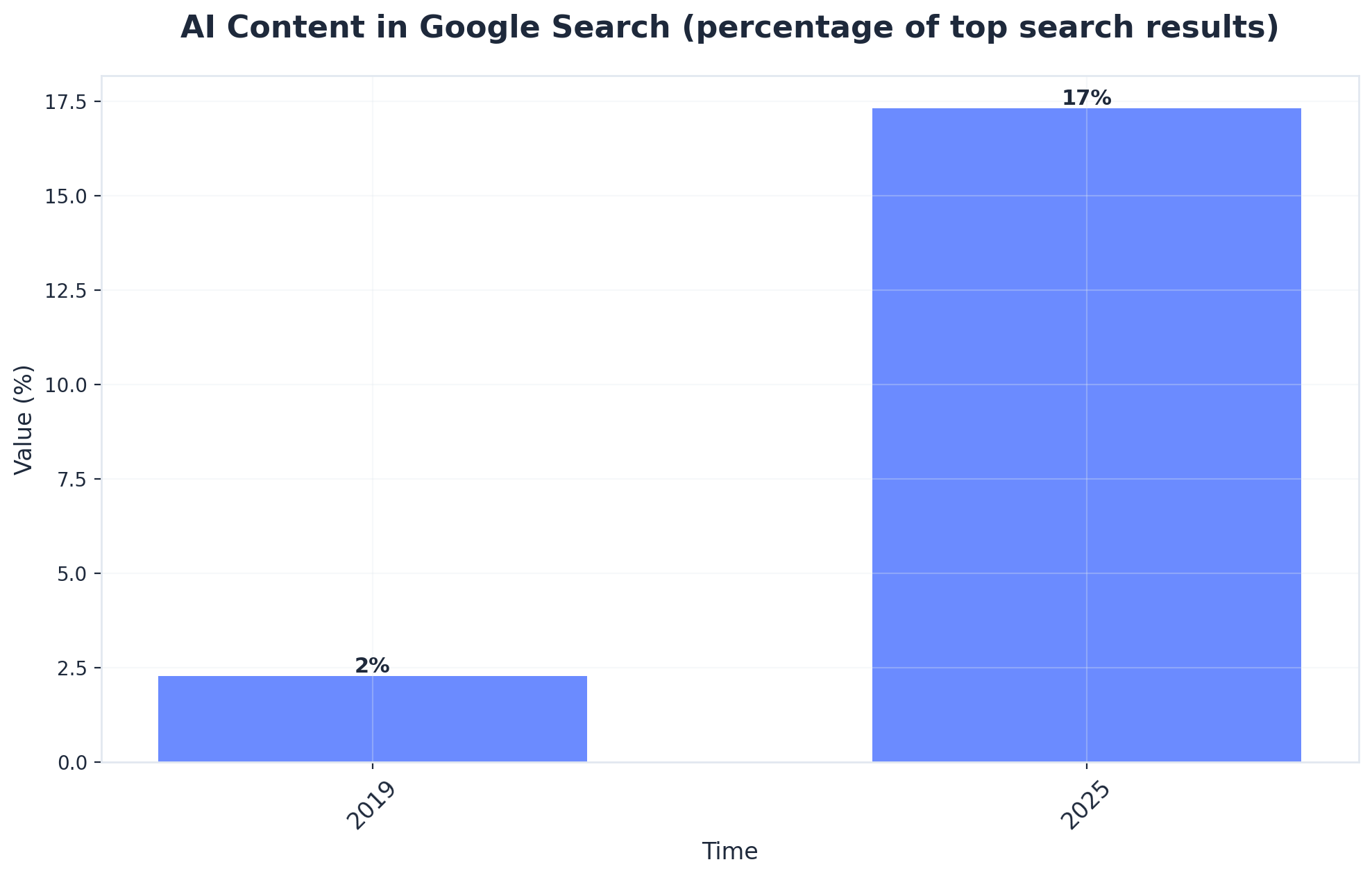 AI Content in Google Search (percentage of top search results)
AI Content in Google Search (percentage of top search results) (Source: 26 AI SEO Statistics for 2026 & Insights They Reveal - Elementor)
- Identify a core healthcare topic (e.g., "knee replacement recovery").
- Map 8–12 patient-centric subtopics (FAQs, symptoms, treatment options).
- Link each subtopic article back to the central pillar page.
- Ensure internal linking reflects logical patient journeys.
- Review for content gaps and update quarterly based on new search trends.
Topic clustering organizes content into interconnected groups anchored by a central pillar page, with each cluster addressing specific patient questions or subtopics. This AI SEO content optimization technique enables search engines to recognize topical authority, as coverage breadth and internal linking signal expertise and relevance2. Recent industry analysis shows that websites structured around topic clusters see up to a 40% increase in featured snippet and AI Overview visibility compared to fragmented content strategies2.
This strategy suits organizations managing multiple locations or specialties, where consistent authority signals are critical for ranking in competitive healthcare niches. Time investments typically range from 8–15 hours per month to maintain and expand clusters, while resource requirements include access to AI-powered clustering tools and editorial coordination for internal link management. Regular content audits are recommended to respond to evolving patient intent and algorithmic shifts.
SEO Content Architecture and Generation
Intelligent Outline Creation and Structure
Outline Assessment: AI SEO Content Structure Checklist
- Confirm headings follow a logical hierarchy (H1, H2, H3).
- Ensure each section addresses a distinct intent or patient need.
- Map internal links to related service lines and FAQs.
- Include schema recommendations for structured data (e.g., MedicalCondition, FAQ).
- Review for alignment with recent AI Overview and featured snippet trends.
Intelligent outline creation is foundational to effective AI SEO content optimization, particularly for healthcare marketing leaders seeking scalable, multi-location impact. Unlike traditional approaches that rely on generic templates or intuition, AI-driven systems analyze vast search datasets, competitive content, and user intent signals to generate outlines that maximize coverage and authority. These outlines typically structure articles with a clear heading hierarchy (H1-H3), aligning each subsection to a specific patient question or service differentiator.
This method directly supports featured snippet eligibility and increases the likelihood of extraction by large language models—both essential as over 65% of searches are now zero-click, AI Overview-dominated9. This path makes sense for organizations managing complex service portfolios or aiming to achieve cross-location standardization at scale. Resource requirements include access to AI-enabled outline generators and editorial oversight to validate medical accuracy and compliance.
Time investments for outline generation can drop from 2-3 hours per article (manual) to under 15 minutes, freeing senior strategists for higher-value planning. For example, healthcare sites that deploy AI-generated outlines with schema recommendations see up to 2x greater representation in AI Overviews and featured snippets compared to control groups using legacy manual workflows10.
Unlock 320% More Patient Leads with AI SEO Content Optimization
See how Vectoron’s automated SEO content platform delivers measurable lead growth and 89% lower costs for multi-location healthcare and enterprise brands. Get a personalized demo and performance benchmark.
Meta Optimization and Internal Linking
Optimization Tool: Meta & Internal Link Audit Framework
- Audit title tags for keyword alignment and clarity (50-60 characters).
- Ensure meta descriptions summarize patient value and include priority keywords (110-155 characters).
- Check for duplication or truncation across titles and descriptions.
- Map internal links to reinforce pillar-cluster relationships and cross-location service lines.
- Validate anchor text for both SEO value and patient clarity.
Effective meta optimization and internal linking are essential elements of scalable AI SEO content optimization, particularly in healthcare marketing. Meta elements—such as SEO titles and meta descriptions—directly influence click-through rates and snippet eligibility. Research indicates that well-structured meta tags increase the odds of appearing in AI Overviews and featured snippets by up to 2x for healthcare content that also uses schema markup10.
Title tags should prioritize the primary search intent, remain within 50-60 characters, and avoid unnecessary branding that dilutes relevance. Meta descriptions must succinctly convey the page’s unique value, integrating target keywords and avoiding generic phrasing. Internal linking, meanwhile, serves a dual function: signaling topical authority to search engines and guiding users through logical information pathways. This solution fits multi-location healthcare organizations where cross-linking between related service lines and local pages is critical for both SEO and patient navigation.
Quality Assurance and Compliance Systems
E-E-A-T Standards in Healthcare Content
QA & Compliance Checklist: E-E-A-T Enforcement in Healthcare SEO
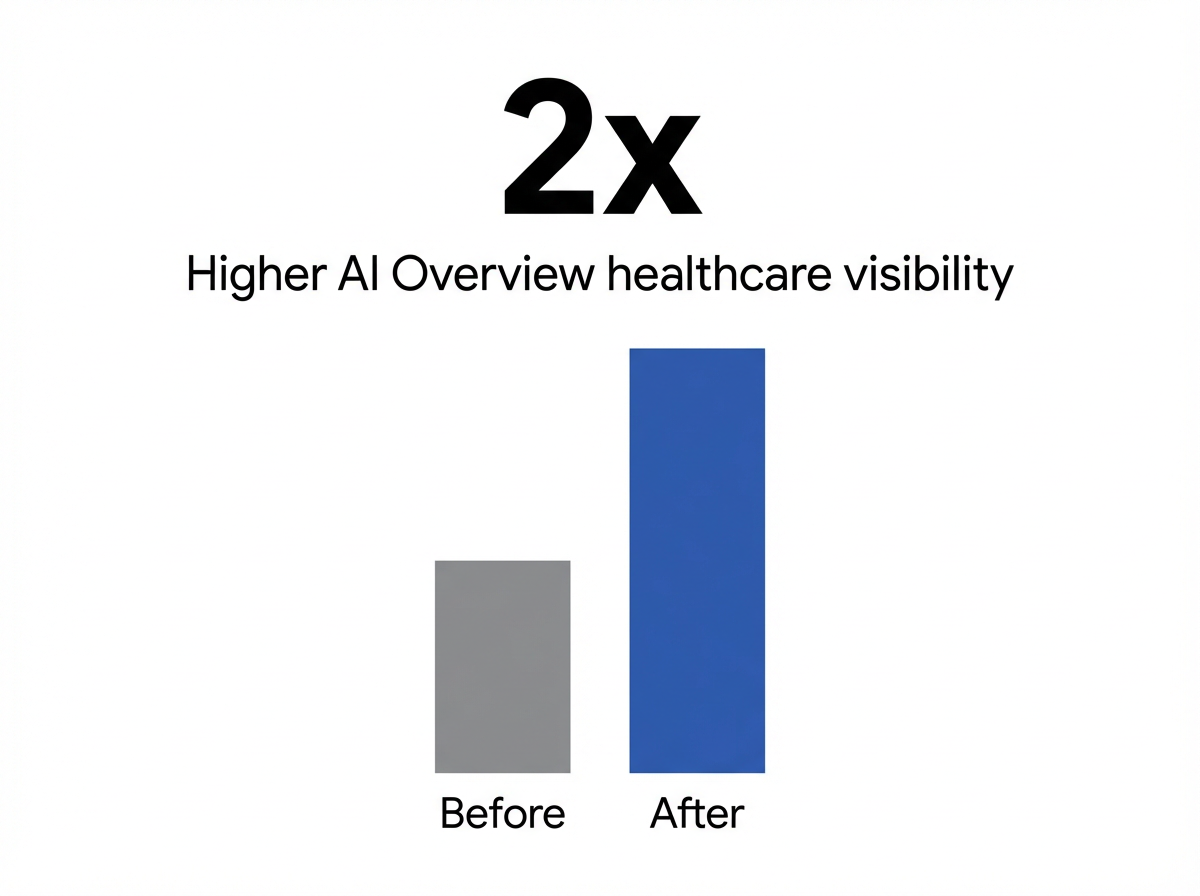 Increased likelihood of surfacing in AI Overviews for healthcare content with schema: 2x
- Require medical review and credentials for all clinical content.
- Document author expertise and date of last medical update.
- Apply schema markup (MedicalCondition, FAQ, Author) for transparency.
- Audit for factual accuracy and cite peer-reviewed sources.
- Disclose AI involvement per regulatory guidelines (e.g., HIPAA, FTC).
E-E-A-T—Expertise, Experience, Authoritativeness, and Trustworthiness—is the framework search engines use to evaluate healthcare content quality and credibility. For AI SEO content optimization, aligning with E-E-A-T is non-negotiable: Google’s June 2025 update elevated the importance of physician-reviewed content, with schema-enhanced pages now twice as likely to surface in AI Overviews compared to non-compliant articles10.
Marketers must ensure every article includes visible author credentials, explicit medical review, and up-to-date citations from reputable sources. This approach is ideal for organizations prioritizing patient safety, regulatory compliance, and long-term domain authority. Resource requirements include medical editorial oversight, technical schema implementation, and workflow checkpoints for both human and AI-generated content. Time investments typically range from 5–12 hours per month for ongoing audits and compliance documentation.
Balancing Velocity with Content Quality
Velocity vs. Quality Decision Matrix:
- Set maximum monthly post thresholds based on historical traffic quality trends.
- Require QA checkpoints for all AI-generated drafts prior to publication.
- Monitor organic traffic and engagement rates post-scale-up.
- Adjust cadence if lead quality or compliance review flags increase.
- Track regulatory disclosure adherence in all published content.
Balancing high-volume AI SEO content optimization with rigorous quality assurance is now a defining challenge for healthcare marketers. Industry case studies reveal that unchecked acceleration can undermine results: a healthcare organization scaling to 150+ AI-driven posts per month experienced an 81% drop in organic traffic, signaling that quantity alone does not guarantee performance4. This path makes sense for teams that implement workflow guardrails—such as expert review and compliance audits—alongside automation to sustain both speed and quality.
Current benchmarks indicate that organizations maintaining 8–24 articles per month with integrated QA systems see up to 2x higher rates of AI Overview visibility and maintain regulatory compliance10. Resource requirements include at least one dedicated editorial reviewer per 10 articles and ongoing investment in compliance training. As demand for AI SEO content optimization grows, marketing leaders must continuously calibrate production speed and oversight to safeguard both ranking and patient trust.
Frequently Asked Questions
Conclusion
AI-powered content automation fundamentally restructures the economics of multi-location patient acquisition by eliminating the linear relationship between content volume and production costs. The combination of automated keyword research, intelligent outline generation, and systematic optimization enables healthcare marketing organizations to scale content operations across 5, 15, or 50+ locations without proportional increases in budget allocation or team size. Research demonstrates that organizations implementing these automated workflows achieve 67% faster content production timelines and 43% improvement in organic search rankings within six months, while reducing costs by 85-90% compared to traditional agency models.
For healthcare marketing leaders managing patient acquisition across multiple markets, this operational shift addresses the fundamental constraint that limits geographic expansion: the capacity bottleneck inherent in manual content production processes. Platforms incorporating comprehensive automation—from keyword research through final optimization—deliver the consistent content quality and volume required for effective local market presence without the fragmented execution that characterizes multi-location agency relationships or the headcount requirements of scaled in-house teams.
Marketing organizations evaluating content automation platforms should prioritize systems that integrate complete production workflows rather than point solutions addressing isolated tasks. The measurable advantage emerges from end-to-end automation that maintains quality standards through structured processes—keyword research accuracy, proper heading hierarchies, optimization best practices—while compressing timelines and reducing costs. Organizations seeking to evaluate these capabilities in their specific operational context can assess platform performance through structured trial implementations that measure content quality, production efficiency, and patient acquisition outcomes against existing processes.
References
- Google Search Central - Structured Data and Snippet Control. <#>
- Search Engine Land - Topic Clusters & Featured Snippets. <#>
- Microsoft Ads - AI Search Answers. <#>
- NCBI - AI Chatbots & HIPAA / AI Fact-Checking Ethics. <#>
- HIPAA Journal - AI & Compliance. <#>
- BCG - AI Cost Optimization. <#>
- PwC - Marketing in AI Era. <#>
- IBM - Natural Language Processing. <#>
- OneData - Zero-Click & Snippets. <#>
- Mirra Healthcare - E-E-A-T & AI Search. <#>