
Key Takeaways
- STAT Search Analytics anchors enterprise SERP reporting with daily refreshes and API access, but leaves the AI citation layer to a second vendor.
- SE Ranking unifies classical SERP tracking with an AI Visibility Tracker that logs linked versus unlinked mentions and source position inside generated answers 8.
- Ahrefs Brand Radar extends across five AI indexes and 100 million-plus prompts, making it the natural AI add-on for shops already at Ahrefs enterprise tier 9.
- Nightwatch delivers prompt-level LLM analysis with sentiment scoring across ChatGPT, Perplexity, Gemini, Claude, and Google AI Overviews, valuable for reputation-sensitive verticals 1.
- Rankscale led a 2026 comparison on coverage and accuracy by exposing evidence trails that show the prompts, responses, and source order behind every visibility change 13.
- Vectoron sits above the trackers, consuming SERP and AI signals and routing them into an approval-first execution workflow that shortens the cycle from ranking movement to shipped work.
Rank Tracking Split Into Two Disciplines
Rank tracking used to mean one thing: a daily crawl of Google positions for a fixed keyword set, logged over time to spot drops and prove progress to clients 3. That definition covered agency reporting for roughly two decades. It no longer does.
The category has split. Classical SERP position tracking still monitors ordered results one through ten across Google, Bing, and mobile-desktop splits, and remains the backbone of organic visibility reporting 2. Sitting next to it now is a separate discipline: AI search monitoring, which tracks whether a brand is mentioned, cited, or linked inside generated answers from ChatGPT, Perplexity, Gemini, Claude, and Google AI Overviews 1. The measurement outputs are different. Positions are ordinal. Mentions are not.
For agencies, the split creates a stack problem. A traditional rank tracker cannot see AI citations. A pure AI visibility tool cannot report SERP movement for the 2,000-plus keywords per client that enterprise reporting standards assume 2. Running both as separate line items doubles the tool cost and fragments the client-facing report.
The six software choices covered below sort into three archetypes: enterprise SERP backbones, unified SERP-plus-AI suites, and AI-native trackers built around citation evidence. Each solves one part of the split. None solves all of it cleanly, which is the point of the evaluation.
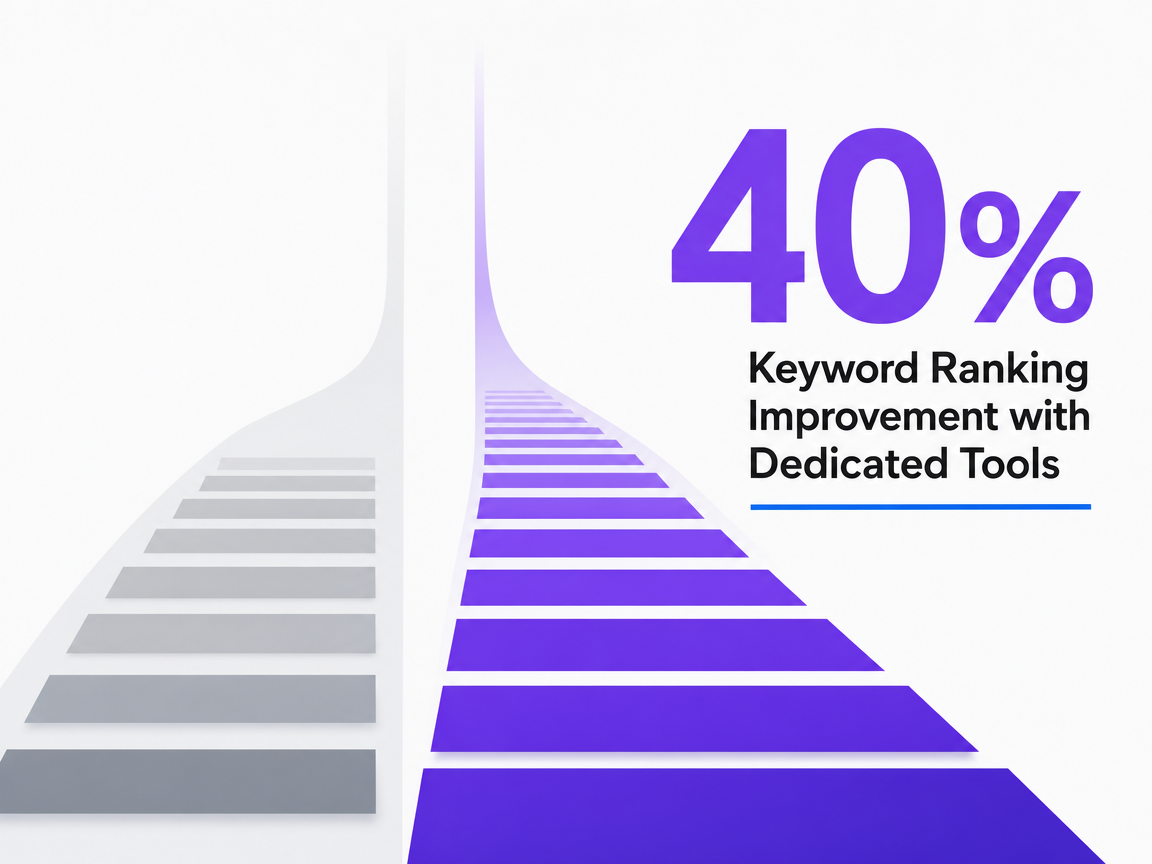 Keyword Ranking Improvement with Dedicated Tools
Keyword Ranking Improvement with Dedicated Tools
The Agency Evaluation Framework
Five Criteria That Matter for Multi-Client Delivery
Feature checklists rarely survive contact with a 40-client roster. The criteria that actually separate viable agency tools from consumer-grade software cluster into five categories.
- Multi-client architecture. Client-level workspaces, role-based permissions, and white-label reporting are the baseline. Tools that treat clients as tags rather than tenants force the delivery team into manual segmentation every reporting cycle.
- AI plus traditional coverage. The stack needs both SERP position data across Google and Bing and mention data across ChatGPT, Perplexity, Gemini, Claude, and Google AI Overviews 1. A tool that covers only one layer forces a second contract.
- Reporting cadence. Daily updates are the enterprise standard for classical rank tracking 5. AI visibility feeds refresh less predictably because they depend on prompt sampling rather than direct SERP crawls 8.
- Accuracy evidence. Position accuracy is verifiable against manual SERP checks 2. AI mention accuracy is harder to audit. Tools that surface citation-level evidence trails, not just aggregate scores, give the analyst something to defend in a client meeting 13.
- Cost-per-tracked-keyword at scale. At 2,000-plus tracked keywords per client, per-keyword pricing beats seat pricing 2. The math flips at lower volumes.
Why Position Tracking and Mention Tracking Need Different Measurement
A SERP position is a rank. It sits at slot four or slot nine. Movement is ordinal, comparable across days, and tied to a specific query on a specific device.
An AI answer does not rank a brand. It cites one. SE Ranking's AI Visibility Tracker illustrates the shape of the data: the tool monitors AI-generated answers tied to tracked prompts and checks whether a brand is mentioned, whether that mention is linked or unlinked, and where it appears among the sources the model pulled from 8. Competitor citations are logged over the same prompt set to show relative share of voice inside the answer, not above or below it 8.
That difference has reporting consequences. A position report shows a line moving from 12 to 6. A citation report shows presence, absence, link status, and source position inside a generated response. Agencies that hand clients a single "visibility score" without separating the two layers hide the mechanism. Analysts who report both layers separately preserve the ability to diagnose what changed and why.
GEO Adoption Is No Longer Optional
Generative engine optimization software adoption among agencies is projected to rise from 18% in 2024 to 65% by 2028, a CAGR of 25.6% 9. The trajectory reframes the buying decision. AI visibility tracking has moved from experimental line item to expected deliverable inside the reporting cycle.
The client-side pressure is quieter but consistent. Brands that ask about ChatGPT visibility in Q1 tend to ask about revenue attribution from AI referrals by Q3. Agencies that cannot answer the first question rarely get to answer the second.
The stack implication for Heads of SEO is direct. A tool selection made in 2026 needs to survive the volume shift implied by that adoption curve. Choosing a SERP-only backbone now and bolting on an AI feed later is a defensible sequence, but only when the SERP tool exposes an API or reporting layer the second feed can plug into 5. Choosing a unified suite trades some depth on the AI side for consolidated reporting. Both paths are live in the six choices that follow.
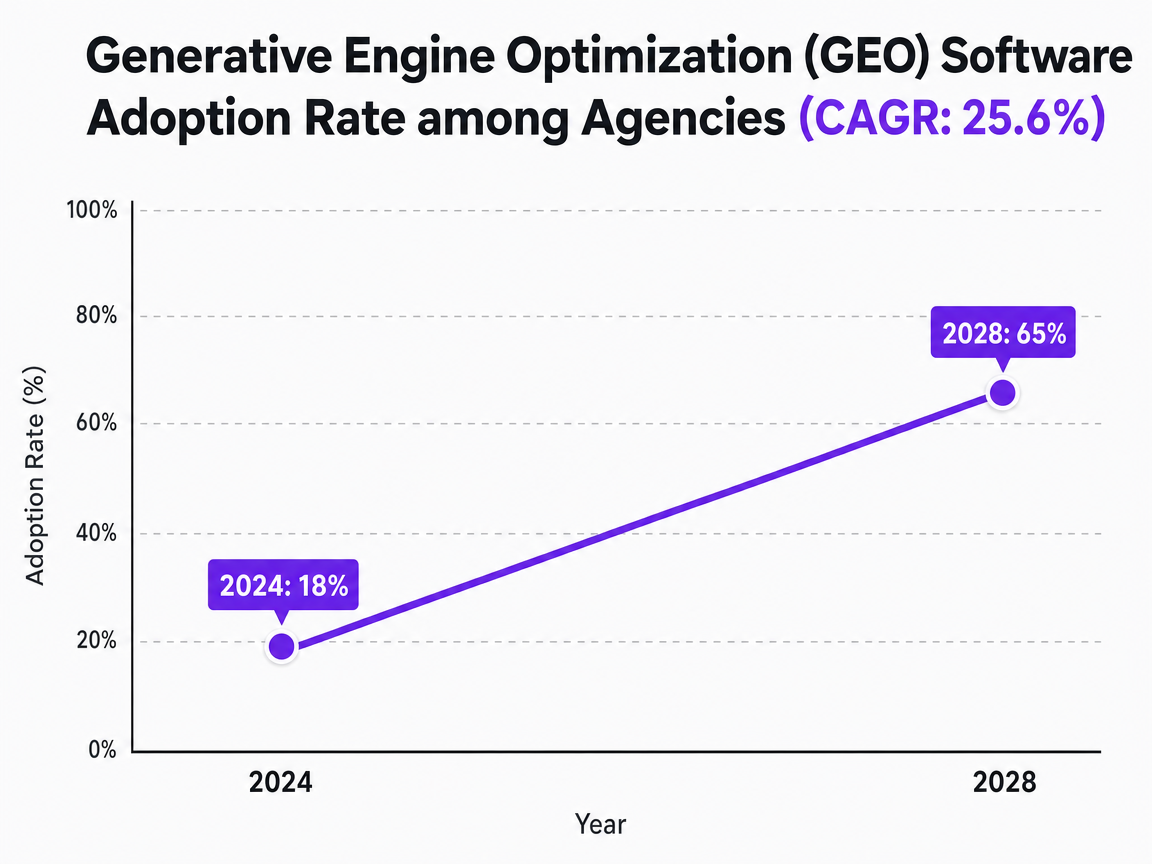 Generative Engine Optimization (GEO) Software Adoption Rate among Agencies (CAGR: 25.6%)
Source: Rankability - 22 Best AI Search Rank Tracking & Visibility Tools for 2026
Test AI rank tracking workflows on live sites
Benchmark your agency’s real client rankings using automated, production-ready reporting during your free trial.
Six Software Choices Mapped to Agency Archetypes
STAT Search Analytics: Enterprise-Grade Daily SERP Backbone
STAT Search Analytics, now part of Moz, is built for daily large-scale rank tracking and sits inside most 2026 enterprise rosters alongside SEOmonitor, seoClarity, Conductor, and BrightEdge 5, 12. The design assumption is straightforward: agencies operating at portfolio scale need every tracked keyword refreshed every 24 hours, not sampled weekly.
The archetype fit is the SERP-first agency. STAT does not track AI mentions. It tracks positions, SERP features, share of voice, and competitor movement across markets and devices at volumes that break mid-market tools. Location-level granularity handles multi-location clients without stitching separate accounts together.
For a Head of SEO managing 40 to 200 accounts, the operational value is data volume plus API access. The API is what makes STAT usable as a backbone rather than a reporting endpoint. Agency BI teams pull position data into internal dashboards, blend it with GA4 and GSC, and layer a separate AI visibility feed on top without exporting CSVs.
What the tool does not solve is the citation layer. STAT reports where a client ranks on page one for a query. It does not report whether ChatGPT cited the client when a user asked the same question in natural language. Agencies choosing STAT are choosing a strong classical spine and accepting that the AI feed will come from a second vendor. That trade is defensible when SERP volume dominates client reporting and AI referrals are still under 10% of tracked demand.
SE Ranking: SERP Suite Plus Citation-Level AI Visibility
SE Ranking is the leading example of the unified suite archetype and is called out specifically as well-suited for traditional SEO agencies transitioning to AI search tracking 10. The suite covers classical keyword position tracking across search engines and pairs it with an AI Visibility Tracker that monitors generated answers tied to tracked prompts 8.
The AI layer is the differentiator worth examining. SE Ranking's tracker checks whether a brand is mentioned inside an AI answer, whether the mention is linked or unlinked, and where the brand appears among the sources the model pulled from 8. Competitor citations are logged across the same prompt set, giving analysts a share-of-voice view inside the answer itself rather than around it 8. That citation-level evidence matters when a client asks why their AI referrals dropped: the report can show that a competitor moved from source position four to source position one, or that a mention lost its link.
For agency delivery, the multi-client architecture handles white-label reporting and per-client workspaces without add-on fees at most tiers. The consolidated feed means one dashboard for both layers, which shortens reporting cycles noticeably when a delivery team is producing 30-plus monthly client decks.
The limit is scale. Agencies tracking 3,000-plus keywords per client hit pricing curves faster than they would on a dedicated enterprise SERP tool. SE Ranking fits agencies in the 500 to 2,000 keyword-per-client band who want the AI feed included, not billed separately.
Ahrefs Brand Radar: Wide AI Index Coverage for Established Ahrefs Shops
Brand Radar tracks brand mentions across five AI indexes and over 100 million prompts, making it one of the widest-coverage AI visibility products on the market 9. It also appears in the leading 2026 AI search monitoring rosters alongside Profound, OtterlyAI, Scrunch, ZipTie, AthenaHQ, and SE Ranking 6.
The archetype fit is the agency already anchored on Ahrefs for backlinks, keyword research, and site audits. Brand Radar plugs into the same account and account structure, which removes the second-vendor procurement path and the second white-label configuration. For agencies already paying Ahrefs enterprise rates, the marginal cost to add AI visibility is smaller than acquiring a standalone AI tracker.
The reporting shape leans quantitative. Mention frequency, prompt coverage, and competitive share are surfaced across the tracked indexes. That works well for aggregate visibility trends and client-facing summaries.
The caveat is depth of the citation trail. Brand Radar reports mention data at scale; analysts wanting the exact prompt-and-source lineage a diagnostic conversation demands sometimes still need a specialist tool alongside it. For agencies whose clients accept a scored visibility view without demanding per-prompt evidence, Brand Radar consolidates AI tracking inside a stack that already handles SERP research and backlink monitoring. The stack question is not whether Ahrefs adds AI visibility, but whether the agency has already committed to Ahrefs at the tier that makes Brand Radar economical.
Nightwatch: Prompt-Level LLM Analysis With SEO Tool Integration
Nightwatch positions as a unified platform combining LLM monitoring, search engine rank tracking, prompt research, and sentiment analysis 1. Pricing starts at $32 per month, on the low end of the $29 to $3,000-plus range documented across AI search monitoring tools 1.
The distinguishing capability is prompt-level analysis. Nightwatch LLM offers AI-powered search visibility and tracking with prompt-level analysis across multiple language models and integrates with existing SEO tools 11. Prompt-level here means an analyst can inspect which specific queries produced which specific answers, and how the brand appeared or failed to appear inside them. That granularity is what separates diagnostic tools from dashboard tools.
Coverage spans ChatGPT, Perplexity, Gemini, Claude, and Google AI Overviews, with sentiment analysis layered on top of the citation data 1. Sentiment is the softer signal in the stack. It reports whether the brand is described positively, neutrally, or negatively inside an answer, which matters more in reputation-sensitive verticals like legal, behavioral health, and dental than in commodity ecommerce.
The archetype fit is an agency that needs the diagnostic depth of a specialist tool but wants the SEO integration of a suite. Nightwatch sits closer to a specialist than SE Ranking does, and closer to a suite than pure GEO tools do. Agencies running mid-sized rosters (20 to 60 clients) with reputation-sensitive verticals benefit most from the sentiment layer.
Rankscale: AI-Native Tracking With Evidence Trails
Rankscale is called out as the strongest AI-native rank tracking tool tested in a 2026 comparison, standing out on coverage, high accuracy, and evidence trails 13. The evaluation framework applied to the category matters: visibility coverage across AI platforms and tracking accuracy were the primary metrics, and Rankscale led on both 13.
Evidence trails are the operational differentiator. When an AI visibility score changes, most tools show the score. Rankscale shows the underlying prompts, the responses, the citation status, and the source order behind the change 13. That trail is what an analyst hands to a client asking "prove it," and it is what the agency's own SEO team uses to reverse-engineer why a mention appeared or disappeared.
The archetype fit is the AI-first or AI-heavy agency. Rankscale does not replace a classical SERP tracker. Agencies deploying it typically pair it with STAT, Ahrefs, or SE Ranking's SERP module and let Rankscale handle the generative engine layer. The pairing works because the evidence trail addresses the accuracy gap that pure aggregate scoring tools leave open.
For agencies whose clients are asking harder questions about AI visibility, such as which specific prompts drive their citations and which competitors are eating share inside answers, Rankscale is the tool that produces defensible answers. It is a specialist purchase, not a stack replacement.
Vectoron: Ranking Signals Routed Into Execution
The prior five choices are trackers. They report data. Vectoron sits one layer over, as an AI marketing execution platform where ranking signals from SERP and AI visibility feeds route into a specialist strategist workflow that produces approved content, technical SEO changes, and campaign adjustments.
The archetype fit is different from the others. Agencies that already own a competent tracking stack but still spend two weeks translating ranking movement into briefs, drafts, approvals, and published work are the operational readers. Vectoron consumes the same signals a Head of SEO reviews in STAT, SE Ranking, or Rankscale and routes them into a Command Center where SEO, content, PPC, backlinks, social, and call intelligence specialists surface ranked recommendations for human approval before execution.
The measurable value is cycle time. Position drops or lost AI citations that would normally trigger a briefing meeting, a copywriter assignment, and a two-week production cycle instead surface as approval-ready work items tied to the underlying signal. Nothing ships without sign-off, which preserves the strategic control agency Heads of SEO already exercise.
Vectoron does not compete with the trackers listed above on dashboard features. It consumes their output. Agencies evaluating it are answering a different question than "which tracker," which is "how does tracking data become executed work without adding analysts or copywriters to the roster."
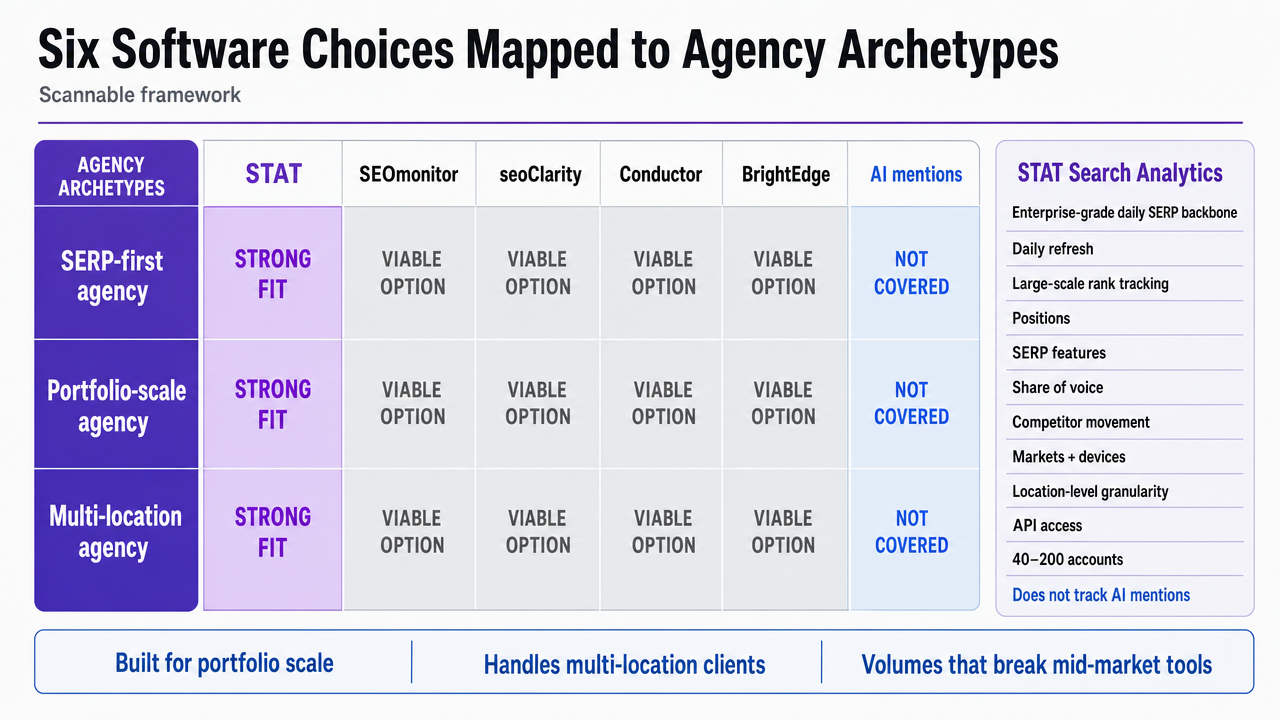 Visualize the comparison of the six software choices against the three agency archetypes described in the section, giving readers a scannable framework that matches the article's structure
Cost-per-Tracked-Keyword at Agency Scale
Tool selection at 40-plus client accounts stops being a feature decision and becomes a unit-cost decision. The relevant math is cost per tracked keyword per month, calculated across the full portfolio, not per-tool list pricing.
Monthly pricing for AI search monitoring tools spans $29 to $3,000-plus, with Nightwatch starting at $32 per month and enterprise deployments landing near the top of the range 1. That spread reflects three cost drivers: prompt volume for AI feeds, keyword volume for classical tracking, and seat count for multi-client workspaces. Agencies operating at the 2,000-plus keyword-per-client threshold cited as the enterprise standard hit the top of that range fast when both layers are billed separately 2.
The consolidation logic is straightforward. A unified suite that bundles SERP tracking and AI visibility inside one contract eliminates the second vendor's floor price, the second white-label configuration, and the second per-seat charge. An enterprise SERP backbone paired with a specialist AI tracker doubles the fixed costs but often lowers the per-keyword cost at high volume because the SERP tool's pricing curve flattens above 5,000 keywords.
The table below frames the three archetype economics at agency scale. Only sourced ranges are used; vendor-specific pricing must be confirmed at purchase.
| Archetype | Typical Monthly Floor | AI Visibility Included | Best Volume Band |
|---|---|---|---|
| SERP-only enterprise backbone | Upper end of $29-$3,000+ range 1 | No | 5,000+ keywords per client |
| Unified SERP + AI suite | Mid-range of $29-$3,000+ 1 | Yes | 500-2,000 keywords per client |
| AI-native specialist | Starts near $32/month 1 | Yes (AI only) | Paired with a SERP tool |
The operational takeaway: agencies running the math on cost per tracked keyword usually find the unified suite wins below 2,000 keywords per client, and the paired SERP-plus-specialist stack wins above it. The break point is portfolio-specific, but the calculation is not optional.
See How Leading Agencies Automate and Scale Rank Tracking With AI
Connect with specialists to evaluate AI-driven rank tracking solutions that centralize reporting, streamline approvals, and eliminate manual data pulls across multi-client portfolios.
Where AI Visibility Measurement Is Still Unreliable
The category has a standardization problem. Different AI visibility tools measure different things and call them the same name. Some report mention frequency across a prompt set. Others report proprietary visibility scores built from weighted mentions, sentiment, and citation position. Others report share of voice inside answers versus above them. The ecosystem lacks a common definition of what "AI rank" means, and the tools surveyed across 22 platforms use overlapping but non-identical measurement approaches 9.
Three specific gaps deserve caution in client reporting:
- Prompt sets are not standardized. A tool that samples 100 prompts for a client will produce different visibility numbers than a tool sampling 500 prompts on the same brand, and neither number is wrong.
- Sentiment classification varies by model. The same AI answer can register as positive in one tool and neutral in another.
- Linked versus unlinked mention accounting differs by vendor, which changes what "citation" means in a report 8.
The operational response is to lock a measurement definition per client before the first report ships. Analysts who name the tool, the prompt set size, and the mention definition inside every deck avoid the argument six months later when a competing vendor's number disagrees with theirs.
Choosing a Stack Configuration
The six choices sort cleanly against portfolio shape. Agencies with SERP volume above 5,000 keywords per client and AI referrals still under 10% of tracked demand default to a STAT backbone paired with a specialist AI feed like Rankscale or Nightwatch. The classical spine holds; the AI layer is diagnostic rather than the main report.
Mid-market rosters running 500 to 2,000 keywords per client consolidate on SE Ranking. One contract, one white-label configuration, both feeds inside the same deck. Ahrefs Brand Radar is the parallel consolidation move for shops already committed to Ahrefs at enterprise tier, where the marginal AI cost is smaller than adding a second vendor.
Reputation-sensitive verticals such as legal, behavioral health, and dental get more value from Nightwatch's prompt-level sentiment layer than from broader-index tools that report mention frequency without tone.
None of the tracker choices solve the execution gap. Position drops and lost citations still translate into briefs, drafts, approvals, and shipped work through whatever production system sits downstream. That gap is where Vectoron fits, consuming the signals the chosen tracker produces and routing them into approval-first execution.
Frequently Asked Questions
References
- 1.Best AI Search Monitoring Tools for Marketers in 2026.
- 2.Top 10 Best Rank Tracker Tools of 2025 for Effective SEO.
- 3.Best SEO Ranking Tracking Software in 2025: A Hands-On Review.
- 4.Best Keyword Tracking Tools in SEO 2025.
- 5.Best Rank Tracking Software 2026: 12 SEO + AI Tools.
- 6.Best AI search monitoring tools for 2026.
- 7.The 12 Best AI Visibility Monitoring Tools in 2026.
- 8.AI Visibility Tracker that fits your delivery map - SE Ranking.
- 9.22 Best AI Search Rank Tracking & Visibility Tools for 2026.
- 10.Best AI Search Tracking Software for Agencies in 2026.
- 11.How do you rank in AI? Top AI Visibility Tools Overview.
- 12.12 Best Enterprise Rank Tracking Software Platforms in 2026.
- 13.AI Rank Tracking Tools | Which One Should You Use.