
Key Takeaways
- AI visibility trackers resolve brand presence into four states — mentioned, cited, recommended, or ignored — across ChatGPT, Perplexity, Gemini, Claude, and Google AI Overviews 2.
- Engine coverage of five to seven platforms and a refresh cadence measured in days, not weeks, is the current working ceiling for agency-grade tooling 4.
- Share of Model extends CTR-weighted SOV math to answer engines by scoring prompt-cluster observations against the same competitor set already used in traditional reporting 7.
- Route tracker outputs into the refresh queue and attribution warehouse rather than a standalone dashboard, and report state counts instead of vendor composite scores 3.
The measurement gap agencies are quietly absorbing
Rank tracking still tells an agency where a client sits in the ten blue links. It does not tell the agency whether ChatGPT names that client when a prospect asks for a family law firm in Denver, whether Perplexity cites the client's service page, or whether Google AI Overviews recommends a competitor two lines above the organic result. A growing category of software now measures exactly that: whether a brand is mentioned, cited, recommended, or ignored inside AI-generated answers across ChatGPT, Google AI Overviews, Perplexity, Gemini, and Claude 2.
For a Head of SEO running 15 to 60 accounts, the gap is not academic. Branded search volume shifts, direct traffic climbs or dips, and clients start asking why their assisted conversions look different this quarter. Without a visibility layer aimed at answer engines, the agency is reporting on a shrinking slice of the funnel.
The pillar that follows treats AI visibility trackers as an input to production, not a dashboard. It covers what the tools actually measure, the four tracker categories worth stacking, a Share of Model formula that extends familiar SOV math 7, portfolio-scale operating economics, and the honest limits of the data.
What AI visibility trackers actually measure
Mentioned, cited, recommended, ignored: the four states
Every AI visibility tracker resolves a brand's presence in a generated answer into one of four discrete states: mentioned, cited, recommended, or ignored 2. Those states are not synonyms.
Mention : Names the brand in passing.
Citation : A citation links to a specific URL on the client's domain, typically surfaced in Perplexity's source list or a Google AI Overviews expansion.
Recommendation : The strongest signal — the engine actively suggests the client as an answer to a commercial-intent prompt.
Ignored : The default, and it is where most clients sit for most prompts on day one.
The distinction matters at the reporting layer. A dental group's Perplexity citation on a "best cosmetic dentist near me" prompt is a bottom-funnel event. A generic mention of the same group inside a ChatGPT explainer on veneer costs is upper-funnel context. Rolling both into a single "AI presence" score, as some dashboards do, collapses signal that a Head of SEO needs to keep separated.
Trackers also log adjacent metadata: the exact prompt that triggered the answer, the answer text, competitor brands named in the same response, and, in some tools, sentiment around the mention 8. That metadata is what turns a state into a diagnosis.
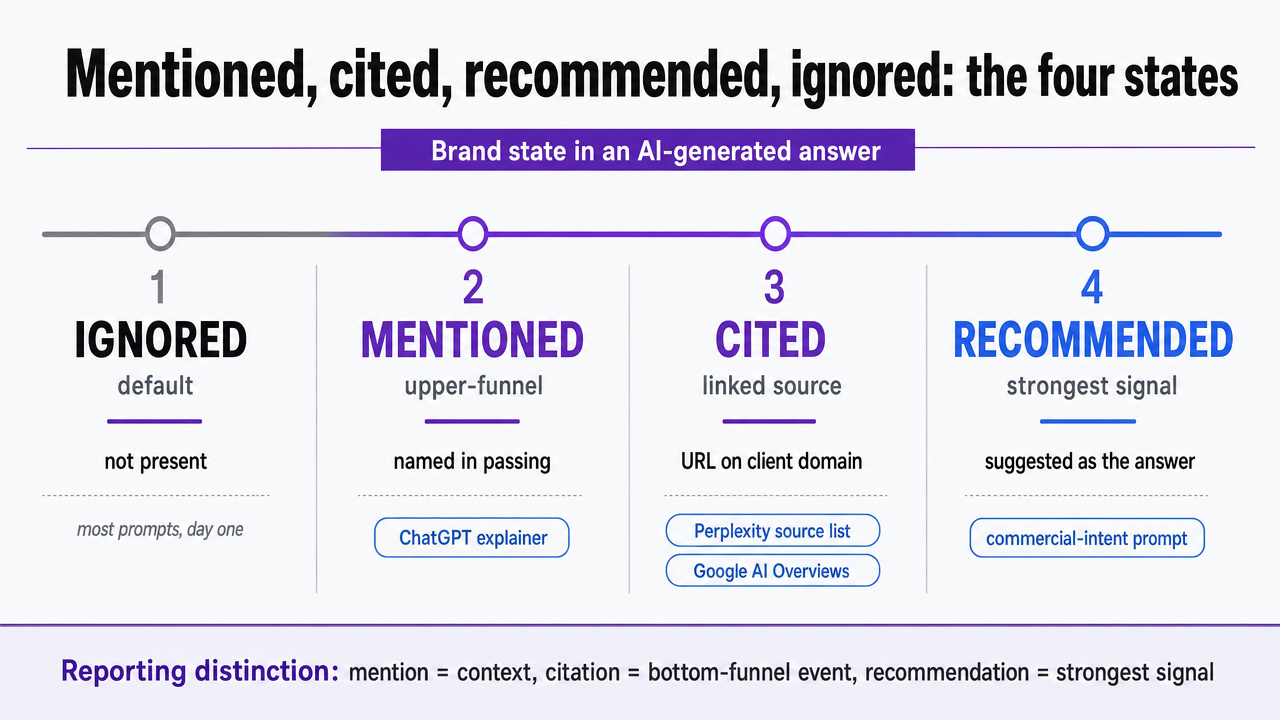 Visualize the four discrete states a brand can occupy inside an AI-generated answer, which is the core measurement framework introduced in this section
Engine coverage and refresh cadence as the real product
The feature that separates trackers is not the dashboard. It is which engines they poll and how often. A tool that watches only ChatGPT misses the Perplexity citation surface where a legal client's service page is actually being linked. A tool that refreshes weekly will not catch the two-day window during which a home services client vanished from Google AI Overviews after a competitor's programmatic content push.
A May 2026 comparative analysis of more than 30 AI SEO tracking platforms flagged one tool covering seven engines — ChatGPT, Perplexity, Claude, Meta AI, Gemini, Google AI Overviews, and Google AI Mode — on a refresh cadence of roughly every three days, paired with a 4.7 out of 5 user rating 4. The number is one data point in a fragmented market, not a verdict, but it sets a working benchmark: coverage across five to seven engines and a refresh cycle measured in days, not weeks, is the current ceiling of what agencies can buy off the shelf.
Cadence has portfolio consequences. A three-day refresh across 40 clients, each with 30 prompt clusters, produces roughly 1,200 prompt-cluster observations per cycle and 400 per day. A weekly refresh cuts that observation density by more than half and delays every downstream decision — refresh queue prioritization, competitor mention triage, share-of-model recalculation — by the same interval. Faster is not always better; each cycle also generates noise the analyst team has to filter. The operating question is whether the cadence matches the client's competitive volatility, not whether it matches the tool's marketing copy.
Four tracker categories and where each earns its seat
Citation-first, referral-first, GEO-first, monitoring-first
The AI visibility tooling landscape has splintered into four practical categories, each solving a different slice of the measurement problem. Treating them as interchangeable is the fastest way to overpay for overlapping coverage and still miss the signal a client actually needs.
- Citation-first tools are built around the source list. They log which URLs from a client's domain get linked inside Perplexity answers, Google AI Overviews expansions, and Gemini responses, and they roll those citations up into multi-client project views a Head of SEO can hand to an account team 3. This is the category that maps most cleanly to bottom-funnel reporting: a legal client's fee-schedule page appearing as a Perplexity source on a commercial-intent prompt is a defensible line item.
- Referral-first tools point in the opposite direction. Rather than watching what the engines say, they measure the traffic those answers send, typically reported as AI referral traffic and AI agent reports on a weekly update cadence 3. For clients where ChatGPT and Perplexity referrers are already showing up in analytics, this is the category that closes the loop between mention and session.
- GEO-first tools orient around production. They score content for machine-readable, answer-ready structure and track multi-platform coverage as a downstream effect of on-page changes 4. Agencies running high-volume content programs use them to prioritize which pages to restructure first.
- Monitoring-first tools are the widest net. They run scheduled prompt batches, log brand and competitor mentions, track citation frequency, and layer sentiment analysis and trend reporting on top 8. For a portfolio-scale operator, this is the category that produces the raw observation stream the other three can be aimed at.
Most agencies end up running two of the four rather than one of everything. Citation-first plus monitoring-first is the most common stack for reporting-heavy accounts. GEO-first plus referral-first is the more common stack for content-production shops that want to trace output back to sessions.
Native LLM telemetry as a complement, not a substitute
Third-party trackers are not the only source of visibility signal. Vendor-native logs, custom GPTs configured as watchers, and platform-side analytics from ChatGPT, Gemini, and Claude sit alongside dedicated trackers, and the more thorough measurement guides now list them in the same inventory 5. A custom GPT tuned to a client's competitor set can surface prompt-level context that a scheduled batch run misses, and native referral data from an AI assistant is more trustworthy than a scraped approximation of it.
Native telemetry does not replace a tracker. Coverage is uneven across engines, historical retention is limited, and no vendor exposes competitor data on its own surface. Combining a monitoring-first tracker with two or three native feeds bridges the gap between what an external observer can see and what the platforms themselves report. The operating principle is straightforward: use the tracker for cross-engine comparability and competitor benchmarking, use native telemetry for depth on the engines where a client is already earning presence.
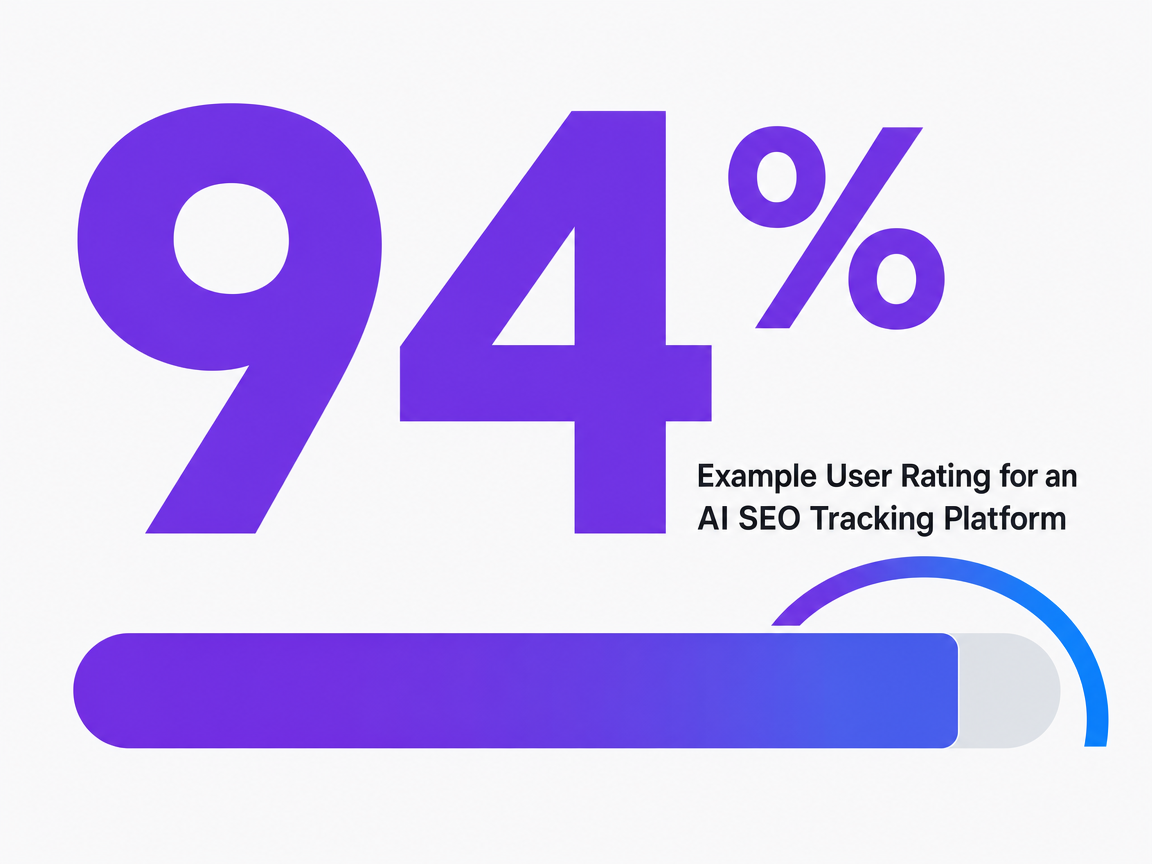 Example User Rating for an AI SEO Tracking Platform
Example User Rating for an AI SEO Tracking Platform
Experience AI visibility tracking at enterprise scale
Test real-time AI visibility analytics and publish live content risk-free for 7 days.
Share of Model: extending SOV into AI answers
From CTR-weighted SOV to a portfolio-scale SoM formula
Share of Voice in traditional SEO quantifies the percentage of total organic impressions or clicks a domain earns across a predefined, revenue-critical keyword portfolio versus the combined total of all tracked competitors 7. The advanced version is not a rank average. It is a CTR-weighted calculation run against a curated keyword corpus assembled from Google Search Console exports, rank-tracking APIs, and CRM-derived commercial-intent terms, then rolled up in a warehouse so the same math can be re-run every week without hand assembly 7.
Share of Model applies the same discipline to answer engines. The corpus shifts from keywords to prompt clusters — the natural-language questions a prospect actually types into ChatGPT, Perplexity, Gemini, Claude, and Google AI Overviews when the intent maps to a client's commercial pages. The competitor set stays the same as the SOV competitor set, since the prospect is choosing between the same firms regardless of surface. The scoring changes: instead of CTR-weighted impressions, each prompt-cluster observation resolves to one of the four states — mentioned, cited, recommended, or ignored 2— and each state carries a different weight.
A workable weighting scheme treats recommendations as the heaviest signal, citations next, mentions light, and ignored as zero. Multiply by engine coverage (five to seven engines in current tooling 4) and the number of prompt clusters, and the output is a single portfolio-scale number per client and per competitor. Run it against the same corpus every refresh cycle, and the delta becomes the reportable metric.
The formula only works if the prompt corpus is built the same way the SOV keyword corpus is built: revenue-critical, competitor-shared, and stable enough to compare quarter over quarter.
Reporting SoM to clients without inviting the wrong questions
A single SoM number on a client dashboard invites the question no agency wants to answer on a Tuesday call: "Why is it 12%?" The percentage itself carries no meaning without the competitor benchmark and the corpus definition sitting next to it. Reports that lead with the raw score, rather than the delta against a named competitor set, tend to produce more work than insight.
The cleaner reporting pattern presents three things together:
- SoM versus the same competitor set the client already sees in the SOV report — reusing the competitor list keeps the two metrics comparable and prevents cherry-picking.
- The state breakdown: how many prompt-cluster observations landed as recommendations, citations, mentions, or ignored, since a rising SoM driven by mentions is a weaker story than one driven by recommendations.
- The movement since the last refresh cycle, framed against the engines where the movement occurred.
Honest reporting also names what the number excludes. Refresh variance across engines, the black-box nature of some vendor scoring 3, and the absence of standardized KPIs across the tooling market 8mean SoM is directional, not audited. Clients who understand that upfront ask better questions in quarterly reviews and stop treating a two-point dip as a crisis.
Wiring tracker outputs into a production loop
Signal to prioritization: turning prompt clusters into a refresh queue
A tracker that generates 400 prompt-cluster observations a day across a 40-client portfolio is producing prioritization data, not reporting data. The failure mode most agencies fall into is exporting that stream to a slide deck once a month. The higher-leverage move is routing it into the same queue the content team already works from.
The mechanics are straightforward. Every prompt cluster in the SoM corpus maps to one or more client URLs — a service page, a location page, a fee-schedule article. When a cluster's state degrades — a recommendation on Perplexity drops to a citation, a citation drops to a mention, a mention drops to ignored — that URL surfaces at the top of the refresh queue for the next cycle. When a competitor gains a recommendation on a cluster where the client is ignored, the same URL surfaces with a competitor-gap tag attached.
Sentiment and citation-frequency data from monitoring-first tools 8add a second sort key. A mention with negative sentiment on a bottom-funnel prompt is a higher-priority intervention than a neutral mention on an informational one. The queue ordering that comes out the other side is not "pages we want to refresh." It is "pages where the answer engines have already signaled a gap the client is losing revenue behind." Feeding that ordering into the production schedule is what converts a tracker subscription from a dashboard cost into a delivery input.
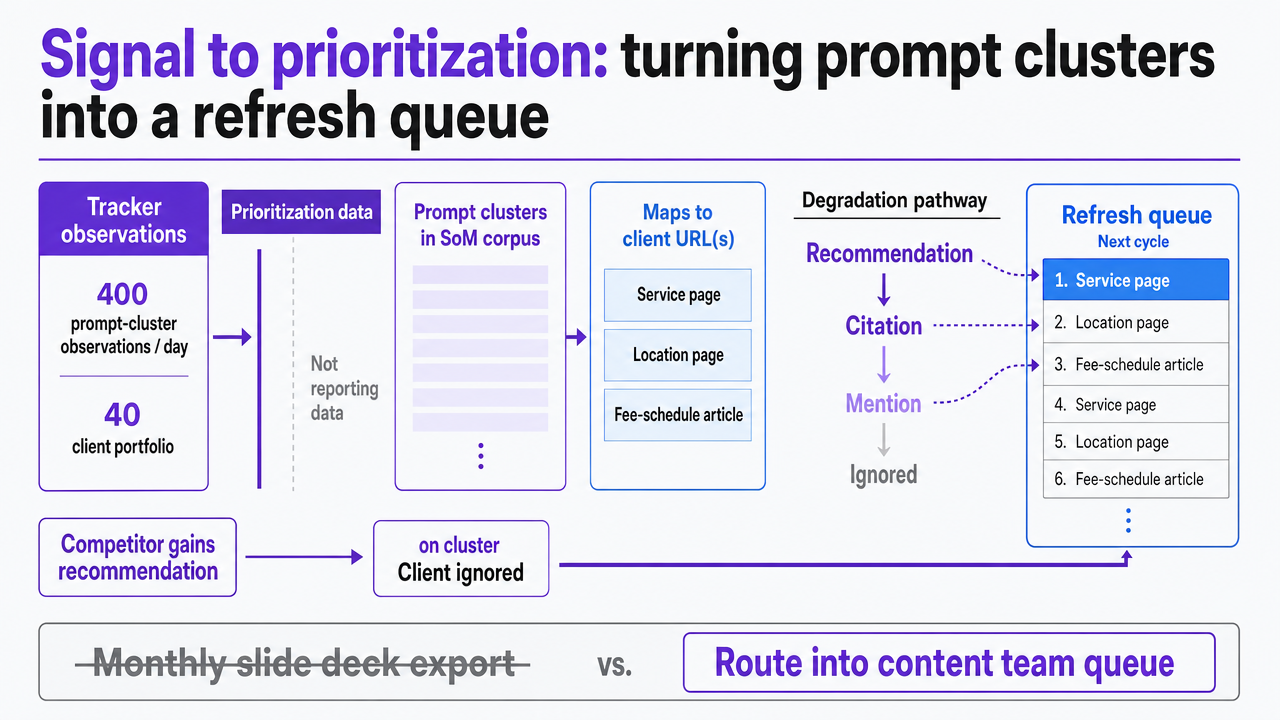 Visualize the production workflow that converts tracker observations into a prioritized refresh queue, matching the operational process the section describes
Where automation is safe and where human review has to stay
Not every step in the loop deserves the same level of oversight. The observation layer — scheduled prompt runs, state classification, competitor mention logging, SoM recalculation — is safe to automate end to end. The tools already run these on daily or weekly cadences without analyst intervention 8, and the outputs are deterministic enough that a human reviewing each refresh adds cost without adding accuracy.
Prioritization is a middle case. Auto-generating the refresh queue from state deltas and competitor gaps is safe. Auto-assigning that queue to writers is not. A cluster showing a citation drop may reflect a genuine content decay, or it may reflect refresh-cycle variance across engines — the black-box scoring problem the tool reviews have flagged 3. An SEO strategist eyeballing the top of the queue for false positives before it hits production catches the second case in minutes.
Publishing is where human review is non-negotiable, especially in legal, healthcare, and financial verticals where a tracker-suggested rewrite can introduce claims the client's compliance team has not approved. The operating pattern that scales is approval-first: automate the signal, automate the ranking, keep the sign-off. Platforms like Vectoron structure the workflow around that split — recommendations surface with reasoning, execution waits for approval — which is the shape a portfolio-scale AI visibility loop needs to take.
If you manage a portfolio: operating economics across 15–60 clients
The economics shift the moment an agency crosses roughly 15 accounts. At that scale, the analyst-hours a tracker consumes on manual review start to eclipse the hours it saves in reporting, and the refresh cadence stops being a feature and starts being a staffing constraint. A Head of SEO running a 40-client portfolio is not buying a tracker. They are buying a rate of observation their team can act on.
The variables that actually move the operating model are narrower than the tool marketing suggests: prompt clusters per client, refresh cadence, engines covered, and where the human review sits. The table below frames the tradeoffs against the ~3-day, 5–7 engine benchmark surfaced in the 2026 comparative analysis of AI SEO tracking platforms 4.
| Variable | Light portfolio (15–25 clients) | Mid portfolio (26–45 clients) | Heavy portfolio (46–60 clients) |
|---|---|---|---|
| Prompt clusters per client | 20–30 | 30–45 | 40–60 |
| Refresh cadence | Weekly | Every 3 days 4 | Every 3 days, staggered |
| Engines covered | 5 | 5–7 4 | 5–7, tiered by client |
| Analyst hours per client per month (manual review) | 3–5 | 4–6 | 5–8 |
| Analyst hours per client per month (queue-fed workflow) | 1–2 | 1–2 | 1.5–2.5 |
| SoM reporting cadence to client | Monthly | Bi-weekly | Monthly with weekly delta alerts |
The hours reclaimed per client per month — the delta between manual review and a queue-fed workflow — is where portfolio math gets interesting. On a 40-client book, the difference between five analyst hours and two per client is 120 hours reclaimed monthly, which is closer to a headcount decision than a line-item saving. That is the number to defend at a leadership review, not the tracker's list price.
Two operating rules hold across all three tiers. Stagger refresh cycles across the portfolio so that observation load spreads evenly through the week rather than spiking on a Monday. And tier the engine coverage: not every client needs Meta AI monitoring, and paying for it on all 60 accounts is where budget quietly leaks.
See How Leading Agencies Integrate AI Visibility Tracking Across Client Portfolios
Request a walkthrough of enterprise-grade AI visibility trackers, including workflow integration and KPI impact data for multi-client SEO operations—purpose-built for agencies managing high-stakes, multi-location brands.
The measurement honesty problem
Every AI visibility tracker on the market ships with three unresolved problems, and pretending they are solved is the fastest way to lose a client argument. Naming them once, in one section, is more useful than sprinkling caveats through every report.
- The first is black-box scoring. Several vendors publish composite visibility scores without disclosing the weighting behind them, and the review literature has flagged the resulting comparability issues across tools 3. Two trackers can watch the same client on the same day and produce different scores, because each is applying its own undocumented math to the underlying observations. The defensible move is to report on raw state counts — recommendations, citations, mentions, ignored — and treat any vendor's composite score as a directional indicator rather than a KPI a client should be graded against.
- The second is refresh variance across engines. A ChatGPT answer at 9 a.m. and the same prompt at 3 p.m. can produce different brand mentions, and no tracker resolves that stochasticity by polling harder. Cadence smooths noise; it does not eliminate it. A single-cycle drop in citations is rarely a story worth reporting.
- The third is the absence of standardized KPIs across the category, a gap the 2026 monitoring-tool literature explicitly acknowledges 8. There is no MOZ-equivalent authority for AI visibility, no agreed definition of "citation frequency," and no cross-vendor benchmark for what a healthy SoM looks like in a given vertical. Agencies that pretend otherwise get caught when a client compares two vendor reports side by side. The operating stance is simpler: define the corpus, define the weighting, hold both stable across cycles, and let the client-specific delta carry the reporting weight.
AI visibility as an attribution input, not a vanity metric
The value of AI visibility data collapses when it lives on its own dashboard. It compounds when it feeds the same attribution model the agency already runs for paid, organic, and direct. Multi-touch and cross-channel attribution adoption has climbed in step with journey complexity, and AI-enhanced models are increasingly applied to reconcile high-dimensional touchpoint data that single-source reporting cannot resolve 9. A Perplexity citation on a bottom-funnel prompt is a touchpoint. A ChatGPT recommendation that precedes a branded search two days later is a touchpoint. Neither shows up in GA4 with an honest label unless the agency routes tracker outputs into the attribution layer.
The mechanics are prosaic. Prompt-cluster observations get timestamped and tagged by state — recommendation, citation, mention — and joined against branded search lift, direct traffic deltas, and assisted-conversion paths in the same warehouse that already holds GSC and rank data. Where direct observability is thin, modeled conversions fill the gap, which is the pattern platform-side measurement guidance already endorses under privacy constraints 10. The output is not a cleaner attribution model. It is one that stops undercounting the AI surface.
Reporting SoM alongside assisted-conversion movement, rather than as a standalone slide, is what keeps the metric out of vanity territory and inside the quarterly business review.
Frequently Asked Questions
References
- 1.Best AI search analytics tools for marketing teams.
- 2.22 Best AI Search Rank Tracking & Visibility Tools for 2026.
- 3.The Best AI Visibility Tracking Tools (My Honest Reviews).
- 4.AI SEO Tracking Tools 2026: Comparative Analysis of Over 30 Platforms.
- 5.14 best tools to track brand visibility in AI search.
- 6.How do you rank in AI? Top AI Visibility Tools Overview.
- 7.Share of Voice - SEO Visibility & Competitor Benchmarking - SEOJuice.
- 8.AI Search Monitoring Tools 2026: The Best Platforms to Track ....
- 9.Marketing Attribution Statistics (Multi-Touch, Cross-Channel, AI).
- 10.How AI is Transforming Marketing Measurement.