
Key Takeaways
- Google shipped three core updates in 2025 plus overlapping spam actions, making single-cause attribution unreliable and turning rollout cadence into a portfolio-level risk agencies must model 11, 12.
- The March 2024 quality reset removed 45% of low-quality content, resetting the scoring threshold so any content strategy predating it now competes against a moving benchmark 5, 16.
- Scaled content abuse and site reputation abuse policies now target intent and editorial ownership regardless of authorship, exposing programmatic directories, /partners, /deals, and contributor placements to enforcement 4, 6.
- AI Overviews cut traditional clicks from 15% to 8% of visits, and only about 15% of citations overlap with top-10 rankings, so reporting must track organic and citation visibility separately 9, 10.
The Portfolio-Level Risk Nobody Priced In
Agency SEO leaders spent 2024 and 2025 absorbing a run of ranking-related changes that arrived faster than most retainer scopes could accommodate. Google's status dashboard confirms three core updates in 2025 alone, with the final rollout running from December 11 to December 29 and reshuffling rankings across every vertical 11, 12. That cadence is now the baseline, not the exception.
The uncomfortable reality for anyone managing a book of clients: the volatility is no longer contained to individual pages. Google's own documentation describes ranking systems that combine page-level signals with site-wide signals, which means a quality problem on one product category can drag a whole domain 1. A single client with thin content is one problem. Forty of them, publishing on production timelines set before the March 2024 quality reset, is a portfolio-level exposure that most agency P&Ls never modeled 5.
Layer AI Overviews on top, and the risk compounds. Rankings move, click-through drops on the pages that survive, and citation patterns in AI summaries only loosely track the top ten 9, 10. Agencies that treated each client as an isolated engagement now face a systems problem across the entire roster.
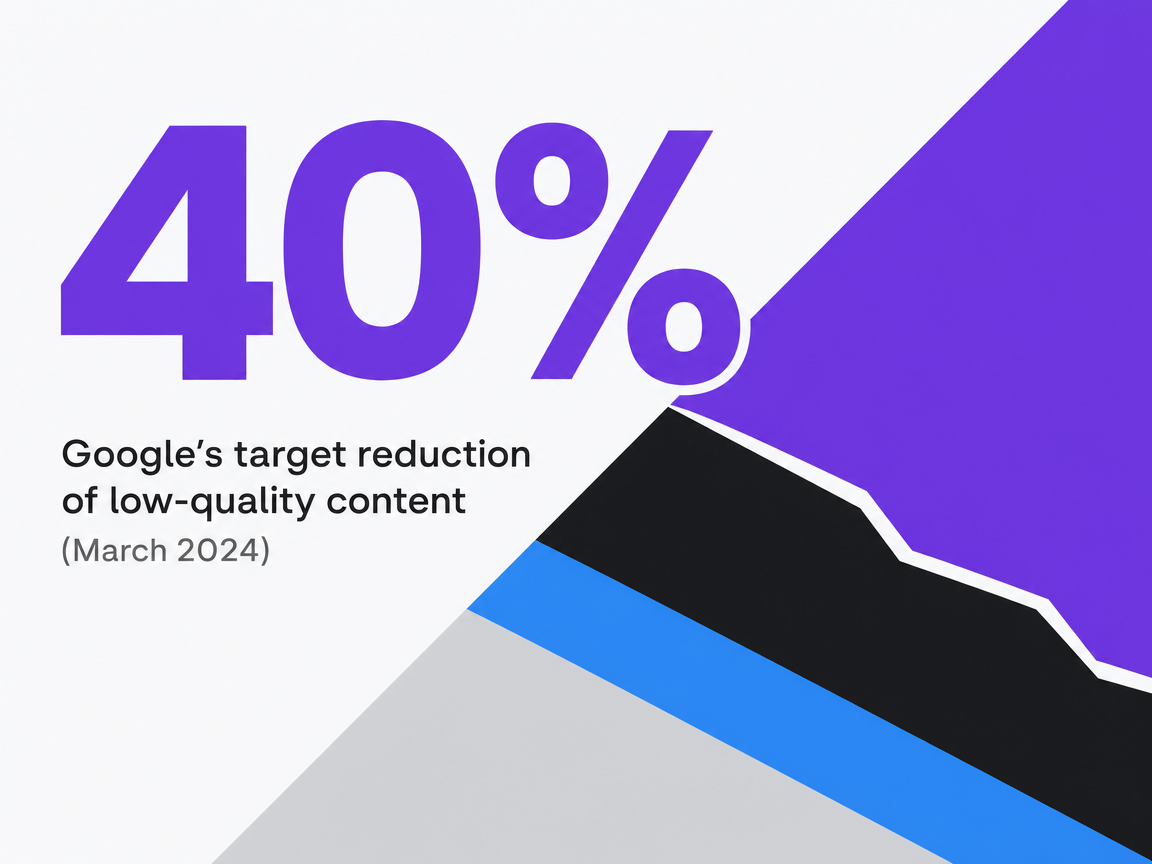 Google's target reduction of low-quality content (March 2024)
Google's target reduction of low-quality content (March 2024)
A Calendar of Volatility: What Actually Shipped in 2024–2025
Core Updates Now Ship in Overlapping Waves
Anyone attributing a client traffic drop to a single rollout is fighting the calendar. Google's status dashboard confirms:
- a March 2024 core update that ran 45 days
- a 14-day March 2024 spam update
- a June 2024 spam update from June 20 to June 27
- an August 2024 core update lasting 19 days
- consecutive November and December 2024 core updates that closed the year with almost no quiet window between rollouts 2, 13
The pattern continued into 2025: three core updates over the year, with the March 2025 rollout running March 13 to March 27, and the December 2025 core update running December 11 to December 29 11, 12.
For an agency managing thirty or forty client sites, this cadence breaks the standard diagnostic workflow. A drop that begins mid-rollout may reflect the current update, residual movement from the prior one, or a spam-side reassessment happening on its own timeline. Google's own ranking-systems documentation notes that page-level and site-wide signals interact across multiple systems, which means a single client's chart can be answering three questions at once 1.
The practical adjustment is to stop writing update-specific recovery memos to clients. Track rollout windows from the dashboard, hold analysis until the window closes, and compare portfolio-wide movement against the affected verticals rather than isolating any one property. Single-cause attribution is a story clients want. It is not what the data supports 8.
The Quality Bar Moved: 45% Less Low-Quality Content
Google went into the March 2024 core update announcing a 40% target reduction in low-quality, unoriginal content in results. After the rollout, the company revised that number upward, stating searchers would see 45% less low-quality, unoriginal content than before 5, 16. The five-point delta between forecast and outcome is the number worth studying. It signals that the threshold cleared more content than Google's own pre-launch modeling anticipated.
That gap changes how agency leaders should read the update. A 40% reduction is a policy target. A 45% actual reduction, sustained across subsequent core updates and reinforced by the August 2024 rollout's stated focus on surfacing genuinely useful content, is a threshold reset 17. Pages that cleared the bar in February 2024 were not grandfathered. They were reassessed against a higher standard.
For portfolio operators, the implication is direct. Any client whose content strategy predates March 2024 is running against a scoring model that was retuned mid-year and has been retuned again in every core update since. Google's core update documentation is explicit that recovery is not about reacting to one rollout but about the overall quality of what is on the site 3. Translating that into agency operations: the audit question is not "which pages dropped in the last window," but which pages would clear a 45%-reduction bar if they were being scored for the first time today.
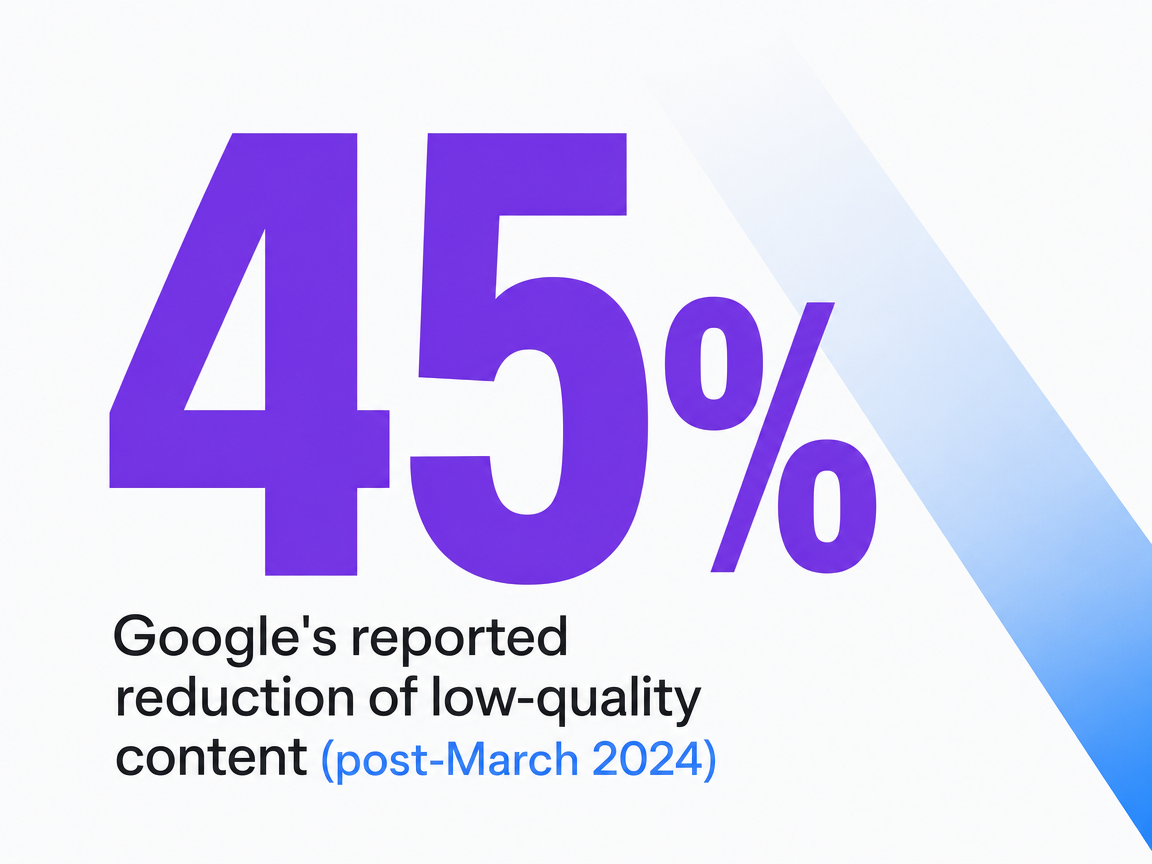 Google's reported reduction of low-quality content (post-March 2024)
Google's reported reduction of low-quality content (post-March 2024)
Where Scaled Content Crosses Into Spam Policy
Reading the March 2024 Scaled Content Language Like an Operator
The March 2024 spam policy update rewrote the boundary agencies operate against. Google's language treats "producing content at scale to boost search ranking" as abuse whether the work is done by automation, humans, or a combination 16. The method is not the trigger. The intent to manipulate ranking is. That framing collapses a distinction most agency production lines were built around.
Google's spam policies page reinforces the point, defining scaled content abuse alongside cloaking, doorway abuse, and link spam as behaviors intended to "deceive users or manipulate" Search systems 4. Enforcement dates matter here: the March 2024 policies took effect for scaled content immediately, with related rollouts continuing through the year, including the June 2024 spam update that ran from June 20 to June 27 as a broad enforcement pass rather than a link-only action 13, 14.
For a portfolio operator, the practical read is not "stop producing at volume." It is that volume without a defensible per-page purpose is now the enforcement signature. Two questions distinguish scaled production from scaled abuse:
- does each page answer a query a real user would type
- does it contain information, judgment, or firsthand context a searcher cannot get from the first ten results already indexed
Programs that fail both are exposed regardless of who or what wrote them.
Site Reputation Abuse and the End of Parasite Placements
The site reputation abuse policy, clarified in November 2024, targets a specific arrangement: publishing third-party pages on a host domain "in an attempt to abuse search rankings by taking advantage of the host site's ranking signals" 6. Google's initial May 5, 2024 enforcement date focused manual action on the clearest cases; the November update tightened the written policy to remove ambiguity about intent 16.
Any agency running syndication deals, sponsored subfolders, coupon microsites hosted on client domains, or contributor programs that publish outside content under a stronger domain's authority is now operating inside the enforcement surface. The policy does not prohibit guest content or partnerships. It prohibits arrangements whose primary function is transferring ranking signals to material the host would not otherwise vouch for.
The operational test is editorial control. If the client's editorial team cannot defend why a given third-party page belongs on the domain, and cannot show substantive review before publication, the placement is at risk. Portfolio-wide, the exposure is often invisible from a rankings dashboard until enforcement arrives. Auditing every client's /partners, /deals, /reviews, and /guides directories for third-party content lacking editorial ownership is a task worth running this quarter, before the next spam update rolls 4.
Test real-time SEO adaptation on live sites
Experience direct impact by publishing optimized content in response to the latest algorithm changes during your trial.
AI Overviews Are Not a Separate Optimization Problem
The Click Loss Is Real, and It's Measurable
The strongest behavioral evidence to date on AI summaries comes from Pew Research, which analyzed real Google browsing activity from 900 U.S. adults across 68,879 searches conducted in March 2025. When an AI summary appeared on the results page, users clicked a traditional search result on 8% of visits. When no AI summary appeared, that rate was 15%. Clicks on links inside the summary itself landed at 1% 9.
The shape of that delta matters more than the headline number. It is not a case of the AI summary redirecting clicks to its own citations. It is a case of the session ending. Users read the summary, get what they came for, and close the tab. For agency SEO leaders reviewing client dashboards, this reframes what a flat impression count with declining clicks actually means. It is not a targeting or intent-match failure. It is a surface change on the SERP itself.
The scope of the Pew study is worth stating plainly so the finding is not overextended. It measures U.S. adult browsing behavior in a specific month, across a broad query mix, and does not isolate commercial versus informational intent or any single vertical. Click loss will vary. Legal, medical, and financial queries — where AI summaries carry more caveats and users often need a source — likely behave differently than recipe or definitional queries. Agencies should not model a uniform 47% relative click drop across every client. They should model that top-of-funnel informational content is now competing with a summary that answers the question before the click, and adjust the KPI mix accordingly.
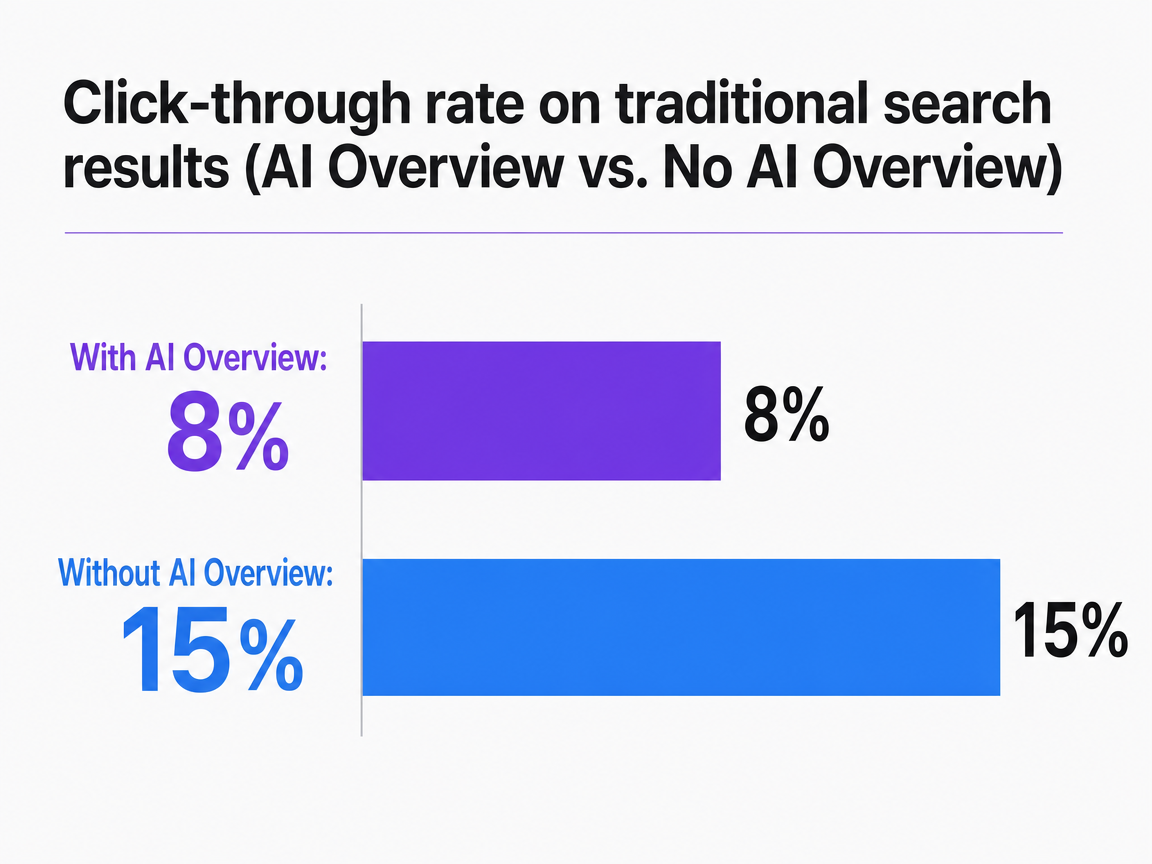 Click-through rate on traditional search results (AI Overview vs. No AI Overview)
Pew Research found that when an AI summary appeared, users clicked a traditional search result in 8% of visits, compared to 15% of visits when no AI summary was present.
Citation and Ranking Are Decoupling
BrightEdge data reported after the March 2025 core update showed the overlap between pages cited in AI Overviews and pages ranking in the top 10 organic results moving from 16% to 15% 10. The one-point drop is not the interesting number. The absolute level is. Even before the update, only about one in six AI Overview citations came from a page also ranking in the traditional top 10 for that query. After the update, the fraction fell slightly further.
That gap tells agency leaders two things. First, ranking well organically no longer guarantees inclusion in the AI summary above the organic results, and being cited in the summary no longer requires a top-10 rank. Second, the two visibility surfaces are being scored, at least in part, by different criteria. A page can win one and lose the other on the same query.
The temptation is to read this as an opening — pages outside the top 10 have a real shot at citation, so the strategy becomes bidding for AI Overview inclusion directly. That reading misplaces the causal weight. The BrightEdge overlap moves in one direction across an update, but Google's own documentation on core updates continues to describe ranking as a broad quality reassessment, not a citation-eligibility tuning 3. Pages that get cited tend to be the ones that answer a specific sub-question cleanly, whether or not they rank number one for the parent query.
Why 'AI Overview Optimization' Is Not a Distinct Tactic Stack
The market is already producing service lines branded around AI Overview optimization, generative engine optimization, and AI-citation strategy. The research does not support treating this as a separate discipline. Google's spam policies explicitly extend to attempts to manipulate generative AI responses, and the spam policies page was updated to include that language 4. Anything that would count as gaming a citation is already inside the same enforcement surface as gaming a rank.
The pages that get cited in AI Overviews are pages that cover a topic with enough specificity that a summarizer can pull a defensible answer from them. That is the same content posture the March 2024 quality reset already rewarded 16. The tactic is not new. The reporting is.
For agency operations, the practical read is to fold AI-citation tracking into the existing content brief and QA loop rather than spinning up a parallel workflow. One quality bar, two visibility surfaces, one production posture. The next section covers what that looks like inside briefs, QA, and client reporting.
The Production Posture Agencies Should Adopt This Quarter
Briefs, QA, and the End of Volume as a Deliverable
The output metric that carried most agency retainers for a decade — pages shipped per month — is now the metric most likely to trigger enforcement. Google's spam policies treat scaled production intended to manipulate ranking as abuse regardless of authorship, and the language explicitly covers automation, human writers, and hybrid workflows 4, 16. That collapses the operational distinction between "we outsource to freelancers" and "we use AI-assisted drafting." Both are inside the same enforcement surface if the per-page purpose is thin.
The brief is where this gets fixed, not the QA checklist. A defensible brief specifies the exact query a page answers, the sub-questions a searcher would ask next, and the firsthand information the writer must contribute — a client interview quote, a pricing detail from the client's own systems, a case outcome, a data point from operational records. If the brief cannot name the original contribution before the page is written, the page is a candidate for the scaled-content bucket the March 2024 update targeted 5.
QA then changes shape. The reviewer is not checking for keyword density or heading structure. The reviewer is answering one question: would this page clear a first-time quality assessment against results published this quarter? Google's core update documentation frames recovery as a reassessment against newly published or improved content, which means the comparison set moves every rollout 3. Portfolio-wide, an agency running twenty client blogs on a shared brief template is running twenty pages against the same moving benchmark. One template failure is a portfolio failure.
Reporting: Two Visibility Surfaces, One Quality Bar
Client dashboards built around average position and organic sessions are now describing half the picture. The Pew browsing data showed session-ending behavior on results pages with AI summaries — users clicked a traditional link on 8% of visits with a summary present versus 15% without one 9. Flat impressions with declining clicks are no longer a diagnostic signal about the page. They are a signal about the SERP surface above it.
Reporting has to track both. Organic rankings and clicks remain the primary revenue surface for most client accounts, but a second column now belongs next to them: presence in AI Overview citations for the client's priority query set. Agencies that have added citation tracking are finding that the two columns move independently, consistent with BrightEdge's finding that only about 15% of AI Overview citations overlap with top-10 organic results after the March 2025 core update 10.
The reporting narrative to clients follows from the data structure. One quality bar produces two visibility outcomes. When a client asks why a page ranks fifth organically but does not appear in the AI summary, the answer is not a separate optimization gap. It is that the summarizer pulled a cleaner sub-answer from a different page. The fix is on the content side of the same production system, not a parallel workstream.
The Technical Baseline Clients Still Pay You to Hold
Content quality carries the ranking argument, but the technical baseline is the reason a client's site is eligible to be scored in the first place. Current page experience guidance centers on Core Web Vitals, with INP having replaced FID as the interaction metric, alongside responsive design, HTTPS, and avoidance of intrusive interstitials 15. None of these are ranking differentiators on their own. All of them are floor conditions.
The portfolio implication is boring and important. Every client site should be clearing Core Web Vitals thresholds on the templates that carry the priority query set — category pages, service pages, top-linked posts — before any content-quality work is scored against a moving benchmark. Agencies that let technical debt accumulate across a book of clients are running content programs against a scoring model that will discount the work.
Navigate Algorithm Shifts with AI-Driven Precision and Oversight
Connect to discuss how centralized, approval-first workflows and specialist AI can help agencies adapt to recent search algorithm updates without increasing headcount or losing strategic control.
If You Manage a Book of Clients: A Portfolio Exposure Matrix
Agency leaders running thirty or more accounts need a way to triage exposure across the roster before the next rollout window opens, not after. The matrix below maps the four enforcement and ranking surfaces active in 2024–2025 against the production levers an agency actually controls. Durations come from Google's status dashboard and confirmed 2025 reporting 2, 11.
| Exposure Surface | Rollout Signature | Portfolio Signal to Monitor | Production Lever |
|---|---|---|---|
| Core update | 19–45 day windows; three in 2025 including Dec 11–29 11, 12 | Sitewide movement across priority templates during and 14 days after the window closes | Per-page originality and sub-question coverage in briefs 3 |
| Spam update (scaled content) | 7–14 day windows; June 20–27, 2024 as reference 13 | Sudden drops on programmatic or template-driven directories | Kill or rewrite pages without a defensible per-page purpose 4, 16 |
| Site reputation abuse | Policy tightened November 2024; manual and algorithmic action 6 | Third-party subfolders, /deals, /partners, contributor pages on client domains | Editorial ownership test on every hosted third-party placement |
| AI Overview expansion | Continuous; overlap with top-10 organic at ~15% post–March 2025 10 | Impressions flat with clicks declining on informational query sets | Sub-question specificity in existing pages, not a parallel workflow 9 |
Two operating rules follow from the matrix:
- Score every client against all four surfaces each quarter, not only the one that caused the last complaint.
- Weight remediation by the surface most likely to fire next, which for most portfolios is the core-update window that has been running on a three-per-year cadence 12.
What to Tell Clients Who Ask If SEO Is Still Worth It
The honest answer is that search is still where the demand starts, but the surface has changed and the KPI mix has to change with it. Rankings still convert, and the pages that clear the current quality bar hold visibility across rollouts 3. What clients are actually asking, most of the time, is whether the money they spend on content is still buying attention. The data says yes, with conditions. Sessions that end on the SERP are real, and the pages that survive the shift tend to be the ones that answer a specific sub-question a summary cannot fully resolve 9.
The frame that holds up in a client meeting is this: search demand has not shrunk, but the click-per-impression yield on informational queries has compressed, and the ranking systems now reward sitewide quality signals more aggressively than at any point in the last five years 1, 16. Programs that were producing thin content on a monthly cadence are the ones asking whether SEO still works. Programs built around defensible, original pages are compounding through the rollouts, not against them.
The recommendation to give clients is unglamorous. Fewer pages, each with a defensible per-page purpose. A technical baseline that clears Core Web Vitals thresholds on the templates that carry priority queries 15. Reporting that tracks organic and AI-citation visibility as two outputs of the same content system. That posture is what platforms like Vectoron are built to run at portfolio scale — approval-first execution across content, technical, and monitoring workstreams without adding senior headcount to keep pace with a three-core-update year 12.
Frequently Asked Questions
References
- 1.A Guide to Google Search ranking systems.
- 2.History for Ranking | Google Search Status Dashboard.
- 3.Google Search's Core Updates.
- 4.Spam Policies for Google Web Search.
- 5.our March 2024 core update.
- 6.Updating our site reputation abuse policy.
- 7.Introducing our new guide to Google Search ranking systems.
- 8.How to Use the Google Search Status Dashboard.
- 9.Google users are less likely to click on links when an AI summary appears in the results.
- 10.Google AI Overview-organic ranking overlap drops after March 2025 core update.
- 11.Google December 2025 core update rollout is now complete.
- 12.Google algorithm updates 2025 in review: 3 core ....
- 13.Google June 2024 spam update done rolling out.
- 14.Google Completes June 2024 Spam Update Rollout.
- 15.Everything you need to know about page experience in 2025.
- 16.New ways we’re tackling spammy, low-quality content on Search.
- 17.What to know about our August 2024 core update.
- 18.Google SGE: Study Reveals Potential Disruption For Brands & SEO.