
Key Takeaways
- Stage one uses allintitle only to shrink a raw candidate list into a shortlist, recording the integer as a discovery signal rather than a difficulty verdict.
- Stage two checks the live SERP for dominant intent format and feature saturation, rejecting phrases whose above-the-fold layout the client cannot realistically enter 10.
- Stage three replaces the raw count with a qualitative audit of the top ten organic results, scoring authority, depth, freshness, and topical fit 3.
- Stage four applies a four-input business-value rubric covering commercial proximity, existing coverage, internal linking value, and reporting attribution before any brief is written.
- Each stage carries a binary pass/fail gate so junior analysts reach the same qualification decisions as strategists without introducing subjective judgment calls.
Why the allintitle count keeps misleading agency keyword pipelines
Junior analysts often use allintitle: to identify keywords with low competition, leading to content that ranks poorly or generates minimal clicks. This approach is flawed because allintitle: restricts results to pages whose titles contain every specified term, acting as a filter on a single text field rather than a comprehensive difficulty score 9. Google's ranking system is far more complex, evaluating numerous page-level and site-wide signals such as neural matching, RankBrain, passage ranking, links, freshness, originality, reliability, and the helpful-content system 3. Relying solely on a single title-text filter cannot accurately approximate this multifaceted evaluation.
This misinterpretation is amplified at an agency level. When hundreds of keywords are pushed into production based on an incorrect qualification logic, every subsequent step—from content briefs to internal linking and reporting—is compromised. This article redefines allintitle: as merely the first step in a four-stage qualification workflow, providing agencies with clear pass/fail thresholds to ensure more effective keyword selection.
What allintitle actually measures — and what it doesn't
The allintitle: operator's function is singular: to narrow search results to documents where the title includes all specified terms 9. This is a basic string-match filter on a single text field, counting pages that Google associates with a title containing the exact tokens provided. It does not assign weight, score, or rank these pages against each other.
A significant discrepancy arises between what allintitle: inspects and what Google considers a title for ranking purposes. Google's documentation indicates that the displayed title link is generated from multiple sources, including the HTML <title> element, on-page headings, other prominent visible text, anchor text, and structured data 1. Consequently, a page can rank highly for a query even if its final displayed title differs from its HTML title. This is a standard feature of how Google assembles search results, not an anomaly.
Operationally, this means allintitle: queries only the HTML title field, while Google's ranking layer synthesizes a title from at least five signal sources. A competitor with a strong H1, optimized anchor text, and relevant schema can outrank a page whose HTML <title> contains all target terms. Such a competitor would not appear in the allintitle: count but would be present in the SERP.
This leads to two mechanical limitations:
- First, the
allintitle:count systematically underestimates the true number of title-relevant competitors by ignoring other title sources Google uses. - Second, it provides no insight into the quality or authority of the pages it does return. A title-matched page from a low-authority domain with thin content is counted identically to one from an authoritative publisher.
Treating this integer as a difficulty proxy oversimplifies Google's multi-source, multi-signal ranking reality 3.
The ranking-signal gap: one filter versus a scored system
Assuming an allintitle: count reflects difficulty incorrectly equates the operator's inspection field with Google's ranking criteria. Google's ranking systems documentation details an evaluation process that considers numerous factors across billions of pages, including neural matching, RankBrain, passage ranking, links, freshness, originality, and reliability 3. The presence of title terms is just one input among many, not the primary determinant of ranking.
The core issue is a mismatch in scale. An allintitle: query yields a single integer from one string-match filter on one field. A ranked SERP, however, is the product of a weighted composite of these diverse signal categories. This highlights the analytical gap: one axis of title-term presence versus at least seven signal categories, none of which the operator inspects 3. Any workflow that reduces this complex composite to a title-count threshold disregards most of the information Google uses for ranking decisions.
This gap further widened in March 2024, when Google integrated the helpful-content system directly into its core ranking systems 3. Page-level assessments of originality, depth, and user value are now part of the same core evaluation as links and relevance. A page that passes an allintitle: filter can still be outranked by a competitor with superior topical depth, better internal linking, and clearer first-hand expertise. The allintitle: operator would treat both pages as equally contributing to its count, failing to differentiate their actual competitive strength.
Consequently, no allintitle: threshold can definitively identify low competition, as Google does not publish a single ranking formula and explicitly describes its process as multi-signal 3. Any cutoff (e.g., 10, 25, 100 results) is a local heuristic, not a Google-defined boundary. The operator's output should be viewed as a candidate count, not a competitive verdict. A phrase with fourteen title-matched pages might face three strong competitors and eleven weak ones, while a phrase with eighty might face eighty weak pages and one authoritative one. The integer alone cannot distinguish these scenarios; stages two and three of the workflow are crucial for this differentiation.
Test low-competition keyword strategies on live sites
Validate allintitle keyword opportunities and publish real content during your trial—measure actual ranking impact fast.
A four-stage qualification workflow for agency teams
Stage 1 — Title-match scan with allintitle
Stage one's purpose is to refine a raw list of keyword candidates—sourced from Search Console, competitor analysis, or seed-expansion tools—into a manageable shortlist for human review. The analyst uses allintitle: in an incognito window for each phrase, records the resulting integer, and proceeds. This count is a candidate indicator, not a final judgment.
To maintain accuracy, two operational rules apply:
- First, the phrase must be queried exactly as a user would type it, without quotation marks within the operator, as
allintitle:already restricts results to titles containing all specified terms 9. Adding quotes alters the match logic, yielding a different, non-comparable count. - Second, the count must be recorded on the same day the SERP audit (stage three) will occur. Title-matched inventories fluctuate as pages are updated, retitled, or deindexed, making older counts unreliable for current SERP analysis.
This stage does not assign a difficulty score, predict click volume, or approve a phrase for a brief. Whether a phrase returns six or six hundred title-matched pages, it advances with the same status: candidate, awaiting intent review. The scan's sole function is to eliminate phrases so saturated with title-matched competition that further analysis would be inefficient. All surviving candidates move to stage two.
Stage 2 — Intent and SERP-feature reality check
Stage two addresses two critical questions that allintitle: cannot: whether the query's live SERP aligns with the client's service capabilities and if organic listings will receive significant clicks given existing SERP features. Both are assessed directly from a live, incognito SERP.
The intent analysis is straightforward. The analyst examines the top ten organic results to identify the dominant content format—e.g., commercial landing pages, editorial guides, comparison lists, forum threads. If a SERP is dominated by e-commerce category pages, a blog post, regardless of a low allintitle: count, will not succeed. Google's Search Essentials emphasize matching content format to user expectations 5. If the client cannot produce the dominant format at a competitive quality, the phrase is rejected.
The SERP-feature analysis often reveals why low-competition candidates fail. Studies show that SERP features can negatively impact organic click-through rates, with effects varying by ranking position, feature type, and site inclusion 10. Features like AI Overviews, People Also Ask, local packs, and shopping modules push organic results down or answer queries directly. A phrase with eleven title-matched pages but a feature-rich SERP might yield fewer clicks than one with three hundred title-matched competitors and a clean ten-blue-links layout.
The operational rule for stage two is to reject any candidate whose SERP is dominated by a feature the client cannot leverage (e.g., an AI Overview where they won't be cited, a local pack outside their service area, a shopping module not fed by their catalog), irrespective of the allintitle: count. Surviving candidates receive a one-line SERP note detailing the dominant intent format, feature presence and type, and whether the client's domain appears in any feature. This note serves as a reference for stage three's competitor audit and for strategist review.
Stage 3 — Competitor quality audit on the live SERP
Stage three replaces the quantitative allintitle: count with a qualitative assessment of the pages actually ranking. The analyst reviews the top ten organic results (not the allintitle:-filtered set) and scores each on four criteria:
- Domain authority (e.g., established publisher, forum, thin affiliate)
- Content depth (assessing if the page answers related subquestions)
- Freshness (publication or update date relevant to the topic)
- Topical fit (whether the broader site cluster supports the query)
This audit is crucial because Google's ranking documentation explicitly states that page-level judgment incorporates links, originality, reliability, and helpful-content evaluations alongside relevance 3. A title-matched page from a domain lacking topical depth, recent updates, or a strong backlink profile is a weak competitor, even if included in the allintitle: count. Conversely, a title-matched page from an authoritative publisher with robust internal linking and first-hand expertise is a strong competitor, regardless of the raw count.
Google's title-link documentation also highlights that displayed titles can originate from HTML titles, headings, visible text, anchor text, and structured data 1. Pages ranking in the top ten without an exact HTML title match are still competitors and must be evaluated. The analyst records a competitor-strength rating—strong, mixed, or weak. Mixed or weak SERPs advance. Strong SERPs are rejected unless the client possesses a demonstrable content or link advantage identified during the audit.
Stage 4 — Business-value scoring before brief handoff
The final stage determines if a surviving candidate warrants the client's production budget. A phrase might pass the first three stages but still fail here if its business value is insufficient to prioritize over higher-yield candidates.
The scoring rubric uses four inputs, each rated on a three-point scale to ensure consistent output from junior analysts. These inputs are:
- Commercial proximity (top, middle, or bottom of the client's funnel)
- Existing coverage (does the client already rank for a close variant, risking cannibalization)
- Internal linking value (does an existing pillar or service page need this asset)
- Reporting attribution (can the client's analytics accurately measure the page's contribution)
Candidates that score mid or high on all four inputs proceed to the brief queue. Those that pass stages one through three but score low on business value are moved to a secondary list. This list is useful for expanding topical breadth or supporting pillar content rebuilds but not for standalone briefs. The initial allintitle: count, which began the workflow, is now a deeply embedded data point in the qualification record, appropriately positioned as a discovery filter.
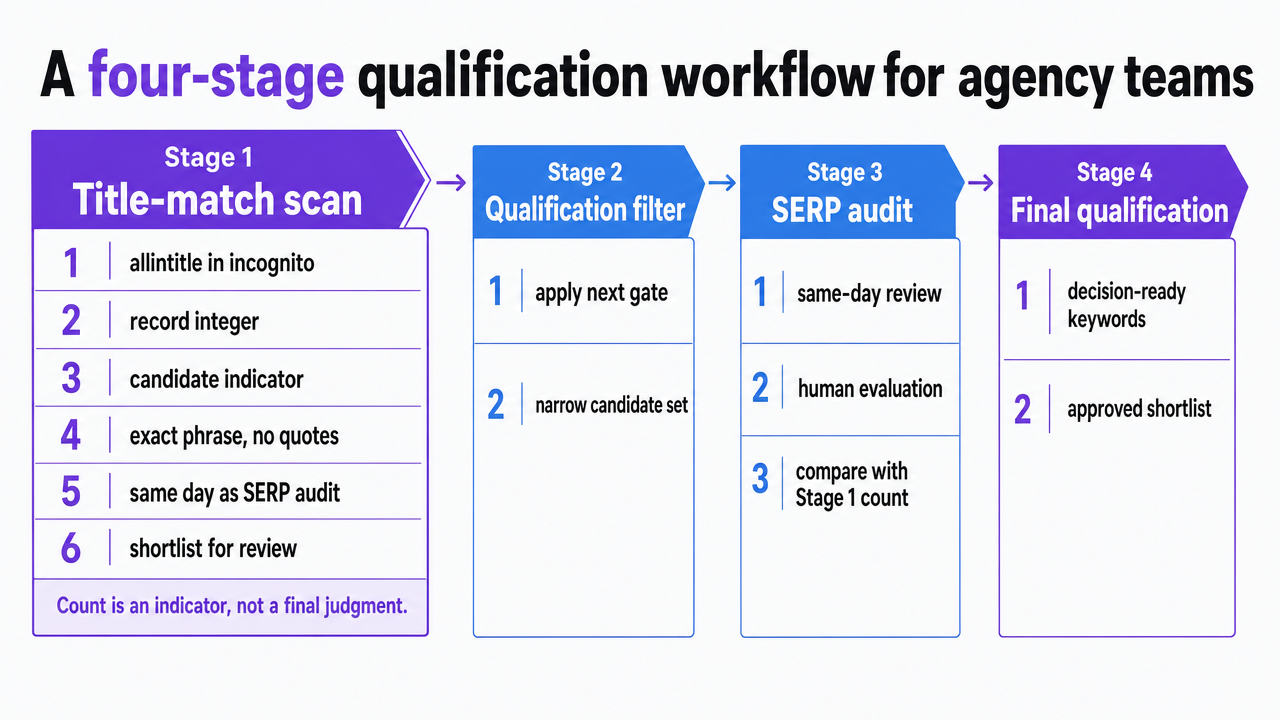 Visualize the four-stage keyword qualification workflow described in the section, giving readers a scannable map of the sequential gates
Pass/fail thresholds junior analysts can apply without a strategist
For a workflow to be effective, a junior analyst must be able to apply it consistently, producing the same qualification decisions as a senior strategist. This requires clear, binary gates at each stage, rather than subjective prompts. The following thresholds assume the analyst has already recorded the stage-one count, the stage-two SERP note, and the stage-three competitor assessment.
Stage 1 — Title-match scan. Advance the candidate unless the allintitle: integer indicates saturation for the client's domain profile. Rejection occurs only when the count is so high that a stage-three quality review would be inefficient. No universal number applies, as Google's ranking systems evaluate many signals beyond title-term presence and do not publish such a threshold 3. Each team must establish its own cutoff per client tier and review it quarterly.
Stage 2 — Intent and SERP features. Reject if the dominant organic format cannot be produced by the client at a competitive quality, or if a SERP feature the client cannot enter occupies the above-the-fold viewport 10. Advance if the dominant format matches an existing asset template and the feature layout allows for clickable organic listings.
Stage 3 — Competitor audit. Reject if the audit reveals a strong competitive landscape, unless a specific content or link advantage for the client is identified. Advance for mixed or weak competitive landscapes, applying the title-source correction from Google's title-link documentation 1to ensure pages ranking without strict HTML title matches are still scored.
Stage 4 — Business value. Advance only if at least three of the four rubric fields score mid or high. If two or more fields score low, the candidate is moved to the secondary list. The analyst does not have discretion to override; this decision rests with the strategist during weekly pipeline reviews.
Accelerate Keyword Discovery with AI-Driven allintitle Analysis
Connect with specialists to streamline low-competition keyword identification at scale—enabling your team to deliver data-backed SEO wins across multiple clients without expanding headcount.
If you manage multiple client accounts: qualification cost per portfolio
The four-stage workflow outlined above focuses on a single client account. Agency leads managing keyword pipelines across multiple clients face a different challenge: optimizing analyst time per candidate before it reaches a brief, and understanding the pass-through rate at each gate. Modeling this efficiency is crucial for scaling pipelines without over-committing strategist time.
The table below illustrates the qualification pass-through for a single client account using variables, not specific dollar figures. This research does not include agency pricing or analyst wage benchmarks, and Google does not publish a ranking threshold to fix the stage-one cutoff 3. Agency leads should input their own account tiers and internal rates.
| Stage | Analyst minutes per candidate | Illustrative pass-through | Candidates remaining (start: N) |
|---|---|---|---|
1 — allintitle: title-match scan | ~1 min | 60% | 0.60N |
| 2 — Intent and SERP-feature read | ~4 min | 50% | 0.30N |
| 3 — Competitor quality audit | ~8 min | 50% | 0.15N |
| 4 — Business-value scoring | ~3 min | ~65% | ~0.10N |
Two portfolio-level implications emerge. First, stages two and three consume approximately 80% of analyst time per candidate. Any attempt to bypass these stages for increased throughput risks reintroducing the very misinterpretations the workflow aims to prevent—such as a low allintitle: count masking a feature-heavy SERP 10or a title-source discrepancy hiding strong competitors 1. Second, the roughly 15% pass rate into stage four means an agency managing ten accounts with weekly pulls of one hundred candidates each will generate about 150 briefable phrases per week, not 1,000. Pipeline capacity should be planned based on the post-stage-three number, not the initial seed list. Strategists who budget against the raw count risk overpromising client coverage or compromising gate discipline to meet volume targets, leading to potential Search Console declines months later.
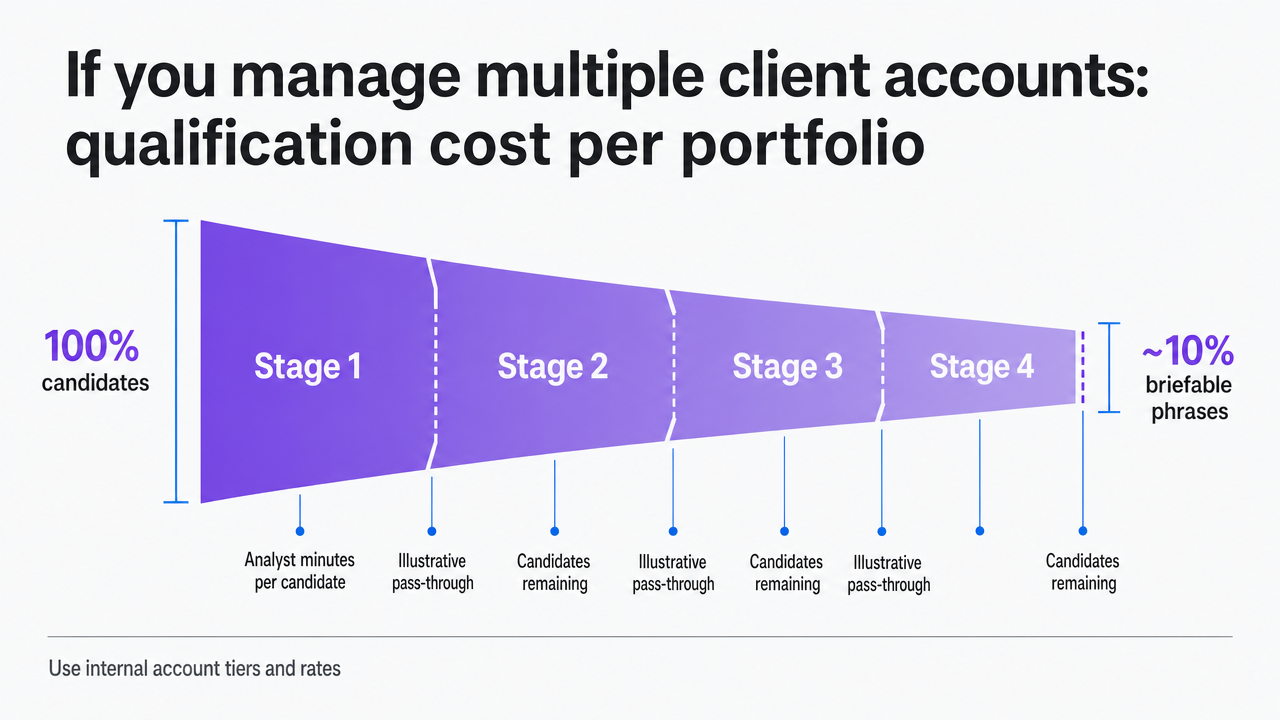 Visualize the funnel pass-through rates from the section's table, showing how 100% of candidates narrow to ~10% briefable phrases across the four stages
The scaled-content risk agencies keep underestimating
Agencies that treat allintitle: as a definitive green light, rather than an initial filter, often end up with a pipeline that produces numerous thin pages per client per month for low-count phrases. This rapid content generation, often due to a skipped qualification loop, now poses a significant spam-policy risk, not just a quality issue.
Google's guidance on generative AI content explicitly states that creating many pages with AI or similar tools without adding value may violate its scaled-content-abuse policy 4. The policy's focus is on whether the content provides substantive value to searchers, not on whether it was manually or automatically produced 6. A low allintitle: count alone does not guarantee value. It merely indicates few competitors have targeted the exact title tokens, a condition that makes mass-produced pages attractive to throughput-focused teams but appears as search-abuse patterns to Google's evaluation systems.
The portfolio math clarifies this risk. An agency using the four-stage workflow across ten accounts will produce a post-stage-three volume of approximately 15% of the initial seed list as briefable candidates. An agency that bypasses stages two and three, relying solely on a raw allintitle: threshold, will produce six to seven times that volume. This higher volume often comes with a quality distribution that Google's core ranking evaluation is designed to demote and its spam systems are designed to detect 3. Any perceived efficiency gain is temporary, as the subsequent remediation—dealing with deindexed pages, eroded client trust, and rebuilding content clusters—will consume far more analyst hours than the shortcut initially saved.
Frequently Asked Questions
References
- 1.Influencing Title Links in Google Search.
- 2.Search Engine Optimization (SEO) Starter Guide.
- 3.A Guide to Google Search Ranking Systems.
- 4.Google Search’s guidance on using generative AI content.
- 5.Google Search Essentials.
- 6.Google Search spam policies.
- 7.Debugging with Google Search Operators.
- 8.Latest Google Search Documentation Updates.
- 9.Search Operators - Google Guide.
- 10.Exploring the Impact of SERP Features on Organic Click-Through Rates.