
Key Takeaways
- The allintitle: operator filters Google results to pages whose HTML title tag contains every query term, giving a directional count of publishers deliberately targeting a phrase 2, 4.
- Result counts are index-snapshot estimates and the operator is not formally documented by Google, so treat allintitle: as a stable convention rather than a precise difficulty score 1, 2.
- Reject the 'under 10 equals easy' folklore because title presence is not title quality, and low counts can hide competitors who front-load keywords in the first 65 characters 6, 7.
- Judge competing titles against four rules: first-65-character placement, 1–2 keywords per title, descriptive and unique phrasing, and value-forward language over clever copy 6, 7, 10, 11.
- Pair the count with a top 10 SERP scan checking keyword placement, term density, and specificity to expose whether ranking pages earned position through strong or weak titles 6, 7, 11.
- Sort each keyword into Proceed, Investigate, or Deprioritize based on both the count and the title-quality scan, replacing single-threshold shortcuts with a two-input, three-action decision.
- Industrialize the workflow with locked query templates that block operator stacking, staggered manual submission to avoid CAPTCHAs, and clear pass-fail checks that junior analysts can own 2.
- Stop relying on allintitle: when SERPs are dominated by ads and local packs, when queries are branded or navigational, or when long-tail matches are too sparse to tier reliably 2.
Why Title-Tag Competition Signals Matter for Portfolio Keyword Research
Agency SEO leads managing keyword research across a dozen or more clients need a fast triage signal to filter raw keyword lists. The allintitle: operator provides this by restricting results to pages whose HTML title tags contain every term in the query, returning a count of documents that have explicitly targeted the phrase in the title tag, which search engines weight heavily 2, 4.
The title tag is a strong competition proxy because SEO best practices recommend placing the most important 1–2 keywords within the first 65 characters, and search engines assign higher weight to leading words 6, 7. When a competing page includes the target phrase in this position, it signifies a deliberate targeting decision. Counting such pages estimates how many publishers have made this strategic choice for a given query.
For portfolio managers, the value lies in enabling a documented, repeatable triage layer. This allows junior analysts or automated query templates to process client keyword lists efficiently, reserving the strategic judgment of agency leads for the shortlisted keywords. This article outlines a rubric for this process and addresses the operator's limitations.
What allintitle Actually Measures Inside Google Search
The Operator's Formal Definition and Google-Documented Behavior
The allintitle: operator filters Google's search results to display only documents where every term following the operator appears within the HTML title tag 2. For example, a query like allintitle:best dental implants near me will only show pages where all five words are present in the title element, excluding matches in the body, URL, or meta description 3, 4. The result count displayed by Google for such a query is the signal that agency SEO leads use for competitive analysis.
While allintitle: is not officially documented by Google in its Search Central for debugging, unlike operators such as site: or filetype: 1, its behavior is consistently observed. Independent sources like Google Guide, the University of New Mexico, and Newcastle University's 2025 operator PDF all describe its function as scoping to the title tag 2, 4, 5. However, its lack of formal support means its result counts, syntax tolerance, and future availability are not guaranteed. Agencies building workflows around this operator should treat it as a stable convention rather than a contractually supported API.
How allintitle Differs from intitle, Quoted Phrases, and Plain Queries
Understanding the distinctions between various query modes is crucial for accurate analysis. A plain query for personal injury lawyer returns any page Google deems relevant. A quoted phrase, "personal injury lawyer", narrows results to pages containing that exact string. The intitle: operator, as in intitle:personal injury lawyer, restricts only the first term to the title tag, with other words matched anywhere. In contrast, allintitle: restricts every term to the title tag 2, 3, 4.
Google Guide and UNM confirm that intitle:personal intitle:injury intitle:lawyer yields the same results as allintitle:personal injury lawyer 2, 4. This equivalence makes allintitle: efficient for scaling, as analysts only need to prepend the operator once for multiple terms.
Illustrative result-count comparison for the same three-word keyword across four query modes. Actual counts vary by index snapshot; the pattern is what analysts calibrate against 2, 3, 4.
In practical terms: plain queries can overstate competition, quoted phrases estimate demand for exact strings, and allintitle: specifically identifies pages that have deliberately targeted a phrase in the highly-weighted title field.
The Stacking Limit and Why Result Counts Are Estimates, Not Scores
Google Guide explicitly states that allintitle: should not be combined with other operators 2. Attempting to stack it with operators like site:, filetype:, or inurl: leads to unreliable results. Agency teams must enforce this constraint at the template level, preventing analysts from combining operators. Assuming a query like allintitle:best dental implants site:.com will yield a clean subset is a flawed approach.
The result count displayed by Google is an estimate, similar to any other SERP hit count. It is derived from Google's index snapshot at the time of the query and can fluctuate. Two analysts running the same allintitle: query an hour apart from different locations might see different counts. This variance does not invalidate the signal but indicates that the count is directional, suitable for categorizing keywords into broad bands, and not precise enough for a decimal-level difficulty score.
Presenting allintitle: counts as fixed numbers to clients can lead to misinterpretations. However, when presented as a triage band, supplemented with context from the top 10 SERP, the same number becomes a defensible input within a broader scoring rubric.
Rejecting the 'Under 10 Equals Easy' Myth
Where the Folklore Came From and Why It Misleads Agency Analysts
The notion that an allintitle: count under 10 signifies an "easy" keyword has been prevalent in SEO circles. This heuristic is appealing because it simplifies complex SERP analysis into a single, actionable threshold. Its origin is not from Google but from a community-driven simplification, easy to teach and market.
This heuristic is misleading for several reasons. First, allintitle: counts are estimates from Google's index snapshot and can vary by locale and query time. Since the operator is not formally documented by Google 1, 2, the number lacks contractual precision. A count of 7 for personal injury lawyer Denver might appear as 42 from a different IP an hour later. Treating this fluctuating number as a fixed difficulty score builds a rubric on an unstable foundation.
Second, the count only measures how many pages targeted the phrase in their title, not the quality of that targeting or their overall SERP entrenchment.
Title Presence Is Not Title Quality
A page might include every query term in its title tag but still rank poorly against a page with fewer terms. The allintitle: definition from Google Guide is a set-membership filter; it doesn't evaluate term placement, surrounding copy, or intent alignment 2, 3. A low allintitle: count might seem promising, but a deeper look at the SERP could reveal that many of those pages front-load the primary keyword within the first 65 characters, a position identified by peer-reviewed and publisher-side guidance as highly weighted 6, 7, 8.
For example, consider best dental implants near me. A low allintitle: count might be deceptive if, upon inspection, three out of six competing titles read Best Dental Implants Near Me | Board-Certified Prosthodontists, placing the keyword prominently. If the other three bury the phrase after a clinic name, the effective competition is three, not six. A raw allintitle: filter cannot discern this nuance. Agency analysts who report only the count provide a number that doesn't accurately reflect the actual ranking difficulty. The count is merely the first step; a title-quality inspection of the top 10 SERPs is essential for informed decision-making, as formalized in Section 5 10, 11.
Test live allintitle-driven workflows before committing
Validate scalable SEO research and content output in your agency workflow with real-time, publishable results.
The Title-Construction Rules That Make allintitle Signals Meaningful
The utility of an allintitle: count depends on an analyst's ability to interpret the returned titles. Four key title-construction rules, derived from peer-reviewed and publisher-side SEO guidance, define what constitutes genuine competition. Analysts should use these as a checklist when reviewing the top 10 SERPs.
- The primary keyword should be within the first 65 characters of the title. This zone is recognized as the most heavily weighted position, with search engines giving more importance to leading words 7, 8, 6. A title that buries the target phrase after a brand name or address loses significant weight, even if the terms are present.
- Title tags should ideally contain 1–2 keywords, abstracts 2–3, and dedicated keyword fields 5–7 11. A title excessively stuffed with keyword variants indicates weak optimization, not strong targeting, and should be down-weighted in competitive assessment.
- Titles must be descriptive, precise, relevant, and unique 6. Generic titles like Dental Implants Services are less competitive than specific ones such as Best Dental Implants Near Me | Board-Certified Prosthodontists, even if both appear in an
allintitle:query. - The title should succinctly state the key finding or primary value proposition, using primary keywords rather than clever phrasing 10. Strategic placement of key terms in the title, abstract, and keyword fields enhances indexing and appeal 9.
These rules provide a consistent checklist for junior analysts. While an allintitle: query confirms term presence, the actual competitive threat depends on how many of these four rules the title satisfies. The next section formalizes this scoring.
A Documented Scoring Rubric for allintitle Triage
Reading the Top 10 SERPs for Intent Fit and First-65-Character Placement
After obtaining the allintitle: count, the analyst's next step is a structured review of the top 10 organic results for the plain-query version of the phrase. The count indicates how many pages targeted the phrase in their title. The top 10 review assesses whether the ranking pages achieved their position with strong or weak titles. Both pieces of information are necessary before a keyword can move past the triage stage.
This scan is focused and rapid. For each of the top 10 titles, the analyst records three observations:
- Is the primary keyword within the first 65 characters, the position most heavily weighted by search engines 7, 8, 6?
- Does the title contain 1–2 keywords, aligning with optimal density guidance 11, rather than being keyword-stuffed?
- Is the title descriptive, precise, and unique to the query, or is it a generic service label combined with a brand name 6?
If most of the top 10 results satisfy all three criteria, it signals entrenched competition, regardless of the raw allintitle: count. Conversely, if the majority of results meet two or fewer criteria, it suggests a SERP where a well-constructed title can compete effectively, even if the raw count appears high. This inversion is a key insight provided by the rubric.
Three Triage Buckets: Proceed, Investigate, Deprioritize
The rubric categorizes each candidate keyword into one of three buckets, based on the combined assessment of the allintitle: count and the top 10 title-quality scan. These buckets provide operational instructions, not just scores, guiding the next steps for the analyst.
Proceed.
: This category is for keywords where the allintitle: count is directionally low, and the top 10 scan reveals that most titles lack strong first-65-character keyword placement or use generic phrasing 7, 6. These keywords are moved to the content brief queue, with a note on the title pattern the client's page needs to outperform.
Investigate. : This bucket is for keywords where the count and the top 10 scan present conflicting signals. This occurs if the count is low but three or more top results prominently feature the keyword with 1–2 focused terms in the title 7, 11, or if the count is high but most titles bury the phrase after a brand name or address 6. Keywords in this category require a second-pass review, incorporating backlink profile, domain authority, and SERP feature analysis before a final proceed or deprioritize decision.
Deprioritize.
: Keywords fall into this category if the allintitle: count is directionally high, and the top 10 scan shows most titles meeting all three quality checks: keyword in the first 65 characters, 1–2 terms in the title, and descriptive, unique phrasing 7, 11, 6. These keywords are dropped from the current cycle and can be revisited when the client's topical authority is sufficient to challenge entrenched competitors.
This rubric replaces the simplistic single-threshold approach with a two-input, three-action framework. Its consistent application ensures reliability, making it suitable for junior analysts and integration into query templates.
Worked Examples: 'Best Dental Implants Near Me' and 'Personal Injury Lawyer Denver'
These examples illustrate how the rubric refines keyword decisions beyond what the raw allintitle: count alone would suggest.
For Best dental implants near me, an allintitle: query typically yields a directionally low count. Under the old folklore rule, this would immediately send the keyword to production. However, the rubric mandates a top 10 scan. If four top titles are constructed as Best Dental Implants Near Me | Board-Certified Prosthodontists, with the phrase in positions 1–5 and no keyword stuffing, they satisfy all three quality checks 7, 11, 6. If the remaining six are generic, the mixed picture places the keyword in the "Investigate" bucket, not "Proceed." A second-pass review then determines if the client's domain can realistically outrank the four strong titles.
For Personal injury lawyer Denver, the allintitle: count is usually higher due to aggressive targeting by law firms. The folklore rule would typically deprioritize this keyword. However, a top 10 scan might reveal that most competing titles read Denver Personal Injury Lawyer | Firm Name — Free Consultation. This places the geographic modifier before the service term, pushing the primary keyword out of the highest-weighted zone 7, 6. While keyword presence is met, leading-word weight is forfeited. This keyword would then move to "Proceed," with a brief specifying Personal Injury Lawyer Denver in positions 1–4 of the client's title. The seemingly prohibitive count becomes actionable once the title quality is assessed.
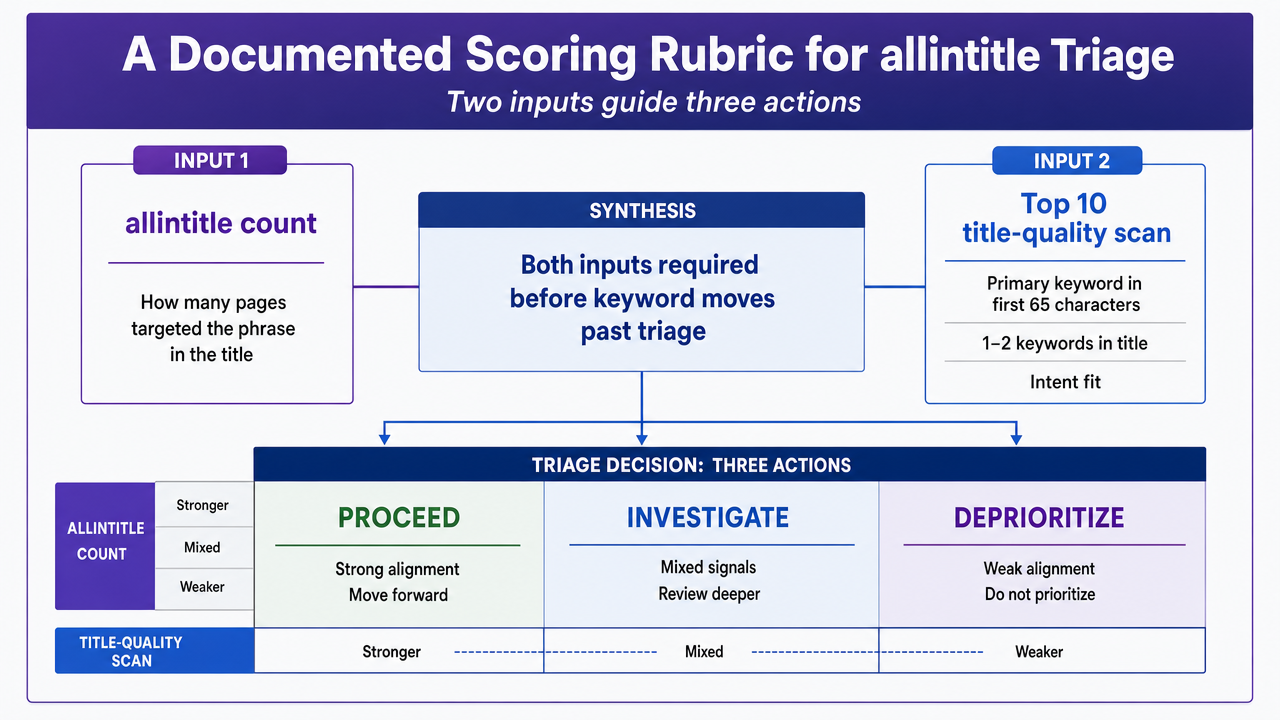 Visualize the two-input, three-action triage framework (allintitle count + top 10 title-quality scan mapping to Proceed, Investigate, Deprioritize) that the section explicitly defines
Streamline Keyword Opportunity Analysis with AI-Driven allintitle Insights
Connect with specialists to see how leading agencies automate competitive SERP research, quantify true ranking difficulty, and accelerate SEO workflows using scalable allintitle data—without increasing headcount.
Industrializing the Workflow Across a Client Portfolio
If an Agency Manages Multiple Client Keyword Lists: Portfolio-Level Triage Economics
When managing keyword research across numerous clients, the focus shifts to portfolio-level triage economics, measured in minutes-per-keyword rather than just ranking predictions. The combination of the allintitle: count and the top 10 title scan condenses what would otherwise be a full SERP review into a repeatable, two-input decision. This efficiency is where the workflow delivers significant value.
The table below illustrates the potential time savings per keyword compared to a full manual SERP review. The minute values are agency-defined variables and should be calibrated against internal analyst timing studies before being used as production estimates.
| Keyword Tier | allintitle Count Range | Recommended Analyst Action | Est. Minutes Saved vs. Full SERP Review (agency variable) |
|---|---|---|---|
| Proceed | Directionally low, top 10 titles weak on first-65-character placement 7 | Move to brief queue with title-pattern note | ~12–18 |
| Investigate | Count and top 10 scan disagree 6, 11 | Second-pass review: backlinks, DA, SERP features | ~4–8 |
| Deprioritize | Directionally high, top 10 titles hit all three quality checks 7, 11, 6 | Drop from current cycle | ~15–22 |
These economic benefits are realized only when the rubric is applied consistently across all clients. Inconsistent application, such as allowing one analyst to use the old folklore threshold while another uses the two-input rubric, undermines the portfolio consistency and the defensibility of time savings in client discussions.
Rate Limits, Query Templates, and What Junior Analysts Can Own
Google aggressively throttles automated allintitle: queries. Although there's no published rate limit since the operator is not formally documented 1, agencies sending numerous queries from the same IP quickly encounter CAPTCHA challenges and temporary blocks. This practical constraint means manual browser execution across staggered sessions is necessary, rather than scripted scraping. Query templates ensure standardization, while human input handles submission.
The template layer is critical for enforcing the non-stacking rule explicitly mentioned by Google Guide 2. A locked template that accepts a keyword string and outputs allintitle:{keyword}, without options for site: or inurl: appendages, eliminates the discretion that can lead to bad data. Analysts simply paste the keyword, and the template handles the rest.
Once the rubric is documented, junior analysts can manage the full triage pass. Tasks include:
- capturing the count,
- scanning the top 10 for first-65-character keyword placement,
- checking title term density against the 1–2 keyword rule 11, and
- classifying results as descriptive or generic 6.
These are observable and have clear pass-fail criteria. Senior agency leads then handle the second-pass review for "Investigate" keywords and make strategic decisions for "Proceed" keywords entering the content cycle. This division of labor allows a small senior team to scale keyword vetting across a large client portfolio without needing to hire additional strategists for each new client.
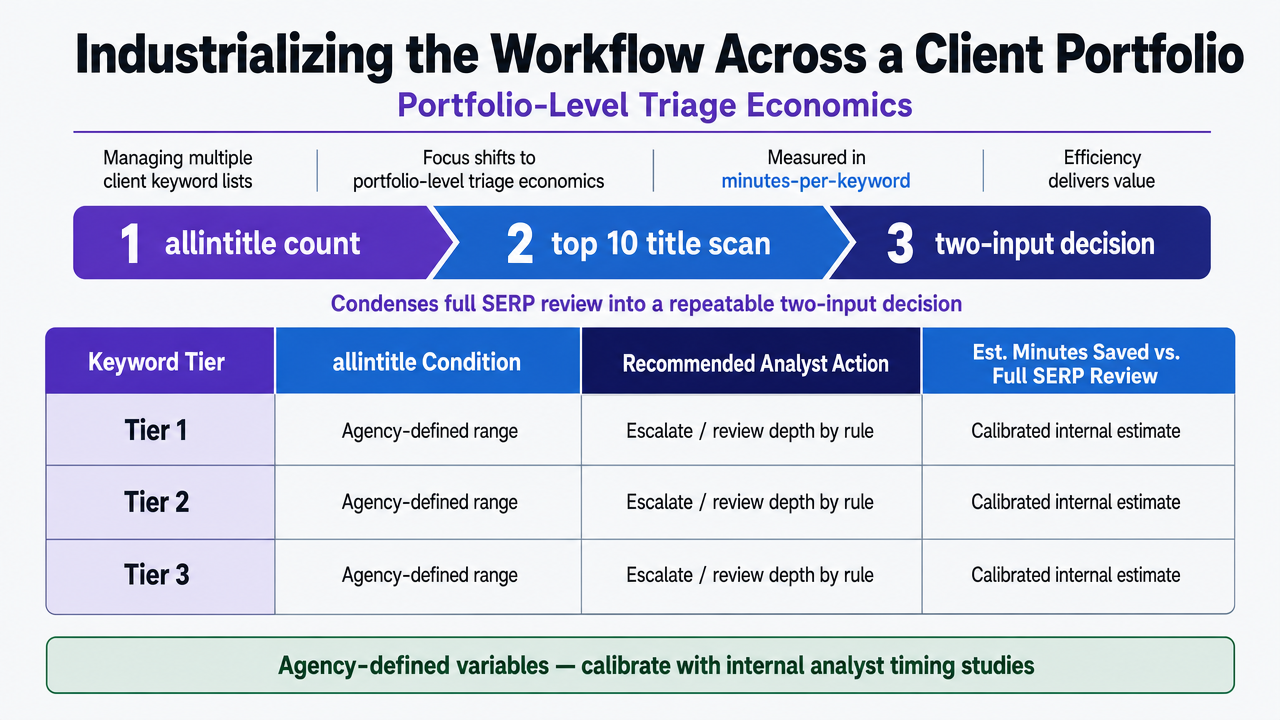 Visualize the portfolio triage economics table comparing the three keyword tiers, their allintitle conditions, analyst actions, and estimated minutes saved — directly supporting the section's operating model
Where allintitle Stops Being Useful
The allintitle: operator has limitations, and pushing beyond them yields unreliable data. Three conditions indicate when allintitle: ceases to be a valuable part of the workflow.
- First, in highly commercial SERPs dominated by ad inventory, local packs, and video carousels, the operator's utility diminishes. It counts title-tag matches in the organic index but does not account for SERP features that push organic results below the fold. A low count for a phrase like emergency plumber Chicago can be misleading when the top of the SERP is filled with a three-pack and four ads before any organic title becomes visible.
- Second, for branded or navigational queries, title-tag targeting is not the primary competitive factor. In these cases, the
allintitle:count reflects noise rather than deliberate optimization decisions. - Third, for long-tail phrases with very few index matches, the count is too sparse to be useful for tiering. Below a certain floor, analysts should proceed directly to a top 10 SERP review without the triage layer 2. Recognizing these limits ensures the rubric remains accurate and client discussions are grounded in reality.
Frequently Asked Questions
References
- 1.Debugging with Google Search Operators | Documentation.
- 2.Google Search Operators - Google Guide.
- 3.Using Search Operators - Google Guide.
- 4.Advanced Search Operators - Search UNM - University of New Mexico.
- 5.Google Advanced Search Operators.
- 6.SEO for scientific articles: Practical SEO tips for journal editors and.
- 7.Search engine optimization for scientific publications - PMC.
- 8.Search engine optimization: What is it and why should we care?.
- 9.Title, abstract and keywords: a practical guide to maximize the visibility and impact of academic papers - PubMed.
- 10.Search Engine Optimization for Journal Articles:.
- 11.Search Engine Optimization for Journal Articles: Best Practices for ....