
Key Takeaways
- The allintitle operator restricts Google results to pages carrying every query term in the HTML title tag 2, functioning as a title-scoped document frequency measure rather than a difficulty score.
- Read allintitle as title-level supply, not competition writ large; a raw count reveals nothing about domain authority, backlink profiles, or SERP composition that actually govern rankability 10.
- Replace the popular sub-5,000 heuristic with intent-specific bands for informational, commercial, and local queries, recalibrated per vertical after thirty to fifty ranking outcomes 1.
- Fold allintitle into a composite priority score as a banded coefficient against KD, with volume and business value in the numerator, so difficulty and title supply push queries back down 7.
- Score at the cluster level using the median of five to fifteen sampled queries per cluster, which stabilizes noisy counts and produces topical territory decisions strategists can defend 8.
- Choose execution mode by list size: manual under 200 queries, cluster sampling for mid-sized portfolios, and batched programmatic pulls above 2,000, keeping the shipping decision human 9.
- Retire the operator entirely for map-pack SERPs, queries below roughly 100 monthly searches, and brand-locked top tens, where title-level supply misreads a closed competitive picture 11.
Why title-level competition deserves a second look
Most agency SEO teams treat the allintitle operator as a trick learned early and abandoned quickly. It gets pulled out during a pitch, then dropped in favor of a keyword difficulty score from whichever tool the seat license covers. That reflex is understandable, but it wastes a signal that becomes more valuable as topic backlogs grow past what any single strategist can score by hand.
The operator restricts Google's results to pages carrying every query term inside the HTML title tag 2. Read as a raw filter, that count answers a narrow question: how many indexed pages have explicitly claimed this exact phrase in the most prominent on-page slot Google reads for topical intent. It is not a difficulty metric, and treating it as one produces bad prioritization calls 10.
Read differently, allintitle behaves like a title-scoped document frequency measure, the same construct that underpins classical information retrieval weighting schemes 4. That framing is where the operator earns a second look. For Heads of SEO scoring thousands of queries across client portfolios, a cheap proxy for title-level supply, folded into a composite score alongside volume and business value, changes what gets shipped first and why.
What allintitle actually measures
The operator's semantics, sourced from primary documentation
The allintitle operator is narrow by design. When a query is prefixed with allintitle:, Google returns only pages whose HTML title tag contains every word in the query 2. The MIT Libraries operator guide is explicit on the mechanics: no space follows the colon, and the filter applies to the title field rather than body copy, headings, or anchor text 2.
Technical cheat sheets group allintitle with other field-restricted operators such as allintext: and allinurl:, each of which limits matches to a specific document region 3. That grouping matters. Allintitle is not a competitive intelligence tool. It is a field query, and the count it returns is the count of indexed pages that have chosen to place the full phrase in their most prominent on-page slot.
Allintitle as title-level document frequency
Classical information retrieval offers a cleaner frame for what the operator produces. Document frequency, written dft, is defined as the number of documents in a collection that contain a term t 4. Stanford's CS276 lecture notes state the same definition and show how document frequency feeds into tf–idf weighting, where terms appearing in fewer documents carry more discriminative weight 5. Course materials elsewhere repeat the construction: dft is the count of documents in which the term occurs, full stop 6.
Allintitle produces something structurally similar, with two constraints. The corpus is Google's index rather than a controlled collection, and the field is restricted to the title tag. Read this way, an allintitle count is a title-scoped document frequency estimate: how many indexed pages have declared this exact phrase in the field Google reads most aggressively for topical intent.
That reframing changes how the number should be used. A raw count of 3,200 pages is not a difficulty score. It is an approximation of title-level supply for a given phrase. When agency SEO teams treat it as document frequency rather than as a proxy for competition writ large, the operator slots into the same analytical machinery that governs term weighting in retrieval systems 4. The signal becomes composable. It can be combined with volume, intent, and business value in a scoring model rather than acting as a standalone gate.
What allintitle is not: keyword difficulty, ranking predictor, or SERP quality signal
Keyword difficulty is a different construct. MetricHQ defines it as a 0–100 score built from a weighted combination of domain authority, page authority, backlink profile, content quality, and search volume of top-ranking pages 10. None of those inputs are visible in an allintitle count. A phrase can return 400 allintitle results and still be dominated by three high-authority domains whose backlink profiles make displacement unlikely.
Allintitle also says nothing about SERP composition. It does not distinguish informational pages from commercial ones, does not detect featured snippets or local packs, and does not weight the quality of the titles it counts. A page that stuffs the exact phrase into a thin title receives equal credit to a page that uses the phrase in a well-optimized editorial title.
Treating the operator as a ranking predictor produces two failure patterns:
- skipping topics that look crowded on titles but have weak-authority incumbents, and
- greenlighting topics with low counts that are actually locked up by branded SERPs.
The operator measures title-level supply. Difficulty, SERP quality, and rankability are separate questions that require separate signals.
Test allintitle-driven keyword selection at scale
Prioritize and publish high-impact SEO topics using real allintitle data during your trial period.
Calibrating thresholds by intent instead of a universal cutoff
The <5,000 heuristic and where it breaks
The most widely cited allintitle threshold in agency circles traces back to a straightforward claim: if fewer than 5,000 pages carry the exact phrase in their title, the query is worth pursuing for a page-one attempt 1. The number is memorable, easy to hand to a junior strategist, and roughly correct for a narrow band of English-language informational queries with moderate volume.
It also fails often enough that treating it as a validated cutoff is a mistake. The threshold was never derived from a controlled study of ranking outcomes. It is a practitioner heuristic, useful as a starting anchor and dangerous as a decision rule 1.
Three patterns break the 5,000 rule in agency work:
- Local service queries frequently return allintitle counts well under 500 while the SERP is locked up by directory aggregators no independent site displaces.
- Commercial-intent queries in mature verticals can show counts above 25,000 yet still have a rankable gap in the top ten.
- Broad informational queries in the 2,000-to-4,000 band often clear the heuristic while offering no meaningful conversion path.
A single cutoff cannot separate these cases. Bands calibrated to intent can.
Vertical-calibrated bands for informational, commercial, and local service intent
A more defensible approach replaces the universal cutoff with three intent-specific bands, each read against the SERP type the query actually produces. The bands below are operational heuristics, not validated cutoffs, and should be recalibrated per vertical after the first thirty to fifty ranking outcomes are observed 1.
Informational intent. Blog-style queries where the SERP is dominated by editorial content. Under 2,500 allintitle results signals thin title-level supply and warrants a fast-track production slot. Between 2,500 and 25,000 sits the working middle, where composite scoring against volume and business value decides priority. Above 100,000, the query is a saturated topical territory where entry requires either differentiated depth or a hub-and-spoke play, not a single post 7.
Commercial intent. Comparison, review, and buyer-guide queries. Title-level supply matters less than SERP composition because commercial SERPs are frequently controlled by authority publishers and affiliate networks whose backlink profiles do not appear in allintitle counts 10. Under 5,000 is worth investigating; between 5,000 and 50,000 requires a manual SERP read; above 50,000, allintitle is a weak signal and difficulty scoring should carry the decision.
Local service intent. Under 200 allintitle results is common and does not indicate opportunity. Local SERPs are dominated by map packs and directory listings that the operator does not measure. Bands here should be paired with a manual check for aggregator dominance before any priority is assigned 11.
Failure modes: title stuffing, brand-heavy SERPs, long-tail noise, and Google's count inconsistency
Four failure modes recur often enough that every allintitle-based scoring rubric needs explicit checks against them.
- Title stuffing inflates counts without signaling real competition. Pages that pack the exact phrase into thin, templated titles are counted equally with editorially strong titles on authoritative domains. A count of 8,000 that is 60 percent doorway pages is not the same competitive picture as 8,000 well-optimized editorial titles, but allintitle cannot distinguish the two 2.
- Brand-heavy SERPs suppress apparent competition. Queries where the first page is dominated by two or three known brands often return low allintitle counts because only those brands have bothered to optimize titles for the phrase. The count reads as opportunity; the SERP reads as closed. This pattern is common in commercial verticals with entrenched category leaders 10.
- Long-tail queries collapse to noise. Below roughly 100 allintitle results, the count stops discriminating. Fifteen versus forty pages is not a meaningful competitive difference, and volume data at that tail is typically unreliable as well 8.
- Google's count reporting is inconsistent. Reported allintitle totals can shift between queries on the same day and between logged-in and incognito sessions. Any scoring model that treats a single pull as authoritative will produce noisy priorities. Averaging two or three checks, taken minutes apart, materially stabilizes the input.
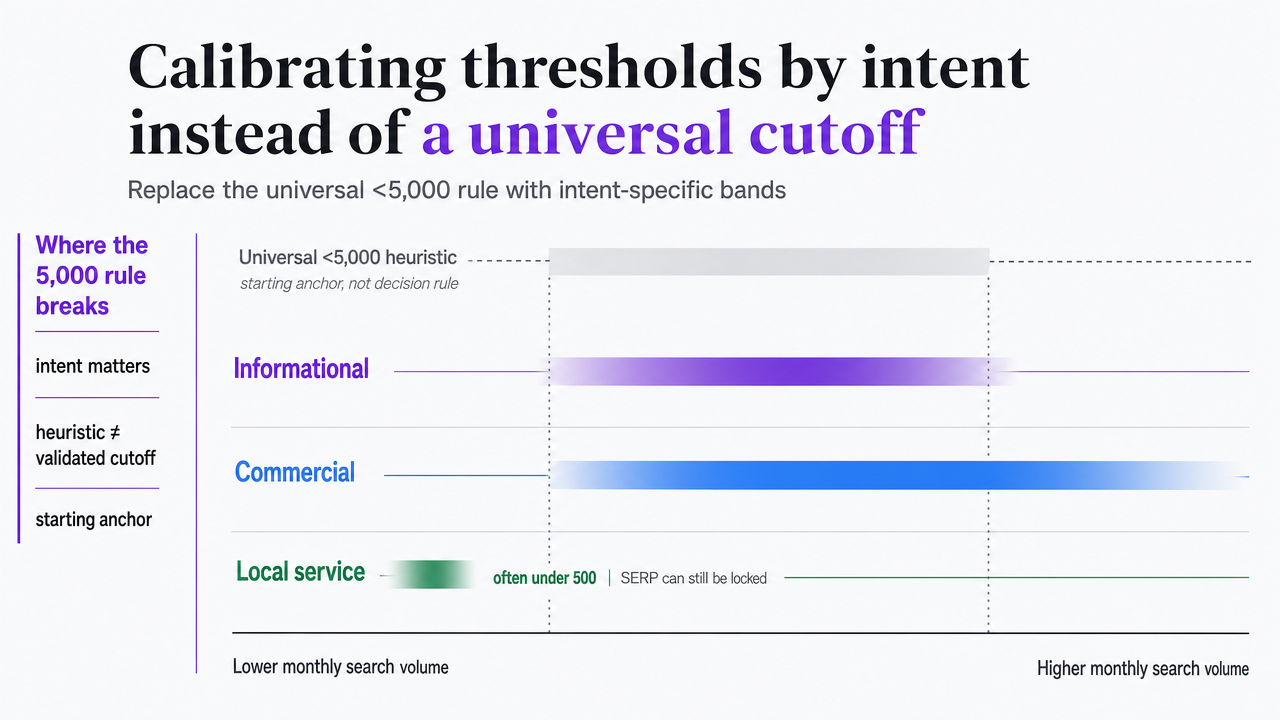 Visualize the intent-specific allintitle bands described in the section, replacing the flawed universal <5,000 heuristic with three calibrated ranges for informational, commercial, and local service intent
Folding allintitle into a composite priority score
The scoring stack: volume, business value, KD, and title-level supply
Allintitle earns its place in an agency scoring model as one input among four, not as a gate. The stack that survives contact with a large keyword list contains:
- monthly search volume,
- business value (conversion likelihood weighted by revenue per acquisition),
- keyword difficulty as a proper authority-and-links composite 10, and
- title-level supply as read through allintitle.
A workable formula treats the first two as the numerator and the second two as the denominator. Priority score = (Volume × Business Value) ÷ (KD-weighted allintitle band). Volume and business value drive the query up the queue; difficulty and title-level supply push it back down. The allintitle input is banded rather than raw, because a difference between 3,200 and 3,800 results is noise while a difference between 800 and 40,000 is signal.
The banding is what keeps the operator honest. Analysts multiply the KD score by a band coefficient—for example, 0.5 for under 2,500 allintitle results, 1.0 for the working middle, and 1.5 for saturated ranges. The result is a composite that respects Seer Interactive's nine-element logic while giving associates a single number to sort on 7. The math is simple enough to run in a spreadsheet and rigid enough to hand off without constant supervision.
A worked example across three clusters
Consider three clusters a home services agency might score for a regional plumbing client:
- Cluster A covers emergency plumber variants at roughly 14,000 combined monthly searches, with an average allintitle count near 42,000 per query.
- Cluster B covers water heater replacement cost variants at 6,200 monthly searches and an average allintitle count of 3,800.
- Cluster C covers how to fix a leaking faucet variants at 22,000 monthly searches and an average allintitle count of 87,000.
Volume alone would put Cluster C first. Business value flips the order immediately. Emergency and replacement-cost queries convert at rates several times higher than DIY informational queries, because the searcher is closer to a purchase decision 7. Applying the composite score with business value weights of 3.0, 2.5, and 0.4 respectively, and allintitle band coefficients of 1.5, 1.0, and 1.5, produces a different ranking: Cluster B first, Cluster A second, Cluster C third.
The pattern is instructive. Cluster B wins not because it has the highest volume or the lowest allintitle count in absolute terms, but because it sits in the working middle of title-level supply while carrying strong commercial intent. Cluster C, despite dominating on demand, is pushed down by both a saturated title field and weak conversion economics. This is the shape agency teams should expect: allintitle rarely picks the winner on its own, but it consistently reorders the queue in ways raw volume misses 8.
Cluster-level rollups instead of per-query decisions
Scoring at the individual query level scales poorly. A mid-sized client portfolio can generate ten thousand candidate keywords, and running the composite on each one produces a queue no strategist has time to read. The correction is to score at the cluster level and let individual queries inherit the priority of their parent territory.
Keyword clustering groups semantically related queries into content hubs that can be planned as a unit rather than as isolated posts 11. For allintitle, the rollup is straightforward: sample five to fifteen representative queries per cluster, pull their counts, and take the median as the cluster's title-level supply estimate. The median is preferable to the mean because a single high-count outlier—often a broad head term inside an otherwise long-tail cluster—distorts the average.
Cluster-level scoring changes what gets shipped. Instead of debating whether query #47 or query #63 deserves the next production slot, strategists decide which of three or four topical territories the client should own next quarter 8. That decision is easier to defend to a client, easier to hand to a producer, and easier to revisit when Search Console data comes back six weeks later.
See How Leading Agencies Use allintitle Data to Scale Topic Selection
Connect with our team to benchmark your current SEO topic workflow against allintitle-driven prioritization models used by high-performing agencies.
Running the workflow at agency scale
Manual, sampled, and batched checks: when each fits
Three execution modes cover most agency workloads, and the choice between them is a labor calculation, not a preference.
- Manual per-keyword checks fit small lists—roughly under 200 queries—where a strategist is already reading the SERP for intent and SERP feature composition. At that scale, the marginal cost of typing an allintitle query is trivial, and the analyst is likely to catch brand-heavy SERPs and title stuffing in the same pass 1. Below that ceiling, manual work is the correct default.
- Sampled checks fit mid-sized lists between 200 and 2,000 queries, typically organized into clusters. Rather than pulling counts for every query, the analyst samples five to fifteen representative queries per cluster and takes the median as the cluster's title-level supply estimate 8. Sampling trades precision for throughput and works because cluster-level scoring is the decision the reader actually needs to make.
- Batched checks fit anything above 2,000 queries. At that volume, allintitle counts should be pulled programmatically against a scoring rubric that produces a ranked queue automatically. Strategists review the top and bottom of the queue rather than the middle, spot-checking for the failure modes the operator cannot see on its own.
If the portfolio spans multiple locations or client sites
The workflow changes shape once the scope moves from a single client to a multi-location or multi-client portfolio. At that point, the operator economics matter more than the operator's precision.
Consider the labor arithmetic. A manual allintitle check, including the SERP read that gives it meaning, runs roughly two to four analyst-minutes per query 1. For a single client with 500 candidate keywords, that is 17 to 33 analyst-hours before any prioritization decision is made. For a portfolio of 25 clients at the same list size, the same approach requires 420 to 830 analyst-hours per scoring cycle. The table below frames the tradeoff with variables rather than invented figures.
| Approach | Time per query | Portfolio cost (25 clients × 500 keywords) | Fit |
|---|---|---|---|
| Manual per-keyword | 2–4 min | 420–830 analyst-hours | Single client, small list |
| Cluster sampling | 2–4 min × 10 samples per cluster | 50–120 analyst-hours | Mid-sized portfolios |
| Batched programmatic | Setup cost, then near-zero marginal | Setup hours + review time | Large portfolios, recurring cycles |
The decision is not whether allintitle is worth running. It is which mode preserves strategic oversight without consuming the hours a Head of SEO needs for higher-leverage work. Portfolios that recalibrate scoring quarterly, as predictive SEO frameworks recommend 9, typically converge on cluster sampling for active clients and batched programmatic checks for opportunity scans across the book.
Multi-location clients add one more constraint. Local service SERPs are dominated by map packs and directory listings the operator does not measure, so allintitle counts must be paired with a manual local SERP read for at least one representative market before the cluster score is trusted across the client's footprint 11.
Handing the rubric to associates and automated pipelines
A scoring rubric that only the Head of SEO can execute does not scale. The point of banding allintitle counts, weighting them against a proper difficulty score, and multiplying by volume and business value is to produce a single number an associate or a pipeline can sort on without judgment calls at every row 7.
Three practices keep the handoff clean.
- Document the band coefficients and intent-specific thresholds in a shared reference the associate consults rather than memorizes. Bands drift as verticals mature, and a coefficient set frozen in someone's head becomes a source of silent scoring errors.
- Require a manual SERP read on the top ten queries of any batch before the queue is approved for production. This catches brand-heavy SERPs and directory-dominated local queries that the composite score cannot see 10.
- Recalibrate the bands quarterly against actual ranking outcomes 9. The first thirty to fifty pages published under the rubric reveal whether the band coefficients are pulling priorities in the right direction.
Automated pipelines follow the same rules, with one addition: the approval step stays human. The scoring math runs unattended; the shipping decision does not.
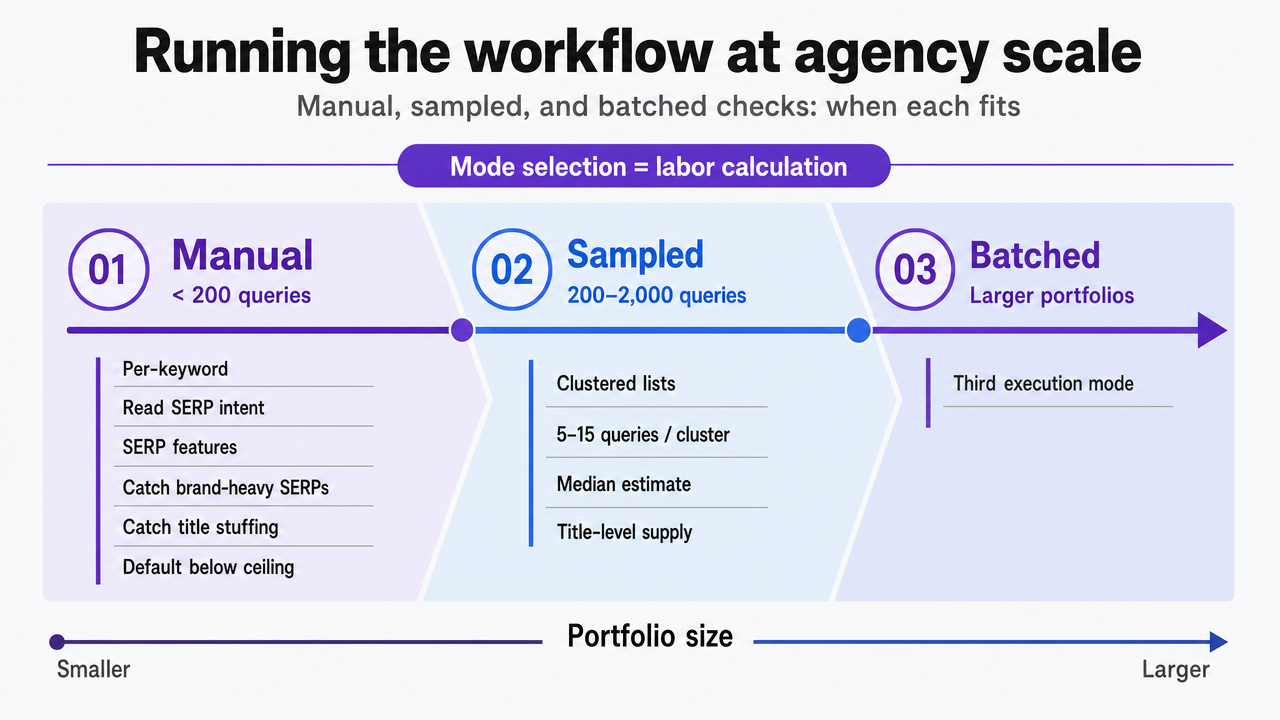 Process infographic showing the three execution modes (manual, sampled, batched) mapped to portfolio size thresholds, directly supporting the operating model described in the section
Where allintitle stops being useful
Three conditions retire the operator from the scoring stack entirely, and recognizing them saves analyst time that would otherwise chase a signal that is not there.
- Map packs, directory grids, or knowledge panels instead of ten blue links. Allintitle counts the title tags of indexed pages, and those surfaces do not compete on title tags in a way the operator can measure 11.
- Queries below roughly 100 monthly searches, where both the volume estimate and the allintitle count become too noisy to score reliably 8.
- Top ten results locked to two or three known brands. Title-level supply looks thin, but the competitive picture is closed 10.
In these cases, strategists skip the operator and decide on SERP composition and business value alone.
Frequently Asked Questions
References
- 1.Search Engine Optimization Competitor Analysis using AllInTitle.
- 2.Google Search Operators Guide – MIT Libraries.
- 3.Google Search: Operators.
- 4.Introduction to Information Retrieval.
- 5.Lecture 6: TF-IDF – Stanford CS276.
- 6.Information Retrieval: tf.idf.
- 7.How to Prioritize SEO Content Topics.
- 8.7 Tips to Organize Your Topic Cluster Strategy.
- 9.What is Predictive SEO and How to Plan Content with AI.
- 10.Keyword Difficulty (KD).
- 11.Keyword Clustering: A Guide to Grouping Keywords for AI SEO.