
Key Takeaways
- AEO success in 2026 hinges on separating eligibility work, governed by Google's standard Search fundamentals 1, from extractability work that restructures passages into answerable units the AI layer can lift.
- Briefs should decompose each head query into six to ten fan-out sub-questions 1, with structured answer blocks and schema that mirrors visible text field for field.
- Replace click-only reporting with a four-layer scoreboard covering eligibility, extraction rate, citation share, and assisted conversion, aligning with Google's guidance to measure conversions and sign-ups over raw traffic 2.
- Throughput is the binding constraint: templating and AI-assisted drafting inside governed workflows are the only levers that close McKinsey's 20 to 50 percent GEO-vs-SEO lag 4within a renewal cycle.
The agency delivery problem behind AEO in 2026
Answer Engine Optimization has moved beyond tactical debates. For agency SEO leaders managing numerous client accounts, the challenge lies in execution: who performs the work, how quickly, and against what performance indicators. The knowledge is readily available; the bottleneck is throughput.
McKinsey's 2025 analysis projected that AI-powered search could impact approximately $750 billion in revenue by 2028, noting that even industry leaders' generative engine performance might trail traditional SEO by 20 to 50 percent 4. This gap is not a strategic flaw but a production issue within client portfolios already strained before the advent of AI Overviews, AI Mode, ChatGPT Search, Perplexity, and Gemini began mediating the top of the funnel.
PwC defines Answer Engine Optimization as the practice of making content easily discoverable, interpretable, and reusable by AI systems in their direct responses, shifting focus from click optimization 12. This redefinition has a significant operational consequence many agencies have yet to fully grasp: every page now serves two audiences—the human reader and the AI extraction layer. The latter prioritizes structure as much as prose.
Retrofitting a portfolio to satisfy both audiences is not a simple checklist. It impacts content briefs, schema implementation, internal linking strategies, editorial review processes, and the metrics reported in every Quarterly Business Review (QBR). The agencies that will gain market share through 2026 are not those with the most advanced AEO theories, but rather those that restructure content production, structured data, and measurement. This enables specialists to produce more answer-ready pages weekly without compromising editorial quality.
This article details that operating model, section by section, distinguishing between Google's official guidance and vendor narratives.
What Google actually requires versus what vendors are selling
Agencies should prioritize Google's own documentation, as the disparity between primary sources and practitioner marketing often leads to wasted AEO budgets. Google Search Central's documentation on AI features explicitly states:
"There are no additional technical requirements" for a page to appear in AI Overviews or AI Mode 1.
Standard Search fundamentals determine eligibility. Google's May 2025 guidance identifies helpful, reliable, people-first content, good page experience, valid structured data, and clear snippet controls as the crucial levers 2.
This contrasts sharply with what many AEO vendors promote. The market is saturated with proprietary "answer engine" audits, specialized prompt-injection tactics, and paid tools that promise dedicated optimization for ChatGPT Search, Perplexity, and Gemini, implying each engine requires a unique approach. While some of this work offers diagnostic value, much of it rebrands standard technical SEO and content quality checks under a new label, then charges for it as a distinct service.
For portfolio delivery, the critical distinction is between eligibility and extractability. Eligibility, covered by Google's guidance, concerns whether a page is indexable, structured, and trustworthy enough for consideration. Extractability, formalized by the arXiv Generative Engine Optimization paper, addresses which content structures, given eligibility, increase the likelihood of a passage being quoted in a generative response 10. The paper confirmed that generative visibility can be influenced, but it did not assert that its techniques universally apply across all domains or model updates.
Agencies should structure their AEO offerings around this distinction. Eligibility work is not a new revenue stream; it represents the technical and editorial hygiene clients should already be paying for, now more rigorously enforced because AI systems process structure faster than humans. Extractability work is where new production time is invested: rewriting passages as answerable units, refining entity references, and ensuring structured data accurately reflects the visible page content, as mandated by Google's structured data policies 8.
Bundling these two as a single, undifferentiated package erodes agency margins. Separating them allows agencies to justify pricing during QBRs.
Query fan-out and the new brief structure
Decomposing head queries into answerable units
Google's AI features documentation confirms that AI Overviews and AI Mode use a "query fan-out" technique to gather subtopic coverage and surface more supporting links 1. This single statement holds more implications for agency brief structures than most 2026 planning documents acknowledge.
A head query no longer corresponds to a single page and meta description. Instead, it expands into six to ten related sub-questions that the engine processes in parallel, then reassembles into a synthesized answer. A page that only addresses the head query receives partial credit at best. Conversely, a page that answers each subtopic as a distinct, self-contained unit becomes a strong candidate for citation across multiple fan-out branches within the same search session.
The change in brief structure is tangible. Traditional SEO briefs typically listed a primary keyword, secondary keywords, and a target word count. AEO-ready briefs, however, specify a head query, an enumerated set of fan-out sub-questions, and the desired answer format for each sub-question (e.g., definition, comparison, step sequence, threshold, or example). Word count then becomes an outcome, not an initial requirement.
Agencies that continue to brief based on keyword density will encounter an extraction ceiling that no amount of rewriting can overcome. While these pages may read well to humans, they will consistently lose to competitors whose sections are designed as retrievable answer units. Retraining specialists to define the sub-question list before outlining is the starting point for portfolio-wide AEO retrofits.
The structured answer block: extraction-ready page anatomy
Within each fan-out sub-question, the most effective unit of production is a structured answer block: a scannable pattern that the AI extraction layer can directly lift without human interpretation of paragraph flow.
Four elements define an effective block:
- The question is stated as a heading, using language a user would naturally type or speak.
- A direct answer is provided in the opening sentence immediately below the heading, complete on its own, typically 40 to 60 words.
- Supporting evidence qualifies the answer with scope, source, or conditions, ensuring the passage remains defensible even when quoted out of context.
- A schema wrapper mirrors the visible text, which Google's structured data policies require to be an accurate representation of page content, not a separate version optimized solely for machines 1.
Google's guidance explicitly states that AI features rely on query fan-out to gather subtopic coverage and surface supporting links 1. Pages designed as sequences of these blocks provide the extraction layer with clear points of access at every branch of the fan-out. Conversely, pages written as continuous essays force the model to infer which sentence belongs to which sub-question, often leading to a competitor's content being chosen.
The editorial cost is significant. Specialists must formulate answers before writing transitions, which reverses traditional content drafting habits. However, the reward is seen in citation rates, not merely word count.
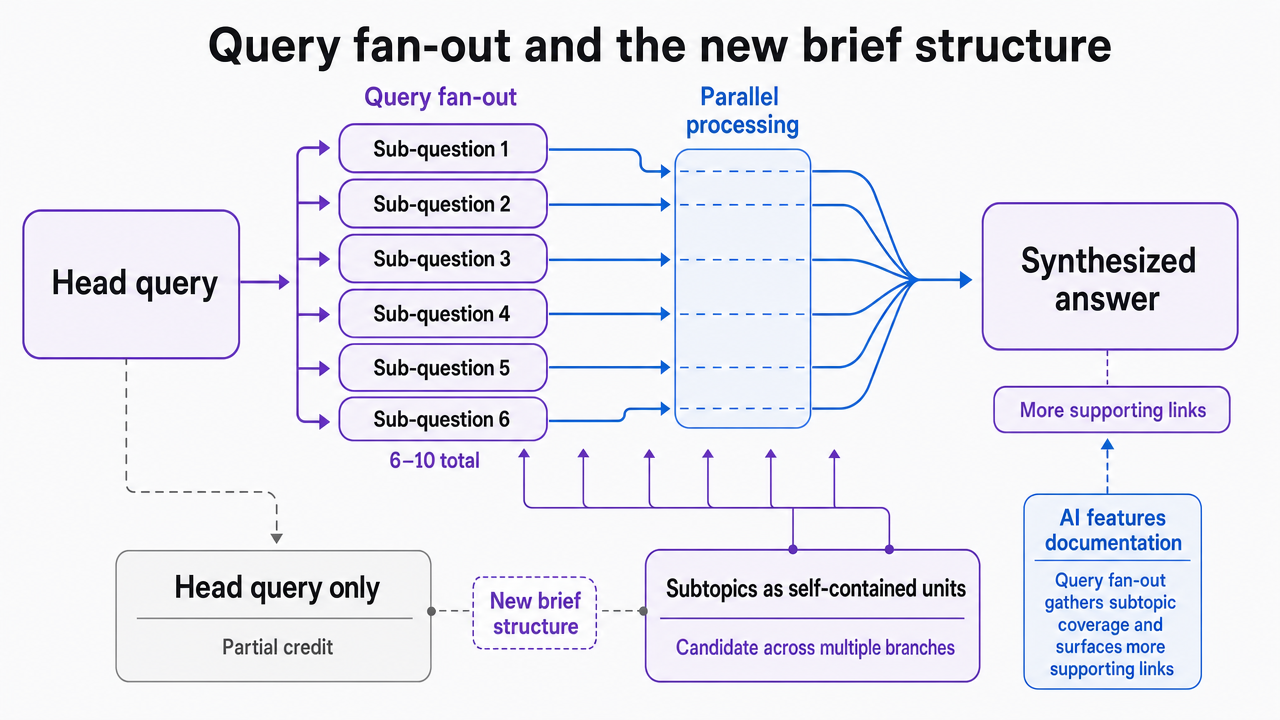 Visualize the query fan-out concept and the new brief structure as a process diagram, directly supporting the section's explanation of head query decomposition into sub-questions and answer formats
Test AEO workflows with live content publishing
Validate your answer engine optimization strategy on real projects before making a long-term commitment.
Structured data as the deliverable, not a checklist item
Most agency workflows still treat schema as a final QA step: a validator pass at the end of a sprint, a green checkmark, and a closed ticket. This approach was adequate when structured data primarily served as an eligibility signal for rich results in traditional blue-link SERPs. However, it falls short when the AI extraction layer reads markup to determine which passage will be cited in an AI answer.
Google's documentation defines structured data as a standardized format for providing information about a page, which helps search engines understand content and can enable richer results 7. Policy guidance further specifies that markup must accurately represent the page content and should not be misleading 8. Google's May 2025 best-practices post reiterates this for AI experiences, recommending structured data that aligns with visible text rather than a separate machine-only version 2. Article schema guidance adds a crucial operational step often overlooked by teams: validating code with the Rich Results Test and then using URL Inspection to see how Google actually renders the page 9.
Collectively, these four Google sources describe schema as a core production output, not merely an audit artifact. The deliverable is a page where visible answer blocks, entity references, and supporting evidence are precisely mirrored, field for field, in the JSON-LD. Elements like author, publisher, dateModified, headline, and any FAQPage or HowTo blocks must resolve to text a reader can find on the page. Nothing should be asserted in markup that a human editor cannot locate in the copy.
For a portfolio, this shift redefines schema ownership. It moves from being a developer ticket appended to content review to an upstream consideration, integrated into the brief itself. Specialists now specify entities, schema types, and their corresponding visible passages before drafting begins. Editorial review includes checking parity between prose and markup as part of a single pass. The Rich Results Test becomes a "definition-of-done" gate, rather than a post-publication spot check 9.
Agencies that continue to relegate schema to the QA bucket will pass validators but lose citations. Pages that are quoted are those where structured data is integral to the answer, not merely an add-on.
Reframing measurement around citation and conversion
Why click-only reporting stopped defending retention
The QBR problem is not simply that clicks are down; it's that click metrics no longer adequately explain the journey from query to client pipeline. When a Digital Content Next member site experiences a 1 to 25 percent loss in Google referral traffic due to AI Overviews, that range tells a significant story 11. Some publishers in this sample saw minimal impact, while others lost a quarter of their referrals. A single, portfolio-wide talking point cannot address such varied outcomes.
Pew's October 2025 survey of U.S. adults found that 65 percent at least occasionally encounter AI summaries in search results, and 52 percent of those exposed rated the summaries as at least somewhat useful 3. This indicates a mainstream audience already resolving their intent within the AI answer, rather than on the destination page. For informational and mid-funnel queries, the click was never the ultimate conversion; it was a proxy for reach that agencies could present in a slide deck.
Google's own May 2025 guidance for AI experiences conveyed the same message more plainly to site owners: evaluate conversion, sign-ups, and information lookups, not just traffic 2. Agencies that continue to prioritize sessions and impressions are defending client retention with a metric that the platform itself has deprioritized. Attentive clients will notice this before renewal.
The four-layer citation-first scoreboard
Replacing click-only reporting begins with a framework that measures the actual journey an AI answer takes. This involves four layers, each with its own instrumentation and potential failure points.
Eligibility. The foundational layer assesses whether a page can even be considered. This includes indexation status, valid structured data, page experience, and Search Console coverage. Google's guidance is clear: standard fundamentals govern AI visibility, with no additional technical requirements 1. An agency unable to report the eligibility rate across a client's answer-target pages cannot effectively measure anything higher up the stack.
Extraction. The second layer determines whether eligible passages are being pulled into AI responses. This involves sampled prompt panels across AI Overviews, AI Mode, ChatGPT Search, Perplexity, and Gemini. Extraction rate is the percentage of a defined query set where any passage from the client's domain appears in the generated answer or its supporting links.
Citation share. The third layer compares the client's extraction performance against named competitors for the same query set. Citation share is a head-to-head metric, not an absolute one, and it translates effectively into QBR slides demonstrating relative gains against a rival's domain over time.
Assisted conversion. The top layer connects AI-mediated visibility to the outcomes clients truly value: form fills, calls, bookings, and information lookups. Google's May 2025 guidance explicitly highlights this shift, recommending the measurement of conversion and sign-ups over raw traffic 2. PwC's perspective from the boardroom reinforces this, treating AEO as content reused within the answer rather than content clicked from a link 12.
Instrumenting all four layers ensures the scoreboard withstands scrutiny. Neglecting a layer means the client will hear the platform's narrative before the agency's.
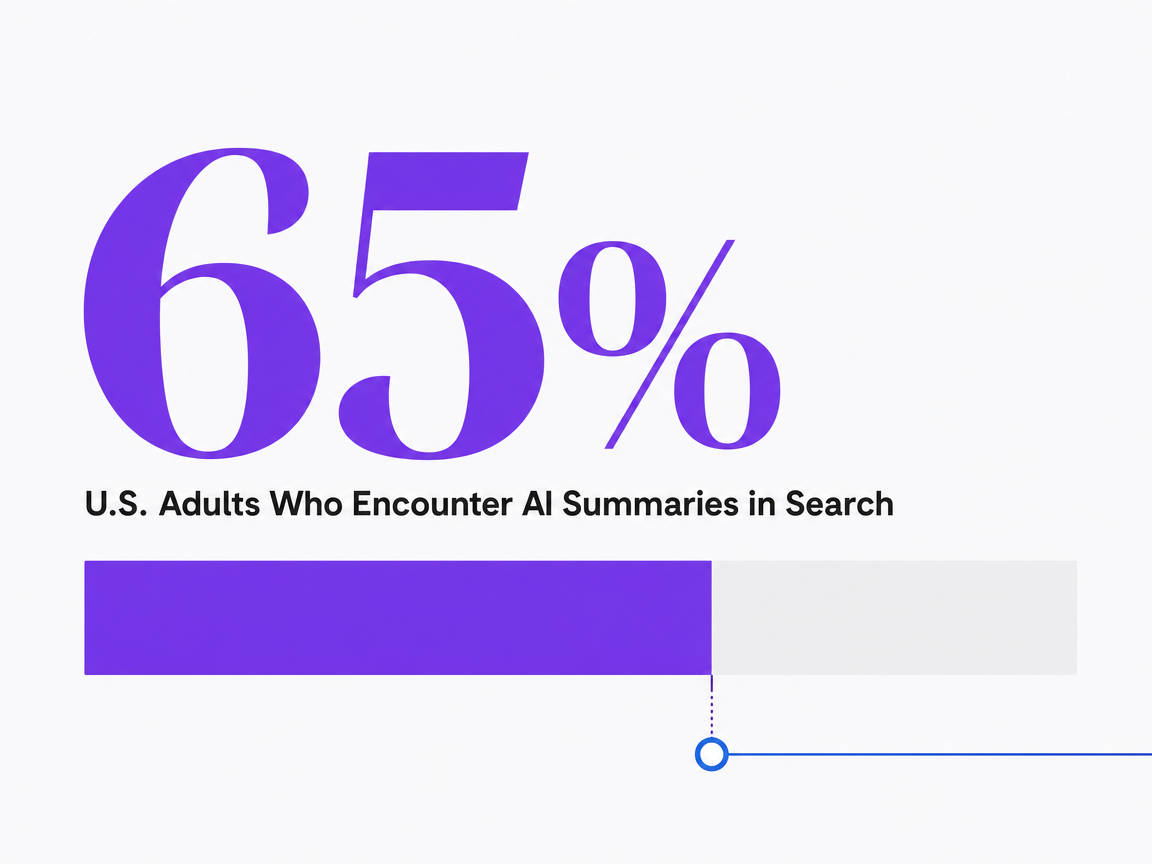 U.S. Adults Who Encounter AI Summaries in Search
U.S. Adults Who Encounter AI Summaries in Search
Throughput: the real constraint on portfolio AEO
Every preceding section describes tasks agencies are already familiar with. Rewriting for extraction, mirroring schema to visible text, and implementing a citation-first scoreboard are not novel concepts. The challenge lies in the arithmetic. A specialist managing 6 to 10 client accounts cannot re-engineer a portfolio of 200 to 800 answer-target pages within a single quarter, regardless of how refined the brief template becomes.
McKinsey's 2025 analysis quantified the gap agencies are expected to close. Even among industry leaders, generative engine performance might lag traditional SEO by 20 to 50 percent, within a market McKinsey estimates could impact approximately $750 billion in revenue by 2028 4. This 20 to 50 percent range represents the performance delta agency leaders inherit per account. It is not a minor discrepancy. Closing it requires producing structurally different pages, not just more pages faster.
Consider the math against a realistic team. A senior content specialist can produce or retrofit between 4 and 8 answer-ready pages per week, assuming each page requires fan-out decomposition, structured answer blocks, entity references, and schema parity review. For a portfolio of 40 accounts, this translates to a two- to three-year retrofit horizon with current headcount. The gap McKinsey identified will not remain open for that long, nor will client patience.
Two levers can increase output without compromising editorial judgment:
- The first is templating: standardizing fan-out patterns, schema blocks, and answer-unit shapes as reusable production assets. This allows specialists to focus on judgment calls rather than reinventing structure for each page.
- The second is AI-assisted drafting within a governed approval workflow, where the specialist defines the fan-out, reviews extracted answers, and approves schema parity, but does not manually type every supporting sentence.
Neither lever replaces the specialist. Both, however, alter the ratio of pages per specialist per week, which is the only variable that can close the McKinsey delta before the window of revenue at risk narrows 4. Agencies that solve throughput in this manner will compound their market share. Agencies that add headcount to maintain outdated workflows will price themselves out of their existing accounts.
See How Leading Agencies Operationalize AEO Strategies for 2026 at Scale
Request a walkthrough of unified workflows that streamline Answer Engine Optimization across multiple clients, with KPI tracking and approval controls designed for high-volume agency environments.
If you manage multi-location clients: templated AEO with local credibility
Consolidation economics: a decision model for DSOs, legal networks, and home services
This section targets agency leaders whose client portfolios are heavily weighted towards multi-location operators, such as dental support organizations, regional legal networks, home services franchises, senior living portfolios, and multi-site behavioral health groups. The AEO economics for these accounts differ from single-site brands because the retrofit horizon scales with the number of locations. Templating becomes the only viable method to close the arithmetic within a renewal window.
Three production models describe how this work can be executed:
- SEO-only production with current headcount, where specialists create location and service pages according to classic on-page standards.
- AEO-retrofit with current headcount, where the same specialists apply fan-out decomposition, structured answer blocks, and schema parity to every page.
- AEO production with AI-assisted specialist workflows, where templating and governed drafting enhance the pages-per-specialist-per-week ratio without eliminating editorial review.
Use the model below with your specific variables.
S : The fully loaded specialist cost per week.
P : The number of pages a specialist can produce per week in each model.
L : The number of locations per client.
N : The number of answer-target pages per location.
The retrofit horizon per client is calculated as (L × N) / P weeks per specialist. The goal is to close the McKinsey 20 to 50 percent GEO-vs-SEO lag 4by increasing P, not by increasing S.
| Model | Pages per specialist per week (P) | Retrofit horizon (weeks) | Cost per retrofitted page |
|---|---|---|---|
| SEO-only, current headcount | Baseline P | (L × N) / P | S / P |
| AEO-retrofit, current headcount | ~0.5 to 0.7 × P (ceiling) | (L × N) / (0.5–0.7P) | S / (0.5–0.7P) |
| AEO with AI-assisted workflow | 1.5 to 3 × P (target) | (L × N) / (1.5–3P) | S / (1.5–3P) |
For example, a 40-location Dental Support Organization (DSO) with 12 answer-target pages per location totals 480 pages. At a retrofit ceiling of 0.6P, where baseline P is 6, this requires 133 specialist-weeks. The AI-assisted path at 2P completes the same scope in approximately 40 weeks, a timeframe where the 20 to 50 percent lag 4becomes defensible within a client's fiscal year. Local credibility is maintained by the specialist, who validates entity references, review evidence, and jurisdictional or clinical claims before schema is generated.
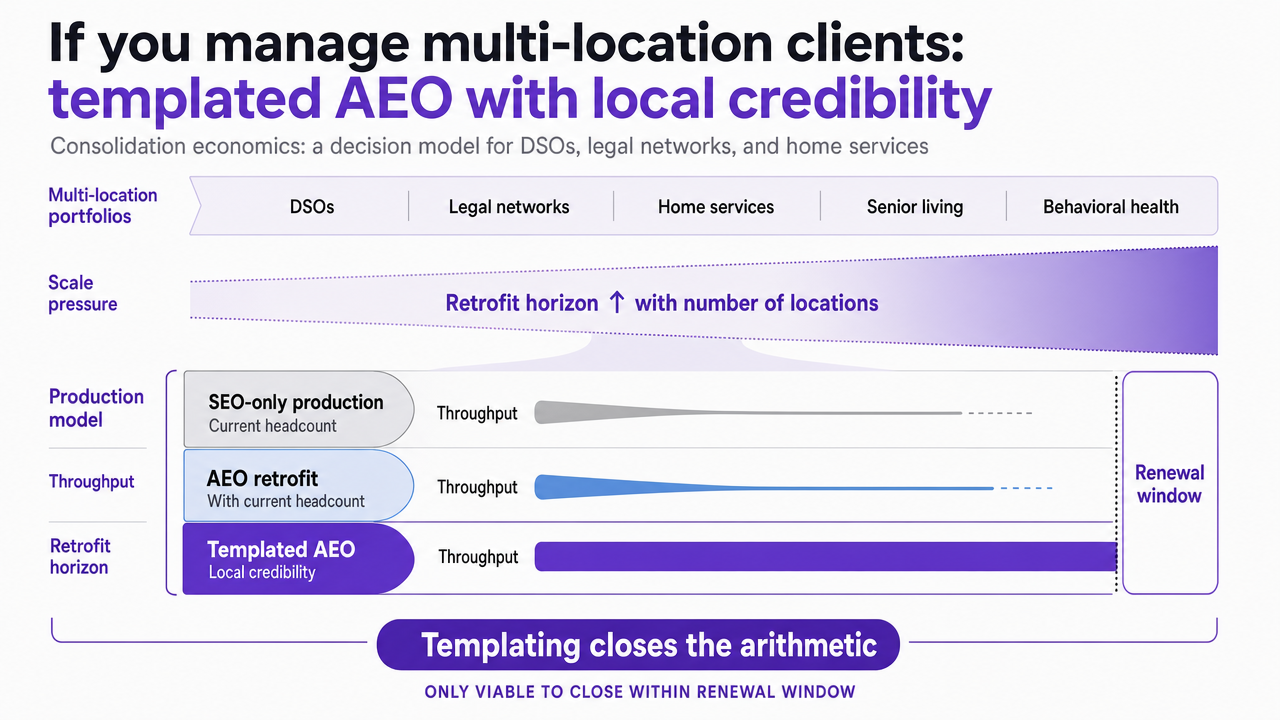 Reinforce the three production models comparison table with a visual that highlights the throughput differential and retrofit horizon math central to this section
A defensible 2026 operating model, tested against the three-question rule
NN/g's 2025 framework for AI investment distills down to three questions: what constitutes the core business, is the value genuine or merely perceived, and what specific problem is being addressed 6. When applied to an agency's AEO practice, these questions reveal which components of the 2026 operating model will withstand a QBR and which are merely performative strategies.
The core business is client retention and margin across the portfolio, not just citations. An agency that produces more AI-visible pages while eligibility, extraction, citation share, and assisted conversion metrics diverge from the client's pipeline is optimizing for the wrong scoreboard. The operating model must link every production hour back to an outcome that a client's finance team recognizes. This is why Google's May 2025 guidance to measure conversions, sign-ups, and information lookups should be a prominent part of the QBR slide deck, not a footnote 2.
The value question distinguishes genuine gains from perceived ones. NN/g's 2025 UX research also reminds practitioners that traditional search behavior persists alongside AI answers 5. A model that abandons blue-link fundamentals for an exclusive AEO push trades one revenue stream for another that is still developing. A defensible approach maintains eligibility work as the foundation, layers extractability on top, and reports on both.
The specific problem being solved is throughput. Fan-out briefs, structured answer blocks, schema parity, and citation-first measurement will not close the 20 to 50 percent GEO-vs-SEO lag 4unless specialists can produce more answer-ready pages per week without sacrificing editorial judgment. This is the operational challenge Vectoron was designed to address, and it is the benchmark against which every 2026 agency roadmap should be evaluated before the next renewal cycle begins.
Frequently Asked Questions
References
- 1.AI Features and Your Website | Google Search Central | Documentation | Google for Developers.
- 2.Top ways to ensure your content performs well in Google's AI experiences.
- 3.Americans have mixed feelings about AI summaries in search results.
- 4.Winning in the age of AI search.
- 5.Top 10 UX Articles of 2025 - NN/G.
- 6.AI Strategy: 3 Key Questions (Video) - NN/G.
- 7.Intro to How Structured Data Markup Works | Google Search Central.
- 8.General Structured Data Guidelines | Google Search Central.
- 9.Learn About Article Schema Markup | Google Search Central.
- 10.GEO: Generative Engine Optimization.
- 11.Google AI Overviews linked to 25% drop in publisher referral traffic, new data shows.
- 12.What is Answer Engine Optimisation?.
- 13.How AI and data reinvent customer experience and revenue.