
Key Takeaways
- Article schema is the structured contract that lets Search, Discover, News, and AI answer panels understand a page's title, image, date, and author information 2.
- Subtype choice should follow content class: NewsArticle for reported publisher coverage, BlogPosting for editorial blog content, and Article as the default for evergreen guides 8.
- Google labels headline, image, datePublished, dateModified, author, and publisher as recommended, but missing eligibility-critical fields silently strips rich result presentation across a portfolio 2, 3.
- Governed deployment at scale requires two-layer template libraries, dual-validator CI gates using Schema.org and the Rich Results Test, and Search Console drift monitoring 10, 4, 5.
Why Article Schema Became the Machine-Readable Contract with Search
Article schema stopped being a rich snippet trick years ago. It now functions as the structured contract between a publisher and every downstream surface that reads the page — traditional SERPs, Discover, News, and the AI answer panels that summarize source material before a user ever clicks. Google's own framing is explicit: Article structured data helps Search understand the page and improve the presentation of title text, images, and date information 2. That is a statement about machine comprehension, not ranking lift.
For agency SEO leaders, the strategic implication is different than for a single-site operator. Structured data is what makes result items differentiable when the underlying content is topically similar — a problem the NJIT research on structured result differentiation formalizes by showing that feature selection over annotated items is what maximally distinguishes one result from another 1. Article properties (author, datePublished, section, publisher, image) are the differentiating features search engines pick from.
The operational question is not whether to deploy Article markup. It is how to deploy it consistently across hundreds of client sites without silently losing rich result eligibility to policy violations, missing properties, or date drift 3. Google recommends measuring impact through Search Console before and after implementation 5, which means agencies need governance, not one-off snippets. The rest of this playbook treats Article schema as a governed production system.
The Type Hierarchy: Article, NewsArticle, and BlogPosting in Practice
Choosing the Right Subtype Per Content Class
Schema.org exposes three subtypes agency teams end up touching most often: the generic Article, and its narrower siblings NewsArticle and BlogPosting. Google's Article documentation treats all three as members of the same supported family, with the same recommended properties and the same eligibility model 2. The subtype choice does not unlock separate rich result formats — it sets the semantic contract for what kind of content the page actually is.
The practical rule for portfolio work is content-class alignment:
NewsArticleis appropriate for reported, dated, editorially-timed pieces from a publisher — press releases, breaking coverage, wire-style updates.BlogPostingfits editorial or opinion content published on a blog surface where cadence and authorship are visible.Articleis the safe default for evergreen guides, product education, and reference content that is neither news nor blog-shaped.
Misalignment is the failure mode agencies see at scale. Marking an evergreen service page as NewsArticle to chase News surfaces, or forcing BlogPosting onto a landing page, violates Google's requirement that markup accurately represent the visible content 3. The subtype should describe what the page is, not what surface the client wishes it appeared on.
Where Article Markup Actually Surfaces in Google Search
Google's Search Gallery lists Article as a supported feature covering "news, sports, or blog article" rich result appearances — a single family of surfaces served by the entire Article type hierarchy 8. That framing matters for subtype decisions: Article, NewsArticle, and BlogPosting all feed the same rich result eligibility path, differentiated by content class rather than by a separate SERP treatment.
The presentational payoff is narrow and specific. Google states that Article structured data helps Search show better title text, images, and date information 2. It does not unlock a distinct visual card per subtype. Agency teams that promise clients a "news carousel" or "blog rich card" from a schema change alone are overselling what the gallery documents.
The infographic below anchors the decision: pick the subtype that matches the content class, expect the same core Article rich result surfaces across all three, and treat News surfaces (Top Stories, News tab) as governed by separate publisher-level eligibility, not by the NewsArticle label itself.
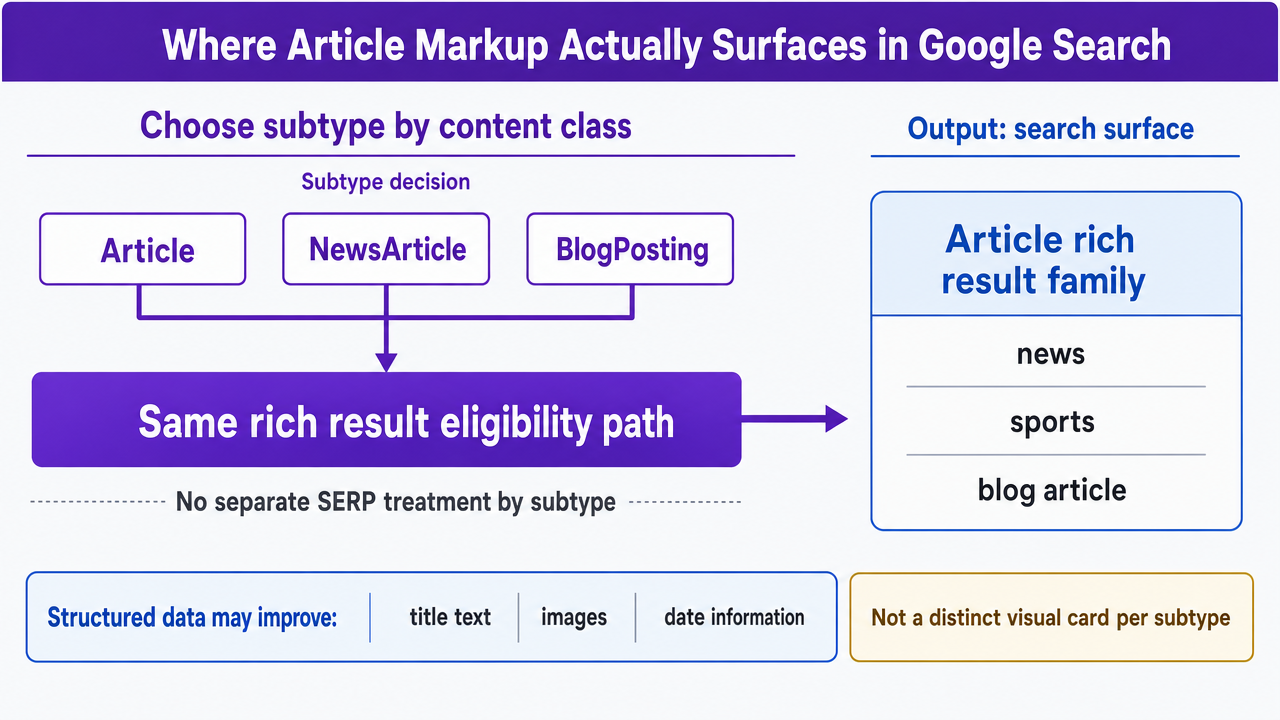 Visualize the subtype-to-content-class decision framework explained in this section, showing that Article, NewsArticle, and BlogPosting all feed the same rich result family
Property Scoping: Recommended, Eligibility-Critical, and Everything Else
Google's Recommended Properties vs. Policy-Level Eligibility Rules
Google's Article documentation is careful about vocabulary. It lists recommended properties — headline, image, datePublished, dateModified, author, and publisher among them — and frames them as fields that help Search show better title text, images, and date information 2. Nothing in the Article page is labeled a required property in the way other structured data features enforce required fields. That linguistic distinction matters for how agency teams template markup across a portfolio.
The eligibility rule sits one layer up, in the general structured data policy. Google's policy language states that when required properties are missing, items become "not eligible for rich results," and that markup misrepresenting visible content violates the guidelines regardless of validator output 3. In practice, that policy converts several of the Article documentation's recommended properties into eligibility-critical ones the moment a client wants rich result presentation. headline, a crawlable image, and datePublished function as the working floor for eligibility — omit them and the presentational payoff Google promises in the Article guidance disappears 2, 3.
The chart below maps the recommended property set against eligibility risk. Fields that Google recommends and that also gate rich result presentation belong in the global template every client site inherits. Fields that Google recommends but that only enrich entity extraction — author.url, publisher.logo dimensions, articleSection, wordCount — belong in per-client overrides where the source data actually exists. Fields Google does not recommend but Schema.org exposes belong nowhere in a governed pipeline until a specific downstream surface justifies them. Scoping this way keeps template diffs small, keeps validator noise low, and prevents the silent eligibility loss that comes from omitting one of the working-floor properties across a bulk republish 3.
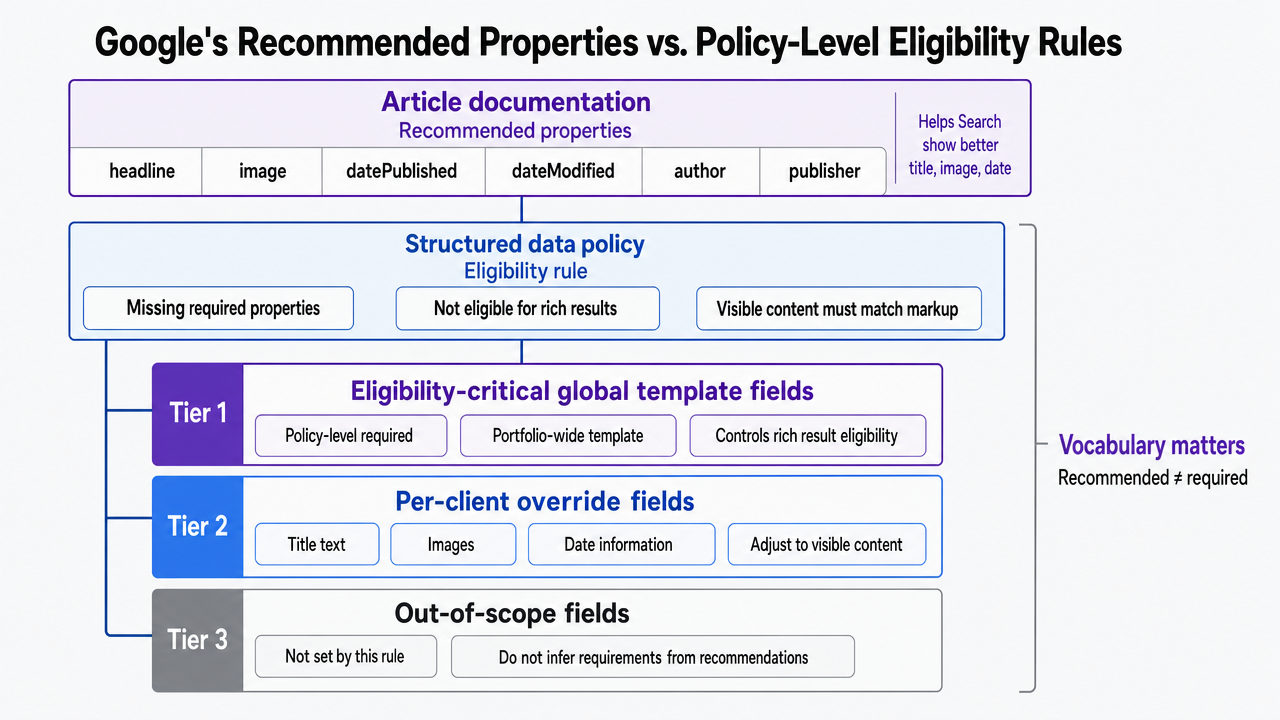 Map Article properties into three governance tiers as described in the section prose: eligibility-critical global template fields, per-client override fields, and out-of-scope fields
The NP-Hard Case Against Maximalist Markup
The instinct in agency delivery is to ship every property Schema.org exposes and let search engines sort it out. The research argues against that. The NJIT work on differentiating search results over structured data formalizes the problem of selecting the feature set that maximally distinguishes one result from others and proves that selection is NP-hard 1. The practical reading for portfolio SEO is that more properties do not linearly improve differentiation. Past a point, additional annotations dilute the signal search engines can use to tell one client's article apart from a competitor's on the same topic.
That reframes property scoping as a discipline, not a completeness exercise. The properties that differentiate — a specific author entity, a stable publisher, an articleSection that reflects the actual content taxonomy, a precise datePublished — carry more weight than the long tail of optional fields templated on top of them. Bloated markup also raises the surface area for policy violations, because every property added is another field that must match visible content under Google's accuracy rule 3. Scoped markup is the defensible default across a large portfolio.
Test Article Schema Impact With Live Publishing
Evaluate real-world schema performance by publishing and tracking actual articles during your trial period.
Date Handling as a Portfolio Risk Category
Dates are where multi-client agencies lose rich result eligibility silently. Google's guidance is direct: use ISO 8601 formatting for datePublished and dateModified, and make sure a visible date on the page corroborates what the structured data reports 7. That corroboration rule is where portfolios fail. A CMS that updates dateModified on every template deploy while the visible byline still shows the original publication date creates exactly the mismatch Google's structured data policy treats as misrepresentation of visible content 3.
Three failure patterns recur across large client portfolios:
- Timezone drift — a JSON-LD payload emitted in UTC while the visible date renders in the client's local timezone, producing off-by-one-day disagreements that trip validators and freshness signals 7.
- Phantom modifications — bulk republishes, plugin updates, or global CSS changes that bump
dateModifiedwithout touching the article body, inflating freshness claims the visible page cannot support 3. - Missing
datePublishedon legacy content migrated from older CMSes, which quietly removes eligibility for the presentational payoff Google documents for Article markup 2.
The governance move is to treat dates as a first-class field in the template, not a CMS side effect. Emit ISO 8601 with explicit timezone offset, render the same value visibly on the page, and gate dateModified updates behind an editorial signal — a body-content diff, not a deployment event.
Paywalled and Gated Content Without Cloaking Violations
Paywalls sit in an awkward spot for portfolio SEO. The publisher wants Googlebot to see enough of the article body to rank and summarize it, but human visitors hit a gate. Serving different content to crawler and user without disclosure is cloaking — a policy violation that outweighs any rich result gain. Google's structured data guidance for subscription and paywalled content resolves the tension by making the access restriction explicit in the markup itself 6.
The mechanics are narrow. Set isAccessibleForFree to false on the Article node, then declare the gated portions with a hasPart array of WebPageElement objects, each carrying its own isAccessibleForFree: false and a cssSelector pointing at the DOM region behind the paywall 6. That structure tells Google the crawler is seeing the same content the paying user sees, and that the gate is a business rule rather than a serving trick.
The portfolio failure pattern is templates that hardcode isAccessibleForFree: true across every client, including publishers running metered or hard paywalls. That misrepresents visible content under Google's general policy and puts the whole property at eligibility risk, not just the gated pieces 3. Treat the flag as a per-client, per-content-class variable in the template library.
Dual-Validator Workflow: Schema.org Vocabulary Plus Google Rich Results
What Each Validator Catches and Misses
The two validators agency teams reach for solve different problems, and treating them as interchangeable is where portfolio quality control breaks down. Schema.org's Markup Validator checks structured data syntax and vocabulary against the Schema.org model, flagging fields that do not exist on the declared type, malformed nesting, and JSON-LD that will not parse 10. It is a vocabulary-side tool. It does not know or care which properties Google requires for rich result presentation.
Google's Rich Results Test sits on the opposite side of the boundary. It reports whether a publicly accessible page is eligible for specific rich result formats based on the structured data Google actually reads from it 4. Google positioned it as the preferred validator for rich-result-eligible markup when the Rich Results Test came out of beta, retiring the older Structured Data Testing Tool for that purpose 9. It surfaces missing eligibility-critical properties, image crawlability failures, and Article-family warnings the Schema.org validator will pass without comment.
The coverage matrix below maps both tools against vocabulary correctness, rich result eligibility, error surfacing, and policy-adjacent checks. The point is not to pick one. A payload can pass Schema.org's vocabulary check and still fail Google's eligibility test — a novel property name will trip Schema.org while a missing image will only trip Google 10, 4. Neither tool audits Google's structured data policy rules on visible-content fidelity; that stays a human review responsibility 3.
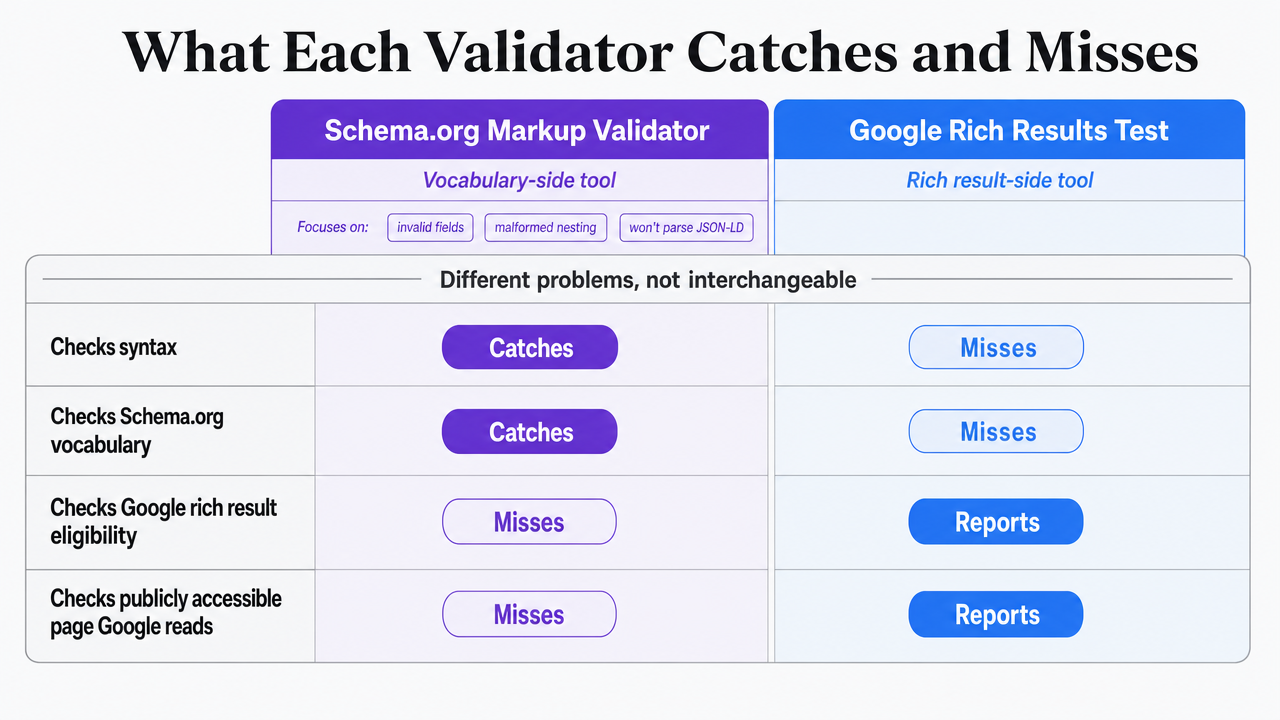 Show the coverage matrix comparing Schema.org Markup Validator and Google Rich Results Test across the four dimensions described in the section
Wiring Both Into Pre-Publish CI Gates
Portfolio scope matters here. An agency shipping Article markup across dozens or hundreds of client sites cannot rely on manual validator runs — the failure mode is silent regressions on CMS updates, plugin changes, and bulk republishes that no one thinks to re-test. The fix is a pre-publish CI gate that calls both validators programmatically on every template change and every content type that emits Article JSON-LD.
A workable gate has three stages:
- Run the payload through Schema.org's vocabulary validator to catch type-model violations before Google ever sees them 10.
- Run a staging URL through the Rich Results Test to confirm Article eligibility survives the client's actual rendering path, including any JavaScript hydration that mangles JSON-LD 4.
- Block merge on either failure and route the diff back to the template owner.
Post-publish, the loop closes in Search Console. Google recommends before-and-after Search Console monitoring to measure structured data impact 5, and the same enhancement reports surface eligibility drift when a client's CMS quietly changes markup between deploys. Automated validators catch code errors; Search Console catches the policy and rendering failures the validators cannot see.
See How Leading Agencies Operationalize Article Schema at Scale
Connect with specialists to review your current schema markup processes and identify evidence-based opportunities to streamline structured data deployment across large client portfolios.
A Portfolio Operating Model for Multi-Client Deployment
If You Manage Dozens or Hundreds of Sites: Template Libraries and Per-Client Overrides
This section shifts scope. The mechanics above apply to any single-site Article implementation. What follows is written for delivery leads running structured data across dozens to hundreds of client properties, where the failure mode is not a bad payload but hundreds of small drifts no one owns.
The organizing structure is a two-layer template library. The global layer holds the eligibility-critical fields that every Article payload must emit — @type, headline, a crawlable image, datePublished, dateModified, author, and publisher — with property shapes that satisfy Google's Article documentation and the general policy on visible-content fidelity 2, 3. The per-client override layer holds the values that legitimately vary: publisher entity, logo URL, author taxonomy, articleSection vocabulary, subtype selection, and the paywall flag 6.
Two governance rules keep the library defensible. First, no client override can remove a global eligibility-critical field — the override layer can only supply values or extend, never subtract. Second, every override lives in version control alongside the client's CMS configuration, not in a spreadsheet or a Google Doc. That is the difference between a template library and a folder of snippets. When Google updates the Article guidance or the policy page, the diff flows through one global template and one CI run, not through per-client tickets.
Operating Cost Comparison Across Three Deployment Models
The economics of Article schema deployment change sharply once portfolio size crosses roughly 25 to 50 client sites. Three delivery models dominate agency practice, and each has a different scaling curve. The table below uses operational variables rather than invented dollar figures, because the actual cost turns on wage rates and portfolio composition that vary by agency.
| Model | Hours per site (initial) | Hours per site (monthly maintenance) | Error rate at scale | Rich result eligibility rate |
|---|---|---|---|---|
| Per-client manual implementation by technical SEOs | High — bespoke JSON-LD per template | Moderate — every CMS change reopens the payload | Rises with portfolio size as institutional memory fragments | High on day one, degrades without monitoring 3 |
| Templated CMS implementation with manual QA | Moderate — one template class per CMS | Moderate — QA burden scales linearly with site count | Moderate — human validator runs miss silent regressions 4 | Moderate — depends on QA cadence 5 |
| Automated template plus CI validation gates | High upfront, amortized across portfolio | Low — validators run on every merge 10, 4 | Low — regressions block merge before publish | High and stable — enhancement reports catch drift 5 |
The pattern that shows up in delivery data is that models one and two look cheaper per site in isolation but produce compounding maintenance debt. Model three front-loads engineering time to build the template and CI harness, then flattens the marginal cost of each additional client site. The decision point is portfolio size and republish frequency, not preference.
Monitoring Cadence: Search Console, Enhancement Reports, and Drift Detection
Validation catches code errors before publish. Monitoring catches everything else — CMS updates that mangle JSON-LD in production, plugin conflicts that strip properties on cache rebuild, and client-side edits that break visible-content fidelity long after the template shipped clean. Google's own guidance is to measure structured data impact through Search Console before and after implementation 5, and the same enhancement reports serve as the drift detection layer once markup is live.
A workable cadence has three loops:
- Weekly, pull the Article enhancement report per property and flag any change in valid-item count greater than a threshold tied to publish volume.
- Monthly, spot-check a sample of live URLs through the Rich Results Test to confirm rendered eligibility matches what the enhancement report claims 4.
- Quarterly, rerun the Schema.org vocabulary validator against the current template output to catch schema.org model changes the CI harness may not have picked up 10.
The reason to layer cadences is that each loop surfaces a different failure class. Weekly catches acute regressions. Monthly catches rendering-path failures. Quarterly catches vocabulary drift. Skip any one and the portfolio accumulates silent eligibility loss.
Future-Proofing for AI Search Surfaces
The AI answer panels now summarizing source pages before a click ever happens read the same JSON-LD Google's traditional crawlers do. That is the practical case for treating Article markup as the machine-readable contract, not a rich snippet accessory. Google's Article guidance frames the payoff as helping Search understand the page and improve title, image, and date presentation 2— the same properties AI summarization surfaces lean on when they attribute a quote, cite a publication date, or credit an author entity.
The NJIT research on differentiating structured results reinforces the direction. When items are topically similar, the annotated features are what let a system pick the maximally distinguishing signal 1. AI answer generation runs into that same selection problem at scale. Articles with disciplined, accurate author, publisher, datePublished, and articleSection values are the ones a summarizer can attribute cleanly.
The future-proofing move is not new markup. It is the governance already built above — scoped properties, dual-validator CI, date fidelity, honest paywall flags, Search Console drift monitoring 3, 4, 10. Portfolios that run that loop are the ones whose content stays legible to whatever surface reads it next. Vectoron's approval-gated execution model exists to keep that loop running across client counts no manual team can cover.
Frequently Asked Questions
References
- 1.Differentiating Search Results on Structured Data.
- 2.Learn About Article Schema Markup | Google Search Central.
- 3.General Structured Data Guidelines | Google Search Central.
- 4.Rich Results Test - Google Search Console.
- 5.Intro to How Structured Data Markup Works | Google Search Central.
- 6.Structured data for subscription and paywalled content.
- 7.Help Google Search know the best date for your web page.
- 8.Structured Data Markup that Google Search Supports.
- 9.The Rich Results Test is out of beta.
- 10.Schema.org Markup Validator.