
Key Takeaways
- Predictable pipeline requires three stacked layers in order: governed first-party signals, a measurement portfolio, and a weekly intake feedback loop—each with its own operating discipline.
- No single measurement method covers the forecast: run attribution weekly for tactics, incrementality quarterly for causal reads, and marketing-mix modeling twice a year for allocation 2.
- Call-intake data is the highest-impact signal because qualification tags lead pipeline rather than lag it, and 2024 TSR rules require specific call-detail fields retained for five years 7.
- Multi-location operators should consolidate the signal inventory first under one schema, then unify call intelligence, so bias assessment, retention mapping, and consent audit trails hold up 2, 3, 8.
Why Persona Decks Stopped Predicting Pipeline
Most audience insights work still delivers what a VP of Marketing already has: a slide deck of personas, a demographic breakdown, and a GA4 view that explains yesterday. None of that forecasts next quarter's booked revenue. The gap between knowing the audience and predicting the pipeline is where marketing leaders lose credibility with their CFO.
The failure is structural. Persona work treats audience understanding as a describable artifact. Pipeline prediction treats it as an operating system that has to ingest signals, weigh them against outcomes, and produce a number the finance team can defend. Those are different disciplines, and the second one is almost never what an agency ships.
Three shifts have made the old approach obsolete. First-party signals from CRM, web behavior, transactions, and call intake now carry more predictive weight than any third-party segment, but only when they are unified under governed data flows 1. Measurement has splintered: last-click attribution answers tactical questions, incrementality testing answers causal ones, and marketing-mix modeling answers budget-allocation ones, and no single method covers the full forecast 2. And for service verticals handling health, legal, or high-consideration decisions, the analytic inputs themselves are regulated, which means the insight layer and the compliance layer have to be built together, not sequenced 1, 4.
What follows is the operating stack a marketing VP can actually forecast against.
The Three-Layer Stack: Signals, Measurement, Loop
Predictable pipeline runs on three layers stacked in a specific order. The bottom layer is Signals: governed first-party data from CRM records, web behavior, transactions, and call intake, inventoried and controlled under a documented privacy framework 1. The middle layer is Measurement: a portfolio of attribution, incrementality testing, and marketing-mix modeling that answers different questions rather than pretending one model covers them all 2. The top layer is the Loop: an operational feedback path where qualified-inquiry patterns from the intake layer refine targeting, content, and channel spend, then get re-measured.
The order matters. Measurement built on ungoverned signals produces confident numbers from dirty inputs, which is worse than no forecast. A loop wired to measurement that ignores incrementality will keep amplifying whatever last-click rewards, usually branded search. And signals collected without a mapped lifecycle become a liability the moment a regulator, auditor, or plaintiff asks where the data came from 3.
Each layer has a specific operating discipline. The next three sections work through them in that order.
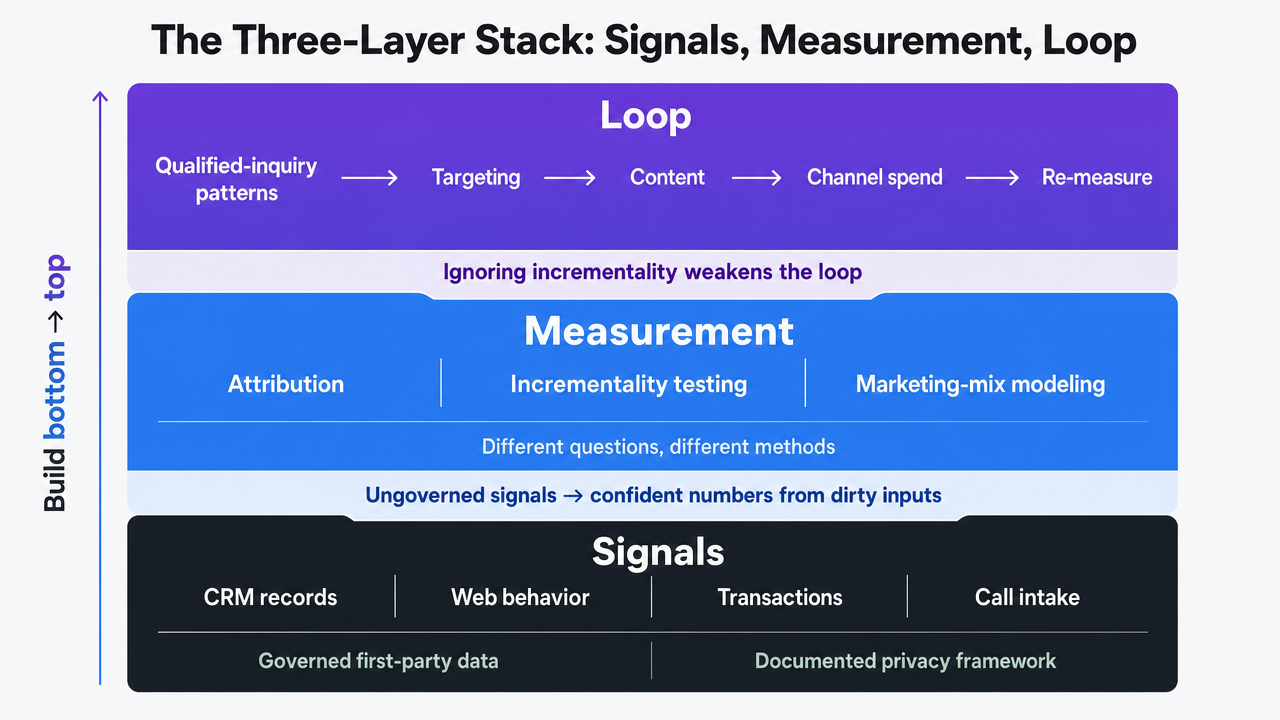 Visualize the three stacked operating layers introduced in this section as a foundational framework diagram, since the entire article structure depends on this stack
Layer One: A Governed First-Party Signal Foundation
What Actually Counts as a Signal
A signal is any first-party data point tied to an identifiable person or session that changes the probability of a downstream outcome. That definition rules out most of what shows up in a typical audience report. Aggregate pageviews are not signals. Demographic overlays purchased from a third-party data broker are not signals. A cookie-based lookalike built on a competitor's audience is not a signal.
Four categories carry real predictive weight for service verticals:
- CRM records — CRM records capture stage transitions, disqualification reasons, and revenue outcomes.
- Web behavior — captures the specific pages, forms, and repeat visits that precede a qualified inquiry.
- Transaction data — captures what was actually purchased, at what price, and how often.
- Call intake — captures the language a prospect uses, the questions they ask, and whether the front desk marked the call qualified.
NIST treats each of these as an analytic input that must be inventoried and evaluated for bias and impact before it drives a decision 2. That framing matters because it forces a distinction most audience-insight work skips: the difference between data a marketing team happens to have and data a marketing team has cleared for use in targeting, scoring, or model training. Only the second kind belongs in a pipeline forecast.
The Data Lifecycle Checklist for Audience and Call Data
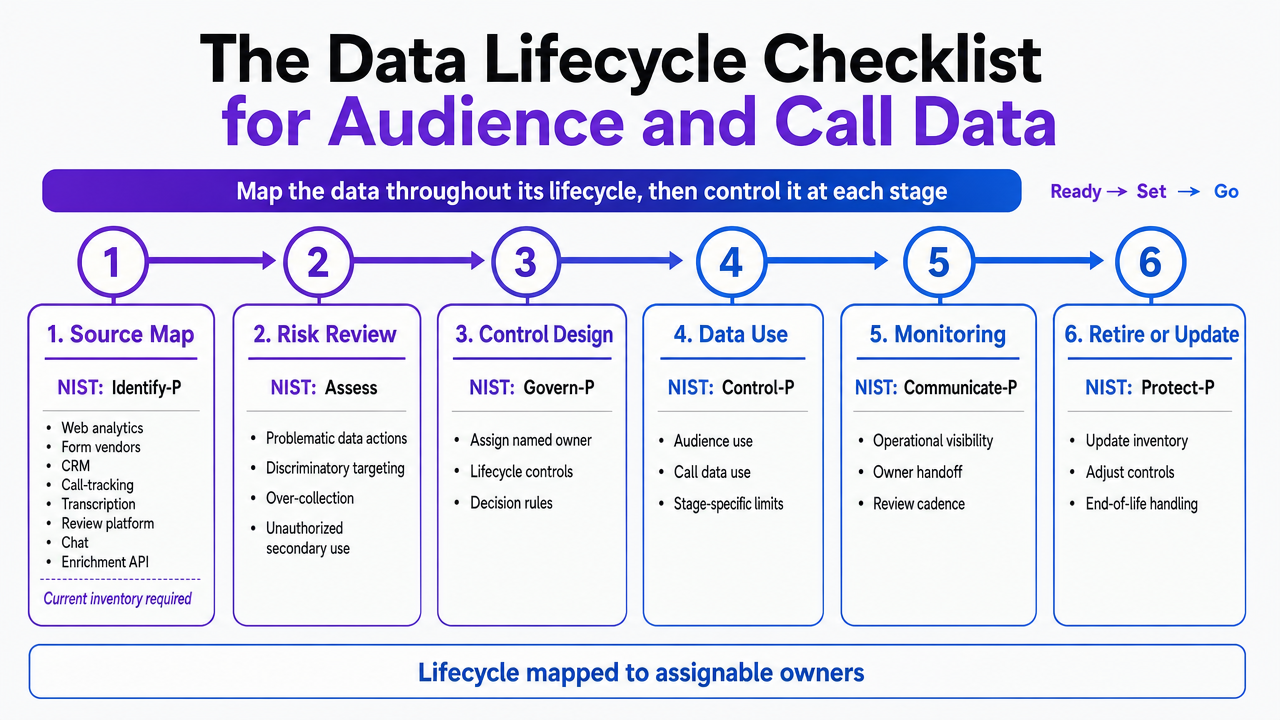
NIST's Getting Started guide organizes privacy work around a "Ready, Set, Go" progression and a single instruction that carries the most operational weight: map the data throughout its lifecycle, then control it at each stage 3. For audience and call data, that lifecycle has six concrete stops, and each one maps to a NIST function a marketing VP can assign to a named owner.
- Map every source that feeds the audience layer: web analytics, form vendors, CRM, call-tracking platform, transcription service, review platform, chat, and any enrichment API. This is the Identify-P function 1. Without a current inventory, no downstream control is defensible.
- Assess each source for problematic data actions and impacts, which is the language NIST uses for outcomes like discriminatory targeting, over-collection, or unauthorized secondary use 2. This is where Govern-P lives, and it is where the marketing team decides which signals are eligible for pipeline models and which are not.
- Control access with role-based permissions so intake staff, analysts, and vendors see only what they need.
- Encrypt sensitive fields in transit and at rest, particularly call recordings and transcripts. These two steps sit under Control-P and Protect-P 1.
- Retain data only as long as the business or a specific regulation requires.
- Delete on a documented schedule. Communicate-P covers what the organization tells prospects about that schedule in its notices and consent flows 1.
The value of running this checklist is not compliance theater. It is that a pipeline forecast built on mapped, assessed, and controlled signals can be defended in a board meeting, an audit, or a discovery request. A forecast built on a scraped CRM extract and an unlogged call archive cannot. NIST's own framing is explicit that inventorying analytic inputs and outputs is the prerequisite for evaluating bias and impact 2, and that mapping the full lifecycle is the prerequisite for controlling it 3. Marketing leaders who treat this as an IT problem hand off the one artifact that determines whether their audience layer is an asset or a liability.
 Visualize the six-stop data lifecycle mapped to NIST functions described in the section prose
Test real-time audience insights in your workflow
Experience live pipeline impact by applying actionable audience data to your campaigns before making a commitment.
Layer Two: A Measurement Portfolio Instead of a Single Model
Attribution, Incrementality, and Marketing-Mix Modeling
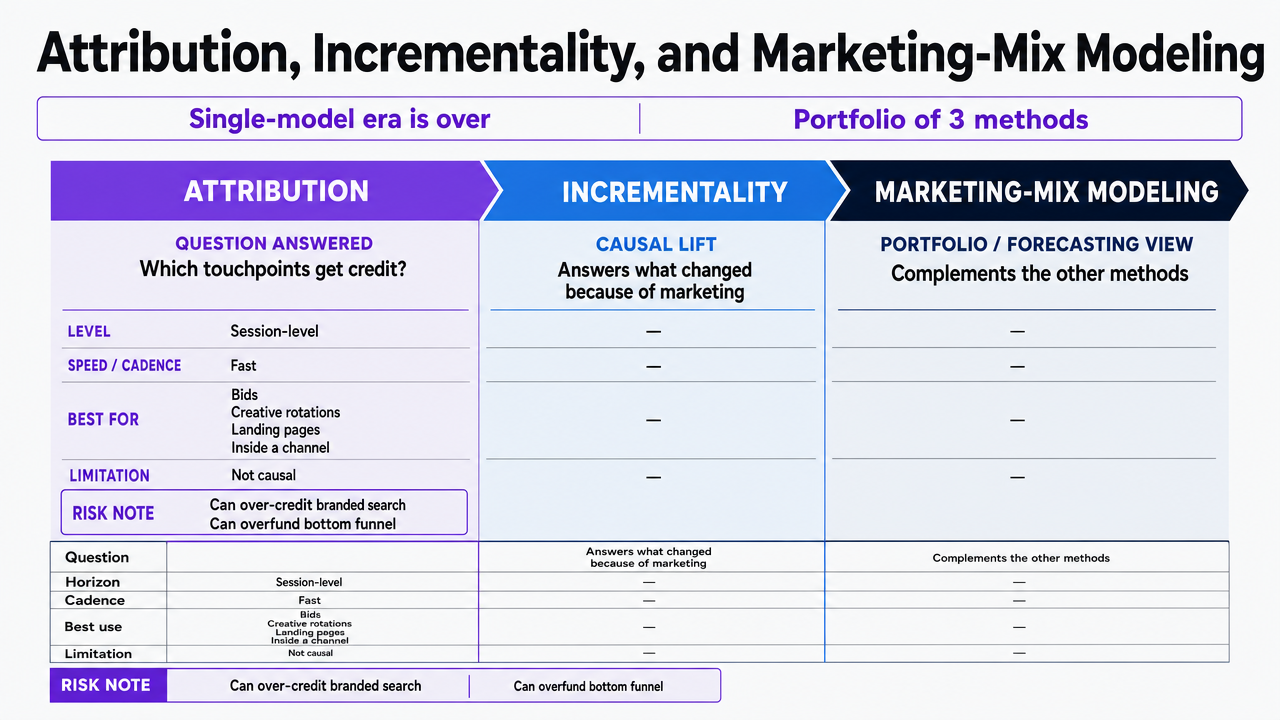
The single-model era is over. Any VP still running the pipeline forecast off a last-click attribution report is building a number on top of a method that was never designed to answer the question being asked. Forecast accuracy now depends on a portfolio of three methods, each answering something the others cannot.
Attribution answers a tactical question: within the paths a converter actually took, which touchpoints deserve credit under a chosen rule? It is fast, session-level, and useful for optimizing bids, creative rotations, and landing pages inside a channel. It is not causal. A last-click or data-driven model will happily assign 80% of credit to branded search that would have converted anyway, which is why attribution alone tends to overfund the bottom of the funnel and starve the sources actually producing new demand.
Incrementality testing answers a causal question: what would have happened without this spend? Geo holdouts, ghost bids, and matched-market tests isolate the lift a channel actually produces above baseline. The time horizon is longer than attribution—weeks to a full quarter—and the decision it drives is different: keep, cut, or resize a channel based on evidence rather than credit assignment.
Marketing-mix modeling answers an allocation question at the portfolio level: across all channels, seasonality, promotions, and macro effects, how should the next dollar be distributed? MMM works on aggregated historical data, tolerates the loss of user-level tracking, and produces the budget scenarios a CFO can plan against.
The three methods are not interchangeable, and no single touchpoint model covers the forecast. NIST's guidance on governing analytic systems is explicit that inputs and outputs of each model should be identified and evaluated on their own terms, including for bias and impact, rather than treated as one undifferentiated pipeline number 1, 2. Run attribution weekly for tactics, incrementality quarterly for causal reads on high-spend channels, and MMM at least twice a year for allocation. That cadence is what turns audience insights into a forecast a finance team will actually defend.
 Comparison infographic of the three measurement methods, their questions answered, time horizons, and cadence — all directly described in the section
Governance of Analytic Inputs and Outputs
A measurement portfolio is only as trustworthy as the data feeding it and the outputs it produces. That is where most marketing organizations quietly lose the plot: attribution platforms, incrementality tests, and MMM vendors each ingest slightly different slices of the signal layer, and no one owns the reconciliation.
NIST's Core is direct on this point. Analytic inputs and outputs should be inventoried and evaluated for bias, and problematic data actions and impacts should be prioritized before those outputs drive spending decisions 2. Applied to a measurement portfolio, that means three concrete disciplines:
- Document which signals feed each model—CRM conversion events, offline sales uploads, call-qualified outcomes, form fills—and version that map so a shift in inputs does not silently move the forecast.
- Assess each output for known failure modes: attribution's bias toward trackable channels, incrementality's sensitivity to test design, MMM's reliance on sufficient variance in historical spend.
- Log the decisions each model informs, so a budget reallocation can be traced back to the specific analytic evidence that supported it.
Governed this way, the measurement layer stops being a black box the CFO has to trust on faith and becomes an auditable record of how audience insights translated into dollar decisions 1.
Layer Three: The Intake-Signal Feedback Loop
Turning Call Outcomes into Targeting Decisions
The intake conversation is the richest audience signal a service business collects, and most marketing teams throw it away. A form fill captures a name, an email, and a checkbox. A ten-minute call captures the prospect's actual problem, the language they used to describe it, the objections that surfaced, whether they had already talked to a competitor, and whether the front desk marked the inquiry qualified or not. That gap is where the feedback loop lives.
The loop has four moves:
- Call intelligence tags each inbound conversation with a qualification outcome and a set of content features—service line requested, urgency, insurance or payment mentioned, geography, referral source.
- Those tags roll up into patterns: which keywords, campaigns, and landing pages produce calls that the intake team actually books, and which produce volume that never converts.
- The patterns then feed targeting decisions: pause the ad group generating unqualified volume, expand the content cluster that keeps producing booked revenue, adjust the landing page copy to preempt the objection that keeps killing qualified calls at the door.
- The refined targeting produces new calls, and the cycle repeats.
What makes this a loop rather than a report is cadence. Attribution and MMM operate on weekly and quarterly rhythms. Call-signal refinement can operate weekly on high-volume channels because the qualification tag is a leading indicator of pipeline, not a lagging one. NIST's Core is direct that the outputs of any analytic system, including call-scoring models, should be evaluated for bias before they drive spending decisions 2. A model that systematically under-scores calls from certain ZIP codes will quietly starve the channels serving those markets.
Call-Detail Records as the Backbone of the Loop
The feedback loop only holds up if the underlying call records are complete, consistent, and defensible. The 2024 FTC Telemarketing Sales Rule updates settled what that record has to contain for covered activity, and the list doubles as an operational spec for any service business that wants its call data to support forecasting rather than guesswork.
The required call-detail fields are the caller's number, the called number, the date, the time, the call duration, the caller ID transmitted, and the call disposition, and the records must generally be retained for five years 7. Each field carries analytical weight beyond compliance:
- Caller and called numbers let the loop tie a specific inbound call to the specific tracking number placed on a specific campaign or landing page.
- Date and time expose intake-staffing gaps that no attribution model will surface.
- Duration correlates with qualification more reliably than most CRM fields.
- Caller ID and disposition together separate the calls that produced a booking from the ones that hit voicemail, got misrouted, or ended in a hang-up.
The five-year retention window is longer than most marketing dashboards keep data live, which matters for MMM and for year-over-year seasonality analysis. Teams that let call platforms roll off records at 90 or 180 days lose the historical variance MMM needs to produce trustworthy budget scenarios. The 2024 rule also updated expectations around consent records and allocation of recordkeeping responsibility between sellers and telemarketers, so the audit trail has to name who captured what 8.
Treated as marketing infrastructure rather than a legal file, the call-detail record is the backbone every other layer of the audience stack ultimately reconciles against.
Governance for High-Stakes Verticals: HIPAA and the 2024 TSR
The signal layer, the measurement portfolio, and the feedback loop all sit inside a regulatory perimeter that tightened in 2024. For legal, behavioral health, dental, home services, senior living, and healthcare operators, two regimes carry the most operational weight for audience work: HIPAA where health information is in play, and the updated FTC Telemarketing Sales Rule where any outbound or automated calling touches the pipeline.
HIPAA's treatment of oral communications is narrower than most marketing teams assume, and more consequential. Covered entities are not required to record calls, but recordings a business does maintain and uses to make decisions about an individual can qualify as part of the designated record set 4. That single fact reshapes how call transcripts flow into audience models: once a recording informs a decision, it inherits the access, amendment, and disclosure obligations that attach to protected health information. Sending those transcripts to an external analytics vendor for audience scoring is a disclosure, not a workflow detail.
The marketing definition matters just as much. HHS defines marketing as a communication about a product or service intended to encourage its purchase or use, subject to specified exceptions 5, and a covered entity generally needs prior written authorization to share PHI with a telemarketer for marketing, unless an exception or a properly scoped business-associate arrangement applies 6. Operational intake analysis that refines targeting is different from a promotional communication built on PHI, and the audience layer has to reflect that boundary in its data flows.
The 2024 TSR updates add a parallel discipline. The rule now specifies which call-detail fields sellers and telemarketers must capture, extends recordkeeping obligations, and addresses consent records and AI-enabled calling practices, with allocation of responsibility between sellers and telemarketers made explicit 8. Verbally requested consent has to be captured completely, and where the rule requires recorded consent, the recording must make the purpose of that consent clear 10. For an audience system that ingests call data, this means every automated dialer, callback bot, or AI-assisted outbound sequence has to produce an auditable consent record tied to the same call ID the analytics stack uses.
The practical takeaway for a VP: name one owner for HIPAA-scope call data and one owner for TSR-scope outbound activity, and require both to sign off before any new analytics vendor, model, or automation touches the signal layer. That single control prevents the most common failure mode, which is a well-intentioned audience experiment quietly moving regulated data into an unvetted pipeline.
See How Leading Brands Use Audience Insights to Forecast Pipeline with Confidence
Request a walkthrough of data-driven audience intelligence workflows that help enterprise marketing teams surface patterns, prioritize spend, and reduce pipeline volatility—without increasing team size or vendor complexity.
If You Manage Multiple Locations: The Signal Fragmentation Cost
A quick audience shift: the rest of this article applies to any service business running the three-layer stack, but the economics change materially once a marketing VP is accountable for more than one location. Multi-location operators—regional dental groups, DSO platforms, behavioral health networks, home services brands, senior living portfolios, multi-office law firms—pay a fragmentation tax that single-site operators do not. Each location tends to accumulate its own call-tracking vendor, its own CRM instance, its own review platform, its own attribution report, and its own consent workflow. The audience layer becomes a federation of dashboards no one can reconcile, and the forecast degrades location by location.
The cost is not primarily financial. It is the collapse of the governance and measurement disciplines the earlier sections describe:
- A signal inventory that has to be reassembled from twelve vendors cannot be assessed for bias or problematic data actions on any coherent schedule 2.
- A retention policy that varies by location fails the mapped-lifecycle test 3.
- A consent record scattered across three dialers cannot produce the auditable trail the 2024 TSR expects 8.
The consolidation question is not "which vendor is cheapest" but "what does a single governed workflow replace."
| Capability | Fragmented setup | Consolidated setup |
|---|---|---|
| Audience data unification | N CRMs, N analytics accounts per location | Single governed store, one inventory |
| Attribution & measurement | Per-location reports, no portfolio view | One model portfolio across locations |
| Incrementality testing | Rarely run; no matched-market design | Geo holdouts across the location set |
| Call intelligence | Multiple vendors, inconsistent tags | Uniform qualification schema |
| Privacy & consent governance | Consent records scattered per site | Single audit trail, one retention policy |
Weeks-to-insight compress to days when one schema covers every location, and the forecast finally rolls up cleanly to the number a CFO can defend.
Wiring Forecast Accuracy Into the Operating Cadence
The three-layer stack only produces a defensible forecast if the operating cadence matches the rhythm of each layer:
- Signals get inventoried and reassessed on a quarterly review, because vendor changes, new intake scripts, and new landing pages continually alter what the audience layer actually contains 3.
- Attribution runs weekly against tactical decisions.
- Incrementality tests run quarterly against the top three or four channels by spend.
- Marketing-mix modeling refreshes twice a year and anchors the annual plan.
The call-signal loop runs weekly because qualification tags lead pipeline rather than lag it, and that is the cadence at which targeting decisions actually move CAC. Every new analytics vendor, model, or automation touching the signal layer clears the same two-owner sign-off—HIPAA scope and TSR scope—before it goes live.
A marketing VP who runs this cadence stops presenting audience insights as a narrative and starts presenting a forecast with named inputs, evaluated outputs, and a documented chain from signal to spend. That is the artifact a CFO will fund, and it is the operating discipline platforms like Vectoron are built to keep on schedule without adding headcount.
Frequently Asked Questions
References
- 1.NIST Privacy Framework: A Tool for Improving Privacy through Enterprise Risk Management.
- 2.NIST Privacy Framework CORE.
- 3.Getting Started with the NIST Privacy Framework.
- 4.Standards for Privacy of Individually Identifiable Health Information.
- 5.Marketing.
- 6.Marketing.
- 7.Mark your calendars, telemarketers and sellers! October 15 is the ....
- 8.FTC Implements New Protections for Businesses Against ....
- 9.Complying with the Telemarketing Sales Rule.
- 10.Telemarketing Sales Rule -- proposed text.