
Key Takeaways
- Semrush Market Explorer maps SERP intent clusters and competitor coverage at scale, compressing brief construction from days to hours but leaving the 'why buyers care' question unanswered.
- AnswerThePublic surfaces the actual question phrasing buyers use during early category exploration, making it ideal for FAQ and long-tail planning when cross-checked against volume data.
- SparkToro reveals where target audiences spend attention off-search — podcasts, sites, hashtags — informing both topical relevance decisions and unpaid distribution opportunities.
- Audiense clusters audiences into discrete cultural segments with distinct objections and reference brands, replacing monolithic personas with segment-specific briefing targets 8.
- GA4 exploration reports separate content that converts from content that only ranks, turning underperforming organic pages into rewrite candidates rather than sources of net-new topics.
- Similarweb exposes competitor traffic sources and referral behavior at the URL level, distinguishing pages winning on distribution from pages winning on topical gaps worth briefing.
- Brand24 captures buyer language across 25M+ sources in real time, letting writers enter conversations already underway instead of publishing generic pillar pages 13.
- BuzzSumo maps topic velocity and content resonance over 90-day windows, showing which angles are accelerating and which peaked — reframing brief writing around active conversations.
- CRM and sales-call transcripts link specific objections to closed-won and closed-lost outcomes, producing message maps and middle-funnel topic lists no external tool can generate 12.
Why single-source audience research stopped working
For most of the last decade, a single tool did the job. A keyword planner told content teams what buyers searched for, and a persona doc filled in the rest. That model is quietly breaking. Guideflow's 2026 platform review pegs the global audience intelligence market at $5.52 billion in 2024, projected to reach $15.54 billion by 2033 — a 12.2% CAGR that reflects buyers spreading across search, social, community, and AI-generated answers faster than any one dataset can track 10.
The shift is behavioral, not technological. McKinsey's personalization research found that consumers respond best to messages tied to their specific interests and prior searches, which means a content brief built on search volume alone misses the affinity signals that decide whether a piece converts 6. A keyword tool sees the query. It does not see the podcast the buyer listened to on the commute, the subreddit where they vetted the category, or the sales call where they named the actual objection.
Peer-reviewed B2B research reinforces the point. A LUT University thesis surveying large B2B brands concluded that effective content strategies begin with understanding the customer through buyer personas and segmentation that drives data tracking and content decisions — a workflow no single tool delivers end to end 9. Content teams under pressure to increase output are discovering that faster production on thin research produces more articles, not more pipeline. The nine tools that follow are organized by the specific data layer each one owns, so a lean team can assemble a stack that covers what buyers search, believe, do, say, and tell the company directly.
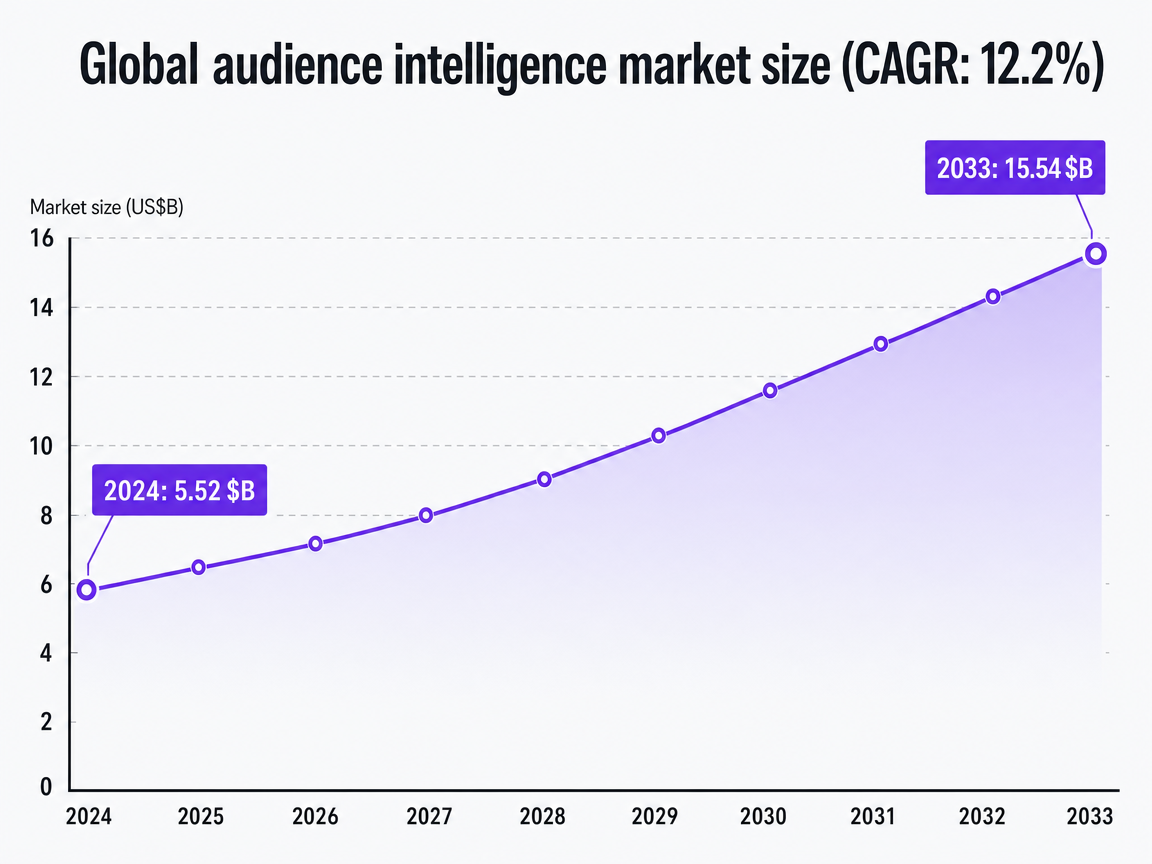 Global audience intelligence market size (CAGR: 12.2%)
Source: Guideflow - 15 best audience intelligence platforms in 2026
The four data layers a modern content stack needs
Every content brief that converts pulls from four distinct research layers, and each answers a different question about the buyer.
Search intent : Captures what buyers type when they have a problem to solve, and it drives keyword clustering, SERP structure, and topical authority decisions.
Psychographic and affinity data : Reveals what those same buyers read, watch, and follow when they are not searching — the podcasts, subreddits, and creators that shape category perception long before a query is entered.
Behavioral analytics : Tracks what buyers do once they land: which pages they revisit, where sessions collapse, which CTAs actually pull weight.
First-party voice-of-customer data : Sales-call transcripts, CRM notes, survey responses — surfaces the exact language buyers use to describe their own problem, which rarely matches the language marketers assume.
Academic segmentation research supports treating these as separate layers rather than a single dataset. A methodological study on combining behaviors and demographics for segmentation found that hybrid approaches produce more actionable audience groups than either variable set alone 8. The Census Bureau's 2020 segmentation program applied demographic, behavioral, and psychographic variables together to craft tailored messages and identify efficiencies in ad allocation — a public-sector benchmark that segmentation improves message efficiency when the layers are combined 3. Content teams that skip any one layer end up with briefs that rank but do not convert, or convert on the wrong audience.
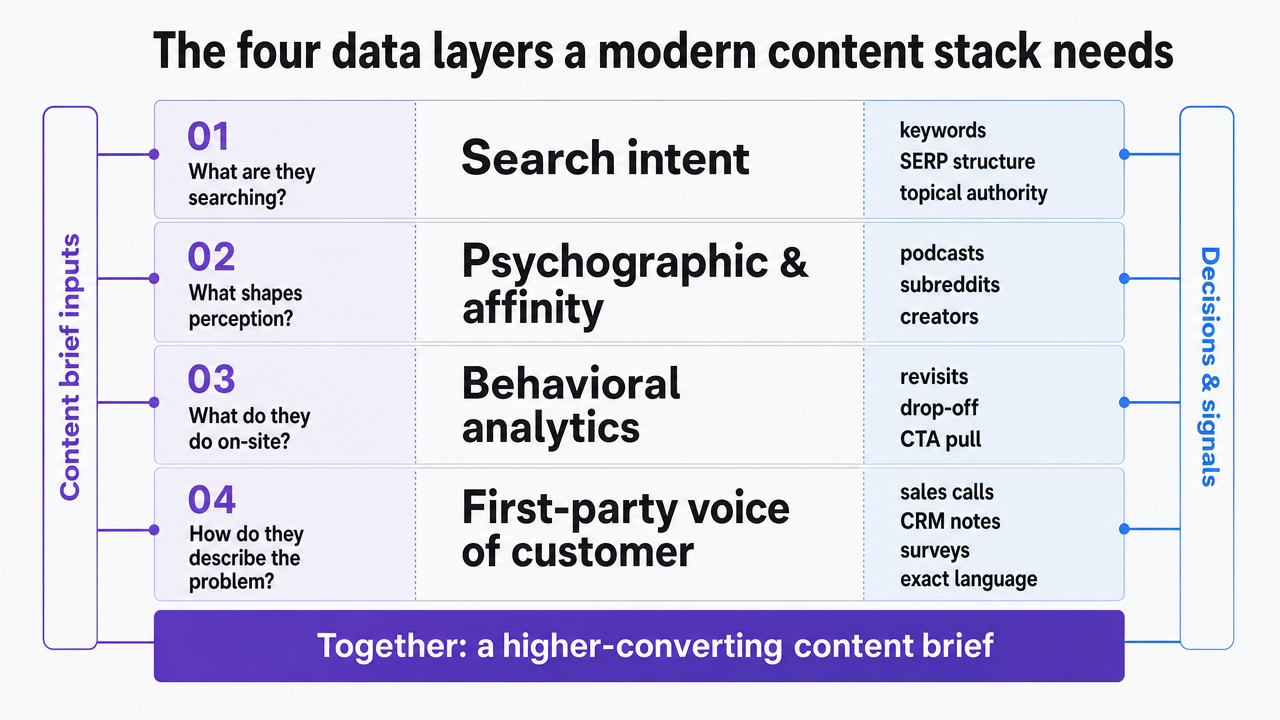 Visualize the four distinct research layers described in the section as a framework, giving readers a clear mental model of the stack
Search intent tools: what buyers are actively looking for
Semrush Market Explorer — SERP intent clustering at scale
Semrush Market Explorer sits in the search intent layer because its output is not a keyword list — it is a map of how a category's SERP is actually structured. Content teams use it to cluster queries by intent type (informational, commercial, transactional, navigational), see which competitors own each cluster, and identify topical gaps where SERP volatility signals an opening. Guideflow's 2026 platform review situates Market Explorer alongside other integrated consumer intelligence tools that combine search and web data as a category standard 10.
For a lean content team, the operational value is speed of brief construction. A single query pulled through Market Explorer returns cluster size, top-ranking domains, and content-type distribution — the raw material for a topical map that would otherwise take a strategist two days to assemble by hand. That compresses the interval between a topic decision and a writer receiving a brief.
What Market Explorer will not tell content teams: why buyers care. The tool reports what is being searched and who is winning, but it cannot surface the affinity signals, community context, or emotional stakes that decide whether a ranked article converts. Pair it with a psychographic layer, or the briefs will read like every other page on the SERP.
AnswerThePublic — question-shaped intent discovery
AnswerThePublic pulls autocomplete data from search engines and organizes it into question, preposition, and comparison structures — "how," "why," "vs," "for," "with." It is the fastest way to see the actual phrasing buyers use before a category has settled into standardized keyword clusters. The 2025 audience research overview from Temitayo lists it alongside Google Trends and Reddit Insights as a core input for search-intent discovery 11.
Content teams get the most value from AnswerThePublic at two moments: early category exploration, when the buyer's vocabulary is still forming, and FAQ or supporting-content planning, when a pillar page needs to capture long-tail question variants. The output feeds directly into H2 and H3 structures without a second interpretation step.
What AnswerThePublic will not tell content teams: volume reliability or commercial value. Autocomplete surfaces phrasing frequency, not qualified demand. A question that generates 30 autocomplete variants may carry no measurable monthly search volume, and a high-intent commercial query may barely register in question form. Cross-reference every promising cluster against a volume-and-difficulty tool before committing writer time to the brief.
Psychographic and affinity tools: what buyers actually care about
SparkToro — affinity mapping across podcasts, sites, and social
SparkToro answers a question no keyword tool can: where does this audience already spend attention when a brand is not paying for it? The platform's core output is affinity data — the podcasts a defined audience listens to, the websites they read, the accounts they follow, the hashtags they use, and the phrases that appear disproportionately in their bios. A comparison of leading audience tools describes SparkToro's differentiator as "affinity mapping across websites, podcasts, social with deep persona enrichment," which is the specific job it does that a search-intent tool cannot 13.
Content teams pull SparkToro output into two workflows. The first is topical relevance — using affinity signals to decide which adjacent subjects a pillar page should cover, based on what the target audience actually consumes elsewhere. The second is distribution — identifying the podcasts and publications where a completed piece can earn a link, a guest slot, or a syndication placement without a paid promotion budget. Both compress the gap between a research finding and a shipped asset.
What SparkToro will not tell content teams: whether an affinity is causal or coincidental. The platform surfaces correlation across public profile data, not motivation. A high-affinity podcast may simply share demographics with the target audience while contributing nothing to purchase intent. Validate the top three affinities against sales-call transcripts or customer interviews before rebuilding a content calendar around them.
Audiense — cultural affinity and psychographic segmentation
Audiense pushes the psychographic layer one step further by clustering an audience into cultural segments rather than surfacing a single blended profile. The platform ingests social graph data — primarily from X, with supporting inputs — and returns discrete audience groups with distinct media habits, personality traits, purchase drivers, and influencer relationships. The same tools comparison characterizes Audiense's specialty as "deep psychographic segmentation + cultural affinity analysis," which distinguishes it from platforms that treat an audience as one monolithic persona 13.
For a lean content team, Audiense earns its seat when a category has clearly heterogeneous buyers. A B2B SaaS audience that looks uniform in a CRM often splits into three or four psychographic segments with different objections, reference brands, and preferred content formats. Peer-reviewed segmentation work supports treating these clusters as separate briefing targets: a methodological study on combining behaviors and demographics for segmentation found that hybrid approaches produce more actionable audience groups than single-variable analysis 8. That translates to briefs written for a segment, not for a company.
What Audiense will not tell content teams: what segments do off-platform. The data is strongest where social signals are strongest, and it thins out for audiences that decide inside private communities, gated Slack groups, or vendor evaluations that never surface publicly. Treat the segmentation as a starting hypothesis, not a closed answer.
Test Audience Insights With Real Content Publishing
Run live campaigns and validate audience research impact before making a commitment.
Behavioral analytics tools: what buyers do on-site
GA4 — session-level behavior and conversion pathing
GA4 sits in the behavioral layer because it records what buyers do after search intent and affinity have already done their work. Session paths, engaged sessions, scroll depth, event triggers, and conversion pathing across cross-domain journeys — the tool answers a single question with precision: which content is doing the work, and which is decoration. The 2025 audience research overview from Temitayo highlights Google Analytics specifically for "website visitor tracking, demographics, traffic sources, behavior flow," which is the operational spine of any content performance review 11.
For a content marketing manager, the highest-leverage GA4 workflow is not the standard traffic report. It is the exploration report that segments organic landing pages by engaged-session rate and downstream event completion, which surfaces the pieces that rank but do not carry buyers forward. Those pages become rewrite candidates, not net-new topic ideas. That distinction alone changes quarterly output planning.
What GA4 will not tell content teams: why a session collapsed. The tool reports the drop, not the motivation. A page with a 12-second average engagement time may fail because the headline oversold, because the intent match was wrong, or because a CTA loaded below a broken image. Pair GA4 with a session-replay tool or a qualitative feedback loop before deciding whether to rewrite, restructure, or retire the asset.
Similarweb — competitor traffic and referral behavior
Similarweb extends the behavioral layer outside a team's own domain. The platform estimates traffic volume, channel mix, referral sources, top pages, and audience overlap for competitor sites — the data that tells a content team whether a rival's ranking article is actually pulling qualified traffic or floating on brand searches. Guideflow's 2026 platform review situates Similarweb among the leading integrated consumer intelligence tools that combine web and audience data at scale 10.
The most useful application for a lean team is competitive gap analysis at the URL level. A ranked competitor page that draws 60% of its traffic from a single referring publication signals a distribution opportunity, not a content one. A page pulling steady organic from a long-tail cluster the team has not covered signals a topical gap worth briefing. Both readings come from the same data pull, and neither is visible in a keyword rank tracker.
What Similarweb will not tell content teams: conversion outcomes. The platform models traffic and engagement, not pipeline. A competitor page with strong session metrics may convert at 0.2%, and a lower-traffic page may quietly close deals. Treat Similarweb output as a demand and distribution signal, then validate commercial value against first-party data before shifting a content calendar.
Social listening tools: what buyers say when no one's selling
Brand24 — real-time sentiment across 25M+ sources
Brand24 sits in the social listening layer because it captures buyer language in the wild — the forum thread where a category term gets picked apart, the LinkedIn post where a competitor's rollout gets ridiculed, the Reddit comment that names an objection the sales team has been dancing around for two quarters. A comparison of leading audience tools highlights Brand24's coverage across 25M+ sources with real-time sentiment and emotion AI, which is the operational reason it earns a seat separate from a pure analytics or SERP tool 13.
The channel case is not abstract. Pew's fact sheet on social media and news reports that about half of U.S. adults say they at least sometimes get news from social media, which means the language a buyer encounters between formal searches is often social-first, not brand-first 2. For a content marketing manager, that reshapes the briefing question from "what should this article say" to "what conversation is this article entering." Brand24's mention feeds, sentiment scoring, and share-of-voice tracking give a writer the specific phrases, complaints, and endorsements circulating in the week the piece will publish — which turns a generic pillar page into a response to something buyers are already discussing.
What Brand24 will not tell content teams: intent depth. A spike in mentions signals attention, not readiness to buy. Cross-check any sentiment shift against pipeline or search-trend data before rebuilding an editorial calendar around it.
BuzzSumo — content resonance and topic velocity
BuzzSumo answers a different social-layer question than Brand24. Instead of tracking mentions of a brand or category term, it ranks the specific pieces of content earning shares, backlinks, and engagement inside a topic — which formats are traveling, which headlines are pulling weight, which authors and publications keep resurfacing in a niche. A comparison of leading audience tools groups BuzzSumo with SparkToro, Audiense, Similarweb, and Brand24 as a core content-analysis platform used by marketers and PR teams for influencer mapping and topic discovery 13.
For a lean content team, the highest-leverage BuzzSumo workflow is topic velocity mapping — pulling the last 90 days of top-performing content in a category to see which angles are accelerating and which have already peaked. That data reframes brief writing. A subject with three high-share pieces in the last month signals an active conversation worth entering with a differentiated angle; a subject with a single 2022 winner and nothing since signals a topic the audience has moved past.
What BuzzSumo will not tell content teams: whether shares translate to pipeline. A viral post can generate zero qualified traffic, and a quiet asset can quietly close deals. Treat resonance as a demand signal, not a performance forecast.
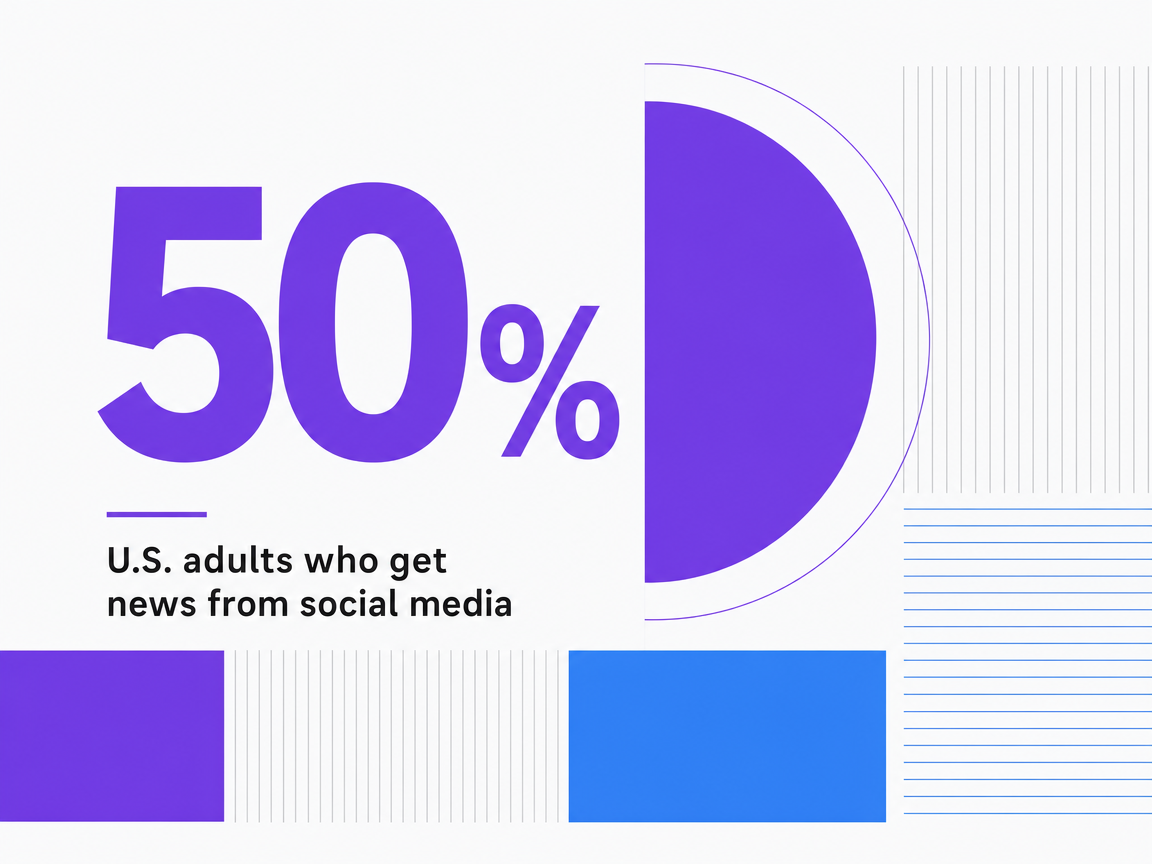 U.S. adults who get news from social media
U.S. adults who get news from social media
First-party voice-of-customer tools: what buyers tell the company directly
CRM and sales-call data as a research surface
The most under-used audience research tool inside most B2B content teams is the CRM the sales team already fills out every day. A practical guide to audience research inputs calls CRM or sales data a must-have because it connects research directly to purchase behavior and pipeline — the one dataset that ties a specific objection to a specific closed-won or closed-lost outcome 12. That linkage is what none of the external tools can produce.
For a content marketing manager, the operational workflow is narrower than it sounds. Pull the last 40 closed-won and closed-lost deals, read the sales-call notes or transcripts attached to each, and tag three fields:
- the initial trigger phrase the buyer used,
- the top two objections raised before commitment, and
- the reference competitor named in the deal.
That output feeds directly into two artifacts — a message map that overrides generic keyword phrasing with the language buyers actually speak, and a topic list for middle-funnel content aimed at the specific objections that stall deals. Ipsos' CX Global Insights 2025 reinforces the underlying case: customer experience expectations vary by sector and region in ways broad surveys smooth over, which means first-party transcripts capture segment-specific language external panels cannot 4.
What CRM data will not tell content teams: what the buyers a team never spoke to are thinking. Sales-call data is biased toward deals that entered pipeline. Pair it with a survey or a social-listening pull before treating it as the full picture.
See How Leading Teams Accelerate Content Production With Real-Time Audience Insights
Get a tailored walkthrough of unified audience research and approval workflows designed for agencies and enterprise brands aiming to scale high-impact content—without adding headcount.
Assembling a working stack without three new hires
The temptation, faced with nine tools across four layers, is to buy three and hope integration happens later. It rarely does. A lean content team of three to eight people gets more leverage from a deliberate two-tool starting stack than from a four-tool subscription pile that no one has time to actually operate. The question is not which tools are best in isolation — it is which pairing covers the most layers with the least redundant data.
Guideflow's 2026 platform review, which compares Audiense, SparkToro, Similarweb, Brandwatch, Brand24, BuzzSumo, and Semrush Market Explorer across primary use cases and differentiators, makes one pattern clear: the platforms cluster tightly within a data layer but diverge sharply across layers 10. Two tools inside the same layer produce overlapping outputs. One tool from each of two different layers produces a brief that beats a single-layer competitor page.
Three starting pairings cover most content-team situations:
- A team ranking in an established category but struggling to convert should pair Semrush Market Explorer (search intent) with a CRM voice-of-customer workflow (first-party) — the fastest route from SERP presence to language that matches how buyers actually describe the problem.
- A team entering a category where competitors already rank should pair SparkToro (psychographic affinity) with Similarweb (competitor behavioral) — affinity data reveals where the audience lives, and competitor traffic data reveals where the winning distribution already flows.
- A team defending a mature category from newer entrants should pair Brand24 (social listening) with GA4 exploration reports (on-site behavior) — the combination surfaces which external conversations are pulling attention and which internal pages are quietly leaking it.
Add a third tool only when a specific brief keeps stalling on the same missing input. A stack expands to solve a diagnosed problem, not to feel complete.
Stack cost logic: layered SaaS vs. a dedicated research analyst
The budget conversation usually collapses into a false binary: subscribe to more tools, or hire a dedicated research analyst. Neither framing survives contact with a growth-stage marketing P&L. A layered SaaS stack — one search-intent tool, one psychographic tool, one behavioral tool, one social-listening tool — carries a predictable per-seat cost that scales with users, not with output. A dedicated analyst carries a fully loaded salary that scales with tenure and benefits, and produces research only as fast as one human can read, synthesize, and write.
The trade-off is not cost — it is throughput and coverage. A single analyst can go deeper on one segment than any platform. A layered stack covers more layers simultaneously but requires someone on the team to actually operate it. Most lean teams over-index on tools and under-invest in the two to four hours per week of disciplined synthesis that turns dashboards into briefs.
One audience note before moving on. Multi-location service brands — law firms, dental DSOs, home services groups — carry an extra layer: location-level search intent varies by market, and a single national research pull will miss the geographic variance that decides which briefs rank in which metros. That variance is a stack input, not a headcount question.
Where orchestration fits: turning research into shipped content
A layered stack surfaces the right inputs. It does not, on its own, produce a brief, a draft, an approval, or a published page. Most content teams lose the compounding value of their research because the handoff from dashboard to writer still happens in a doc someone opens on Tuesday and forgets by Thursday. Guideflow's platform review notes that integrated consumer intelligence tools now standardize psychographic profiling and trend detection, but standardization at the input layer only widens the gap at the execution layer if there is no workflow catching the outputs 10.
Orchestration is the discipline of turning research signals into a governed production loop — ranked topic recommendations, drafted briefs, approval routing, and published pages, with the reasoning behind each decision visible to the marketing manager who owns the quarter. Vectoron operates in that layer, sitting downstream of the nine tools rather than competing with them, and routing every recommendation through human approval before execution. The stack question stops being "which tool" and becomes "which loop."
Frequently Asked Questions
References
- 1.Measuring News Consumption in a Digital Era.
- 2.Social Media and News Fact Sheet.
- 3.2020 Census Predictive Models and Audience Segmentation Report.
- 4.CX Global Insights 2025: Unlocking the Future of Customer Experience.
- 5.What matters to today's consumer: 2025.
- 6.The art of personalization— Keeping it relevant, timely and contextual.
- 7.Leveraging YouTube Audience Segmentation: Data-Driven ....
- 8.Combining Behaviors and Demographics to Segment ....
- 9.Digital content marketing in B2B (Master’s thesis, LUT University).
- 10.15 best audience intelligence platforms in 2026.
- 11.Top 15 Audience Research Tools to Consider in 2025.
- 12.5 Must-Have Audience Research Tools to Create Targeted Content.
- 13.The 6 Best Audience Analysis Tools for Your Business (Tried and Compared).