
Key Takeaways
- Author schema works as three separate roles: attribution on the Article node, entity description on a ProfilePage, and an identity graph built through matching sameAs values across both.
- Choose Person for @type only when a named human will publicly stand behind the content; use Organization honestly for house-produced pieces rather than inventing a persona 1, 4.
- Markup cannot manufacture E-E-A-T. Author pages need real bios, verifiable credentials, and live off-site profiles before schema can make that authorship resolvable to AI systems 3.
- For multi-client rollouts, treat the author dictionary and sameAs graph as a governed, CMS-agnostic spec with quarterly audits, since template updates scale by client but author pages scale by roster.
Why identity resolution now sits upstream of citation
AI search systems no longer ask only what a page says. They ask who said it, and whether that person can be resolved to a coherent entity across the open web. Google frames AI Overviews as answers backed by top web results with links to supporting resources 10, and its AI features documentation positions those overviews as jumping-off points to explore sources rather than terminal answers 11. That framing puts source identity, not just content quality, in the selection path.
Author schema sits at the center of that resolution problem. Google's Article documentation states that markup can help it understand the page, and it names author.url and sameAs as the properties that uniquely identify who wrote it 1. ProfilePage markup extends the same logic to standalone author pages, letting Google connect a byline to a creator profile with its own identity attributes 2. Neither type promises a ranking lift. Both reduce ambiguity about who is speaking.
For agency SEO leads, the strategic point is upstream of any single client site. When a citation-worthy article, a credible author page, and a consistent off-site identity graph all resolve to the same person, AI systems have fewer reasons to hesitate before quoting the source. When any layer is missing or contradictory, the resolution fails quietly, and the citation goes to a competitor whose identity signals hold together.
What Google actually documents about author markup
Article.author: the properties Google names by hand
Google's Article structured-data documentation is unusually specific about which author properties matter. It names author as either a Person or an Organization, then singles out author.url as a link that "uniquely identifies the author of the article," with sameAs as an alternative identifier when a canonical URL is not available 1. The documentation also handles multi-author bylines directly, telling implementers to specify each author in its own array entry rather than concatenating names into a single string 1.
Two implementation details tend to get lost in agency handoffs. First, author.url is not decorative. Google recommends it point at a page that resolves to the author as an entity, which in practice means a standalone author page on the same site rather than the article itself or the homepage 1. Second, the choice between Person and Organization as the value of @type is a factual claim about who produced the work, not a stylistic preference. Google's guidance frames the type selection as a representation of reality, and its separate AI-content guidance reinforces that bylines should be accurate 1, 4.
For Article markup, then, the load-bearing properties are author with a correct @type, author.name, author.url, and author.sameAs. Everything else is decoration until those four resolve to a real person or entity.
ProfilePage: the standalone author-page contract
ProfilePage is a separate schema type with its own contract. Google's documentation scopes it to pages "where the focus is a specific person or organization sharing first-hand perspectives," and it requires a single property: mainEntity, pointing to a Person or Organization 2. Author pages are one of the primary use cases Google names, alongside forum profiles and community contributor pages 2, 7.
The recommended properties on the mainEntity node are where the identity signal actually lives. Google lists name, alternateName (handles), image, description, jobTitle, sameAs, and agentInteractionStatistic for follower or content-interaction counts 2, 7. The gallery of supported types confirms ProfilePage as a first-class structured-data feature rather than an experimental extension 6.
What this means operationally: an Article's author.url should resolve to a page that carries ProfilePage markup, and the mainEntity on that page should describe the same person referenced in the article byline. When both pages describe the entity with matching name, image, and sameAs values, Google has the machine-readable evidence it needs to treat them as the same creator. When they drift, the resolution weakens without producing any visible error in Search Console.
sameAs: the identity graph that connects the two
sameAs is the property that turns two isolated schema nodes into an identity graph. Google's Article guidance explicitly recommends it as a way to "help Google better understand the author," and its ProfilePage guidance carries the same property forward on the mainEntity node 1, 2. The mechanic is straightforward: each URL in the sameAs array is a claim that this entity is also the entity described at that address.
Useful sameAs targets are pages that themselves resolve to a stable identity for the person: a LinkedIn profile, an ORCID record, a professional licensing registry, a verified social handle, a university faculty page, a bar association listing. Vanity URLs, redirects, and dead accounts weaken the graph rather than strengthen it. The same array should appear on both the Article's author node and the ProfilePage's mainEntity node, with matching values, so the two on-site nodes and the off-site references form one consistent identity cluster.
The payoff is disambiguation. When AI search systems try to resolve who wrote a page, a coherent sameAs graph gives them one entity to match against instead of several candidates with the same name.
The three schema roles agencies keep collapsing into one
Most agency implementations treat author identity as a single markup task. The Article template gets an author block, someone ticks the box in Search Console, and the ticket closes. That collapses three distinct schema roles into one, and it is why so many client sites carry technically valid markup that produces no identity signal at all.
The first role is attribution. Google's Article documentation assigns this to the author property on the article itself, with author.url naming the page that uniquely identifies the writer and sameAs available when a canonical URL is not 1. Attribution answers a narrow question: who is being credited for this specific piece of content. It lives inside the Article node and travels with the article.
The second role is entity description. Google's ProfilePage guidance handles this through a mainEntity node that carries the creator's name, image, job title, and identity properties on a page dedicated to that person 2, 7. Entity description answers a different question: who is this person, independent of any single article. It lives on the author page, not on the article.
The third role is identity graph. This is what sameAs does when it appears on both nodes with matching off-site targets, connecting the on-site attribution and the on-site profile to the same set of external references 1, 2. The identity graph answers the question AI search systems actually care about: is the person named in this byline the same entity referenced elsewhere on the open web.
Agencies that collapse these into one node ship articles where author is a bare name string, no author page exists, and sameAs is either missing or points at the site's homepage. The markup validates. The identity does not resolve. Treating attribution, entity description, and identity graph as three separate deliverables, each with its own template and QA step, is what turns author schema from a checkbox into a signal.
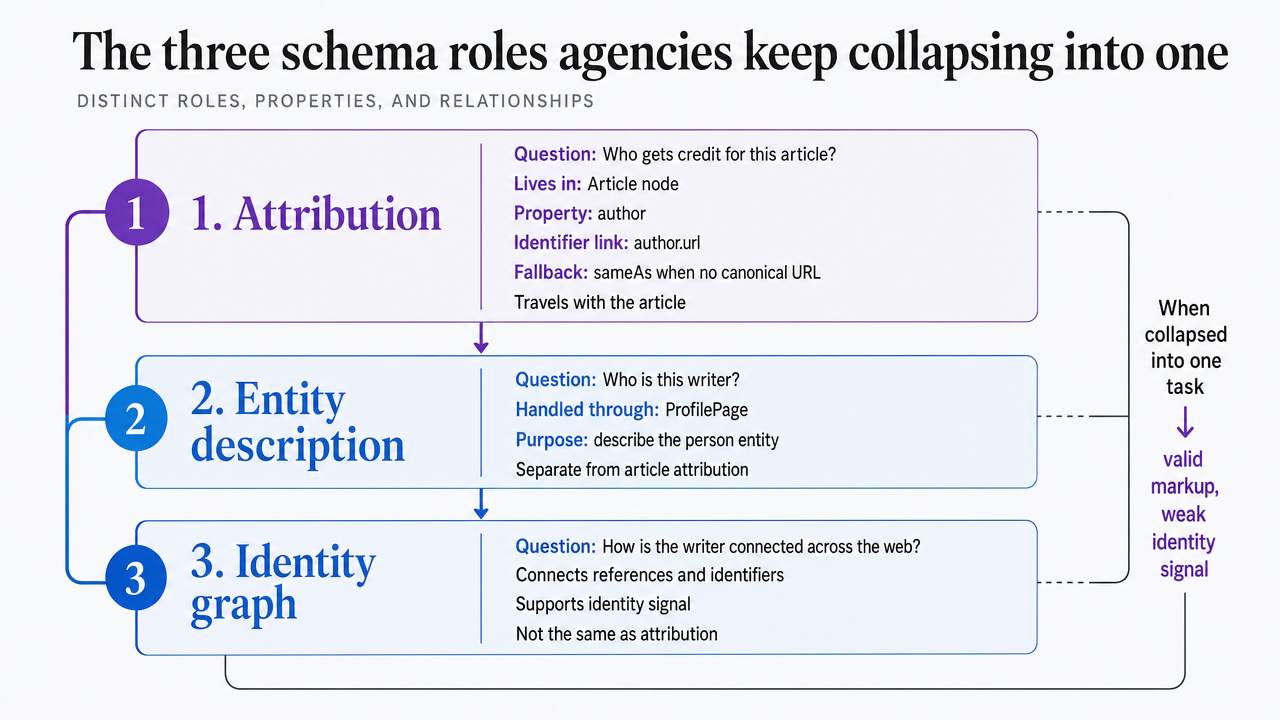 Visualize the three distinct schema roles (attribution, entity description, identity graph) that the section explicitly separates, showing which schema property serves each role and how they connect
Test Author Schema Impact on Live Content
Measure how structured author data affects E-E-A-T and AI search visibility with real-time publishing during your trial.
Person or Organization: deciding who owns the byline
The accountability test Google published for AI-assisted content
Google's 2023 guidance on AI-generated content is the clearest thing it has published on byline policy. Two sentences do most of the work: consider accurate author bylines where readers would reasonably expect them, and giving AI an author byline is probably not the best way to follow that guidance 4. That is not a ban on AI-assisted production. It is a rule about who takes accountability for the finished piece.
Read alongside Google's Article documentation, which frames the @type choice on author as a factual representation of who produced the content 1, the accountability test becomes a decision matrix agencies can actually operationalize.
- A staff writer producing original reporting resolves to a
Person. - A named freelance subject-matter expert who edits, approves, and stands behind the piece resolves to a
Person, with asameAsgraph pointing at their professional identity. - An AI-assisted draft that a named human editor reviews, revises, and publishes under their own name resolves to that editor as a
Person, because the human is the accountable author. - A ghostwritten executive byline, where the named executive has genuinely reviewed and approved the content, resolves to that executive as a
Person. - A piece with no accountable human reviewer resolves to an
Organization, not to a fabricated persona or a house pen name treated as a real writer.
The test agency editors should apply on every article is simple. If a specific human will publicly stand behind the claims, that human is the Person author. If no one will, do not invent one.
When Organization is the honest answer
Some content genuinely has no individual author, and forcing a Person byline onto it weakens the identity graph rather than strengthens it. Product update notes written by a rotating internal team, legal disclosure pages maintained by a compliance function, service pages that describe what the business offers rather than what a specific expert thinks: these belong to the organization. Google's Article documentation explicitly permits Organization as the value of author 1, and its AI-content guidance implies the same conclusion by insisting that any human byline be accurate 4.
When Organization is the honest answer, the identity work does not disappear. It moves. The author node should reference the organization's canonical entity URL, typically the About or company page, and the sameAs array on that node should point at the same off-site identity anchors the site uses on its Organization schema elsewhere: LinkedIn company page, Crunchbase, verified social profiles, industry registries. Consistency between the article-level author and the site-level publisher entity is what lets AI systems resolve the source to a single organization.
The failure mode agencies keep shipping is a Person author with a plausible name, no author page, and no sameAs graph. That is worse than an honest Organization byline. It creates an entity that cannot be resolved and invites AI systems to route the citation elsewhere.
What author schema will not fix
Markup does not manufacture authority. It represents it. When the underlying authorship is thin, schema makes the thinness legible to machines faster, not slower. That is worth stating plainly before any agency spends a sprint rolling out author identity across a client book.
A ProfilePage node with three sameAs URLs pointing at a dormant Twitter account, a personal blog last updated in 2019, and a LinkedIn profile with no employer or credentials does not produce E-E-A-T. It produces a well-formatted description of an entity with no verifiable expertise. Google's helpful-content guidance asks whether it is self-evident who authored the content and whether bylines lead to further information about the author's areas of expertise 3. Schema answers the machine-readable half of that question. It does not answer the second half, which requires an actual bio with credentials, a track record readers can verify, and off-site references that resolve to real professional identity.
The same logic applies to experience. The 2022 addition of Experience to E-A-T made first-hand perspective a distinct evaluation criterion 8, and the Quality Rater Guidelines overview describes raters weighing the first-hand experience, expertise, authoritativeness, and trust of the creator 9. None of those are properties in schema.org. They are qualities of the content and the person behind it. Author schema can point at where that evidence lives. It cannot supply it.
Two agency pitches to retire: markup as a fix for anonymous content mills, and markup as a shortcut past the work of building author pages that actually describe qualified people. Google's Article documentation is careful to frame structured data as help for understanding, not a promise of ranking or visibility 1. Ship the visible authorship first. Then let the schema make it resolvable.
See How Structured Author Data Impacts E-E-A-T and AI Ranking Signals
Request a demo of advanced schema implementation workflows designed for agencies managing multi-author content at scale. Explore data-driven approaches to optimize author transparency and search performance across client portfolios.
Author identity in AI Overviews and AI Mode
Google describes AI Overviews as answers backed by top web results, with links to supporting resources so readers can explore further 10. Its AI features documentation reinforces that AI Overviews function as a jumping-off point to source pages rather than a terminal answer 11. Both framings put source selection at the center of the AI-search experience, which is where author identity earns its keep.
The empirical picture is still being drawn. A 2025 arXiv preprint on citation patterns in AI search systems analyzed a dataset of over 366,000 citations drawn from conversations across 12 AI search models from major providers, giving the field its first large-scale look at how these systems choose sources 12. The scope matters: it is a cross-model observational study of citation behavior, not a controlled test of schema markup, and it does not measure the effect of author schema on citation odds. Treating it as a citation-behavior baseline rather than a causal finding keeps the argument honest.
What the current documentation supports is narrower and more actionable. AI Overviews draw from Search results, so the same identity signals that help Google resolve a byline in classic Search apply when a passage is selected for an AI answer 10, 11. When Article.author, a ProfilePage-marked author page, and a coherent sameAs graph all resolve to the same person, the source is easier for these systems to attribute confidently. Google does not promise inclusion, and its AI-content guidance keeps human accountability at the center of any byline decision 4, 11. Agency teams pitching author schema as an AI Overview lever should stop. The defensible pitch is that identity resolution reduces ambiguity in the selection layer, and that is worth building for on every client site producing content someone qualified is willing to sign.
If you manage multiple client sites: a portfolio-level rollout spec
One author-identity spec, many CMSes
The audience shift here is deliberate. Everything upstream applies to a single site with a single author. This section is for the SEO lead running author identity across a book of clients on WordPress, HubSpot, Webflow, custom headless stacks, and whatever else the last three acquisitions dragged in. The unit of work is no longer an article. It is a specification that survives translation across CMSes.
The spec has four load-bearing components, and each corresponds to a distinct schema role Google documents.
- An Article template rule: every published article emits
authoras an array ofPersonorOrganizationnodes, each withname,url, andsameAs, following the property list Google names in its Article guidance 1. - An author-page template: every named
Personin the author dictionary has a live URL on the client domain, and that URL emits ProfilePage markup withmainEntitypointing to aPersonnode that carriesname,image,description,jobTitle, andsameAs2, 7. - An author dictionary held outside any single CMS, listing every author entity with a canonical URL and the authoritative
sameAsarray. - A QA rule that the
sameAsvalues on the Article node match the values on the ProfilePage node, byte for byte.
When the spec is CMS-agnostic, the rollout stops being twenty custom builds and starts being one contract with twenty implementations.
Portfolio effort model for a 50-client book
The table below models a hypothetical 50-client agency book to make the unit economics of an author-identity rollout legible. It uses only structural variables: how many author entities exist per client, how many templates need Article.author updates, and how many ProfilePage instances need to ship. No hourly rates. No invented benchmarks. The point is to expose where effort actually accumulates so delivery leads can staff and sequence the work.
| Client profile | Clients in book | Author entities per site | Author pages to build | Article templates to update | sameAs targets per author |
|---|---|---|---|---|---|
| Solo practitioner (law, dental, medical) | 20 | 1 | 20 | 20 | 3–5 |
| Small team (5–15 named contributors) | 20 | 8 (avg) | 160 | 20 | 3–5 |
| Multi-location or DSO (regional experts + house content) | 10 | 15 (avg, Person) + 1 Organization | 150 | 10 | 3–5 |
| Portfolio total | 50 | — | 330 | 50 | — |
Two patterns fall out of the model. The Article-template work is bounded by the number of clients, not the number of authors, because a single template change propagates to every article on that site. That is the leverage point: 50 template updates cover the entire book. The ProfilePage work scales with the author roster, and it is where the hours go. 330 author pages across the portfolio, each needing a real bio with credentials the client can vouch for, is the real budget item 2, 3.
Solo-practitioner clients are the fastest wins. One author, one ProfilePage, one sameAs graph tied to the practitioner's professional identity, and the site's author signal resolves cleanly. Multi-location books are where sequencing matters. Start with the named regional experts who already have off-site identity to reference, and use Organization as author for house content until the human bylines are actually staffed 1, 4.
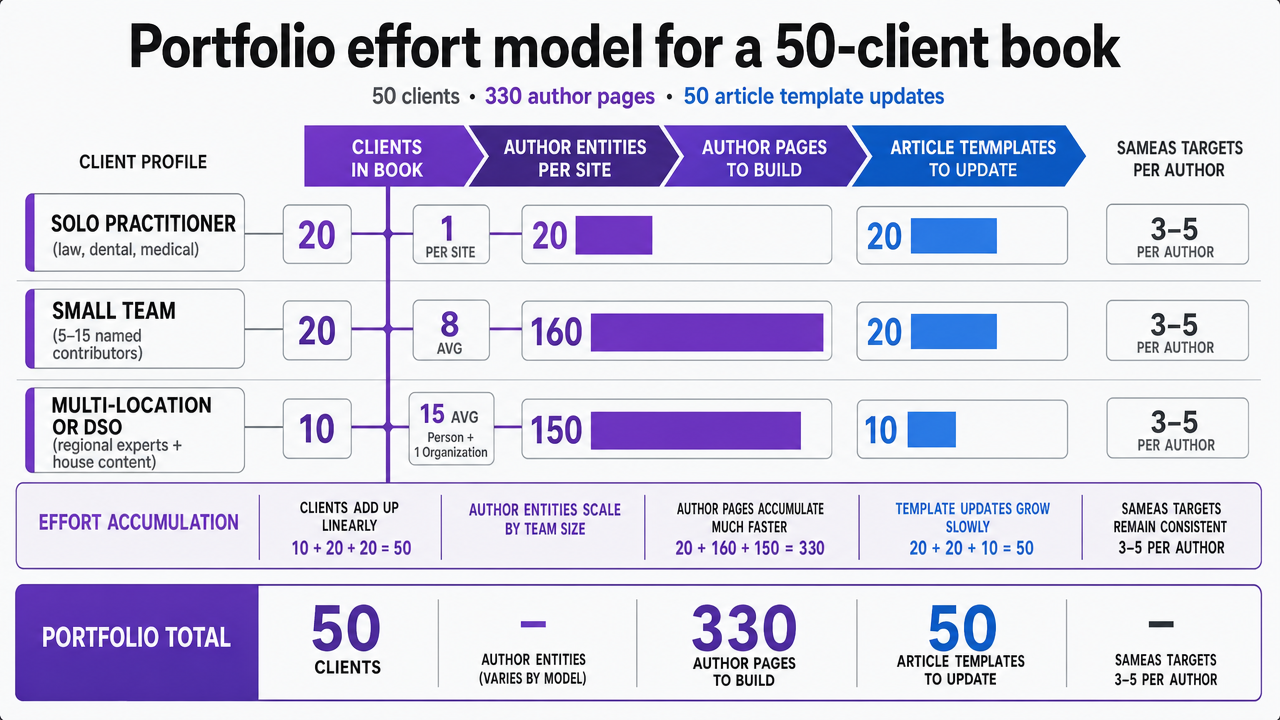 Reinforce the section's own portfolio effort model by charting the exact numbers cited in the article table (author pages to build and article templates to update across three client profiles totaling 50 clients and 330 author pages)
Governance: keeping author entities clean after launch
The rollout is not the hard part. Keeping the identity graph coherent eighteen months later is. Authors leave, LinkedIn URLs change, freelancers get replaced by staff writers, and client marketing directors quietly add ghostwritten bylines that no one reviews. Every one of those events breaks the sameAs match between the Article node and the ProfilePage node without triggering a validation error.
Three governance rules keep the graph honest.
- Ownership of the author dictionary sits with the agency, not the client CMS, so a single source of truth for every author entity's canonical URL and
sameAsarray can be audited without crawling. - A departure protocol handles what happens when a named author leaves a client: their author page stays live with an archival note and the
sameAstargets are preserved, or the byline is reassigned toOrganizationon new articles going forward 1, 4. - A quarterly identity audit checks that every
sameAsURL still resolves to a live profile for the named person, because a dead LinkedIn account or a redirected faculty page silently degrades the identity signal Google's helpful-content guidance is asking for 3.
Author schema is a standing operation, not a one-time deliverable. Agencies that treat it that way turn a compliance chore into a compounding identity asset across the client book.
Frequently Asked Questions
References
- 1.Learn About Article Schema Markup | Google Search Central.
- 2.Profile Page (ProfilePage) structured data.
- 3.Creating Helpful, Reliable, People-First Content.
- 4.Google Search's guidance about AI-generated content.
- 5.Understanding the sources behind Google News.
- 6.Structured Data Markup that Google Search Supports.
- 7.New in structured data: discussion forum and profile page markup.
- 8.Our latest update to the quality rater guidelines: E-A-T gets an extra E for Experience.
- 9.Search Quality Rater Guidelines: An Overview - Google.
- 10.AI Overviews and AI Mode in Search - Google Search.
- 11.AI Features and Your Website | Google Search Central.
- 12.News Source Citing Patterns in AI Search Systems - arXiv.