
Key Takeaways
- Authority functions as a governance layer over content production, not a writing style—requiring verified expertise, cited evidence, disclosed relationships, technical integrity, and monitored reputation as repeatable gates 8.
- Credibility rests on five interlocking layers: named authors and reviewers, primary-source citations with update dates, ownership and endorsement disclosure, stable secure delivery, and reputation signals collected under the FTC's 2024 rule 7.
- Ranking and authority drift apart because search rewards relevance and links while qualified visitors verify authorship, currency, disclosure, and source hierarchy—variables often absent even on visible pages 9.
- In-house teams can close gaps through a 90-day sequence: audit expertise and evidence first, then disclosure and technical integrity, then install reputation workflows and a named approval loop 2.
Authority is an operating system, not a content type
Most authority-site advice treats the problem as a writing exercise: longer articles, better bylines, more schema. That framing understates what the search and regulatory environments now reward. Authority is what a site can prove about itself under scrutiny—who wrote a page, what evidence supports each claim, who owns and funds the publisher, how reviews and endorsements are collected, and how the whole apparatus holds up when a regulator, a referring physician, or a general counsel checks the receipts.
The research points in the same direction. A systematic review of 73 studies drawn from 3,827 records found that credibility on high-stakes websites tracks with owner authority, author authority, ease of use, content quality, and clear layout, while advertising drags credibility down 8. Stanford's Internet Observatory frames the same phenomenon at ecosystem scale: trust is a property of interacting systems—platforms, verification signals, reputation flows—not a single page's copy 4. A page-by-page rewrite cannot fix a publisher whose ownership, authorship, and evidence chain are opaque.
For a VP running organic pipeline in legal, behavioral health, DSO, senior living, or home services, that reframes the operating question. Authority is not a content type produced by writers; it is a governance layer that sits over content production. Every draft passes through the same gates: verified expertise, cited evidence, disclosed relationships, technical integrity, and monitored reputation. Sites that install those gates as a repeatable workflow compound organic visibility and referral trust. Sites that treat authority as a stylistic overlay generate volume that ranks briefly, converts poorly, and creates regulatory drag. The rest of this piece maps that operating system layer by layer.
How users decide a site is credible before they read it
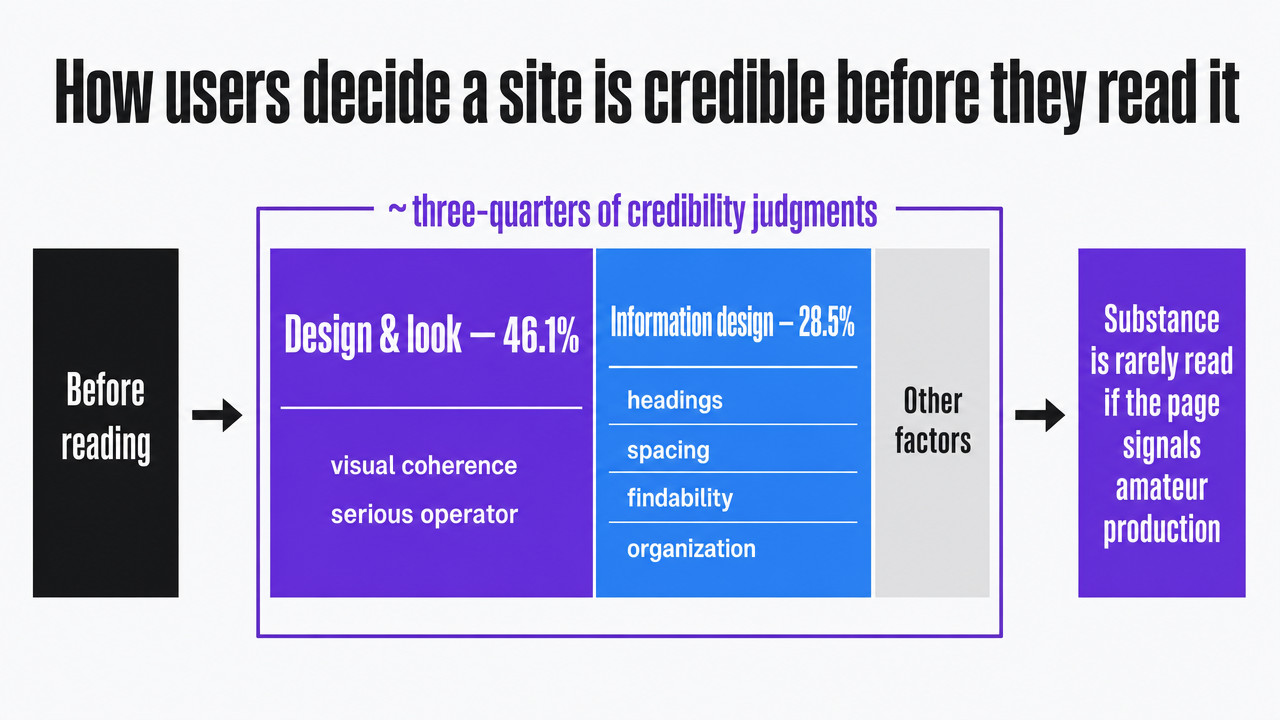
Credibility judgments happen faster than most content plans account for. Before a visitor evaluates a single argument, they have already scored the publisher on visual coherence, layout logic, and whether the page looks like it belongs to a serious operator. A peer-reviewed review of credibility research found that 46.1% of respondents cited design and look as the deciding factor when judging a web page, while 28.5% pointed to information design—headings, spacing, findability, and how content is organized on screen. Together, those presentation categories accounted for roughly three-quarters of reported credibility judgments 1.
That number does not mean design substitutes for substance. It means substance rarely gets read on a page that signals amateur production. For a behavioral health intake page or a law firm practice-area page, the sequence is the same: layout stability, typography, image quality, and navigation clarity establish whether the visitor treats the page as a legitimate source or bounces to a competitor with a cleaner presentation.
Secondary signals reinforce or undermine that first judgment within seconds. A systematic review of 73 studies drawn from 3,827 records identified a recurring set of credibility factors—owner authority, author authority, ease of use, content quality, clear layout, and interactive features—while noting that advertising drags perceived credibility down 8. A page cluttered with retargeting units, interstitials, and unmarked sponsored blocks reads as commercial noise regardless of the underlying expertise.
Users also apply a checklist most operators underestimate. MedlinePlus's public guidance for evaluating web information advises visitors to identify who runs and funds a site, confirm author qualifications, check for cited references, review update dates, and inspect the privacy policy before trusting what they read 11. That checklist mirrors what a compliance reviewer or referring physician would run against the same page. Authority sites that pass the seven-second design test and the two-minute verification test convert; sites that pass only one do not.
 Visualize the cited credibility judgment breakdown (46.1% design and look, 28.5% information design) that appears directly in the section prose
The five layers of a defensible authority stack
Expertise layer: named authors, credentials, and reviewer chains
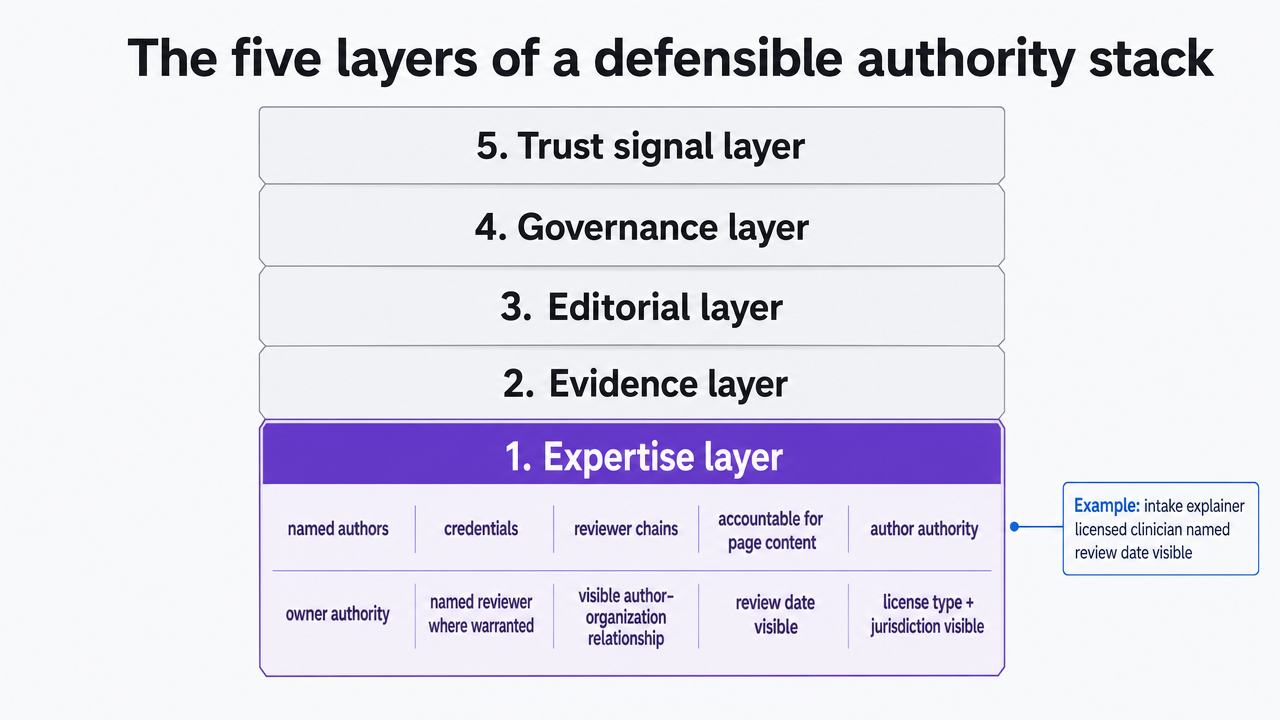
The expertise layer answers a single question: who, specifically, is accountable for what appears on the page. A systematic review of credibility research consistently identifies author authority and owner authority as positive credibility factors across high-stakes web content 8. That finding is operational, not aspirational. Every substantive page should carry a named author with verifiable credentials, a named clinical, legal, or technical reviewer where the content warrants one, and a visible relationship between the author and the publishing organization.
For a behavioral health group publishing an intake explainer, that means the licensed clinician who reviewed the copy is named on the page, their license type and jurisdiction are visible, and the review date sits above the fold. For a law firm practice-area page, the attorney of record and bar admissions appear on the page, not buried on a separate bio. MedlinePlus's public evaluation guidance instructs readers to check writer qualifications and expert review before trusting the content they read 11. Referring physicians, opposing counsel, and prospective patients apply the same test.
Reviewer chains matter as much as bylines. A page written by a marketing coordinator and reviewed by a subject-matter expert is defensible; a page with an unnamed author and no reviewer is not. The expertise layer fails silently when it is treated as a template field rather than a governance requirement.
Evidence layer: citations, primary sources, and update dates
The evidence layer converts claims into checkable statements. MedlinePlus's evaluation guidance tells readers to look for cited scientific references, identify when content was last updated, and treat unsupported personal stories as insufficient proof 12. Sites that expect qualified visitors to convert must give those visitors something to verify.
That translates into concrete page elements. Statistics carry inline citations to primary sources—regulatory agencies, peer-reviewed studies, official filings—not links to secondary aggregators repeating the same number. Clinical, legal, or financial claims name the study, the year, and the population studied. Every substantive page carries a visible "last reviewed" date, and outdated content is either refreshed or removed rather than left to accumulate.
The evidence layer also disciplines what makes it onto the page in the first place. A meta-narrative review of 153 studies covering 11,785 health websites found that quality varied widely by assessment instrument and specialty, with governmental sources rating higher than academic sources, which rated higher than other media 9. The pattern suggests that source hierarchy matters: authority sites that cite regulators, national libraries, and peer-reviewed literature inherit some of that credibility. Sites that cite competitor blog posts and syndicated press releases do not.
Disclosure layer: ownership, funding, endorsements, and material connections
The disclosure layer is where regulatory exposure and credibility converge. MedlinePlus advises visitors to identify who runs and funds a site, determine its purpose, and review the privacy policy before trusting the information presented 11. Authority sites answer those questions on the page: a visible "About" section names the operating entity, ownership structure where relevant, and any commercial sponsorships that shape the content.
Endorsements and testimonials sit inside a stricter regulatory frame. The FTC's Endorsement Guides require that endorsements reflect the endorser's honest opinion and that material connections between an endorser and the advertiser be disclosed clearly and conspicuously 2. A generic footer disclaimer does not satisfy that standard when a video testimonial features a compensated patient, an incentivized reviewer, or an employee's family member without a visible relationship label.
Disclosure also covers what is absent. Peer-reviewed credibility research consistently finds that advertising has a negative effect on perceived credibility, while owner and author authority carry positive weight 10. Pages layered with unmarked sponsored blocks, native-ad units disguised as editorial, and interstitials with unclear origins signal commercial intent to both users and reviewers. Authority sites label commercial content, isolate advertising from editorial, and make ownership legible without requiring a click.
Technical layer: stability, accessibility, and secure delivery
The technical layer determines whether the other four layers ever get read. Systematic credibility research identifies clear layout, ease of use, and interactive features as positive credibility factors, alongside authorship and content quality 10. Layout stability, fast rendering, keyboard-accessible navigation, and functional forms are not user-experience niceties; they are the substrate on which credibility judgments form.
Secure delivery carries similar weight. MedlinePlus's evaluation guidance directs users to confirm secure connections and check contact information before submitting personal details or trusting the site 12. For a senior living inquiry form or a behavioral health assessment, a missing HTTPS certificate, a broken form field, or an unreachable contact page ends the session before an authority claim is even tested.
The practical audit is narrow. Pages should:
- render without layout shift on mobile,
- meet baseline WCAG accessibility criteria,
- serve over HTTPS with valid certificates, and
- expose a working contact path within one click.
Sites that fail any of those tests forfeit visitors before the content layer has a chance to convert.
Reputation layer: reviews, mentions, and ecosystem trust signals
The reputation layer extends authority beyond the site's own pages. Stanford Internet Observatory's task force report frames trust as an ecosystem property—shaped by platform design, verification signals, and information quality across the surfaces where a brand is discussed—not a page-level decision the publisher can make alone 4. A law firm's authority is partly built on its own site and partly built on how it appears in bar directories, court filings, media coverage, and third-party review platforms.
Reviews are the most exposed part of that layer. The FTC's final rule on consumer reviews and testimonials, effective October 21, 2024, prohibits fake or false reviews, undisclosed insider testimonials, deceptive company-controlled review sites, and review suppression, and authorizes civil penalties for knowing violations 7. The rule explicitly covers AI-generated fake reviews, which closes a workflow shortcut some operators had quietly relied on 6. Authority sites collect reviews through auditable processes, respond to negative reviews rather than suppress them, and keep review-generation workflows documented for compliance review.
Mentions in trusted institutions—medical associations, licensing boards, government registries, established publications—carry weight that on-site copy cannot manufacture. The reputation layer is the slowest to build and the fastest to lose, which is why it belongs inside the same governance workflow as the other four.
 Visualize the five-layer authority stack the section explicitly defines, using the same layer names as the article subheadings
Test AI-driven authority site strategies risk-free
Evaluate live authority-building tactics and measure real organic impact in your market with a full-access trial.
Why ranking is not the same as authority
Search visibility and authority correlate less tightly than most content plans assume. A page can occupy the top three positions for a commercial query and still fail the credibility checks a qualified visitor runs before submitting a contact form. The meta-narrative review of 153 cross-sectional studies evaluating 11,785 health websites is the clearest evidence of that gap: not a single site earned an "excellent" quality rating across the review's assessment instruments, 37–79% were rated "good" depending on the instrument used, and only 18% carried HON Code certification. Quality was higher for governmental sources than academic sources, and higher for academic sources than other media 9.
Those numbers describe a market where ranking and quality drift apart. Search systems reward relevance, freshness, link graphs, and behavioral signals that can be produced without a defensible evidence chain. Credibility assessments run by users, referring professionals, and compliance reviewers weigh authorship, currency, disclosure, and source hierarchy—variables the meta-review found were unevenly present even among visible sites. A behavioral health page can rank on intent-matched keywords while lacking the reviewer name, license disclosure, and cited primary sources a clinician or a family member would look for before making a referral.
For a VP measuring organic pipeline rather than sessions, the operational consequence is direct. Traffic acquired against thin authority converts at a lower rate, generates weaker referral loops, and exposes the site to volatility whenever search systems tighten quality thresholds or a competitor with stronger evidence structure moves into the same query set. It also raises the cost of every downstream channel: retargeting audiences built from low-trust pages carry the same credibility gap into paid campaigns and email nurture.
Authority narrows that drift by making the same page defensible to both a ranking algorithm and a skeptical human reader. That is the operating-model problem the rest of this piece addresses.
Governing AI-assisted content without losing credibility
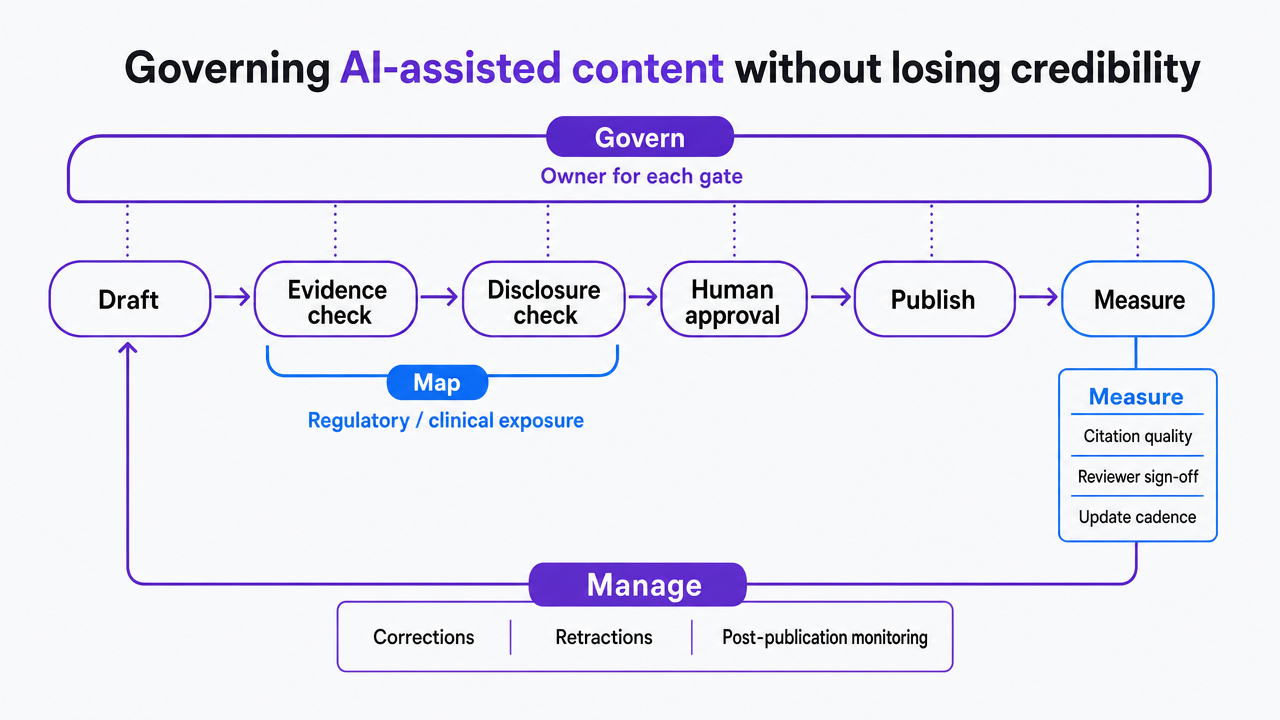
AI-assisted drafting is now standard inside in-house content operations, and the credibility question has moved from whether to use it to how to govern it. NIST's AI Risk Management Framework organizes that work around four functions—govern, map, measure, and manage—designed to keep human review, traceability, and accountability inside the production loop rather than bolted on afterward 3. Applied to an authority-content workflow, those functions map cleanly onto a repeatable approval sequence:
- draft,
- evidence check,
- disclosure check,
- human approval,
- publish,
- measure.
Govern : sets who owns each gate.
Map : identifies where a page carries regulatory or clinical exposure.
Measure : records citation quality, reviewer sign-off, and update cadence.
Manage : handles corrections, retractions, and post-publication monitoring.
The reputation layer is where AI-assisted content collides directly with enforcement. The FTC's final rule on consumer reviews and testimonials, effective October 21, 2024, explicitly covers AI-generated fake reviews and authorizes civil penalties for knowing violations 6. That closes a specific workflow shortcut: using generative tools to fabricate reviewer voices, synthesize testimonial video, or populate a controlled review site with machine-written entries. The rule sits alongside the FTC's Endorsement Guides, which require that endorsements reflect the endorser's honest opinion and that material connections be disclosed clearly and conspicuously 2. AI-generated summaries of real customer feedback are not prohibited, but the underlying feedback must be genuine, attributable, and disclosed where a material connection exists.
Inside the approval loop, that translates into specific gate criteria. Evidence checks require that every statistic, clinical claim, or legal assertion added by an AI draft be traced back to a primary source before human approval. Disclosure checks confirm that any customer voice, expert quote, or testimonial included in AI-assisted copy carries verifiable provenance and correct relationship labels. Human approval is not a rubber stamp—it is the point where a named editor accepts accountability for what the page claims. Sites that operate the loop this way retain the production speed of AI assistance without transferring the credibility risk to the publisher.
 Visualize the cited NIST AI RMF approval loop (draft, evidence check, disclosure check, human approval, publish, measure) mapped to govern/map/measure/manage functions described in the section
See How Authority Website Strategies Deliver Measurable Pipeline Impact
Request a data-backed assessment of your current authority signals and discover actionable steps to drive organic growth—built for agencies and enterprise marketing teams seeking scalable, efficient solutions.
Consolidating authority production across a location portfolio
The operating math changes when the reader is a VP overseeing 40 dental practices, a 12-market behavioral health network, a senior living portfolio spanning three states, or a law firm with regional offices. Authority production that works for a single flagship site multiplies into a coordination problem the moment location pages, provider bios, service-line explainers, and local review streams are duplicated across dozens of markets. Each location carries its own authorship, reviewer chain, evidence citations, disclosure text, review-generation workflow, and update cadence—and each one is a place the governance layer can fail quietly.
Stanford Internet Observatory's task force framing is useful here: trust is an ecosystem property shaped by platform design, verification signals, and information quality across every surface where a brand is discussed 4. For a portfolio operator, that ecosystem includes the parent site, every location subdirectory, third-party review platforms, licensing directories, and local media mentions. A single unlabeled testimonial on one location page, or an outdated clinician bio in one market, can pull down the credibility of the parent brand in ways a location-level marketer never sees.
The fragmented approach assigns each authority function to a different vendor or internal role:
- One agency writes location pages.
- A separate reputation vendor solicits reviews.
- A backlink firm chases directory citations.
- Compliance review happens ad hoc when legal notices a problem.
- Publishing sits with a webmaster queue.
The result is a workflow where no single approval gate can confirm that a page carries a named author, a current reviewer, cited evidence, correct disclosures, and reputation signals collected under the FTC's 2024 rule prohibiting fake reviews, undisclosed insider testimonials, controlled review sites, and review suppression 7.
A consolidated model routes each of those functions through the same approval loop, with the same evidence and disclosure checks applied to every location page before publication. The variables to compare across models are operational, not speculative:
| Authority function | Fragmented vendor model | Consolidated approval workflow ||---|---|---|| Location page authorship and reviewer chain | Distributed across content agency and internal SMEs | Single gate confirms named author and reviewer per page || Evidence and citation checks | Ad hoc, varies by writer | Standard check applied before human approval || Disclosure and material-connection labeling | Handled by legal on exception basis | Built into the approval gate for every page || Review-generation compliance (FTC rule, Oct 21, 2024) | Reputation vendor, uncoordinated with legal | Documented workflow inside the same governance layer 7|| Publishing and update cadence | Webmaster queue, separate from strategy | Executed after approval, tracked against measurement |
The consolidation argument is not that fewer vendors cost less on a line-item basis. It is that a single governed workflow closes the gaps where authority decays across a portfolio—unnamed authors on outlier location pages, stale review dates in secondary markets, disclosure text that drifted during a template update. Those gaps compound across 40 or 400 locations, and they are the failures a regulator or a referring professional finds first.
A 90-day audit sequence for an in-house team
A defensible authority stack does not require a rebuild. It requires a sequenced audit that surfaces where the governance layer is missing, then installs the gates that close each gap. The following 90-day sequence is scoped for an in-house team of two to five people without new hires.
- Days 1–30 cover the expertise and evidence layers. Every high-intent page is inventoried against three questions drawn from the credibility research consensus: is there a named author with verifiable credentials, is there a named reviewer where the content warrants one, and is every substantive claim traced to a primary source 8. Pages that fail on any question are queued for correction, not deletion. Update dates are added or refreshed so visitors can verify currency at a glance 11.
- Days 31–60 address the disclosure and technical layers. Ownership, funding, and material connections are audited against the FTC's Endorsement Guides, with testimonial and endorsement pages flagged for clear-and-conspicuous relationship labels 2. In parallel, mobile rendering, HTTPS delivery, form functionality, and contact-path integrity are tested against baseline accessibility criteria.
- Days 61–90 install the reputation and governance layers. Review-generation workflows are documented against the FTC's 2024 rule and its prohibition on fake reviews, undisclosed insider testimonials, controlled review sites, and review suppression 7. The approval loop—draft, evidence check, disclosure check, human approval, publish, measure—is written down and assigned to named owners. After 90 days, the team runs the same loop on every new page.
Frequently Asked Questions
References
- 1.Credibility judgments in web page design – a brief review.
- 2.FTC’s Endorsement Guides: What People Are Asking.
- 3.Artificial Intelligence Risk Management Framework (AI RMF 1.0).
- 4.New Report: "Scaling Trust on the Web".
- 5.16 CFR Part 465: Trade Regulation Rule on the Use of Consumer Reviews and Testimonials.
- 6.Federal Trade Commission Announces Final Rule Banning Fake Reviews and Testimonials.
- 7.The Consumer Reviews and Testimonials Rule: Questions and Answers.
- 8.Trust and Credibility in Web-Based Health Information.
- 9.Can Patients Trust Online Health Information? A Meta-narrative Systematic Review Addressing the Quality of Health Information on the Internet.
- 10.Trust and Credibility in Web-Based Health Information.
- 11.Evaluating Health Information.
- 12.Online health information - what can you trust?.