Key Takeaways
- Triangulating authority across raw, trust-weighted, and behavioral signals beats anchoring a pitch on a single vendor's domain rating, which research shows varies widely between tools 7.
- Spam mass estimation places referring domains on a defensible continuum using the gap between regular and trust-biased PageRank, replacing binary toxic flags that misclassify legitimate niche communities 2, 3.
- Link neighborhood and cross-domain weighting expose reciprocal clusters that inflate authority scores, letting analysts discount echo-chamber links and accelerate penalty triage 1.
- Competitor gap mapping holds up under CMO questioning only when SERP-derived competitor sets pair link intersection with feasibility scoring and topical relevance at the page level 12.
- Anchor distribution paired with page-level topical relevance scoring catches manipulation patterns and justifies why a lower-DR but topically aligned link earns priority 3, 8.
- Differential change monitoring at the link level flags dropped editorial links, nofollow conversions, and 404s fast enough to drive recovery emails before rankings shift 10.
- Content-to-link integration clusters referring pages by the topic that triggered citations, turning the content calendar into a validated link acquisition plan 12, 8.
- Outreach workflows embedded in the checker handle verified contacts, cadence throttling, opt-out persistence, and FTC disclosure fields in one auditable record 9.
- Link-to-revenue attribution joins acquired links to ranking deltas, Search Console traffic, and assisted conversions, replacing vendor promises with measurable QBR evidence 4.
- Built-in empirical testing through link-cohort tracking, holdout comparison, and metric-disagreement logging moves client conversations from vendor scores to evidence the account owns 4.
- Vectoron's Backlink Strategist meets most criteria through integrated triangulation, spam mass continuums, and consolidated workflows, though empirical cohort testing requires roughly 90 days of in-platform history.
- Multi-location healthcare accounts need a branded entity layer and account-level audit consolidation that compresses analyst hours threefold and surfaces cross-location patterns invisible to per-site workflows 6.
Why Link Data Decides Pitch Meetings
Pitch decks rarely lose on creative. They lose when a CMO asks, "How do you know that link will move our rankings?" and the agency answers with a domain rating screenshot. Link data decides the room because it is the one signal that connects competitor visibility, technical credibility, and forecastable growth in a single artifact.
The research record is blunt about why raw counts fail. PageRank-style models treat the web as a flow of influence rather than a tally of inbound URLs, which is why a thousand directory links can sit beneath a single editorial mention from a trusted publisher 10. Trust-weighted variants go further, demonstrating that standard link counting cannot reliably separate genuine endorsements from manipulated ones 5. A backlink checker that only surfaces totals leaves the analyst defending a metric the algorithm itself does not respect.
For an agency SEO lead pitching against three other firms, the question is narrower: which features in the tool let the team build an audit narrative, a competitor gap map, and a credible impact forecast that survive scrutiny. The ten capabilities that follow are evaluated against that standard, not against feature checklists.
Trust-Weighted Authority Beyond a Single DR Score
A single proprietary authority score is a vendor's opinion dressed as a metric. Research evaluating the reliability of domain authority scores from Moz, Semrush, and similar vendors found that these numbers are quantitative proxies built on different inputs and weighting models, not ground truth about how Google treats a domain 7. Two tools can score the same site thirty points apart, and neither is wrong in its own framework. Neither is correct enough to anchor a pitch deck either.
The capability that wins client trust is triangulation. A backlink checker worth its retainer surfaces at least three independent signals for any referring domain:
- a raw authority estimate,
- a trust-weighted variant that biases toward proximity to known reputable seeds, and
- a behavioral signal such as organic traffic or ranking keywords.
Trust-biased link models exist precisely because standard counts can be gamed by link spammers boosting a node's score through manipulation 5. When the analyst can show a CMO that a target link sits in the 80th percentile across all three lenses, the argument stops being "our tool says so" and becomes a defensible pattern.
The same logic applies in reverse. Empirical work testing common SEO assumptions against an actual ranking system found gaps between popular beliefs about link metrics and what the algorithm rewards 4. An agency that builds its narrative on one vendor's headline score inherits that vendor's blind spots. Tools that expose the raw inputs, let the analyst weight them, and flag disagreement between metrics give the account team something to defend in the room.
Spam Mass Estimation, Not Just Toxic Flags
A red "toxic" badge on a referring domain is a verdict without a defense. When a client's in-house SEO asks why the agency flagged 340 domains for disavow, "the tool said so" ends the conversation in the wrong direction. The credible answer is a quantitative one: spam mass, the gap between a page's regular PageRank and a trust-biased PageRank that gives more weight to known reputable seeds. Gyöngyi et al. formalize this as m̃x = 1 − p′x/px, where px is the regular score and p′x is the trust-biased version. Pages whose authority collapses once trust weighting is applied are the ones carrying spam mass 2.
A backlink checker built on this logic does something a color-coded flag cannot. It tells the analyst how much of a domain's apparent authority disappears when the algorithm leans on trusted seeds, and it places each referring domain on a continuum rather than a binary. Four buckets emerge in practice:
- trusted authority (low spam mass, high trust-biased score),
- neutral (moderate values across both),
- suspicious (meaningful spam mass but ambiguous neighborhood), and
- toxic (spam mass approaching the page's full score).
The bucket assignment is auditable. The analyst can show the seed set, the formula, and the threshold a client's risk tolerance demands.
The false-positive problem is where lesser tools embarrass agencies. Link-based spam characterization research found that several detection metrics also flag tightly knit legitimate communities, such as professional associations, regional medical networks, or niche B2B ecosystems where genuine reciprocal linking is the norm 3. A checker that surfaces the underlying signals, rather than collapsing them into a single toxic label, lets the account team override flags with documentation. That distinction matters when a healthcare client's state dental association link gets bucketed alongside a Russian gambling PBN. One belongs in the disavow file. The other belongs in the pitch deck as evidence of category authority.
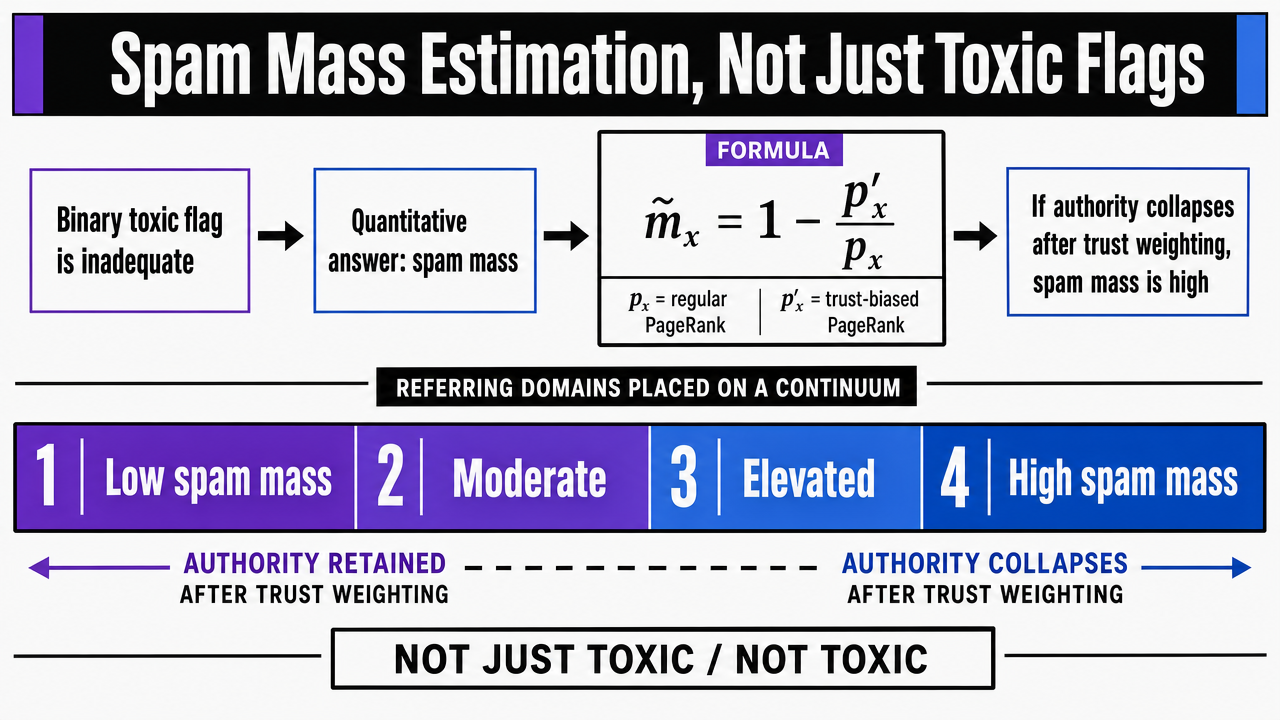 Visualize the four-bucket spam mass continuum described in the section, replacing binary toxic flags with a defensible quantitative framework based on the Gyöngyi et al. formula cited in prose
Link Neighborhood and Cross-Domain Weighting
A single editorial link from a publisher embedded in a healthy neighborhood is worth more than fifty links from a domain that sits inside a dense reciprocal cluster. The research behind this is older than most agency tech stacks. Work on local link aggregations showed that authority flows are distorted when a small cluster of sites links heavily to itself, and proposed methods to downweight those clusters so rankings reflect cross-domain endorsement rather than internal echo 1. A backlink checker that treats every referring domain as an independent vote misses this entirely.
The capability the account team needs is a neighborhood view: for any referring domain, what other domains link to it, what domains it links out to, and how concentrated those relationships are. When 70% of a domain's inbound and outbound links sit inside a 40-site cluster, the link is structurally weaker than its authority score implies. Tools that surface co-citation patterns and outbound link diversity give the analyst a defensible reason to discount a glossy-looking link, or to elevate a modest one whose neighborhood reaches across industries.
This is also where penalty triage gets faster. A client whose rankings dropped after a competitor's negative SEO push needs the analyst to isolate which referring clusters appeared in the same window, not just which individual domains. Cross-domain weighting turns a flat backlink list into a map.
Competitor Gap Mapping That Survives a CMO's Questions
Every new business deck includes a competitor backlink slide. Most of them collapse under the first serious question: "Why these competitors, and what would acquiring those links actually do for us?" A gap report that lists 1,200 domains the competitor has and the prospect does not is not a strategy. It is a spreadsheet dump dressed in agency branding.
The capability that holds up in the room starts with competitor selection the analyst can defend. Three filters matter:
- SERP overlap on the prospect's revenue keywords,
- topical proximity rather than industry label, and
- link velocity over the trailing twelve months.
A regional dental group's real competitors in link terms are often not the other dental groups. They are the health publishers, local news sites, and condition-specific resources that already rank for the procedures the prospect sells. Tools that let the account team build the competitor set from SERP data rather than from a client-supplied list produce a sharper gap map.
From there, the gap itself needs three layers:
- Link intersection: domains linking to two or more competitors but not the prospect, which Michigan Tech's SEO guidance identifies as a core competitor backlink discovery pattern worth pursuing 12.
- Content-anchored opportunity: which pages on the competitor earned those links, and what topic, format, or asset triggered the citation.
- Feasibility scoring: trust-weighted authority of the referring domain, outbound link cadence, and whether the link was editorial, resource-page, or directory.
A CMO who asks "How many of these can you actually get?" deserves a number with reasoning behind it. Tools that surface only the gap, without feasibility signals, force the analyst to guess. Tools that pair gap data with topical relevance scoring let the account team commit to a quarterly link target the prospect can hold them to, which is the difference between a pitch that wins and a pitch that gets a polite follow-up email.
Test Advanced Backlink Analysis on Live Sites
See real backlink data and publish content with full platform access, no limitations during your seven-day trial.
Anchor Distribution and Topical Relevance Scoring
Anchor text is where manipulation tells on itself. A backlink profile with 38% exact-match commercial anchors on a mid-authority site is not a profile, it is a flare. Modern link spam detection work shows that abnormal distributions across anchor types, source neighborhoods, and degree patterns are among the most reliable signals separating manipulated portfolios from organic ones 3. A backlink checker that buries anchor data in a tab labeled "anchors" misses the point. The capability that matters is a distribution view ranked against a peer set of legitimately ranking sites in the same category.
Three breakdowns earn their place in the audit:
- Anchor type: branded, naked URL, generic, exact-match, partial-match, and image.
- Topical alignment between the anchor phrase and the destination page's primary topic, scored independently of the referring domain's authority.
- Anchor diversity across referring domains, which catches the pattern where one outreach campaign produced 60 links all using two phrases.
Topical relevance scoring is the companion signal. A link from a high-authority general news site carries less weight for a cardiology practice than a link from a smaller, topically aligned medical resource where internal and external links already map the page into a coherent topic ecosystem 8. Tools that score relevance at the page level, not just the domain level, let the analyst defend why a lower-DR link earned a spot on the target list.
Change Monitoring and Lost-Link Triage
A backlink portfolio is not a snapshot. It is a moving balance sheet, and the agencies that retain accounts longest are the ones who notice when the balance shifts before the client does. A backlink checker that only refreshes its index monthly loses half its strategic value, because the window between a lost editorial link and a ranking decline is usually shorter than the next refresh cycle.
The capability that matters is differential monitoring at the link level, not the domain level. Three change events deserve immediate flags:
- a previously linking page that drops the link entirely,
- a dofollow link that switches to nofollow or sponsored attribution, and
- a referring page that gets removed or 404s.
Each carries a different remediation play. A dropped editorial link from a topically aligned publisher is worth a recovery email the same week. A nofollow conversion across a cluster of guest posts is a pattern, not an accident, and signals the publisher network is tightening policy.
Change data also feeds penalty triage. When organic traffic drops and the analyst can correlate the decline window with a spike in lost links from a specific neighborhood, the diagnosis takes hours instead of weeks. Without that timeline, the account team is guessing at algorithmic causes while competitors keep their links intact 10.
Content-to-Link Integration for Earning, Not Buying
The agencies that scale link acquisition without scaling outreach headcount stop treating links and content as separate workflows. A backlink checker that exposes which competitor pages earned the most editorial links, what those pages contain, and which referring domains repeat across the top performers, turns the content calendar into a link acquisition plan. Michigan Tech's SEO guidance frames this directly: discovering where competitors obtain quality backlinks is the starting point for building link-worthy pages of one's own 12.
The capability worth paying for is bidirectional. From the link side, the tool clusters referring pages by the topic that triggered the citation, not just by domain authority. A surgical orthopedics page that earned 40 links from rehabilitation resources, medical news sites, and patient advocacy groups tells the content strategist exactly what asset is missing from the prospect's library. From the content side, the checker maps existing client pages to the referring domains most likely to cite them, based on outbound link history and topical alignment. Internal and external links carry more weight when they sit inside a coherent topic ecosystem, which is why relevance scoring at the page level beats domain-level proxies 8.
The operational payoff: the account team stops pitching one-off guest posts and starts proposing assets the link data already validates as citable.
Outreach Workflow With Compliance Baked In
Link acquisition lives or dies on the outreach side of the workflow, and the agencies that scale without adding link builders are the ones whose backlink checker hands off prospect lists directly into a compliant sending environment. A tool that ends at "here are 400 domains worth pitching" leaves the account team to rebuild contact data, dedupe sends, and track opt-outs in a separate stack. That gap is where compliance breaks and where junior staff burn hours that should belong to strategy.
The capability worth paying for handles four things inside one record:
- verified contact discovery tied to the referring domain,
- send-cadence controls that throttle volume per inbox,
- opt-out persistence across campaigns and clients, and
- the FTC disclosure fields required of commercial email, including a valid physical address and a working unsubscribe mechanism honored within ten business days 9.
When that scaffolding sits inside the checker, the analyst can show a client the prospect list, the message template, and the suppression log in a single audit trail.
See How Advanced Backlink Analysis Wins Agency Deals
Connect with our team to review automated backlink checker features proven to accelerate link audits, surface competitor gaps, and support high-stakes pitches for enterprise and multi-location accounts.
Link-to-Revenue Attribution for QBRs
Quarterly business reviews are where retainers renew or unwind. A backlink slide that shows "47 links acquired this quarter" without a downstream metric attached is the slide a CFO uses to argue the line item is overpriced. The capability that protects the retainer is attribution that connects specific link acquisitions to ranking movement, organic traffic shifts, and assisted conversions on the pages they point to.
Three data joins make this credible:
- Tie each acquired link to the target page and the keyword cluster that page ranks for, then track position change in a defined window after the link went live.
- Overlay Search Console impression and click data on the same page, so the analyst can show whether ranking gains translated into traffic rather than stalling at position five.
- Pull assisted conversion data from analytics, attributing downstream signups or revenue to the organic sessions that link acquisition helped produce.
Empirical work testing common ranking assumptions makes the case for measuring link impact directly rather than trusting a vendor's promised lift 4. A backlink checker that stops at the link itself leaves the QBR narrative half-built. One that closes the loop turns a cost center into a forecast.
Empirical Impact Testing Over Proprietary Promises
Vendor promises sell tools. Empirical tests sell retainers. A backlink checker that publishes a methodology page explaining how its authority score correlates with actual ranking outcomes is more useful to an agency than one that markets a higher ceiling on its proprietary metric. Reverse-engineering work on Google's ranking system documented real gaps between popular SEO assumptions and what the algorithm actually rewards, which is the case for testing link impact rather than accepting a vendor's promised lift 4.
The capability that earns analyst trust is a built-in experimentation layer. Three tests deserve to run continuously inside the tool:
- Link-cohort tracking: group acquired links by referring-domain authority band, topical relevance score, and anchor type, then measure ranking and traffic deltas on the target pages over 30, 60, and 90 days.
- Holdout comparison: matched pages that received link acquisition versus matched pages that did not, controlling for content updates in the same window.
- Metric-disagreement logging, where the tool flags cases in which its own authority score predicted impact that did not materialize, and exposes which inputs misfired.
An account team that can show a client which link characteristics produced measured ranking movement in their own portfolio stops arguing about vendor scores. The conversation moves to evidence the client owns.
Vectoron's Backlink Strategist Under the Same Lens
Applying the nine criteria above to Vectoron's Backlink Strategist produces a mixed scorecard worth naming honestly. The Strategist triangulates referring-domain authority across multiple inputs rather than reporting a single proprietary score, which addresses the reliability problem documented across major vendor metrics 7. It implements trust-weighted scoring against seed sets the account team can inspect, and it surfaces spam mass signals as a continuum rather than a binary toxic flag 2. Competitor gap mapping runs from SERP-derived competitor sets and pairs each opportunity with feasibility scoring and topical relevance at the page level 8.
Where it earns its place in this list is the integration layer. Link prospecting, content asset planning, and outreach with compliant suppression handling run inside one account-level workflow rather than three disconnected tools. Change monitoring feeds the QBR attribution model directly, so acquired links connect to ranking and traffic deltas on the target pages without a manual export.
The honest limitation: the Strategist's empirical impact testing is strongest on accounts with at least 90 days of in-platform link history. New accounts inherit the methodology but not yet the cohort data.
If You Manage Multi-Location Healthcare Accounts
The audience narrows here. For agency SEO leads running backlink programs across multi-location healthcare operators, dental service organizations, regional medical groups, or physical therapy networks, the feature requirements shift in ways that single-site checkers do not anticipate. Each location carries its own NAP footprint, its own local citation surface, and its own branded entity links from referral partners, hospital affiliations, and patient resources. A backlink checker that treats the operator as one domain misses the link economy that actually drives location-level visibility.
Two capabilities matter most:
- A branded entity layer that groups referring domains by which location they cite, so the analyst can see that 70% of one clinic's local press coverage points to a competitor while another location dominates regional health publishers.
- Account-level audit consolidation. Running 12 separate backlink audits across 12 location domains burns hours that an account-level workflow recovers.
Healthcare SEO research underscores why this matters: discoverability for patient-facing pages depends on coordinated link and content systems, not isolated location efforts 6.
The consolidation math, using variables an account team can fill from its own rate card:
| Variable | Per-Location Workflow | Account-Level Workflow |
|---|---|---|
| Locations audited | L | L |
| Audit hours per location | H | H ÷ ~3 (shared seed sets, shared competitor maps, shared neighborhood data) |
| Tool seats required | L (or shared with context-switching overhead) | 1 account seat |
| Blended analyst cost | L × H × R | (L × H ÷ 3) × R |
| Cross-location pattern detection | Manual reconciliation | Native |
For a 12-location group at H=4 audit hours per location, per-location workflows consume 48 analyst hours per cycle. Account-level consolidation compresses that to roughly 16, and the cross-location patterns, such as a shared toxic referrer hitting six locations or a regional publisher citing four, surface without manual reconciliation. The hours saved are real. The audit coverage delta is larger, because patterns invisible at the location level become obvious at the account level.
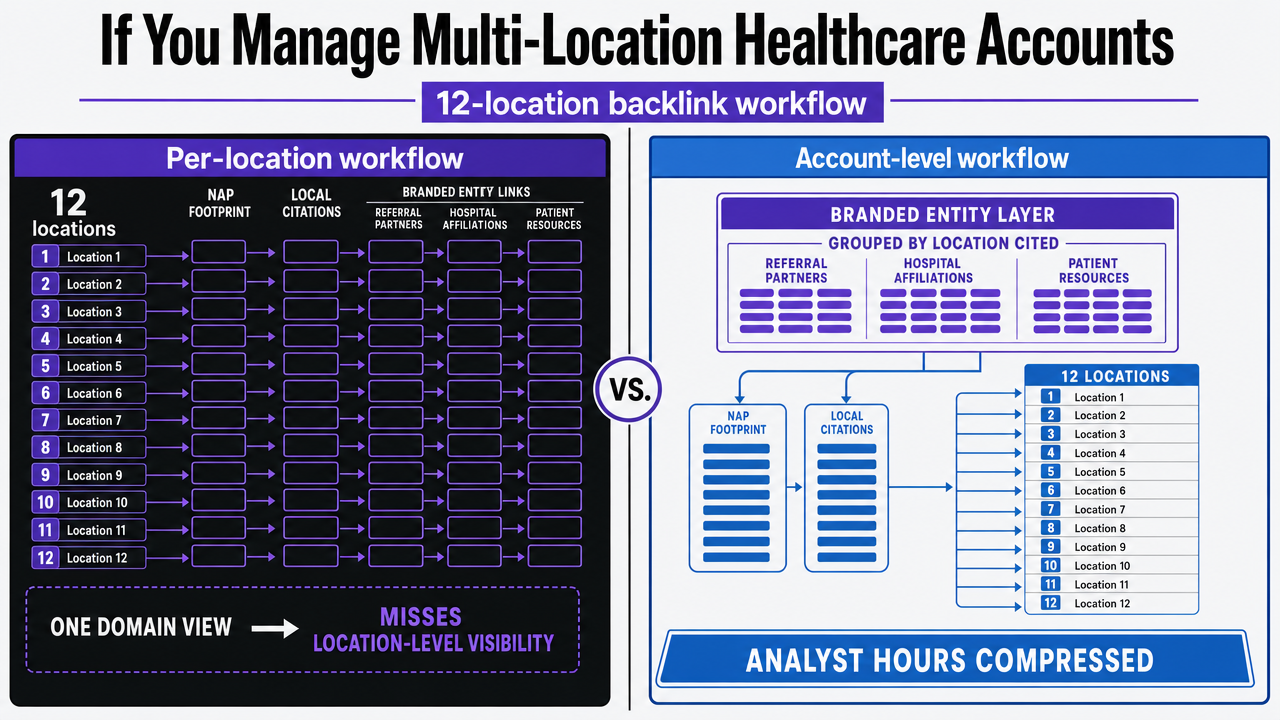 Render the comparison table from the section as a side-by-side visual showing the analyst-hour compression between per-location and account-level backlink workflows for a 12-location healthcare operator
Frequently Asked Questions
References
- 1.Improved Link-Based Algorithms for Ranking Web Pages.
- 2.Link Spam Detection Based on Mass Estimation.
- 3.Link-Based Characterization and Detection of Web Spam.
- 4.How to Improve Your Google Ranking: Myths and Reality.
- 5.Dirichlet PageRank and Trust-based Ranking Algorithms.
- 6.Search engine optimization and its association with readability and ....
- 7.Reliability of domain authority scores calculated by Moz, Semrush ....
- 8.Keyword Research and Search Engine Optimization - Ole Miss.
- 9.CAN-SPAM Act: A Compliance Guide for Business.
- 10.Chapter 14 Link Analysis and Web Search.
- 11.Blogging for Manufacturers: 5 Reasons You Need a Company Blog.
- 12.Six Ways to Improve Your Site's Ranking (SEO).