
Key Takeaways
- Statistical reference citations work because they sit mid-paragraph next to a verifiable number, with anchor text naming the source, mirroring how researchers cite each other 1.
- Institutional endorsements on association resource pages transfer authority through curated taxonomies, which is the reputational signal Google's medical update penalized health sites for lacking 10.
- Expert bylines with credential attribution carry weight because the linked bio page exposes license numbers, board certifications, and affiliations that confirm the author behind the citation 12.
- Evidence-backed resource page citations earn placement when curators verify authorship, primary sourcing, and review dates—commercial framing fails the filter before outreach reaches a human 5.
- Methodology links inside research replications arrive passively, so asset quality is the entire lever: disclosed authors, version history, and a stable URL determine whether the method gets cited 7.
- Dataset and original survey references compound once a credible publication cites them, but require a methodology document, downloadable data, and a version-controlled landing page to function.
- Tool, calculator, and interactive asset citations produce a link signature text articles rarely match, provided the tool uses validated methodology, names clinical reviewers, and discloses inputs 11.
- Structured, metadata-rich linkable assets consolidate the prior seven formats into one canonical page where schema, named reviewers, and dated timestamps make the resource the obvious citation target 7.
Why Citation-Shaped Links Outperform PR Placements in 2025
The link economy stopped rewarding press hits years ago. What earns rankings now looks more like a footnote in a peer-reviewed paper than a brand mention in a trade publication. Stanford's foundational work on link analysis frames hyperlinks as a transfer of authority directly analogous to scholarly citation, where a link from one document to another confers credibility on the target 1. Search engines have spent two decades operationalizing that framing, and the formats that survive each algorithm refresh share the same trait: they sit inside evidence-rich context, not promotional copy.
The shift hits hardest in YMYL categories. Google's medical update reduced visibility for health sites lacking reputational signals, and the affected domains were not penalized for missing press coverage—they were penalized for failing to demonstrate the kind of expertise and trust that authoritative inbound links convey 10. A guest post on a high-traffic marketing blog rarely supplies that signal. A citation from a state hospital association resource page, an academic methodology reference, or a clinical credentialing body does.
The eight formats below are organized around the structural traits that make a link function as a citation rather than an endorsement. Each includes the anchor text pattern, the surrounding sentence shape, and the production brief that scales across an agency portfolio.
The Eight Formats, Anatomy First
Format 1: The Statistical Reference Citation
The most durable backlink format on the open web is the one that mimics how researchers cite each other. A statistical reference citation appears mid-paragraph, immediately after a specific number, and the anchor text either names the source or quotes the figure directly. Stanford's link analysis framework treats this exact pattern as the canonical authority transfer: a hyperlink from one document to another conferring credibility on the target, structurally identical to a scholarly citation 1.
The anatomy reads like this. A referring domain—say, a university extension publication or a state public health bulletin—writes a sentence such as: "Readmission rates for patients discharged without medication reconciliation reached 18% in a recent multi-site analysis from [Anchor: Regional Cardiology Group's outcomes report]." Four traits make that link work. The referring domain carries a reputational signal search engines already weight. The surrounding sentence contains a verifiable statistic. The anchor sits inside the citation context, not floating in promotional copy. The target page hosts the underlying data, not a marketing summary.
The production brief is narrower than agencies often assume. Writers need a target page that publishes an original number—a calculated rate, a survey result, a longitudinal comparison—with methodology disclosed. Outreach teams identify publications already citing similar statistics in the same vertical. The asset itself must survive an editor's fact-check at the referring domain, which is why structurally weak content rarely earns this format. Pages without disclosed methodology, dated figures, or named analysts get rejected before the link is placed.
Format 2: Institutional Endorsement on Association Resource Pages
Association resource pages function as curated link directories maintained by professional bodies, accrediting organizations, and trade associations. A state hospital association listing a member system's patient education library, or a specialty society pointing to a credentialed practice's clinical protocol, transfers a different kind of signal than a press hit. The link sits inside an institutional taxonomy, which means search engines read it alongside other vetted entries.
The Google medical update specifically penalized health sites lacking reputational signals of this kind, and the affected pages were not missing traffic—they were missing the institutional context that algorithms use to confirm legitimacy 10. Recovery patterns tracked in that analysis correlated with rebuilding the reputational layer, not with content volume.
The anchor text on these pages is typically descriptive and non-promotional: "Cardiac Rehabilitation Program – Northwest Michigan" rather than "best cardiac rehab in Michigan." The surrounding context is usually a one-line description paraphrased from materials the organization submitted during application or membership renewal.
Briefing this format starts with eligibility, not outreach copy. The asset team confirms membership status, accreditation IDs, and whether the target page meets the directory's content requirements—often a specific structure, a designated contact, or a credentialing document. Outreach moves through committee channels rather than editorial inboxes. Agencies that route this work the same way they route guest post pitching get nowhere. The format is procedural, and it rewards portfolios that treat directory submissions as a recurring quarterly cycle rather than a one-time push.
Format 3: Expert Byline With Credential Attribution
An expert byline transfers authority through the author signature, not the publication itself. When a board-certified clinician writes a piece on a third-party site and the byline links back to a credentialed bio page on the practice domain, the link carries the weight of the named expert's reputation. The National Institute on Aging's guidance to readers reinforces why this format works: trustworthy health content clearly identifies authors, credentials, evidence sources, and update dates, and pages that surface those signals get treated as more reliable by both human readers and algorithmic raters 12.
The structural example: a contributed article on a regional healthcare publication ends with "Dr. [Name], MD, FACC, is medical director of [Anchor: Cardiology Services at Practice Name]." The anchor points to a bio page that lists credentials, publications, and clinical affiliations. The link is not buried in body copy. It sits in the byline area, where editorial review at the referring domain has already verified the credentials.
Production for this format splits into two workstreams. The content workstream produces clinical articles a credentialed expert is willing to put their name on—which means draft review by the named clinician is non-negotiable. The bio workstream maintains a credential page rich enough to justify the citation: license numbers, board certifications, publication history, and affiliations. Agencies running this format across multi-physician portfolios build a bio template once and populate per clinician, rather than rewriting credential pages each time outreach lands a placement.
Format 4: Evidence-Backed Resource Page Citations
Resource pages curated by public health departments, patient advocacy groups, and academic libraries function as standing reading lists. A page titled "Patient Resources: Understanding Atrial Fibrillation" on a university health system's library site might link to a dozen external explainers, each chosen because it meets the curator's evidence standards. The link sits inside a vetted collection, which is structurally different from any single mention.
The Surgeon General's advisory on health misinformation calls explicitly for amplifying authoritative, evidence-based sources online, and resource-page curators read that guidance as a mandate to link selectively 5. A systematic review of reviews on infodemics reaches the same conclusion from the research side: low-quality content amplification is the central harm, and link-based curation is one of the few scalable counter-pressures 6.
The example pattern: "For patients beginning anticoagulation therapy, the [Anchor: medication safety guide from Practice Name] explains dosing schedules, interaction risks, and when to contact a clinician." The anchor describes the resource's function, not the brand.
Briefing earns this format through asset quality, not outreach volume. The target page must list authors with credentials, cite primary sources, disclose review dates, and avoid commercial framing. Outreach is research-driven: identify curators by reviewing their existing link sets, match the asset to gaps in their collection, and submit through the contact channel the resource page itself specifies. Pages that read as marketing collateral fail the curator's filter before outreach reaches a human reviewer.
Format 5: Methodology Link Inside Research Replication
When another organization replicates, extends, or compares against a published methodology, the citation back to the original method document is the link that earns ranking weight. This format is rare because it requires the source page to host a methodology worth replicating—a measurement protocol, a survey instrument, a scoring rubric, or a data collection framework.
The pattern follows scholarly convention. A referring page might read: "This analysis applied the patient-reported outcome scoring approach described in the [Anchor: outcomes measurement methodology] published by [Practice Name], adapted for a multi-site comparison." The anchor sits next to the verb describing what was borrowed.
Research on SEO for scientific publications notes that structured metadata, clear titles, and citation-friendly formatting are the traits that allow scholarly work to be found and re-cited, and the same traits apply to methodology pages on practice websites 7. A methodology document buried inside a PDF with no headers, no version number, and no DOI-equivalent identifier does not earn this format. A methodology page with disclosed authors, version history, and a stable URL does.
Production sits closer to research operations than to content marketing. The clinical or analytics team documents the methodology with the same rigor a journal would expect. The content team formats it for indexing. Outreach is not active in this format—the link arrives when another organization independently chooses to use the method, which makes asset quality the entire lever.
Format 6: Dataset and Original Survey Reference
Original datasets attract a citation pattern distinct from statistical references. A practice that publishes anonymized appointment-pattern data, a multi-site clinical outcomes summary, or a patient survey series becomes the source the next study cites. The link points to the dataset page, and the anchor typically names the dataset rather than the publisher.
A referring sentence might read: "According to the [Anchor: 2024 Regional Patient Access Survey], wait times for new patient cardiology appointments varied from 12 to 47 days across the sampled markets." The anchor is the dataset name. The surrounding sentence contains the specific finding being borrowed.
A peer-reviewed study on health information sourcing found that knowledge quality rises when readers source from authoritative channels, and dataset pages function as those channels for downstream writers and researchers 14. Once a dataset is cited by a credible publication, the citation pattern compounds—subsequent writers cite the dataset directly rather than the intermediary, building a citation graph that points to the original page.
The production brief requires three artifacts most agency content teams do not produce by default: a methodology document, a downloadable data file or interactive table, and a version-controlled landing page. Outreach is targeted at journalists, researchers, and trade publication editors who write recurring data-driven pieces in the vertical. The format does not scale through volume; it scales through dataset uniqueness.
Format 7: Tool, Calculator, or Interactive Asset Citation
Interactive tools earn a citation format that text-based assets cannot. A symptom-checker logic tree, a risk calculator, a screening eligibility tool, or a cost estimator becomes the asset other sites point users toward when their own content cannot do the calculation. The anchor often reads as an instruction: "Patients can [Anchor: estimate their cardiovascular risk] using a validated calculator developed by [Practice Name]."
This format aligns with what machine learning evaluators of online health information already track. A systematic review of ML approaches for assessing health content quality found that source credibility indicators and link structure are common inputs to trustworthiness models, and interactive assets generate distinctive link patterns that those models recognize 11. A calculator cited from a patient education page on a hospital site, a clinician training site, and a payer resource page produces a link signature that text articles rarely match.
The asset requirements are substantive. The tool must use a validated underlying methodology, disclose its inputs and limitations, name the clinical reviewers, and include a published last-updated date. Tools that wrap a public formula in a branded UI without adding clinical review get cited as the underlying source instead.
Briefing splits between engineering and clinical review. The build team produces the tool; the clinical team validates and signs off; the SEO team structures the landing page so the tool is the obvious link target rather than the marketing page hosting it.
Format 8: Structured, Metadata-Rich Linkable Asset
The final format is the closest direct application of academic SEO principles to commercial content. A structured, metadata-rich linkable asset is a long-form resource page—often a clinical guide, a condition explainer, or a procedural walkthrough—built with the indexing traits that scholarly publishing optimizes for. Schema markup names the medical condition, author credentials, publication date, and review cycle. Section headers map to the questions other sites are likely to cite.
Research on search engine optimization for scientific publications frames the mechanism directly: discoverability follows from correct tagging and structural optimization that allows search engines to index the work properly 7. The same logic applies outside academia. A condition explainer with proper medical schema, named clinical reviewer, dated last-review timestamp, and structured FAQ sections gets cited as a primary reference more often than an unstructured equivalent of the same length.
A study evaluating digital health center websites found that content quality scored as the highest variable across the sites examined, which supports the operational point: the format only works when the underlying content meets clinical and editorial standards 8. Schema applied to weak content does not generate this citation pattern.
The production brief consolidates the prior seven formats. Bylined experts, methodology disclosure, dataset references, statistical citations, and tool links all live inside the structured asset, which becomes the canonical page outreach points to across the rest of the link program.
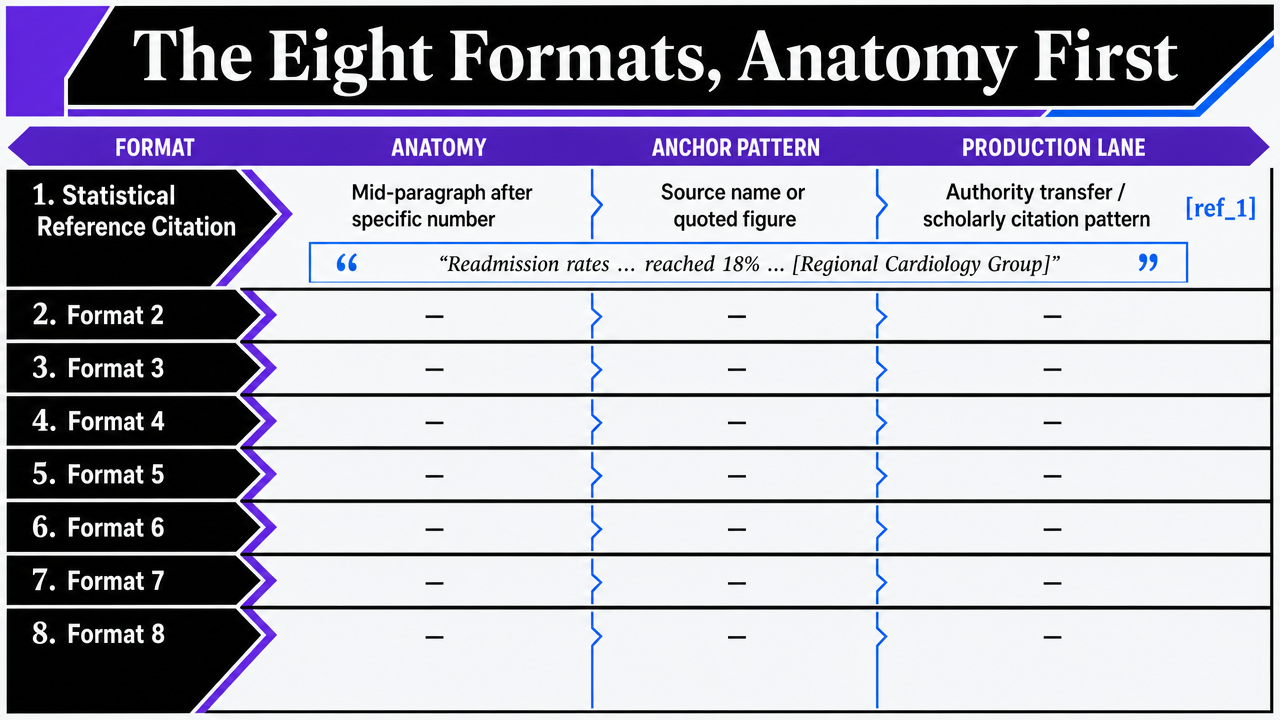 Visualize the eight backlink format catalog as a structured comparison grid so readers can scan the anatomy of each format alongside its anchor pattern and production lane
Trial Real Backlink Strategies With Live Content
Get hands-on experience producing and publishing optimized backlink content for immediate ranking impact during your trial.
How These Formats Map to Machine-Readable Trust Signals
Link structure is no longer just a ranking input. It is a feature set that automated systems read directly. A systematic review of machine-learning approaches to evaluating online health information found that classifiers commonly use source credibility indicators and link structure as inputs when predicting content quality, which means the eight formats above are not just persuading human editors—they are generating measurable traits an algorithm can extract 11.
The mapping is straightforward once the trust attributes are named. Evidence alignment shows up strongest in statistical reference citations, methodology links, and dataset references, where the link sits next to a verifiable number or protocol. Transparency shows up strongest in expert byline formats and structured metadata-rich assets, where author credentials, review dates, and sourcing are exposed to crawlers. Accountability shows up strongest in institutional endorsement listings and resource-page citations, where a vetting body stands behind the inclusion.
The operational consequence for agency briefs: production traits that look like editorial polish to a human reader function as classifier inputs to a machine reader. A bylined author with a credential page, a methodology with a version number, and a dataset with a stable URL produce a link signature the eight formats compound on top of.
If You Manage Multiple Locations: Production Economics for 8–12 Service Line Pages
The format catalog scales differently for agencies running a single brand than for those supporting multi-location healthcare operators with 8–12 service line pages per market. At portfolio scale, the constraint stops being creative and becomes throughput. Each service line page needs its own bylined expert, methodology disclosure, dataset reference, and structured schema before any of the eight formats can be briefed against it. A study evaluating digital health center websites found content quality scored as the highest variable across the sites examined, which means the underlying assets must clear the same bar at every location before link outreach generates any return 8.
The economics break across three production models. The cells below use variables rather than invented dollar figures, except for the one supplied trial price.
| Model | Writer hours per asset | Coordination overhead | Time-to-publish | Monthly cost |
|---|---|---|---|---|
| Traditional agency outreach retainer | Senior writer 6–10 hrs | High (account manager, editor, outreach lead handoffs) | 4–8 weeks per asset | Standard retainer range |
| In-house SEO plus freelance writer stack | Freelance writer 5–8 hrs + in-house review | Medium (PM coordination across freelancers and reviewers) | 3–6 weeks per asset | Freelance per-asset + salary load |
| AI-coordinated production with human approval | Clinical reviewer 0.5–1.5 hrs; approver review | Low (single Command Center approval lane) | Days, not weeks | $599/mo post-trial account-level |
Two operational points sit underneath the table. First, the writer-hour line is the variable most operators underestimate. Each of the eight formats requires a different production trait, and a senior writer producing all eight at scale across 8–12 pages per location becomes the bottleneck the rest of the program waits on. Second, coordination overhead compounds with location count. A program covering three markets at four service lines each carries 12 asset pipelines, each needing clinical review, schema implementation, and outreach pairing. The model that scales is the one that compresses coordination, not the one that adds writers.
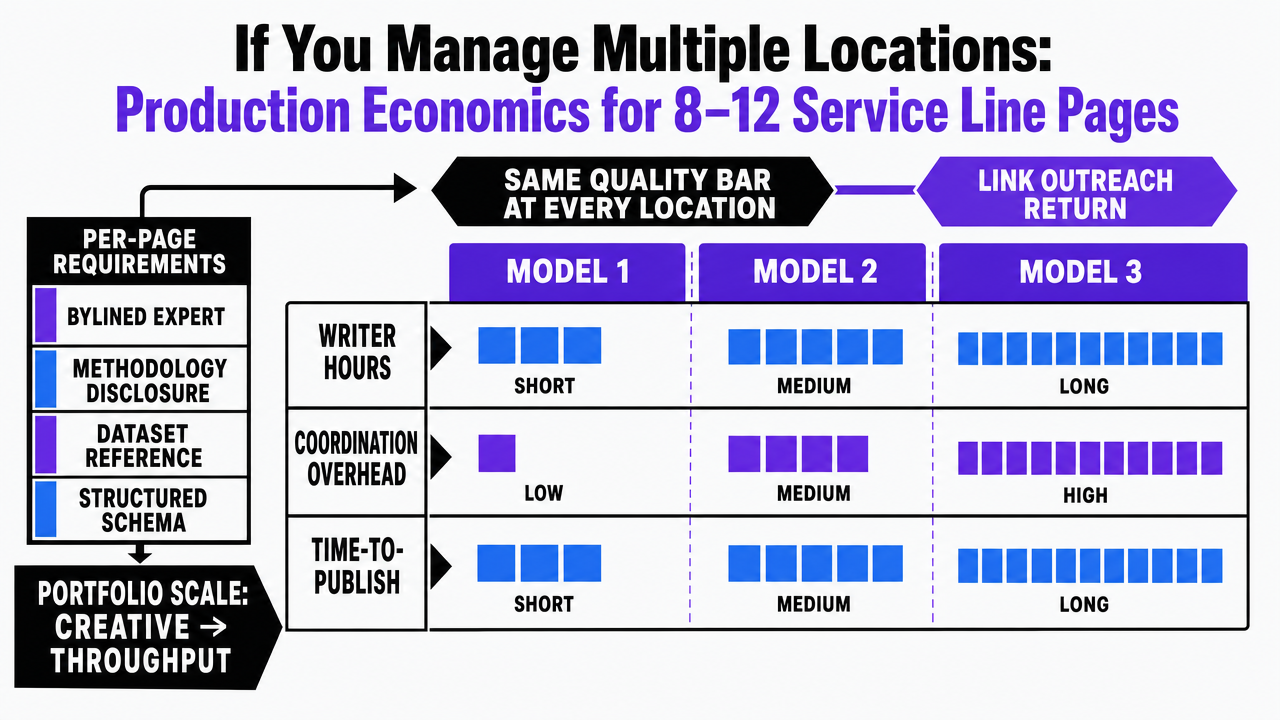 Render the three production models comparison table as a visual side-by-side framework so multi-location operators can compare writer hours, coordination overhead, and time-to-publish at a glance
See How Leading Agencies Systematize Backlink Acquisition at Scale
Request a walkthrough of enterprise-grade workflows for replicating proven backlink formats—built for agencies managing high-volume campaigns and complex service footprints.
Production Briefs: What Writers, Outreach, and Assets Each Need
Each of the eight formats decomposes into three production lanes that rarely share the same operator. Writers produce a draft that survives editorial review at the referring domain. Outreach identifies a referring page where the citation context already exists. Assets carry the structural traits that make the link defensible to a fact-checker. A brief that compresses these into a single writer assignment fails the format every time.
The writer lane needs a named clinical or subject reviewer, a specific statistic or methodology to anchor the piece, and a credential page already published on the target domain. The outreach lane needs a referring-domain list filtered by existing citation behavior, not by domain authority alone. The asset lane needs schema, version history, named authors, and a stable URL before the first email goes out.
The peer-reviewed work on machine-learning evaluation of health content quality found that classifiers read source credibility indicators and link structure as inputs to trustworthiness scoring 11. A brief that staffs all three lanes produces those inputs as a byproduct. A brief that collapses them into one writer's task produces a draft that reads well and earns nothing.
Where Vectoron and Similar Coordination Layers Fit
Coordination layers sit between the eight format briefs and the production lanes that execute them. Their job is not link acquisition. It is throughput: pairing each format with the right reviewer, asset trait, and outreach target without routing every step through a senior writer. A platform like Vectoron operates at this layer, running strategy approval, content production, schema implementation, and outreach pairing from a single account-level plan so agencies covering multi-location healthcare portfolios stop losing weeks to handoffs. The format catalog still drives what gets built. The coordination layer determines how many of those formats clear review per quarter across 8–12 service line pages per market.
Frequently Asked Questions
References
- 1.Link analysis.
- 2.Trust and Credibility in Web-Based Health Information.
- 3.Identifying Credible Sources of Health Information in Social Media.
- 4.Healthcare Network Analysis of Patients With Diabetes and Their Physicians.
- 5.Health Misinformation.
- 6.Infodemics and health misinformation: a systematic review of reviews.
- 7.Search engine optimization for scientific publications: How one can increase the visibility and influence of research.
- 8.Applying Website Rankings to Digital Health Centers in the United States.
- 9.Identifying Credible Sources of Health Information in Social Media: Principles and Attributes.
- 10.Google Medical Update: Why Is the Search Engine Decreasing the Visibility of Websites with a Low Reputation?.
- 11.Evaluating online health information quality using machine learning: A systematic review.
- 12.How To Find Reliable Health Information Online.
- 13.Countering health misinformation: 5 lessons from an expert research psychologist.
- 14.Health Information Sourcing and Health Knowledge Quality.