
Key Takeaways
- Agency link programs fail on governance, not throughput, once CAN-SPAM exposure, FTC disclosure classification, and graph-based detection multiply across a 40-client portfolio.
- In-house pods, freelance marketplaces, retainer vendors, and AI-coordinated approval workflows trade off control, transparency, and scale differently, with only the last separating volume generation from human governance.
- Volume-first outreach creates dense, reciprocal link neighborhoods that graph classifiers flag as spurious, and enforcement gaps in non-English markets close as classifiers retrain 11.
- Treating outreach as regulated activity means every commercial message carries CAN-SPAM obligations and every placement needs disclosure classification recorded before it goes live 6, 5.
- A governed pipeline enforces six approval gates spanning source qualification, list hygiene, header assembly, disclosure classification, anchor review, and post-publication monitoring, logged per message.
- Cost per approved placement, editor hours per placement, disclosure classification coverage, and anchor pattern variance reveal whether a program is governed or simply buying links.
- Vendor evaluation should demand 90-day placement records with disclosure categories, prospect segmentation practices, CAN-SPAM templates, classification ownership, and pre-publication rejection criteria.
The delivery problem hiding inside every agency link program
Most agency link programs were designed for a different era. A single link builder, a shared inbox, a spreadsheet of prospects, and a monthly report showing referring domains added. That model held together when portfolios were smaller and enforcement was softer. It cracks the moment an agency tries to deliver consistent placements across 40 or 60 clients while defending link quality to a director who reads Search Console every morning.
The hidden problem is not throughput. It is governance. Every outreach email is a commercial message the FTC treats as regulated communication, and each separate CAN-SPAM violation can trigger civil penalties of up to $53,088 6. Every guest post, sponsored placement, or gifted-content arrangement carries its own disclosure classification under FTC native advertising rules 5. Every placement lands in a graph that search engines score, and dense, low-quality link structures are algorithmically detectable at scale 11.
SEO leads running delivery already know the tactical playbook. What they need is an operating model that keeps rejection rates predictable, disclosures classified correctly, and outreach volume defensible when a client asks how a link was earned. The choice is no longer in-house versus outsourced. It is ungoverned versus governed, and the sections that follow evaluate four delivery architectures against that standard.
Four operating models for outreach at portfolio scale
In-house pod: control at the cost of headcount
A dedicated in-house pod places a link builder, an editor, and a QA reviewer under the same roof as the SEO strategist who briefed the campaign. This setup allows for immediate feedback on rejection reasons and ensures anchor distributions are checked against a client's existing profile before outreach. Disclosure classifications for gifted or sponsored placements can be determined by someone familiar with the client's regulatory posture.
The primary trade-off is headcount. Delivering four placements per client across 40 accounts requires 160 approved links monthly, and the editor hours per placement quickly accumulate. Most agencies hit a ceiling around 15 to 25 clients per pod before quality declines or velocity is missed, necessitating another hire. Adding a second pod often duplicates management overhead without a proportional increase in throughput.
While control is significant, it is also expensive. In-house pods are most effective when a few clients provide premium retainers that can cover the full cost of specialist salaries, benefits, tooling, and PTO.
Freelance marketplace: throughput without governance
Marketplaces address the headcount issue by distributing outreach tasks to a pool of freelancers paid per placement. This model allows throughput to scale directly with budget. For pure volume, it delivers.
However, governance is a significant weakness. A marketplace freelancer, often working for multiple agencies, lacks incentive to segment prospect lists by client, consistently enforce CAN-SPAM headers, or correctly flag placements requiring paid-content disclosures under FTC native advertising rules 5. The agency bears the compliance risk, while the freelancer retains their fee.
Quality distribution is another challenge. Marketplace supply often favors domains that readily accept placements, leading to dense, reciprocal link networks. Placements sourced through marketplaces frequently face high rejection rates once reviewed by an editor with client context, meaning the effective cost per approved placement can be two or three times the initial sticker price.
Outsourced vendor retainer: predictable output, opaque sourcing
A retainer with an established outreach vendor offers a middle ground between an in-house pod and a freelance marketplace. Output is predictable, and reporting is standardized. The vendor manages recruiting and training, providing the agency with a monthly placement count without adding W-2 headcount.
However, this model often lacks source transparency. Most vendors guard their prospect lists as proprietary assets, preventing agencies from auditing whether the same domains are being pitched to numerous clients simultaneously. This opacity becomes problematic if a client's Search Console history shows overlap with unrelated verticals, or if two of an agency's clients end up on the same guest-post host in the same quarter.
Retainer vendors also tend to under-invest in disclosure classification. Paid placements, gifted content, and editorially-earned coverage are often reported in a single category. The agency remains legally responsible if a sponsored placement runs without a clear and prominent disclosure 5.
AI-coordinated approval workflow: the third path
This architecture separates the two functions that pods, marketplaces, and retainers combine: generating outreach volume and governing it. AI handles prospecting, list hygiene, initial personalization, CAN-SPAM header assembly, and anchor-distribution modeling. A small strategy team then manages the approval process.
Every outbound message, placement offer, and disclosure classification passes through a human approval gate before being sent. The AI does not determine if a placement is editorially earned or paid; a strategist makes that decision, and the system executes. This inversion is crucial because CAN-SPAM treats each commercial message as a distinct compliance event 6, and FTC endorsement guidance requires disclosure decisions to reflect the actual relationship between the endorser and marketer 4.
Operationally, this means one strategist can govern outreach for 30 or 40 clients without becoming a bottleneck. Automation drives throughput, while human judgment maintains control. The delivery organization no longer has to choose between control and scale, as the workflow inherently enforces both.
Delivery-model economics for a 40-client agency
Consider an agency managing 40 clients, each requiring four placements per month, totaling 160 approved placements monthly or approximately 1,920 annually. The four operating models yield distinct unit economics for this target.
| Delivery model | Headcount required | Editor/QA hours per placement | Disclosure & CAN-SPAM review | Rejection rate handling | Scaling constraint |
|---|---|---|---|---|---|
| In-house pod | 4–6 FTEs (builders, editor, QA) | 1.5–2.5 hours | Owned by pod editor per client | Same-day rework, low variance | Linear headcount growth |
| Freelance marketplace | 1 coordinator + variable pool | 0.5–1 hour (agency side) | Inconsistent across freelancers | High rejection, retry cost stacks | Quality distribution flattens as volume grows |
| Outsourced vendor retainer | 1 account lead | 0.25–0.75 hour (agency side) | Vendor-side, opaque to agency | Vendor absorbs, agency sees net output | Source pool overlap across vendor clients |
| AI-coordinated approval workflow | 1–2 strategists at approval gates | 0.5–1 hour (approval + review) | Enforced at gate, logged per message | Filtered pre-send, low downstream rework | Approval capacity, not production capacity |
The governance surface area, rather than just the placement count, is the key differentiator among these architectures. In the AI-coordinated workflow, disclosure classification and CAN-SPAM headers are enforced at the approval gate, with every decision logged against a specific message and placement. This contrasts with the pod model, where an editor manages compliance, the marketplace model, where the agency assumes exposure with limited visibility, and the retainer model, where compliance decisions are often opaque to the agency.
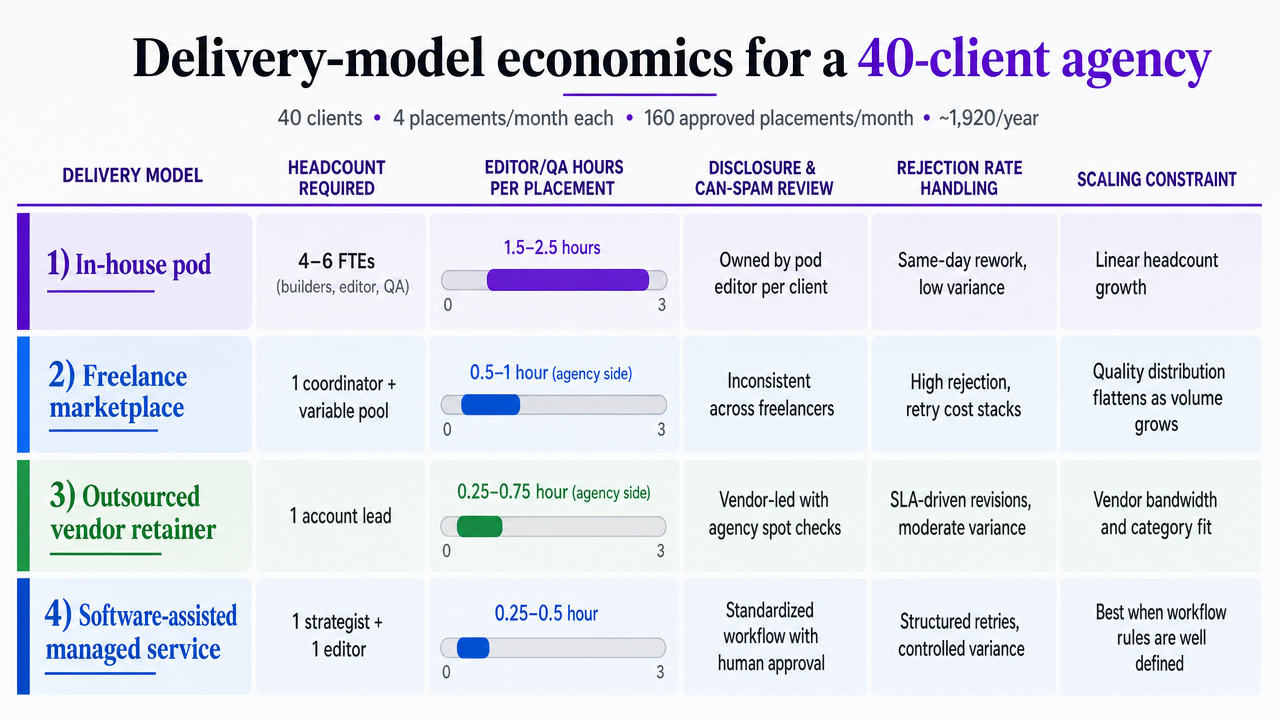 Visualize the four operating models comparison table already present in the section, making the tradeoffs scannable
Why volume-first outreach is structurally fragile
Dense link patterns are mathematically detectable
The premise of volume-first outreach—that search engines evaluate links individually—is flawed. Links are scored within a graph, and dense clusters of reciprocal or coordinated links create patterns that deviate from organic editorial structures.
A large-scale AIRWeb study on link spam detection using graph algorithms provides foundational evidence. Researchers analyzed a web graph of 5.8 million sites and 283 million links, finding that 95.8% of the densest components sampled were classified as spam or suspicious 11. This indicates that algorithms can identify tightly interconnected neighborhoods that fail quality checks, a pattern often generated by volume-first outreach. For example, a vendor pitching the same 800 domains to 30 agency clients creates tight interconnections between unrelated verticals, and a marketplace freelancer placing numerous guest posts on domains that accept placements at scale contributes to this detectable density.
Further network research supports this, showing that likelihood analysis methods can identify spurious links in complex networks with greater accuracy than previous techniques 2. Artificial link structures are mathematically distinct from organic ones, and detection improves as graph density increases. An outreach program adding 160 placements monthly without managing the resulting link distribution is not scaling effectively; it is merely providing training data for classifiers that will eventually devalue it.
Detection is uneven across languages and markets
Enforcement of anti-spam measures is not uniform globally. A peer-reviewed analysis revealed that Google's anti-spam techniques were ineffective against a significant portion of Arabic spam pages, highlighting a gap in language-based enforcement 1. English-language detection has matured more rapidly and aggressively compared to many other language ecosystems.
For agencies running purely domestic English-language campaigns, this disparity might seem minor. However, for those with clients targeting non-English markets, multilingual sites, or international expansion, it's a critical delivery variable. While a pattern quickly discounted in an English-language index might persist longer in a smaller-language index, this creates a deceptive incentive to under-invest in governance for those markets. This incentive is a trap, as enforcement asymmetry diminishes over time with classifier retraining, turning previously safe placements into liabilities. Governed outreach, conversely, applies consistent source-qualification and pattern-review standards irrespective of the target market's current enforcement strength.
Test AI-powered backlink outreach at scale now
Experience agency-grade backlink outreach workflows with live results you can track during your free trial.
Outreach as a regulated activity, not a growth hack
CAN-SPAM exposure across a client roster
An agency managing 40 clients with four placements per month is not just sending 160 outreach emails. It's also sending the prospecting volume required for those placements, which typically ranges from 15 to 25 times higher due to list decay, non-responses, and follow-up sequences. This means the actual outbound volume is between 2,400 and 4,000 commercial messages monthly.
Each of these messages constitutes a separate compliance event. The FTC applies CAN-SPAM to every individual commercial message, including emails promoting content on commercial websites, with each violation potentially incurring civil penalties up to $53,088 6. The FCC's parallel guidance further emphasizes that recipients have the right to demand senders cease communication 13.
The operational risk isn't a single problematic email, but rather systemic drift. This could involve a freelancer forgetting a physical postal address, a template lacking a functional opt-out link, or a follow-up misclassifying its primary purpose. Each such deviation multiplies across the client roster. Effective governance requires treating the header, sender identity, opt-out mechanism, and primary-purpose classification as mandatory fields for every message, not just subjects for periodic audits.
Disclosure classification for paid and sponsored placements
Every placement secured through an outreach program falls into one of three categories: editorially earned, gifted or exchanged, or paid. This distinction is crucial for compliance. FTC native advertising guidance mandates that disclosures be clear, prominent, positioned as close as possible to the content, and easily understandable to average consumers whenever a format might mislead them about its commercial nature 5.
The endorsement framework extends this, requiring disclosure whenever a material connection between the endorser and marketer could influence how audiences perceive the content. Such disclosures must be clear and conspicuous, not hidden in a footer or hover tooltip 4. Subsequent FAQ guidance clarifies that connections not obvious to a reasonable reader still trigger this requirement 10.
The classification decision must occur before the placement goes live, not after a client's compliance team raises questions. For instance, guest posts exchanged for product access are considered gifted, advertorials paid by placement fees are paid, and contributed thought leadership without material exchange is editorial. Governed outreach records this classification for each specific placement, allowing for clear traceability during a client audit months later.
Six approval gates a governed pipeline enforces
A governed outreach workflow implements six sequential approval gates, distinguishing a controlled program from a mere placement factory.
- Source qualification, where a strategist confirms the target domain's editorial fit for the client and verifies it doesn't appear in overlapping vendor pools that could create reciprocal density across the portfolio.
- Prospect list hygiene, including deduplication against active client lists, suppression of opted-out recipients, and verification of the sender identity for the sending domain.
- CAN-SPAM header assembly. Every outbound message must include an accurate from-line, a non-deceptive subject, a physical postal address, and a functional opt-out mechanism, as each commercial email is a distinct compliance event under FTC guidance 6.
- Disclosure classification. Before a placement offer is made, a strategist categorizes it as editorial, gifted, or paid, ensuring the disclosure treatment aligns with FTC native advertising standards 5 and endorsement disclosure requirements when a material connection exists 4.
- Anchor and link-pattern review. The proposed anchor text, target URL, and surrounding link neighborhood are checked against the client's existing profile to prevent compounding detectable patterns.
- Post-publication monitoring. Live placements are logged, disclosures are verified on the published page, and any deviations, such as a disclosure removed post-publication, are flagged for remediation.
This process involves six gates, managed by one strategist, with every decision logged against a specific message and placement.
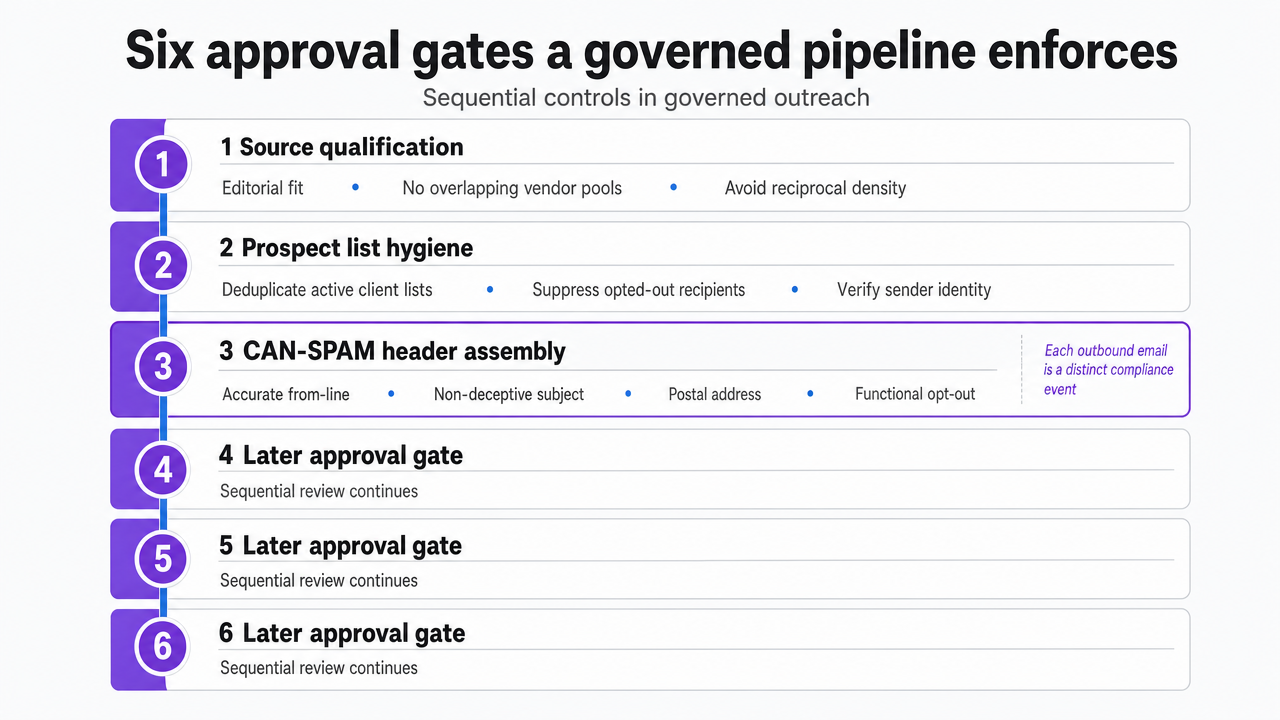 Visualize the six sequential approval gates described in the section as a process flow
Metrics that separate governed outreach from placement-buying
While referring domains added and average domain authority are common metrics in agency link reports, they don't differentiate between a governed program and a placement-buying operation. Both can yield similar headline numbers but carry vastly different downstream risks. To defend link quality to a client's director of SEO, a delivery organization needs a more robust metric stack.
Four operational metrics are crucial.
- First, cost per approved placement, calculated after editor rejection and pre-publication kill decisions. For example, a marketplace placement costing $180 that is rejected 45% of the time by an editor with client context has a real cost closer to $327.
- Second, editor hours per placement, tracked from prospect review through post-publication verification. Governed programs typically fall between 0.5 and 1.5 hours; ungoverned programs either report suspiciously low numbers due to lack of review or exceed two hours because rework accumulates.
- Third, disclosure classification coverage: the percentage of live placements with a recorded category (editorial, gifted, paid) and, where required, a verified on-page disclosure meeting the FTC standard of clear and prominent placement near the content 5. A program unable to provide this data for its recent placements is not truly governed.
- Fourth, anchor and neighborhood pattern variance. Governed outreach monitors the distribution of exact-match, branded, and generic anchors across a client's incoming links. It flags when a proposed placement would push a client's profile towards the dense, reciprocal shapes that graph-based classifiers identify as spurious 2. This metric focuses on a variance band, not a target average.
Referring domain counts are suitable for client reports but should not be the primary focus of an operations dashboard.
Streamline Link Acquisition with Data-Driven Outreach at Scale
Connect with our team to explore automated, approval-based workflows for backlink outreach that cut manual coordination and deliver measurable domain authority gains across client portfolios.
Evaluating a service against the governed-workflow standard
A meaningful vendor evaluation moves beyond asking about monthly placement counts to inquiring about the approval process for each placement. Five diagnostic questions help distinguish governed services from placement resellers.
- Request the last 90 days of placement records, including disclosure classifications. A governed service can readily provide editorial, gifted, and paid categorizations per placement.
- Ask how prospect lists are segmented across the vendor's other agency clients. If the same domain pool is freely circulated, it can lead to reciprocal density in the graph, which classifiers identify as suspicious 2.
- Request the CAN-SPAM header template and the opt-out handling procedure applied to every outbound message, recognizing that each commercial email is a distinct compliance event 6.
- Inquire who classifies a placement as paid versus editorial before it is sent, and whether that decision is logged. FTC endorsement guidance mandates disclosure whenever a material connection could influence audience perception of content 4.
- Ask what criteria trigger a placement rejection at the source-qualification stage, rather than only after publication. Rejections that only surface post-publication suggest a superficial governance process.
A service that provides specific answers to all five questions operates with a structured workflow. A service that primarily offers volume commitments is essentially selling links.
Where Vectoron fits for agencies running this playbook
The playbook outlined above is vendor-agnostic, describing a workflow characterized by automated production behind human approval gates, with disclosure classification, CAN-SPAM header assembly, and anchor-pattern review enforced per message. Agencies already employing such a workflow may not need new tools. Those that don't must decide whether to build or buy this capability.
Vectoron offers a "buy" solution. Its Backlinks strategist manages prospecting, personalization, and header assembly. The Command Center routes every placement decision to a human strategist for approval before execution. This structure enables a small team to govern outreach for a 40-client portfolio, avoiding the compliance risks of marketplaces and the opacity of traditional retainers. A two-week trial is available for $599 per month, incorporating the same approval workflow central to its delivery model.
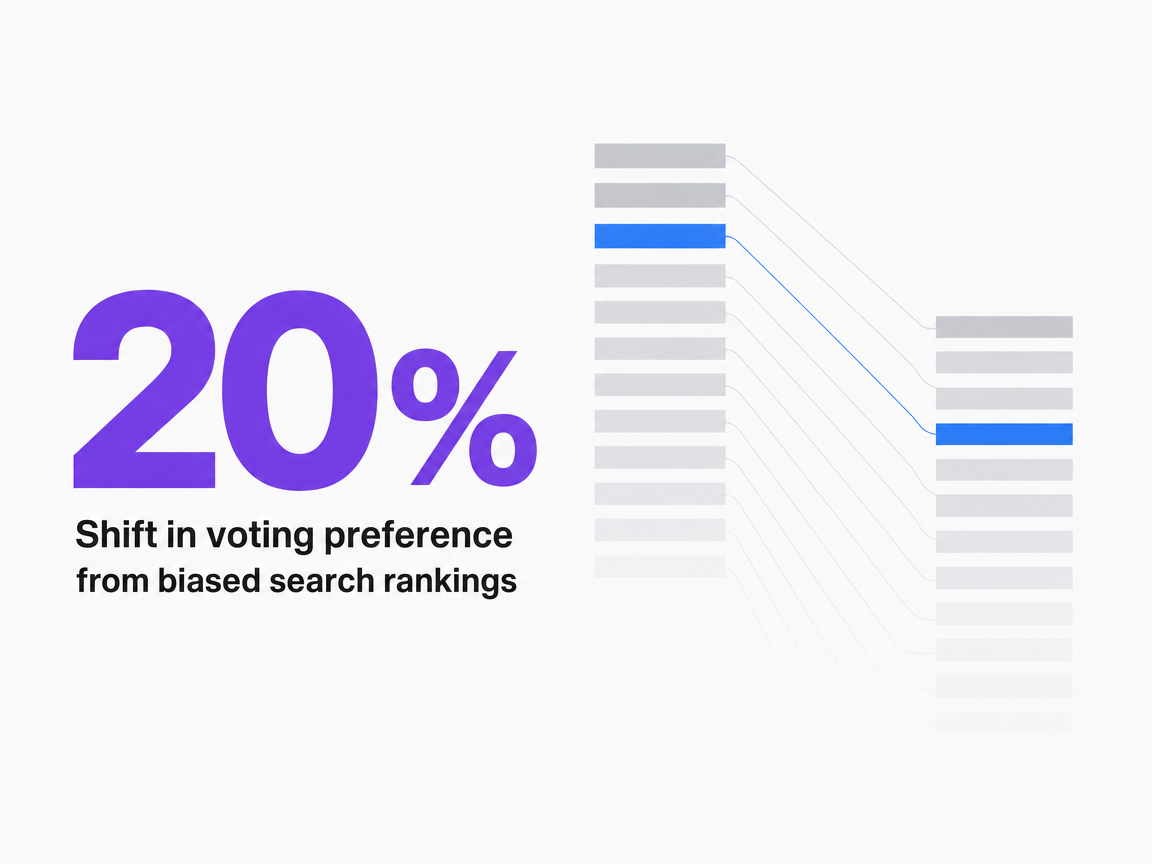 Shift in voting preference from biased search rankings
Shift in voting preference from biased search rankings
Frequently Asked Questions
References
- 1.Analysis of Web Spam for Non-English Content: Toward More Effective Language-Based Classifiers - PubMed.
- 2.Predicting missing links and identifying spurious links via likelihood analysis - PubMed.
- 3.The search engine manipulation effect (SEME) and its possible impact on the outcomes of elections - PubMed.
- 4.Endorsements, Influencers, and Reviews.
- 5.Native Advertising: A Guide for Businesses.
- 6.CAN-SPAM Act: A Compliance Guide for Business.
- 7.Current engagement with unreliable sites from web search driven by navigational search - PubMed.
- 8.Misinformation does not reduce trust in accurate search results, but warning banners may backfire - PubMed.
- 9.Hijacked medical journals rank first via search engine optimization ....
- 10.FTC's Endorsement Guides: What People Are Asking.
- 11.A Large-Scale Study of Link Spam Detection by Graph Algorithms.
- 12.Online Advertising and Marketing.
- 13.CAN-SPAM.