
Key Takeaways
- Treat link acquisition as an integrated system tied to specific tracked commercial pages, not as a procurement function that prioritizes volume over revenue-weighted ranking targets.
- Earn links by producing original assets like benchmark data, frameworks, or proprietary research that meet helpful-content standards 1and warrant editorial citation on their merits.
- Replace DR and DA as primary KPIs with tracked-page link velocity, anchor distribution, referring-page relevance, and downstream position movement on target query clusters 10.
- Focus first on category, comparison, pricing, and bottom-of-funnel pages, and disqualify any placement that fails the intent test defined by Google's link spam policy 2.
Why link procurement keeps missing ranking targets
Most SaaS backlink programs fail because they optimize for agency output rather than the specific needs of commercial pages. Link inventory grows, referring domains increase, but pages crucial for pipeline generation remain stagnant. This disconnect stems from treating link procurement as a separate function, detached from SEO target selection, content production, and conversion tracking.
The consequence is often visible in marketing audits: a category page stuck at position 14 receives irrelevant links from low-context lifestyle sites, while a high-intent comparison page gets no attention. Anchor text becomes dictated by host editors, leading to a healthy-looking referring domain chart but no improvement in revenue-weighted rankings.
Google's guidelines consistently emphasize that link-based ranking rewards links that pass relevance and authority to specific URLs, not just general domain accumulation 10. The March 2024 quality and spam updates further reinforced this by targeting scaled content ecosystems primarily designed for hosting or earning links 4. Programs that view links as a mere procurement item, separate from broader SEO strategy, acquire inputs that the current ranking system increasingly devalues.
The solution isn't just better outreach; it's a comprehensive system that identifies which pages require authority, creates the assets to earn it, and measures the direct impact on those specific URLs.
The 25-year signal: what link analysis actually rewards
Link analysis has been a foundational ranking signal in commercial search for over two decades. Google's original architecture, as described by Brin and Page, explicitly leveraged the "structure present in hypertext" 5. Subsequent major ranking updates have refined this principle, not replaced it. A backlink program built on this enduring fact benefits from a long-term strategic advantage, unlike those based on fleeting tactics.
While the core mechanism remains, the weighting of inputs has evolved. Early SEO focused on link count, but the industry has shifted towards links from reputable, relevant sources that provide genuine value 9. A single link from a domain with an authentic audience and relevant context carries more weight than numerous links from content farms.
Google's March 2024 quality and spam update further emphasized this direction, aiming to surface "the most helpful information on the web" and reduce unoriginal content created primarily for ranking 4. For backlink practitioners, this means the landscape for scalable link placement has shrunk. Sites primarily built to host third-party content for search visibility are now considered ranking liabilities, and links from them are discounted.
This continuity is crucial for resource allocation. A marketing VP investing in links is funding a signal that has been critical since 1998 and is increasingly tuned to reward editorial legitimacy. The strategic question is not whether to invest in links, but rather how to produce links that align with the current ranking system's weighting.
The operating-system stack for earned links
Strategy: tracked commercial pages set the targets
The strategy phase defines which URLs require authority to improve their rankings for specific queries. Without this clear target list, link acquisition efforts become unfocused, prioritizing available placements over those that would genuinely impact revenue-weighted rankings.
A robust target list is typically narrow, focusing on critical commercial pages such as category landing pages, high-intent comparison pages, pricing pages (if they rank), and specific bottom-of-funnel solution pages. These are the URLs where even small ranking gains significantly amplify both paid and organic acquisition efforts. The link program's priorities are thus derived directly from the SEO target list, not from the ease of outreach.
Each target page is analyzed for its query cluster, current ranking, and competitive link gap. This gap analysis goes beyond domain-level metrics, examining the specific referring pages earned by top-ranking competitors for the target query. For instance, a category page stuck at position eight due to competitors having twelve topically relevant referring pages will not benefit from three unrelated lifestyle placements, regardless of the linking domain's authority.
This stage also integrates Google's emphasis on helpful, reliable, people-first content 1. Pages selected as link targets must be inherently valuable enough for a reasonable editor to link to them on their merits. A thin comparison page lacking original analysis is not a suitable link target; it first requires content improvement.
Linkable asset production tied to helpful-content eligibility
The asset production layer focuses on creating content that is genuinely worth linking to, either directly or through supporting hubs that pass internal authority to commercial pages. Many procurement-driven programs falter here because outreach teams cannot secure editorial links for a pricing page in isolation. Instead, links are earned by original research, category-defining frameworks, unique datasets, calculators, or analytical posts that relevant publications would cite organically.
Google's March 2024 update significantly impacted the economics of this layer. The update aimed to prioritize helpful information and reduce unoriginal content created solely for ranking 4. This means scaled content programs designed to host third-party placements have diminished effectiveness. Assets created primarily to attract links, without original analysis or proprietary data, are now less effective. The asset itself must meet the same helpful-content standards as any ranking page 1.
What earns links under this new regime is more specific than previous "link-bait" strategies. Examples include:
- original benchmark data from a SaaS company's product usage,
- a new category framework adopted by competitors and analysts, or
- a detailed breakdown of a technical problem cited by practitioners.
These types of assets generate editorial citations that Google's spam policy explicitly differentiates from manipulative links 2, and they can be strategically placed within the site architecture to pass authority to commercial targets through internal linking 3.
The production cadence is a key variable. A program consistently shipping one defensible linkable asset per month, directly tied to a specific tracked page, will see compounding gains in referring pages. Conversely, a program producing generic listicles will generate little impact. This asset layer is where the system either establishes its right to proceed to subsequent stages or fails.
Outreach and digital PR as a content distribution function
In a system-based program, outreach is not a standalone discipline but rather the distribution arm for the assets created in the previous layer. The pitch centers on the asset's inherent value—its news hook, proprietary data, or framework—rather than a transactional request for a link.
This approach has direct implications for staffing and targeting. Outreach lists are built from publications, newsletters, and analysts who actively cover the asset's subject matter, not from generic blogger databases sorted by domain rating. For example, a SaaS benchmark study on developer tool adoption would be pitched to engineering trade press, infrastructure newsletters, and relevant analysts. This targeted approach yields significantly higher conversion rates than broad, scraped-volume outreach, resulting in placements that carry editorial context instead of transactional baggage.
The distinction between legitimate link earning and link spam is drawn by Google's policy against links created primarily to manipulate rankings 2. This includes:
- undisclosed paid placements that pass ranking signal,
- link exchanges disguised as guest collaborations, and
- content produced by an outreach vendor and hosted on third-party sites for self-linking.
The March 2024 update broadened the practical enforcement of this policy by suppressing the ecosystems where such placements commonly resided 4.
A practical test for operational teams: if a publication would refuse the pitch on its merits without the offered link, the placement is not an earned link. It is a transaction classified as link spam, leading to short-term volume at the cost of a long-term ranking penalty.
Anchor text and crawlability hygiene
The hygiene layer addresses how programs can inadvertently lose ranking signal they've already earned. Two key operational rules apply: anchors must appear editorial, and links must be crawlable by Google 3.
Google's best practices for links emphasize that anchor text should be descriptive, concise, and relevant 3. The starter guide further clarifies that anchors should provide a basic idea of the linked page's content 7. This guidance discourages the exact-match anchor stacking prevalent in earlier link-buying tactics, as well as the opposite extreme of using only naked URLs, which strips context. A natural earned-link profile typically features descriptive phrases naming the linked resource, branded mentions of the company or product, and a smaller proportion of exact-match phrases used only when editorially appropriate.
The distribution of anchor text should arise from natural editorial behavior, not from engineered ratios. Editors writing about a SaaS company's benchmark study will naturally use phrases like "the company's 2024 benchmark report" or the company name. Forcing a commercial keyword anchor into such a placement disrupts editorial logic and signals manipulative optimization. Programs that audit their backlink profiles against Google's anchor guidance 7and warnings against keyword-stuffed anchors find that the most effective profiles are those not overtly engineered by the outreach team.
Crawlability is the second critical component. Links embedded in unrendered JavaScript, hidden behind interaction events, or subject to nofollow defaults across editorial placements can all suppress the signal earned by the program 3. This hygiene check is an ongoing, often overlooked, but essential task.
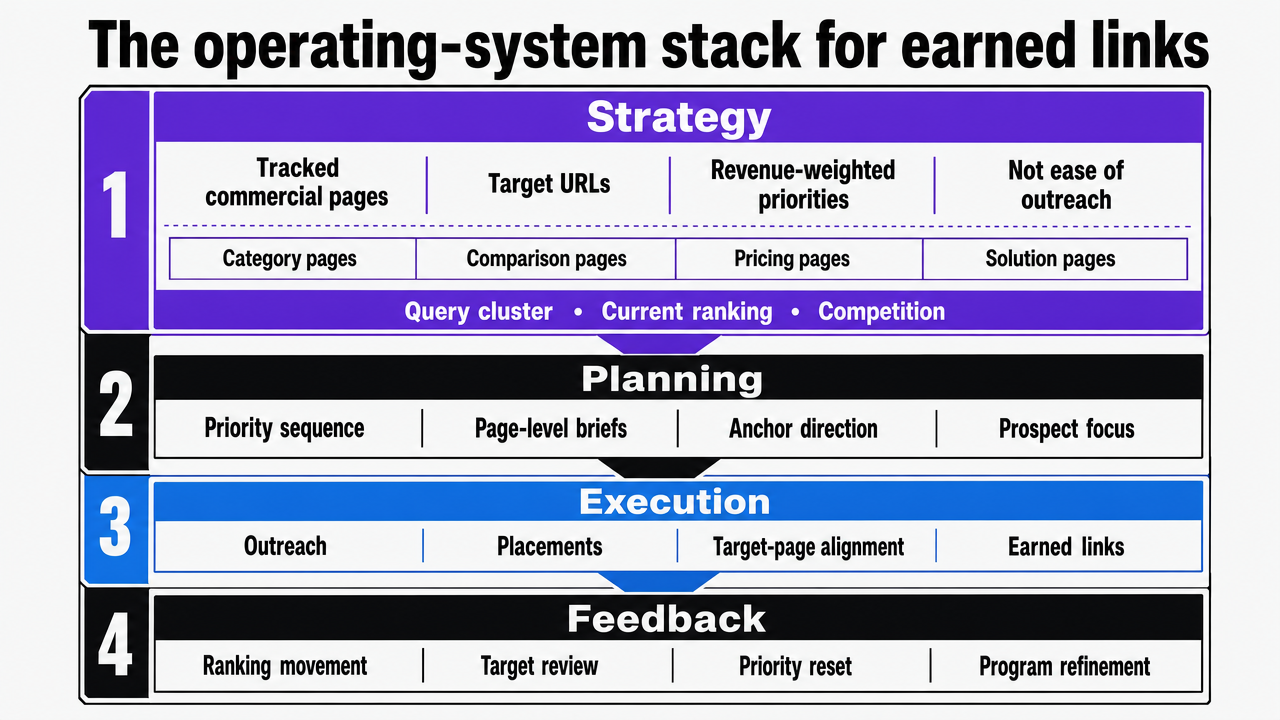 Visualize the four-layer operating stack described in the section's subsections as a vertical process framework
Test a Complete Backlink System in Action
Validate your backlink acquisition workflow and measure link quality with live campaign execution during your trial.
Measurement: tracked-page link velocity over DA/DR
Domain Rating (DR) and Domain Authority (DA) are proprietary, domain-level metrics useful for initial screening of outreach targets. However, they are inadequate as primary success metrics for a revenue-driven backlink program. A program reporting DR gains while its target commercial pages remain stagnant is measuring the wrong indicators.
A system-based program measures four key aspects, prioritized by their decision usefulness:
- First, tracked-page link velocity: the number of new referring pages earned per month, specifically attributed to each target URL. Gaining four topically relevant referring pages for a category page in a quarter is far more impactful than acquiring forty scattered links across a blog.
- Second, anchor distribution: an audit against Google's standard for descriptive, concise, and relevant anchors within the target query cluster for each URL 3.
- Third, referring-page relevance: assessing whether the linking page's subject matter is adjacent to the target page, as PageRank weighting considers link quality, not just quantity 10.
- Fourth, downstream movement: tracking position changes for the target query cluster, organic sessions to the tracked URL, and assisted conversions from referring-domain sessions in analytics.
Reporting frequency aligns with decision-making needs. Monthly reviews cover link velocity and anchor hygiene. Quarterly reviews assess position movement and assisted-conversion lift, acknowledging that ranking changes from earned links have a time lag. Programs that report weekly on DR changes are generating activity metrics, not meaningful performance signals.
A crucial operational outcome of this measurement approach is that outreach prioritization naturally shifts. Teams stop pitching publications that cannot place links on the specific URLs needing authority, and the asset roadmap reorients towards creating content for pages where even a small ranking improvement significantly impacts both paid and organic acquisition.
The compliance layer: what disqualifies a link program
The compliance layer serves as an operational check to determine if earned links will pass ranking signal or be discounted. Google's spam policy clearly defines link spam as creating links primarily to manipulate search rankings 2. Any tactic falling under this intent test is disqualifying.
Three common patterns violate this policy:
- First, undisclosed paid placements that pass ranking credit, including sponsored posts disguised as editorial content.
- Second, reciprocal arrangements, such as scheduled link exchanges presented as guest collaborations.
- Third, mass-produced outreach content placed on third-party sites controlled or coordinated by the program for self-linking.
Each of these is defined by its manipulative intent, not its format, and is treated equally under the spam policy.
The March 2024 quality and spam update intensified the consequences of these violations. The update aimed to prioritize helpful information and reduce unoriginal content 4, leading to the demotion of ecosystems that hosted scaled outreach inventory. Consequently, a link from a demoted site no longer carries the same signal it once did. Programs that audited their referring-domain lists post-update often found that a significant portion of their prior placements had effectively lost value.
A simple pre-publication test can prevent most compliance issues: Would the placement exist without the link offer? Would the publication describe the relationship to its readers in the same way it describes it to the outreach vendor? Does the linking page itself meet Google's helpful-content standards 1? A "no" to any of these questions is grounds to decline the placement, regardless of domain rating or prior effort. The compliance layer's role is to enforce this "no," as the rest of the system cannot recover the ranking discount once a non-compliant link is live.
Streamline Backlink Acquisition with a Unified, Data-Driven Operating System
See how multi-channel coordination across SEO, content, and PPC drives higher-quality backlinks and measurable domain authority gains—without manual outreach or fragmented workflows.
Retainer link buying vs. an internal earning system
The comparison between a retainer-based agency link program and an internal earning system is not about unit price, but about the value each model delivers per tracked commercial page over a 12-month period.
The retainer model is typically priced on output volume: a fixed number of placements per month, often tiered by referring-domain rating. This model is profitable for vendors because placements are interchangeable. They use standardized outreach templates, publication lists, and guest-post inventory across multiple clients and categories. A SaaS program essentially buys a slot in this production line, receiving a monthly report detailing links pointing to whatever URLs were easiest to place—usually the blog, occasionally a category page, but rarely the specific comparison or pricing pages that truly need a ranking boost.
An internal earning system reallocates the same budget towards creating original assets, fostering relationships with analysts and journalists, and building measurement infrastructure. While the headline output (raw link count) might be lower in any given month, the composition of links is fundamentally different. Links land on the specific URLs identified in the SEO target list, anchor text emerges naturally from editorial context rather than vendor specifications, and referring pages cover subjects relevant to the linked resource—a key dimension of PageRank weighting since its inception 5.
The shift towards an internal system became even more compelling after March 2024. The retainer model's inventory often relies on the same scaled content ecosystems that Google's update demoted 4. A link program purchasing volume from a discounted surface is effectively paying full price for a partial signal.
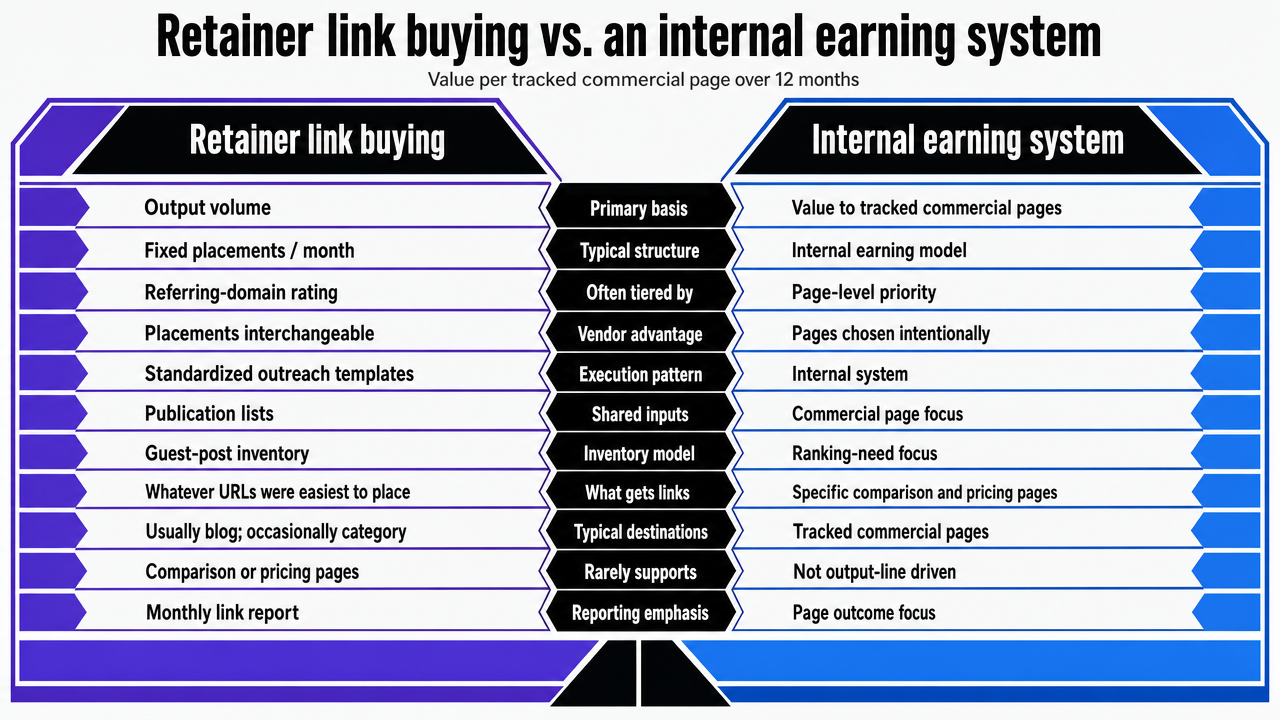 Side-by-side comparison table contrasting the two operating models discussed in this section
What a 90-day rollout produces
A 90-day rollout of this system is designed to optimize for impact on tracked commercial pages, not merely to maximize link count. By day 90, the deliverables and reporting metrics will differ significantly from a retainer-driven program.
Month one focuses on establishing the strategic foundation: creating a target URL list of eight to twelve tracked commercial pages, each with its query cluster, current position, and competitive referring-page gap. During this period, outreach is paused. Asset production begins on the first two linkable resources—typically an original benchmark or dataset and a category framework—developed to meet Google's helpful-content standards 1.
Month two involves launching these assets and initiating distribution. Pitches are directed to publications and analysts who specifically cover the asset's subject, rather than generic blogger lists. Initial placements will be in low single digits, but their quality is paramount: referring pages will cover subjects adjacent to the linked URL, and anchors will be descriptive rather than commercial keywords 3.
Month three marks the first measurable lift window. Tracked-page link velocity replaces DR change in the reporting dashboard. Position movement on the target query clusters begins to register, and the asset roadmap for the next quarter is adjusted based on which pages showed improvement and which did not.
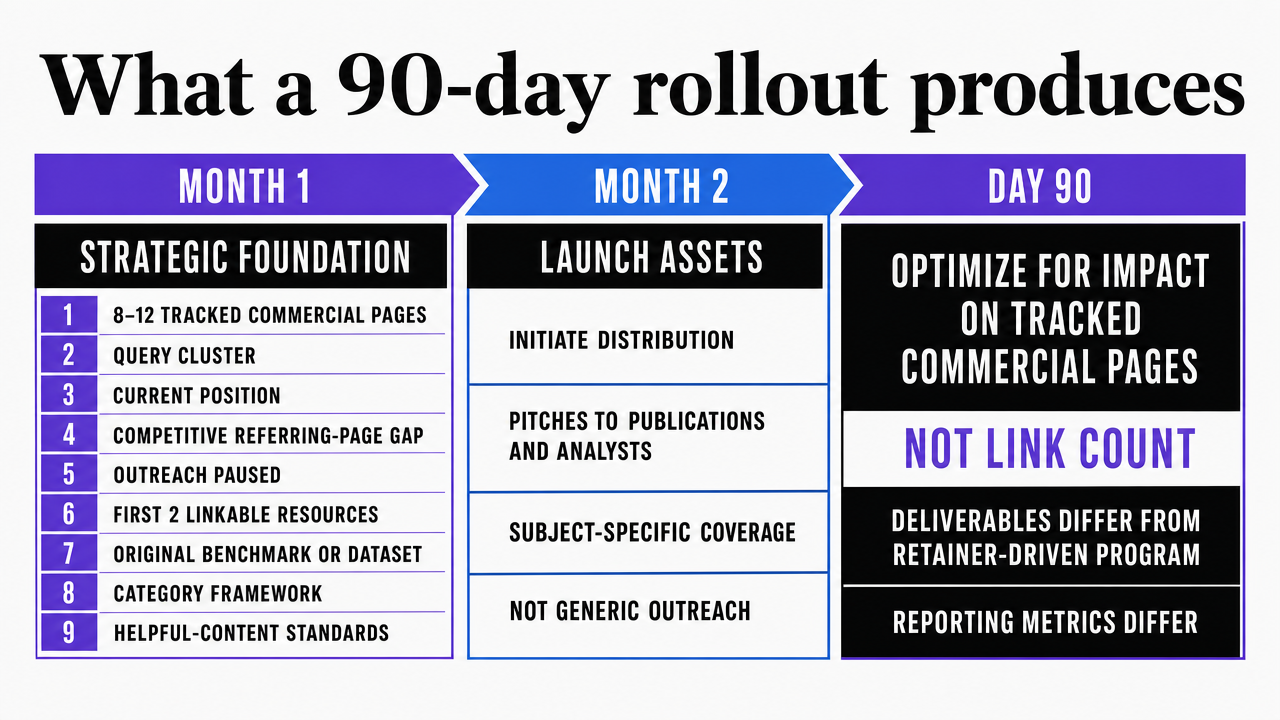 Timeline infographic mapping the three-month rollout milestones explicitly described in the section
Frequently Asked Questions
References
- 1.Google Search Essentials (formerly Webmaster Guidelines).
- 2.Spam Policies for Google Web Search | Documentation.
- 3.SEO Link Best Practices for Google | Documentation.
- 4.New ways we're tackling spammy, low-quality content on Search.
- 5.The Anatomy of a Large-Scale Hypertextual Web Search Engine.
- 6.[PDF] The anatomy of a large-scale hypertextual Web search engine.
- 7.[PDF] Search Engine Optimization Starter Guide.
- 8.[PDF] The Significant Role of SEO in Effective Web Marketing.
- 9.[PDF] How Search Engine Optimization (SEO) Grew From Nascent Stages ....
- 10.Google PageRank: how search engines bring order to the Web.